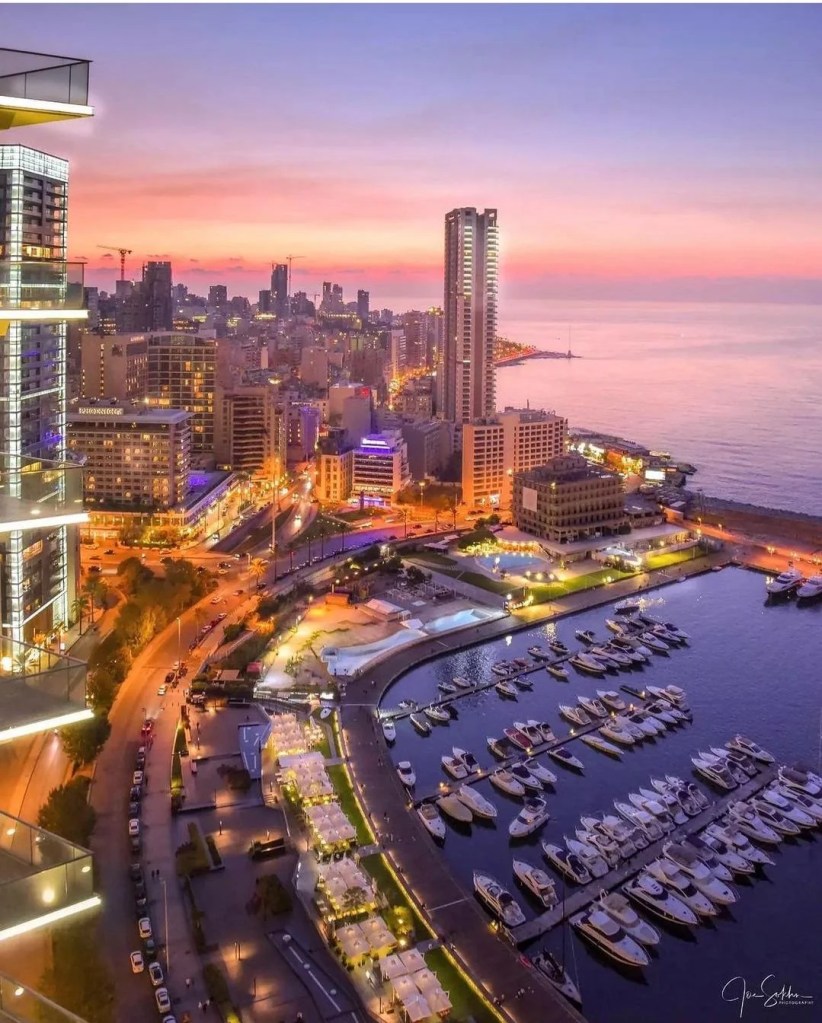
S C E N E (I) — Beirut, 2024
“Let me begin by saying: the Jew of Beirut is kind.”
They said this often, and with a strange insistence, as though kindness itself required defense in this city of layered suspicions. If ever anyone accused him of madness, of petty vice, of wandering too freely among the wrong streets and the wrong people, others would answer quickly, almost nervously: No, not him. You are mistaken.
And yet, even in their defense, there lingered a hesitation. For he had arrived not as a simple man arrives, but as one falls from some uncertain height into the waiting hands of a city already burdened by its own past.
His name was Sebastian Adonaev. Though in Beirut, names did not remain singular for long. He was also Abu Yazan, by inheritance of a story half true and half invented. And elsewhere, in colder lands of conflict, he had been called Kawa Zivistan, the blacksmith of winter. Each name clung to him like a fragment of a life insufficiently lived.
He was, by trade, a paramedic. Which is to say a man trained to intervene in the brief and decisive moments between breath and its absence. Such men develop a peculiar disposition, half healer, half intruder, capable of entering any space without invitation, provided suffering resides there.
This, perhaps, explained his presence.
Beirut did not receive him gently, nor did it reject him outright. Instead, it absorbed him, as it absorbs all things, into its contradictions. He walked its streets with an openness that was either admirable or naive, depending on who observed him. He spoke too much, listened too intensely, and gave of himself in ways that made people uneasy.
“They have no roots,” some said of his people. “They drift.”
But if this was true, then Sebastian drifted with intention. He sought not novelty, but belonging, an endeavor far more dangerous.
It was said he flourished quickly. That he suffered just as quickly. That within forty days he had lived through enough transformations to constitute several lifetimes. Whether this was exaggeration or not hardly mattered. In Beirut, myth attaches itself to the living with alarming speed.
No one knew how many Jews remained in Lebanon. Perhaps a handful. Perhaps fewer. But categories persisted even when their subjects vanished, and so he became, almost immediately, a symbol, claimed by none, suspected by all.
When they finally detained him, it was in Chiyah.
He had wandered there without clear purpose, or perhaps with too many purposes to distinguish among them. The streets were dim, the air heavy with that peculiar quiet that precedes confrontation. A patrol, informal, uncertain in its authority yet confident in its necessity, approached him.
They asked questions. He did not answer well.
There are moments when language fails not because words are absent, but because too many meanings compete for expression. Sebastian stood within such a moment, aware that whatever he said would be insufficient.
“Why are you here?” they asked.
It was, in truth, an unanswerable question.
Inside his mind, voices arranged themselves into a tribunal. One urged restraint, another absurd defiance. A third, quieter voice suggested that perhaps this scene had already occurred elsewhere, in another life, under different names.
He tried to locate himself within reality. Failed.
The slap came not as violence, but as punctuation.
And then, abruptly, motion. Confusion resolving into instinct. He moved, whether in resistance or escape, he could not later say. The street opened before him, narrow and uneven, leading nowhere in particular.
He ran.
Behind him, voices. Within him, more voices still. The city itself seemed to observe without intervening, as though this small drama were merely one thread among countless others woven into its fabric.
As he ran, he experienced a curious sensation, not fear exactly, but a displacement. As if he were crossing, not distance, but layers. Each step carried him further from the world he recognized and deeper into one that operated according to unfamiliar laws.
He wondered, briefly, whether such crossings were reversible.
Elsewhere, along the Corniche, another man arrived.
Yousef Bashir chose his hotel with care. Not for comfort, but for its particular deficiencies, privacy born of neglect, security softened by indifference. The city revealed itself differently from such vantage points, less as a spectacle, more as a mechanism.
Years earlier, their paths had intersected under far calmer circumstances. A shared ride. A conversation that began politely and ended somewhere far more consequential.
They had spoken, then, of history. Of land. Of the peculiar persistence of borders drawn by those no longer present to defend them. Each carried within him a narrative both deeply personal and broadly political. Each recognized, in the other, not agreement, but a kind of symmetry.
What emerged between them was not consensus, but a question.
If division had failed so thoroughly, if it had produced only smaller enclosures of conflict, then what alternative could exist? They entertained, cautiously at first, the notion of expansion rather than fragmentation. Not the erasure of identities, but their uneasy coexistence within a broader structure.
It was, perhaps, an idea suited only to the insulated environment in which it was conceived. Or perhaps it required precisely the chaos into which they had now separately ventured.
Time had not resolved their differences. It had, instead, deepened them.
Yet the question remained.
Beirut, indifferent and attentive all at once, continued its slow, inexorable motion.
And somewhere within it, a man ran through the dark, uncertain whether he was escaping danger, or approaching it.


Leave a comment