
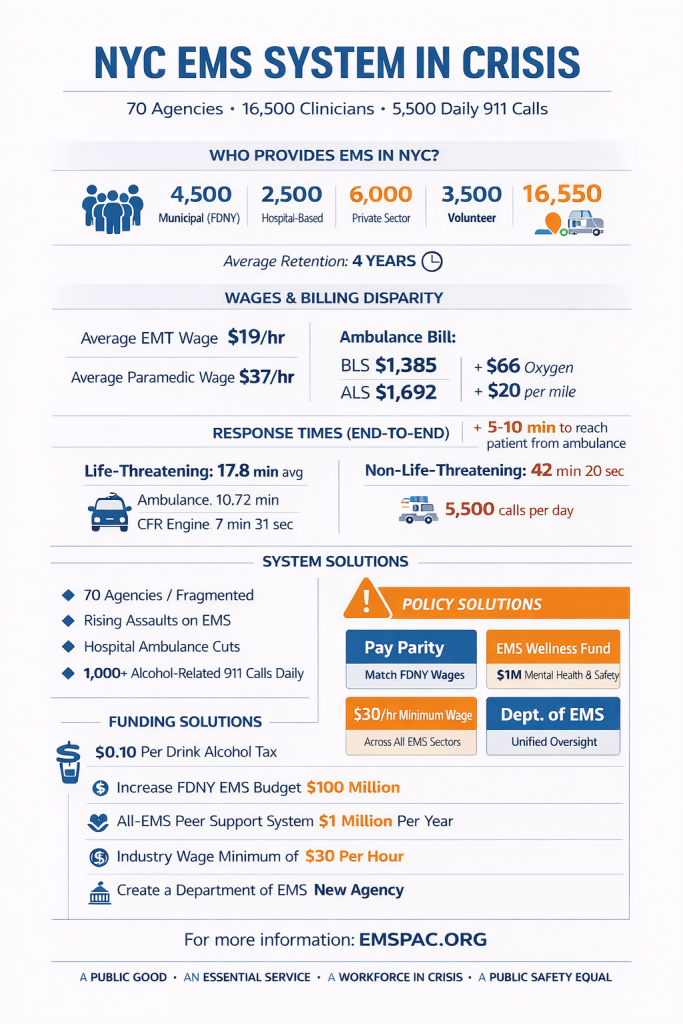
Every day in New York City, about 5,500 medical 911 calls are made, yet only a small fraction are truly life-threatening. Roughly 30% justify the full response of firefighters, EMTs, and paramedics, while most calls still consume significant resources in a litigation-driven system that often uptriages to avoid risk.
The EMS system itself is fragmented: 70 agencies across four sectors and seven unions; municipal, hospital-based, private, and volunteer; all trying to balance rapid response to critical emergencies while maintaining coverage for thousands of unwarranted daily calls.
Response times reflect the strain. A life-threatening call waits nearly 18 minutes for an ambulance. Firefighter first responders, who cannot transport patients, average over 23 minutes, while structural fires receive units in under 6 minutes. FDNY EMS handles about 65% of 911 volume, hospital-based EMS about 35%, with additional calls outside the system. Ambulance bills are between $500–$1,692 per run; FDNY EMS generated $400 million in FY2025 revenue. None of which returns directly to the department, while hospitals increasingly compete for a larger share of the system. While ambulance providers bill for everything, paying the EMS workers has never been anyone’s priority. None of the agencies can retain staffing. The average time an EMT or Paramedic spends in the field is under 4 years. The average wage of an EMT across all sectors is just $19.00. The FDNY EMS have not had a contract in 3 years.
The solution is multifaceted, but it begins with a Department of EMS. If we cannot fathom an FDNY without its own ambulance service, then we are essentially talking about a city agency to regulate the entire ambulance service.
As was recommended by the Citizen Budget Commission, we must reduce the non-emergency call volume by at least 10%; use EMT/Paramedic combined units; and end routine use of FF CFRs on all but the most serious of calls.
As was recommended by the Gilbey-Mole Proposal: immediate pay/benefit parity must be made between FFs and EMS in the FDNY if they are to continue being an ambulance provider (the subject of a Federal lawsuit); end the “promotional” exam, which causes massive attrition of skilled staff in EMS; educate the public on when/ when not to call 911; establish an independent Department of Emergency Medical Services.
As per the Emergency Medical Services Public Advocacy Council:
Let’s set an industry minimum wage for EMTs at $30. As was just done for security guards and delivery workers. Let’s use combined EMT/Paramedic units like the rest of the country to expand advanced life support care. Let’s levy a state-level microtax on the industry that we know most heavily contributes to the 5.5K daily calls: alcohol. Let’s call a hearing on our broken litigation-proof dispatch system. Let’s divert low-priority 4 to 6 out of the 911 system, but not to low-wage, non-union privates, to a real Community Paramedicine program. Let’s use the Dept of EMS concept to compel uniformity across the 70 agencies providing ambulances. Let’s get FFs taking vitals, even staffing EMT/FF units, and drive real emergency service integration. Let’s pick anything from that bucket, anything, and deliver a common-sense approach to getting an ambulance. That doesn’t have to be incompatible with a progressive approach to how we treat our EMT and Paramedic workforce, which has been abused and neglected for decades. We must continue the funding established in the Crisis to Care Budget Initiative to provide all EMS adequate access to mental health support and referrals to clinical services.
We have to resuscitate our NYC EMS service. 17-minute response times are just as unacceptable as the long term mistratement of EMS workers. For the sake of our City and our EMS workforce, the time to act on this matter is now.
Walter Adler is a 23-years on the job paramedic and President of the Emergency Medical Services Public Advocacy Council (EMSPAC).
 WALTER SEBASTIAN ADLER
Leave a comment