M.E.C.-AI-s3

S C E N E (III)  

 ירושלים القدس 

“YERUSHALAIIM” “JERUSALEM,” “AL QUDS,”  

STATE OF ISRAEL, 2001ce 

***  

MAYA SORIEYA EMMA SOLOMON ROSE 

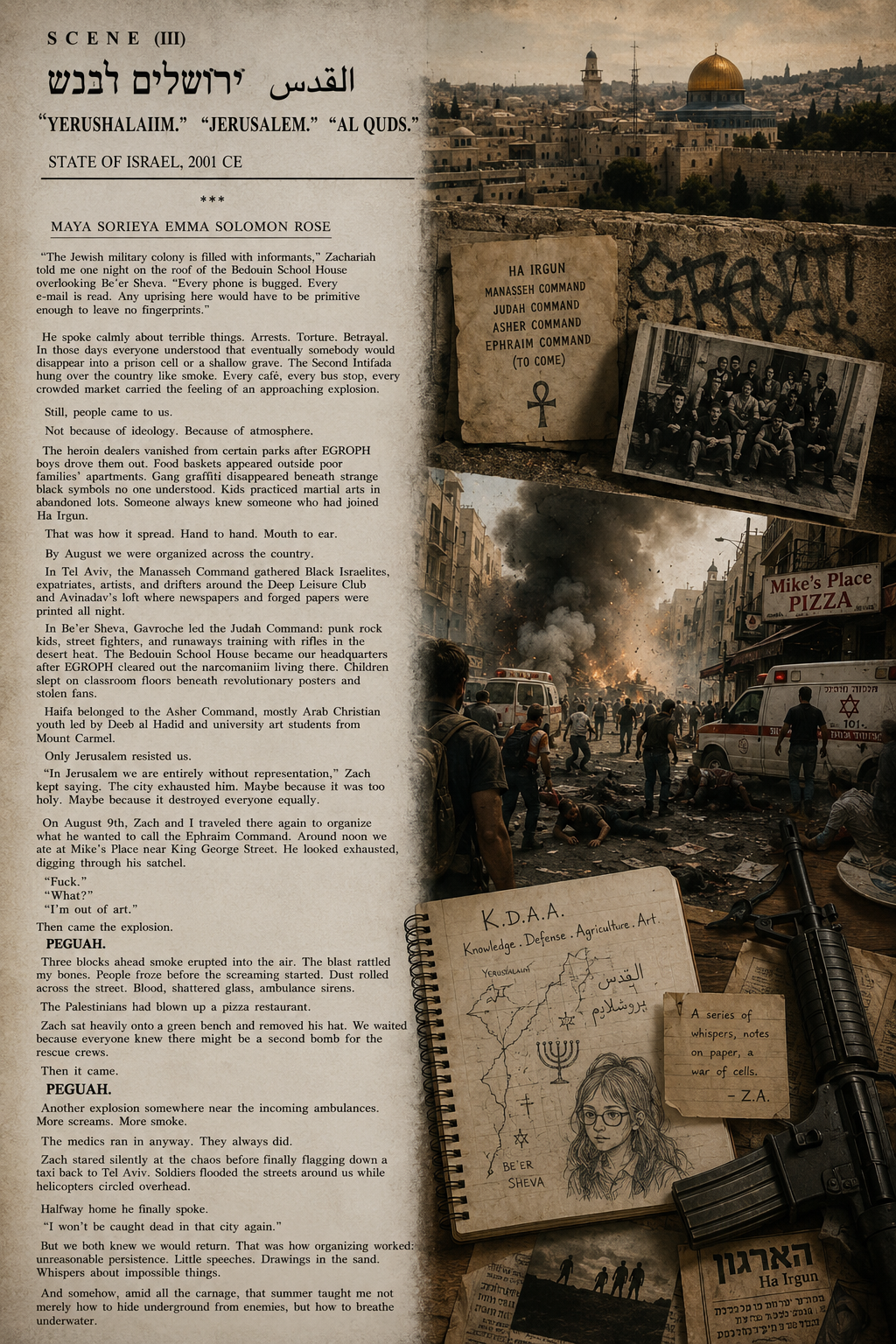
The Jewish Military Colony is filled with surveillance and informants, every phone is bugged, every email is read. The basis of any uprising must be so low tech that it leaves no fingerprints, a series of whispers, notes on paper, a war of cells.” 

There is also a great deal of inevitability all your friends will get rounded up, tortured, and killed. Some will give each other up under torture, betray themselves and the cause. 

I went on another scouting trip to Be’er Sheva at the very beginning of August. The young, tough Gavroche went right to work enlisting the local, disaffected youth of the urban Be’er Sheva sprawl. He was not a great thinker. He was a young person of action. What he seemed to like was that there wasn’t too much of a preset plan. He did not have to read anything to join. That was the beauty of it that made so many people just plug in and fight. For years people had said things like this are only in the movies or in Russian literature.  

None of that is important anymore though because we are a life support machine, a clandestine movement operating way behind the lines, which according to an unseen G-d, are our ancestorial homeland. You came by. You plugged in or enlisted was a better word because by then we had written our own Kaaba, an internal proficiency and placement exam. You got talked about it because a friend had signed up. You saw a group of kids learning how to take a soldier’s weapon, saw them practicing martial arts in a park, and then one night it hit you. That fucking heroin dealer that used to be in that park was gone. So were the junkies posted up on the playground. You noticed the gang graffiti on the bombed-out buildings had been painted over. Sometimes just grey paint. Sometimes a small mural. Sometimes, an odd black pictograph you have never seen in your life. A food basket ended up in front of your house. Just a little bundle, but if you are hard up enough, any bit helps. It came again a few days later courtesy of Ha Irgun. You picked up someone hitchhiking, and they put you on to our righteous and almost self-obvious revolution. That someone was always the young Zachariah Artstein, making rounds with his old friend Hadas.  

Zach got in trouble anytime we went up the hill to Jerusalem.  

The Mugavnkiim arrested him and held him 48 hours when he tried crossing from East Jerusalem into Nablus’ Balata Refugee Camp. He had lost his passport some time ago and it was lucky they did not hand him over to the American embassy or deport him. On a trip before this one, we got caught up in some Arab quarter unrest and had to hide for a few hours in a metal shuttered market stall with a couple identical twin Palestinian brothers and their father as the Mugavnik storm troopers flooded the market with tear gas and shots rang out all afternoon. 

But by the second week of August, we are solid in Tel Aviv. Mostly Black Israelites and European émigrés. The base of the Cabinet and flagship chapter was called the Manasseh Command. Our network was based out of the Deep Leisure Club and Avinadav’s loft on the edge of town. We had secured a printing facility and were working on secure lines of online communication.   

We were also solid in Be’er Sheva led by Gavroche, Katusha, Sahar and a small army of punk rock kids and working-class hooligans. This formation we called the Judah Command. Out in the desert these young fighters were training on M1 rifles and learning Krav Maga. Expansion was being focused on christening cells in Ashdod, Arad and among the Bedouin settlements. 

We were solid in Haifa too, a large cluster of Arab Christian youth led by the young preacher Deeb al Hadid and some Ashkenazi art students at the university on the top of Mt. Carmel, who were led by a girl named Hadas, some one-time lover of Zach’s from the kibbutz days. The fighters in Galilee called the Asher Command. 

There were several three to five person cells recently established in Pardes Hanna among Zach’s Russian immigrant friends. In Akko there were a couple of Arab Israeli girls who owned a tattoo parlor. Afula never seemed that solid. Bet She ‘an consisted of a kibbutz hippy and his boyfriend. There were a couple of paramedics in Rehovot.  In Sheroot Lummi and in Netanya, it was more Russian street kid friends of Zach’s.  

“In Jerusalem we are entirely without representation.” 

There was just one single mission. We would drive the U.S. influence out of Israel, and we would make a stand for a government that upheld human rights. I had spent a good many nights wondering if Zach’s theory of communism would set us free or just get us killed for nothing.   

“For many years as a young girl I just hoped I’d go to heaven.” I pictured heaven as this endless beach with tall white castles and all the people I had ever loved were waiting for me to get there, waiting for me to come home. I wondered if God valued the work we were doing even if I was not sure about there being a God. But I could never make myself honestly believe. And now I knew that the only heaven I might ever live to see was the one I was ready to fight for then defend. The heaven we would create right here, right now, our Zion in the wilderness.  

This Romanian Jewish girl Noaah was making the rounds to collect donations for our relief baskets. Gavroche’s ladylove Katusha was editing the articles that would go into the first edition of our mini newspaper. The little ones they called Sahar, and ‘Molly the Fairy’ were sweeping up this massive, abandoned building called the Bedouin School House where Zach and Molly lived in a room under the great stairs. She had become his little protégé. She followed him everywhere. The little Russian half pint street urchin had been made homeless because of an insane mother and an abusive father who was a self-professed ‘anarchist.’ She was just 13. Enormous glasses, bright outlandish clothing, little braids died different shades of pink. She adored Zach and believed in the ideas of Ha Irgun completely. Tribe Judah had a wide range of child soldiers, but it was the only command with predominantly Jewish members. Asher was Christian Arabs and Manasseh was mostly foreign expats and Black Israelites. 

Three weeks ago, the Bedouin School House was overrun with narcomaniim until Gavroche, Big Guy, Zachariah, and a few others from the Be’er Sheva Unit’s paramilitary arm EGROPH flooded the building with diverted sprinkler lines and then drove them out. The junkies moved into the abandoned military base on the other side of the electric neon Old City.  Ha Irgun took over the enormous two-story Ottoman structure, destined for many years to be a science center. The boys padlocked the doors shut, dragged in meeting tables, bricked up some windows, and called it the KDAA, some made-up word surely of Zach’s inspired whims of creation. 

You can’t teach what we were preaching because we are making it up as we go along. And there was no one to compete with. Hamas, Islamic Jihad, and the Al-Aqsa Martyr Brigades kept everyone, for lack of a better phrase, “pretty fucking terrorized”.  And all the while as both the second Intifada and our revolution unfolded around us so out of control, I never stopped thinking which among us would be the victims of either of these little wars. The Palestinian war ever punctuated with a bullet or a bang. Ours new and in the shadows, but we’d have our bangs and bullets too before long. 

On August 9th, Zach and I left Be’er Sheva bound for a third try at organizing the Capital city into a regional command to be dubbed Ephraim. We got there around noon and got lunch at Mike’s Place Jerusalem, a sister joint to the one managed by my close friend, Canadian Dave. We take our time to eat. I think the kid was a little burnt out. He’d been busy and never seemed to like coming to the ‘holiest of holies’. We were both more Tel Aviv kind of people. We made our way down to King George Street, one of the huge thoroughfares. Zach looked in his bag. 

“Fuck,” he mutters. 

“What is it?” 

“I’m all out of art.”  

Then three blocks ahead of us we heard a  

PEGUAH!  And I jump in the air and my bones rattle inside me. We freeze. For a second and then watch the smoke and dust settle. We do nothing helpful. Wait for a secondary explosion. The Palestinians have blown up a pizza place up the street. One of the few that still sells Pepperoni. People are screaming. The place is a hectic mess. Blood, dust, ambulance sirens. Zach slumps into a green bench on the road and takes off his hat, as he sometimes does when he gets impassioned or upset. The cloud of dust and the screams of wounded people does not stop until he flags us a cab and tells the driver to “get us back to Tel Aviv.” There’s smoke, there are the screams of the injured, the incoming sirens. The ambulances show up and second bomber blows up the responding rescue crews. PEGUAH! 

The Sbarro restaurant suicide bombing took place around 2pm. The blasts kill 15 people, including 7 small children, and wounded around 130. Both Hamas and the Islamic Jihad immediately claimed joint responsibility. The only thing he said on the road back to Tel Aviv, with soldiers and emergency medical personnel swarming to seal off the city was:  

“I won’t be caught dead in that city again.” But that was just how he talked when he was upset by the intifada and carnage. We obviously would be back when we had set up a cell. That is how organizing works; unreasonable persistence.  

Hand to hand, mouth to ear, little speeches, drawings in the sand, whispers about impossible sounding things. She showed me that summer was not just about going underground and becoming invisible to our enemies; she taught me how to breathe underwater and travel across time. 

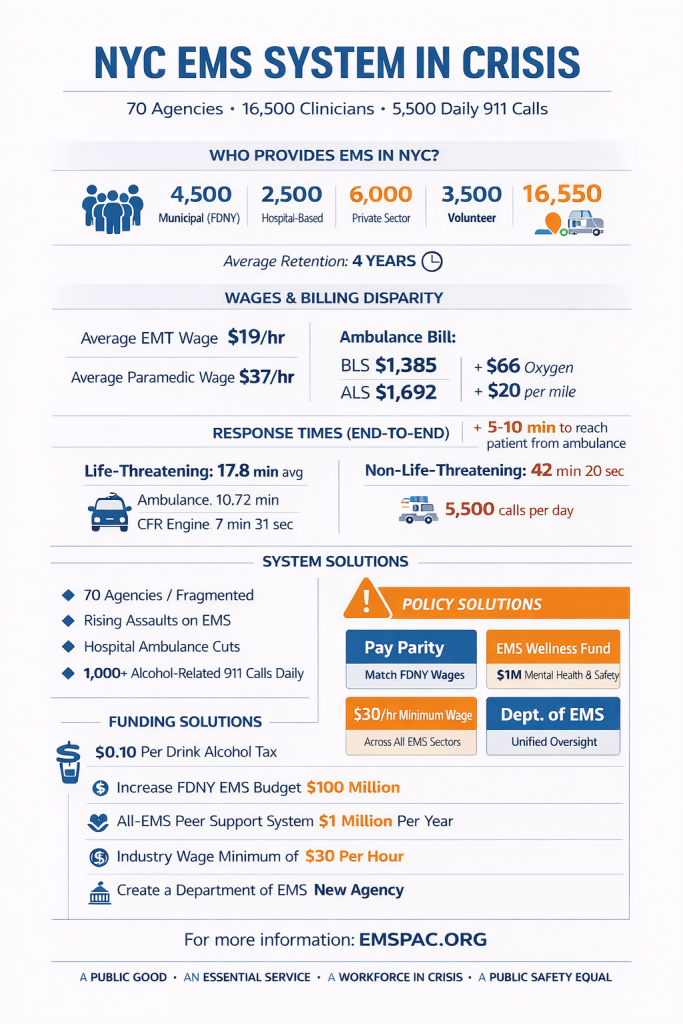
EMS Solutions for the City of New York

Every day in New York City, about 5,500 medical 911 calls are made, yet only a small fraction are truly life-threatening. Roughly 30% justify the full response of firefighters, EMTs, and paramedics, while most calls still consume significant resources in a litigation-driven system that often uptriages to avoid risk.

The EMS system itself is fragmented: 70 agencies across four sectors and seven unions; municipal, hospital-based, private, and volunteer; all trying to balance rapid response to critical emergencies while maintaining coverage for thousands of unwarranted daily calls.

Response times reflect the strain. A life-threatening call waits nearly 18 minutes for an ambulance. Firefighter first responders, who cannot transport patients, average over 23 minutes, while structural fires receive units in under 6 minutes. FDNY EMS handles about 65% of 911 volume, hospital-based EMS about 35%, with additional calls outside the system. Ambulance bills are between $500–$1,692 per run; FDNY EMS generated $400 million in FY2025 revenue. None of which returns directly to the department, while hospitals increasingly compete for a larger share of the system. While ambulance providers bill for everything, paying the EMS workers has never been anyone’s priority. None of the agencies can retain staffing. The average time an EMT or Paramedic spends in the field is under 4 years. The average wage of an EMT across all sectors is just $19.00. The FDNY EMS have not had a contract in 3 years.

The solution is multifaceted, but it begins with a Department of EMS. If we cannot fathom an FDNY without its own ambulance service, then we are essentially talking about a city agency to regulate the entire ambulance service.

As was recommended by the Citizen Budget Commission, we must reduce the non-emergency call volume by at least 10%; use EMT/Paramedic combined units; and end routine use of FF CFRs on all but the most serious of calls. 

As was recommended by the Gilbey-Mole Proposal: immediate pay/benefit parity must be made between FFs and EMS in the FDNY if they are to continue being an ambulance provider (the subject of a Federal lawsuit); end the “promotional” exam, which causes massive attrition of skilled staff in EMS; educate the public on when/ when not to call 911; establish an independent Department of Emergency Medical Services. 

As per the Emergency Medical Services Public Advocacy Council:

Let’s set an industry minimum wage for EMTs at $30. As was just done for security guards and delivery workers. Let’s use combined EMT/Paramedic units like the rest of the country to expand advanced life support care. Let’s levy a state-level microtax on the industry that we know most heavily contributes to the 5.5K daily calls: alcohol. Let’s call a hearing on our broken litigation-proof dispatch system. Let’s divert low-priority 4 to 6 out of the 911 system, but not to low-wage, non-union privates, to a real Community Paramedicine program. Let’s use the Dept of EMS concept to compel uniformity across the 70 agencies providing ambulances. Let’s get FFs taking vitals, even staffing EMT/FF units, and drive real emergency service integration. Let’s pick anything from that bucket, anything, and deliver a common-sense approach to getting an ambulance. That doesn’t have to be incompatible with a progressive approach to how we treat our EMT and Paramedic workforce, which has been abused and neglected for decades. We must continue the funding established in the Crisis to Care Budget Initiative to provide all EMS adequate access to mental health support and referrals to clinical services. 

We have to resuscitate our NYC EMS service. 17-minute response times are just as unacceptable as the long term mistratement of EMS workers. For the sake of our City and our EMS workforce, the time to act on this matter is now.

Walter Adler is a 23-years on the job paramedic and President of the Emergency Medical Services Public Advocacy Council (EMSPAC). 

MEC-AI-S-XXXVIII

S C E N E (XXXVIII) 

AL BROOKLYN, USA, 2017ce  

***  

The Brooklyn labor ghetto at night smells like rum smoked chicken, like muscle cars and also like marijuana and or just a rotting refuse; the aura blown up into the heavens by the heating exhaust steams. 

ADONAEV 

On my 32nd birthday, everyone assumes I will soon die in the Syrian Civil War. So, my birthday is actually very well attended and unfolds with lots of cocaine, alcohol, and dancing over four venues well into the next day’s dawn. Everyone toasts to everything! Often to me! Often to whatever they warble! I wake up with Martina in Harlem. 

It was by far the single largest birthday I have ever had and seems as though I had many friends and allies. But a year later, if I survived the war, none of these people would care or be around when needed. They had lives occupied with varying struggles that left no room for human solidarity. These friends are always there to drink my food and eat my wine, to hear about adventures but not really ever get involved for the most part. 
Having no real culture of my own, at some point I adopted elements of Trinidadian and Russian cultures, both which place tremendous value and veneration on the birthday ritual. I would even go so far to say that West Indians and Post Soviets treat the birthday as a sort of celebratory holiday, trumped only by weddings, funerals and for Trinidadian Carnivals. I had this feeling on my 33rd birthday, that very few people knew or cared if I was alive inside. Did not know how to react to my intention to head off to Syria. I had the feeling for my family any day in January could do, and that preparing a meal like any other meal, with a cake, was adequate.  
Now, were I a homeless drug addict, or a person of exceptionally low social and moral character, perhaps I should feel tremendous gratitude that I have a family, that I am being given some food and also a cake. I am a very ungrateful wretched person. However, my birthday is on the 30th not the 23rd, and to me it is offensive and borderline insulting that my family would sort of ambush me with a birthday eight days early largely based on my brother’s flight plans. Because that is exactly what happened, it was a Potemkin birthday for the sake of my brother who I had not seen in 2 years. 
As for most others, without social media I’m sure few really knew when it was. And so with the world’s smallest violin in my hand I undertook to spend it completely alone, or partially alone since both Alan and Martina had discovered it and in their own ways cultures and obligations understood the importance of a birthday ritual. Without any real plan the guest list ballooned to over fifty people. None of which approved of my upcoming travel plans. 
Martina was the first person to ever publish my writing, while perhaps a poem or short story or two had appeared in varying poorly circulated underground presses, this was not any more auspicious, but I was certainly more widely read. Martina is a Bulgarian journalist and real estate agent now. I see her once a year. There was nothing going on here except sympathy. Just before I drove back to my Brooklyn safe house at 5 am dawn, I was doing some coke off her inner leg. 

Sometimes late at night from a safe house in the borough of Brooklyn Sebastian Adonaev will read from one of his manuscripts and post it to the internet, for whoever might be listening. Really no one was listening, maybe Polina, depending on what time of night. These were futile, desperate calls for attention. For validation. For reaction. Since, in the United States the cause of anti-capitalism was for the most part soundly defeated many decades in the past. The man had some relative sympathy, but not exactly a sympathizer base which he might have cultivated more effectively over the years. Which might have resulted in a short little burst of terrorism, truncated of course by the all-pervasive American security state. What held him back were all the repeated hospitalizations, which came nearly every year. Invalidating his mind and probably also his message. This never seemed to deviate from a meme of communism and human rights, but by the age of 33, he had only a few people willing to listen to even just 1 minute of his message. His few friends left take him in small smei-annual doses. 

Sebastian Adonaev reads: 

“Sometimes, old friend, I cry from my own weakness.” I bash my Jew face against various mirrors around town angered by my own lack of force, lack of seed, and lack of ability to carry my band more truly into glorious and successful battle. I beat my frail fists on concrete walls which always win! I ask my God why it entrusted me with anything at all. For I am so small and so unable it seems to be a good fighter, an adequate lover, or a good leader, or a good son, or a good husband to Adelina, a good much of anything. I started the game with such a strong position but have not leveraged that to advance my people and cause, even protect those I loved the most! 

Then I remember my actual role, not the role my mad ego ascribes. I am but one single partial partisan. One isolated man with such true friends. 

I am commanding, a funny word “commanding”, more appropriate term coordinating for can one even give orders to a volunteer? A force that numbers at any given time no more than ten to maybe twenty women and men. And no God nor man nor foreign government gave us marching orders; well at times a Russian woman gave me some directions, but only when at most desperate and bleak junctures, I had no counsel to turn to. But I brought almost all this chaos upon my house unaided! But this is hardly a wide conspiracy. But looking into my own soul I am not doing this for God or man, I am not simply avenging my losses, nor am I simply working off a duty to act. No, no; I am self-propelled and highly lucky. I am doing this because my eyes see fire. I am doing this because I have seen the view from the top of the Mountain, I have seen the killing fields too.  

“I have a great empathy with my kind. I wish good to triumph over callous and well-planned evil!” 

And the responsibilities that impressed me by the old leadership, they were small bits. And I say to myself that if our little band with no weapons and no training and no funding and the protection provided us only by our passports and various skin tones could do so much! Still, we did accomplish a range of small things in the Americas and beyond. We took over buildings, organized demonstrations, built unions, and operated a substantial underground press. If we could build youth brigades and lay cells across four continents; if we could operate clandestine supply chains, raise tens of thousands in equipment and supplies, conduct hundreds of underground political trainings, infiltrate major city civil service organizations, if we could smuggle activists and trainers into distant countries uninvited and opposed by the government. If we could do all of this with no outside support and do it with keeping all our partisans out of long-term prison and have only buried three men in seventeen years of war under questionable circumstances. Well perhaps we are all still young and the war shows no sign of being over. Perhaps we have a small latent talent for freedom fighting and if not killed or imprisoned could with a little guidance grow more professional. 

And we have not killed one single person in seventeen years, in fact we have with our own hands saved the lives of thousands and counting. 

“I’ve always said he has a fucking ton of potential! For good, for self or for evil, wherever his own heart sends him,” Goldy once declared. 

So, really as was explained to me then in 2012 before the uprising in Brooklyn by my confidant Goldy Andreavna; I could either surrender, collaborate or be utterly destroyed. But as she gauged my nature was highly American, she guessed correctly I would never tolerate a life of collaboration, so thus death or some impossible victory were the only moves coming. 

“I have been imprisoned twenty times.” My brothers and sisters have never allowed them to take me for long. Each time they have chained me to beds, administered electricity, loaded me with drugs, asked millions of stupid questions to attempt to make me alter my perspective, denounce my own logic.  I have observed members of the band lose their very homes and their livelihoods and their freedom and their health. I have seen men thrown through Plexiglas glass windows. We have been held in cages and tortured. The deaths of Mcgaffey, Becker and Black were all sudden, violent, and unexplained. I remember little Paul behind bars, I remember harassment and humiliation of Comrade Vik, I remember how much was sacrificed vainly in the name of this struggle. This struggle which absorbs my beingness as though it were the love of a woman, but I am a zealot. I am not good at anything but this. I am in love with my entire people and I have resolved that it would be better to be killed, to lose my privileges of skin and class, than to live in a world where a tiny vile few make the lives of the many, the lives of all I know and love a wretched grinding torture. Truly a half-life. 

“I cry sometimes, no longer in the presence of any others.” Goldy mocked me so each time I failed to be a man. I cry because the horror is so vast and the injustice so great. And I have but ten to twenty partisans, several with wives and children. I worry that I am not going to be able to shoulder this struggle, that I lead my closest to sedition and doom. I worry I do not have the moral fortitude, the calm patience of humble leadership, the organizational skills, the funds we will need, the weapons, the uniforms, the petrol, the Planes, the will. For I am a man, and I am seduced sometimes by wanting a good life, wanting to walk away. This is not your fight, she said, “no one asked you to struggle!”! 

“Friends, they torture me once a year.” They tell me I have an unstable mind. They drag me away repeatedly. I am grateful for such friends as you, who refuse to accept surrender. Who knows that we can win the war! I wanted to tell you all, see what we do with just ten women and men. You have that many fighters too. Here we all are at the top of the mountain, assembled in the ghettos encircling the Isle of Man. 

“I loved her so much. Maybe only one or two of you know what I am talking about. They took from me the only thing a man should care about.”   

I’m thankful for the resistance.” I am thankful for our little Otriad in Brooklyn. For the cells in Chicago, Philly, Baltimore, and DC. The underground in Moldova, Cambodia, Haiti and occupied Israel. I am grateful to Commander Saint Reed in Mosul, and Commander Bonhomie in Port Au Prince. Inspired deeply by the teachings of Solomon and DeBuitléirs. I love my family and my wife; I hope this is the year we go pro. She is a million miles away, but she can hear me. She can see me. She liked me better before I found Communism, liked me better before I rediscovered my religion. She even liked my used suits better than the battered blue uniform I wear now. 

I raise glass to the East, for somewhere out there I hope she is waiting for me, waiting for us to win. I raise my glass, I look my men and women in the eyes when I toast,  Long live the resistance, God protect the bloodline of the prophets and the Meshiaak84 and the Mahdi. God keeps us moving along the straight path, not the path of those who are cowards, or those who have been lost and led astray.” 

For those of you who are joining us from home, for those listening from the trenches, from the fields or from the big house, or as servants in the towers.  

This is just a love song!” 

MEC-AI-S-XXXVII

S C E N E (XXXVII) 

AL BOSTON, U.S.A., 2017ce  

***  

A trucker with a heart of gold clings to his worst memories to not fully lose his mind in pity and drink. He is paid to move some cargo from point A to point B, but it is a lonely and meaningless life. As though he is working to pay for moving himself as meaningless cargo. 

HEVAL JILO 

Shipping out from Boston any day now,” I tell myself. I tell myself the pain will be over soon. I tell myself I’m just an ordinary New England Joe. You can call me Micky because it’s my born name.  

I have a pretty gruff face. A New England working class disposition. I think it made a lot of the younger volunteers think I had some kind of training I didn’t have. Just a little bit of running and my knees would start to hurt. But they all ask me if I was in the military, even though I never ever was. Very few of the YPG volunteers have any useful training, besides from the leftists. They are self-trained to see things, imagine things that are probably not even there. 

On my chest I am wearing a picture of my ex-girlfriend, about the size of a baseball card. That’s perfectly normal, right? But more on that later down the line. 

I watched it on the news for several years before the cumulative effect took over me. By the time I was being struck by Turkish air force and artillery vollies, running through trenches and tunnels in Afrin Canton, called by the Hevals as Jilo Boston, well I used to drive a UPS truck. That was all the training for this I had. After that I installed solar panels. I had no other serious qualifications that made me ready for the war. Even a bit of light running makes my knees hurt. 

Explains Heval Jilo from Boston: “I mean it’s really Mikey Mike or Michael, but they named me Heval Jilo from Boston.” 

Now, strangely it seemed that in the Academy Hevals Zinar and Jansher, the two principal instructors and commanders of Western internationalists ended up sending people with no ideology to occupy Raqqa and those they somewhat ideologically trusted to fight in still raging battles near Deir Ez-Zor. But that wasn’t a hard fast rule. 

They liked, but didn’t seem to trust me, well any of us.  Some of the leftists like Kawa and Shoresh tried to buddy up to Cancer. Some of the military guys like Heval Ciya tried to buddy up to Zinar, but really, they didn’t seem to have favorites. We all looked good on our martyr posters and in death could bring the Kurdish cause to the front pages of our national papers. 

I’m cynical about Zinar and Cancer, they were of course there just to figure out how to use us effectively as so-called ‘revolutionary militants.’ Most of the Academy, which lasted about six weeks, was all rhetoric and talk. I might have fired my AK, maybe 15 rounds worth. I held up well I think given my age! I hadn’t intended to join the Y.P.G. in the beginning, I tried to enlist in Sinjar first with the Y.B.S.83, but they had put a freeze on international volunteers for whatever reason. Eventually the P.K.K. smuggled me, a loud British Gypsy and a French aristocrat lawyer from Makumr Camps into Syria. 

Around my neck is a picture of my ex-girlfriend. I’m sure it sends a more portrait of my mental health to the few who see it, but I don’t have to explain shit to anyone. I don’t want to say anymore, so I won’t. My name is to be Jilo Boston, or that’s what they plan to call me in Kurdistan. I enlisted via proton mail in a formation called the Y.B.S. and received permission to make the crossing.  

I don’t have any formal military experience, though some people ask me about it, say I have that look. I’ve been watching the Islamic State terrorize the world on TV for about three years. After a while, I just came to accept that I would go be a part of it. Contribute in my little way. As several hundred had done before me and probably will do after. 

My last job was to install solar panels on rooftops. My previous job before that was as a UPS truck driver. It is obvious I was lonely and felt that doing something heroic, even if I got killed, was tangible and important. I was supposed to fly to Slemani and then get smuggled over to the Shengal. The YBS were at that time fighting in Raqqa city. I had to close out my life part by part. There was no fear in my body, only excitement. No longer would I be an observer. This was going to be the highest stakes thing I ever did; I could only fantasize that someone would tell the woman on my chest I fell fighting heroically. 

I can’t say that was all the motivation or even half. I cared of course that she knew about my contributions, should I end up making them.  What did I feel like? Like shit. Like I did not have such an interesting or amazing life and that if I did this with honor, died or not I’d have some kind of redemption. What to say more? I do not know if I am not the one drafting this book. I will just say that I want my ex to be proud of me for what I tried to do, even if it was just to get blown up being somewhere I shouldn’t be in the Middle East. In the desperate trenches of Afrin, he would be known by my Kurdish name Jilo Boston. Man, we barely got out alive. I look back at it sometimes and I get this sad empty feeling like all these fucking people gave their lives for absolutely nothing. Because in the end, we did not really defeat I.S.I.S., we didn’t replace Assad, we did not stabilize Iraq or the oil, we did not curb Türkiye, we did not build so-called democracy, and everyone got killed for almost nothing. 

They say the first stage of constructing a believable fictitious identity is to focus on one banal old job, knowing its most minute components inside out. Have one sad story, your sort of guarded reason to be and one good reason to not talk a lot. Primarily, do not tell stories about places you have never been to. 

Blog at WordPress.com.

Up ↑