Comprehensive Support Request for RETUM
Réseaux des Techniciens en Urgence Médicale
Rebuilding Haiti’s Emergency Medical Future, One EMT at a Time
I. Introduction
In a country where ambulances are rare, emergency rooms are overwhelmed, and health infrastructure remains fragile, Haiti’s emergency medical response depends on the will and courage of its people. RETUM—the Réseaux des Techniciens en Urgence Médicale—is the first and only Haitian institution wholly dedicated to the professional training and deployment of Emergency Medical Technicians (EMTs). For over a decade, RETUM has filled a critical void, training Haitian men and women to respond to trauma, disaster, and crisis with skill, speed, and human compassion.
Founded in the wake of the 2010 earthquake, RETUM’s mission is to build a Haitian-led, nationally scalable emergency medical workforce that meets international standards. We envision a future where no Haitian dies waiting for basic prehospital care. Our EMTs are the first line of defense against disaster, violence, and systemic inequality in healthcare. Through education, service, and collaboration, RETUM stands at the forefront of a movement to bring life-saving care to the most vulnerable.
II. The Origins of Emergency Medical Training in Haiti
The devastating 7.0 magnitude earthquake that struck Port-au-Prince on January 12, 2010, killed over 250,000 people and injured countless more. It was a tragedy of unimaginable proportions—but it also exposed something deeper: the complete absence of a trained emergency medical system.
On January 16, 2010, just days after the earthquake, Mr. Walter Sebastian Adler, a veteran paramedic from New York City, arrived in Haiti as a volunteer responder with hundreds of medical workers from Haitian Physicians Abroad (AMHE). What he encountered was not just devastation, but a system unable to respond. Roads were clogged with rubble. Hospitals had collapsed. There were no field responders. No EMTs. No organized triage. No ambulances equipped to respond with trained personnel. Haiti, at the time, had no formal EMTs trained to international standards.
Understanding the need, Adler helped found the Gwoup Ayisyen pou Ijans (GAI)—the Haitian Emergency Group—alongside Haitian medical students and civic volunteers. With support from organizations like Banshee International (volunteers from the FDNY EMS and other American EMS agencies), Lend a Hand and Foot (LAHAF), and Global DIRT, GAI began the first-ever EMT training program in Haitian history, combining international best practices with local adaptation. ESPWA LEV HOPE RISES A Documentary Film
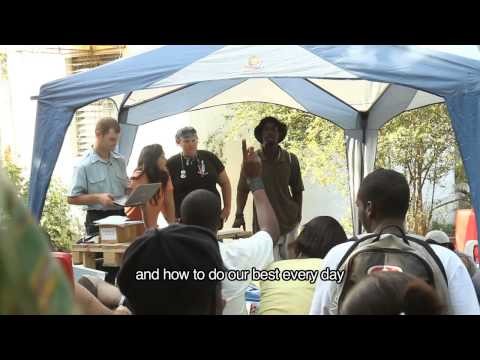
Between 2010 and 2012, GAI trained the first class of 27 certified EMTs, approved and endorsed by Haiti’s Ministry of Public Health and Population (MSPP). These were not just students—they were pioneers, stepping into a completely new profession for Haiti. They were deployed at mass casualty events, during cholera outbreaks, and at political demonstrations. They staffed mobile clinics, rode with the Red Cross, and formed the country’s very first independent EMS teams.
But after GAI’s dissolution in 2012, the mission had to continue.
Thus, on December 13, 2012, RETUM was officially born—an independent, Haitian-run network of emergency medical professionals dedicated to continuing and expanding this vital work.
From 2012-2014 there were three additional EMT Classes coordinated by an EMS Training Symposium that was led by EMPACT NORTHWEST, GAI, BANSHEE, and HAITIAN AMERICAN CAUCUS. This effort, taught in Haitian Kreyol and French trained 104 EMTs, 551 first responders and enabled them to build 4 distinct organizations.
These EMTs went on find employment with CAN the National Ambulance system (now defunct), the local hospitals in an in-patient capacity, a range of ONG, and the Haitian Hero Rescue and Haitian Air Ambulance where they are still employed. RETUM remains since 2012 as the only Haitian rescue organization providing consistent training.
INSERT PROJCTED RESULT
III. RETUM’s Mission and Model
RETUM operates on three core principles:
- Professional Training – To provide comprehensive, hands-on EMT education based on international standards while contextualizing it to the realities of Haiti’s health system.
- Community Deployment – To place graduates in medical facilities, NGOs, and mobile response units that directly serve Haiti’s urban and rural populations.
- Resilience and Autonomy – To cultivate a Haitian-led, self-sustaining emergency medical service network that can function independently of foreign occupation, donation dependency, or short-term missions.
RETUM’s curriculum includes training in:
- Basic and Advanced Life Support (BLS & ALS)
- Trauma management
- Obstetric and pediatric emergencies
- Mass casualty triage
- Natural disaster response
- Conflict zone field medicine
- Humanitarian ethics and community health
IV. Key Achievements Over Twelve Years
Despite working with limited funding and in politically unstable conditions, RETUM has maintained consistent progress in developing Haiti’s emergency medical workforce. Our impact includes:
- 1,780 EMTs trained and deployed since 2012
- Ten full graduating classes, with many graduates now training the next generation
- Active alumni networks in nearly every region of Haiti
- Successful placement of graduates in key Haitian and international institutions, including:
- HERO (Haiti Emergency Response Operations)
- Haiti Air Ambulance (HAA)
- Hôpital Adventiste d’Haïti
- Haitian and French Red Cross
- OTHERS?
- Critical emergency support during hurricanes, political protests, fuel shortages, and public health emergencies
- Partnerships with major hospitals including Hôpital Bernard Mevs, which serves as a clinical training site for EMT students
- Ongoing education workshops, including CPR certification, refresher courses, and disaster simulation drills
RETUM is not only producing skilled responders—it is building a culture of emergency preparedness and professional public health service in a nation that has long lacked both.
V. Our Team
RETUM’s strength lies in its leadership—a collective of dedicated Haitian professionals, instructors, and administrators who operate with discipline, empathy, and a deep sense of civic duty. Our team includes:
- Amos Yseus – Headmaster, Chief Instructor, former firefighter
- Bonhomme Lucien – Instructor and General Secretary
- Yawine – Assistant Secretary PEOPLE NEED TWO NAMES
- Wilkens Joseph – Ambassador, National Trainer, and Marketing Coordinator
- Dave Lauture – Financial Administrator
- Jasmin Mign-Gino – Senior Curriculum Advisor
- Almonord Moviette – Registered Nurse and Clinical Health Coordinator
- Ricardo Joseph – Director of Pedagogy and Public Health Liaison
- Divers Jean Francet – Infrastructure Administrator
- Azor Shneider – Logistics and Equipment Coordinator
They are supported by dozens of other volunteers, teachers, nurses, medics, and international collaborators who have helped RETUM evolve from an urgent post-disaster response into a professional institution.
VI. Crisis and Displacement: The 2024 Attack
On December 16, 2024, RETUM’s headquarters was attacked and destroyed during a wave of gang violence in Port-au-Prince. In one night, we lost:
- Our entire physical facility (classrooms, offices, storage)
- All training materials (mannequins, AEDs, trauma kits)
- Crucial student records, graduation certificates, and documentation
- Medical supplies, medications, and office furniture
This attack was not just a material loss—it was a psychological blow to our staff and students. Yet despite everything, our resolve has not faltered.
We are currently operating in borrowed spaces, with volunteers teaching from memory and improvising training sessions. We have no permanent home, no mannequins, no whiteboards, no trauma kits—but we have our knowledge, our people, and our purpose.
VII. Immediate Needs
To resume full operations, RETUM is urgently seeking:
- A new training facility: secure, accessible, and equipped for regular instruction
- Training and classroom materials, including:
- CPR mannequins (adult and pediatric)
- AED trainers and first aid kits
- Desks, chairs, whiteboards, and projectors
- Diagnostic tools (blood pressure cuffs, pulse oximeters, stethoscopes)
- Personal protective equipment (gloves, masks, eye protection)
- Basic office infrastructure: computers, printers, internet access
- One or more fully equipped ambulances for training and response purposes
VIII. Budget & Funding Goals
We are seeking support at the following tiers:
- $10,000 USD
Will allow RETUM to:
- Secure a temporary training facility
- Replace essential training materials
- Resume our educational program with basic capacity
- $100,000 USD
Will allow RETUM to:
- Establish a permanent training center with classrooms and clinical spaces
- Purchase a fully equipped ambulance for hands-on training and field deployment
- Expand outreach to provinces beyond Port-au-Prince
- Scale up recruitment and increase class sizes
- Launch a mobile education unit for remote areas
IX. Vision: Building Haiti’s EMS Future (2025–2030)
In the next five years, RETUM aims to:
- Train 2,500 additional EMTs across every major region of Haiti
- Establish a national EMT accreditation system in collaboration with MSPP
- Develop Haiti’s first Paramedic-level program, advancing prehospital care
- Deploy mobile EMT response teams in partnership with rural clinics
- Create formal pathways for women in EMS, with scholarship support
- Partner with international institutions for credential recognition, exchange programs, and research collaboration
X. Why Support RETUM?
Supporting RETUM means more than funding a school—it means saving lives, creating jobs, reducing health disparities, and strengthening Haiti’s emergency infrastructure from the inside out.
When you invest in RETUM, you:
- Help prevent needless deaths from trauma, childbirth complications, cardiac arrest, and violence
- Equip young Haitians with high-demand, dignified professions
- Build resilience against future disasters
- Promote Haitian-led solutions to Haitian challenges
XI. Call to Action
We humbly ask for your support in this time of need. With your partnership, RETUM can rise again—stronger, more resilient, and more prepared to train the future heroes of Haiti’s emergency medical system.
To contribute or collaborate with RETUM, please contact us at:
[Insert Contact Information: email / phone / website / donation portal]
Let us work together to rebuild RETUM and ensure that when the next emergency strikes, Haitians will not be alone—they will be ready.
 WALTER SEBASTIAN ADLER