
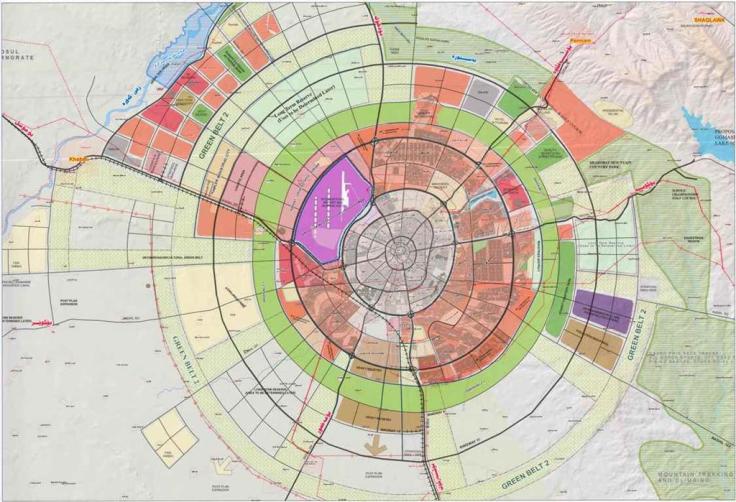
PRELUDE I — ERBIL
اربيل
ERBIL. ARBIL. HEWLER.
Bashur, Iraq — 2014
The order to evacuate came an hour ago. Like all orders in dying cities, it arrived too late and was immediately ignored.
My Kalashnikov lies across the bar, cold, theatrical, unnecessary. Below us, Erbil—the oldest city that refuses to die—glows under electric light, its ring roads circling the citadel like a target drawn by an unseen hand. Six thousand years of life reduced to geometry.
“How many?” I ask.
No one answers. Numbers dissolve here. Thousands, perhaps. Columns moving from the western dark—men in black, engines humming, violence made mobile. Or fewer. Or more. It makes no difference.
Across from me sits a Dutch journalist—if she is that—Justine, her name shifting slightly each time she offers it. Beside her, Abu Hamza of Kirkuk watches the horizon with the stillness of a man already calculating defeat. The last waiter smokes in silence, eyes flickering to a television that repeats panic as if repetition could make it coherent.
“Total chaos tonight,” Abu Hamza says.
He says it like a forecast.
Beyond the outer ring, something gathers. A rumor of annihilation. They call it Daesh. Others say ISIS. Names are irrelevant; the effect is identical. Tens of thousands have already fled toward the mountains, carrying children, memory, and nothing else.
The city remains.
For now.
Its defense is theoretical: fractured Kurdish factions stitched together by necessity—KDP, PUK, PKK—each mistrusting the other, all waiting for American aircraft that may or may not come. Somewhere, unseen, men in clean rooms decide whether this city deserves to exist another day.
Everything here depends on distant hands.
On the Dedeman rooftop, Justine drinks and writes.
“If the strikes don’t come,” she says, “this becomes a very dry town.”
She smiles faintly. People smile at the edge of extinction—it is a reflex.
Her papers speak of larger things: empires that never ended, wars that never stopped, systems that require blood as quietly as they require oil. She dismantles the illusions—civilizations do not clash, she insists. They transact. They arm. They profit.
In distant capitals—New York, Moscow, London—the powerful live identical lives, eat identical meals, finance identical wars. The symmetry is obscene.
Peace is not the objective.
Management is.
Abu Hamza speaks into the night like a man confessing to history.
“This did not appear from nowhere,” he says. “It was enabled. Funded. Directed.”
He lists nations the way others list sins. No one interrupts him. Out here, conspiracy is simply another word for structure.
The Kurds—forty million without a state—remain what they have always been: useful, expendable, perpetually fighting for the right not to vanish.
They will hold, or they will die. These are the same outcome, repeated across generations.
The night tightens.
No one leaves the rooftop. Leaving would imply belief in survival.
Then—toward morning—the sound arrives.
Engines.
Low, mechanical, inevitable.
And then light.
Airstrikes tear open the horizon. Fire blooms in the desert, illuminating columns that existed only seconds before being erased. Sixteen kilometers from the city, men are reduced to fragments without ever seeing the walls they came to conquer.
They do not know how close they were.
They do not know the truth.
That the city behind us is already hollow. That the fighters fled. That the civilians fled. That only the shell remains, glowing, waiting, pretending.
Erbil did not survive because it was defended.
It survived because, for one more night, distant powers decided it should.
And that is the most fragile form of existence there is.
 WALTER SEBASTIAN ADLER
Leave a comment