
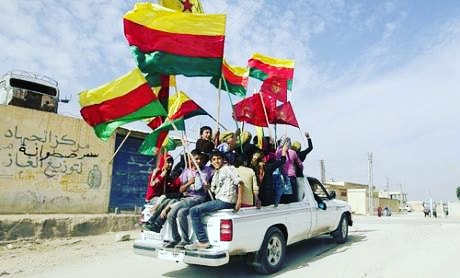
Act I:
BAKUR
“No Friends but the Mountains.”
The North of Kurdistan
An Interlude
“A Special Period in Times of Peace”
SET IN:
HAVANA, CUBA
“1989.”
Comrade Norma Olivia Sanchez has jet black hair and is petite. She’s vaguely malnourished for a Cuban, but still attractive and “dynamico”. Of course! She is and always will be a member of the Committees for Defense of the Revolution. The vigilant internal defense mechanism against Yankee imperialist aggression and unrestrained, insatiable sex tourism. Her mother was a fairly high ranking person in the Party, and told her of the struggles to defend socialism during the Cold War years. Told her of the deprivations and economic siege beginning in 1989 when the Soviet Union collapsed and virtually all proto-communist regimes along with it.
COMRADE NORMA OLIVIA:
“The U.S.S.R. was the sun and we were just a proud and tiny island fortress. When the sun went out, when we lost our greatest, sturdiest ally; we would be in the dark and there were many things in the dark that could ruin us.”
There would be no more petrol for the cars and tractors, buses and power plants. There would not be fertilizer for growing food. There would be shortages of absolutely everything on every level of consumption. There would be long lines and no electricity. There would be no fans or air conditioners, there would be zip-zero-nada. And in this proverbial darkness of our times ahead, our enemy which had sought to ruin us from the very day of our independence would move in, emboldened by the so-called end of history.
I have some understanding that was it not for decisions made during the revolution, if not for our Russian friends and of course the own solid base of our people in the historical context; we could be living in an illiterate and deeply unhealthy place; with a brothel and gambling embankment running from Miramar to Varadero. 500 kilometers long where foreigners could just cheaply, scenically fuck our women, drink our rum and smoke our cigars in the sun.
I knew, the minute I was called to the office that we would not surrender, our great leaders, well the two brothers still alive; would not for one human second consider that the fight was lost.
I was there the day they called us all together. The top nine, the big two; the Ministers and the deputies of industry, defense, finance, agriculture, and espionage later. We had known it was coming, the fall of our protector and benefactor. In embassy cables and diplomatic whispers; we also knew, it was our job to know that when the big bear fell down, died, and became reborn as god only knows what under American guidance! And its brightest, newest oldest and also highly questionable satellites began dropping from the sky; that nothing, not one thing would stop the aggressors to the north from moving in upon us.
We knew this was the beginning of the end of the revolution as we understood it, but what could we do? We suspected the Syrians and the Libyans would not give in easily to them at all. And we watched one after another as communist regimes collapsed in Eastern Europe and Africa. It was really our estimation, that by the time the dust settled; it would be only us, the Vietnamese, the People’s Republic of China (both which had embraced capitalism in most regards five years ago, Laos, and whatever the backwards hell they were doing in North Korea! We assumed Nicaragua, Ethiopia, Namibia and Angola would remember what we did for them but be in no position to reciprocate. And between 1989 and 1994, it would all come tumbling down. The failed architecture of a dystopian dream.
We sat together at a time when even the leaders were hungry and when anyone looked in a mirror they would not always recognize their own faces, for a look of despair had set in, inside oneself. All that we had willed as a people could be undone in just one year. We were all the same outside, for the siege had not begun yet, it would begin tomorrow and the next day and for the next ten or twenty years. And the Yankee enemy in the North, the pale colder place just a few days out by raft or one hour by plane; it would either soon invade, or try and starve us out. The ten million that had refused to defect. And the accomplishments of the last fifty years could go up in smoke, or simply in a long whimper, as the Dominoes began to fall.
But I understood, it was my training from Moscow to understand and my own Cuban sense of putting it together and taking it apart and refashioning. I knew that there was only one thing that could hold the country together, and so did Fidel and Raul. We needed to buy the time it required us to shore up. I am not sure that we prepared adequately for this day, actually. I’m not really sure we believed this day would come.
They drove us out to a farm. Well of course they didn’t tell us and we didn’t ask. And we were told in a meeting this was going to be a “special period in times of peace”, which was to say all the conditions of a siege and a war were to be upon us, and really the only question was how long could we last until the U.S. gets bored, not tired for they have never been in a rush. More until the empire is bored with us, less obsessed with us. Long enough for the opposition to imperialism to recoup.
I remember in the car to the ranch which disguised the room for these situations. I remember wondering if this was the end of our experiment and life as we understood it.
“This comes right from Fidel; you’re all going abroad in a week. Some of you will join embassy staff or medical missions, some as private people with foreign passports. You will be going to allied countries and Western countries, you will be going to make some hasty business.”
Well really the whole speech was so much longer. But this was the short of it. We were not told in any specific terms how long supplies and foreign currency reserves could hold out on the island. We were told in no uncertain terms that things were going to run out and that our job was to generate hard currency through the operation of a variety of legal and illegal businesses to shore up the essential purchase; food, fuel, and probably armaments.
“They’re rioting in Moscow, in Warsaw, and in Budapest. It’s all coming down. Even the Chinese are talking about calling it something else.”
I tell you it wasn’t all cigar smoke and mirrors and fake foreign names, Cubans look like everyone and we had trained long ago to act like anyone, and we’d been assimilating for years into the second world and there was a contingency plan for a cut off over time from U.S.S.R. foreign aid, not overnight.
COMRADE NORMA:
“What brought it all down?”
LEADER MAXIMO CASTRO:
“This isn’t a polite or immediate question, comrade.”
But, the answer was several things. First, the West was economically more exploitative and comparatively more ruthless. Second, the Russian Communist Party lost its popular imperative, and third, the endless wars in proxy had sapped its will. But there was something else no one said, which was being said in the West; that Capitalism was simply a better system, no-no no one would say that. But everyone was always hoping blue jeans and popular gringo music would fall off a favela cart or plane hatch back from Miami. And it often did. Luxury carrots for all or for none says the evil murderous and often sloppy C.I.A.! But ours was a hard-won thing that had the support of the people and would not be defeated by American imperialism and temptation.
We will do what we have to do to survive this! Too much is historically on the line, if we fall like the others this idea and all our sacrifices and gains will have been for nothing. We would plot and organize, mobilize and do anything we had to do to secure the revolution. We would survive this coming Special Period in Times of Peace. We will break the grim Yankee blockade and ensure the relevancy of Cuban-style Marxist Leninism for ten thousand years to come! And I will wear blue jeans when I have to. Four people with mixed but exotic features enter the room, two men and two women, clad in loose army green tunics.
Thus declares our jefe:
RAUL CASTRO:
“I would like to introduce the delegation from the Kurdistan Workers Party.”
“They are quite expert in smuggling, establishing European business fronts and of course, they are committed revolutionaries motivated by the same historical forces as our own people.”
That was the very moment that the special relationship between the Cubans and Kurds solidified. Skill in smuggling and commerce would be exchanged for medical specialists and engineers that could design impregnable bunkers. Ten years later, Comrade Norma Sachez’s half Argentine daughter Alina Sanchez would become one of the first Cubans to serve in the Medical and Engineering Brigades attached to PKK guerillas in Turkey. Her Kurdish guerrilla name was Lêgerîn Çiya. One of the longest-serving members of the international brigade mobilized to protect the revolution in Rojava.
Chapter (1) One
Deir Ez-Zor, Syria
Flaming, low-lying wreckage spreads out before us in every direction. The ruins of an already desolate land. Sprawling two-story compounds along a mighty river. Pock marked with rifle rounds. Misery found absolutely everywhere. Syria is now a bi-word for total warfare, over 600,000 have so far died. A Revolution in a Civil War. A Third World War using several dozen proxy armies is underway. Russia, Iran, China, America and Europe all have their boots on the ground. In Northern Syria, an unrecognized administration in three cantons protects 4 million civilians and internal refugees. A Kurdish lead project for democracy, ethnic pluralism, women’s empowerment, and something called ‘social ecology’. The sun bakes you and the dust gets into absolutely everything.
In Deir Ez-Zor Province, a wasteland along the North bank of the Euphrates, in a few hundred hamlets, from their ‘capitals’ in Raqqa and Mosul, Iraq the most hateful and radical of Islamic fascists rules over 10 million persons. Some happily embrace its Caliph Baghdadi as the fulfillment of prophecy. Over 50,000 Muslim Jihadists from around the world arrived to reinforce this effort. At its maximum the Islamic State occupied massive swaths of Eastern Syria and North western Iraq, threatening to capture Baghdad and Damascus.
Deir Ez-Zor was one of the very first Syrian cities in 2011 to stage large scale demonstrations against the Assad Regime. In 2014 ISIS took over the city with little resistance leaving only a small pocket of pro-Assad military and perhaps over 100,000 civilian supporters cut off in an airbase and small section of the city. Supplied by helicopters and high altitude drop services the besieged garrison deep inside the ISIS control zone resisted capture for over 3 years and 2 months.
The siege of Deir Ez-Zor Airbase garrison lasted a very long time. ‘Daesh’ controlled everything except a small military airport which the Russians and Regime supplied by air for all of the war, but could not re-take, along with the city until just a month ago when it was “liberated” on 3rd November, 2017 by the SAA and the Russians.
At some point the Regime soldiers made the local women trade sex for basic rations of food. There were rarely sympathetic forces in the war, besides ours. But even the Y.P.G. conscripts children, forces Arabs off their land and dabbles in war crimes from time to time, to time. Now, on the South bank, Assad Regime forces, Hezbollah, Iranian Revolutionary guards and Russian special forces push south east down the southern bank of the River while Syrian Democratic Forces and United States lead coalition forces pushed rapidly south to the Euphrates North bank, both sides maneuvering to secure the majority of the Syrian oil fields. The S.D.F. capturing most of them. Now we slowly begin the final offensive to capture Isis’s last strongholds, moving down the river toward Hajin. Trying not to kick off World War Three.
“Perhaps I am not where I am supposed to be,” muses Heval Ciya, “Perhaps here, I will die for nothing at all. We can be killed so easily by anything, then they will dance about with my corpse making speeches in Kurmanji for a day, until my death takes on significance that it probably never had.”
Heval Ciya Zinar is the name they gave me. “Comrade Friend Mountain Rock”. I am a separatist minded Scottish Soldier. Although still a member of the British army, I voted for independence in our latest failed referendum. I am a gentleman by most accounts and a Y.P.G. International Volunteer. I have absolutely no political sympathies with the Kurdish lead formations, though I possess formal military training, making me more valuable than most of these preachy, useless ideologically motivated volunteers.
“There’s dust in my beard and men die all around me!” exclaims Heval Ciya from Scottland.
As we grew closer to the Euphrates we can see fire in the sky and the night is lit up with heavy coalition airstrikes somewhere far away to the south. The convoy of nine trucks had left Al Hasakah, the largest rebel held city in the morning and drove about five hours south toward some forward operating base. The eight of us internationals had not been issued weapons until halfway to the front. We stopped of course several times for obligatory tea and some volleyball. The sport of ‘Apoist’ revolution. Sometimes we’d stop at what seemed like the same identical storefront kiosk, next to well stocked pharmacies. The road bodega of Kurdistan is stocked with energy drinks, smokes and Turkish day to day items, never toilet paper. All the toilet paper in Syria was now gone. There we bought energy drinks and cigarettes of a more potent type, as the party issued Ardens were lights or ultra lights at best. There was tons of canned Pepsi, but no Coca-Cola throughout the liberated zones. Real freedom evidently has not been won yet.
In the first battle that I participated in during the Syrian Civil War five Arab soldiers in our S.D.F./ Y.P.G. Unit were blown to bits by mines and mortars as we stormed the river basin a little after midnight. Evidently, there were far more Daesh entrenched than we had thought. From a dirt sand trench I fired my AK-47 shiftlessly over the wall, peaking out I saw an Arab comrade ripped apart by gun fire and collapse in the sand.
The fire fight resumed immediately after a short re-calibration of the battle plan, after Heval Commander Dalil’s men were buried. A larger number of Kasadeh were trucked in, barely trained. Half or more might have fought for Daesh or the Regime at some point. Child soldiers all over the place. A major conscription drive happened, even some cadro tabors were moved in. This was a race to secure as much turf north of the Euphrates as we could as quickly as we could, creating a defensible buffer against the regime, Russians and Iranians to secure the oil fields. Of course, implicit in all that was to finish Daesh for good. Smash their final positions along 60 to 100 hamlets and miserable dust cake boney towns leading to Hajin, for the very last stand of the caliphate.
Very bad intelligence friends! The bandits were still very well dug in, refugee were swarming out and among them suicide bombers. Five so far. it was impossible to know anymore who was Daesh or not among the refugees flooding out. Some two dozen Arab Hevals were martyred the first night of the operation. We were down the hardcore of the elite, the foreign fighter zealots, their families. Motorcycles with snipers affixed to reposition. Sleeper cell deployment, suicide bombers, booby traps, tunnel mines, the usual. Now they would in four battalions capture about fifty tiny key destitute towns working south in several prongs toward the river.
“If you see a helicopter, don’t shoot at it!” Dalal had said, it was our new resupply drop copters. We allegedly had a very, very small air force now. “Do not shoot at the helicopters in general,” was repeated several times in Arabic and Kurdish.
“Also, also! If the regime forces fire, return fire, but do not engage them. Unless they actually cross the river.” Declared Commander Heval Brusk, which means ‘commander lightning’. Commander lightning then personally presided over a few hours on conscript drills. None of these bearded partisans were trusted with grenades.
So the very next day, at early dawn, ten of the destitution ridden little seemingly strategic ISIS hamlets were again stormed.
There was chaotic gun fire erupting everywhere. There were utterly ransacked two story brown buildings all unfinished, all about the same shattered look. From several positions Takim commandos were firing endlessly from roof tops and sniper holes out toward where it was believed the enemy was hiding. A mosque about half a kilometer away. Well of course every Daesh position was in a mosque, hospital or granary since nothing else was defensible.
This was a mostly one sided AK-47 and mortar barrage. Much of the war had proceeded like this, pickup trucks dripping light infantry to storm abandoned Arab homes and light up anything that moved. Loot absolutely anything that wasn’t made of sand and carry it back north. One pipe, one water basin, one carpet at a time.
A small child ran out into the road and was blown away. Briefly a pause, until he was clearly limp and dead. A day or two more of endless AK fire, sometimes at night too. Eventually the Americans were told to bomb the mosque. Spotters transmit grid coordinates. Soon, about 5 minutes later an airstrike rips apart the mosque. Battle won!
Many people have written at length about “how boring” it can be to be at war, but it is more terrifying than boring, actually Heval. You do your best to not think about how men and women far more prepared than yourself took a wrong turn and then just exploded. Or how a sniper cut them down. Or how they died in a Turkish airstrike. Or contracted hepatitis because of poor local appreciation of pooping with toilet paper and hand washing, then eating.
The boredom of war Heval is perhaps a cover for a sneaking debilitating fear, so that is what people write about. Being bored, instead of being afraid. And in a war such as this certainly you sit around quite a lot drinking tea, smoking weak Party issued cigarettes and standing guard. Or looking for strategic places to jerk off or poop without setting off a mine. But nothing for us was the same for very long and thus all the time you spent sitting around was better spent ‘conversating’ on the Revolution’s bleak future, or studying some Kurdish, or horsing around with the Arabs. Who loved to try and communicate actually. And also show you pornography and awkwardly try and steal, trade for or buy your hand grenades. Or ask you to bring them to America or Europe hidden in a bag. Jokes abound, but really it is only you who will be brought back to Europe or America in a bag.
While very few of us actually spoke any real Kurmanji Kurdish or Arabic, it seemed that the Arabs were far more interested in us than the Kurds though. I would call the Kurdish commanders attitude, begrudging appreciation and that of the rank and file borderline insulting. I would go so far as to say that at this stage in the war, being fought in majority Arab zones now by the Euphrates river that an increasing number of the front line fighters were Kasadeh, non Kurdish Arab S.D.F. fighters. The Assyrians too had a small group, less than a few hundred men, many little kids and old men. Many poorly trained and poorly paid semi conscripts. Many were not even very against the Islamic State, more eager to shoot at the Russians and regime forces on the other side of the river. With the Kadros being withheld in clear preparation for the impending defense of Afrin Canton.
In retrospect I assume that Heval Fermander Dalil probably saved our lives by abandoning us in a rear fox hole in the dead of night. The ten internationalists that I was aware of were placed further back in the rear, but Heval Shervan ‘the crazed Irish gypsy’ commandeered a Humvee and caught us up, without any invitation to the troops of “Fermander Dalil”.
I remember freezing out in the dunes all night long while the Arab fighters shared neither bedding nor blanket. It was so bitterly god damn cold! Sometimes Heval Kawa, the idealistic New Yorker and I talk about the girls back home. I talk about my Ms. Ashley. He talks about his “Goldy”. Some escort Russian he has some arty muse thing with. Pretty much this is what men at war do. Although in my case, I motorboated my female best friend. In his case it seems a bit more fucking dark and tragic.
“Sometimes I close my eyes and remember your lips. Late into the long trip back to Brighton to your so-called home. I have no home, only ugly little flats around Brooklyn soviet which I rent out of poverty, artless and shared. Decorated with trinkets. I’ll never go back! To you or to Russia, or Haiti, nor to Mehanata the tavern or even dear Cuba! All these things are a form of slavery now. Your lingering Daria, it takes the form of ruminations on WhatsApp messages telling me to “come home”. But to what? To nothing. Life here is hard, but it is free life as they say.”
Kawa, the so-called American, is more a poet than a medic in his heart of hearts. Me? I am simply a Scottish warrior. I long for the fight and I got some.
I was deployed into the Deir Ez-Zor Province wastelands about ten days ago to the front near Omar, Daesh is nearly completely defeated they say, but everyday we are taking martyr bodies back to Al-Hasake. Assigned briefly to the Tabor Shahid Lawrence; we lost fifty men in the first few battles to advance south on the mighty Euphrates river. After all that initial death it seems they aim to break up our group of internationalists into different places. They do not want us all to die at once. They do not really seem to have achieved consensus or a plan on where we should be or when and if we should die, or what we are actually even good for. Or what to do when ISIS is finished, and America abandons them and the Turkish Army rolls over the border to kill us all. A heated internal debate is constantly held in both Turkish and Kurdish. Sometimes also in Arabic. Which always ends inconclusively. Well its a complex matter anyway. So many ways to die out here for the greatest cause of our time.
On this matter Kawa and I agree, that whatever motives brought us all to this wasteland, this place of dying and suffering over made up Gods and ideologies, invented ethnicities and world war three style great power politics; this was the resistance of the age. This was a battle between good men, bad men and crazy men who could not sit out. Because when the smoke clears there will be a different Middle East, a different world. I am no ideologue. I am no dreamer or religious fanatic. I am a professional soldier. While it is not unreasonable to say the Assad Regime backed by Russia and Iran, the Turks, Al Qaeda and of course the Daesh, are unequivocal forces of religious fanatical reaction, of fascism, or totalitarianism and death, well they are. While the Kurds and Arabs of Y.P.G./Y.P.J./S.D.F. are not saints of course. We are not angels here to help do some God’s work. We are fighting for democracy, feminism, ecology and tolerance in the heart of the Middle East. As opposed to all the other groups that are fighting for radical Islam, chauvinism, fascism and the right to impose the will of the minority on the majority.
Did you know that when you take off a person’s uniform to bury them, you cannot tell a fascist corpse, from a democratic corpse, from a Daesh corpse, not even from the length of the beard? Those three and letter affiliations, they don’t matter anyway. It matters more, the stuff inside a person’s heart. Their moral compass. Not the length of the beard or who they pray to. Not the historic struggle of their people or their claim to the rivers. When true warriors die, they might not end up anywhere glorious. They might just be dead. The “immortality” we are achieving in our death here is thus rooted in the way the story is framed. Which is to say, whoever wins the war. But can you really win a revolution inside a civil war, inside a World War? I see absolutely no good end in sight. Most likely, we will all get killed ingloriously. But there is of course a timeless epic glory for young men of all cultures to join a seemingly impossible battle, risk their lives and join a pantheon of immortal heroes. Of course, the Arabs, Assyrians, Kurds, Turks, Checehens, Turkmen, Persians and all the other micro-ethnic tribes gathered here to make war, well they sadly all have no choices. These are the oil rich, strategic holy lands and mountains they were cursed perhaps by their gods to be born in.
How did we even get here? How did this motley group of around 800 mostly Western foreigners take up the cause of Kurdistan?
Well, it began with a letter of introduction. As well as four short pamphlets that were written by the Uncle Leader himself, while serving twenty-one years in solitary confinement on the Turkish prison island of Imrali. These pamphlets attempt to paraphrase thousands and thousands of handwritten theoretical documents smuggled out by his lawyers from Imrali. The name if this 8 volume treatise are called alternatively “Democratic Confederalism” or “the Defenses of Abdullah Ocalan.” Taken as a body of ideology these writings translated into Kurmanji, Sorani, German, French, English, Spanish and Farsi from Turkish for the theoretical basis for the military and political objectives of the Party.
Chapter (2) Two
Deir Ez-Zor, Syria
On November 26th, 2017.
At the Green Village Outpost contact line.
Sometimes I close my eyes and remember your lips. Late into the long trips home. I have no home, it was your home only. Only my ungly little flats around the Brooklyn Soviet. Rented in desperation, vulnerability, an admission of poverty. And I will never go back to that humilating life. I will never see you again, or see Russia, or Cuba, or Mehanta or any other type of slavery life. Your lingering Goldy. It forever remains.
Now deployed about ten days ago to the Soutehrn front near Omar Feilds. Daesh is nealrly finished they say. Assigned first to Tabor Shihad Lawrence, five quickly died by snipers and mines in the first night of the operation.
The twenty internationalist volunteers are all drifting in different directions. They prefer we not all die at the same time. There are supposedly around 500 international fighters in Rojava, mostly from the U.S. and Europe, also Turkey. But numbers and time to the Kurds mean absolutely nothing. So maybe there are 500, or maybe just 50. Who knows Heval, who knows!
Daesh is nearly defeated. The Islamic State once size of Great Britain at its maximal, poised to take Baghdad and Damscus is reduced to the wasteleands of the deep desert and a strong of indefeinsible towns along the Euphrates River south east. From the North the Syrian Democratic Forces supported by the Western Coalition advance. We are part of that force. On the other side of the Euphrates the Russian Army, Lebanaese Hezbollah, and the Syrian Army advance. We all try and not shoot at each other, at least until ISIS is finished. Over the border in Iraq ISIS has been largely crushed; the SHi’a Populualr Mobilization Forces, the Iraqi Army, the Iranian Pasdaran, and Western advisors and Special forces have all but driven ISIS from Iraq to the Syrian border.
The name I have been given is Heval Kawa Zivistan which means “Comrade Black Smith Winter.” I am a Paramedic in civlian life and therefore one of the highest medically trained foreigners in the brigade.
Heval Shoresh from Brooklyn, I have known him since child hood. He has a child back in America. And I judge him for being here were it my right to judge. But this palace this revolution is irresistible to us both. He is a gardener back home. Here he carries a heavy duty long range, high power rifle called a X which is about twice his size. Hard to aim.
There is Heval Sasson from Austria. He was an EMT who once travelled with his girlfriend all over Africa on a motocycle. He is quiet, ideological, principled and socialist in disposition. With also is Scottish Heval Ciya a former British solider. Also the mad man possible career criminal kicked out of the French foriegn Legion called Heval Sivan, who although he claims he was also a British solider can’t hit a target with an AK to save his reputation. He hasn’t let up for many days talking about the Order of the Knights Templar, talking aboutthe Knights of Malta; actually engaged in an unending pressure of speech manic diatribe about the new crusades, that we are allegedly in. There’s also Heval Azad from Albania, something of a gypsy, a besepckeld intellectual; an anarchist.
There is also a French Legionaire of enormous size, amost a giant. He is called Heval Gabar and speaks only of the Legion, reveals nothing of his life. He isn’t very well liked by the other internationals. There is also a young kid who loks not more than 16 but is allegedly 18 his name is Max. One of the few held back in the Academy because of minor injury. He is dbbed Heval Maslum, but evryone just calls him Max. And that is how he introduces himself. He’s allegedly from Salem, Oregon. No matter what sems to happen he just repeats, “I don’t care.”
After the 5 Arab conscripts were blow apart the first night they broke the internationals nto smaller groupings. Ciya and Sivan were sent to a YPG Cadro Tabor based on being British military they were sent to the front. Soresh, Maslum, Gabar were merged into an Arab unit and sent to the front. Sasson and I were attached to Kurdish Red Crescent outpost in the Naqta in Omar Fields. Gabar and Maslum dubbed “pizkereks” or problem makers were sent to guard a fox hole on the edge of some useless “liberated village”. No one knew where Heval Azad was sent, but Albanians are very tough craft bunker people.
“He will turn up and be fine!” Heval Sasson says, ever an optimist.
***
Then night came and Sasson and I were quartered in a farm house. The commander invited us over to the field command for tea. The mood was the war with Daesh was almost over and very soon we would all be fighting Turkey in the north and or Assads forces right over the river.
The Commander is named Heval Azadi. They basically cycle out the same 50 Kurdish code names for everyone seems like.
The commander in very broken Enlgish invites us for black Tea in one of the many pillow rooms they like to build.
“Trump say, no more guns for YPG,” he tells us the SDF is the brand the YPG uses to appear more inclusive, a little less Apoist, an little more not the PKK, but the commanders almost always say YPG or PKK, theres a lot of little acronyms for small armies out here. The YPG, or the People’s Defense Forces make up 80% of the SDF; the Syrian Democratic Forces. All the best commanders are Turkish Kurd PKK trained.
“Daesh done in Iraq. Two towns left,” Azadi tells us.
“24 little Gundes to take along the river,” he says. A Gunde is a village.
“In Moscow, the PKK make a deal with regime, “ he says, regime meaning Assad and Syrian Army, “Iran, regime, Russian make deal on autonomy and oil rights.”
We are engaged in an operation to seize Syria’s oil fields, Sasson had explained. There were not many ISIS fighters lift after Mosul and Raqqah fell. This all now about who can take as much oil fields as possible to negotiate the final settlments. This seems to discourage Heval Sasson.
“Really all that is lef now, “says Commander, “NUSRA Front and HDS in Idlib.”
“Al Qaedas Syrian brand,” Sasson tells me.
“The PKK make a deal in Moscow, we will end up terms with Assad. The HDS, the Nusra, the Deash all the Islamist proxies in Idlib, Bab and Jarabalus City they must be eliminated to close the gap.”
Closing the Gap we learned in the Academy was about pushing through the Islmists into Turksih Hatay Province to gain sea access for Rojava. The Gap also being closing the lines between Afrin and Kobane. Afrin Canton is hard to resupply and will be the first thing the Turks attack.
“As soon as Deash war is over Turkey will attack, you will fight with Turkey?” they all wanted to know that. Would we we all stay and fight the second biggest army in Nato.
“Of course we will,” Kawa claims, but Sasson knows is suicide and also problematic when they rertun to their home lands.
“When Daesh is done there will be no ceasefire. Turkey will attack immediately. 45% of call Syria now in Rojava. In SDF hands. Turkey will waste no time.”
We all sepcualted about “Fighting the Turks near Afrin” while in the Academy. It will be slaughter. A cadro boasts that “We have peace deals with USA and with Russia maybe also China!” But the dependency on the U.S. airpower is real.
“The Regime will not ever accept Rojava in any form, it is just too weak to defeat it right now.”
“Russia will never abandon the regime,” someone says in Kurdish.
“It is like America and Israel, you have Syria and Russia. The Regime gives Russian Medditteranian Seport access, the Regime is only alive because of Russia and Iran.”
“There are many factors. Russian is loyal, America is not. When Daesh is over there will be no more guns, no more air support.”
“How many Western volunteers do you think are still in Rojava,” Sasson asks the commander.
“50, maybe less,” the Commander says. “50,000 came to fight for Daesh, maybe over time 2,000 came to help the SDF. 1,500 leftists from Turkey and 500 from the West. Now, in country still, 50 maybe.”
“The airports in Erbil and Sulymania are still shit down because of the independence referendum. For now you are here to stay. Who knows what will happen. PJAK is now fighting in Iran again. Maybe soon more fighting between Iraqi Army and Pesh Merga. And Turkey! They are coming trust me heval.”
Goldy wrote that she might have to marry her rich ugly patron. Polina wrote she is leaving me since I am “on the other side of the planet now” Chanie is back with Charlie, so probably I will never hear form her again. Anya, my attache, sends me some news from Baghdad. “They are arresting Western volunteers without good paperwork coming back from Rojava. Slemani and Erbil airports are down everyone ahs to go out rom Baghdad.” But I have good paper work. I called my parents the other day. An Arab had sold me a Syrian SIM card. They seem proud that I’m there.
I hope I can hold it togeter and reach ‘the moutaintop’.
Like in my dreams, the EMT Program of Kurdistan is just a means to an end. An after thought, the G.C.C. barely useful or functional any more out here. My so called partners Andrew, Forti, Jessica, Matthew Smith, Ovid all have defected and left me out here with no help. Can I count on David Smith, Kaveh, Jonah, or Dr. Wagner, probably not or only for a little.
Everything here is an assault on my senses!
Daily, I mist learn ideology, discipline, war, Arabic, Kurmanji, keep Sasson and I from stepping on mines, dying in airstirkes, gettting enough water. Sasson has said he is willing to help me run the EMT program if only we can get authorization to do so. The Kurds don;t believe in time, they don;t believe in space, and they don;t believe in foreigners.
The others we trained with, the twenty are all dispersed to different positions. Ten to Afrin and ten to Der Ez Zore. They must chose their own adventures in Rojava. I do hope that Soresh stays alive for the sake of his 6 year old child and yong wife. Ciya and Sasson signed the G.C.C. paperwork, the cover contracts that they will claim later to the government sof Austtria nad Scottland that when they did out here was purely medical. But, its not so much will they stay 6 months to train an EMT program it s more will the war ever actually end to allow the time and space to justify one.
It’s impossible to know how far up the mountain any of us will really ever go. Heval Barron was there almost a year. The German heval said little good or bad about it, he barely said much.
So many ways to die out here. We or most of the 2,000, or 500, or 50 shared a noble goal. Deafeat Daesh, defend the Revolution in Rojava.
In the mean time Sasson and I have been training Arab fighters in life saving skills. We try and stay sane. I am sure I will have to use this AK-47 before this is all over. The thought doesn bother me but I don’t delight in the thought of any killing.
Today, a villager “gundi” handed me their sick infant and I listed to its lungs and heart, and helped prepare some pedilite mix. The child was sick but dehydrated and stable, the Arab comrades keep telling people an American doctor is in the camp. But even in Syria I am still just a a paramedic not a doctor at all.
So much responsibility is on my shoulders. They all have varying medical issues. Infected toes, rotting death, abdoinal pains. I do what i can. The Party purchased me huge rolling duffle bag of medications and medical supplies. So we saty as busy as we can.
I day dream, and hope Goldy thinks about me more than sometimes, but probably only Chanie does when she is allowed to. Goldy sometimes whatsapps me cute photos and sometimes Anya, the attache flirts from Baghdad. I have been sending Chanie letters via the U.S. Special Forces were run into coming thorugh the camps.
I realize that G-d or no G-d, Abdullah Ocelan is writing about a universal truth. This is the last stand. The last chance we will ever have or get again.
“Deash is all wiped out,” the Commander repeats, ‘BUT THE TURKISH ARMY IS COMING FOR SURE. To burn all we have built to the ground,” he sighs, “Serkaften, we will fight them too.”
So we all still probably have a lot more bleeding left to do no matter what happens.
Chapter (3) Three
Derik, Syria-Rojava Region-Kurdistan
ADONAEV:
“It is not that any of us longed to die.”
It was only that we believed that in this transience, this short human life, it was preferable to die on one’s feet moving towards a just idea. Moving in solidarity, in defense of the powerless. Then it would be to die on our backs or our knees, half-lives, shuffling along like zombies. Always asleep. With meaningless, un-free lives wasted. Lives were spent like wallowing serfs and base slaves.
Have you ever had an amazing noble idea in your head? That simply refused to translate itself or find traction in reality? Have you ever risked everything, sacrificed absolutely everything for such an idea? Myopically, almost psychotically pushing forward in the face of a stubborn, intractable cruel reality. When you can bring yourself to do that. To engage in nothing short of overwhelming zealotry. Pursuing a new reality, a reality where the vast suffering of this world is mitigated. Where the chaos and carnage and daily humiliation that is the lot of most humans is undone by rights, by hope, by heroism. That is called the “motivation for the fight”.
It has been a very long hard bloody road to the mountains and back from them. From Manhattan to Jerusalem to Havana. All the trips to the City of Port-Au-Prince. To Greater Boston. Back to Brooklyn then to Russia. Across Russia on a train then into the Middle East to fight in Rojava. Iraq, Turkey, Syria and Egypt and then back to the Big Apple again. Riding on the backs of armored trucks and flying carpets. On horses, on tanks, on airships. Over the great rivers and through the woods. Mountains beyond mountains beyond mountains. With stopovers where all civilization has come to a resolute end in the Fertile Crescent. Smoldering villages. Enormous cities razed to the very foundations. Once historic places, simply crushed and undone. Burning down river by river shore to deep sands of desolation. A revolution within a civil war within an endless third world war. A place called Kurdistan which exists not on maps but in the hearts and dreams of perhaps forty million stateless, long oppressed people. Engaged a very long fight for their right to exist.
How do you make any sense of such carnage to people that were not there? How do you make an enjoyable narrative about bloody chaos? Articulate ideas that when they become facts on the ground, have vast contradictions. Have improbable capability to survive.
My name is Sebastian Adonaev, but the Kurds named me “Blacksmith Winter”, or Kawa Zivistan. The Arabs needed to name me too in a way familiar to them so they called me “Abu Yazan”. Because my then-part-girlfriend, part-confidant Polina has a son named Yazan. I was 33 when I deployed but looked and felt a bit younger. I felt brave or stupid enough to volunteer for a war. At the most desperate heights of the conflict, which would end up killing over 500,000 people, there was a cry for some extra hands, some Hamsas. Every side called up all available reinforcements. Just before Baghdad almost fell, the mostly Shiite al-Hashid ash-Sha’bi Popular Mobilization Forces called up half a million Iraqis to hold I.S.I.S. back. The Assad Regime enlisted thousands of Russian, Iranian and Lebanese Hezbollah to fight Daesh and other Sunni rebel factions aligned with ISIS, Al Qaeda, the Free Syrian Army brands and the Al Qaeda reboot H.T.S. The so-called Islamic State took in over 40,000 foreign fighters and the mostly Kurdish forces in the “Syrian Democratic Forces” enlisted just 500. I fought alongside the Iraqi Special Operations Forces in Iraq and for the Syrian Democratic Forces, in the Y.P.G. Militia defending the idea of Rojava in Syria. I contributed very few bullets, mostly serving as combat medic during my time there. Mostly stopping hemorrhage and carrying the wounded to ambulances. Mostly trying to train people to save lives, actually, at a time when almost everyone wanted to kill.
After defeating the so-called “Islamic State” as a force holding any territory, the United States military all but completely abandoned their Kurdish allies and Turkey invaded Rojava. Yet, she did not fall.
We who survived to talk about the Syrian Civil War, we often found there were not easy words to describe what we took part in. This is a story grounded in history and ideology. The tale of a stateless people spread over 4 nations, over 40 million strong. This is a love song after a series of hard fucks in Spanish and some love making in Russian. This is a Post-Soviet Lullaby, written in Imperial English about Western privileges. I have heard on the wire that the Turkish Army is fully mobilizing to crush Rojava. A fully modern army of over 435,000 soldiers. That Anya is losing her mind in Baghdad and Ana Campbell, that optimistic young woman I once gave hand grenades to, well she died in an airstrike in Afrin. Here I am in Capitalist Modernity’s very heartland and loving embrace. Doing nothing useful for Kurdistan. Just writing stupid love songs. Composing vain self serving propaganda plays.
I’m not sure exactly what I’m supposed to hide and what I can give away. I’m actually very detached from Western thinking so I don’t even know what actually makes compelling propaganda in the West anyway. Actually, the sly and looming enemy knows most of our real names, and frankly there were many informants amongst us, it is simply a matter of sad fact that to get their passports back many of the French and British volunteers gave us away. Not to snitch jacket, but with a little lean on anyone can make a person flip. Really, there were not that many of us internationalists to keep track of. As the mad China-man Andok said, “the hard drives containing our data were barely even secured and this place is awash in spies.” Our overall numbers were estimated to be around 500 strong of which around 50 later perished. Mostly in combat, some in a wave of alleged suicides. We were small enough therefore for the various security services to keep track of.
So what is the actual purpose of this little manuscript? It is certainly not to glorify or denigrate the volunteers. I think it’s brave we went there but I don’t think we changed a single thing. Perhaps we were all only there to bear witness that the revolution has even happened. It is surely not my aim to give away military secrets and name names, because I am many things but not a Josh, a ‘donkey ass betrayer’. Suffice to say the CIA, MI6 and the MIT. have all of our names.
JANSHER:
“I heard some comrades sang like little opera singers to get their European passports back. All speculation, none can actually say. Americans, you have the easiest deal. After ISIS is finished, maybe it will not be so black and white, fighting a N.A.T.O. ally and what not.”
Assisting a revolution for stateless democracy, women’s emancipation and social ecology in the heart of the war torn Middle East. ‘Heval Ciya’ the Scottsman always used to say that the 231 Sniper Unit changed the entire game, but really only the United States and the Coalition airstrikes probably, certainly did. When the last of the under 2,500 U.S. Special Forces leave the Turks will invade in force and try to undo everything.
There’s a story we heard about a Y.P.G. Euro volunteer vacationing in Turkey immediately after his tour. He was of course arrested and will serve life in prison. He probably should have made better choices for leave and decompression. There are lots of crazy people here. You have to be little crazy to travel halfway across the earth to enlist in a revolution inside a bloody brutal civil war amid a great power confrontation placing Russia and Iran directly against the United States and N.A.T.O.
I was told by ‘Heval Jansher’ the Y.P.G. guerrilla who helped train us that, if I survive the war I should “write something about Rojava that does justice to the over 12,000 martyrs. That does justice to the cause of Kurdistan. Honors Abdullah Ocalan and upholds the values of the revolution.” That it should humanize this resistance struggle inside a revolution inside a civil war inside a great game for the Middle East.
JANSHER:
“Maybe Heval, just make it a kind of strange fucked up love story! Call it; A MIDDLE EASTERN WESTERN!”
Jansher joked with me over cigarettes and endless black tea. He probably would never have cursed publically. As he was living a life of “unlimited modesty”.
So I hope this account manages some of that, compiling the oral history, experiences and many martyrdom shared amongst the approximate 500-600 foreign Y.P.G./Y.P.J./I.F.B. Internationalist fighters. At the very least I’d like to capture what it was that made us enlist in this hell to take part, to fight and die and kill and try and help, to be less than a footnote in the epic tale of Kurdistan. But still a part of a part.
JANSHER:
“It has to be a love story or they will never make a movie about it, comrade! To the West without a Movie, it is perhaps like this struggle is not even happening at all.”
But he also said things like:
“A ‘real revolutionist’ has no love except for his or her people. Any romantic love, or sexual yearning is a bourgeois luxury. For civilians, actually. A Kadro moves beyond the physical temptations of life, not because they are sinful or weak. They are just weakening to a revolutionary militant. Distracting the focus one must have to maintain motivation for our fight”.
“Our love story is for the Resistance of the Age” he used to say, but then Heval Jansher also laughed and noted that Heval Actor Jake Gillenhaul was then already shopping around a script where he plays an anarchist falling in love for a beautiful Y.P.J. fighter and another action exploitation of the Y.P.J. was coming out soon in France.
JANSHER:
“But that will likely not go anywhere useful. By the time it comes out we will all be dead, or have achieved victory, actually.”
He always punctuates, or punctuated his thoughts with “actually”.
JANSHER:
You see Heval, in real life we would probably platform and deport this stupid volunteer and the Y.P.J. comrade, she would be shamed and sent briefly to prison” Heval Jansher told me. A famous saying states that the “Kurds have no friends besides the mountains.” Well that’s no longer completely true. The 600 who served and the 45 who died besides the 12,000 Kurdish and Arab martyrs of the battle to defeat ISIS and defend the Rojava Revolution will live forever in the Kurdish tradition, since in Kurdistan ‘Martyrs never die’. Shahid Namarin.
These were the kinds of little talks we had at the Qerechow Academy. Like a father and son seated on the floor of a small office, in a tiny outpost at the end of the world.
That said, this is not a love story at all. It’s not even “a Middle Eastern Western”. The revolution itself has hardly been secured. The struggle is hardly over. The iron heel and might of the Turkish army looms right over the border to the North. Ready to descend quickly and murder us all. Undo everything that has been fought for against the so-called Islamic State. The Forces of the bloody dictator Assad backed by the Russian army and Hezbollah dig into the south of the Euphrates river. The collaborationist Iraqi Kurdish K.D.P. Peshmerga, the Iranian supported Hashid Ashabi popular mobilization forces, the Shi’a dominated Iraqi Army and all manners of Iranian revolutionary guards to the south east in Sinjar. To the West the Jihadists of Al Qaeda’s latest rebrand and Islamists of different types in Idlib.
Enemies of the revolution on every single side! In fulfillment of my promises I will try and present our little part of the story as the defense has really only just begun. Everything might be wiped away before you even paid attention to the vastness and hope of it. I worry, no sadly I expect, that long before this manuscript is ever published anywhere, all will be lost. My remaining Hevals will all likely be killed. The Turkish Army will literally roll over the border and everyone will be slaughtered. This isn’t really speculation, since it has happened many times before.
Chapter (4) Four
Nizhny Novograd, Russian Federation
“It’s not always cold in Russia,” explains Polina Mazaeva, a Russian Chuvasan sympathizer and mother of a seven seven old named Yazan. Yazan was born to a Syrian Druze father who is not with them anymore. It’s complicated, yet not that complicated in virtually every society.
MAZAEVA:
“As men abandoning women with their child is a very old story actually in all cultures.”
A pause.
“It’s just that we have had to exhibit a certain moralistic coldness. A certainly ethical chill? This was the experience of growing up in the ruins of the Soviet Union. But we are not without beliefs. We are not without our sympathies. You just have to be careful how you talk about them. Things need to be rational, they need to be sentimental but only if sentimentality is kept in letters or behind closed doors.
Outside Moscow and St. Pete’s life is often lived poorly. Nationalism was at an all time high. When many have an internal critique about our leaders, or the price of buses. Or the treatment of homosexuals or Chechens, perhaps we keep it out of our heads. Because the United Russia Party has made many advances to restore us to national dignity. Curb the oligarchy to some degree and reign in the gangster-ism of the 1990’s. The infrastructure of the Russian city of Nizhny Novgorod, outside the downtown area remains largely as it was in the late 1950’s. Optimistically better than what Stalin provided, but still brutalist, soul sucking Soviet crumble. Certainly the upcoming bus boycott will test the limits of ‘free speech’. There are piles of dirty snow all about the fourth largest city in the Federation. The very tall statue of Lenin still stands near the Hotel Marins Park. He’s still the default father of the nation. Only the ultra-wealthy have any admiration for the Czars, except for of course Peter the Great who stands tall over Moscow.”
Russia is a multiethnic, mostly single party oligarchic federation of some 158 nationalities, immediately east four hours from Moscow is the Chuvash Republic. The semi-central Asian Chuvash people are vaguely European and vaguely Asian; almost all are orthodox Christian and have never in remembered Russian history run afoul of the central authority. Never got themselves butchered or deported en-masse to Siberia. No, no, the Chuvash play well with others. The Chuvashan capital is Cheboksary on the Volga, but many can be found in Nizhny Novgorod, the Russian Detroit, once a closed and secret city called Gorky.
Who is Polina Mazaeva? A coy Russian Agit-prop? No, No, she actually has fallen in love with this tragic radical, Sebastian Adon. And they are preparing to meet, but have composed a number of Russian American, or Americano Soviet love songs and scribbles.
Why and when Sebastian and Polina began to write to each other is of no great mystery, both were in pure existential crisis. They wrote often and eloquently in the year leading up to his deployment in Kurdistan Syria and Iraq. These letters and poems all sounded similar, but not the same to previous love affairs across the Cold War, but they reinforced each others’; motivation.
This is not a ballad for two people who move on. But fundamentally the reality of their underlying narrative was that one day Sebastian, who had more agency via his U.S. passport would fly to her and give her a new life. A more tragic but realistic understanding of the correspondence was that before he was going to do the hard part; give her and her son a new life; he would go to Syria, where obviously he could die.
She brought the contradiction up only seldom. Their worst fights were Polina’s frequent accusations of Sebastian’s womanizing. Which was real, but not as magnified as she made. He wasn’t sleeping with every single woman friend he appeared in a Facebook photo with. But, he had lovers she didn’t see. He assumed she did too, but in reality she did not. She loved the idea of him, but never expected him to ask for some mega long distance monogamous relationship. It was strange. But she had a son and little Yazan kept her more faithful. Sebastian in the meantime took under half a dozen women to bed, the idea of Polina was sentimental to him, but also not exactly real. Periodically she would flip out over a woman he appeared with on social media. But, it would fade. Several times he threatened to cancel the Russian leg of the trip, but he didn’t actually want to. Russia was something he needed to see before he died. And, he probably will die out there like the 600,000 plus others who had perished in the war so far. Maybe in an airstrike, but likely from a mine. ISIS had allegedly booby trapped every room of every house of every village, town and city they had occupied.
The correspondence was real. They uniquely relied on each other to float. The underlying assumption that their struggle was real, that Sebastian would die on some barricade rather than raise a family and that Yazan had sort of frozen her life into place. Sebastian had clearly acquired a revolutionary delusion of grandeur and was now enslaved to his own expectations of heroism. Polina had fallen hard for her baby’s father and been rejected and abandoned. The Russian state and her parents shouldered some of the costs of raising a seven year old, but her life was a dull repetition and a soft cage.
Yes, the struggle was quite real! Sebastian had several times averted ongoing suicidal ideations through her soft tone and patient words. Polina had taken on new online classes and high expectations of what was possible. While the flirtation with self-harm was mitigated by the responsibility of motherhood, she had dark times. They needed each other after a point. They waited happily for the next response which honestly flowed all day every day since he was an ambulance man and she was very per diem self-employed with information technology type assignments in graphic design. They wrote and wrote and wrote. Sometimes poems, songs or sketches. Sometimes he would tell her how hard he planned to fuck her, or she would write out something that seemed hard enough to be a rape scene. They both were getting what they needed out of it. A friend in a dark time. Two friends in long distance Post-Soviet love. Two dreamers who live in utter and total nightmares. It gave them something to believe in.
Polina Ivanova Mazaeva throws back her crimson dyed hair and makes a pouty Chvashan face for a selfie. I love only three men! I love my son the very most, he is the future. He is happy and free and built from diverse parts. Yazan is his name and he is seven. Like any mother I have to love my son very first, even before myself! I am sometimes a dramatic and hysterical person, but this is who I am. Also, a jealous wife.
My mother is of unknown ethnicity, unknown as her mother was adopted as an orphan during the Great Patriotic War against Germany. Her father is a happy smiling Chuvash.
I love second, my forbidden ex-husband, Damien. He is in Dubai now, we tried hard to make this work, but he is Druze and I am Chuvasan, and never the two can be together. We tried. But it was too complicated. I love him still, I fantasize about him returning for me and carrying me off to the high tech parts of the Middle East, but he is gone.
Only the face of my son reminds me of him a little. They make fun of him in school and call him Arab, but this is not Arab. He is Chuvash, and Druze. Holy, actually, a reincarnated Druze inside him will speak in parables sometimes.
“My third love, and final for now is Mr. Comrade Sebastian Adonaev. An American. A New York revolutionary, a medical worker on ambulances and a very gifted artist. Perhaps better understood an upper middle class malcontent. Aspiring revolutionary? I hope he will not die in Syria, but statistically, it is probable. He has my heart in some strange way. Actually only with his spirited words.”
Sebastian makes a lot of written reports, partly because he’s a writer and partly because his team is spread widely over four countries. He writes me love letters and also forwards technical reports. They are highly boring, but cast some insight into his Middle Eastern movements and affairs. I am not really invested in his brigade of foreign fighters bound for Syria, of course, but I admire them all for their relative bravery. Rather, it would be better if he just stayed in Russia with me when he arrives, which will apparently be on May Day 2017.
Sebastian writes to Polina Mazaeva frequently, as though the spirit of the 18th century coils still be alive with the tools and technology of Century 21:
Dear Pauline,
There are eight people in or supporting the growing expeditionary party into Rojava. Some are working on the field ground and some from the safety of the U.S.A. Demhat al-Jabari, a Kurdish patriot I met in university, is negotiating with me in Kurdistan. He will likely go to Rojava, but return for school in the fall. Shoresh is an actual anarchist, he doesn’t really have a role as much as he showed up to fight in the Y.P.G. and perhaps do some gardening. The constant gardener doesn’t care about any bigger picture or whether Rojava will rise or fall, he will come for six months and depart. He has a wife and young baby, so it’s better, I guess. Alacan al-Biban Rasool is a Kurdish fixer boss. He’s a local to Erbil. He does Fixing, without ever taking money. Yelizaveta Kotlyarova is a Russian doctor, actually just a podiatrist, and Dr. Jordan Wagner is an ER doctor and they will do medical control from the stateside. Pete Saint Reed is a marine leading a little medical detachment inside Mosul. Justine Grace Schwab is working with Alacan al-Biban, also with Pete, and maybe could be our 8th; but she has savvy and magic and cunning, but doesn’t play on a team well.
Our overall contribution to the humanitarian side of the war in the end was under forty women and men deployed in Iraq under the auspices of Pete Reed’s N.G.O. Global Response Management, and mere four volunteers from abroad, myself and a gardener named Spike going up in the mountains, and over the river and into the Y.P.G. A Peruvian nurse named Francisco who worked briefly with Pete in the battle of Hawija, and a Kurdish American negotiator named Demhat al-Jabari. So Pete Saint Reed was definitely a better commander and focused wholly on the work in Iraq.
“There are a lot of complications,” he claimed. One may have been the lack of a reliable hotel bar in Rojava.
My unit of four, really three in the end was actually all we could manage to get over there and into Syria. Several dropped out, unexpectedly? No expediently expected. The American activist drama queen, “VIP leftist” Cecily Macmillan. A medical assistant in training named Joshua Hunter and a Ukrainian EMT named Philip. Syria is not actually an easy place to sell volunteerism in America.
Few of these volunteers in the end proved dependable, but who could really blame them in the face of the Syrian Civil War bloodbath. Only the Kurds Alacan al-Biban and Roj did any leg work, out of patriotism. Oh yes, Spike did his seven months but certainly none of that was dedicated to the medical mission. He deployed to shoot.
Really Pete Reed’s success, if you can deem it any success what he actually accomplished, in Iraq was about managing to access the W.H.O. money. His military veteran can do bravery and being embedded with the Iraqi Special Operations Forces helped a lot. The potential disaster of our Syria mission had most to do with the near total inability to reinforce or evacuate our team once inside Syria, being therefore wholly dependent on the whims of the YPG. Which again, stands for People’s Protection Units, the P.K.K. mostly Kurdish militia fighting ISIS as the primary Coalition-led proxy. Who allegedly, and in reality have a deep “martyr culture” and a sort of contempt for Western medical workers.
Sebastian’s reports, like his mind, dig deep then ramble out into incomplete destinations. Actually almost no one read them besides Demhat, Alacan al-Biban and Polina; sometimes Mr. David Smith, or Arlington. On the subject of Polina and Sebastian;
“We are both writers and both artists, she took only a slight interest in my Middle Eastern Affairs.” So Sebastian thought, but that was not true she followed Russia in Syria closely. The Russian media anyway called it world war three. Polina wrote many email letters and some he printed out and carried with him in a leather binder.
Sebastian carried her letters about to reinforce himself when the weather was too hot which it always was and death would inevitably get too near, which it sometimes did. Such was one;
My Dear Comrade Sebastian,
Priviet,
Maybe because many of all in my life you don’t know. You are important for me, that’s why I am winding all, afraid to lose you. I don’t want to be selfish, it just happens. And I really didn’t want any relationship before I knew you better, because I needed to take a break after the last relationships, and do something with my psyche and my life.
Why do I love you? When you wrote to me in October, I just couldn’t understand why you sent me such long letters. Especially because most of them were difficult for me to read. I just wanted to be polite and answered when I could. But then I saw that you feel bad, very bad. And I have a rule – if I have failed so far in my plans, I need to support those who don’t see for themselves how much they can do. You can do all you wish. You can gather people and organize them for common activities. For a good deal. You are a wonderful person. You supported me later. And I began to be inspired by you. I learned how you feel, how you sympathize with other people, what your heart is. You have a beautiful smile and so much fire. Simply, we are all people, and we all have weaknesses that we have to contend with. And you too, and me.
Now you inspire me more and more, and I like your ideas, because I begin to understand them (it was difficult before because of the language barrier), and of course this feeling – I hate it, but I miss you constantly and I would not want to share you with anyone. I’m really unstable for the last three years, there were so many reasons, that’s why I did not want to get attached to anyone – it would create problems for everyone.
But you’re great, just know this. I love your strange smile. Your brown eyes. Even when they are tired after a hard day. I love your voice and I love your face. I love your body (so far imagined in the pictures), I love your thoughts and that thing which guides you, the reasons why you are and what you do. You are a very kind person, so you suffered a lot. And you are wonderful, in any case, even when your strength is running out. I just love you because you exist. I would follow you everywhere and support you in any crazy thing, and I would share with you my most beautiful night dreams. And if you were nearby, I couldn’t let you leave a bed, I would give you all of me. Simply, you are very important and forgive me, if somewhere my old complexes I project on you. I’m not perfect at this. Sorry. It happens in only one timeline, then leaves. Wait a little, please, you’ll see a lot of good from me. And I hope you feel a little better today or soon. If you need to speak about any of your problems I am always here.
Your comrade & your future lover,
Polina Ivanova Mazaeva
P.S.
Don’t have affairs with other lesser women or get yourself killed in the war. There are actually many people besides me who care about you!
Chapter (5) Five
Diyarbakir (Ahmed)
Recounts Heval Amraz, also known in certain circles as “Comrade Moving Target.”
AMRAZ:
“I found myself as a young man in Diyarbakir City, the place we long call ‘Ahmed’, the future capital of all Kurdistan.” The black walled citadel of Bakur. The proud capital city of a nation that doesn’t exist, yet.” And the wicked Turkish boots do grind the necks and general spirit of the people all around us.
A poetic if not fully epic place! An ancient citadel of giant black stone walls and total martial law. A town of prisons, stories, heroes and valiance in the epoch of the Kurdish people. Little wine bars, a thriving literary scene. It cannot decide whether to be eastern or western, Turkish or Kurdish. The epicenter of a great revolt, or the dystopian mockery of the full blown repression of a colonizing power forcing a boot heel on our neck. As Kurdistan is a powerful and long repressed enduring idea, that idea is becoming a reality on the barricades here and in a long running fight in the mountains. An imagined community of over forty million souls who are wrongfully, shamefully divided between the imposed nation states of Turkey, Syria, Iraq and Iran all things have two names, all things are both real and imposed upon us. As if to be a Kurd requires an act of insanity, and an act of double thinking. A persistent zealous fight to make the world acknowledge our rights and identity. To admit we have a right to survive as a nation beset with enemies on all sides.
AMRAZ:
“Following the Turkish military coup of 1980, the Kurdish language was prohibited in public and private life. The prison of Diyarbakir filled up and the endless wails of rape and torture propelled the movement to full mobilization and to take up arms again.
Diyarbakir, which in my people’s tradition is also called “Ahmed”, has now swollen to nearly 4 million people since the eradication and ethnic cleansing of over 5,000 Kurdish villages in the great ranges of mountains to the east. The primary battlegrounds between the Party and the Turkish State. Growing up there, there was of course no Kurdish allowed in school, no Kurdish books or music except deeply underground. Were it within the Turkish State’s power, we would not even have Kurdish names! We would admit to being backwards people of “Mountain Turks”. I was born in the year of the largest, latest and greatest uprising. And although since the days of the Medes there have been “one thousand sighs and one thousand failed revolts” ‘, this uprising was to be completely different.
In 1984 Abdullah Ocalan and the Kurdistan Workers Party simultaneously attacked three Turkish army posts and police stations in Bakur and announced the beginning of the revolution. For the next thirty years, almost without pause the P.K.K. and its armed guerrillas would battle the Turkish military across Bakur, the name we call the Turkish occupied zone of Kurdistan which means “the North”. Over 50,000 would die, mostly Kurds actually. The Turks would engage in vast acts of scorched earth barbarism and we in the Party would eventually turn to outright terror. In the end, the majority of the deaths were Kurdish civilians. In the end the only liberated ground was a handful of villages deep in the mountains of North Iraq, the Qandil.
Now, ‘Heval Amraz’ is of course not my original name. It is the name given to me by the guerrillas of the P.K.K. when I joined the Party. By that time we were fully surrounded in Qandil being attacked on all sides and death seemed certain. Total defeat as well. Our great leader had been kidnapped in Kenya. Major leaders of the movement including the brother of Abdullah Ocalan, Osman, had completely betrayed us. Our own Iraqi Kurdish brothers in the K.D.P. and P.U.K.-Peshmerga were collaborating with Turkey and America to annihilate us.
How do I tell you my story? What does it really matter? How does this even begin or end for an outsider. For people who do not even know where Kurdistan begins or ends, or even care. As Turkey is a N.A.T.O. ally, and no matter what it says or does will remain a beneficiary of great power largesse.
AMRAZ:
“I cannot tell you my real name of course. I cannot speak for the Party, nor can I fully disclose the deepness of my hope and my hate to a stranger. I can only speak to a feeling shared on differing levels by thirty to forty million Kurds. ”
I will try to say something for the benefit of doubt, that non-Kurds could care about us so much that they would come to our land by the hundreds. To fight and die alongside us not simply fighting in resistance to Islamic radicalism, genocide and repression, but also because they grasp the larger idea. The total and utter radicalism and implications of Abdullah Ocalan’s vision. The survival of the revolution rests not in securing a Kurdish State, but instead to export these ideas abroad. To make the blood of the martyrs raise the flood waters of all mankind and provide a blueprint for liberation.
Of course we began as communists, we began admiring the Cubans and it was the Russians and Palestinians that first trained armed resistance in the early days in the Bekaa Valley of Lebanon. But we are not Communists or Nationalists anymore. Our thinking on the subject of liberation has evolved. The Cuban connection and the Palestinians connection are very real and enduring parts of the story.
But, when we all almost died on the mountain top, surrounded and out gunned in 2000 there were no Cubans, or Russians or Palestinians to help us as they were all defeated or fully besieged. By some miracle, or just by sheer will the Party survived. And the 1989 defeat of Communism internationally required us to climb higher, dig deeper to criticize and self-criticize. To adopt an evolution in our thinking. With our ranks decimated, the armed struggle In a complete stalemate, declared a terrorist organization by almost every European country; we evolved. The revolution could not ever be won with arms and ideology alone. Nor could we secure Kurdistan while every other nation on earth embraced “Capitalist Modernity”. To secure our victory and survival as a people in Bakur, Bashur, Rojhelat and Rojava we would embrace the ideas of a Jewish anarchist from Vermont, as re-interpreted in prison by Ocalan and implemented by the new largely female leadership of the Party. This methodology called “Democratic Confederalism”, adopted by the Party in 2004 would soon find actual expression in Rojava. The Wild West of Kurdistan, the North most area of Syria. In 2014 when the Civil War broke out the Party and its allied militias seized control of major towns and cities across Syria abandoned by the Assad regime.
AMRAZ:
Thus we came down from the mountains, out of the underground and prepared to make a stand in Rojava where the radicals of the Islamic State were terrorizing our people and butchering everyone in their path. If we go back to the mountains it will signal only our isolation and defeat. If we hold these cities, if we showcase that we are fighting to defend not just for Kurds but for Arabs, Assyrians, Yazidis, Circassaians, Chechens and the Turkmen too; if we show that Democratic Confederalism is the solution, the way ahead for all oppressed peoples; then others will join us. And like the Nawruz mountain fires this uprising will eventually spread everywhere! There is a historic destiny to our revolution. To be victorious where all others failed!
A most dramatic pause.
Out of habit, Comrade Moving Target lights a cigarette and pours himself a cup of black tea. On the walls of the small office set up at the training base, which is also his room, Comrade Amraz looks the dead in the eyes. Or death in the eyes? Or perhaps both. As the posters of the martyrs plaster all the walls and the war expands everywhere around us.
Chapter (6) Six
Newyorkgrad, United American States
“All of the buildings appear to be very, shall we say, forever. Permanent. Almost invulnerable, blyat. These elegant high towers of blue and black, glass and steel, towers built in defiance of gravity and common sense. Like mega sculpture, like a love song to the invisible hero called American Capitalism. You look down at all of the City, even all Downtown and Midtown and imagine all the utter debauchery other people are having at your expense. Well anyway I have my name on my own little cage here. So I too can say I’ve made it in New York City. “So I’ve made it here in America!”
In the background a saxophone cacophony erupts!
As told by “Heval” Goldy. A Russian Sympathizer now held in a small electrified cage in Midtown West. A gated community for the ultra-rich called the Hudson Yards. They call her “Goldy the Very Expensive Goldfish”. Of course that wasn’t her real name at all. Her name at the agency is Sussudio. Her name in Russian, it means “rich soon”.
And she states in letter:
“I live in a tall residential tower complex in Western Midtown in a costly new development named the Hudson Yards. Right in the very heart of success. A tower complex built in recent years above the train yards of west 34th street. I work my sweet ass off to keep that apartment rent free. The game I am playing with this chubby Indian Brahman venture capitalist roommate, is eating off his plate without him imagining he’s becoming my patron. Drain the clock, not his cock as they say. But really he annoyingly proposes marriage as often as my Sergei had. And the others. And the other. I am waiting for a Russian Jewish doctor. He will love me again. I know it. The stars say as much. As for Sebastian. I think he’s calling himself Kawa now.” I guess we all have all kinds of names.
“He writes to me. I don’t write to him back,” I would later tell the FBI, or the CIA, or the Police Dept. and the Department of Homeland Security or whoever else I was being forced to talk to. But I, of course blat, I do write him back, I’m his muse. He creates well, though most of it is chaos. Much of it very much misses the mark, as it were.
I once remarked to Oleg the Bear, a common friend; “A relationship with Comrade Adonaev is like a roller coaster. Extremes of up and down, drama and thrills. But like all such thrill machines. You can tolerate it only in increments, you must step off and stay off. Sometimes for many years.”
My blonde hair is convincingly dyed from light brown. I told Sebastian that once and he said I was beautiful either way, but should try brown hair like him. I don’t hate him. I just prefer not to have him around, thinking he can save me, heal me. Get me to higher ground on his terms. I just don’t like giving him hope that we have a future of any kind. I’ve always been adamant about that. Sometimes against my better judgment I’ve kissed him and those kisses gave him too much hope. That he can save up, get it together and save me, he can’t. I’m a kept woman. That comes with a price tag and comes with responsibilities. Like sex on demand. I’ve told him that, but I’ve told him many not true things so maybe he can’t put it all together. He thinks it’s love. It’s maybe some kind of fucking weird 19th century muse lust love, blat, but it’s really a product of his mental illness, not my encouragement. His writing is pretty prolific, some of his paintings are highly unique. Overall, he’s impressive. But not patron or marriage material, as he is broke.
Not long walks and art making and picnics with couscous and chicken blat with no value. The book and paintings he’s made me don’t help my mom immigrate to the U.S.A. Or get me a passport, for that matter now that it’s looking like my special marriage hasn’t resulted in anything.
“Let me roll up my sleeves and also my skirt, a little! Look at me in the eyes! I have all my teeth to bite. So sexy and educated and multilingual. What a catch to catch if you can. I am a wild debutante, elusive and amazing. I am a graceful fighter of course, forced to pour men off shots in a tavern downtown.”
“Zdrastvistia! The purpose of my sponsor is to buy and sell luxury carrots. Also a flying carpet to get you home after all the bullshit we will make you sit through telling Russian American tales. Also to warn you about Chechens, and also to distribute out a phone number where slaves with abused lives can get J 1, S 1 or go to college. There is singing and poems. We will try and pour you things called Vodka, but it’s not Vodka. To us it’s like water for wound care.”
“Good and also bad men went to war and women also went to war, and Americans and Russians watched out of the corner of the Newspaper or on the telescreen. And of course supplied the arsenal and the airstrikes. But, ultimately it was a far away spectacle happening far from both empires.”
“The papers called them “the New Chechens” because when the war kept going, people came back trained in god-only-knows how much carnage capability. The war I’m referring to is the Syrian Civil War/ the Revolution in Rojava which was a phantom menace to all. But it was more a dark dream based on improbable odds. Chechens, are in fact a very real jihadist menace that fought us to the last bullet in Mosul, Raqqa and Deir-A-Zor. They brought their whole families into their fun little Jihad. These re-moniquored “Chechens” aren’t like them. They were secular and young, and mostly on the Kurdish or Shi’a side, or the Peshmerga. They all left our families at home. There were plenty of war path teams and factions, mine/ ours was the most moral, but lived in a state of total delusion. They were following a pudgy faced aging man in Turkish solitary confinement. We thought breaking rocks was a useful form of soliloquy.”
My latest patron is a Brahman, which is something pretty fancy in India. He’s a tech guy but looks and acts more like a Wall Street guy. He’s just too fucking rough on me. It has a lot in common with rape in my own home. He goes deep up my ass too often. He’s pulling my hair and slamming me against the bar. He punches me in the head as hard as he can. He gets what he pays for. He slams me for about five minutes until he cums. Like a Quisling, snorting pig. I’m the star of a very private show!
Sebastian wrote to me the other night to go down memory lane and formally tell me he is off for Syria soon. Well I guess this is the end of him finally. I don’t feel that bad, or much of anything. He wants to end it like this anyway. He’s living up to an expectation of himself. He wants to die a martyr, that is up to him.
My patron climbs off me eventually. A lot of meat to him, I’ll need to stretch it out. Jon isn’t really just a Jon, he’s my roommate too. He’s the one paying me to live somewhere nice with him. A Brahmin. They do what they want. Including fuck my asshole on a Tuesday afternoon. Am I fucking to not pay my rent? Yes, that’s exactly what I’m doing. I wish I had something better, someone better to do but I don’t. The Russian doctor, well he said I was “a little too high maintenance.”
I haven’t seen Comrade Sebastian Adonaev since the end of the summer. The time we gave it another go, the poetry for some kissing. The hopeless romanticism in him. Well anyway he’s the same old man and I’m the same old gal. He’s still broke and still just a shiftless adventurer, romanticizing the Chornay. He once wrote an 800 page book for me, yet I’ve only read the first couple chapters. He wrote me over 200 poems, but they all sound about the same. Words rhyming about love, hate sex and devastation in Angliski. He painted and framed a painting in Brighton and bought a gold frame for it. It’s still up. I was dating a doctor, but he left me. I was dating a Corporate lawyer but it was never serious. My original patron cut me off over my first Adonaev affair. Now I’m fucking the so-called roommate to cut down on expenses. Well anyway “my roommate” has a pretty big Indian style Xanny Kama sutra cock. He manages some tech finance derivatives schemes in L.A., which could be anything.
Later on, in a year when I was arrested by the secret [police and they demanded that I tell them about what Sebastian was to be doing in Syria, honestly I didn’t know that much. I wasn’t that interested or directly invested.
He periodically would send me all these miserable looking, often bloody war photos, but I didn’t want to see any of them. He would beg to be allowed to see me. But in reality I wanted very little nothing to do with him. I live my own life. It’s mostly mine. I chose it and made all the bad decisions! Later on I’d sometimes message his WhatsApp and tell him to ‘Come home now please’. But I didn’t, mean, to me. He would probably survive the war. He is tough in his own way. Very lucky. The roommate, comrade Brahmin patron, he likes to choke me. I need a new roommate. Or I should just pay cash, every hole is too many holes. I’m working on a possible new patron with a place by the beach in Miami.
I remember thinking only a little bit about his strange Syria objective. What I failed to see, though Sasho, our old boss explained it to me, was that he was actually going to Syria to impress me. How ludicrous, nothing could be further from impressive to me. He was going to live, I was pretty sure. But to do what? Live to be a mentally broken person that I could never imagine how to heal.
We have some fun but also very messy history Sebastian Adonaev and I, blat, but I think going to this war was the stupidest thing he ever did, far worse than Haiti, worse than loving me. It was hard on me anyway. I will certainly not be meeting him at the airport, should he survive the war. I am tougher than he, but it’s still not nice to make a person watch un willingly your attempt at self murder. Functionally speaking that man is dead to me. I have to insulate myself from mad men seeking high publicized means for suicide. The man just wants to die in a meaningful way, but that doesn’t help my situation at all! Yet, I still have all his letters, I still have the two published books about me. I still have the gold framed multi-color pornograph on the wall.
When the secret police dragged me in to find out where Sebastian went, I told them:
“He is probably in Havana…”
“He’s definitely not in Havana, toots.”
“Don’t call me toots, blyat.”
They then did pretty nasty stuff to me just to punish him. Or maybe just cause I don’t have any actual papers? Or maybe because degrading a Russian blonde is as American now as apple pie. They eventually bent me over and just took turns fucking me on the interrogation table. Good times. It’s really not that free a country.
Eventually, my Brahman patron bailed me out, somehow. He lectured me about “pussy footing around with terrorists that don’t have my best interests at heart.”
“Well where the fuck is your useless Jew Chechen is now?” my Patron asks me.
“He’s probably climbing up a Holy Mountain, blyat. In his mind anyway. Thinking of me the whole entire time.”
“But here you are. Locked in a fish bowl with no passport. With one to help you besides me and maybe your Serge,” the patron replies, “And like a goldfish, I can do whatever I want and you won’t remember it 8 seconds later.
He punches her in the face and rapes her with his partner over a table.
Chapter (7) Seven
Shengal (Sinjar), Iraq
“There have been reports of genocide on the Holy Mountain.”
They’re mass executing all the men, and carrying about the women and children as slaves.
Bahaa Ilyas and Roza Saeed Al-Qaidi are Yazidi activists. These are wholly their words. Taken from reports amde right after the genocide:
“The sun greeted me as I woke on the morning of 3 August 2014. I was a researcher at the University of Duhok, 200 miles from Sinjar. It was to be a happy day as I was waiting – first for my salary, and then for Roza, my then-fiancée. Roza and I had plans to go shopping for our engagement party, which was to take place a few days later. We were excited, our future now starting to unfurl before us. We have not felt that way again since.”
As Roza and I waited at the bank, uneasy murmurs started around us, and phones began to ring. My phone vibrated; a friend was calling. ISIS has attacked Sinjar, he said frantically. Time stopped as the news took hold of us. Roza phoned her sister who was at her home on the outskirts of Duhok. Her sister told her that videos were being published online of ISIS fighters in Sinjar, and that there was news of killings of Yazidis in the streets. I called another friend, a Yazidi man in a village in Sinjar, who described ISIS vehicles with banners and heavy artillery driving past his home. My mother who was in my family’s town of Bashiqa, also called to say she had heard that ISIS was slaughtering Yazidi men and taking away women. Yazidis are fleeing, she said, urgently.
I withdrew as much cash as I could and ran outside to flag down a car to take me to my mother in Bashiqa. Roza waited for a bus to take her to her family’s village outside of Duhok. We said goodbye tearfully, but quickly. We weren’t sure if and when we would see each other again. I made my way to my town, into which ISIS had not yet advanced. My entire family was put into the cars and drove to Lalesh, the Yazidi holy site near Duhok. Concerned that ISIS would advance to Lalesh, women and children were then driven by car to Duhok. Some of my uncles and myself followed on foot. Two days later, ISIS had occupied Bashiqa. My family survived, but thousands of Yazidis in Sinjar did not.
The Yazidis are a religious minority that has existed for millennia. With less than a million individuals, most of us live in the Kurdish Region of Iraq. Other Yazidi communities live in Syria, Turkey, Russia, Armenia, and Georgia, as well as farther afield, in Germany, the US and elsewhere. The Yazidi faith descends from the ancient religions of Mesopotamia, and today we believe in the one God. That the Yazidis are a pre-Judaic religion, and so are not ‘People of the Book’, has long motivated the political, economic and social marginalization of our community.
At various points throughout our history, attempts have been made to wipe us out– we regularly refer to the ‘73 genocides’ that we have suffered. Prior to the ISIS attack, it was the Ottoman Turks who had made the most successful attempt. Misunderstandings of our faith are deeply rooted and it is not uncommon for people to casually – and wrongly – refer to us as ‘devil worshippers’ or ‘those who worship stones’. ISIS founded its genocidal attack on these old prejudices.
In the early hours of the morning of 3 August 2014, while I was still asleep in Duhok, ISIS fighters left their bases in Iraq and Syria and moved towards the Sinjar region in northwest Iraq, close to the Iraqi–Syrian border. Hundreds of villages are spread out around the base of Mount Sinjar, with one main town, Sinjar town, huddled at the base of the southeastern side of the mountain. Mount Sinjar, an arid 100-kilometre-long mountain range, forms the region’s heart. Before the ISIS attacks, the majority of the region’s inhabitants were Yazidis, with a smaller number of Sunni Arabs. The relationship between the Yazidi and Arab communities, who lived together in Sinjar town and in some of the other villages, was built on friendship and neighbourly relations that extended across generations.
ISIS attack on Sinjar came two months after they occupied Mosul in June 2014. It was quickly apparent that the Yazidis were their target, our existence perceived to be a stain on their so-called caliphate. Some families fled into the Kurdish Region of Iraq. Others escaped to the upper slopes of Mount Sinjar, where they were besieged by ISIS. Thousands were trapped under Iraq’s August sun, with no shade, water, food or medical care. Hundreds died on the mountain before the Syrian Kurdish forces, operating under the cover of Iraqi and American airstrikes, rescued the survivors.
ISIS captured thousands of Yazidis in their villages or on the roads during their attempt to flee. Within 72 hours, most of the villages had been emptied, with the exception of Kocho, which ISIS did not vacate of its residents until 15 August 2014. Upon capture, ISIS fighters separated Yazidi men and adolescent boys from their families. Almost all of the men and boys were executed, often by a shot to the back of the head. Their families were sometimes made to watch. ISIS fighters then moved the Yazidi women and children deeper into ISIS-controlled territory where they were registered. ISIS took note of the ages of the women and girls over the age of 9: whether they were married or not; whether they had children and, if so, how many. In short, they were pricing them.
Yazidi women and girls have been sold and resold into sexual slavery, beaten, starved and forced into labour in the homes of ISIS fighters. ISIS does not permit the sale of Yazidis to non-ISIS members, but the money to be made is enough for fighters to risk their own lives breaching this rule. Fighters sell women and children back to their families for tens of thousands of US dollars. Yazidi families are selling all they have, and borrowing more, to buy back their women and children from the men who raped and tortured them. There has been tremendous media attention on Yazidi women and girls who have been enslaved – but there has been little attempt to understand how the crimes ISIS commits against our women and girls fit into the group’s attempts to destroy our community. The Yazidi women and girls held by ISIS are not ‘sex slaves’. They are genocide survivors, and for those who did not survive, they are victims.
Boys over the age of 7 are taken from their mothers and forced into ISIS training camps, where they are indoctrinated and taught to fight. Some have died fighting on ISIS’s frontlines. It has been difficult to locate the boys and rescue them.
As ISIS-controlled territory in Iraq and Syria came under aerial attack by the US-led coalition, Yazidi captives, trapped in fighters’ houses and on ISIS military bases, were reportedly among the casualties. As the ‘caliphate’ crumbled, ISIS fighters fled, taking the captured Yazidi women and children with them. Their fate and whereabouts remain unknown.
Today, I am back living in Duhok and working as a research assistant on the LSE Middle East Centre’s project ‘Documenting Yazidi Victims of ISIS‘. The project aims to build a consolidated database of Yazidi victims by age, gender, location and crime(s) suffered, using rigorous demographic techniques modelled on the methodology accepted by the International Criminal Tribunal for the former Yugoslavia. Our team will – with the consent of the survivors and their communities – create and organise data collected for use in accountability proceedings, identification of remains in mass graves, humanitarian interventions, community-building, and broader advocacy. It is specifically envisaged, and is an integral aspect of the methodological planning, that the documentation project will play a significant role in achieving justice for Yazidis against the crimes committed against them by ISIS. The data will ground existing advocacy for accountability processes in national, regional and international courts and tribunals. Once courts or tribunals seize the cases, the documentation project’s data will provide reliable information of high probative value for use before various existing and future accountability processes. I am proud to be part of this effort.
For the Yazidis who have survived, most of us now live in displaced people’s camps, unfinished buildings and in rented accommodation in the Kurdish Region of Iraq. A small number have received asylum in Germany, Sweden, Canada and elsewhere. Others, in their desperation to find safety, have fled on dinghies to Greece. Some, including people I know, have drowned in the Mediterranean. A few have taken the risk and returned to Sinjar, which – though destroyed – is now under the control of the Iraqi central government. The region, littered with IEDs, is not yet safe. Mass graves holding the remains of Yazidis are regularly uncovered. There is a need for forensic preservation and analysis, as well as more generally for reconstruction. Living with dignity in Sinjar remains a challenge.
The Yazidis continue to hope for the rescue and return of the women and children still held by ISIS. We hold out hope that some of the Yazidi men captured have survived and might also be reunited with their families. We have survived, for now, ISIS’s attempt to destroy us, but we remain a deeply traumatized community in need of support: psycho-social support, educational and livelihood initiatives, including those specifically aimed at increasing female social and economic independence, forensic documentation of mass graves, reconstruction, including infrastructure for potable water, healthcare and education – our list is long. But if I were to summarise, I would say the Yazidi community, displaced from Sinjar and desirous to return, needs three things: assured security, justice for the crimes committed against us and recognition of the genocide. The prejudices against our community must be uprooted and made to wither in the light. This requires the calling of the crime committed against us by its true name.
The morning I awoke thinking about my engagement belongs to a more innocent time, one to which Roza and I cannot return. This morning, I sat in front of my computer. On its screen are the names of thousands and thousands of Yazidis.
They are categorized: killed, kidnapped, missing. I know they, like me, they once woke up looking forward to the day ahead of them.
Report by:
Bahaa Ilyas is a Yazidi activist who has been in close contact with internally displaced people through different agencies and organizations since 2014. Currently, he is a researcher on the LSE Middle East Centre’s ‘Documenting Yazidi Victims of ISIS‘ project.
Roza Saeed Al-Qaidi is a Yazidi activist. Since ISIS’ attacks on the Yazidis in August 2014, she has been involved in humanitarian aid and has interviewed Yazidi survivors, particularly women and girls who had been sexually enslaved by ISIS fighters, on behalf of a number of different organizations.
Further explains the fixer Abu Hamza, the assumed Kunya of Kurdish businessman named Alacan Al-Biban of Kirkuk:
ABU HAMZA:
“The Yazidis live in and around a holy mountain called Jabal Sinjar. It lies along the Syrian-Iraqi border 80 kilometers West from Mosul in the Nineveh Governorate. Their holiest site called Lalish, the tomb of their avatar for the Peacock Angel “Tawuse Melek”, Sheikh Adi ibn Musafir is found between three mountains. The Arafat, the Misat and the Hizrat.”
On the highest peak of Jabal Sinjar is the Chel Mera Temple. “The Temple of Forty Men”. The temple is so ancient no one actually remembers how it got that name, but it is believed forty men were buried there.
The Yazidis have three hereditary castes; the Murids, the Sheikhs and the Pirs. In some ways their beliefs are linked to Sufism and Zoroastrianism. They believe in reincarnation and forbid intermarriage with other groups. Although some claim they have holy books called the Kiteba Cilwe (Book of Revelation) and Mishefa Res (Black Book), there is great reason to believe these are forgeries created in 1911-1913 and virtually all Yazidi religious theology is a chain or oral transmission called Qawls; hymns with cryptic allusions and supporting stories.
The Yazidis are ethnically and linguistically Kurdish. They speak Kurmanji, like the Kurds of Syria and Turkey. They are concentrated in North western Iraq in a highly mountainous area called Sinjar by the Arabs or Shengal, by the Kurds. They are monotheistic, Gnostic religion. Over the years Sunni Muslim Arabs have typically accused them of devil worship, because of their belief in a pea cock fire angel. In 1414 their sacred Lalish was razed. In 1640, Ottoman Turks carried out a pogrom killing around 5,000 of them. In 1892 Turkish Ottoman Sultan Abdulhamid II mass conscripted the men to eradicate their faith. In 1974-1975 Saddam Hussein deported Yazidis and re-settled Arabs in Sinjar. Around 137 Yazidi villages were destroyed. In 2007 there was a Jihadi campaign of bus bombings, kidnappings and terrorism that left as many as 300 Yazidis death and over 1,500 injured. In 2009 Al-Qaeda used a series of truck bombs in Sinjar to kill upwards of 500 Yazidis in Qahtaniya and al-Jazira. So Turks and Arabs killing Yazidi is as Sunni Islamic as tea and shawarma.
The story of the woman being fed, oh yes, fed, her one year old son. A later story.
In August of 2014 “Those who run from death”, the KDP Peshmerga, abandoned their positions and allowed almost all of Shengal to fall to ISIS without firing a shot. ISIS then began a rapid campaign of summary execution, forced conversions, sex slaving and out right genocide. On August 3rd 2014 ISIS captured the holy city of Sinjar. A massacre began. Over 200,000 Yazidis fled into the surrounding mountainside. 50,000 of them were trapped on Mt. Sinjar exposed to the elements with ISIS bandits raping and murdering their family and friends.
ISIS Cheta shot 70 to 90 men in Qiniyeh Village, 360 in Harden village. 200 Yazidis were lined up and shot in Sinjar city. 60 to 70 killed in Ramadi Jabal. 50 in Dhola village, 100 in Khana Sor and 200 more on the road between Adaniaya and Jazeera. Dozens in al-Shimal village and more on the road from Matu to Jabal Sinjar. Women were gang raped. Children were buried alive. In most cases the Yazidi girls and women were separated for rape and sex traffic to various ISIS held cities. Old women were shot.
Using “rape as a weapon of war” Daesh bandits actually had gynecologists examine their captives to set slave prices based on virginity. They were treated like cattle. There were online price indexes. Sales on Telegram, Facebook and WhatsApp. Prices varied. Between $2,000.00 and $10,000.00. Less than 5 women actually escaped. Many died in captivity or allied bombardment.
The Sinjar Mountains are over 100 km long range running east to west. The lower western segment in Syria and eastern higher segment in Iraq. The range is viewed as sacred by the Yazidis who consider them the place where Noah’s ark came to rest.
On August 8th the United States President Barack Obama ordered airstrikes against ISIS in the area of Sinjar. Air strikes and supply drops for the Yazidis hiding there.
ABU HAMZA:
The 50,000 Yazidi besieged on top of Mount Sinjar began to die from hunger and thirst and exposure to the elements. On August 10th P.K.K. and Y.P.G. guerrillas, with truck mounted heavy machine guns supported by mobile light infantry charges, broke the ISIS siege and began guiding Yazidis to refugee camps and shelter. Some were evacuated by the Peshmerga via Cezanne and Telkocher roads to Dohuk, Iraq-K.R.G. Though the majority broke out with the P.K.K.-Y.P.G. safe corridor to Rojava.
They fought most of the rescue operation from pick up trucks or on foot. With small backpacks which mostly had been loaded with extra magazines and hand-grenades, canteens of water and sometimes a few cans of Mortadella. Or canned olives or whatever there was left before they shipped out. Clad in green baggy fatigues the PKK made a rapid incursion through ISIS held territory to launch the largest humanitarian evacuation of the war, saving the lives of tens of thousands of civilians hiding on the mountain.
By August 8th most of the remaining Yazidis had been evacuated by the P.K.K. to the K.R.G. areas and Rojava. On August 10th airstrikes opened up a passage for another P.K.K. evacuation into Syria of some additional 20,000 to 30,000 Yazidis. But there were still around 10,000 trapped on the mountain still by 13th August receiving airdrops of food and water from the coalition forces. Eventually, the guerrillas got almost everybody out alive.
On August 15th there was a large massacre in Kojo. Over 80 men were killed outright. The entire male population of Khocho, around 400 men were butchered. Around 1,000 women and children were abducted for sex slavery. In Tal Afar 200 Yazidi were shot at the prison. A report in late September concluded over 5,000 Yazidis had been exterminated. Several thousand, perhaps as many as 7,000-10,800 women and girls were carried off to Mosul, Raqqa and other ISIS strongholds. The confirmation of the missing versus the dead has not been cleared up yet many years later.
Repeated raids by P.K.K. commandos rescued 51 Yazidis in March and 53 in April. The majority of the abducted women and girls are still missing, having been living in brutal, in-human slavery for over four years. Most have all been presumed dead. Mass graves keep getting found all over the liberated areas.
“From time to time a young woman, an escapee, jumps off Mt. Sinjar. That will probably go on for many years to come,” explains Alacan, known mostly to outsiders and journalists as Abu Hamza.
“They were all mentally and definitely physically abused by the vile bearded Chetta in ways we cannot ever possibly comprehend. That few can even bear to hear.”
Chapter (8) Eight
‘The Academy’ on Mt. Qerechow, Rojava-Syria
On April 25th, 2017.
A few hours ago the Turkish State rocket bombed our training academy on the plateau of Mt. Qerechow. 18 Hevals died, some of them foreign volunteers. 5 Peshmerga also died in the strikes. The training base has been moved down the ridge into the oil pumping facility. It is unclear what makes the new location any safer. A new batch of internationals has just arrived from Sulaymaniyah. The lessons and training must continue.
Jansher is a mustached bear of a man, clad in a forest green multicam uniform gesticulating all his lessons with his animated hands.
“People were being massacred and sold into sexual slavery. Gang rapes and decapitations were gleefully being live streamed. What exactly would you have done?” recounts Heval Jansher the intellectual Georgian Kadro responsible for the ideological and historical training of new Internationalist volunteers.
“We came down from the mountains in convoys of pick up trucks, semi-armored school buses and on foot. We moved in fearless columns committing perhaps half of our remaining beleaguered armed forces. Tens of thousands of Yazidi men, women and children were huddling helplessly and exposed in the Shengal mountains. Without our intervention all their men would have been massacred and their women sold off in markets. In Kobane around this same time Daesh has surrounded our Syrian Kurdish brothers and sisters and were on the verge of wiping us off the ground in North Syria. At that time ISIS was 30 miles from Baghdad and 100 miles from Damascus. Every day hundreds of foreign fanatics were joining them. Entering easily with the help of the Turkish state.”
“We broke through the Turkish lines and along with American airstrikes saved Kobane from total destruction. We literally saved the lives of over 50,000 Yazidis trapped in the Sinjar facing Daesh genocide. We took up positions in Kirkuk awaiting an inevitable Daesh or Iraqi Army attack.”
Perhaps sometimes we changed out of our baggy green guerrilla uniforms into those of local forces or simply took the uniform off. Without the Party, without the People’s Defense Forces which bolstered every Y.P.G./Y.P.J. position there would have been no one for the Americans to arm as it would have all been Islamic State territory.
It is possible that the P.K.K., that is to say the Kurdistan Workers Party did some very nasty things internally and externally during its thirty year war with the Turkish State. Certainly there were both internal purges of real and imagined counter revolutionaries as well as deliberate attacks on civilians, but war is war and war is very brutal on absolutely everyone.
The P.K.K. was trained in war by the Palestinians in the Bekaa Valley of Lebanon in the 1970’s. There is a historic sympathy that the Party has to the cause of Palestine as a thankful result of this early collaboration. It is completely unacknowledged, and unsubstantiated that the Russians also trained the P.K.K. But that’s who was hanging out in the Bekaa Valley in the 1980’s. Palestinian guerrillas. Iranian special forces. Lebanese Shiite partisans. Russian spies.
The P.K.K. got openly involved in the fight against ISIS first in Kobane and then in Sinjar. It can be said in unambiguous terms that without the leadership of the Party, assisted by coalition air power the revolution in Rojava would not have survived the Islamic State onslaught. Abdullah Ocalan has been in prison since 1999.
A variety of tactical and ideological innovations have had to have been made for us to survive. However, the adaptation of Democratic Confederalism is not a publicity stunt or mere revisionism. The Party has had to adapt, Ocalan has helped us find the context to adapt. Without his leadership the P.K.K. would not have withstood the tumultuous collapse of global state socialism in the 1990s.
The Revolution in Rojava is of course a product of Party discipline and functionally speaking there is very little difference between the Y.P.G./Y.P.J. and the People’s Defense Forces of the P.K.K., the majority of the Y.P.G./Y.P.J. commanders are P.K.K. cadres.
In the insurrection against the Turkish State which began in this phase in 1984, over 50,000 people died and the majority of them were Kurds. If nasty, brutal violent things such as burying people alive, executing busloads of Turkish civil servants, carrying out suicide bombings, periodically purging the ranks of real or accused counter revolutionaries.
But even though we are declared a terrorist organization because Turkey is so important to N.A.T.O. and the Kurdish issue is so intractable, the U.S. led coalition of course used the Y.P.G./Y.P.J. dressed up as the Syrian Democratic Forces to annihilate ISIS. The Turkish state had a daily telephone riot with their American counterparts. No one was stupid. Everyone knew every dollar, every rifle and every bit of training given to the Syrian Democratic Forces which was over 60% Kurdish Y.P.G./Y.P.J. anyway would be routed to the P.K.K. when the war with ISIS was over and the fighting resumed in earnest between the Kurdish allies and Turkish Army. But, in 2015 after Kobane there was no other reliable ally on the ground and the Turks had to wait for the dust to settle. In Kobane the tide was turned for ISIS and the S.D.F. became the default U.S. Coalition proxy in Syria. Between 2015 and 2018 the S.D.F. smashed ISIS towns and cities from the North and the Assad Regime aided by the Russians hit them from the West. With no friends, under attack in every direction the once seemingly invincible Jihadists of Daesh were defeated, falling back to Ar-Raqqah and holes in the desert to hide. The Regime forces, Hezbollah, the S.D.F., the P.K.K. the Coalition, the Iraqi Army, the Iranian Revolutionary Guards and the al-Hashid ash-Sha’bi Popular Mobilization Forces we all ground them under our boot heels on all sides. Now only Deir Ez-Zor is left to liberate. But once these Cheta Daesh are temporarily defeated, isolated, trampled on and crushed in some shitty desert town that will change nothing. The Saudi funded and Pakistani spread Wahabbi-Salfist virus By no means will this war be over any time soon.
By 2014 around the time that the Y.P.G./ Y.P.J. militia, assisted heavily by the P.K.K.’s People’s Defense Forces, the K.D.P. Peshmerga and the Coalition airstrikes were battling their way out of the ISIS siege in Kobane, effectively cementing for five years an American led Coalition- leftist Kurdish alliance and changing the dynamics of the Civil War in the North of Syria completely. But no one was stupid, not Turkey, not Daesh not the American Special Forces sent to arm and coordinate airstrikes with us. There were acrimony upon acronyms, there were shells of meaningless letters to make the American Congress feel better about releasing military aid. But, no one Heval was completely stupid. We all knew that the very minute Daesh was defeated we’d be alone and that all these enemies and friends knew the truth. That nothing happening politically or militarily in North Syria would be decided except by the Party.
The P.K.K. Our Party, the Kurdistan Workers Party! To the Turks we are nefarious terrorists. They want to hunt us down and kill us all. For we are an existential threat to the Turkish State. All states, really Hevals.
They convinced America and Europe to adopt that line. To the Kurdish people the premier Party of Resistance to oppression and total annihilation as a coherent people. The very last defense against seemingly triumphant Capitalist Modernity. The only military force capable of defeating I.S.I.S. on the ground. An entity that is outside the immediate theatre of war, with the possible exception of Russia and China, still very much considered a terror group by the West and N.A.T.O. forces of which the Turkish State contributes the second largest military force. Over 250,000 combatants.
No one in their wildest dreams can imagine that when the smoke clears and ash settles that the first Democratic Confederalist polity, safeguarding some 4-5 million people will be allowed to survive. But for now the total rubble of what was left from the siege of Kobane has in defiance been rebuilt in the sprawl of white brutalist two to six story dwellings buttressing in defiance the long white wall and treacherous minefield the Turks built across the entire northern border.
Says Heval Commander Cancer, pronounced ‘Jansher’ the Guerrilla from his notes,
“Actually, I tried to prepare them for a lifestyle of revolutionary militancy. Kill the enemy. Kill the enemy before the enemy can airstrike, execute, torture or disappear you and your friends. I don’t think they all got it. The training was just too short. They retained much of their Western bourgeoisie privileges. They thought it would maybe be like a movie. It’s a shame the British woman died, she was the one with possibly the very most revolutionary potential, for a foreigner excluding the Germans. That’s all I can say about that, Heval.”
Heval is the Kurdish Kurmanji word for friend, or comrade. In case you had forgotten that. Sometimes I find it best just to repeat myself over and over and over again to make sure you’re paying attention. I was born in Georgia. I’m not even ethnically Kurdish, actually.
Within the Kurdish movement there is a tendency to imbibe a rather endless amount of black tea. A tendency to have poor sleeping habits. A tendency to chain smoke. But, they also light their own cigarette. To let another light your cigarette is ideologically suspect.
Sometimes the Party has debated on banning cigarette smoking, like it has alcohol, drugs, sex, romance, having kids, having a family, contacting your immediate family and acquiring any material things beyond what fits in a ruck sack, in service of the war effort. However, being a revolutionary militant is quite stressful actually. And there sure are a lot of things that can kill you faster than a cigarette. A whole lot of things, actually.
“The legend goes that in a meeting in a tea house in the village of Lice near Diyarbakir City, on November 25th of 1978 a group of young students lead by Abdullah Ocalan founded the Kurdistan Workers Party and launched a revolution unlike anything the world had ever seen before it,” explains Heval Jansher. A Guerrilla in good standing with the Party. Good standing means trust. Good standing means not being a Pizkarek; a problem. Bad standing, means re-education, prolonged isolation or indefinite detention. Eventually, if nothing else seems to work, it means a bullet.
Chapter (9) Nine
Birmingham, United Kingdom
In Birmingham, U.K. sometime in late of 2016, two British Hevals meet in a bleak coffee shop with no phones to say hello, good bye and hash out some final details for their upcoming deployment into Rojava.
“My government name is not relevant to you, Hevalin, as they say.” Havalin is the plural of Hevals, my man and multiple friends.
Says Heval Errdal, a cheeky British Jew of left wing leanings with many Kurdish friends. He sits with his old friend Ana Montgomery Campbell from Lewes, U.K. who later died a Martyr in the defense of Afrin Canton. The British pipeline begins in Birmingham. Actually hundreds of ISIS Islamists had been recruited from Birmingham. Literally many hundreds.
“You may call me by my Kurdish guerrilla name, Heval Erdal. I’m lanky and have a highly disarming grin, so say the ladies. I’m just having a kid, which is to say a laugh; the ladies don’t say nothing like that. I’m British clearly, but also a cheeky part Jew. It’s not a very well thought out part to be honest. Don’t practice any of it. I became active in the Kurdish movement protesting Turkish arms deals and attending cultural events at the centers. My working class British city had literally hundreds of Jihadists who took off for the Middle East and joined Daesh. Fuck all mate, hundreds! They took wee kids and wives with them. They thought it was the end of times. Well it had end of times properties, I’ll give it that.”
So I was always a ‘wee activist’ with politics of the progressive kind, but I love them Kurds man! They’re so awesome. Humble, principled mountain people. Leftists. Warriors. Love um! Sometime in August of 2016 I made up my mind to travel to Kurdistan and join up with the People’s Protection Units; the famous and glorious Y.P.G..
So I worked a bit more than usual. I saved up about 2,000 quid and there I had a chance to ask the right questions about who to contact, literally just an email address called YPG REVOLUTION, and I answered a bunch of questions for them. Then I was approved to go. It didn’t take nearly as long as lots of chaps complained. Britain has the second largest contribution of foreign fighters to Y.P.G./Y.P.J. right after Turkish leftists.
But life happens, you have a girlfriend you can’t bring, and you have an apartment you can’t just leave. You also have a bit of fear in you. No one wants to die! Unless you’re one of these Jihadist tossers. You make various excuses. Well not me, I don’t worry about dying. I had a pretty boring apartment. My job was bullocks. We all have bollocksy jobs so it made it easier to leave mine and go, knowing how much I hated my current situation in what Kurds call Capitalist Modernity. Also, there were brave Hevals who went in earlier, when things were more desperate and asymmetrical.
I had become friendly with Heval Helen Qerechow, whose British name was Ana Campbell via the various protests and Kurdish events. She was far more ideological than I was. She was what we called later a ‘true believer’ a highly committed young revolutionary. Me, I just wanted to kill Daesh, and also the Turkish fascists. I wasn’t stupid to the politics mind you, but I was more of the fighterly mind set. I had set myself on a warpath. I grew up working class and I would die working class and revolution would never come home to the U.K., but if I could contribute well to the Y.P.G. and aid the Kurdish resistance then I would feel like I was a man of my word. All these years yelling about arms deals and Turkish coups all didn’t ever do much, but it was how you made friends with Hevals and aspiring Hevals. Heval in Kurdish means comrade/friend. It’s what movement people call each other affectionately and ideologically.
Actually they had met just one weekend before her self deployment to Syria. I went out with Ana and we talked a little bit about what we were risking and why we were risking it. She went in about five months before me. This was maybe on the eve of.
“I’m all in the game mate, I’m just all about it. As an anarchist and as a human, this is the real deal as I see it,” Ana declared.
“I mean eye to eye sis, I agree,” I tells her.
“I mean as a woman and as an activist this seems so big, so important, how could we ever just go on and ignore this and act like we have and validity to our own fight?”
Ana always talked in big questions, rhetorical like ones for circular thinking.
“I mean are you scared?” she asks me, “I’m not scared at all.”
“No, not scared to die. Maybe scared to be tortured or maimed, but all part of a revolution I guess,” I reply.
“You have to be brave. Everyone is watching us. The Kurds and the vultures, you know they want to make up stories about why we went out there, going out there to die in a foreign war, a Kurdish war! It’s our war, it’s the last stand for idealism.”
“It’s pathetic so few leftists are going, have gone,” I say.
“No, it’s up to us to be an example of trust worthy European leftists and what we can contribute. Everything has to be about possibility not fear!”
“You’re a shining star,” I tell her.
“Serok Apo says that Womens’ leadership is what saved the P.K.K. in Qandil, and has saved the Rojava revolution.”
“Well surely it has,” I just agree with her now because I’m not ever one to argue with her on either Feminism or what Serok Apo said. She’s very ideological and I am not, so it’s easy to avoid contentious bickering.
“I’m so happy we’re both finally going,” she says.
“Yeah, good times,” I reply.
“We probably won’t see each other that often. The Y.P.J. has its own separate structures. How do you feel about that? I think I prefer the old way when we were all together.”
“I think I read they need to be able to tell the conservative Kurdish village fathers their daughters aren’t getting banged out in the P.K.K., and also because Kurdish Women’s Movement wants their own self-governing spaces.”
“Yeah both probably. But anyway we will meet up for tea and have long fireside talks about ideology like you love so much,” she smiles.
So I was scheduled to begin the Academy in Qerechow in August of 2017. I had booked a direct flight to Erbil from Heathrow. Ana was in the class before me for the Y.P.J.; Women’s Protection Units, the co-gendered womens structure.
We had both been arrested several times scuffling with the Turkish security service at this demo or that. Never did any hard times either of us. Well why should we have? We were fighting for Kurdish Freedom, for peoples’ freedom; against fascists and Islamic terrorists, the kind that lived in Birmingham and migrated to Syria with their families for the war.
Now my motives were pure, but they were not purely ideological. Apo didn’t make me do it! I just felt that Daesh was a heinous evil. I felt the Turks to be true aggressors. And I wanted to avenge the fact that so many people from my city had headed over to the enemy. An enemy which throws homos off roof tops. Kidnaps and sex enslaves young women. Commits genocide! And until the Operation Inherent Resolve I.S.I.S. was gradually taking over the entire Middle East into their “Caliphate”.
“So I packed my bag and joined the international volunteers!” About five months after Anya went down to Rojava to join the Y.P.J. The proud, inglorious 500 or 600 so who ended up with the Y.P.G. and its various affiliated structures. The embarrassingly low turnout compared to the well over 40,000 Jihadists who turned out to join I.S.I.S. is a matter of leftist defeat, human cowardice, ineptitude of Kurdish propaganda, and the psychological barriers of joining a violent shit show that no one is clearly ever going to win.
Her last words before she left England were actually the same last words she said to me before she was blown apart on the Afrin Front. The phrase has a couple meanings to the Hevals. “Onwards to invincible victory,” or “Victory is certain ”, or in Kurman, “Serkaften ”.
To which I replied “Serchevan.” On the eyes.
Within the next year Heval Errdal’s entire family would be arrested in the United Kingdom and cahrged with aiding terrorists financiall and Anna Campbell would be dead.
Chapter (10) Ten
Raqqa City, ISIS Controlled Territory, former Syria
Recounts the decapitated mujahadeen Abdullah Shamil Abu-Idris.
ABU IDRIS
“There is a protracted siege now well underway of this Syrian Bunker Citadel, that historically changed hands many many times; and it was clearly not going to end well. Not for the attackers, the defenders, or the 200,000 plus people trapped standing in between.”
Not every single ‘Daesh’ is an intimately, innately miserable and evil person. Some are also Turkish spies, the mentally ill, or rapists. Some are on drugs, some are sadists and also people with identity crises. Some just wanted to fuck concubines. Or impose themselves upon others. For many of the ten million people who found themselves within the ISIS zone of control, an area around the size of Great Britain. It was the lesser of many evils. That is why in virtually every city that initially encountered ISIS with all but a few exceptions, there was no resistance at all.
The City of Raqqa at the height of the S.D.F. Offensive had around half a million people living in it and under it. Raqqah was re-developed by the Assad regime as one enormous bunker complex, a fall back base for the regime if Damascus fell. Which it nearly did. The capture of either Baghdad or Damascus, historic centers of Islam would have triggered in the global Muslim community a surge of foreign fighters. It would have subconsciously triggered a mighty influx of support.
“God is Great”, but his actions are often highly in-understandable! Everywhere on earth the Ummah was suffering, crying out for the righteous to stand up to these Crusaders, these Shiite Apostates and their Zionist allies. That is what the Baghdadi Caliphate was set up to achieve. The defeat of the Kafirs and the glorious triumph of Sunni Islam. Real Islam, not the Islam of reformers, collaborationists, idolaters and innovationists. Embracers of Shirk. The inevitable return of the Mahdi our redeemer. But, things have again completely fallen apart. We’re barely holding on now, surrounded by a united cohort of enemies.”
As explained by the Jihadi Abdullah Abu-Idris a Syrian Arab from Medayiin captured and interrogated during the gruesome 9 month battle for Raqqah City.
At the height of the Caliphate following the death of the Prophet Mohammed, Abu as Salem, in X year our Ummah stretched from Spain to Indonesia, from the Balkans down to Africa. The Caliphate of Baghdadi well it was allegedly the size of Great Britain, had some 12 million subjects and stretched from just west of Baghdad to just east of Damascus. The largest city, currently completely under siege was Mosul and the administrative capital also completely now surrounded by Kurdish hordes is Ar Raqqah.
There are barren beige rocky, earth dunes in every direction. Alongside the Euphrates River it is lush and periodically scenic, but less than three kilometers out; dust and despair. Ramadan has begun, but the infidels bombard us day and night. We are in full retreat on all sides.
It is so hot, but of course I remember to make my prayers and keep my faith, because I am a Muslim. I submit only to Allah, and I know the road I am on will lead me to paradise either in this world should we be victorious, or in the next should we fall as Martyrs.
There remains a deep vacuum in the depiction of the war to explain the motivation of the 40,000 estimated Muslim volunteers who crossed the world, infiltrated Iraq & Syria, to defend the radical Caliphate led by Baghdadi. Humanizing these people is essential to making any basic arguments that ISIS had real grievances and framed reality in a way that spoke and speaks to a whole generation of Muslims. However, as complex the span of motives might have been, but 2017 most of them were dead and the coalition had encircled both Mosul and Raqqa City their dual capitals. If a Mahdi was coming, he was very late in the game. As rapidly as “the Caliphate” had risen and marched in every direction, its forces were now nearly obliterated. Of course it was this hardcore of foreign fighters that held out the longest, with their families, with absolutely nowhere to run and nowhere to hide.
My name is Abdullah Shamil Abu-Idris, or ‘Shamil Basayev’ as my name of war. I’m named after a famous Chechen Mujahideen, freedom fighter killed in the liberation and resistance wars that happened in the Caucuses between 1994 and 2004. He was killed in an airstrike to his phone in 2006. I am Syrian, but to us Shamil is a real Muslim hero. He took on the Russians after all, the same barbarians we fight now on our south western front. Well anyway, the Russians eventually martyred Shamel. Allegedly also they killed 1 in 7 Chechens and raped 1 in 3 of all Chechen women. Which perhaps is why such a large contingent of foreign mujaheddin as Chechens.
Now, we fight the Russians and Hezbollah from the South and the Kurds from the North. In Mosul the Shiites surround us. The American airstrikes have completely tilted the battle field against us.
There are not that many of us left. Perhaps 5,000 fighters, in the beginning it seemed we were sanctified and invisible, mujahedeen arriving from around the world. There is a distinctive dread of impending defeat. The Kafirs have bombed all out cities and given weapons to the Kurds and Shi’ites who are our resolute enemies.
I never got enthusiasm from a public beheading. I’m a good Muslim, so I never got down on the excesses happening under the mantle of the Caliphate. I came with my wife and two children from Chechnya. Clearly the Ummah is under attack in every corner of the globe and the Caliphate here was such an obvious form of resistance. The endless be-headings, gruesome public burnings and sex slaves were a little much for me. Over tea, some of us would go so far as to say it was the actual undoing of the entire Islamic State project this very well publicized brutality. Throwing homosexuals off the roof tops, well everyone had a chuckle about it, but really we should not have televised all that stuff.
Now, Mosul and Raqqa are completely besieged and we’re all going to fight to the death. Raqqah City was rather beautiful once. The Caliphate was nothing like all the slaughter and terrorism on the media, though we made that media and we made that terrorism. What people will never understand, the Kafrs I mean, is that we all actually want a caliphate. We want women protected in the home. We want non-believers regulated paying the Demi tax. We want alcohol and cigarettes banned. We want mandatory prayer five times a day. It’s Islamic to want these things. The Kurds are all secular communists, so we killed them. The Shi’a are treacherous hypocrites, so we killed them. The Yazidis are devil worshipers, so we massacred them in Sinjar and made their women sex slaves. I didn’t do any of that. I arrived in 2016. It was actually beginning to crumble apart already, but I had faith in the Caliphate. Well of course I still do have faith that the will of Allah is highly complicated and this grand set back is all part of a larger clash, a cosmic war. Of course Islam will triumph in the end, because that is what the prophet declared. But, for now, things look bleak.
I mean, how many generations of Muslims must fall to these crusaders before we restore the true religion of Islam? This is about resistance to the genocide of Muslims. Albeit, strange that the leaders live in mansions and drive sports cars. Strange that none of the Imams are very learned. Strange that Turkish and Saudi money is all over the place in rumors, but all the ISIS leaders met in an American prison.
Frankly, life here is not a lot better or a lot worse that in fascist Russia. I would say that for my family all things are comparable, or were until Raqqah was besieged. Now, I suppose we will all die here at the murderous hands of Kurdish communist armies.
I think it is good to die for Islam, but maybe for the sake of my family we will try and get through the lines and cross down the river to Al-Mayadeen.
The last stand against the invading Kurdish army will be in the Deir-Ez-Zor Province, deep in the desert along the Euphrates River valley.
The Western Media dehumanizes Muslims and makes us look fanatical, but after our people are massacred in every single nation on earth and the West declares explicit war on our religion, what exactly is the moderate position? There isn’t one.
I was young when the towers came down, but it was appropriate. The C.I.A. and its Zionist allies have toppled the governments of Iraq, Afghanistan, Libya and Syria. They are remaking the Middle East for the good of Israel and oil corporations. The fact that their alliance against is one of Shiites and Kurds speaks to how they will stop at nothing, arm anyone to destroy Islamic law and governance. The great hypocrites are the Saudis for while they secretly send us money and clerics, they live off the glut of American petroleum trade.
This project, the Caliphate had contradictions of course. But, it was popular to many and most under its rule. Sunnis welcomed a protecting force with so much instability in Syria and Iraq. Iraq has fallen to the Persian Kafirs who fight us with Iranian help in Mosul.
We are better warriors than the Shi’a or Kurds, but we don’t have air power. This is why we are now losing the war town by town, street by street.
I will get out of Raqqah, but I will fight and die with the brothers for the Islamic State. I know that at least for me and my Muslim brothers, this is very historical and important. 40,000 of us came to support this, thus it is not the cult of Baghdadi or extremism. It is legitimate and essential to Sunni that this survive, whatever the odds.
I am of course willing to shoot Kafirs to protect true Islam! That is in the Qur’an. That is what Jihad is. War is terrible, the war in Syria is very awful. But, we didn’t start the war. The war is a product of the big game between Russia and America. Everyone is clear on that. The Shiites side with Russia because of oil interests and politics. The Kurds side with America, because everyone hates their seditious plans.
Look, I’m not so violent! I’m not so radical. I’m against the sex slaves, fast cars and big houses of the leadership. I’d like to sometimes have a drink, sometimes. I had bacon in Russia, it was very tasty. You will never understand why this was important to us, but it was very important to us. For my generation it was almost cataclysmic. As if the Prophet himself might show up any day now.
But in the end he did not. And the coalition airstrikes took their bloody toll. Though I will likely meet a martyr’s death out here, I must say that the Caliphate and the rise of ISIS was enthralling to all the billion or more believers. Everywhere on earth Muslims are being massacred. Everywhere we are impoverished and abused.
If like others I had sat this all out and watched it from a TV screen I would not have lived up to my own beliefs about Allah and my faith and my religion.
Later on they very much beat me badly for many days. Then eventually I was executed in a ditch. I cannot really confirm or deny that there were any virgins where I went because I do not want to upset any of the tens of thousands of Islamic martyrs who resisted the Kurdish infidels, Shiite apostates, and Western Crusader forces.
But actually, when I died, I was just dead, with no bells whistles, virgins or rivers of milk or of red wine. The only virgins were probably the Kurdish and Yazidi girls we all abused.
Chapter (11) Eleven
Kobani
(Ayn al-Arab),
Rojava Region, Northern Syria
Kobani—also known as Ayn al-Arab—lies to the east of the Euphrates River.
The town had grown up around a 1912 train station built as a stop on the Ottoman Empire’s Berlin-to-Baghdad railway. The city was largely home to Armenians and Kurds and had a population of about 45,000 when Syria’s civil war began in 2011.
In July 2012, Kurdish forces in the Y.P.G./Y.P.J./P.K.K. took over protection of the city of Kobani and all the districts around it.
Kobani holds a strategic position on the border with Turkey. From Kobani in the West, past Sinjar and toward Erbil in the East, lay a corridor of oil pipelines and refineries. ISIS was tapping the oil for more than $2 million per day in revenue. Control of Kobani would help solidify ISIS control of Syria’s oil fields. Locking down that revenue was part of the goal for creating the ISIS caliphate Under ISIS control, Kobani would also be a haven for recruits going south to fight in Iraq. Already over 50,000 had crossed in.
“It looked easy.” On Sept. 16, ISIS forces seized a key bridge over the Euphrates. A drive with tanks and artillery captured small villages and brought ISIS to within 10 kilometers of the city of Kobani by Sept. 20. Soon artillery fire was falling into the city. Turkey counted 130,000 Syrian Kurdish refugees streaming across the border four days later.
Up to 4,000 ISIS fighters were advancing in parts of the city. Countering them was a determined force of fighters, starting with groups of Syrian Kurds. They were soon joined by Peshmerga, official Kurdish forces of Iraq’s autonomous Kurdish region, and numerous other groups. Kobani’s defenders were in trouble, though. ISIS took an important hill from the YPG—Kurdish militia in Syria—on Sept. 26. The momentum could overwhelm the city. Brazen ISIS forces behaved like an army moving freely, out in the open on the roads and arid terrain.
The Siege of Kobanî was launched by the Islamic State of Iraq and the Levant on 13 September 2014, in order to capture the Kobanî Canton and its main city of Kobanî (also known as Kobanê or Ayn al-Arab) in northern Syria, in the de facto autonomous region of Rojava.
By 2nd October 2014, the Islamic State had succeeded in capturing 350 Kurdish villages and towns in the vicinity of Kobanê, generating a wave of some 300,000 Kurdish refugees, who fled across the border into Turkey‘s Şanlıurfa Province. By January 2015, this had risen to 400,000. The Kurdish People’s Protection Units (YPG) and some Free Syrian Army (FSA) factions (under the Euphrates Volcano joint operations room), Peshmerga of the Kurdistan Regional Government, and American and US-allied Arab militaries’ airstrikes began to mount a last minute defense.
For the next 112 days the world watched as the Kurdish forces defended the city street by street by street block by block in horrific bloody street fighting.
Waves upon waves of Daesh truck bombs blowing young men and women apart. It was believed that the outnumbered and outgunned Free Syrian Army, Peshmerga, Y.P.G. and Y.P.J. were doomed and would be quickly annihilated.
The Islamic State advanced with precision and with incredible confidence. In several prongs they attacked Kobane City murdering everyone standing in their way. Some people they put them naked in cages, then burned them alive. Some they gang raped, some they scalped, beheaded or others they burned alive in cages.
In the ISIS mythology anyone killed by a female fighter is denied the glory of martyrdom, so they savagely set on any female defenders they captured.
In many ways, every horrific thing you might associate with the Syrian Civil War came from the Islamic State, or the Assad Regime and or the Russians. But the brutality Daesh is known for, they recorded it gleefully. They broadcast it freely. They made it sleek for replay in dark corners of the internet. And also on the screens of Western TV.
In a Report by American Air Force analyst Rebecca Grant:
“When the so-called Islamic State set its sights on Kobani, Syria, in mid-September 2014—encircling Kurdish fighters there—then-Secretary of State John Kerry warned that the city couldn’t be saved. As Turkish tank crews watched tensely from across the border, the US Air Force and coalition air power went into action, making supply drops and hitting surrounding ISIS forces with bombs dropped from B-1B bombers.
The 112-day siege proved to be the turning point in America’s commitment to fighting in Syria, and a battle lab for dynamic air and ground tactics.”
Mosul, Iraq, fell to ISIS in June 2014. Three months later, ISIS fighters were battling Iraqi forces less than 25 miles from Baghdad. The fall of either Baghdad or Damascus would have sent a theological signal to an even greater number of foreign volunteers to enlist. At the time of Kobane it was widely understood by the intelligence community that over 50,000 foreign fighters had joined ISIS. Largely entering through Turkey.
US and coalition airpower intervened, releasing 1,200 weapons in strikes during August and September 2014.
“As you know, this has been an important week for the US and our coalition forces as we began air strikes in Syria,” Defense Secretary Chuck Hagel said Sept. 26. US and Arab allies carried out 43 air strikes into Syria, he reported.
The first US airstrikes near Kobani began on Sept. 27. Air Force F-15Es struck an ISIS command and control center; a typical target for that phase of the campaign. Also in action were aircraft from the carrier USS George H. W. Bush. For the next two weeks, coalition air strikes continued, but only in small doses. Coalition planners struggled to pinpoint suitable targets and to work with Kobani’s defenders. By Sept. 30, the Pentagon reported 76 airstrikes in Syria, mostly near Kobani.
Washington was in shock. The Intelligence Community and Director of National Intelligence James R. Clapper “acknowledged that they underestimated what had been taking place in Syria,” President Barack Obama told “60 Minutes” on Sept. 30, 2014.
Defending Kobani would take a direct US commitment to defeating ISIS in Syria. While US and coalition partners were pledged to chase ISIS out of Iraq, Syrian policy was another matter. Fighting for Kobani meant more intelligence, surveillance, and reconnaissance, more air strikes, and forging a relationship with groups of Syrian Kurds as new partners on the ground.
“You can’t defend Kobani, Baghdad, Mosul, Erbil, and Sinjar,” as well as conduct strikes “against the Islamic State in places such as Raqqa, with a limited number of ISR orbits to collect necessary intelligence,” a senior Pentagon official told Kate Brannen of Foreign Policy on Oct. 7.
Although the coalition apportioned air strikes to the beleaguered town, pessimism prevailed. A total of 135 air strikes had been carried out on Kobani targets by Oct. 9. “The US has now struck Kobani more than any other target except the Mosul dam,” Jim Sciutto of CNN tweeted on Oct. 9, 2014.
Still, Washington wavered. The Obama administration had committed publicly and at the United Nations to pursuing ISIS through Iraq. What about Syria
“As horrific as it is to watch in real time what is happening in Kobani … you have to step back and understand the strategic objective,” Kerry said at a news conference in Washington with Philip Hammond, Britain’s foreign secretary.
“We are trying to deprive ISIS of the overall ability to wage [war], not just in Kobani but throughout Syria and into Iraq,” Kerry added.
“No Can Do” screamed Time magazine’s headline on the prospects of saving Kobani.
“The US has been restricted in its ability to battle ISIS for two reasons: it waited for months before taking action, and then—per Obama’s orders—it decided not to commit any US ground troops to the fight,” Mark Thompson wrote in Time on Oct. 9, 2014. Katherine Wilkens of the Carnegie Endowment for Peace called Kobani “A Kurdish Alamo.”
“In a coalition where most of Washington’s regional partners are primarily focused on regime change in Syria, the jihadist attack on Kobani offers a test case of whether the United States can get its partners to temporarily set aside their other priorities and act effectively against the Islamic State,” Wilkens wrote in an Oct. 10, 2014, piece.
NATO allies such as the Netherlands and Belgium were deploying forces to join the coalition, and France was already in the fight. For the time being, their parliaments had restricted air strikes to territory in Iraq only. Ultimately, Bahrain, Britain, Jordan, Qatar, Saudi Arabia, and the UAE air forces participated alongside the US providing air support for Kobani.
Airpower was the main tool available. “Just to remind, there’s not going to be a US ground combat role here,” Rear Adm. John Kirby, Pentagon spokesman, said on Oct. 10, 2014. “I’m putting that out very clearly.”
As for airpower, some doubted its effectiveness, given the slipping situation.
“I don’t know what’s going to happen because, again, in the absence of any ground force there, it is going to be difficult just through airpower to prevent ISIS from potentially taking over the town,” then-Deputy National Security Advisor Tony Blinken told NBC News on Oct. 13.
Air strikes were, however, definitely having an effect. The attacks quickly constricted the mobility of ISIS forces. “Before the air strikes happened, they pretty much had free rein,” admitted Kirby. “They don’t have that free rein anymore, because they know we’re watching from the air.”
ISIS forces got better at concealment, according to Kirby.
Two types of air strikes were underway. First was dynamic targeting of what Kirby called “mobile assets on the ground.” These included tanks, command posts, even trucks used in the oil smuggling. Deliberate, pre-planned targeting also went against “fixed targets, a headquarters building, command and control nodes, a finance center, oil refineries.” The idea was to prevent ISIS from consolidating its gains.
However, a sprinkling of strikes wasn’t going to be enough. ISIS forc- es and tanks advanced closer to the center of Kobani on Oct. 10. A spasm of suicide vehicle bombings followed as ISIS fighters tried to dislodge Kurdish strongpoints.
Both sides were now determined to prevail.
Saudi Arabia joined US fighters and bombers striking ISIS targets southwest of Kobani on Oct. 13.
“Rather than the bombing prompting a tactical retreat” by ISIS units, “they appear to have doubled down in their quest for Kobani,” observed Derek Flood, a journalist who was in Turkey on Oct. 15, 2014. As American air strikes rapidly increased in and around Kobani, ISIS fighters “ushered in reinforcements from their reservoir of recruits in al-Raqqa and Aleppo, and ramped up their employment of vehicle-borne suicide bombers,” Flood wrote in the CTC Sentinel, West Point’s counterterrorism journal, in November 2014.
For ISIS, too, this was chosen ground. It clearly mattered to ISIS, Kirby said, “because they kept presenting themselves there and presenting targets.”
In fact, the air strikes put Kobani in the global spotlight. For the US and coalition partners, Kobani was on the verge of becoming a major failure.
Across the border, Turkish tanks lined up to keep a wary watch. Turkish civilians could see the fighting in Kobani from the town of Suruc on their side of the border.
ISIS fighters took over key checkpoints then a key outlying overlooking hill. And then drove the Kurdish defenders out of a key defensible school building. Defeat look inevitable.
With Kobani nearly defeated, Washington made its move. NATO ally Turkey had entered the anti-ISIS coalition on Oct. 2. Now Turkey agreed to allow resupply to the Kurds to sustain the fight in Kobani. Washington placed its bet on airpower.
On Oct. 20, three USAF C-130s conducted multiple airdrops to resupply Kurdish forces, defending the city. In the airdrops were 24 tons of small arms and ammunition. The airdrops also included 10 tons of medical supplies. Kurdish authorities in Iraq provided the supplies, according to Central Command. As the operation progressed, Operation Inherent Resolve would log over 1.4 million pounds of supplies airdropped from August to December of 2014. From a strategic perspective, there was hope.
“For its campaign against Kobane, [ISIS] has converged en masse for a conventional attack upon a fixed geographic point,” observed Jill Sargent Russell of Kings College London. While ISIS “might momentarily hold an advantage against any concerted defense with effective fire support, they are weak and soft targets,” she pointed out in an Oct. 20, 2014, comment to Britain’s Daily Telegraph.
“Suddenly, the fight for this little-known town took on vast symbolic significance,” wrote Fred Kaplan in Slate on Oct. 31, 2014. “And if ISIS was telling the world that Kobani was a decisive battle along the path to the Islamic State’s victory, then Obama—who’d put American resources and credibility on the line—had little choice but to treat it as a decisive battle as well,” Kaplan assessed.
By early November, ISIS was failing to gain new ground. Four attempts to take a border crossing with Turkey had failed. ISIS called for reinforcements. So did the Kurdish fighters. Backed by steady US and coalition airpower, the Kurdish groups were securing their foothold in Kobani.
ISIS controlled about 60 percent of Kobani as of Nov. 5, 2014. It would prove to be their high-water mark.
The decision to assist Kobani marked a change in the US strategy in Syria. Now the US had to “deliver on helping develop a trained, moderate opposition in Syria that has the requisite leadership and military skills to actually go ahead and defend territory inside Syria,” as Kirby explained at the Pentagon.
What followed was two months of street-by-street fighting. For US airpower, the problem was that ISIS fighters had wrapped themselves around the city and what was left of its civilian population.
It was up to a combination of ISR and battlefield input from the Kurds to outline areas for strikes. As the force on the ground improved tactically, so did its use of airpower. Open supply lines from Turkey also had a significant effect.
US and coalition aircraft striking Kobani faced a long flight from deployed bases. They also had to fly past Syria’s air defenses. Syria’s integrated air defense system usually looked westward, toward Israel, and coalition aircraft operated in the East. Yet the threats were real.
American F-22s in-theater helped quarterback the strike packages. Aircraft such as B-1 bombers, F-15E and F-16 fighters, and others carried electronic warfare systems able to process and jam signals. The B-1s were especially good at dealing with electronic threats.
Dynamic targeting was sharpened during the siege of Kobani. Joint Tactical Air Controllers rarely deployed with the Kurds. Instead, they employed ISR to watch the fight. As targets developed, JTACS did collateral damage estimates and forwarded targeting. Sometimes cell phones were part of the process.
Lt. Gen. John W. Hesterman III, then-commander of US Air Forces Central Command, explained that the vast majority of dynamic targeting strikes were “well away from friendly troops in contact. And we use a multitude of sources to initially ID the enemy and communicate what we see. Then JTACS in operations centers do a collateral damage estimate and then we deconflict friendlies. And when that’s done, a senior officer clears the sortie.”
“You know, the average time for those strikes, by the way, is measured in minutes, not hours, or even halves of hours.”
By far the single largest amount of ordnance pounding ISIS targets in Kobani came from B-1 bombers, which dropped 1,700 precision guided weapons on Kobani during the siege.
“Bones” from the 9th Bomb Squadron at Dyess AFB, Texas, deployed to Qatar in July 2014 expecting six months of long combat overwatch flights to and from Afghanistan’s airspace. They had been used consistently since 2001 to loiter and drop bombs, provide overflights, or simply keep watch. Previously, in Afghanistan, the 9th Bomb Squadron’s B-1 crews found it could take four to five hours to develop and strike a target.
In 2013, they’d dropped just 93 bombs in Afghanistan over six months.
At Kobani, the intensity of the fight ratcheted up. “It was a massive shift in rules of engagement,” said Lt. Col. Erick Lord, the 9th BS commander, to Military.com in a January 2018 interview.
In Kobani, “It was just go. Blow everything up,” Lord said.
“It was an urban environment, so there were a lot of buildings,” Maj. Charles Kilchrist told the website.
“We had jets there every single day for 24 hours a day. Along with the F-15E Strike Eagles,” he said.
An F-16 pilot described her missions over Kobani. Especially after night sorties, dawn would break over the deserted town. It looked “like a moonscape,” she said.
One ongoing concern was interference from Syria’s Air Force. This F-16 pilot appreciated how F-22s often just took care of air superiority and let the F-16s concentrate on air-to-ground work.
Maintaining air patrols over Kobani meant six or more hours on station. Depending on what happened, fighters were often rerouted back into Iraq to refuel.
The F-15s and B-1s would tag each other, handing off targeting coordinates as they rotated in and out for the days-long watch.
“We were just bombing them back, and back, and back … to the West, and [ISIS] would try to sneak around to the South, and then we would see them, and … it was just a huge battle,” Kilchrist said.
On the ground, the arrival of Iraqi Kurd Peshmerga troops brought forces with experience in coordinating US air strikes.
“There were times we were bombing across the street, and as soon as the weapons were going off, they are charging into the rubble to take out what’s left and move forward that line of troops to the next block,” one B-1 pilot told Air Force Times. “It’s an amazing job the [Kurdish forces] did and how they are, more so than air- power, critical to victory in Kobani.”
The B-1s went Winchester—dropping their entire bomb load in one mission—a total of 31 times in the fight for Kobani. That was a credit to smooth air-ground coordination. Typically, crews would release weapons on individual targets throughout several hours.
“The more they [ISIS] try to act like an army … they just reinforce failure, and we kill them at a very great rate,” concluded Hesterman.
“They were very willing to impale themselves on that city,” one B-1 crew member told Air Force Times.
On Jan. 19, 2015, Kurdish YPG fighters stormed Mistanour Hill. Kobani was declared fully liberated about a week later.
The “air strikes helped a lot. It helped when we had a reliable partner on the ground in there who could help us fine-tune those strikes,” Kirby told reporters at the Pentagon on Jan. 27.
Kobani was a significant defeat for ISIS. It lost personnel, territory, and its command and control safe haven. The ISIS plan to mass and exert military force over the city fell apart.
CNN reported ISIS fighters withdrew from Kobani because “we no longer had places to hold there,” an ISIS fighter said. “We were inside Ayn al-Arab and we occupied more than 70 percent, but the air strikes did not leave any building standing, they destroyed everything.” The targets even included motorcycles, he added.
Also in late January, Hagel announced the US would begin to train and arm Syrian opposition forces. The success of combining Kurd ground forces and coalition airpower at Kobani had proved the concept.
Then-USAF Chief of Staff Gen. Mark A. Welsh acknowledged that his service flew about 60 percent of the sorties in the air war against ISIS. However, he shrugged off the credit.
“The DOD approach is not to defeat ISIS from the air. The intent is to inhibit ISIS, to attrit ISIS, to slow ISIS down, to give a ground force time to be trained because the ground force will be required,” Welsh said in a State of the Air Force press conference on Jan. 15, 2015.
Holding Kobani was not the end of the ISIS fight. It took a huge acceleration of air strikes from 2015 through 2017 to secure Iraq and bottle up the worst of ISIS. The weapons release count for Operation Inherent Resolve reached 106,808 at the end of 2017.
However, at Kobani, airpower again stepped in as the workable option in a foreign policy crisis, with lives on the line and the world watching. As with Bosnia, Kosovo, and the early days of Afghanistan, allies found their airmen provided a way to fight.
Concluded one B-1 crewman: “I look forward to telling my grandkids that I got to help these people and to defend their homes.”
On 26 January 2015, the YPG and its allies, backed by the continued US-led airstrikes, began to retake the city, driving ISIL into a steady retreat. The city of Kobanê was fully recaptured on 27 January; however, most of the remaining villages in the Kobanî Canton remained under ISIL control. The YPG and its allies then made rapid advances in rural Kobanî, with ISIL withdrawing 25 km from the city of Kobanî by 2 February. By late April 2015, ISIL had lost almost all of the villages it had captured in the Canton, but maintained control of a few dozen villages it seized in the northwestern part of the Raqqa Governorate. In late June 2015, ISIL launched a new offensive against the city, killing at least 233 civilians, but were quickly driven back.
The battle for Kobanî was considered a turning point in the war against Islamic State and the beginning of official collaboration between the United States of America, the single largest military force on earth and the Kurdistan Workers Party, considered a terrorist organization by Turkey, American and virtually every major country in NATO.
This was also the beginning of the PKK-American alliance lacking any other credible ground force to take on ISIS; a leading imperalist hegemon shortly after began training and funding one of the last important leftist gurerral groups left standing after the cold war, as long as they could work under a front; and the name of that front become the SYRIAN DEMOCRATIC FORCES.
Chapter (12) Twelve
Paris, the Capital of France
Located inside the Sheghan Zone of the European Union
HEVAL PILING
“I am a comrade, and have always been a comrade, that is that.
Absolument tout moun, all people, in “La Resistance”, which is to say le People’s Protection Units (Y.P.G.) and Women’s Protection Units (Y.P.J.), will give you only a Kurdish guerrilla name,” says Heval Piling of Paris, France. He is the son of African immigrants that have settled in the outskirts of the French capital.
Some are given their “heval name” by the P.K.K. cadros during the smuggle crossing from the base of the Qandil mountain over le Tigris river into north east Syria’s Jazeera Canton. Others are given their nom de guerre in the first few days of their arrival at the guerrilla Academy near Qerechow. Some gain it beforehand through their affiliation with Kurdish Movement in Europe. There are probably under 100 names used. 20 of them are quite common and they are frequently recycled.
The training base is located amid the levers, pumps and minoring systems of the Ruemelin oil fields, the original base and 22 foreign volunteers and Y.P.G./Y.P.J. fighters were incinerated in Turkish airstrikes which occurred in early May.
You are given a first name and can choose your last name. And this is who you are while fighting for the Revolution in Rojava.
My code name means ‘The Tiger’. I heard a story before I left for Syria from a tall anarchist, code named Heval Firat. I am very paranoid about any press coverage or even photographs the French police are already harassing my family. I am a black so I will not be treated the same as other French. I am already under suspicion.
Heval Firat told me that after his first tour of six months he came back and held a small meeting of radicals. He told them of his time in Rojava and encouraged them to go experience the revolution themselves. He was arrested two days later. Clearly an informant was in the meeting. He was charged with terrorism and recruitment of terrorists. His passport was confiscated and it took him a year to travel to Rojava because getting it back was such mierd. (Such shit).
I grew up on the outskirts of Paris. In one of those Arab ghettos you always see the riots happening in. I am of African descent thus I am not treated exactly like a French man. When I deployed to Rojava with the volunteers my family was harassed weekly. I was accused of joining Daesh and preparing for terrorism. The entire time I was there serving, I was stressed. So stressed. The security service kept telling my Mom I was a traitor to France. France is one of countries with strict policies on entering the Y.P.G. as a volunteer. Like Britain they make your life a living hell and try confiscate your passport on reentry.
My name is the Tiger, or Piling in Kurdish. The Arabs have given me another name, but it is top secret. I later went on to kill many men in Deir-Ez Zor with the Dragunov sniper rifle I was given. I speak fluent Kurmanji so I was put in a Kadro unit. Party lifers who have sworn total allegiance to ‘the Revolution’ and Serok Apo. Fanatics, like me.
Abdullah Ocalan’s face is absolutely everywhere in Rojava we have read. The sly, chubby brilliant revolutionary beaming out at us all from his prison cell in Imrili, should he still be alive. He is perhaps not alive. The Turkish fascists have held him hostage and tortured him since 1999. But this is his party and his revolution. One must accept the cult of Apo (which means uncle) because his leadership allowed miracles for the Kurdistan Workers Party (P.K.K.); yes ‘our P.K.K.’ survived the Cold War and is the last resistance movement left to challenge the West and its puppet Turkey. We are asked to read his books and understand his thinking before we enter the Y.P.G. because this is a revolutionary militia. We are fighting for far more than the destruction of Daesh!
I am an Anarcho-Syndicalist and a Platformist. My group in France and Russian has sent to the Y.P.G. to make an assessment about its capabilities and Rojava’s potential for survival against the Turkish army once Daesh is eradicated. Groups like M.L.K.P. have for years used Rojava as a training ground and contributed hundreds of fighters to the cause. Not as many as the Jihadists certainly. But it is thought that more than half of the 500 volunteers were Turkish nationals with the M.L.K.P. I am to discover if my group can make a base here like they do. I am to discover if the Turks will just burn this whole revolutionary effort to the ground.
HEVAL PILING
“I am very excited to join the armed struggle.”
I think it is inspiring what the Kurds have done since the Siege of Kobane when they were almost completely annihilated.
Of course the U.S. airstrikes saved them. Of course as soon as ISIS is finished the Turks will sweep south to mop up this cordon of resistance the P.K.K. has built via its Syrian arm the P.Y.D. We are probably the last wave of foreigners that will go in. The logistics will get worse and the fight with Turkey will not be the same as the fight with Jihadists in Daesh.
I am good with a rifle. I know the language. They will respect me more because I have taken the time to learn Kurmanji, the other volunteers always complain how shut out they are by language. Firat managed to get his passport back and not be charged with terrorism. He arrived in Rojava a few months before me and went back to his Suikast unit. Heval Firat encouraged me to come, though I was not at the fatefully infiltrated meeting where all the potentials were discovered, charged and shook up to step down.
The number 500 is very small. Embarrassing even; the M.L.K.P. is a disciplined Turkish communist group who has taken on over 100 Shahids. They have a deep alliance with the Party. But my structure has sent me to make the same deal. Can Rojava hold out long enough to export revolution? Can volunteers survive long enough to return to fight in the West? These are the questions I must answer. And while I’m away French police will make my mother very upset and afraid. They will basically terrorize her.
Besides from Firat the Anarchist and Piling, the Tiger; there were several other French of note who prepared to cross into Rojava or were already inside. We know them only by their assigned Kurdish names. Heval Serhat was a lawyer and a petite aristocrat. Proudly French he prepared for adventure not revolution. He was there to kill ISIS and avenge his terrorized homeland. France had over all borne the brunt of ISIS terror. They sure underestimated what effect the well-choreographed executions would have on the hyper-plugged in West. If anything it got them invaded with greater speed.
Serhat wasn’t named Serhat yet, nor was he even trying to join the Y.P.G. He was not a leftist and was hoping to link up with a famous Spanish fascist who had made a name for himself in Sinjar with the YBS. Unlike the YPG, he wouldn’t have to deal with all the ideological bullshit he was told. Serhat was a dandy; handsome and conservative. The struggle of his life before he got to the killing fields may have been the challenge of law school examinations. Some woman may have broken his heart once.
A stranger to military or Islamist danger, Sher was “a Parisian waiter with socialist family values”. He had less qualms with the left being a leftist and was eager to join the YPG. His English was almost non-existent as was his Arabic and Kurdish, but he was eager to battle ISIS. Sher was a communist but not in any party. He had fired a rifle before and assumed he proved to be a good enough shot.
Neither Heval Sher nor Heval Serhat were eager to battle the Turks. They were aware that they were coming in on the tail end of the counter-ISIS operation. Raqqa, Mosul and the rest would all fall one after another by the wintertime. And after that all acknowledged the Americans would abandon its Kurdish and Shiite allies. The Turks would then move in to crush the revolution in Rojava and kill anything in their path. These were the discussed eventualities.
HEVAL PILING:
This was going to be the last time volunteers could get in easily, and fight ISIS, as they would be finished soon and the border sealed up for a time.
After this batch, everyone will be fighting against Turkey. What made the period of our deployment most uncertain was a combination of factors. First, ISIS was almost entirely annihilated in Raqqa and on the run in Deir Ez-Zor. Second, the Russian Syrian-backed army and the Y.P.G. were racing on either side of the Euphrates River to seize more territory. So far most of the largest river cities were in the hands of the Syrian Regime and most of the oil was in our hands. Tension was building, sometimes erupted into firefights; since no one realistically believes the Assad Regime will tolerate Federal Rojava. At the same time, Turkey is ready to attack Afrin Canton at any time, seizing the Western most Canton before we can fight our way through Syrian Jihadists in Al Qaeda to close the gap. And, everyone knows our U.S. allies will abandon us as soon as ISIS is vanquished. Thirdly, the impending Kurdish referendum will provoke the Iraqi Army to seize border crossings in Sinjar and North West of Dokuk, making betting people and supplies into Rojava even harder.
The biggest uncertainty is what will happen when ISIS is inevitably defeated. But it’s not that uncertain really. Turkey, the second largest military in N.A.T.O. will immediately attack us and try and crush the revolution. Any of us are still here to face them. We will all most likely be killed. C’est la vie. This is the risk of real change. This is the Resistance of our time so we say. The historic event that will shape the movement for real change for the next thousand years.
“Only a full coward would profess loudly these coffee house revolutionary views, these most noble of aspirations for the brotherhood of all mankind; then, when pressed to relinquish the luxury and safety of the West! They turn their back on defending a real revolution!”
Not I comrade, not I, Pasdaran! These Turkish bstanrds will not pass.
Chapter (13) Thirteen
Mosul,
in ISIS controlled territory,
formerly in North eastern Iraq
A battle is raging.
“Peter Reed,” I presume.
But there was no need for presumption and it was just a jokingly used phrase; the two of them had served in an international brigade before; 3 years ago in Haiti.
ADONAEV
I have known Comrade Peter Saint Reed, the marine since the long, hot summer of 2014. We served together for three months in Croix-Des-Bouquets, Haiti. Staffing a small fort where about forty Haitian patriots were being clandestinely trained as emergency medical technicians, community health workers, and comabt medics. We were developing and implementing the fourth version of the remote EMT training program in Haiti on behalf of sveral udnergorund Haitian political parties and their diaspora. I am unabashedly a fan of his work.
SAINT REED
“We could liberate this whole damn country with less than 500 women and men,” he had once said.
ADONAEV
Liberate is very relative word, but what he meant to say in his own cowboy way wss that the Haitian people could cast off foreign oppression with a relatively small armed force.
Only shortly after that 2014 training operation, Saint Reed bought a one way ticket to the Kurdish region Iraq and subsquently enlisted with a group of Slovakian mercinaries providing medical aid to the Peshmerga forces. It is widely understood his bravery and EMT training saved many lives.
“I saw you again on the news,” Sebstian wrote to him, “I envy you and think what you are doing is very important. I’ll contact you when my team is coming over the border.”
Reported by Gareth Browne on 18 December 2016:
Meet the U.S. volunteers treating patients at a front line clinic in Mosul! Pete Reed, and Derek Coleman both 27, catch their breath during one of the many long waits at a frontline medical clinic in Eastern Mosul.
MOSUL, Iraq – Grasping her son’s arm in one hand, and a saline drip in the other, Hamdiya Saleh stumbled across the dirt. The 30-year-old Mosulawi had walked for several hours, her black abaya trailing on the ground, to the motley Al-Samah Clinic in the Al-Samah neighbourhood of eastern Mosul.Just five days ago, her nine-year-old son Thanoor Saleh was caught in the blast of an Islamic State group mortar. Their home, in the now partially liberated neighbourhood of Aden in eastern Mosul, is often the target of reprisal IS mortar attacks on as much as an hourly basis.
While playing in the street outside his home, Thanoor took a piece of shrapnel to the neck. Despite receiving near immediate treatment, the injury is still causing him problems, and this clinic staffed by Iraqi special forces medics with the help of the Academy of Emergency Medicine, a Slovak-US NGO, is the only front line clinic in the east of the city. It is the only help they can reach.
Hamdiya and her young son, seeking follow-up medical treatment, are among the first to arrive at the clinic early that morning. Pete Reed, 27, from Trenton, New Jersey, is a bearded former US marine with two tours of Afghanistan under his belt and a commanding presence, now helping to run the clinic.
After leaving the marines, he spent time working as a ski instructor, but was drawn to Iraq late last year, originally to fight alongside the Kurds, but it quickly became evident that his skills as a combat medic were of far greater value. He instructs Hamdiya to take her son to the hospital. There is still shrapnel in his wound and he requires treatment. The treatment may require surgery, and with those at the clinic only trained in basic trauma medical care, it goes beyond their remit.
Iraqi army medics, with the help of medics from US-Slovak NGO, fight to save a young boy with shrapnel wounds from indiscriminate mortar fire carried out by the Islamic State.
The journey should take no more than one hour, but between these eastern outskirts of Mosul and Erbil there lie at least 4 checkpoints, some controlled by the Iraqi army, and beyond that by the Kurdish Peshmerga.
The journey via ambulance should be straightforward, but this is the humanitarian front line in the war against IS, and nothing is as it should be. Hamdiya returns to the clinic later that afternoon, just as the medics are packing up like shopkeepers after a long day of trade. She told of how she and her son were arbitrarily stopped at two Peshmerga checkpoints, and the journey took almost five hours. Some of the soldiers insisted that “there was nothing wrong with him”, and he did not need treatment. Then upon arriving at the hospital, Hamdiya was asked: “Why are you here? You’re Arab,” before being turned away.
Arab-Kurdish tensions have ratcheted up in recent weeks, and many Kurds are intensely suspicious of Sunnis fleeing the largely Arab city of Mosul. Following the liberation of Ramadi earlier in the year, ISIS attempted to use abaya-clad women to attack checkpoints, the explosive vests hidden away under their garments. Male fighters have also attempted to flee the embattled city, posing as civilians, making life even more difficult for those citizens genuinely trying to flee.
“We just do what we can,” says Saint Reed
What happened to Hamdiya was not an isolated incident. First Sergeant Ghali, the moustached spokesman of the elite Counter Terrorism Unit’s medical corps unit in charge of running the clinic, says it is “happening every day,” adding “sometimes we have to send people to Baghdad [400 km away] for treatment.”
The clinic is officially an Iraqi army installation, but the support of the NGO is both welcome and necessary. Iraqi army medics and the NGO staff – particularly Reed and Coleman – work hand in hand treating patients, maintaining the clinic and sourcing supplies. The two came to Iraq late last year with the vague notion of wanting to help in the battle against Islamic State. Instead, it was providing basic trauma medical care and training that they deemed the most effective means of helping. They worked initially with the Kurdish Peshmerga, and only in recent weeks joined up with Iraqi forces, sweet talking generals and hustling their way through military checkpoints as “Special Forces”. They openly admit they have been “blagging it.”
This delay and sometimes denial of surgery and more advanced medical treatment is costing lives, as Reed acknowledges: “We know that a lot of people we patch up here die en route to the hospitals in Erbil, we just do what we can”.
Saint Reed, a former US combat Marine, battles to stop a patient bleeding. This is just one of dozens of patients treated in the clinic everyday.
Reed’s colleague Derek Coleman adds: “The medical care after us is the weak link; all we can really do is stabilise people, and give them a bit more time. The suspicion of IS fighters and supporters doesn’t help, nor do this part of Iraq’s long-standing Arab-Kurdish tensions.”
Periods at the clinic consist of long waits – moments of reflection disrupted by a heavy influx of patients. It is during one of these interim periods that a macabre sense humour and deep conversation about what exactly is going on take place. As Reed says, dragging on a cigarette and sipping from a can of home-brand energy drink, “some days we’ll have 60 patients, other days it’s only 25, but that doesn’t make it any easier, because in the interim you just have more time to think about who you had today – the downtime makes it harder.”
Reed’s colleague, Derek Coleman, 27, is a former machinist from San Diego, with only basic civilian medical training, but that hasn’t stopped him from trying to make a difference. Like Reed, he too initially came to Iraq to join the Kurds as a foreign fighter. But, he says, “I realised that was all bullshitt, and this was a better use of my time.”
The two are fiercely critical of the overall medical situation. “There is no coordination between the government and all the agencies, they all do their own thing,” says Coleman.
It would be easy to dismiss the two as war junkies, and indeed some have. Coleman, however, seems to be a well-read and intelligent man. He tends to casually drop the likes of John Stuart Mill into the conversation and answers tough questions with reason, a far cry from the war junkie some have tried to paint him as being. Coleman recalls the case of a young girl he treated recently. “She didn’t make it,” he avoids eye contact, as his voice begins to break, “but I just remember trying to wash her blood off my hands; that was hard.”
Despite months of exposure to this suffering, he is anything but immune to the emotional effects. Similarly, it is clear that Reed is not just here for the ride. He has the sort of experience – providing critical care in conflict zones – that often makes the difference in tough cases where patients could go either way.
A conversation with Coleman about his favourite tanks is interrupted with the eerie sound of a Golden Division Humvee’s horn. Skidding to a halt, civilians drag two men from the vehicle – brothers, both injured in an Islamic State mortar attack. “Get him on oxygen,” yells Reed, seeing instantly that the first of the men pulled from the vehicle is in a critical state.
Within minutes, the 27-year-old named Ali Khalil is declared dead, and focus switches to his brother Umar Khalil who lays on a stretcher in the building’s courtyard as his chest is bandaged. “How is my brother?” he asks repeatedly; “Don’t worry, he’s going to be fine,” whispers an Iraqi medic in his ear.
“But really we get almost no support from anyone,” Saint Reed says.
Outside the clinic stands the brother’s neighbour, who is exhausted and covered in dust. With Umar stabilised, and Ali dead, they discuss what to do next. According to Islamic custom, after death a body should be buried as quickly as possible. “We can’t just bury him, his family must see the body,” shouts Ubay Abdel Basset, the neighbour who pulled Ali from the rubble. He explains that much of the family has fled Mosul to Erbil. But without identity cards, their car will likely be unable to cross checkpoints. They elect to return to Mosul, and with Ali’s body wrapped in a blanket, they board an Iraqi army Humvee and head for the family’s plot in a graveyard in the Mosul neighbourhood of Qadisiya.
This is but one example of the logistical dilemmas friends and families increasingly find themselves facing as the civilian casualty rate climbs.
As the vehicle accelerates away, towards the sound of distant gunfire, Ali shouts: “Only God can help us. We will go back to Mosul. Maybe tomorrow we will die, but we will go back to Mosul.” And, as suddenly as they came, no more than 20 minutes after arriving, the patients are gone, and the clinic returns to a deathly silence, interrupted only by the slopping sound of a young Iraqi private mopping blood.
Despite the great number of deaths, some of the toughest times ahead are for those that the clinic does manage to save. As the medics finish a lunch break, a middle-aged man is brought in, his arms slung over the shoulders of his father and a brother, and he is placed on the stretcher and whimpers a few barely audible words over and over again – “my legs, my legs.”
Sami Abdul-Razaq has been shot in the back by an IS sniper while trying to flee the city despite carrying a white flag. An Iraqi medic frisks his pockets urgently searching for a key, but settles on a pair of scissors sitting on the side. Using the sharp end, he prods the man’s feet searching for some sort of response but nothing. “This is not good,” he whispers to himself.
Psychological and physiological support for those who have survived serious injuries is not readily available in Iraq, and even where there is an NGO or government department in place to support patients, treatment is often delayed or incomplete due to a lack of coordination and bureaucracy. It is the same obstacles that often leave this clinic short on supplies or without an ambulance, and that leaves critically injured civilians stuck at army checkpoints for hours on end because of a lack of paperwork.
As one ONG worker, who as usual declined to be named, said: “Even if the Islamic State doesn’t kill you, the chronic inefficiency just might!” What a dumb fucking thing to say.
Chapter (14) Fourteen
Al-Brooklyn Okrug, Newyorkgrad, U.A.S.
On December 29th, 2016.
“Yulia is dead,” Kreminizer wrote to me.
A horrible feeling, feeling someone who is very strong buckle, being in the shadow of their horrible feeling.
“She and I never had that great art and writing collabo moment we always talked about.”
“And you never will. She died on Tuesday.”
She was one one of the very few that every had read deeply into nay of my books. Kreminaizer was one of the men who trained me as a Paramedic.
I was in Al-Brooklyn, U.A.S. The heart of a party and the very soul of New-York-Grad; “the big apple”. The City that never sleeps, or slept and sleeps no more. . In a clear and well furnished safe house abutting the J-M-Z line. I never want to go above $800.00 for a room at a safe house. Okay, I’ll rephrase that. $800.00 is the cap my budget can allow such a room. I always pay cash, I never sign anything. I always put down one month in advance. The people I have to live with are all just as shady as I am.
In terms of a safe house, what you’re basically trying to establish is secrecy and staging. You can’t have anyone in the security apparatus know where it is of course, you need it to be hiding in plain sight.
“Don’t bring lovers to the safe house. Bring them to a fucking hotel.”
There are a ton of women in my life, but they all do different very things, chemically electrically speaking. Without them, I would perhaps not have as much supporting strength to carry my beleaguered little projects out into the world in the face of great risk, there would also not be as much love or hope in me. Or as Kurds like to say, “Motivation.”
Broadly, I could say there are women I fuck and who I don’t fuck, love and who I don’t feel that much at all, but there is a lot more to it than that distinction. Friends with benefits competing with lovers who are impossible to win, buttressed by ex-girlfriends who still want to help the cause. I learned about Jinology in Kurdistan, but I’m not sure if it all stuck.
The “Science of Women” (Jinology) cannot be taught in two days and much of what it has to say is just a radical take on feminism. For instance that for every position of power should be co-chairs; a male and a female running the show together. Women are not special, or complicated. In many ways they are just the same as men. I like listening to them more though, I appreciate the feminine presence.
They all want something different though, but the same. And it’s all built on the foundation of friendship, like any healthy relationship. The way they pity me is different. Very few admire me, well they do but the pity instinct is a greater driver of their behavior. Or the way my work inspires them.
Goldy Andreavna was no longer answering my calls or returning my letters. She had had enough. It sure is cold. And the worst parts of me just want to die. Life is thankless, and I am aware that it is also very cruel to most of my human people. That all makes me want to fight, but I’m sure I’ll just make myself into a new statistic. The train rattles by on the above ground track next to the room I’m renting. It doesn’t sound like the ocean at all. It sounds like living in poverty next to plenty. I worked 80 hours this week. I still can’t manage to sleep.
“A hero or a hooligan, well that part’s never clear.” I would have them put that Might Might Bosstone lyric on my tombstone if I believed they would ever find my body or figure out how to make me die.
I lean towards Hooligan in depicting myself, “lower your flighty expectations”. I will not live up to your expectations for me and my agency, me and my powers. I am an easily broken man running from capitalist modernity into dreams, poems and the world beyond American reach.
It was the icy cold night of Purim in the Hebrew year 5777. Super Futuristic. The full moon was huge and it was brick as shit, it was Friday, everyone was drunk. But that had nothing to do with their silly drunk festival called Purim. The coldness goes right through his sheets, through his comforter, the space heater doesn’t start up right away. It’s a fire trap in here with all the subdivided dry walls. But it’s brik, as the brothers say, no matter how many layers I put over him. That means harshly cold in the Ebony peasant vernacular. He knew that were I so inclined there would be multiple places to fete and masquerade tonight, but I was conserving my finances. Hoarding up my comfortable sleeps on his big Queen sized mattress made in Brooklyn that he’d lashed now three times to the roof of my civic and trafficked about the borough. Moving rooms in safe houses. Working everyday towards my next operation. Nothing is given to you in the movement. You have to earn or take initiative. That can appear attractive to women, sometimes, for a bit. But he’s basically broke.
The safe house isn’t so bad. It has high ceilings. The train is obnoxious and the neighborhood used to be a war zone. It’s still dirty. There’s still robberies every day. But the rent was a square $800, which was reasonable. Things were gentrifying here in the Bed Stuy- Bushwhack area. Still looked and felt like the ghetto Adonaev worked the 37 Bravo unit in. It still looked like the dark place Rahula died in.
That was our first American Martyr, shot himself twice in the head. But now there were white hipsters and cafes. It was a cute place except a couple little things. Like the no drinking rule which annoyed me and the German intelligence officer slash painter greatly.
Her name was Brit Tully and we did time together in the camps a few years back. She never admitted to being such but this is what my associate Alan Medved told Adon, and he knew about such things. Brit was a metal worker, glass worker and an introvert. Her square job was retail in a fancy SoHo denim outlet. We co-habituated the domicile, a medium spacious loft on the third floor of Broadway across from the J & M above ground rail line and, I can’t say any more precisely where; I can’t tell you; it’s a safe house. It was Brit Tully in the small middle room, with my room to the right and Handler Hicks to the left. A fucking nut. We had all these hippy rules none of us followed and we both kind of hated him, he was a shifty fuck.
The man who set up this little shop was none other than the infamous small time publisher and writer Handler Hicks, who for a lesser intellectual was wild eyed.
And somewhat muscular and vigorous looking from being straight edge, being Zen and believing that “God is Good!” He is a total nut who fixates on 9/11 conspiracy theories and has all the tendencies of being a junky off junk. His little boy, when custody allowed as always there every other weekend, looked feeble. Looking malnourished and unhappy to be there, yet chipper. Handler is an endless passive aggressive pain in the ass, but Brit and Sebastian Adonaev need a house for a cash and paper trail and you get what you pay for in this city.
Handler took me in when the safe house just before it got too hot. Right before I skipped town to Baltimore to get my assignment from the local committee. A safe house falls apart for two main reasons; too much traffic or drama among spies. This place Brooklyn is infested these days with whores, with criminal scum, with sedition and with spies. It’s a good staging area for working in the City with no papers.
Natasha Salzano, which was just her passport name was a cold cunt. Natalia Khiterova, which was her name in Russia, had fled almost overnight back to Russian Federation and left me and poor confused student Tanya Drozdova, basically squatting a lovely grand place on Eastern Parkway with the rent supposedly 8,000 plus dollars in arrears. I made off with a fancy mirror and my gear in almost the dead of night.
A couple things about a good safe house, it’s hard to find. And, frankly the Russians have too many rules and idiosyncrasies. Like if you live with a woman and you keep leaving the seat up, or water on the floor after you shower; a good fucking or not fucking or two, some talk it out and you can be socialized. In a safe house; whoever is on the lease is the boss.
So Natasha’s whole thing was always “touching her stuff” which was all over the place, but even a slight movement of the cutting board, or moving the walk in storage closet around; she’d flip. She was tall and bleached, she was stern. She claimed she had gotten a Masters in International Communications, but who knew.
She left Tanya and I with a flat where the rent hadn’t been paid in months, the landlord was threatening to evict us; and she took off back to Russia. There was Mongol in her, I could sense it and she never smiled but the now defunct safe house on Church & Eastern Parkway was really quite luxurious for my tastes. She had basically turned the entire living room into my room and with it came actually really, really nice stuff which incrementally she sold, and the Mirror well I guess I stole. Her last words in an email were, “calm the fuck down you’re acting like a stupid fucking American! Everything’s gonna be fine!”
I didn’t pay her last month’s rent because Tanya said she’d just rob it and leave us high and dry anyway. But if one day I bump into her in Russian and she has a tough guy kill me over $735, well, that’s life. I’d kill someone over no less than 5,000 and depend on what they’d done to deserve it.
Handler Hicks had written and gotten published two books on 9/11 Truth and was maybe the figurehead of that rabble band of conspiracy theorists and anti-Semites. Anti-Zionists, excuse me. His first book was that the government did it, the second was that the Saudis were in on it too and after a recent trip to Iran, well his third book is about the Zionist angle, which I’m sure will go over great here and get rave reviews.
Moving on, it was so damn suddenly cold. It had been jeans and t-shirt weather in March. It had been the most limp, listless winter ever, or maybe I was still traumatized by the two year winter of Boston and the Blizzard of 2010. I had invested in a long heavy Soviet grey coat, and layers of thermal underwear as well as an Ushanka. The big furry hat everyone knows and loves. Fucking around with the contents of my desk I find some letters from Adelina Blazenaya, a lover long gone. She called me some time a year ago on the road to Washington D.C.
And really I never heard from her again. Like someone with a better, more giving dick inside her or maybe her conscience ordered her not speak with ever me. I have three love letters she wrote me and I carry them around in the black leather party envelope I was issued in Haiti. I try quite hard to break that silence of hers. To get friendship or something more or less than that. No dice ever. Legally speaking, I’ve left her 33% of this new shell company if I’m killed in the coming deployment.
I’m rambling about nothing useful. My existential first world concerns to my laptop, I’m comparing gear I need to procure. Bags and boots and devices. I’ll expropriate them with a fabricated credit card. About 2,000 worth of kit. Maybe I’ll even get a new laptop. If anyone manages to rob me on the road from Havana to Qamishli, well it would be a damn good haul.
Handler is out first every night. He sometimes reads in the living room, we wait it out in our rooms. Brit and I are almost pure night creatures. Once I was fired from my slave job about three weeks ago I immediately reverted to my preferred biological clock. I’d been waking up at 445 am all summer and fall to drive to the ambulance base in the Rockaways. Now I’d wake up at 1 to 2pm and go to bed at 5am to 6am. I just like working at night, less witnesses? I’m sitting at the big long wooden table Handler built. It’s shoddy work like the bunk beds he builds. He’s a carpenter by trade, like my man Jesus was. But he’s chicken shit. It’s pretty ok, this safe house. Even if we can’t drink here. I think Brit does heroin in her room or at the very least smokes dope on the roof, she’s great though. Never emotional and always objective, she’s going back to Berlin soon, her case work never comes up and isn’t polite conversation.
We were imprisoned in a detention facility in 2013. Now the year is 2016. She had handed me her email address on a green paper with a Walt Whitman quote, something about noting. Well anyway many years later like six months ago I found it and when Handler subdivided the loft into three rooms I social engineered her in, but she was my second choice. I’d really wanted to live with my friend Erin Moore who is dark humored and funny and can cook her ass off. But, frankly Handler sketched her out too much. The subdivide room was also not such a steal ever for $600 USD, and maybe a little firetrap hazardous.
Actually I plan to drug Handlers and burn him alive in his home the night after I leave the states. That’s not because he gets under my skin. It’s because he is working for the Iranians and that’s what Brit and I were paid to do. Burn him alive.
Weird fantasies of murder still pop in and out of my head from time to time, but I’m a medical man in the emergency Pre-hospital health field.
The thing about a safe house is that you don’t tell anyone where it is, you don’t have your name on it, you pay cash and don’t sign anything, and everyone in it is a super hero in their own mind. And you don’t pick up a blonde bimbo hipster in a bar and bring her back there to savagely fuck her in every hole in her body with a belt around her neck. How do I say that again, the people living in a safe house are shady fucking gypsies? The people living in safe houses, like me have something to hide? Or for people just too unstable in credit and finances to sign a lease. It could be a number of factors.
But, Brit was supposedly German intelligence, Handler a well-known brilliant crack pot being paid by the Iranians to enlarge the American propaganda base of Press TV. Also the undisputed leader of a 16 year effort to uncover 9/11 Truth. Most things seemed to tick back to that. His father is a famous IMF economist. He single handedly helped push an unauthorized biography on George W. Bush to market via his printing house, and then that man “killed himself” and that seemed to weigh on Handler, and behind the hippy Zen retreats, the walls of books that he had in fact read, he was always reading, or pretending to be reading behind the chirpy banter was a killer. And, an Iranian propaganda asset. And I was going to dope him up with benzo sedatives and literally cook him alive.
I say that still having shared Rosh Hashanah with him, that means Hebrew New Years; and we cooked for each other the cuisine of vegetarian poverty goulash, and yes once he threatened to throw me out, and yes like Natasha he was a total tyrant, but I played several times with his dorky little scientist son, the fucker was so precocious. I don’t mean to talk so much shit, I’m working on it. I’m in shit talking recovery!
I am not a great person all of the time. I fucked that little hipster like a Ukrainian by the hour. Her face to the wooden floor and my cock up her ass. For something a lot like rape she took it seven or eight times before I murdered Handlers and jumped country.
Handler Hicks is a zealot, I respect him only for that. And about ten years my senior was in many ways what I worried a failed version of myself might look like complete with child and broken marriage. Fuck, I just did it again. I like him, he likes me, and he’s really not a bad guy in fact, he’s a lesser hero of this story I’m about to tell. But, I will admit that I didn’t mind the idea of killing him. He was annoying and also human trash. Because the truth is Iran doesn’t have any shortage of agents in this city, and his theories on 9/11 aren’t that well received anywhere. And he’s big faggot dork; so why did a two person hit team get sent to cook him?
Well, that’s because loose lips sink ships and traitors get put in the ground.
I am one to think every other high powered person living in the darkness is mental, a whore, a killer or a spy. It’s mostly true. It’s baseless. God only knows what they whisper about me back in the station or worse, the home office. They probably just say I’m crazy. But, I am a paramedic and it took me a while to reconcile that; helping and saving sometimes, murdering and torturing other times. But a man’s got-to-do what a man’s got to do.
So this small plane is gonna take off from an airstrip on the south coast of Brooklyn near Queens Border and it’s gonna fly me low down the coast to Cuba. And pretty much I’m gonna sit on a beach and meditate with rum and pussy after a meeting with Cuban intelligence about my training system and how it works.
Then I’m gonna fly back to Brooklyn and trade tropical white linen clothes for Spring in Russia clothes and I’m gonna fly to Finland then Moscow and check into the hotel Metropole to meet my “new attache” and confidant Ms. Polina Mazaeva, who I’ve never met but have corresponded with for about six months and seen naked many times, more on that later. Thanks to the internet. And she will take me by the trains to Nizhny Novgorod, check me into a hotel with an Irish Pub, a Sushi restaurant and Strip Club, all a New Yorker really needs, and we’re gonna be working on a few things. Getting some paperwork and concepts in order before I fly to Erbil, Iraq then infiltrate Syria to reach the Rojava Revolution sometime in the fall. But before I leave my city for a while, perhaps forever. Handler Hicks will die! If not by my hand, then his own. He’s a black hole or vile negative sucking energy.
Polina is a cozy, coy little red head doll. Died of course. She’s overly attentive to my interests and actually reads my work which is flattering since, honestly most Russian women take all my money and suck on my dick, try to rearrange my wardrobe and ride me for housing and good meals. That’s cheap, but no totally off. Polina is looking at editing my shortest book, which means she’s manipulating me for someone. She has a little kid, she lives in the fifth biggest Russian city Nizhny Novgorod, looks provincial and bleak.
I’ve never been to the Russian Federation. It won’t be hostile, well it might be a little. It’s better when I don’t talk because vaguely, I look like them. That is what people say.
A translation of a book about Haiti into Russian, a joint collaboration called ‘Endless Walk’ which you are now reading; and how we can pose as a family with her seven year old son Yazan and secure work visas for Dubai, in the heart of the United Arab Emirates. And then, we fall in love. Or I’ll use her and she’ll use me, and when it stops working we can part as nothing.
But mostly my heart is cold, but I still know how to talk soothingly to a woman and I am governed by both the Code of the Haitian Gentleman, Hebrew tribal law and the desire to be a good communist; so whatever happens between is of course, or course based on consent and mutual admiration for the work of the other. She is a talented singer, a painter and really too much of an artist for Russia’s third to fifth biggest city. She should be in Moscow, London or New York; her son has her pinned down though and wages are low in Russia. She makes her pittances as a graphic designer. They pay her jackbumsquat, which is my gibberish for fucking less than nothing. She lives with her kid, her brother and her parents in what looks worse than an American housing project.
I’m looking forward to May Day in the Capital and Victory Day in Nizhny, which according to my research survived the Mongol horde invasions nicely, combatively speaking. Those savage fucking Mongols.
Then I’ll load into a plane at GOJ Nizhny, fly to Istanbul, then provided I am not arrested and detained, head into Iraqi Kurdistan as we like to call it; Erbil City. And wait for Demhat al-Jabari, my colleague and fellow card carrying D/U associate, to arrive a week later so we get to Sulaymaniyah, contact the resistance and be smuggled into Syrian Kurdistan, over the border into the Rojava Federation. It’s very exciting to me anyway, I’ve wanted to see all these places for years, but for two years I’ve been an ambulance slave. My operational budget is a lot leaner than last time, I am trying to get a good price for my car, but all the prices have sucked; I did too much damage to it using it like an ambulance. $2650 is the best price so far for a no-frills 2009 Honda Civic with paramedic plates and 58,000 miles, which Brit says is low, like I only drive in circles in this dark city rat race, with a two year little exile in Boston.
I’ve been to Russia in a past life, which I hope to see again in my present and future. I spend most of my time in the Russian quarter on the Brooklyn coast. I like everything about them. I can go deep or very, very shallow on it. I have read several dozen pieces of Russian literature and deeply admire the effort of the Soviet Union. I was blowing the coke off a Bulgarian lady friend’s tits the morning after my 33rd birthday. I liked it a lot, but it felt also disgusting and cheap and I couldn’t bring myself to fuck her, so I paid and left. I guess Malcolm Veshanti, one of our comrades who stayed up all night with us, I can’t confirm but I think she passed out there at the Harlem brothel, woke up and fucked her.
So there I was making a procurement list and seeing how I could raise a little cash here and there without breaking too many laws, and safe house, the high ceilings with pipes running across was so quiet only the pitter patter of my keyboard, and, Handler was asleep since 11:43pm and Brit was out not long after and I just felt compelled to get my inventory logs sorted, my deployment budge square, file the logs; transcribe some poems I found in a little notebook to Adelina, send them to her, no response. Svetlana, her confidant messaged me on the book face that she did wish me luck, I pretended Adelina was there with her watching me type.
Sveta said she had a man now, and was surely happy. I hope she’s happy and motherfucker isn’t twice her age. It might seem like I have all these lovers laying around, or like I’m a cold confused whore mongering whatever I am; but no. That’s not true. Generally I have a free life partner, she bares me and the movement for a year or two, and she tries to save or fix or improve me; get me out of the movement and into medical school; then ultimately breaks it off when I do some time. I’ve spent 2 ½ years of my life inside camps cells and involuntary detention.
I’m not a cheat, I don’t beat women up except when they like that in bed. Which seems like a lot, leading me to question my own sweetness. I pay for everything. I dress pretty well, I’m smart and an artist. I’m a decorated hero paramedic. I’ve written 8 books. I’m just a little bit crazy. And I’m a communist. And I do think those things are fine in Russian Federation, no cause for alarm like here. I did bring not one but two pairs of handcuffs to put Polina in, which is kinky but also tasteless and savage.
Tonight, just after midnight the man who helped the most to train me as a paramedic Mikhail Kreminizer messages me. His wife, maybe just his longtime girlfriend, has just died, will be cremated in the morning. That’s the way poor people do it. Burying people isn’t cost effective. It can cost over forty grand.
You have to understand this man is a tank. A big Russian-Israeli storm trooper who used to torture people, Palestinians specifically. May or may not be a Mason, definitely some kind of strange Q-ANON enthusiast. has killed men with his bare hands and now operates an ambulance in midtown Manhattan. Trying to save his own soul which he barely believes in? No for money. No one gets saved on ambulances. It’s all a profiteering machine of mythology and greed.
After the secret police broke up our attempt to hold the 9th Congress of the Association & Union in North Brooklyn, after they raped my Polina Mazaeva and tortured me for 5 weeks until the underground could force my ransom; after we bombed the five Strip clubs on Victory Day, after we kidnapped the Satmar Rabbi, well I was too hot for a lot of people in 2016 and Michael had to distance himself from me and withdraw his orbit of protection, which was as vast as he is tall.
“Yulia is dead,” Kreminizer had written to me.
A horrible feeling, feeling someone who is very strong buckle, being in the shadow of their horrible feeling.
“She and I never had that great art and writing collabo moment we always talked about.”
“And you never will. She died on Tuesday.”
“Fuck. I’m so sorry.”
“Thank you.”
“No, that’s horrible. I’m so sorry Michael. I know how much you loved her.”
“Yup. I just came from New Jersey. She will get cremated tomorrow.”
“I remember it was two summers ago. Yulia and I were on the phone and I was so manic and we were talking about her illustrating my book.”
“Well. That won’t happen.”
“Not in this life, no.”
“Agree.”
“In the world to come maybe she will be willing. I’m so sorry.”
“I’m going to get some rest. Good night buddy.”
I hate it when he calls me “buddy” but his chick is dead.
“Good night.”
“I’m leaving the States on April 12th for Adelina’s birthday. I’m sure you prefer to suffer in silence, but if you want to hang out. I’ll drive out your way. She loved you so much.”
“We will see how I feel in the morning. Where are you going this time?” he asks me.
“Cuba. Then Russia. Iraq and then Syria. I’ll leave the night after Passover.”
“Be careful. You were just lucky last time.”
“Yeah. But I’ve got more men and training now. A good team. A real fine outfit.”
“Only reason you’re still alive.”
“I’ll try and get to see you more than the one year usual. I do not only feel your pain, but I know it like I know my own mask of a face.”
And he didn’t reply because he doesn’t have to pretend to be strong, but I felt a small cry in me, this man had patiently precept-ed and apprenticed into paramedicine, my secondary trade, but first love trade; he had shown me how to put IVs in the dark with feel, while in a moving vehicle at high speeds, he’d talked me through heart blocks, and my own blocked heart over Daria, and always treated me like an Israeli, not an American even though I’m really from here, wink. He taught me how to interrogate traffickers with the EKG monitor, how to start or stop the human heart, he was patient with me, he didn’t have to take that time I was on the black list I’d never be allowed on a good truck, a 911 truck again.
I felt this great knot of sadness because Michael Kreminizer suddenly had nothing to live for and not fearing god or devils; his self-destruction was frankly inevitable.
You have to always be ready for suicide watch dealing with out kind, dealing with high energy people, empaths, bipolar ones, bonobos; whatever. We feel too much and frankly get a little self-destructive which is why so many join the service and why so many die off the job where no one can see it happen.
Michael is a pretty hard man. And maybe he killed so many people he had to stay working to balance it out, but I know, I know he loved her, loves her so much. And this could be the one thing. I have to stop. Stop, the archangel won’t die tonight or tomorrow, and you haven’t even seen him in a year? Two years? Three years? Four years? Stupid time, like a lot of people he said he’d be my reference, but worried about me. And didn’t have time for the hootenanny I got into. He called me Chechen once, because he could read into me and see many of my past lives.
I felt so sad, like I hadn’t been sad in so long and I thought about Adelina. What would I do if she took me back and we made a life and then died?
Suicide rates are actual low in Israel. And I was born in Trinidad and Michael was born in Lithuania, but we’re both Ivory. We’re both paramedics. We’re both parapsychologists. We’re both a lot crazy. We both love Russian women. And he’s the size of a killer robot made of steel from the future, but this could kill him. If anything could, this could.
“One by one having fun tonight, if she only knew what I did for life, it’s an endless walk of dreams versus nightmare.”
Don’t leave me alone.
A late night later on I joined Comrade Brit on the roof for a smoke.
We were sure looking off the safe house roof, the city visible 5 miles out, the evil stack house of Woodhull hospital within rocket range and the tallest city project on Myrtle Ave, the sniper nest in days to come, we were sure it was jeans and t-shirt day, because Brit Tully and I were wearing jeans and t-shirt, well I was.
Brit almost always wore black and on top a black overcoat which had seen its prime days some time ago, like my ideals. We were smoking some of her American Spirit dark greens and I hadn’t slept in 24 hours. It was really nice out for mid-March; it had never gotten cold in December, January or even February.
“They are conserving the weather machine for when it matters,” Brit said, and I agreed.
She was so dark and introverted and cynical, as well as a lesbian. We only went out together a handful of times, but we smoked on the roof together a lot and both hated the passive aggressive Handlers.
Brit would always say she’d leave for a lover in German soon, I always said I’d leave for revolution in Syria. We were both suffering in the Brooklyn ghetto, in the loft of Handler Hicks the conspiracy theorist and Iranian puppet. Who we had been paid to rub out of circulation. But, you can’t just kill a man and get away with it in the United States. You have to be realistic about that. We weren’t really gonna light him on fire, nobody really paid us to kill him and neither of us were really intelligence agents.
We were all just living in relative poverty of conscience and slight material poverty deep in the Brooklyn labor ghetto, where you lived paycheck to paycheck. Where your collar is blue shade. It was just a transit point to death or greatness. But death was more likely to come first.
Chapter (15) Fifteen
Al-Brooklyn Okrug, Newyorkgrad
At the “House of Yes” on New Years Eve there is glitter fucking everywhere.
On January 1st, 2017. In an underground afterhours party there is a young Peruvian girl with great big tits and a tramp stamp dancing on my face. Happy new years to me. Or to somebody with a better looking life. Sure better than any house of no!
ADONAEV
“What a City? It can get as flashy, as artsy, as chic or as Ghetto as you want. You can get anything here. It can all be found or obtained somewhere in all five boroughs of the City for a price. IF YOU CAN’T MAKE IT HERE YOU CAN HOPEFULLY MAKE IT SOMEWHERE ELSE!”
But nothing is ever real. It’s a gathering point for people who have abandoned their people. It’s a petting zoo for an Empire filled with hookers and administered by the cream of the Jews.”
Sebastian Adonaev the paramedic adventuer watches over the Brooklyn Ghetto at night. Smoking a Newport from the rooftop. Recording his angry thoughts in a leather bound journal.
As is typical in my own fashion I worked on a holiday that to me is a pagan aberration. Clearly 2017 is not the actual year. In the Russian culture which I have in some form absorbed into my own amalgamated creed, what you do and who you surround yourself on New Years Eve, is essentially a sample of the year to come. Which is like many Russian idioms, up to variable interpretation. Especially as Old Russian New Year is probably a couple weeks away, still in the future.
ADONAEV
I am a civilian and a transport paramedic. A serf in the latest New New York City. Or, NEWYORKGRAD; depends if you know about the occupation or not.
Danny Hertz has a crazy looking hippy beard. He throws me some nightlife work over the years. He offers me $250 for a 10 hour gig at House of Yes, the artsy hipster performing arts multi-space. So I take it, just like I did in 2016.
So the shortlist of the New Years variables. I came off my real ambulance job. I slept 6 hours had dinner with aging parents. Took a cab to House Of Yes. Made new work friends. As usual got on well with security and took care of two intoxicated women, both who invited me into the cab I placed them in. Then a guy went briefly unconscious, I induced vomiting and cleaned him up, leaving him with the doctor friends. When the ball finally dropped, my two ambulance partners Alisha and Jose wished me well. Julia the lawyer invited me for coffee in the New Year. Polina Mazaeva left me a voicemail. No one tried to kiss me. But that was way after midnight. And of course I had a long conversation about not a lot with a gangster from East New York named Cyrus. I ran into my old volunteer and friend Jon Denby, who fought with us in Haiti, and eventually Danny Hersh came at 9am to relieve me, as the party was to carry on until 6pm.
There is this Peruvian-Italian chick. With enormous breasts dancing near me while I made sure the intoxicated people sleeping were dead. And I felt a kind of savage carnal lust, very different from that which I felt in awhile. And I saw her look at me and I knew she’d let me draw her something, but I didn’t do or say shit. And not new years or sleep deprivation, or run changes all that. And the bartender offered me a drink, but I don’t let battimen I don’t know give me drinks, no, it didn’t matter he was gay. I just didn’t really need or want a drink. Smoked some cigarettes, ate complimentary egg and cheese. Texted Polina happy New Years and took the trains home not an Uber. Like a worker. Because, fundamentally I have been a hard worker for awhile. And fundamentally, I like trains. But not as much as I like to fuck that Italian with big tits like a savage.
I feel like 2016 was a year of incredible defeat, near death and only partial recovery. So that would mean 2017 has the potential to be, anything. Since Russian idioms are about mind games and superstition, not about fate or destiny. But no matter how much I would like to say I’ve developed some real self interest. It may be a year to stack cash, and stabilize what’s left of sympathetic base and fee friends. A part of me wants to blow coke off her tits, and ravish her in a way that my girlfriend can’t manage. .the reality is that I must maintain my honor and my courage, my course. It is my destiny to be a guerrilla, not a reckless debauch. Not a scoundrel. Not a normal serf. I will use my time this year to be healthy enough to resume the fight, when I am ready to sustain it.
***
A few weeks before Sebastian Adonaev left New York for Cuba, then Russia, then Turkey, then Iraq for Rojava he gave a firebrand speech in front of nearly 40,000 people sometime in early April on Time Square at a large liberal pageant called ‘Today We Are All Muslims’. His speech was just a 5 minute radical little foot note in an overall group hug of liberalism. Under five minutes in duration, its message to remember how all immigrants were treated when they arrived here was coupled with an extollation for the resistance to defend Muslim lives in America. This ‘resistance’ that he spoke of us was nebulous here in the U.S.A. Mostly it amounted to loud anti-Trump pageants. Freedom of speech almost without any limits.
He imagined while speaking that his on again off again, sometimes hot mostly cold muse, a debutante of Midtown, possibly Russian courtesan ex-flame Goldy was watching it from the crowd, but that was improbable that she was. The speech called for the defense of Muslims amid the international genocide being perpetrated against them. It called on immigrants and descendants of immigrants to mount collective defense. My family came to watch, it was the very last thing they were ever proud of. Better to say it so others can do it, it seemed to be the family ethic.
His kid cousin Alexis came to watch him speak. She was into it, but also a bit chicken shit and American mentally at the end of the day. Also something of a hipster. Not a bad kid, just high levels of probably not gonna make it in New York. But maybe, she could still make it somewhere else? Eventually later when the art didn’t pay the bills she turned to sex work.
After a fancy dinner, which was once a week normal for his upper middle class household, lots of bottles of white wine later; perhaps three, still in the dark blue rebel uniform of a G.C.C. a “staff medical officer”, he headed off to the fancy night club Le Bain on the roof of the Standard Hotel with Benny, his younger brother, Benny’s fiance Nessa-Vanessa and little hipster cousin Alexis. They all rediscover old friend uncle Vodka, they all get pretty fucking lit. In the glamour and chaos of the night, Sebastian Adonaev is to meet his future lawyer. Buxom and brilliant Ms. Chanie Chanel Rossi. His future lawyer.
Remembers Sebastian,
Out of my left eyes I saw a very attractive blonde in big glasses looking elegant and upper class but well intentioned. I saw her surrounded by tall dark and handsome men, wondering if she was an escort. Wondered what she charged. You see I’m not about that life because I can’t afford it sure, but not about that life because it’s so fucking degrading to all the women walking it. The woman who introduced herself as Chanel was happy and pleasant and gave me an email address and number to send her some of my work. My paintings.
It was all very businesslike, like a transaction. But she was filled with good happy energy and I was about to fly off and possibly die for this cause! If necessary. Not ideally. Ideally I’d come back and get the girl. Like in an American movie.
Remembers Chanel:
I think he wants to put me on my back for a very long time. I think I would open minded to it, except that I love my boyfriend Charlie. So therefore, it actually barely doesn’t cross my mind. Charlie and I are made for each other, which is why I have to be so careful with this older man writing to me. But if his cock was between my legs, actually even if Charlie finds a single letter; then I get off my master plan, which is Harvard and Law and a perfect husband. Charlie is actually nearly perfect and we’ve been together seven years.
It’s safe to say I find Sebastian Adonaev more than a little attractive. And that has to do with what he is, a paramedic and also what he says he will do which is much more than regular people. Which is to say volunteer in Syria.
Sebastian recounts:
If I told you that I wasn’t hoping to have a lot of sex with this young woman, I would be a great big fucking liar. But, it was all highly innocent talk. She admired my work and my lifestyle and I admired her convictions. Her words you could say had pure and undiminished optimism.
Her body, I could spend days on, in one or many settings. But, the opportunity would never present itself. In my culture you can marry women half your age plus seven, but it was not about that. She had a man.
That never came to be an option for us as lovers, as she was very devoted to her boyfriend Mr. Charlie, a bit of a possessive psychopath if you ask me. He would later find the innocent letters and flip out. I suppose he was right that I would go to bed with his girlfriend, probably anyone might, if given the opportunity. As the story goes he just left her in an airport and turned around.
But they were always off and on for as long as she ever wrote to me about magic and positive energy and hopeful living. He got her pregnant and abandoned her. She had an abortion, he took her back. That was her miserable lot, Charlie. But Sebastian neither passed judgement nor respected things without rings on fingers.
I never got the opportunity because of her morals and of course logistics, I met her about two weeks before deployment. She was up in Harvard and I was down in Brooklyn.
But she made quite an impression, he notes:
Let’s talk about Chanel Chantal Rossi, shall we. She’s a blonde bourgeoisie from the Caribbean island of St. Martin. I met her only briefly, perhaps under a minute in a fancy supper club in the city. It was just long enough for me to take her information and strike up a correspondence based on her hippy views and happy optimism. I made her a rather beautiful sketch, she mailed me a book called ‘Mindfulness on the Go’ and we wrote to each other periodically throughout the war.
Actually she never got any of my letters until about half a year after I returned because the Special Forces were running a really special pony express from the front to her apartment near Harvard in Boston.
By that time her boyfriend Charlie had found the letters and didn’t think very well of them at all. Really in the end Ms. Chanie without engaging in a single infidelity unleashed an incredible insecurity and rage. But at that stage, there was only light magic and enchanted optimism. She was delighted with the painting. She mailed him some candles and a small book called Mindfulness on the Go.
To Mr. Sebastian Adonaev,
I apologize for not responding sooner. As you can imagine, I was quickly drowned in work once I got back. Your letter touched my soul in so many ways. First, your awareness and choice of words and how you articulate them together, are mesmerizing. You are a truly gifted artist with strong depth.
The journey you are about to embark on is one of great respect and inspiration. I know you will touch many lives, however slight, but most likely grand as you have done so far, and I am sure of that. Without knowing you in a material physical aspect (as in only speaking with you for a brief 30 seconds), you have already impacted my life in which I will never forget.
With that being said, I would love to be your pen pal and hear all about the moments you experience. I have so much respect for you, people like you are those who make a difference in our world for the greater good. Even if it is to put a smile on a stranger’s face.
Send me your address. We will be hand-writing letters to each other very soon.
Yours truly,
Chanel
+++
Dear Ms. Chanie,
Such is the hard work of studying law, and surely it will be daunting but you will persevere. Your words are quite kind and make me feel quite appreciated. It is a very complex task ahead and it makes me glad you will allow such correspondence. Although after 12 April I will be abroad more a year or more and with often a wholly unreliable postal system, we can alternate pen and email as you see fit, and of the letters you send to the address below can be pony expressed or scanned and sent. Any art I make out there, same route. Cuba and Russia will be short wonderful extremes before I get into Iraq in late May and soon after North Syria; a place called Rojava.
I make drawings, and paintings, I make long rhyming poems and I’ve written some novels, but I suppose it just makes me very happy to have a chance to put my mind before a stranger and see yours as you reveal it. As said the idea of you was a strange magic, but I long to know the actual you as well and make you the subject of my art. It will also be surely relieving to sometimes hear of Boston, and your woes of scholarship, and your loves and losses and all. I thrive on the attention of strangers and can only be well informed via their impartial critiques. But, as stated, you were fascinating to me.
Best wishes, Happy International Women’s Day! I look forward to our exchange.
+++
Dearest Sebastian,
Words cannot describe the appreciation I feel. I’ve always felt as if I was maybe underestimated by my looks and at times may be overestimated in this judgmental society we live in. Everything is based on how you look and not what you offer as a human.
Yet,
You made me feel like although that does come into play, you made me feel much more than that with eyes beyond the physicality of objects of this world with your attention to detail. It is not the mere creation of technique, but what it intends to portray with the story it wants to tell.
I am so thankful to the universe for that day, in so many ways, and one being our casual, brief and meaningful kindle.
Funny story; my over protective brother thought I was giving you my phone number & got a little mad. I explained to him and told him it was okay, he trusts my judgment. And to be honest… it was your old-school way of a notepad and pen that really played well with my instinct. I am an old soul too.
I love candles, how did you know? I cannot wait and look forward to hearing about your future endeavors. You will be receiving something from me by early next week 🙂 Again, Thank you!
Yours Truly and also Dearly,
Chanel Rossi
***
Chapter (16) Sixteen
Greater Boston Area, USA
On January 9th, 2017 in Al-Boston, U.S.A. A trucker with a heart of gold clings to his worst memories to not fully lose his mind in pity and drink.
HEVAL JILO
“Shipping out from Boston any day now,” I tell myself. I tell myself the pain will be over soon. I tell myself I’m just an ordinary New England Joe. You can call me Micky because it’s my born name.
I have a pretty gruff face. A New England working class disposition. I think it made a lot of the younger volunteers think I had some kind of training I didn’t actually have. Actually, just a little bit of running and my knees would start to hurt. But they all ask me if I was in the military, even though I never ever was. Very few of the YPG volunteers have any useful training, besides from the leftists. They are self trained to see things, imagine things that are probably not even there.
On my chest I am wearing a picture of my ex-girl friend, about the size of a baseball card. But more on that later down the line.
I watched it on the news for several years before the cumulative effect took over me. By the time I was being struck by Turkish air force and artillery vollies, running through trenches and tunnels in Afrin Canton, called by the Hevals as Jilo Boston, well I used to drive a UPS truck. That was all the training for this I had. After that I installed solar panels. I had no other serious qualifications that made me ready for the war. Even a bit of light running makes my knees hurt.
Explains Heval Jilo from Boston.
“I mean it’s really Mike, but they named me Heval Jilo from Boston.”
Now, strangely it seemed that in the Academy Hevals Zinar and Jansher, the two principle instructors and commanders of Western internationalists ended up sending people with no ideology to occupy Raqqa and those they somewhat ideologically trusted to fight in still raging battles near Deir Ez-Zor. But that wasn’t a hard fast rule.
They liked, but didn’t seem to trust me, well any of us. Some of the leftists like Kawa and Shoresh tried to buddy up to Cancer. Some of the military guys like Heval Ciya tried to buddy up to Zinar, but really they didn’t seem to have favorites.
We all looked good on our martyr posters and in death could bring the Kurdish cause to the front pages of our national papers.
I’m cynical about Zinar and Cancer, they were of course there just to figure out how to use us effectively as so-called ‘revolutionary militants.’ Most of the Academy, which lasted about six weeks was all rhetoric and talk. I might have fired my AK maybe 15 rounds worth.
I held up well I think given my age!
I hadn’t intended to join the Y.P.G. in the beginning, I tried to enlist in Sinjar first with the Y.B.S., but they had put a freeze on international volunteers for whatever reason. Eventually the P.K.K. smuggled me, a loud British Gypsy and a French aristocrat lawyer from Makumr Camps into Syria.
Around my neck is a picture of my ex-girlfriend. I’m sure it sends a more portrait of my mental health to the few who see it, but I don’t have to explain shit to anyone. I don’t want to say anymore, so I won’t. My name is to be Jilo Boston, or that’s what they plan to call me in Kurdistan. I enlisted via proton mail in a formation called the Y.B.S. and received permission to make the crossing.
I don’t have any formal military experience, though some people ask me about it, say I have that look. I’ve been watching the Islamic State terrorize the world on TV for about three years. After a while, I just came to accept that I would go be a part of it. Contribute in my little way. As several hundred had done before me and probably will do after.
My last job was to install solar panels on roof tops. My previous job before that was as a UPS truck driver. I think it goes without saying I was lonely and felt that doing something heroic, even if I got killed was tangible and important.
I was supposed to fly to Sulymania and then get smuggled to Shengal. The YBS were at that time fighting in Raqqa city. I had to close out my life part by part. There was no fear in my body, only excitement. No longer would I be an observer. This was going to be the most high stakes thing I ever did, I could only fantasize that someone would tell the woman on my chest I fell fighting heroically.
I can’t say that was all the motivation or even half. I cared of course that she knew about my contributions, should I end up making them.
What did I feel like? Like shit. Like I didn’t have such an interesting or amazing life and that if I did this with honor, died or not I’d have some kind of redemption.
What to say more? I don’t know I’m not the one writing this book. I will just say that I want my ex to be proud of me for what I tried to do, even if it was just to get blown up being somewhere I shouldn’t be in the Middle East. In the desperate trenches of Afrin he would be known by my Kurdish name Jilo Boston. Man, we barely got out alive. I look back at it sometimes and I get this sad empty feeling like all these fucking people gave their lives for absolutely nothing.
Because in the end, we didn’t really defeat I.S.I.S., we definitely didn’t replace Assad, we didn’t stabilize Iraq or the oil, we didn’t curb Turkey, we didn’t build so-called democracy and everyone pretty much went and got killed for almost nothing.
They say the first stage of constructing a believable fictitious identity is to focus on one banal old job, knowing its most minute components inside out. Have one sad story, your sort of guarded reason to be and one good reason to not talk alot. Above all else, don’t tell stories about places you have never been to.
Chapter (17) Seventeen
Al-Brooklyn Canton
On January 31st, 2017 in Al-Brooklyn, U.S.A.
ADONAEV
“The Brooklyn Labor Ghetto at Night, smells like drum smoked chicken, like muscle cars and also like marjuana and or just a rotting refuse the aura blown up into the heavens by the heating exhaust steams.”
On my 32nd birthday, everyone assumed I would soon die in the Syrian Civil War. So my birthday was actually very well attended and unfolded with lots of cocaine, alcohol and dancing over four venues well into the next day. Everyone toasts to everything!
Often to me!
Often to whatever they warble!
It was by far the single largest birthday I have ever had and seems as though I had many friends and allies. But really actually a year later when and if I survived the war, none of these people would care, or were going to be around when really needed. They of course had lives which were occupied with varying struggles that left no room for actual human solidarity. These friends are always there to drink my food and eat my wine, to hear about adventures but not really ever get involved for the most part.
Having no real culture of my own, at some point I adopted elements of Trinidadian and Russian cultures, both which place tremendous value and veneration on the birthday ritual. I would even go so far to say that West Indians and Post Soviets treat the birthday as a sort of celebratory holiday, trumped only by weddings, funerals and for Trinidadian Carnivals.
I had this feeling on my 33rd birthday, that very very few people knew or cared if and when I was alive inside. Didn’t know how to react to my intention to head off to Syria. I had the feeling for my family any day in January could do, and that preparing a meal like any other meal, with a cake was adequate.
Now, were I a homeless drug addict, or a person of very low social and moral character, perhaps I should feel tremendous gratitude that I have a family, that I am being given some food and also a cake. Perhaps, I am a very ungrateful wretched person.However, my birthday is on the 30th not the 23rd, and to me it is offensive and borderline insulting that my family would sort of ambush me with a birthday eight days early largely based on my brother’s flight plans. Because that is exactly what happened, it was a Potemkin birthday for the sake of my brother who I had not seen in perhaps 2 years.
As for most others, without social media I’m sure few really knew when it was. And so with the world’s smallest violin in my hand I undertook to spend it completely alone, or partially alone since both Alan and Martina had discovered it and in their own ways cultures and obligations understood the importance of a birthday ritual. So without any real plan the guest list ballooned to over fifty people. None of which approved of my upcoming travel plans.
Martina was the first person to ever publish my writing, while perhaps a poem or short story or two had appeared in varying poorly circulated underground presses, this was not any more auspicious but I was certainly more widely read. Martina is a Bulgarian journalist and real estate agent now. I see her maybe once a year. There was nothing going on here except sympathy. Just before I drove back to my Brooklyn safe house before 5 am dawn, I was doing some coke off her inner leg.
Sometimes late at night from a safe house in the borough of Brooklyn Sebastian Adonaev will read from one of his manuscripts and post it to the internet, for whoever might be listening. Really no one was listening, maybe Polina, depending on what time of night. These were futile, desperate calls for attention. For validation. For reaction. Since, in the United States the cause of anti-capitalism was for the most part soundly defeated many decades in the past.
The man had some relative sympathy, but not exactly a sympathizer base which he might have cultivated more effectively over the years. Which might have resulted in a short little burst of terrorism, truncated of course by the all-pervasive American security state.
What held him back were all the repeated hospitalizations, which came nearly annually. Invalidating his mind and his message. This never seemed to deviate from a meme of communism and human rights, but by the age of 33, he had only a few people willing to listen to even just 1 minute of his message.
Sebastian Adonaev reads:
Sometimes, old friend, I cry from my own weakness. I bash my Jew face against various mirrors around town angered by my own lack of force, lack of seed, and lack of ability to carry my band more truly into glorious and successful battle. I beat my frail fists on concrete walls which always win! I ask my God why it entrusted me with anything at all. For I am so small and so unable it seems to be a good fighter, an adequate lover, or a good leader, or a good son, or a good husband to Adelina, a good much of anything. I started the game with such a strong position but have not leveraged that to advance my people and cause, even protect those I loved the most!
Then I remember my actual role, not the role my mad ego ascribes. I am but one single partial partisan. One isolated man with such true friends.
I am commanding, a funny word “commanding”, more appropriate term coordinating for can one even give orders to a volunteer? A force that numbers at any given time no more than ten to maybe twenty women and men. And no God nor man nor foreign government gave us marching orders; well at times a Russian woman gave me some directions, but only when at most desperate and bleak junctures, I had no counsel to turn to. But, I brought almost all this chaos upon my house unaided! But this is hardly a wide conspiracy. But looking into my own soul I am not doing this for God or man, I am not simply avenging my losses, nor am I simply working off a duty to act. No, no; I am self-propelled and highly lucky. I am doing this because my eyes see fire. I am doing this because I have seen the view from the top of the Mountain, I have seen the killing fields too.
I have a great empathy with my kind. I wish good to triumph over callous and well planned evil!
And the responsibilities that were impressed on me by the old leadership, they were small bits. And I say to myself that if our little band with no weapons and no training and no funding and the protection provided us only by our passports and various skin tones could do so much! Still we did accomplish a range of small things in the Americas and beyond. We took over buildings, organized demonstrations, built unions, and operated a substantial underground press. If we could build youth brigades and lay cells across four continents; if we could operate clandestine supply chains, raise tens of thousands in equipment and supplies, conduct hundreds of underground political training, infiltrate major city civil service organizations, if we could smuggle activists and trainers into distant countries uninvited and opposed by the government. If we could do all of this with no outside support and do it with keeping all our partisans out of long term prison, and have only buried three men in seventeen years of war under questionable circumstances. Well perhaps we are all still young and the war shows no sign of being over. Perhaps we have a small latent talent for freedom fighting and if not killed or imprisoned could with a little guidance grow more professional.
And we have not killed one single person in seventeen years, in fact we have with our own hands saved the lives of thousands and counting.
“I’ve always said he has a fucking ton of potential! For good, for self or for evil, wherever his own heart ultimately sends him,” Goldy once declared.
So, really as was explained to me then in 2012 before the uprising in Brooklyn by my confidant Goldy Andreavna; I could either surrender, collaborate or be utterly destroyed. But as she gauged my nature was highly American, she guessed correctly I would never tolerate a life of collaboration, so thus death or some impossible victory were the only moves coming.
I have been imprisoned twenty times. My brothers and sisters have never allowed them to take me for long. Each time they have chained me to beds, administered electricity, loaded me with drugs, asked millions of stupid questions to attempt to make me alter my perspective, denounce my own logic. I have observed members of the band lose their very homes and their livelihoods and their freedom and their health. I have seen men thrown through Plexiglas glass windows. We have been held in cages and also tortured. The deaths of McGaffey, Becker and Black were all sudden and violent and unexplained. I remember little Paul behind bars, I remember harassment and humiliation of Comrade Vik, I remember how much was sacrificed vainly in the name of this struggle. This struggle which absorbs my beingness as though it were the love of a woman, but I am a zealot. I am not good for anything but this. I am in love with my entire people and I have resolved that it would be better to be killed, to lose my privileges of skin and class, than to live in a world where a tiny vile few make the lives of the many, the lives of all I know and love a wretched grinding torture. Truly a half-life.
I cry sometimes, no longer in the presence of any others. Goldy mocked me so each time I failed to be a man. I cry because the horror is so vast and the injustice so great. And I have but ten to twenty partisans, several with wives and children. I worry that I am not going to be able to shoulder this struggle, that I lead my closest to sedition and doom. I worry I do not have the moral fortitude, the calm patience of humble leadership, the organizational skills, the funds we will need, the weapons, the uniforms, the petrol, the Planes, the will. For I am a man and I am seduced sometimes by wanting a good life, wanting to walk away. This is not your fight, she said, no one asked you to struggle!!
Friends, they torture me once a year. They tell me I have an unstable mind. They drag me away over and over and over again. I am grateful for such friends as you, who refuse to accept surrender. Who know that we can win the war! I wanted to tell you all, see what we do with just ten women and men. You have that many fighters too. Here we all are at the top of the mountain, assembled in the ghettos encircling the Isle of Man.
I loved her so much. Maybe only one or two of you know what I’m talking about. They took from me the only thing a man should care about.
I’m thankful for the resistance. I’m thankful for our little Otriad in Brooklyn. For the cells in Chicago, Philly, Baltimore and DC. The underground in Moldova, Cambodia, Haiti and occupied Israel. Thankful for Commander Reed in Mosul, Commander Bonhomie in Port Au Prince. Inspired deeply by the teachings of Solomon and DeBuitléirs. I love my family and my wife, I hope this is the year we go pro.
She is a million miles away, but she can hear me. She can see me. She liked me better before I found Communism, liked me better before I rediscovered my religion. She even liked my used suits better than the battered blue uniform I wear now.
I raise glass to the East, for somewhere out there I hope she is waiting for me, waiting for us to win. I raise my glass, I look my men and women in the eyes when I toast, “Long live the resistance, God protect the bloodline of the prophets and the Meshiaak and the Mahdi. God keeps us moving along the straight path, not the path of those who are cowards, or those who have been lost and led astray.”
For those of you who are joining us from home, for those listening from the trenches, from the fields or from the big house, or as servants in the towers. This is just a love song!
***
Chapter (18) Eightteen
NIZHNY NOVGOROD, RUSSIAN FEDERATION
On February 3rd, 2017 in Nizhny Novgorod, Russian Federation.
“The confluence of two cultural contexts, generally can only result in disappointment, misunderstanding, sexual disappointment, further misunderstanding or far worse a nuclear war in the Middle East, ” Polina Mazaeva informs Sebastian in a letter.
“Actually, Putin and the leaders of the Russian government will never ever-ever, ever-ever abandon Syrian President Bashar Hefez al-Assad, the chubby brutal ophthalmologist.”
“Nizhny Novgorod stands at the confluence of two rivers. The Volga and the Oka. The Oka divides the city in two parts, the upper part and the lower one. And people from the top hate people from the bottom, because the upper part is educated and cultured people of the European type, and in the lower part live like Gobniki; Orcs. With Gopnik’s world view. Serfs and half human Gopnik Orcs!” writes Polina Mazaeva from the little ninth floor apartment she cohabitates with her mother, father, part Middle Eastern son and Orc-like vile brother.
The legend says that once upon a time the holy elder Makariy. The person who founded our famous Makaryev Monastery sailed down the Oka River. He sailed, and moored to the pier at the mouth of the Pochaina River near Nizhny Novgorod. He was seen by women who washed their underwear there. And they thought that he was a beggar. They beat him with wet panties and trousers, and he was very offended. And he cursed the city! So, probably, everything here is so terrible. He said that when there is a Last Judgment, the city will flood one of the rivers, Pochayna. But so far with the city there is a lot of other garbage worse than flooding going on.
The main square of the city is the Minin and Pozharsky square. There are monuments to Minin and Pozharsky, as well as access to the Upper Volga Embankment and to the monument to Valery Pavlovich Chkalov was a Russian aircraft test pilot and a Hero of the Soviet Union (1936), also to Chkalovchka staircase, very large and quite beautiful.
The policy of our city is this: “We have a historic city and we preserve its historical appearance.” In fact, you can read: “We don’t want to spend money on reconstruction, and when the houses collapse by themselves, these lands will be bought by rich people to build another shopping center.” Malls here are very large, real small smart cities. But I’ll write about this later too. So, here a little photo of the area of Minin and Pozharsky, as well as – the upper Volga embankment. She attached many photos of the city, but it looked quite sketchy in most of them.
Polina Mazaeva is translating Sebastian’s book on Haiti into Russian. She claims its content of American volunteers arriving uninvited into a national disaster will “tickle the Russian cultural context.” The subject of Haiti is exotic and endearing to Russian audiences, your other books are actually way too political to even try and approach the Russian publishing agencies with.”
“Wait for Part Two edits tomorrow my friend. Here it is not so bad in general, because many of them are strange and interesting. As you know, I started to translate your book and do it when I have time, but I need your help. Even if I can’t write adequately in English, I can see much of difficult places in the book, which I can’t change without you, because it’s all written by you, yes, but made into understandable form only by me. I can tell you that there are many difficult words which your people don’t perceive. And also there are many strange structures in your text. And things you know, but people don’t. So. For example:
“They are all mostly unfamiliar with the dynamic of free association based on two tiered consensus utilized by the People’s Army.” I know not what that even means in translation!”
“I can’t change this phrase exactly for simpler text, because it is how you called these things officially. But who knows, what is it? People can lose their interest in these phrases.
Also: “multidisciplinary; a linguist, a paramedic, a marine, a fire commissioner, a spook and an inner city transport” – but transport is not profession! You can’t tell this about any person, but may be you mean – a driver of inner city transport? It would be more correct, or I can’t understand something.
Also:
“Sebastian and Adelina are lovers living together for the last nine months in the exile of Massachusetts so despite it” – great!! Readers at last can see real faces, real persons in your books, but not difficult phrases, but after this I read: “one shit given not a shit of a shit…” Is it a deliberate tautology? But it does not sound out!
(Who the blat is Adelina I wonder).
So, I translated it more freely, but I marked some places in text with red and asked you questions, please, take a look at this document and help me. I will need it a lot. And I really have to translate with free style, because many things sound tricky.
“I love you also. It is a really interesting thing you wrote, but let people chance to read it the easiest way. So, can I edit it as I do it in Russian (only), and you will check it after of course? This is all I can write for now. I am thinking of you and hoping your ongoing projects bring forth a victory! What victory can he possibly hope for in Syria? A place of total hell on the earth.”
“There was a lot of obsessing over Russian women going on in his life over the years”, explained Polina Mazaeva in a letter to her friend.
“It should make him easier to influence then,” wrote the friend.
“I was told not to play with his emotions, but the man is as much as true an artist as he is a committed revolutionary. But for who?”
“Just make sure you keep him writing everything down,” replies the well resourced and deceptive friend.
“Make sure he gets some actual training when he gets to Nizhny,” the friend also says.
We Russian women are hard to win and hard to keep and seem to make our men tougher, stronger men. Not always happier though because once early rough thrusts of sleeping with the enemy wore off, I realized dating us was not unlike dating an unhappy prostitute sometimes. And all of them, well at least the five I read about all of them for the most all wanted some security that Sebastian didn’t have so the thing always had a shelf life. But I would say when it comes to me, Polina Mazaeva, there was a lot of foreplay. And even though I was paid to watch him, I did really grow to like him alot.
We wrote back and forth for almost a year before we even met, so old school, is that what chornay say “old school.”. Which was indeed of the old school, co-dependant and wonderful.
Polina Ivanova Mazaeva and Sebastian Adonaev met on Facebook “by accident”, which is really kind of banal.
Her “job” was for an agency, or an agency, sub contracted to a less department of a government bureau called the F.S.B., “to influence Americans, pre-election”. She was part of a very large team doing so before and after their stupid upcoming election. The logic was very simple. Trump would have major conflicts of interest preventing a new Cold War style escalation while Clinton, well Hillary Clinton is a sworn life long enemy of Russia. But they discovered Sebastian almost by accident.
She looks in her photos like a red headed version of Sebastian’s very first love Gabby. And so it took for about a year to casually banter and not so casual dream planning. Lots of co-psyche-social support. A lot of sharing of writing through Google translate, “I’m not even sure I spoke English very well when the writing first began sometime in late 2016. I was probably not his only mail order girlfriend, but I planned to be an exceptional one! As that is what ‘the agency’ which helps feed myself and my son pays me for.”
Reads Polina Mazaeva:
It is only “Google translator” translation. We can make it much better! It is based on real events that have not yet occurred. I am like a precognitive person I think sometimes, I know you will understand. I miss you and the weather is still cold. Yazan is afflicted with attention deficit disorder and I’m struggling to keep him in school. Kisses. Yazan, my seven year old Syrian Druze son had another strange lucid dream about the end of the world.
Grandmother always said that human history is built on legends. Legends can turn human consciousness. They are building a world system. And every person, regardless of fame and origin, also has a legend. Sometimes it grows and becomes so huge that it transcends one person, grows and becomes public. If you do not believe me, tell me, how much do John Lennon’s panties cost? More Rubles than you even know!
I was much more fortunate than the famous musician. Because if you hold this diary in your hands, then we are still in the same reality. Before you start reading, I should warn you. Some things that I wrote half a lifetime ago, cause a rush of blood even to my transparent cheeks. Now I have changed beyond recognition, and I am ashamed of many thoughts of the past. But I cannot hide them, since I think and act differently half a lifetime ago, I would never be the same as now. I changed some lines and edited them so that the reader was comfortable navigating in time. As much as it is possible in the circumstances of this story.
The outgoing day unswervingly followed its manner of spoiling the mood of people. It would seem that it’s much worse: the school year barely had time to start, as you were overwhelmed with a ton of homework and extra-curricular duties. Do this, learn it, take part in the contest for the best beaver from the dried stems of bamboo, show others an example and draw a portrait of your best friend. Especially when you consider that my friends at my school did not start, not counting Anki the dog-owner. That is, the “dog girl” she was nicknamed for a special love with dogs, and with people she has about the same as me. No wonder: no one loves children from large and poor families, who only dreamed of smartphones and who do not shine to dress, like the girls on the pictures in Tumbler.
Actually sometimes trying to communicate in English degrades into a mass of perishable gibberish.
And the “Capsule of Time” on the nose. Such an event, when they gather all the best students from different schools and force them to write touching letters to their descendants, and then put the whole thing in one big urn and dig in for many years. Then somebody (at best) extracts “letters of happiness” to the light and solemnly reads to the disciples of the future. In the worst case – just lets in the expense of a school subbotnik. To kindle fires, or you yourself understand in what capacity.
To my regret, I turned out to be one of those “lucky ones” who had the honor to put aside the maggot for these shoots from a bright future. And today there was to be a photo shoot about this. They told everyone to look better than they really are. And you understand what a 15-year-old girl can come up with about this, who has neither work nor well-off parents. That’s right – nothing good.
For this reason, yesterday I again had to spend my lunch money for a conversation with Mr. Comrade Marmalade. So it’s called on the Internet, but in the life of this guy I have not met. All that is known about him is that he is about the same age as me. And that he is studying in some particularly cool school, just does not say exactly where. I do not know the real name either. And I understand how stupid this will sound, but … I can say with full confidence that this person can be considered my only friend. Without him, I would have completely gone mad, there is so much injustice in my life, and only he is the only one I can tell about everything. I do not have a smartphone, just a button phone. But, fortunately, in our remote places there were still Internet clubs, not yet rebuilt into some other laser tag. People have not forgotten how cool is sometimes a personal presence, even if you are fighting over the net. And this fact gives me a chance for moral support of the only person in this world who understands me.
“Mr. Comrade Marmalade is a character I created after you because you Sebastian are both cool and smooth like a cool Mr. Butter. I honor you as a writer this way my love.”
As usual, after talking with Mr. Comrade Marmalade, I calmed down a bit. Decided to follow his advice and talk with his mother, with whom my relationship is not glued. It’s useless to talk to my father, and he was not my father at all-when I was eight years old my mother met this ram and, to brighten up her loneliness, married him. After the first spit in my soul happened the second: the mother gave birth to Seryozha. This small squeaking lump of evil grew wider day by day, as if even his physical shell was filled with a sense of self-importance. Now he is three years old and looks like Homer Simpson from the cartoon. The same bald and fat, and just as little understands what they want from him. But his mother simply adores him and devotes all his time to him. The stepfather devotes his time to work as a loader and his school friends, with whom he successfully divides his love for a bottle every day for almost six months.
A neighbor on the landing says that soon it will all end badly for him and he will be fired, but at work, only Tajik guest workers will be left as porters, because they are always sober. But none of our family seems to care about that, and her mother likes to turn away from unpleasant subjects, and when her stepfather returns home, she simply goes into the bedroom and puts Seryozha. The stepfather remains in the kitchen, eats his dinner, smokes and after a while breaks into my room, where I try to do my homework. He sits on a chair and asks me to turn to him and listen to what an adult, intelligent person will say to me. I break away from the lessons and try to pretend that I’m very interested. Because if you try to agree to him, after half an hour he, satisfied, is expelled from the room and goes to the bedroom, where the mother already pretends to be asleep. There he falls to his part of the bed and is forgotten by a sound sleep until the morning.
At six the alarm goes off and he again goes to work as a loader. And as soon as the door closes behind him and the key turns in the lock, each of the remaining houses exhales quietly and begins to gather for their business.
I dress my rejuvenation from my neighbor’s shoulder, because I have nothing more to wear. I’m having breakfast with what’s left from yesterday, picking up my backpack and going to school. The mother rises, reluctantly takes a shower (because after a night in the stepfather’s step-father’s room without this in any way) and goes to prepare food for her beloved Seryozhenka. Sometimes she pretends not to notice me, and then suddenly takes offense at the fact that I did not tell her “Good Morning” first. On this, we diverge, and I remember my mother again when I hear the whistling of a teapot from a window on the way to school.
Yesterday I broke the tradition of almost not talking to my mother and asked her to buy me a mascara and a dress to look decent on the photo, which will go to the city’s educational news blog. But the mother pretended not to hear me. I repeated my question, but she just turned away and rather grumbled “leave me alone.” And then she simply retired to the bedroom, to her Seryozhenka.
Having lost all hope of transformation, I locked myself in a bathtub. From the mirror, I saw an ugly face: narrow brown eyes. Liquid light brown hair to the shoulders. The red tubercle above the lip is the first sign of Herpes that grows in all directions, just the day before the photo session. And now the eyelids are still swollen from tears of resentment. Cool!
I had five minutes to make a decision. Now I admit that I did a pretty bad thing: but what was left for me under the current conditions? I waited until my mother drove Seryozha for a walk. She did it quite detached, without even calling me to help her pull out the stroller. Probably was too angry with me, but I was just glad about it.
From my hiding place I heard the wheelchair rattling its spokes on wheels, rolled out onto the landing. As the elevator rose and opened, letting my mother and Seryozhenka in, how his doors slammed shut and the booth went down. As soon as everything was quiet, I left the bathroom and made my way into my parents’ bedroom. There they have a closet in which the mother hides usually all the valuable things and things that should not be caught by the eyes of me personally. She does not know that I’ve already found many interesting things there.
I crept in there and found a cosmetic bag, in which the mother keeps her little secrets, which should help her to keep my stepfather’s interest. For example, a tube of cheap hand cream. Or here, colorless lipstick (mother almost does not make up). And the only toilet water, to which “daddy” was ruined on the day of her birth (she herself was to blame, it was necessary to choose someone richer, not this drunkard). Somewhere on the very bottom of the cosmetic bag there should be an old-old mascara that needs to be rubbed with a brush, like shadows. If this compound is applied to the eyelashes, then there will be nothing like this ink.
Finally, I groped for the right box and, squeezing it, I took my hand out into the light. But rummaging through the cursed cupboard, I did not hear the front door open. And as soon as I returned the cosmetic bag to the place and tightened the closet doors, I was waiting for a surprise.
Silent scene – my alcohol-stained “daddy”, barely standing on his feet, swaying in the doorway, trying to realize the full extent of my impudence. After all, as luck would have it, the bedroom is just opposite the front door. And who knew that today his patience will burst with patience, to whom the labor of Tajik migrant workers really turned out to be both cheaper and more sober.
My step dad was ready to rape me! Again. Perhaps once he did it and I made myself forget about it. Over and over. Violation and forgetting! This is Russia, a violation and then forgetting for hundreds if not thousands of years. Then it was like a bad movie. That is, as in a movie with a bad ending, and not some foreign comedy, where everything always ends well! Like our strange love for each other. Please don’t die in this war Sebastian Adonaev. You will not replace so easily. Is that even normal English?
Chapter (19) Nineteen
QANDIL MOUNTAIN, IRAQ
The epicenter of the entire revolution lies far beyond the indefensible deserts and three month a year grass and flower lands of Rojava.
The majority of the fight for the future if not existance of Kurdistan has taken place on Turkish territory in the region known as Bakur. This is where the PKK was founded, though militarilty it was trained by the Palestinians in the Bekka Valley of Lebannon before the beginning of the armed conflict in 1984. After the arrest of Abdullah Ocelan in 1999 the Party and its armed forces were driven from Turkey into Northern Iraq where they reestablished their bases in the impenetrable moutnains around Mount Qandil.
The following is an interview with PKK co-founder Mustafa Karasu, conducted by İsmet Kayhan. The interview is about Haki Karer, a Turkish internationalist and co-founder of the PKK. The Kurdistan Workers Party.
KARASU:
The years in which Haki Karer began to study at the university were the years of strong repression as a result of the military coup of March 12, 1971. The effects of the resistance of the revolutionary leaders Deniz Gezmiş, Mahir Çayan and İbrahim Kaypakkaya against the fascism of March 12 shaped Haki Karer very much. He took a place in the front ranks of revolutionary youth resistance, which spread like an avalanche from 1973. During this time, from 1973 onwards, he personally got to know the leaders of the left-wing and revolutionary youth movements. The person who shaped him most and was to change his life was the Kurdish people’s leader Abdullah Öcalan.
He met Öcalan in 1972 and from then on their paths did not part. The central reason that brought these two revolutionaries together was the ideological line that saw the liberation of Kurdish and Turkish society as a unity.
Haki Karer lost his life on 18 May 1977 as a result of a plot by the “Sterka Sor” after a year in Dîlok (Antep). His death was to deeply affect Öcalan and his friends. Öcalan called his companion Haki Karer his “secret soul”. Mustafa Karasu, a member of the Executive Council of the Community of Societies of Kurdistan (KCK), has reported on Haki Karer’s organizational activities within the workers and students of Dîlok and on the ideological struggle with Turkish left circles. Karasu, who also took part in the funeral of Haki Karer, spoke extensively about this time.
Although there were not many, the Apoist group had created a core of cadres in Ankara in 1975. The same was to be achieved in Kurdistan’s cities. The logical step was to go to Kurdistan. At the end of 1975 the Apoists began their journey there.
Dîlok (Antep), Serhat, Amed (Diyarbakır) and Êlih (Batman) were the first cities organized by the Apoist movement. Haki Karer “shouldered his blanket” and went to Adana-Iskenderun. Kemal Pir, Cemil Bayık, Mazlum Doğan, Mehmet Hayri Durmuş, Duran Kalkan and Ali Haydar Kaytan also left for Kurdistan. Mustafa Karasu went together with Doğan Kılıçkaya, who later fall, to Dîlok in July 1976. There Haki Karer had returned from Êlih. He played a pioneering role in the ideological group formation of the Apoists and in the movement of the group to Kurdistan.
ABU HAMZA:
“Where and when did you first meet Haki Karer?
What impression did he make when you first met him?”
KARASU:
“I saw Haki Karer for the first time at a meeting in 1975. I don’t remember exactly which month it was. I didn’t know then that he came from the Black Sea, Ordu. I saw him as a normal member and cadre of the group. I didn’t know that he had met the chairman Apo and the movement much earlier, because I had never seen him with his friends before. So I thought he was new. He didn’t speak much at the meeting either, he listened more. But he was a quiet friend, serious and wise with a soft expression on his face. That was my observation. At first glance, he made the impression of revolutionary seriousness, determination, and commitment to the cause. We concluded this from his attitude and behaviour.”
ABU HAMZA:
“Ağrı was the first city in Kurdistan he went to?”
KARASU:
“It was the year 1975, when he went to Agirî (Ağrı), I don’t remember that month exactly. He went together with Abdurrahman Ayhan, who knew Agirî well. When they left, they took quite a few books with them. At that time we sent many books from Ankara to Kurdistan, especially books about national liberation movements and Marxist classics. Among the Marxist classics there were especially the books of Lenin on the right of self-determination of peoples and national liberation wars as well as Stalin’s book on the national question. We mainly sent books about organisation at that time. I think Haki also took many books with him to Agirî. It was his first trip to Kurdistan. It was not about staying there for a long time, but about getting to know Kurdistan, making contacts and having discussions.”
“In the first phase, it was mainly for this reason that people went there. They stayed in a city for a few months and returned to Ankara. Friends who studied went to their towns and villages during the holidays. Haki Karer was one of the friends who had gone to Kurdistan before the decision to return to the country, taken at the Dikmen meeting in January 1976. At that time, of course, we already knew his personality, his character and his origins in the Black Sea.”
ABU HAMZA:
“It is remarkable that he, as someone from the Black Sea, was one of the first to go to Kurdistan…”
KARASU:
“I remember that he went to Agirî with great enthusiasm. He reflected the first steps, the first attitude for the decision to develop the national liberation struggle in Kurdistan. The fact that he, as a friend from the Black Sea, was one of the first to leave shows how much importance and value Haki Karer attached to the liberation struggle of Kurdish society. He was one of the first friends of the chairman Apo. After the chairman was released from prison in 1972, he went to Haki and Kemal’s apartment at the suggestion of a friend. He then lived with them in the same house. Kemal and Haki as revolutionary youth immediately accepted that another revolutionary friend lived with them. This relationship and acceptance are also important to show the revolutionary character of Haki Karer.”
“A later meeting was important: The meeting in January 1976, when the decision to return to Kurdistan was made, was also attended by the friends Kemal and Haki. There I got to know their character and attitude better. At this meeting, everyone spoke about their family situation, their background, the social structure of the family, the course of studies, the first discussion of revolutionary ideas and the phase of joining the group. We heard the story of Haki and Kemal and learned that they had met the chairman Apo much earlier.”
ABU HAMZA:
“What role did Haki Karer play in the emergence of the Apoist movement?”
KARASU:
“His friend Haki embodied the Apoist culture, the cadre and cooperative understanding of the chairman Apo and the revolutionary attitude. He best represented the mentality, attitude, and life of the leadership in the communes and in Dîlok. He had many responsibilities but was very modest. He was not one to carry out his responsibility with authoritarian behavior, but rather with work, ideas and personality. His personality already created respect in one day. Those who knew him respected his friend Haki and listened to him. The chairman said about him: “He was my secret soul, we looked into each other’s eyes and understood each other”. The friend Haki did the work with his gaze, his word and his attitude. He shaped the standards of the commune with his friendship relations, his orderly attitude, his language and his character. He was strong in giving value to friendship relations. Where he stayed, he created the atmosphere of a commune, solidarity and a common spirit. This reality makes the difference between the Apoist group and other Turkish left or Kurdish groups. There were also communal houses in the Turkish left. But in the place where Haki stayed there was not only a common life, but a common spirit, an attitude of mutual respect and love, the fulfillment of work and the organization of life in collective competition.”
“At that time, everything was done together in the communal houses. The laundry was washed together, the food prepared together. There was no real system. If the situation was right, then the work was started. And comrade Haki was always in first place. He made most of the effort within the commune. He wore the oldest clothes. First and foremost he took care of his friends. Because he always wore the oldest clothes, the friends sometimes made jokes. Even in winter, Comrade Haki always wore the oldest clothes. There was a series on television at the time, Commissioner Columbo. The commissioner’s coat was always wrinkled, messy, and old. Because Haki Karer also always wore the oldest, his friends sometimes said that he would wear Columbo’s coat.”
“The theoretical consciousness and ideological power of Haki were very pronounced. He explained the thoughts of the chairman and the line of the Apoist group in the best way and thereby gained reputation. When Haki spoke to someone, he gained respect and seriousness. Nobody could take a non-serious attitude towards Haki. He was a revolutionary personality with seriousness and a sense of responsibility.”
ABU HAMZA:
“The Turkish left claimed that the Apoists would not discuss, but force their ideas on them. Was this really the case?”
KARASU:
“It was necessary both in the ideological and in the anti-fascist struggle to be right at the front. The Apoists did both. They offered both a strong ideological resistance and constantly discussed and led an effective fight against the fascists. Therefore this assertion is not true. There was an intense ideological struggle with a militant attitude. The greatest peculiarity was that the Apoist group had detached itself from the system. It had broken away from the state, the family, the school, from petty bourgeois dreams and longings. There was no egoism, they had dedicated no second of their lives to anything other than the struggle for freedom, democracy and socialism. This made the ideological struggle so strong. For they were steadfast in word and deed. They were socialist in language and socialist in life. If they had been socialist and revolutionary only in their words and had not detached themselves from the system, traditional relations and traditional gender relations, they would not have been able to influence the youth.”
ABU HAMZA:
“They brought the body of Haki Karer to Ulubey … Can you tell us about the commemoration? In an article you wrote in 1991: ” We have not taken an appropriate attitude towards Haki”. Why?”
KARASU:
“When Haki Karer fell, we were not in Dîlok, but in Ankara. We heard about his death and left Ankara for Dîlok with some friends. We left with the perspective of fighting against the attackers. On the way, friends stopped us and said they would bring the body from Ankara to Ulubey. So we went from Ankara to Ordu, with over 30 friends, mainly from Ankara, and from Ordu to Ulubey.”
“Haki was a well-known personality in Ulubey and a youth that everyone liked. During his time in Ulubey he worked in the gardens and fields. He was known everywhere. That is why hundreds, if not thousands, of Turkish left-wing groups came to his commemoration. Every group was there. At that time there were sympathizers from China, the Soviet Union and Albania. They called each other social fascists and social imperialists. They all came to the memory of Haki. We were not able to classify this well. We were not good enough in bringing these groups, through the person of Haki, closer to the apoist group and building cooperative relations. We were just a group whose friend had fallen and buried him. But we should have had a different approach, at a memorial service for a friend like Haki who attracted so many people.”
“When we told Chairman Apo about the funeral, he criticized it. Two months later he went to Ulubey himself and expressed his condolences to the family. He brought the character and personality of Haki closer to his family and people he knew.”
ABU HAMZA:
“Kemal Pir gave a speech at the commemoration ceremony?”
KARASU:
“The funeral was attended by about 30 friends. Among them were Duran Kalkan and Muzaffer Ayata. The people had gathered in front of the house before going to the cemetery and a speech was to be made. Everyone said that Kemal Pir should talk. He was an agitator. But when he stepped up to Haki’s body, he could only say, “This friend, Haki.” His neck became narrow and he could say nothing more. He cried and stepped back. They had been long friends, lived in the same house, and knew each other very well. Losing such a friend had touched Kemal very deeply.”
ABU HAMZA:
“In his defense writings, written on the prison island Imralı, Öcalan writes: “Haki was my invisible soul”. How was the relationship between Öcalan and Haki Karer? Were you able to witness a conversation between them?”
KARASU:
“The chairman Apo was always very respectful in his relationship with Haki. There was mutual respect. When you look at Chairman Apo’s relationships with other friends, his relationship with Haki was a little different. The chairman said that Haki was his invisible soul. Invisible soul meant that Haki practiced what he thought; that he knew, without saying anything, how to behave. You didn’t have to say anything to Haki. He was aware of his responsibility anyway and fulfilled his duties wordlessly. This means secret soul.”
Chapter (20) Twenty
Isle of Mann, Newyorkgrad, U.S.A.
On April 11th, 2017.
It is a Passover to remember or at least not to immediately forget. At least as far as Sebastian was concerned. The house was entirely packed to capacity, probably for the same reasons my birthday had been. Tonight’s the night, am I right?! My very last night in America.
“Emotional blackmail at its highest theological and ideological levels!” maybe, just maybe for some.
But what was I really getting out of any of this besides a loose sympathy? Later on it would seem that some of these friends and family would complain that I had traumatized them with my conduct in Kurdistan! That somehow they had suffered worse than me! Imagine, the power of social media.
The House of Adonaev, the family name of the soon-to-be S.D.F. Partisan Kawa, also to be known by his Arab guerrilla name Abu Yazan, was down on the edge of the District Financial had not seen such a feast in years. It was the second night of Passover of the “Hebrew Year 5777”, the spacious loft apartment of Avram and Barbara was filled nearly to capacity around a long makeshift series of contiguous tables. Candles flickered, Israeli pop music, Jazz and Afro-pop played over the sound system. Red wine, white wine, Champagne and Vodka. The place kept filling up. In the coming morning, perhaps in eight hours, Sebastian Adonaev would leave for Cuba. From Cuba he would fly to Moscow, travel by train to Nizhny Novgorod, then fly to Iraq and shortly after be smuggled into Northern Syria. It was unsaid, but reflected on popular attendance, that many were making sure they didn’t miss the last chance to see him alive they might get.
Adonaev was always known for having dinners, political salons and regular salons, Jazz with red lights and Hebrew feasts like Passover, Chanukah, Sukkot, but not Purim; that sort of used the excuse of a holiday to get everyone under one roof.
“Everyone was very nice to me, presuming they would never see me again. Most did not even really bother to stay in touch during my travels, with friends such as these! Later, those left breathing and sober went out together into the night. They did techno at the Output, a mega venue. Never was actually fun, never was good for talking to women. At least if art or politics was involved it didn’t feel like I was selling myself.”
It was evident by the nature of the music that there was no soul to any of this. There was no battle cry, no telling out of a forlorn love song, there weren’t even words. There was no feeling of anything except the thumping bass, which crept through the warehouse and rattled the bones more than the nerves. The people look like zombies, they make little words and ideas, they make transactions. And everyone was on drugs. So it probably didn’t matter what was or was not being programmed into them.
In the mass of gyrating listless corpses were vampires selling more cocktails. It would be easy to speculate that the dead could dance if you called a lot of this dancing with crystal powders, bumps of this and that, the bass began to shake the floor in pulsing waves. Sebastian could sense other tribesmen, knew Israelites were here and there buying and selling.
This was underground to them, this was the full extent of their capability for a rebellion. Escaping from empty meaningless lives into technology. He imagines that maybe each session was different by a little but he liked words, liked romance. His world view was fine if Dancehall, Soca and Calypso. His world was either a world of the future or a golden age or both, there was no middle way, this was hell and demon shit. This was fire and brimstone. Perhaps that allegory gave it too much credit. This was the neo-Rock and Roll, the beat drop in all the capitals of the empire.
In the dark and red and base of this grim warehouse deep into the Queens-Brooklyn border, sitting in the corner collecting twenty dollars an hour to not do much yet, he wonders two things, at the same time. Firstly he wonders when his papers will arrive which give him the ability to leave the Mountain for good, for it is better to die in battle than end your wasted self here. Second, though he doesn’t hope for it. He wonders how he got so lost. Was there not anything better he could be doing? Finishing up a manuscript, making the new girl a painting, writing the blueprint, sleeping in a bed. So alien here. In the corner writing a book no one will read on a smart phone with a radio in his pocket hoping it won’t go off, which there are at least 3 more hours of wishing, the zombies don’t drop tonight. Not because he can’t handle it, but because he doesn’t care.
Out of the corner of the darkness and throbbing lights; was that Goldy?
If she showed up here it would be sad. He’s slowly fucking his way out from under her memory, going through slow motions that he’s a single man. Better to not write about it, less maybe it’ll happen. He thinks it healthy to not even use her name in polite conversation.
When the world ends, he guesses ‘the last Harrah’ will probably make the burning man look meek. But there will be techno. Now that it’s 5am the zombies are gonna fall over. Well that’s what they pay him for. That possibility. If he smoked some weed maybe he’d be better adjusted. Everything about civilian life is hard. What’s your name and what’s your number is so-so hard. He’d sooner intubate a child in a moving ambulance. Well that’s extreme. It’s hard to talk to people you fundamentally don’t believe are human any more. And there’s never anything to say. All parts of his identity betray him. If only he were a strong and silent type, but he is not. All the things he wants to talk about are unattractive. Actually all of them, beginning with dialectical socialism, history, Russian literature, bipolar disorder, theology, parapsychology, Medical internationalism, black power, Cuba, Haiti, revolutionary theory, and maybe also the Israel Palestine conflict and his role in it. But actually all those things are unattractive to most women. So he tries to pretend that things like their careers, their interests, and their history are interesting. But he can’t take that so far even as ‘an Empath.’ All he can think about right now is when will this stupid fucking zombie party be raided by the cops. Wonders if he should go down the alley and make that happen. He would but that idea passes, he’s not a snitch. This is not a party for people who don’t take drugs.
“All that time I kept thinking, this is probably the last time I will see New York alive. The day after, really the early morning after Passover I boarded a plane to Havana. I was sleep deprived, but felt so excited to be out of this Babylon rat race. I felt like landing for the second time in Cuba. I was setting foot on liberated territory. Hard defended rebel turf. It felt almost like I was making this little Communist pilgrimage before my dangerous mission. And that is because I was convinced of the barbarism of my own country and the vile greedy rapacious nature of Capitalism in modern times and historical context.
I never go to sleep on the night before a flight. Flying is always terrible and unnatural. I take a long lukewarm shower in the morning, I put on my flight suit, a gray cotton tracksuit. I take a cab to J.F.K., mumble something about the educational, non-touristic purposes of the visa, pay a small bribe and then fly directly to Havana.
Chapter (21) Twenty One
Havana, Cuba
On April 13th, 2017 in Havana, Cuba. Jet lagged on the roof of Miramar district Casa Bella Vista owned and operated by his acquaintance, a Party man, a hablador, a nuclear physicist. Sebastian composes a letter.
Dear Ms. Chanie,
Writing to you from Havana; it’s a dream. I was here in 2014 and not so much has changed. It was illegal then, it will be legal for a little longer then, Trump will try and close the short openness. But maybe that won’t happen right away. You should visit. It;s a city of love and intrigue. For late night dancing, live music. So many dark corners, so much tension without much or many dangers. It’s safe here. I’ve been to a lot of places in my wild ride so far; like Haiti, D.R., Egypt, Israel, Czech, Turkey; where I would always have to watch my back; not here really. It’s this impressive citadel of sprawl, of crumble and rebuild, or repaint and make last. Of the colonial old districts, the tenements of centro, the brutalist Soviet skyscrapers. And of course the seawall and sea, the people and the party. One day, you have to come. It’s a city for lovers anyway. It’s got damn good magic to it. I came last time with a woman I loved in 2014. There is still this happy feeling of having seen it with her all for the first time.
I’m on something of a walkabout this time. Retracing the past steps of a lost life toward an old friend I have to make case to.
I walked 5 miles across town from the Casa I stay at to Old Havana. I stopped at a seawall Russian bar, Nozdrovia. A Soviet themed Bar owned by the kids and grandkids of USSR Cuban love kids. A bar-resto with Micheladas and Bosrshe. A huge red USSR flag still hanging on the second floor balcony facing the sea. Just like I left it last time.
It was my last drink and writing haunt. I’m only here for 12 days but I always feel like I want to live here for a while, pull a Hemingway.
So, I’m a communinist.
I hope that doesn’t upset you too much. But that is what I am. I’m not in any Party but I have long identified with Cuba and with Socialism. Because it seems so much more fair. It seems to make poor people actually empowered. So imagine you all your life held a belief which all around you ridiculed, told you it was aberrant. Told you it was failed logic at best, sinister and evil at worst. And coming from an upper middle class family as I do; growing up with virtually unlimited opportunity; well I sort of just found the basic teachings and beliefs on the right side of humanity. On the right side of history. Now imagine you discover a palace where, one of the only places where; you ideas, really the ideas of Marx-ENgles and Lenin had pretty much cured illiteracy and disease; and turned a country of mafia owned sugar salvery, sex tourism and gambling brothels into a medical super power! Well anyway, it’s amazing and powerful. I’m happy to be back here. To most people, stupid, but to me, proof. Proof this idea works.
In a controlled, small relatively isolated environment. And ideas about civil poltical rights I value aer subsumed by the idea that having seen D.R. and Haiti; knowing what occurs in Jamaican and PR; this country is FREE. It makes its own terms and it exports human development all over the world.
Anyway, I will try not to preach to you Ms. Chanie. Not for too long anyway in my long winded letters. I just wanted to tell you that what was bouncing around my mind earlier coming off the plane, having a Michelada on the roof of the Hotel Ambrose Munidos where Hemmingway used to live. My arms are already red.
I have not been in the sun in maybe 2 years. I used to tan very well. Everyone thinks I’m Cuban until I talk. My friend thinks I should enroll in the University of Havanas Spanish program; make more friends, stay awhile.
And I’d love to. From the bottom of my heart. To make $16 a month as Havana paramedic? Be an expat writer on the booze and lusty late night pursuits? Fight for medical internationalism in the darkest corners of mother Africa? Just change my name and papers and commit some treason? It’s all very possible here. I don;t know if you know what the legal concept of “duty to act” is, yet, but that, that’s what is pushing me toward Syria.
It isn;t about age, but I am 33. There is a crush on me, a sense of making myself into the man I want to be, the man I think I am. I don’t know if it is a wholly American concept. It is bound by a sense of personal honor. A sense of needing to carry out a course of action because one’s honor is relying on it and a higher course of being demands it; family, god, country; no. A sense of human patria.
A duty to act, means one has the agency and training to act, and is bound by a duty to act because one is capable of it.
So these skills I have learned to save lives, the ability to engage in politics, my training in development; I have a duty to use this and of course Syria, Rojava was not my first plan. I submitted plans to actors in Haiti, Jamaica; DR, South Sudan, Liberia and Bangladesh first. And they responded fastest from Rojava with the most guarantees and logistical promises.
When it is all said and done I will not be paid one single shekel for my work. Not one dollar. I helped build a small army of EMTs, Medics, teachers and sympathizers to help; and on April 29th I will go to Russia, then May 26th to North Iraq-Kurdistan and if we manage to get over the border; into Rojava.
And it’s not the higher power that put all this training into me; and I do feel it; the power of a conscious humanity; my duty to spread an idea. The world is such a shit show. A circus. A theatre of the oppressed. They say I have delusions. Delusions of grandeur; but its so fucking logoical to me now. One foot in front of the other, the left hand clasping the right; you get teams into the worst and poorest places and you teach young women and men to form groups, emergency groups to replace broken social services beginning with health and education. Just as the Cubans do as foreign policy.
Enough, Havana is amazing. I’m taking a bus to Santiago de Cuba in a few days. Right after Easter. That’s the second biggest city. On the eastern side of the Island. 12 hours east. Then, I’ll head to Sancti Spiritus to meet an old friend. A man I met in Haiti, from the Cuban Medical Brigades. I’m sure after Syria I’ll come back. I’d quite like to be here longer. So, you must visit one day. After Harvard, after law school is conquered.
With a lover preferably, though Cuban men are hot too. I hope so, as they all keep saying I look like one. I hope law school is going very well. I will shortly after sending this letter be one the moves again. Well abroad from here the postal system may break down. I’ll keep using the couriers. Write to me in New York; my little cousin says she will camera phone them and send them on signal. Or we can type it out I guess, but there isn;t a lot of art in that.
Like the 18th century but with adjacent technology. I have your little book. I’m working on it. Being less primitive and more open. And I have a lot of potential, they say. My hope is to be less savage, I’ll write about it as I read deeper. At a later date. As long as being a Communist isn’t offensive to you. But, it is part of what I am. So I sought to share it, it’s a highly civilized form of communism, mostly law abiding, human rights respecting. Like Cuba, mostly.
“My heart is in Havana.”
Before he deployed to Russian and then Kurdistan, Sebastian Adonaev decided to take a pre-probable death holiday. From April 12th until April 29th. But really nothing with him was ever as simple as a holiday. He packs very light clothes and dresses in linen. He carries an external hard drive. In it is a training system for Prehospital care providers he developed in Haiti. Some pictures and short films documenting the effort. Also a short message to the Health Ministry of Cuba through an old contact in the Medical Brigades.
Havana looks like a paint job just won’t do it. Everything chipped and in decay. Not even the phrase ‘faded charm’ applies. “Seaside police brothel without any paint”. No mattresses fit to really get sleep on. Nothing that tasty to eat. Where everybody, or just about nearly everybody is a whore with no pimping. For sale, but not at market value.
When he came the first time in the summer of 2014 the embargo was fully on and he had to pass through Haiti. Now, under the Obama thaw, he can fly directly from J.F.K. on JetBlue. He sleeps most of the day at a Casa Particular, a guest house. Then he goes for a walk in the evening.
He walks along the sea wall from Mirmar toward the Old City through the crumbling slums of Barrio Centro. The electricity is still on, the entire place still needs one huge coat of paint. Everyone has been wearing their clothing a bit longer than you might in a country where a box of worldly goods can get sent to your doorstep. There’s chain smoking. There’s live music everywhere. There is Santeria, and food with pork, and sexual tension that is also material frustration long simmering.
He meets a young woman named Safia Férnan in a city park and she attaches herself to him. That’s what Cubans do, they attach themselves to foreigners. It’s as invasive as you want to make it.
First, for ‘sexual practice acts’ and second to discover what he was doing in Havana. Third, because he made love well enough to not charge him for it. And she needed money for baby formula. No she didn’t. She was hustling, but it wasn’t in-complicated hustling. Her mother was a very famous woman here. For her work during the ‘Special Period in Times of Peace.’ As a school teacher Safia was making 16 CUC a month, $16. As a CDR agent, she makes a little more, but not a lot more.
Sebastian had barely been in Cuba 24 hours when Safia Férnan spotted him coming out of the Tower Bar and followed him to the park, where she introduced herself and soon offered sex. Through mobile translating devices. The next morning she formally turned him over to Norma, a local block President of the Committees for Defense of the Revolution, the C.D.R. and then she was assigned to watch and report on him for the rest of his trip. He seems clever, but not wholly sure how closely he’s been being watched.
“Cubans attach themselves to you and begin making up stories. They begin making up tours using their social network and the promise of small enterprise kickbacks. That’s Safia brought me to Norma and how Norma referred to Estevan the driver who brought us to the Banyans. Banyans are the painted rush hills of the Western most end of the island. Safia and I drove out there on a day trip. It was pure second rate tourist stuff, not nearly as tropical lush as the D.R. for whatever reason.”
This year it is estimated that the Republic of Cuba, which recently opened to US tourists since 2014 is absorbing 4 million visitors a year. There is no longer an off season, there is only a rapid scramble to accommodate multiplying American tourists who are forgoing more traditional tourist destinations of Mexico, Puerto Rico, Dominican Republic, Jamaica and Costa Rica for Cuba. Such is working class America’s pursuit of the mostly all-inclusive, approximately two week annual vacation on a beach for two under $4,000.00, with or without a cruise.
There are two currencies available in Cuba, the Convertible Peso (CUC) pegged to the dollar with an 87 to 96 CUC trade in value on island dollars to CUC. There is also the Cuban Peso (CUP) worth 24 or 25 CUP to one CUC, depending on the arbitrary ruling of the vendor, which for a Gringo, will almost always be 24. The ideal conversion currencies are Euros and Canadian dollars, and any debit/credit card issued by an American bank is useless.
But, Cuba is so safe. Because really as a non-Spanish speaking American, really all of the countries we like to go to are not safe, at all. Mexico and Jamaica outside resorts are really, really not safe. Maybe more so than much of the USA, Cuba at all hours is not a threat to you. You would really have to go out of your way to be robbed or molested in Cuba. Allegedly sometimes people are given the 25x less valuable CUP as change for a CUC, but that never happened to me and they really look quite a bit different. There are not only committees of unpaid, innocuous secret Police called Committees for the Defense of the Revolution (CDR) on every single block, but a heavy police presence as well. Grey and blue is armed and a dark green unarmed military deployment assisting in both traffic and making arrests. A vast consensus exists now that tourism is the only thing this country is floating up on. Which is not wholly true accompanied with biomedical research, pharmaceuticals, medical/technical services and soon oil.
Cubans don’t for the most part speak English, at all. So it’s good that I know some. Enough to navigate, bargain and order food, but also to show respect. But that doesn’t keep them from trying because the monthly salary is currently around 32 CUC a month for teachers and around 1,000 CUC a month for certain types of doctors or top officials. Which means that virtually every single person has a second job and third kind of hustle related to tourism.
According to my new comrade Raphael,
“Every single week the government rolls out more and more small liberalizing regulations, everything is changing, but with smarts, piecemeal. To obtain the clear gains of capitalism, while preserving the health and educational benefits we fought sixty years for in our revolution.”
Rafael believes within 5 years the Party will remain, Fidel, Raul, Che, and Emilio Camfuegos (a much lesser known hero) will all still be venerated; but capitalism will be here mostly in the sectors of tourism and petroleum. Cuba has major reserves off the North West coast. Which is good according to Alvaro, “As the CIA has almost completely destabilized Venezuela, the faltering ally who under Chavez began trading Cuba oil for technical support and doctors amongst other things. But now Chavez is dead and Maduro is neither as popular nor effective as a leader. Whether you blame mismanagement, the drug trade, the Colombian Civil War (now mostly over thanks to Cuba) or socialism itself; the impending end of the Bolivarian Revolution/ Socialism in Venezuela; Cuba made a detente with the U.S.A. in 2014.
The revolution to all the Cubans I drank with, road tripped with, beach burned with, danced until 7am with, debated with, played Dominos or GO with, took long walks on the Sea Wall (Malecon) with, did business with; because as a US citizen I was certain there not for tourism at all but one of the 12 categories I signed on my affidavit. In my case, a business trip. Which could really also have been medical research or cultural exchange. And clearly no one, right now in the State or Finance Department cares.
Between 1994 and 1999 Cuba experienced a time called the Special Period in Times of Peace. Abruptly cut off from the U.S.S.R. which collapsed as a patron and protector by 1991.
“But now we are in a delicate new time,” explained Mauricio Alfonso, retired nuclear physicist and internationally famous hablador, a big talker, also host of the Casa Bellvista, in Miramar, the wealthier, more suburban diplomatic district. “It is unclear to those of us following the international news whether Trump will make the blockade an anachronism, an do lots of good business, or be influenced by the Cubans in Miami, and make things unreasonable again.”
But everyone else, all 24 of my mostly new friends were optimistic, unabashedly so. There was not one without a relative in Miami. Not one who didn’t want to visit or live in New York. Not one, except the older ones who didn’t openly so, we need more to keep this going.
Alvaro Cancio is a 54 year old translator for the Medical Brigades and teaches English, French and Italian at a university in Sancti Spiritus, in the very center of the island near UNESCO protected Trinidad, allegedly a historic wonder of colonial architecture. I was a bit more about the night club Cabaret deep in the cave.
“I have a daughter in the USA. I hope the laws will change and she will be able to see us soon in person. She defected and it is heartbreaking for us. But it is true, the younger generation doesn’t know exactly why this is so important, they are less political and more culturally curious about the USA. I will tell you though just 5 years ago it would have been a crime to talk with you, to have you in my home.”
Alvaro, who Sebastian has corresponded with as a colleague for three years since he met him in Haiti, is markedly candid,
“There is some middle way the leadership is trying to find. We did not have this revolution to give everything away for rap music and new clothing, and no one will ever accept anything less than the one unified party that brought us here. But, we are slowly finding a middle way like China and Vietnam to preserve the party and liberalize the economy, on our own timetable. Our own terms.”
Safia Férnan is 26, petite and vaguely malnourished; she has a wee, three year old son named ‘Hayson’ in Camaguey. She left the city about a month ago with a 6 month internal Visa. Cubans need to live in Havana, a city of roughly 2.7 million people. Safia and I met in a WiFi park, for 3 CUC any Cuban can go online in dozens of parks, but no YouTube or Instagram. Facebook is newly allowed. All pornography is not only blocked, but a serious crime to import or partake in. A serious issue now is prostitution Safia says. Young girls like her come from all over the country are coming to Havana attempting to bed foreign tourists for money, or opportunity. The Party is cracking down hard. No Cuban, who cannot plausibly converse with a foreigner, is safe. Police when they see girls with foreign men will ask for papers or make arrests. Prostitution as a repeat offence carried 4 years in prison. It is currently illegal for a Cuban and a foreigner to share a bed for one night without some clearly documented prior history of friendship or relationship.
“Except for the hotels, Safia says, “they are hypocrites, rich tourists will do as they want. The issue in play is money. No one makes enough money. So we attach ourselves to tourists and hope for something better, but really it is black and white. Some girls just want 60 CUC to screw. Some want relationships,” she explained. “Which do you want,” I joke, realizing she attached herself to me. “I want you to marry me and take me to New York of course,” she jokes, but it’s a halfway joke. It’s actually not really any kind of joke at all. She’d be very happy if the gringo took her to New York.
There are really only 5 Communist Parties running countries left on the earth, in the sense of continuity between a group which staged a revolution and objectively brought their people tumultuously to higher ground, or something, that’s 5 of 206 countries post-Cold War holding out. China and Vietnam are politically on party communist, but went capitalist economically in 1986. Laos is not such a revolution to write home about, its people didn’t gain very much. Russia’s second biggest party is the party that ran the U.S.S.R., but it’s very secondary to Putin’s United Russia Party. North Korea is not actually communist anymore. It’s something called “Juche”, an autocracy that can barely feed its people. Finally it stopped calling itself that and no one was so upset. An international pariah, propped up by China. But Cuba has really no reservations about being Communist, staying communist, although nothing but liberalization is happening. Liberalization and higher salaries was a means to shore up social gains, not an end in itself at all. They’re trying to preserve social services.
Safia told me, “You’re crazy to romanticize anything here. It’s very, very hard here. We always work two, three or four jobs. It’s never ever secure, it’s never enough of anything.” Tu entiendo nada, she reminded me every day. Safia never, ever went so far as to criticize the party, but she never ever seemed to accept the social benefits outweighed the gain. During my two weeks in Cuba two of her friends were arrested by the police for “being with foreigners”, which was understood as a euphemism for hooking. Actually Safia was constantly worried about being arrested when out with me, even after Norma and Alvaro both assured me she was not going to be harassed, which coming from two connected people seemed like enough to me, but not her.
You never ever feel, at least not when you only speak English, that you are in a highly disciplined police state, which for now is really governed on the admittedly liberalizing ideas of President Raul Castro, one of the 12 original, last surviving M26 July revolutionaries that landed in Cuba on the Granma yacht to launch the revolution. And to put that in perspective for the Cubans in Cuba, this is like George Washington’s brother being still alive, but also something far more profound. 86 men invaded Cuba to end the Bautista dictatorship in 1952, and only Raul is still alive.
“It’s so different, now we talk about whatever we want, we criticize whatever we want,” says Rafael, “we can’t form a second party, we can’t make demonstrations and we can’t print serious opposition to the party, but all else is open now,” he says.
There is a painting openly hanging in the chic Ideas Café in Vedado of the Granma Newspaper, the party daily organ, hanging as a roll of toilet paper. The TV is a poorly produced mix of lectures, telenovelas from the continent, and subtitled American serials. There is a heavy open trade in American pop culture via USB, there is actually an Agency de Rap in district Centro. And none of the American pop culture is prohibited.
Isabel, the only other Cuban I met in open opposition says, “They all live stupidly trapped in the past. They are holding on to a revolution that is actually very over. And when they all die soon,” she says never referring to a Castro by name, “no one will care about liberalization. It’s happening, it’s going to happen more and nothing will stop it. We are living in a time warp still.” Isabel is GLBTU rights activist and a so-called independent journalist.
“All C.I.A. stooges and Miami influenced rightist subversives,” Alvaro explains, “they are all on a CIA payroll to discredit the regime and accelerate liberalization on the terms of the North.” And only Alvaro goes so far as to affirm that the USA is still mostly an actual antagonist, and only Isabel would go so far as to state both the USA and the party are two evils on their own. But for everyone else this is the Special Period in a Time of Tourism.
Which means that Cuba is open for business, more and more day by day. Direct foreign investment is booming, new hotels and new developments are going up and across the capital everything is for sale.
In Casa Particulars, private homes run a bit like Airbnb for between 15 to 50 CUC a night. You basically just live with a key in a Cuban home, and you find these also on every single block. And in a country where the maximum price of a cocktail is 2-6 CUC and a five star hotel costs nearly what a 5 star hotel costs. There isn’t really any sense of anything in between. Which is to say that you can reach the white sand beaches of Varadero or Cayo Largo del Sur and spend well above Mexican all inclusive, or kind of ball out at 100 CUC a day. And it’s all very much a feeling of tourism wise, not being ready for the big leagues, not quite elite but why would you think it would be that way, the only country to go out of its way as a population to not go capitalist. And I would say Cubans are warm and amazing. I would go so far as to say in 12 days you can’t see anything, or know anything without Spanish. But, you have to use common sense. And you have to ask yourself what you are getting out of your vacation, because Cuba has soul. It has a lot of authentic, indigenous souls. Which is currently being granted to you for a limited time at a price that does beat out the rest of the beach properties you could escape to.
And things are changing, on Cuban terms and they will continue to do so. Here is the one country in all of the developing world that eradicated illiteracy, brought health care to a first world level and projected itself as a power despite being no more than 13 million people. And you get all the beach, all the club, all the music, all the real sense of national pride based on hard struggle and work; and maybe all you want is rum based cocktails. And some sand. And surely for that it’s a big Caribbean, but if you would like to see something that is alive not selling itself while dying, this is the reverse of all you were taught. But absolutely everyone could use more.
“What are you doing here really? Just some passing sex tourism and short vacation?” she asks through the translator device.
“Ha. I came to bring a proposal to the Health Ministry. I don’t work for the CIA, or the Mossad, or the M5 or 6. Not even 7. Or anybody important who fucks things up economies and assassinates people, or plies people with whores. I mean people can trust me. I am an American Communist looking for a way forward,” comes his reply.
“A freelance trouble walker maker? Maybe worse, like an anarchist with a white linen suit. Like I previously deduced. No one cares though. You treated me quite a bit like a whore last night. But I treated you like a mark, so maybe it was all okay. All in the violence. I know you’re good with your fat little hands.”
“My hands are completely normal sized! Do you remember how hard I tried to justify Cuban style communism? And myself? I really wanted to be liked, wanted, and desired, you know “mi amore”.”
She types; “I remember your penis down my throat and getting fucked pretty hard in stupid English. I think you tied me up with your belt. You do that a lot to women Mi Amore? Tie bitches up? I’ve had a lot better if you can handle the small talk papi. Do you remember my son? I told you about my baby. The one I was trying to feed, fuck your silly ideas about communism up the ass. Seriously. It doesn’t work well. I want higher wages and tight modern blue jeans! And luxury carrots!”
He simmers on all of her words. Harsh words on a tiny little screen.
“Was it always you doing this with the foreigners or did I? Hmm. Miss a crucial sex traffic plot point and road signal? I didn’t come to Havana for this. It was a side project.”
“All men come to Havana for this Punto. Yes, you fucked a Cuban whore with no money and contributed very little since you managed to not have to pay me after the very first night. Do you think I sit in parks making translator apps talk to get banged around in overpornofied fashion? With my legs over your chubby shoulders. Well I guess you weren’t that chubby. Fucked me like a hooker though, papi. You don’t make love ever do you to anyone? What about your Russian girl? The one you have never met yet.”
“So you like me? A little? I don’t want to talk about my so-called Russian girlfriend, who is perhaps not Russian or a girl friend.”
“Pocito, pocito. Yes my friendly gringo asshole do I kind of like you. You’re medium classy and thick to fuck. You try way too hard to prove you’re not an American, but you’re an American and unfortunately I’m not the chick who you were hoping to irrationally solve all here problems with green cards and rough sex. It should make you sick. I’m a mother though, the things you called me in bed! Man, go home to Brooklyn and get some work with your fat hands and friends of hands.”
“Calm down lady. You bit off more than you planned to chew?”
“Who’s paying you for all this? You’re a fucking gringo spy aren’t you! You’re an enemy of the people! I can have you arrested gringo!”
“I don’t work for anybody. I’m here as a friendly courier. I’m bringing a report indirectly to the medical brigades.”
“I don’t really care. No one cares though really. You don’t speak Spanish so you can’t talk to like 90% of the population. You treated me quite a bit like a whore though. One hundred CUC for the fuck you gave me was not enough. The rest was all pro bono as your Jews say. You’re a Jew right?”
“Tell me again, was our exchange really just pure commercial?”
“I have a son. I live on $16 a week. What don’t you get baby asshole? You only paid on the first night.”
“What kind of foreign lover do you take me for?”
“A renegade. A freelance trouble walker. A guy who thinks he’s too classy to pay, but doesn’t mind paying once if he can pay the rest in art and small talk; you think I need your art and companionship? I don’t think it was a lost business opportunity those two weeks. A total wash. Well anyway I hooked you from the park when you travelled to the interior of your alleged business.
“Sad. I’m feeling sad, small, and pathetic. Like a guy who buys his sex. And grossly underpaid for it at that.”
“It’s okay gringo. It’s all for fun anyway. Wake up Yankee playboy. Communism is completely dead. I tell you definitively, its words are like bullshit. I’m poor. Everybody here is poor. And you’re having fun in Havana behind your Russian girlfriend’s back. Right? Am I right? I know I’m right, I’m a woman.”
“You’re mostly right. I guess nothing is super real to me. I’m just getting comfortable in pretty places before I perhaps die in the war. That’s the excuse anyway. The hope is not to die of course, but death seems quite possible.”
“Wake up baby. Don’t go to Syria. What the fuck for? Communism is dead, I’m super poor and you’re still calling yourself a communist. Right? Am I right? Wake up, you live in some Cold War fantasy world, but it is 2017,papi. Don’t die in Syria please.”
“I don’t feel a lot of guilt. You faked it all very well”
“Not as well as your Russian girlfriend will. You’re gonna kill her when you die though, maybe. Me and you are a summer fling, but you and she, well she invested in you to deliver her. To let her be weak and you be strong. But here you are with me, here you are talking about Syria. You can’t help but feel sorry for yourself a little. But, you’re not a good horse to bet on for a marriage.”
Safia looked angry some nights after sex. We’d go for a few hours in the Casa particularly owned by a slughlty aging by regal Ms. Norma Sanchez. She was never allowed to sleep over, that was the law here. I’m not sure what Norma was being permissive about, Safia had brought me here after our first night together. But she still fucked me every single night I was in the capital. It was maybe just “sexual practice.”
It wasn’t that Polina Mazaeva wasn’t real, it was that she wasn’t ever going to be real. She was in many ways not unlike an app which spouted off reassuring words of friendship punctuated with a few naked pictures. Maybe, none of it was real, just a pleasant dream fuck before my inevitable death.”
Well, it went on like that for two days or so. Real rough fucking con balada con Rum. With a two day trip to the interior, on the Viazul bus to Sancti Spiritos to turn over the training materials to Alvaro. Try and get some support from the only government partly singing my song, and equipped to use my methods on the large scale playing field.
Chapter (22) Twenty Two
Sancti Spirtos, Cuba
On April 15th, 2017 in Sancti Spiritus, Cuba. My Informal diplomacy into the interior began with a long and very uncomfortable night bus ride on the Verazul and ended in turning over my entire hard drive.
Senore Comrade Alvaro and I have been corresponding for around three years. We met in 2014 during my work in Haiti, he was serving as chief translator for the Medical Brigades in Port Au Prince. Mostly I kept him informed about my travel goals, latest political developments in the States, really nothing of meat.
The Viazul bus left Havana in the evening and drove for what felt like six or seven hours east to Sancti Spiritus, a historic city in the dead center of the island.
When we met at the central bus station in that dreary, but not miserable little town they didn’t almost recognize each other. Since they had only met in person just once before. Three years ago in Haiti.
“I think in my own quasi-grandiose mind I had some hope I’d one day be a Jewish Che Guevara. Or at the very least live a life of meaningful adventure fighting on behalf of the working class and oppressed masses. Such was the mentality that led me to be negotiator with the Palestinian, briefly their human shield. Such was the thinking behind Occupy Wall Street and my several deployments to Haiti, later to Kurdistan. Always with Fidel, Che and Cubans in my heart.During the campaign in Haiti I had the pleasure of meeting the leadership of the Cuban Medical Brigade and making a short presentation on our work.”
I attempted then in 2014 to summarize the training operations and place them within a broader context of Medical Internationalism. The chief translator was named Alvaro Cancio. For the next three years I wrote to him, but it never seemed to go anywhere. There seemed no real role for an American in Cuba. But, Alvaro was never discouraging. I learned nothing on my first trip in 2014 for a week to Havana except that it was a very enjoyable tourist location. I didn’t go anywhere or really meet anyone. Adelina, my ex once got sick drinking the water for two days, otherwise, it was a honeymoon from Haiti.
I had prepared a short letter to deliver to Alvaro this second trip. I took the uncomfortable bus out to the mid-island city of Sancti Spiritus fairly aware that without moving here and outright becoming a Cuban, there wasn’t a lot of room for compromise with their most important trade secret; the deployment of medical workers in service of the developing third world.
16 April, 2017
Attn: To Whom It May Concern
At the Cuban Ministry of Health:
Dr. Michel Salona Martin and Mr. Alvaro Cancio suggested that I write to you. I had the pleasure of meeting both of them in Haiti in the summer of 2014. Mr. Cancio and I met again in April in Cuba to discuss the possibility of my working as a part of the Cuban Medical International service.
I am a United States National Registry Paramedic from New York City. I also hold a Masters Degree in Sustainable International Development from the Heller School for Social Policy & Research at Brandeis University. I have been referred to you by my Cuban colleagues in hopes that a role might be found for me in the support of Cuban medical efforts throughout the developing world.
My expertise and previous work has been focused on developing and delivering emergency medical training modules for Haitian nationals. I have led the implementation of four successful medical training sessions in Port-Au-Prince between 2011-2015. The 104 Haitian EMT cadets we have previously trained are employed in a variety of Haitian emergency response agencies. They have also implemented four of their own self-sustaining medical training sessions independent of any foreign support. A version of this austere medical program is preparing to be launched in Yangon, Myanmar in the fall of 2017. I have been working in Iraq since May 2017 negotiating the partnerships needed to begin such training camps for emergency medical services in Qamishli, Syria, Erbil, Iraqi Kurdistan and Mosul, Iraq.
My colleagues and I are devoted to providing foreign nationals in under developed countries with self-reliant emergency medical training sessions that can be replicated by the people we train and that can also expand educational and medical service capacity in the countries where they are held.
These medical training modules are very different from existing Western health care interventions implemented by non-governmental organizations. They are based on models generally disregarded by the United States and Europe, and are more aligned with models utilized in the U.S.S.R., China, Cuba, Iran, Bangladesh and Israel. The training modules have been designed to enable local capacity with minimal long-term foreign investment and no ongoing foreign subsidy.
My research at Brandeis University has validated my concerns about the gross inadequacies, intrinsic foreign dependencies, and the overt political motivations of the international development efforts of European and American non-governmental organizations. My field work and research suggest that the majority of current international development methods rather than building sustainable capacity actually keep developing nations in full economic dependence on the priorities of providers’ national interests. There are heroic exceptions, which attempt to advance self-reliance and cooperation, which I have witnessed and studied. I wish to be a part of such efforts in the medical field. My work is devoted to developing the internal capacity of nations with critical social service deficits, which can operate cost effective training programs that result in highly trained indigenous medical workers and trainers.
Cuba’s work in providing medical services is a remarkable example of human solidarity and the quest for effective solutions that are truly liberating to the poorest of the poor. I am deeply inspired by the courageous and effective collective efforts your organization has accomplished exemplified by its multi-dimensional approaches, which combine a variety of effective development technologies. I am currently seeking to enlist myself in whatever capacity my training and abilities could bring to the Cuban International Brigades needs, in a manner acceptable to my U.S. citizenship and my current lack of ability to speak Spanish. I would quickly immerse myself in learning Spanish and am quick with learning languages.
I have developed some viable and innovative tactics that will add further impact to Cuba’s global medical operations. I have developed both a theoretical framework and proven tactical applications through my work in the Republic of Haiti. The name of this theory is called Mass Capacity Development. It is a framework which posits that a wide range of professions critical to daily needs and rights can be taught to local people in a modular fashion with capacity building training. We have demonstrated that this can be successful and sustainable without capital inputs from non-indigenous people or foreign governments or non-governmental organizations. Skills and training in the fields of education, health care, hydrology, agronomy, green energy, and community infrastructure can be successfully delivered to local populations in austere conditions while they are being simultaneously organized into operational social services.
My current objective is to test the broader international validity of this model under the supervision, the expertise and guidance of your leadership. This model allows even resource-poor organizations working and leading from the developing world a means to exponentially increase their impact and effectiveness without dependency. I am interested in working with your paraprofessional and health units to facilitate the scalability of this mass capacity module development program.
I am submitting this letter accompanied by my CV in the hopes that your leadership might eventually authorize a limited pilot program of mass capacity building in one of the countries in which you operate; or that I might serve in an operational role in a medical capacity or provision of service within one of your existing projects to learn more about the work your organization employs with existing health workers training in the field.
The macro-level of my intentions is built on the rational foundation that Cuba already has long surpassed all other nations and non-governmental organizations in the field when it comes to massive capacity building centered on the developing world.
I am seeking to demonstrate how rapidly and how remotely with as few resources as possible we can expand the training of millions to raise them out of their poverty, desperation, exploitation and imposed foreign dependency through providing a way for them to earn meaningful livelihoods while introducing critical community assets. This module-based capacity building program is not just about fighting poverty; it is about equalizing power differentials. As your nation has known for years, the poor are not poor by virtue of some unexplained calamity; they are poor because powerful people have denied them access to a means which enables their needs, rights and emancipatory development. My vision is that if we can prove that mass capacity works in the health sector we can expand its use to other strategic fields, and that your nation, based upon the actual needs and aspirations of the communities you serve, can solicit a participatory call for what skills and services are needed in their communities. I believe that by using modern technology coupled with low tech implementation and the absorption of risk; that your national mission, which I and others interpret as the emancipation of victimized people, will see rapid and exponential realization.
I completed my graduate education on May 5th, 2015. I would like to set up an appointment with an appropriate member of your brigades to explore how I might partner with you either to implement the module I have developed or to work in some other needed capacity to build confidence. I am attaching a CV with a summary of my technical skills, current certifications and a program design executive summary based on the four successful EMT Modules deployed in the Republic of Haiti. As stated the aim is to introduce these trainings into Iraq, Syria and Myanmar in 2018. We request your blessings and your eventual involvement in such operations.
Sincerely,
Sebastian Adonaev
MA, EMT-P
Director of Training & Education
General Coordinating Committee (G.C.C.)
“Well anyway, such letters don’t go anywhere in English or Spanish, no one can sign on to what might be a spook trick. More CIA games at our expense, of course you understand. You are a suspect my friend.”
“I’m just passing along what I’m doing in Syria. In case anyone is interested.”
“Well anyway, I’ll pass it along. I don’t think you are a spy persay, but who knows these days? You’re just too reckless and creative to be a good spy anyway. I still think you should enroll in the University of Havana, get a little better known here. You’re gonna get your head cut off in Syria right now.”
They are drinking 3 year aged ‘Mulatta Rum’ in the basic two bedroom apartment Alvaro shares with his wife, when he isn’t deployed to Haiti. A simple home not lacking much, but still by any developed nation’s standard quite basic. Alvaro has a daughter in Miami. She’s a doctor. She defected with her husbands to the Americans while deployed to Brazil. Alvaro has been a translator for ten years. Mostly in Haiti. He speaks English, Spanish, French and Haitian Kreyol.
“Let me ask you some questions, ” says Alvaro, “I’m sure they will ask them all again in greater detail if and when you are ever called to the Ministry. Some short answers to the basic, but crucial questions posed to accompany the more extensive briefings we are sending.”
“How many cadres can be trained at a time?” he asks Sebastian.
“With a ground staff of a paramedic, an EMT, a teacher, and two local nationals not necessarily but preferably with some teaching/ medical experience; we can train 40 students at a time over 246 hours, approximately 3 months. This presumes the students have no prior medical training and do not necessarily speak English. A larger number of indigenous national support staff, i.e. your organization providing more adjunct instructors (nurses, doctors or combat medics); the non-indigenous (extra-national) staff could train 80 students in the same period of time if a night/ day class was organized. The ideal ratio of students to instructors is 5 to 40.
“What group will be the recipient of the training?” Alvaro asks.
“The EMT course is designed for both civilian and military use. Therefore given the context of the ongoing Syrian civil war and the complexities of Rojava; we recommend a mixture of front line combat medical personnel, ambulance workers, hospital staff as well as civilians be selected to participate, but we place those policy preferences on your local leadership. We will be throughout the course identifying the top students and working with them to make the programs replicable past the departure of the GCC unit. If it is in the interest of the sponsoring organization we can tailor additional sessions of the course to the personnel likely to engage in military defense operations with an emphasis on the practical skills over the strictly medical curriculum.
“Will the students require any prior medical or educational background?,” Alvaro asks.
“No, none is required or encouraged. This course is designed to rapidly make civilians professionally proficient in basic life support, prehospital care.”
“What is the age range and gender demographics?”
“Students should be 18 years old and be approximately half male, half female.
“How big does the class room space need to be?”
“The classroom should allow 40 students to be seated in front of a power point projector with the ability for them to take active notes in notebooks. It should be shielded from the elements as best as possible and should be able to have the desks quickly cleared for drills where the 40 students are broken into units of 5-10. The power point projector requires the room to be relatively dim when lectures are being given. Electricity is required for 4-6 hours each day. A white sheet can be used as a projector screen, we can acquire and move a projector device into the country if none is available. There should be mats or drop rugs to allow students to be supine on the floor for drills and assessment training. There needs to be an open space near the class room, indoors or outdoors where the students can drill in the practical skills; a space double or triple the size of the classroom. There should be a ready source of hydration available to the students.
“For how many hours a day/ days a month will the training class run?”
“A standard class of 40, morning, afternoon or evening will be between 4-6 hours per day, 4-5 days a week for approximately 3 months (246 hours of training). About half of this time will be spent in a medical/ trauma lecture and half as practical skill drills and hospital rotations.
“What materials and equipment will be needed?”
Sebastian reads a list of easily obtainable basic life support and first aid equipment.
“What must be provided to sustain your foreign instructor staff?”
“Instructors will require the following things from the hosting organization.
- A mutual aid contract specifies the stakeholders, their roles, and obligations to each other.
- Contacts or support to assist the team in transport from Erbil to the Rojava border.
- Pick up at the border and facilitation of transportation to the site of training
- Basic and secure location to sleep, wash and rest.
- A modest living stipend to be negotiated, if available.
- Three basic meals a day.
- A regular provided source of hydration.
- Periodic access to the internet.
- Logistical support to and from the border and then a year later assistance in crossing back to Iraq.
“What translation activities must be provided?”
“There are approximately 50 power point slide presentations that must be translated before or during the course into Kurdish or Arabic. There are 12 exams that must be translated and 8 skill sheets. As none of the GCC instructors speak Kurdish or Arabic there must be at least 2 full time bi-lingual instructors on site, at all hours of instruction to render short spurt translation (burst per sentence) of what the EMT and Paramedic are saying. The course should be taught off the slides by these same 2 local national bilingual instructors. When a more detailed question emerges the foreign national EMT or Paramedic will assist in expanding on the topic. The third member of the foreign team, an educator will be constantly working with staff and students to improve and modify teaching methods. The workload on the local national teaching staff is immense. They must teach a course in a second or third language while working to translate slides and materials. This translation process is essential to indigenous control of replication, ideally more than 2 instructors should be employed by the sponsoring organizations, agencies, governmental, non-governmental and social movements enrolled in the mutual aid agreement. The actual calculated GCC cost to implement a year of courses, four rounds of EMT training for 160 EMTs is approximately 500,000 USD. Due to the unique and exceptional circumstances of the civil war, the Rojava governorate as well as G.C.C.s broad sympathies with your people we are waiving all normative salaries. To carry out a three month course where your organization will then possess the ability for replication will require a sturdy coalition of actors in mutual support and the rapid ability for you to translate the materials. This is by default going to be an operation and implementation based heavily on confidence building and trust.”
Alvaro asks, “Who will ultimately certify, credential and take responsibility for the newly trained EMT personnel?”
“Following a procedural model established in the Republic of Haiti; the ultimate authority over the newly trained EMTs is a nationally licensed physician in the country’s Ministry of Health and other doctors who employ and deploy these EMTs after graduation. The majority of the EMTs in the Rojava context will be likely deployed as combat medics and rearguard ambulance operators as well as technicians in hospitals to support existing nurses and emergency room physicians.”
Whatever medical body funds and operates your health care system will ideally over time replicate this course using the materials we provide modified for the local contexts and epidemiology. Certification has to occur through the primary implementing body, the group hosting the training and facilitating the class. In the Haitian context, this was a major NGO Project Medishare controlling one of the biggest hospitals in the capital and Haitian American Caucus a Haitian civil society organization. The ministry of health is still evaluating the EMT title to this day, and allows EMT employment but due to the Haitian context is not overseeing the EMT training process. Credentialing has to occur through the government so once certified a political representative must push to recognize this title in the country. In practical terms these 40 new EMTs should be absorbed as needed into existing groups in the coalition with one particular group assuming ongoing training operations.
“In the Haitian context and in the context of most developing nations the EMTs will either seek employment at hospitals, NGOs and ambulance groups. In the Rojava context most of these students will assume positions of prehospital care as needed in the ongoing defense of the country.”
“Fucking Syria of all palces right now!,” Alvaro mutters, “what motivates you to take on projects like this for no compensation?” asks Alvaro.
Sebastian reads “We are medical internationalists. Completely nonaligned with the foreign policy of any government and also broadly contemptuous of the N.G.O. industrial complex. Our willingness to work with any actor is based on the belief that healthcare is a right and that the post-colonial, developing and maldeveloped world inhabited by the majority of the human race requires bold action to meaningfully advance. Our members are primarily U.S. and Haitian nationals and therefore they are beholden to the laws of our countries of origin. But, in so far as a government, organization or social movement will facilitate this course and replicate it. We will work with you as a partner to discover how to make these training sessions feasible.”
“At this time it will be impossible to provide Kurdish or Arabic speaking instructors without a payroll. This a strong local team of bilingual instructors is essential to the success of this program. As payroll will not be available we will have to utilize available resources and what they lack in language skills they will make up for in clinical acumen and experience in remote operations. If all items above are negotiated and in place we would hope to move the unit to Rojava by early June.”
“We are foreigners and we are aware of the risks involved in this undertaking. We are deeply moved by the long suffering of the Kurdish people, the complex national aspirations and nuanced Democratic Confederalism realities of the dispersion. We pledge that we will bring you the best trainers we have and in the period we are there we will deliver your organization a means to save lives in the many coming battles to follow. We have not the arrogance to suggest our model, the system of Anglo-American pre-hospital care is relevant to your people in all contexts, and we will help modify them. However, we can assure you that this is not medical vocational training; this is the nucleus of an expandable medical brigade your organization and your people can rely on as front line providers of emergency care. The G.C.C. looks forward to negotiations and partnership.”
Alvaro takes a minute, “Off the record. Can you be talked out of going to Syria? Who put this terrible fucking idea into your head?”
“Can you make me some incredible alternative offer of access and support from the Brigades? Will the Ministry even humor something like this? Do you really think they will let an American carry out anything from your bases, ever? We can all dream right?”
“I’m afraid, these things all take time. Especially since you’re a North American gringo, who doesn’t speak Spanish. But if you go through with your plans, I think you’ll end up dead before we can build a working relationship with you.”
“But in Syria, it’s all happening right now. Two years of plotting have launched this attempt into quick reality. I certainly tried other places, other potential patrons. All I can ask is you to read, translate and forward my reports.”
“It’s too unpredictable right now. You’re taking a huge risk. We don’t even have a brigade out there except some minimal commitments in Damascus. I think if you survive your interpretation of the factions will be very interesting to us. Should, informally you decide to share that information. As your Companero I wish you would reconsider your little committee’s plans. You’re going right into a civil war zone with very very little support.”
“I appreciate your concern, friend, but the time for any reservations has already passed and the plot set in motion and the plane tickets are fully purchased one way.”
“We can’t get involved with Rojava because we’ve been working with Assad for many years. Well I’ll make sure the Palestinian reps show up in Qamishly once you get established there. Try not get yourself killed before they get to Qamishli or basically all of your hard work and maneuvering will be for big fat nothing. You’re gambling with your life.”
“No one is gonna back this program because they can’t see the bigger effects of it. They need to see it work outside of the chaos of Haiti.”
“Syria is a very bad idea hermano. Everyone has already probably told you that before. I’ll tell you again. And again. It is a horrible misuse of your time and talents.”
“I’m committed.”
“That’s a pity. We can never trust you fully, but here we can give you a real base for your work. There, well brother it is very bad in Syria now. Like World War Three.”
“I am unfortuntely committed. But I plan to survive, and return with a more refined product to pitch again.”
“You are wanting a life like Ernesto Che Guevara? Have you read about him in any depth?” Alvaro asks me.
“Yeah, some.”
“I’ll give you a very good book. You try and read it before you go over. It is about his life. On the surface, we venerate him as a martyr. Below the surface, remember that we got everybody close to him killed. He failed at every single operation outside of Cuba, and he got many good people killed because he had too much zeal and not enough common sense.”
“I’ll read your book, of course.”
“People are manipulating you possibly. Maybe the Russians. Maybe the Kurds. Possibly the Mossad. But you have to agree to be used, don’t you? I assure you that you will remain in my prayers and I’ll pass your curious case along. And Cuba will be here when you get back of course. Just remember that Che was badly tortured, had his hands cut off and dumped in an unmarked grave. While Fidel and Raul went on to raise families, write books and run a country. Not every single person is cut out for the guerrilla. Not every person has a good head like yours. Don’t get it cut off.”
“I’ll do my best, of course.”
“You are sure what you’re after is really to found in Syria?”
“I’ll tell you when I get back.”
“Don’t play games with your life Comrade Adonaev.”
“They say I’m a hard man to make disappear.”
“Well then comrade, don’t play games with the lives of others.”
Chapter (23) Twenty Three
Havana Libre Hotel, Havana, Cuba
From April 18th-29th, 2017.
Sebastian Adonaev was in Cuba. This was his second time there and it felt, feels, laways will feel to him somewhere he is safe, and somewhere be belongs. That is not really because he either speaks Spanish, or as an American can every truely be safe or trusted there. But, as a younger man he identified as a Communist, and this being a Communist country is a palace where in his mind people of his world views, are safe.
ADONAEV
My Informal Diplomacy into the Interior began with a long uncomfortable night bus ride on the Verazul and ended in ghosts that go everywhere with you. The ghosts of past and present lovers. The ghosts of dead friends and ghosts of impending doom.
“Unsurprisingly, you can cheaply call Russia from any Cuban hotel or home.”
The phone rings just a couple times. I call Polina Mazaeva pretty cheaply from Havana, as you might expect if you read any history. I was staying in a Casa Particular owned by Norma, the President of her C.D.R. Black in Vedado. Safia is coming later for another session of “sexual gymnastics.” Maybe some drawings. She’s not allowed to stay the night. I think they can only fuck foreigners with enough money for hotels. Maybe it’s actually a law. Polina picks up and strains to speak English.
“What if you don’t find me beautiful, in the real?” Polina asks me over the phone to Cuba. Her English is absolutely improving.
“I think you’re very beautiful already. I’ve seen your pictures, I’ve seen you on Skype, I have all the proof I need” Sebastian replies.
“Yes, but anything is possible, Heval!”
Polina Mazaeva and Sebastian Adonaev talk on the phone with VIBER sometimes, but in Cuba he calls her from the casa particular of Norma Sanchez, a C.D.R. volunteer. It doesn’t cost that many CUC to do it. Polina’s English is slow, but determined. His Russian, an embarrassment. How did he make it through years of Maria, Yelizaveta, Daria and Adelina without picking up the language? American laziness and anything else is a rationalizing subterfuge. He was lazy with language. All four women had tried to teach him a little. He had retained barely fifty phrases and words.
“Dobre Utro, no more negro spirituals for now,” he says. She protests all the Afro Caribbean YouTube links he sends. Like every Russian broad before her. They share nothing really when it comes to culture.
He has sent her a picture of a sketch he has made of her. It’s ok. It’s not the best of his work to be honest and she knows that too.
“An interesting type of art you make, very sexual,” Polina Mazaeva notes, “Is this one all about your Saturday, future Saturdays and us, and dancing and our kissing? Polinka is my more sweet nickname by the way, clever guess. I see it all over the piece.”
He had sent her a picture of a small sketch he had made of her, not as good by any stretch of imagination as that which he made for little Chanel Rossi, but it was just ok.
“Like it still?”
“It’s beautiful, I inspire you to do great art.”
“Thank you darling, was reading a book on the beach about Che Guevara, cutting the medical, the political and dreaming about the erotic. You have to sometimes, I like making you good art, I like the idea of being with you soon.”
“You were right,” he continues, “hearing you makes one want to meet you even more. I’ve become addicted to you, even the thought of seeing you in two weeks makes me giddy.”
“I think you are an ideal lover,” she interjects.
“I’ll look into that, we can try and speak again Friday after my dinner with Alvaro. He’s trying to talk me out of Syria.”
“Syria is way too dangerous. I wish to talk you out of Syria too! Don’t have to go still!”
His heart lightens. He is in a sense addicted to her words and the idea of one day getting to meet her in the flesh. Just another week and a jet plane.
“You make a grown man blush, I’ll read more after the gym, stay dry and I’ll message you later before bed,” he tells her and cuts off the chat.
+++
Later on I got casually drunk at the Hotel Havana Libre roof club and had rough sex with Safia all night back at the Casa. She never stays over, it’s actually against the law. More so as I’m staying at a CDR commanders apartment.
“You have to stay at a five star to fuck a Cuban and let him or her sleep over, or at the very least not stay with the block comadante of the CDR!”
Next day, after some light Havana Club Rum based day drinking. Sebastian calls Polina again in the evening glow;
“Dobre Utro, had a very crazy night! Bed time shortly. Have a lovely day in this neutral weather,” he writes.
“How are your negotiations going,” she replies.
“They’re just going. Nothing so optimistic to report. Alvaro lets me talk a lot, but offers up very little.”
“The Cubans don’t trust you of course.”
“Well, no one trusts me I guess. Do you trust me?”
“Of course not. Get some rest, you can tell me about your night after.”
“Okay, dream about you if I have permission, peonies are my favorite flower too.”
“Get into your wild imaginations,” she tells him.
“To the things we might do and the places I hope we will go, good night, keep me in your wild thoughts too,” and he smiles inside.
+++
One night towards the end of the trip in a downtown tavern in the Vedado District. Sebastian is drunk and happy on smoke and rum. In his head, he imagines the gangster Medved lecturing him.
“You can’t even consider supporting Polina, look at the state you’re in,” exclaimed the ghost of the gangster Medved. “Even if in a year you were rolling in it, why would you support a woman and her son? Out of made up imagined duty to act? The kind that is sending you off to Syria in the first place?”
“Maybe.”
“No. Certainly. What do you care or know about children, much less someone else’s children. The boy will need Russian language school. He has ADD so maybe a specialized school. Where will you live? Where are you living now? How will you get that bitch a visa?”
“These are all unanswered questions. I love her though, I feel like I need to do this.”
“Nope. You do not. In a month you’ll have another woman, or girl if you want. In the meantime is Polina even talking to you honestly? Or is she just handling you like this Cuban broad? ”
“No, she is not.”
“Prosto, that’s it. She might be. You two are a pretty okay team. You weren’t prolific like with Daria or exceptionally motivated like with Adelina. In fact, I think you could almost say she did nothing to help your cause. I guess you gonna mind fuck a bit in Russia? To what end.”
“No, it was only okay, sometimes less than okay to be honest.”
“And you want a marriage and a world of work?! You’re not stupid Sebastian, but your head is not on the right way. Go slap yourself in the bathroom. Go jump on the Cuban shot girl for a ride.”
That seemed like a terrific idea.
Safia draws him over to a small table, though on duty as a shot girl she remains an inquisitive lover. She understands that he is not a threat to her. She passed him a note on her phone.
“Tell me about the civil war. A little bit, enough to have a sense of what anyone is supposed to do about you or your friends who came back to us.,” she types out and it translates.
“More good will hopefully be done than evil, by me anyway. I’m sure the others will kill more Jihadists and I did more medical care, but it was all a group effort. But really, most of my friends survived the war. The Arabs and Kurds are just going to grind away until Turkey rolls in to squash the revolution.
“So, you are aware then that the Afrin Canton is almost completely overrun and Mambij is next and the Turkish army will probably undo all if any progress you all had made?
“I don’t sleep anymore. I use combinations of masturbation, drinking and drugs to put the lights out, I guess some emphasis on the drinking too. I get it. We all died or almost died or didn’t die and it was all for nothing. I get it. And Polina and I never saw each other again, and I writhe in pain avoiding my face in the mirror.”
“Prosto! You need a whore! Someone to pay to love you. Not me, I’m too much for you. I want luxury American carrots to remember, not paintings or poems. The couple times we eye kissed, it just makes me pity you a lot. You’re basically not a man to me. You have no car, no property and for right now no ability to move beyond your own paralysis.
“Neyet Prosto. Not simple. I need a revolver so I can restively and decisively shoot myself in the head like a man! That will be enough. I should have died with my friends in Afrin. Do you even possess the understanding to know what was on the table there? Do you even have the care? They were liberating the women, they were instituting a democracy and they were planting trees. I feel like I briefly defended a utopia, only to be cast out.
“Prosto! (Simple) Go back to the beginning of the narrative and explain to me your inner most motivation! Tell me how your mission began and the connection between your ideas on free life verses a meaningful life in motion. Be, fucking linear! Tell the tale from beginning to end instead of dancing around like a crazy person.”
But Sebastian, being Sebastian hoped to convolute the story war and Islamic militancy and revolutionary fervor with sex-escapades, poems and perhaps some borrowed prophesy.
“Safia Férnan, I would like a one song lap dance from you. I will pay the full price.”
“You know I don’t partake in the lapland. Don’t you have a forest wife in Nizhny Novgorod as well as a son? It will cost you one hundred dollars to degrade you and me.
“I don’t have 100 left in CUC to my name.”
“Then you get what you pay for, which is small talk, medium talk and physical nothing.
“What is my story worth?
“It’s worth a lot more than a lap dance. That’s my guy feeling,” she says.
“I’m not making you into a muse you know.”
“I’m gonna dance on your face until your mask falls off.”
His dick goes in every single one of her tight holes. He can tell Safia is pro one way or another. He wonders what she’s getting if anything from this. Wonders if Alvaro, Safia or the CDR secret police set this all up. I Try to not think too much about it. The Cubans love sex. Safia sucks on him for what seems like several hours then takes it up the ass, yet again.
He wakes up alone and calls Polina.
“Polina, I was dreaming of some wonderful things.”
“Are you working so little, to have time for these dreams? I’m looking at your drawings again. You’re a pervert you know.”
“I’m still back in Havana. I’m not a pervert. I just like fucking.”
“Thinking about you fucking me soon. How is Havana?”
“One day soon I’ll take you here.”
“Who says I want to go back in time dear? You can take me to New York City instead.”
“It’s just a fun time.”
“Well I’m glad it makes you feel that way too,” she states, “Not too many girls around I hope.”
“No, business only of course. Craziness over here, Polina Mazaeva you are never far from my thoughts. Ever! It makes me feel vulnerable given so many other aspects of our lives. When you sleep, think of me pleasantly. Nothing on this island has anything on the way I feel when I kiss and dance with you.”
+++
Later on. With heat and Rum onboard.
Safia can only really communicate via her phone. They dine out at a Russian restaurant on the Malecon Sea Wall called ‘Nozdrovie’. They go to see a Cabaret show on the roof of the Havana Libre Tripe Hotel. He fucks her without a condom. He cums on her face. She leaves him at the Casa. It feels increasingly like prostitution without any money up front.
He calls Polina from the lobby of the Trippe.
“Hey beautiful one, Polina, just got home. Can’t wait to see you. Hope I will dream of kissing you all over. Read more of the book. Everyone wants to be unique, but we can be. I can make all the logistical decisions but anything you’d like to do tonight we can do. Thinking of you makes me smile.”
“I just wanted to thank you for coming into my life, as uncertain as everything may be. It’s been a long time since I thought very much about smiling. I swear to g-d that if you learn to trust me I will never let you down. Good night and see you hopefully in dreams. You’re incredible and I had a great time.”
“Vibes don’t lie, you make me feel different. Is this the right word for the vibes?”
“That’s exactly how I feel. I couldn’t stop kissing you in my dreams. It was amazing, it felt like I’d known you for so much longer.”
“They say when you have that feeling we have crossed paths before in past lives.”
“I believe in that very much. That’s what the mystic and I were talking about. Separating the illusion from the delusion, the fakeness from the real, and the dreams from the lives before from the world to come after. Alvaro asked me if we’d been separated for a long time and were making up for lost time.”
“That might just be how we are in love without even ever kissing.”
Like the old country, he thinks.
+++
Havana with Safia Fernan seems just like a slew of Rum based cocktails and Salsa dancing, he wonders what he would do if had to live here for more than three weeks. Alvaro has no more leads and he can tell no one trusts him. How can you trust an American in Cuba in this age anyway? Safia Férnan gives him a few more fucks and a few more dances and dinners. They make real small talk through the cell phone. He draws her part naked a few times.
“I got one life and it’s not a rehearsal, I have room to be a little naughty.”
Calls Polina after she leaves:
“If you were to pick one thing that gets you so turned on about me what would it be,” she asks him.
“Polina Mazaeva, there are so many things! And if I have my way they will all be the subject of a body of art and writing and actions of the next 100 years or more. But for now I’ll start with telling you that when we kiss and your eyes are open and it goes on and on, the way you look at me, the way you feel. It feels like undivided passion.”
“Did I kiss your ear last night in your dreams? Kissing and oral are my two weaknesses.”
“Yeah, you sure did. And it made me crazy and all I wanted to do was ravish you for days on end. You don’t have weaknesses, you only have ways I want to please you.”
“I’ll be honest your hands drive me crazy. I have a hand fetish.”
“I like putting them all over you. I think we have a matching animalistic desire. Amongst a good deal of other things in common. I can barely take my eyes off you, all three times so far.”
“It only gets better and harder.”
“I don’t doubt it. Insatiably so. Making men do fearless or irrational things. Last night honestly it was like none of those people were there. I could have kissed you for hours and hours. Nothing mattered at all. There’s only one historic defense from a siren. Tie yourself to the mast and put wax in the ears of the crew. And don’t hit the rocks. You’re not fully siren though strong suit wise. As I’m not fully ideal. I don’t fear your powers, I revel in them. Still may need to tie myself to something though,” he says with a smile, “What’s so captivating about you is that I want to trust you and be trusted.”
“PS, bathtub reading says I’m not a dandy or a natural.”
“Sebastian, you’re not a specific one thing. Your qualities fit into more than one description, interesting people like us have several types of personalities. And, as a woman I bring out of you some things you never knew you possessed.”
“Oh, I’m not any of them, because I don’t go through life thinking that seduction is any substitute for that which I really want most. It’s an engaging bathtub book though. As a woman you are incredible in all ways. As a Polina Mazaeva I can only guess what you’ll bring out. Which is to say I find you wholly attractive.”
“Kissing me while pulling my hair; I like pain. Pull away.”
“You’ll like it even more when it can seamlessly move based on your desires between rough and highly tender. Good night gonna probably stay in and do work. When you’re beautiful and sleeping just remember how much I want you back in my arms.”
She remarks, “Spakona Noche Sebastian.”
“Spakona noche Polinka.”
“That’s because I was having a dream about making love to you. And my passion could be felt from Brooklyn to Queens. I woke up at 11am and felt very alive and had to hold back an immediate desire to ask you to see me again, or text before seemed appropriate.”
“That was a crazy feeling.”
“I just want you to know that you are amazing and powerful and so am I and we just have to go slowly.”
“I’m in no rush.”
“Me neither. Because as mostly free people we make most our own rules. You’re exceptional and it makes me wild. But, we both have duties we have to work around. Remember that a man lives or dies by his words. So while I may speak well I act in harmony. Wink at me and I’ll kiss you in a dream.”
She winks.
“Not all men are true, to their words. I hope you will stay different.”
She winks again.
“I run with a very small and embattled Otriad, but we were raised by giants not wolves. Lead by women and children of believers. Which is my cutesy way of saying, I swear I’ll never let you down.”
“Sebastian Adonaev, those are strong words.”
The next day.
She quotes him from his third novel, she has found excerpts online.
“I will extend my hand and then step back for the right hand salute given my Otriad fighters to their commanding officers, he thinks,” she quotes.
But he is groggy and doesn’t hear a quote, he hears a challenge or a value proposition.
“No. Nobody will be able to control you. So it has never factored into any kind of calculation. I do a lot more fighting than commanding so I never lost the mentality of the rank and file. Good afternoon sweetness.”
“I was reading some of your work. Impressive. You describe the character based on who you are in many scenes, but are very adequate able to be other people..”
“I managed to send the third and best book to the publisher late last night actually. It’s written mostly narrated by me, third person omniscient and a series of dangerous female protagonists. How was the wedding? My partner is teaching me free weights in the Spartan Club, just run four miles.”
“Have fun, whatever books you end up in will be even better.”
“I bet that is possible,” she says.
“I’m not really the gambling type.”
He uses almost the last of his CUC to Jose Marti International. He flies out to Moscow via Finland the very next day.
Chapter (24) Twenty Four
Moscow, Russian Federation
On April 30th, 2017.
Sebastian arrives in Moscow, Russia. Very few things in his entire life have had, or will ever have the momentous combined dual feelings of excitement, anticipation, and being acutely aware you are some where potentially very unsafe.
Vulnerable is the right word, like whatever the Russian security state wants to do it can and will do.
ADONAEV
I land in Moscow and promptly got ripped off on the cab fare from the airport to the Hotel. To the tune of nearly 150 dollars’ worth of rubles. But, I didn’t care, it was like living a wild dream. I even tipped the man who robbed me. The Metropole was built grand and epic; a room for every day of the year. The founding fathers of Russian Socialism lived here. The Hotel Metropol has one room for every day of the year.
My room is smallish, but has a fancy chandelier. High ranking members of the Communist Party had lived here immediately after the 1917 revolution. Outside a British boy band called “the King’s Men” put on a show in a park with an enormous statue of Karl Marx. The British and the Russian upper classes always seemed to have an eye to eye understanding.
The flight was uneventful. That is how I prefer flights to be. There was a transfer in Finland. All four of my cargo bags go through without any extra customs inspection. Moscow actually has four international airports. And quite a lot more way to get ripped off for a cab ride.
Sebastian Adonaev arrives at the Hotel Metropole after an unusually expensive cab ride.
“I must admit that I fear flight and find it very, very unnatural. I can never sleep the night before a flight and no amount of on board drinking ever really puts me to ease. While flying I half expect the wings to fly off, or terrorists to emerge or someone to go into cardiac arrest. I don’t hope for it, I just expect it.”
I wander Moscow on foot all day long. Everything is futuristic and hyper material and yet also Brutalist, and historic and simply put, exactly as I left it, though I have never been to Russia before. I am blown away by the crossing of futuristic and Soviet, classical and Russian orthodox. The city was so beautiful. There is live music being performed in parks. Wide clean streets and elegant people. Designer stores and expensive cars.
I eat Vietnamese food for lunch, quite by accident. Sort of just wandering into the place. I am still kind of in a dream, sleep deprived from the flight. Not fearing anything at all. An English boy band of around ten singers called King’s Men performed in the park. There are Communist emblems and statues just about everywhere. Perhaps Putin had them put back, perhaps they never came down at all.
I walk across the Red Square and take some epic selfies. I walk for miles just taking in the vibe of the Russian capital. Wanting to pause here. For a year or so, maybe ever longer. Not keep moving toward my inevitable self-destruction, or at least probable self-destruction.
I’d arrived in the morning and Polina will join me some time in the evening. I don’t feel nervous about it, though the entire interaction is not like any of have ever had. Meeting a woman online. Writing for a year, may more than a year.
***
That night I meet Polina Mazaeva at the Hotel Metropole. She seems coy. Nervous, but also giddy. We go for dinner and a walk, she admits she’d been drinking a bit. Out of nervousness. Her English is basic, but limited. It is also like there is only formality, having written so intimately for so long through a translator.
We collide. We kiss passionately. Behind the sheets, love making and fuck making. And with them torn away like we had waited a year. I was a mail order boyfriend. But no one paid this time. I guess I needed some excuse to come here, it had been a decade long obsession anyway. I placed myself in every hole in her body and put her in metal cuffs of something near pleasure.
I took her in every hole in her body, largely because it was pleasurable and I promised I would do so. I pulled her hair and pushed her over the bed ramming my cock inside her. She took it on her knees, she sucked in on her knees. I penetrated her asshole deep and harsh so I could cum a third time. There were many elements to a rape, a ravishing an all three holes for several hours. She asked for it and offered it up, I take her roughly. Was there not just a way to claim, we had a pent up lust waiting almost a year to unleash it itself, or just say, we made love at the Hotel Metropol?
***
In the morning we ate a huge breakfast of Champagne, black caviar crepes and just about everything else you might want to eat for breakfast then went to explore art museums. I would almost go so far as to say that it was the most decadent breakfast I have ever had ever.
After many years of flirting dangerously with Brighton Beach I decided there were an enormous amount of things I deeply enjoy about the people of the “former Soviet Union”. What we erroneously lump together in New York City as “the Russians” is really a deeply heterogeneous, historic culture linking perhaps as many as 185 designated nationalities within the Russian Federation and the 17 now independent former Soviet states. So, after many years of talking about it I bought a ticket and decided to live in Russia for a month.
The first thing I will note, which is not news to anyone who does their homework before they travel, is that the people of the Russian Federation do not hate Americans per say. At least not to our faces. In the immortal words of my colleague, “We don’t hate you, we just want to have your things and live in your homes, drive your cars and have your lifestyles!” But really people in Moscow are cool. It is true almost no one is smiling.
We are all at least partially familiar with the Cold War and its antagonisms between 1917 and 1991. I would go so far as to say that very few people even in Moscow speak English well and outside Moscow or St. Petersburg really no one speaks it at all. But, innumerous businesses place their signs in English, English language education is a booming business and of course American pop culture is virtually everywhere. Russians by and large are happy and curious to meet Americans. There is in fact a Lenin statue or a hammer and sickle on almost every corner. Stalin mostly invokes warm feelings of previous Russian might. The Communist Party is still the second biggest political party in Russian Federation. Most Russians think their government brought Trump to power. Everyone is closely following the war in Syria. However, everyone really likes having new stuff and for the most part Muscovites engage in one of the warmest cultures to foreigners I’ve actually ever seen. (Second of course to the people of Brooklyn and Queens). African Americans especially are a hot commodity and there is a growing popularity for hip hop dance competition. Of course racism and bigotry exist in Russia, but frankly speaking in a nation of 185 ethnic groups with a younger generation raised on hip hop and American movies; it’s not as visceral as the US.
Three days before I arrived Russian opposition leader Alexei Navalny, who regularly goes to jail for challenging corruption in Russia, was hospitalized after caustic green antiseptic dye was splashed on his face for the second time this year.
Now maybe you’re saying, but wait, “you (the author) look very Russian and you have an attractive Russian girlfriend translating everything.” Fine, that’s perhaps true, but there were tourists everywhere of all ethnicities and frankly for older non-Russian speakers there is veritable playground of theatre, dance, art and architecture. For younger tourists a plethora of night life and out all night drinking culture again gives New York a real run for the money.
Moscow is a great deal like New York in several regards. It’s a sprawling metropolitan playground with many things to do all seven days of the week. It is a series of concentric rings around the Red Square and Kremlin with real-estate rising exponentially toward the center. Its population is around 13.2 million people. At the 3 international airports a highly efficient system is place to rob you on a Taxi charge. You need to find yellow cabs and ask them to run the meter. Or a ride from any of them to hotels at the center will be the equivalent of $150. Running the meter in a yellow cab will make it about $60 depending where you are going. The ruble is currently 57 RUB to 1 dollar and while it is possible to find a $35 cocktail or ruthlessly exclusive via “face control” night spots; besides from real-estate nothing in Moscow is as expensive as Manhattan unless you hunt for it. I would go so far as to say a five star Hotel like the Metropol Moscow in the very heart of the city can be booked for under $160 a room a night. Fancy restaurants all cost less than Manhattan. Except the Troyka Multispace, which is actually a shape shifting mansion monthly party which physically rearranges the club each party. Upscale nightclubs are not that much more exclusive or expensive than upscale Manhattan clubs. Make a reservation, wear nice clothing, have money to spend and or arrive with a beautiful woman, or two. The pure Russian phrase “face control” literally means if you didn’t do any of those things I just listed and they don’t like your face you will not get in ever. Simple. Russian clubs do not have last call until near 7 am. There are definitely a lot of places just like New York for art, live music, theatre, dance and ballet.
You clearly cannot try to do Moscow in only five days.
We did the best we could.
There was live music acts on every other city block celebrating May Day, the rest of the world’s version of Labor Day. Russian spring break had bars and clubs packed every night. On 9 May which is known as Victory Day celebrating the Russian defeat of Nazi Germany (and commemorating the loss of over 20 million of its soldiers and citizens) there is full blown military parade in every major city. Every male Russian above 18 who does not get into university is conscripted to the military.
The Moscow subway is beautiful, clean and efficient. It is sprawling and absolutely the best way to get around until it closes at 1 am. If you like staying out drinking and dancing until 7am you are in luck because it reopens around 5:25am. Otherwise it is expensive cab time.
We took selfies on Red Square of course. We picnicked at the Kremlin, the historic red fortress and government center. We hit the Red October District’s highly packed art gallery scene and elevated bar restaurants; the River Club, Gipsy and Icon at night. We saw fine art at the State Tretyakov Gallery. We got really drunk at the City Space elevated bar in the Swiss Hotel. We also got really drunk in Stalin’s Bunker 42 a bar deep under the city. Then we got drunk at expat favorite Propaganda. And a Vietnamese speakeasy bar. Also Jazz spot Forte Club and the fancy high rise supper club White Rabbit (which was still not as expensive as New York) and also tried to find the Mayakovsky Museum, but it was closed indefinitely for renovation. For some reason, although right outside out hotel I seem to have forgot to buy tickets for ballet at the Bolshoi Theatre, next time. We found a deeply confused old man from the Caucuses wandering around the river walk late at night and called an ambulance for him which came in under 8 minutes. Moscow ambulances are staffed with nurses or doctors.
I would say that there is certainly a culture of endless drinking, but it is deeply embedded in a culture of eating while drinking so in all the drinking that we did over those 5 days I really felt pretty coherent. As a lot of 4 course meals go with the Vodka. All the food we had was really quite good, but outside of Moscow’ center all of the food is really barely edible or really quite good. Not unlike social services, housing and depth of the democracy here.
Then we make love again back at the Hotel Metropole.
I cannot overstate that everyone was really nice and happy to meet an American, especially a New Yorker. I do not speak more than 100 words, maybe really 50, but my partner was fluent so it was all smooth. But I would stress that the whole trip is more fun with a native who knows what they’re doing, like anywhere. But nothing really ever felt unsafe or even slightly threatening. Warnings from all that “Moscow is the most expensive city on earth”, maybe but New York City is worse item for item service for service. That then said culture, dining, fine art, live music, party all night wise; Moscow can give New York a serious run for the money. What it does lack in diversity it makes up for in doing things well.
Then after just 5 days in Moscow, instead of doing the typical tourist thing which is to see St. Petersburg, the cultural capital and second biggest city; we took a train to the fifth biggest Russian city Nizhny Novgorod, home of writer Maxim Gorky. Sealed off from the world as a “closed city” until 1990, Nizhny is also known as “Russian Detroit”. Not because the water is contaminated, the city awash with violent street gangs and there are no jobs. No, it’s because this is where Russia used to make all its cars.
We observe the International Working Class celebrate itself from the hotel window. A tame but happy pageant is on and I seek to join in it. Later, we’re lying about the bed in the Metropole. The room smells like perfume and also a great deal of sex. She’s a sexy red headed fox. Polina reads me from her upcoming classic book, it makes absolutely no sense in English. After five days exploring the capital we prepared to take a train four hours east to Nizhny Novgorod.
Chapter (25) Twenty Five
Moscow, Russian Federation
On May 2ndh, 2017 in Moscow, Russia. A really impressive night club in a bunker. A really dirty night in a Hotel.
X
Chapter (26) Twenty Six
Nizhny Novgorod, Russian Federation
From May 5th to 10th, 2017 Sebastian Adonaev was in Nizhny Novgorod, Russia. The very most basic of basic training begins.
“American friend, you have to keep your finger off the trigger until you plan to try and kill someone,” the instructor says.
The Russian Forest rolls by as the train makes its way four hours to the east from Moscow to Nizhny, Polina’s home city.
A Gopnik is a Russian petty criminal, or an unemployed petty crook most associated with squatting in tracksuits in front of housing projects. Also beating the shit of people they don’t know, and do know, and robbing them for fun. It is Polina Ivanova Mazaeva’s intention to keep Sebastian out of their hands.
“Look, what do I know? You are going to the war. I want you to come out of the war alive, okay. So we must take you for some training. I think this is best.”
The Marin’s Park Hotel comes with breakfast and dinner, neither are much to write home about. There is an Irish themed pub, a Karaoke Bar, a steakhouse, a strip club and a pay by the hour bath house all to be found in the lobby. Outside are an amusing array of stretch limousines for hire which no one appears to hire.
In front of the Marins Park Hotel, which has existed since Communist times is an enormous statue of Lenin, perhaps three stories tall cast in Iron. He looks like he is triumphantly leading the working class to something epic pointing in the direction of the Marin’s Park. In the hotel is an Irish Pub, a pay by the hour bath house and a strip club as stated and they try all of them except for the strip club. All are pretty mediocre. One thing to notice about this sad American who never left the hotel on his own, was his obedience. He never once picked up a girl in the streets or the strip club or in the lobby. He just sorted of got picked up by the girl with red hair and dropped off by the same girl and presumably their child.
The little boy looks peculiar and foreign to Russia, perhaps foreign to this world. He did not resemble the American at all or even his own mother. He was so lanky and his face was Asiatic not Slavic or American. It has been several hundreds years since the Tartar raiding of the white slave trade delivered Eastern European flesh to the Middle Eastern slave markets, but since 1991. Russian women have ended up everywhere.
They took the boy to supper at the hotel cafe each night, well almost each night. There was always mediocre live music and sub-mediocre food. Sometimes the Borscht was red, and sometimes it was Brown. The boy always ate off the red headed woman’s plate and never had his own. It was sort of her being economical for the American the help guessed. The American tipped a few hundred rubble a meal, which was bizarre. Everyone looked kind of sad, like it was unnatural for them to all be together, like the American had no place in Nizhny Novgorod. Over the years many Americans had swooped in to claim mail order brides and internet girlfriends. It was a common enough ritual.
Now every night around 7 the three of them took a meal for two in the dining hall. There were only a couple of variations they made from the meal after they tried all four options on the menu. The borscht was either red, or disgusting brown. The American always tipping for some reason. No one cared very much to judge or not judge, these things happened. There was not really such a thing as a happy friendship between an American and a Russian.
More
More
More
Chapter (27) Twenty Seven
Nizhny Novgorod, Russian Federation
On May 11th to 27th, 2017 in Nizhny Novgorod, Russia.
“A life you never got to lead in Russia.”
I wanted to figure out what the hell I might do for money here. Maybe wash dishes, she said, maybe. But in the long term its not safe. More than not safe its a waste of your talent to sat here.
The realization that he could just stay here
A strip club, a banya and an Irish pub
Weapons and parkour training
Yazan
Strip Karaoke at Gold Snure
The Top Club
MORE
The last night before goodbye we didn’t sleep. Sex was perfunctory. Lazy even, it took less than ten minutes. But cuddling went on all night. The desire for sexual satisfaction was truncated by Polina’s inner rage over all the lovers before her.
Sebastian’s sex drive was a bipolar as he was. He had taken as much as he needed for his ego, but realized she was distant and cold and it was basically his fault. That then said, they had grown on each other in the month together in Russia. And, she didn’t want him to die. About a full bag of his stuff was to be left with her in Nizhny, including the book Revolution in Rojava. The propaganda summary he had just completed.
They held each other tight. In the morning she shared the cab with him to the airport driving through the Gopnik parts of town she’d kept him away from. She was happy to have given him a little holiday before his deployment.
At the boarding gate Polina gave him a loving but ultimately haunting and tragic embrace. A very long kiss then last gaze good bye. As though she knew and he knew that they would never see each other again. Well anyway her body alive or my body dead was still going to be something to write about.
 WALTER SEBASTIAN ADLER
Leave a comment