
Conflict Analysis of the World System
UNDERSTANDING ANTAGONISMS BETWEEN THE RUSSIAN FEDERATION, UNITED STATES OF AMERICA AND THE PEOPLE’S REPUBLIC OF CHINA POST-2015.

Walter Sebastian Adler, NREMT-P
Development Analyst
Heller School for Social Policy & Management,
Brandies University
1
Contents
PROFILE
GAME THEORY
P A R T 1
POWER BLOC PROFILES
POLITICAL, ECONOMIC, SOCIO-CULTURAL CONTEXT WHAT IS THE NATION STATE
WHAT IS THE WORLD SYSTEM
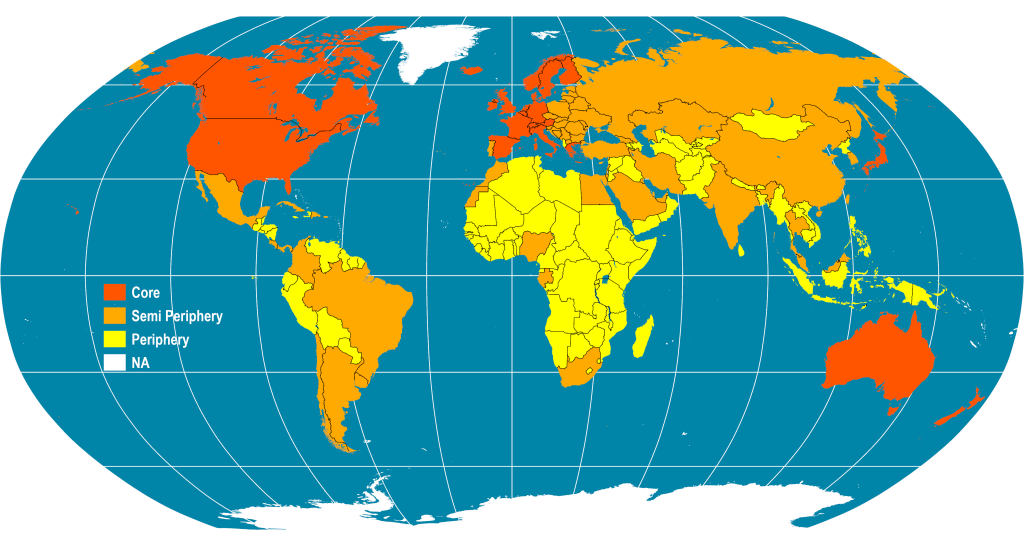
WHAT IS THE CORE
WHO ARE THE CORE CONTENDERS
WHAT IS THE SEMI-PERIPHERY
WHAT IS THE PERIPHERY
WHAT IS A FAILING STATE
WHAT IS A FAILED STATE
WHAT IS THE WILDERNESS
WHAT IS THE ABYSS
P A R T 2
WHAT ARE THE EMERGENT ISSUES
POLITICAL ISSUES
ECONOMIC ISSUES
SOCIAL ISSUES
ACTORS
USA
RF
PRC
OUTLIERS
IS THERE A HISTORY OF CONFLICT
WHAT ARE THE CONFLICT AFFECTED AREAS PROXIMATE CAUSES
TRIGGERS
DYNAMICS
TRENDS
FACTORS PROLONGING CONFLICT
FACTORS FOR POSSIBLE PEACE
CONCLUSIONS
ANNNEX
2
Profile
The wide array of structural problems within the intrinsically interconnected fields of development, humanitarian relief, human rights advocacy, peace building and coexistence work are rooted in that they attempt to treat a disease [conflict, war and endemic global poverty] by diagnosing wrongly and then prescribing inadequately remedies for singular systems of the global body; namely the states. They proscribe their treatments as if the national unit was an isolated system that needed critical care in imagined isolation. As sub-system after sub-system are sucked into a violent pathology it is still wrongly presumed in the West that this collectively atrocious mass behavior is in our very nature (Konner, 2000); that it is the normative clash of civilizations and states (Huntington, 1993); or that policy premeditation of this planned atrocity on behalf of poly oligarchic elites is not a feasible hypothesis (Fitzduff, 2014). This analysis attempts to provide the reader with a more holistic diagnosis of the world conflict. For if any nation and its people are to ever be healthy and secure we must frame our interventions on relevant causality; not provide treatment based on partial data and imagined regional motive. Nor on faith in national particularity or the misunderstanding that the parts of a whole are supposedly independent of each other.
Game Theory
It is my hypothesis not that some oligarchic collective controls all world events, instead that three competing poligarchic blocks (Oligarical Collectives) unleash war and trade policy into a world system that synergistically amplifies their carnage throughout the state system. This theory of [ inverse consiationalist republicanism ] runs as follows; within each nation state a
3
hierarchy of local oligarchs called dismissively as elites forms a network around shared culture, educational experience, business ventures, military and or family ties. The more developed a nation is has less do with the actual wealth of this national oligarch collective than how much it can leverage the state architecture to enrich itself and how efficiently it can shield its wealth from taxes and scrutiny (Winters, 2011). As well as how it can accumulate that wealth in assets and amassed capital. On the state level these oligarchs are all in conflict with each other to control means of capital accumulation and they vie for control as well over politicians, opinion makers and religious leaders. According to inverse consiationalist theory; eventually the arch oligarchs arrive at a collective bargain where by sectors of the population and special interests within a nation are pitted against each other to keep the social sphere of a society unstable, unable to effectively coalesce into a resistance movement.
Taken to the world system level we arrive at three particular groupings with particular interests at stake. The Euro-American Oligarchy, the Post-Soviet Petro-KGB Oligarchy and the Princelings Oligarchy; all of which function under the basic rules of this nine principle theory1.
1. Elite groupings in each nation form combines to enhance wealth and pit population ethnicities and value groups against each other.
2. Elite groupings diversify their portfolios by washing their money in foreign banks and investing in venture capital, infrastructure, real estate and extra-legal enterprises.
3. Elite groupings utilize their wealth to control overt political authorities.
4. Elite groupings from Oligarical Collective frameworks to direct state policy to their advantage and default high degrees of control over states and power blocks.
5. These three paramount Oligarchic Collectives are in direct competition with each other but there are relative bounds to the degree that they will destabilize each other’s domains, rules to the game as it were.
6. All major conflict hostilities will be limited for the most part to a resource control axis that falls within the under-developed and developing world and fought through proxy whenever possible. Incursions and terror attacks outside of that zone are to be avoided.
7. All Oligarical Collectives are rational actors with power and profit as their uncomplicated bottom-line. Ideologically, ethnically and ethically dissimilar they do not all share normative values about property rights, collateral damage and social policy. They are all however alarmed by Jihadist tendencies of Political Islam2 which is an adversarial ideology not compatible with any of the three block interests that threatens all three blocks asset controls.
8. All of the blocks encourage and amplify conflict violence on a variety of levels. Violence as psycho-social methodology directed outward at rivals interests and inward towards each other’s populations is implicitly linked to the conduct of each block.
9. Crucial to the maintenance of power inside each core and core contender’s powerbase is the paramouncy out the Westphalian state system. More important than any other identity variable the belief in the sovereignty of nations and nationalism fuels all other subordinations.
1 The Euro-America Oligarchy being oldest is more traditional. It’s organized in social clubs and exercises the most control via campaign finance, control of banking and media sectors and longevity of control. The predominant coordination points for this Oligarchy are Bohemian Grove, Bilderberg Group and Davos. The Princeling Oligarchy is a direct familial link between blood descendants of the Eight Immortals called princelings; an estimated 147 people in charge of the most important aspects of the Chinese political and economic architecture. The Russian Petro-KGB Oligarchy is the newest grouping based upon various KGB
2 Which can be loosely sub-divided into Sunni Wahabi-Salafism (Spread by Saudi Arabia and Pakistan) and Revolutionary Shi’ism (Spread by the Iranian Revolutionary Guard Corps).
4
BRIEFING PART ONE
Power Bloc Profile
There are three major power blocs that while they differ in their development theories, national cultures, state ideology and psycho-social interpretations of international relations as well as each other; they are all firmly vying for core dominance of the global economic system. They are via their foreign policies, trade relationships, consumer cultures, militaries and intelligence services responsible for virtually all ongoing 35 medium-large scale armed conflicts3. They fuel the vast planetary degradation via their rapid and massive scale industrialization drives. They have in differing capacities triggered the underdevelopment of half of the human species; 3,500,000,000 people living today at and below $3.00 a day. At least 1.2 billion on less than $1.25 a day (World Bank, 2014) (UNDP, 2014).
The political leaderships of these blocs are pragmatic and non-ideological, even if their political classes are varying degrees to the left or right of center in embrace of liberal democracy, democratic oligarchy and state capitalism with a socialist face. They cannot be purely referred to by the respective nation state that officially marshals them: The United States of America (the declining Core hegemon) is financially coupled with the European Union, Switzerland, the Holy Sea, New Zealand, South Korea4, Australia and Japan. The Russian Federation (the defeated core Contender) relies on a co-dependent fusion of resource clientalism and extra-legal mafia cronyism rooted in the now defunct KGB to exert varying degrees of control over former Soviet nations and former satellite states. The People’s Republic of China (the emergent Core hegemon) has massively invested in African nations, trade relationships in the Pacific and $ 11 trillion of US bonds and debt. Simplifying as such would be a gross minimization of the US’s integral allies, especially in the European Union & Switzerland. Or the more nuanced post-Cold War cooperation between RF its Post-soviet former satellites where 20 million ethnic Russians reside (cite); and its Middle Eastern allies like Egypt (prior to 1971), Syria, Iran, and before the US invasion and its complete disintegration; Iraq. Or even more significantly the PRC’s investment in nearly every country in Africa regardless of political tendency or crime against humanity5. These blocs cannot also be purely gauged by their military alliances, trade pacts, or proclaimed ideologies as repeatedly stated. For while the US-EU-NATO alliance is normatively neoliberal, democratic and pro-market its participating governments have funded overtly and covertly all manner of dictatorship, non-aligned oligarchy such as arming Saddam Hussein against the Islamic Revolution in Iran (1980-1988); as well as helping to establish the training bases, weapons supply and advanced training of proto-Al Qaeda Mujahidin formations attacking the Soviet occupation of Afghanistan (1979-1989).
The Russian Federation is a vast oligarchic transnational mafia state. Over the course of the Cold Wars Russian provided a wide array of military and technical aid to numerous
3 See annex for listing of the 35 Conflicts, casualty counts & durations.
4 The USA has been invited to occupy Japan since 1945 serving as its default army and the Korean peninsula since 1950 buffering the South from the massive North Korea army.
5 Chinese oil purchases and arms shipments to Sudan are directly responsible for the Darfur & Khortofan genocides.
5
developing countries fostering incredible regional loyalty particularly in Cuba, Angola, Ethiopia, Tanzania, Mozambique, Syria, Iraq and Iran.
The People’s Republic of China is state capitalist authoritarian regime lead by the Communist Party. It’s interventions in North Korea and Vietnam played pivotal roles in both nation’s independence. It has intermittently provided military and intelligence aid to a wide range of Asian and African groups. Each block rarely has aligned foreign policy except perhaps in regards to Islamic terrorism and the environment. Each core tender also faces long running internal ethnic antagonisms with minority groups at their country core; African Americans & Caucasians in the USA, North African & Turkish immigrants in the EU, Tibetans and Uyghurs in China and a wide range of Turkic and Central Asia minorities in Russia [notably Chechnya].
Each block is governed quite differently with varying adherence to rule of constitutional law. Kleptocratically in Russia, Nepotistcally in China and via Legislative Capture6in the USA. Through a variety of arrangements rule by a diffuse elite of oligarchic collectives networked around shared financial interests as stated, but each extracts wealth and exerts influence quite differently (Princeton, 2013)(Winters, 2011). As well as direct accesses chains to the the national policy makers. In the USA and EU they utilize campaign finance structures quite overtly and constitutionally allowing state sanctioned bribery. In the RF a more direct cronyism based on shared Soviet networks is in place. In China elite privilege is enabled by direct family relations. The elites are all beneficiaries of the existing financial order regardless for the most part of which of any of the three existing blocs hold the core. A critical core shift from USA to China will not radically effect the holdings of the most prominent oligarchs.
It was estimated that 85 members of this elite are worth cumulatively what that bottom 3.5 billion poorest of humanity are worth combined (Oxfam, 2014) and this bears some repeating because state relations between the USA, the RF the PRC and their allies, proxies and clients are not beholden purely to political interests; but by it is this Oligarchical Collectivism that governs the world system and drives its subsequent carnage (Piketty, 2014). While it is highly tempting to believe these oligarchies cannot properly coordinate nor can the governments they set up in power; it is crucial to understand that what a government perceives it is doing in its own national interest is often a directive, a pre-written policy package drawn up by the national oligarch collective. Or individual oligarch with the means to do so.
The fundamental question is what are the likely chain of conflict, development and economic events that will result in the next ten years due to the core shift from USA to PRC. It is those predictions that is subject of this analysis. And while the US-EU media and political apparatus has been quick to declare the irrelevance of Russian Federation; this defeated core contender is an integral player in upcoming core transition and conflict.
Political, Economic and Socio-Cultural Context
The World System Analysis, as developed by Immanuel Wallerstien posits that the world’s nation state system as an arbitrary socio-political patchwork of cultivated identities that divide humanity presently into 206 manageable, unmanageable and mismanaged units for the purpose of aligning their economies to the benefit of the Core Hegemonic power block. Before
6 Legislative capture is a system of elite control via campaign financing.
6
1500 CE it was impossible for any singular national unit to completely dominate. The globalization of trade and warfare via industrialization, slavery, colonization and the World War had by 1945 erected an architecture of trade regulations, protectionism, direct foreign investment, banking, lending, development and ensuing dependency that all but two Superpowers; the USA and the USSR were aligned in varying semi peripheral and peripheral dependencies back to either power. With the exception of the People’s Republic of China which after its 1949 Revolution, Cultural Revolution and 1978 economic realignment has emerged as the logical core contender after a period of unipolar USA hyperpower hegemony which lasted from 1991-2001. A mere ten years.
The 1945-1989 Cold War was a global engagement between the intelligence, development and military forces of these two blocks which the PRC for strategic and practical reasons did not align directly or over commit to the subsequent proxy wars. After directly engaging the USA on the battlefield in the 1950-1953 Korean War proxy struggle the PRC has quietly built its formidable base via the non-aligned movement, all of whose members over the course of the Cold War aligned, realigned or disintegrated. The key conflicts in checking the United States were Vietnam (1950-1975), Afghanistan (2001-ongoing) and Iraq (2003-2012). The key conflicts for checking the RF (then USSR) were Afghanistan (1980-1989) and Chechnya (1994-2010). The PRC has not had to pay for a costly confrontation since the Korean War in which it instead had to long term subsidize a costly and inefficient failed state.
Let us for analysis remove the national borders of the Peter’s world map the one where all things are represented at their actual presumed size. Let us examine it inverted. Let us look at it East on top West, then South on top of North. Note the arbitrary placement of not only national borders but also spatial embarkations and hemispheric directions. As if the sun still was through to revolve around the earth or that the earth was clearly fat. Let us again for analysis abolish those markings too. Let us turn it from a two dimensional boundary maven into a three dimensional sphere, then pull up like a hand on a cloth the developed northern nations as if into a the shape of a mountain, a mountain where the OECD countries are the core on top and down the mountain are arrayed the middle income than low income town the bottom of this precipice.
On this mountain and its foothills live roughly 7 billion humans broken into 206 national plantations. Identity driven work camps each with their own flag and imagined identities. Half (3.5 billion) are living below 2.50 a day in a range of miserable impoverishment. While extreme poverty according to Millennium Development goals has been halved via China and India; extreme poverty is actually expanding in Sub-Saharan African and Central Asia. A full 5 billion humans live at around and below 10 dollars a day bound for most of their lives to their wage slavery in a range of industrial or agricultural tasks (World Bank Data). The rate of environmental exploitation and pollution have gotten so egregious that disastrous climate change has begun resulting in more catastrophic climate disasters than any time in recorded history( ). Over the course of the Cold War there were no less than 17 documented genocides and 23 major proxy war engagements (cite) as well as 37 democidal purges7. In 35 of 206 plantations violent conflicts have broken out and are spreading, but only at the base of the mountain. They
7 Please see attached annex of Proxy War listings and Democide Listing. A democide is defined as a state unleashing it’s military against its own people in ethno-political purge of civilians. While the Jewish Holocaust in Europe is the oft cited example there have 17 subsequent genocides (such as Former Yugoslav Rwanda & East Timor) and 37 total including Democides (Duvalierist Haiti & Argentine Dirty Wars)
7
increasingly are to be fought intra-state with ethnic cleansing, criminal profiteering, and the targeting their own repressive and failing state systems (Kaldor, 2013).
In the year 1492 CE the Catholic monarchs Isabella and Ferdinand of what would become the nation of Spain instituted a massive purge coupled with torture, expulsion, and general atrocity directed against the Muslim and Jewish populations of that emerging nation. Simultaneously they sponsored the imperial expedition of Christopher Columbus which would alongside the Portuguese conquests of Brazil and West Africa would trigger an unprecedented bloodletting over the next 500 years of slavery, colonization, decolonization, World War, Cold War and Global Jihad. All of these manifestations based on manufactured identities (Anderson, 1983) as well as local greed and grievance variables ( ). Most importantly these endless conflicts were harnessed for the control of the means of local production and the profiteering off of trade routes. All of which raised the capital necessary for the formation of the nation state system.
By 1500 CE the social, economic and environmental underpinnings of human civilization were consolidating around the dominance of a world system (Wallerstien, 1974). The globalization of markets with an ever more authoritarian institution of sovereign states were the logical evolution of capital accumulation (Marx, 1887). Humanity would be subjugated, brutalized and reduced via these emerging nation states into more manageable social units for economic exploitation and administrative consistency. Although ideology, normative rights, cultures and religious mobilizations would vary tremendously by the year 2014 the World System had in affect crystalized around three primary trade & power blocks or hegemons; USA EU, Russian Federation, and the People’s Republic of China. The Global Core, under a steady evolution of socio-political justifications has passed from Netherlands, to England, then finally to the United States of America. After the defeat of the German contestation for core power in 1945 a series of unending proxy conflicts began under the mantle of decolonization, but were more particularly a battle over markets, extractive resources, commodities and trade relations between the USSR lead by Russia and NATO allies lead by USA. The Chinese experiments with Maoist communism via their 1966-1976 Cultural Revolution resulted in the deaths, starvation and purge of and x and removed them from hegemonic position until in 1978 when Deng Xiaoping and the Party embraced state capitalism (Gao, 2008). After the economic defeat of the USSR in 1989 American neo-conservatives posited a strategy for a New American Century (CITE ) which involved amongst other things redrawing the map of the Middle East and by default controlling the life blood of the globalized transport system; oil & natural gas. By 2001 directly advising the Bush Presidency in USA they began implementing this reconsolidation package. As the Russian Federation accelerated theirs under President Putin (Politkovskaya, 2005). However, by 2001 the US-EU had reached Peak Hegemony.
All nations have their national mythologies and state ideological narratives in varying doses and degrees. The world system is based on which ever power or power block can marshal the supply lines and coerce with aid and trade all other powers into economic dependency. According to Immanuel Wallerstien; the architect of world system analysis there are core nations that via conflict, development and hegemony impose an economic order which sub serves semi peripheral and peripheral national oligarchies to organize their economies around core needs and enrichments. Semi peripheral nations such Cuba, Israel, South Africa, Brazil, and Iran have achieved moderate independence through some strategic action or relationship but remain irrelevant to shaping the world systems supply lines, trade relations and core economic demand.
8
Peripheral nations such as Sudan, Egypt, Ecuador, and Bangladesh are organized to supply labor and commodities for the economic wellbeing of the core.
What is the Nation State
The Nation state is the macro unit of global economic harvest (Proudhon, 1876). The natural resources, the commodities, the manufactured goods and most importantly the human capital; their labor and their tax base are bound via this system into manageable units for exploitation. (Gellner, 2008). Under the guise of order the state system crystalized dynamic ethnic relationships and power differentials into control zones. As of 1 January, 2015 there are 206 such units, loosely organized into three major power blocs; divided into five world system dependency zones claiming sovereignty over shifting swaths of geographic turf. The cultivation of false consciousness (Engles, 1893) subsequently divides humanity further into dominant and subservient genders, ethnic groups, religions, nationalisms, political tendencies and sexual orientations; all with imagined identities that are wholly constructed via socialization and neuroscience for the purpose of disunity.
While almost all nation states have relative sovereignty; constant and repeated foreign and domestic assaults on this sovereignty lock each unit into a dynamic hierarchy of the world system. The metaphor of the world system; the mountain is subject to power shifts; thus via culture, warfare and economics the dominance of the core has shifted. Each nation state’s Oligarical collective controls its political leadership with few outliers regardless of proclaimed ideological tendency. Nation state level oligarchs enrich themselves by aligning the human and resource capital of their nation with economic prerogatives set by the core nations at both international forums such as Bretton Woods, Davos and the United Nations. As well as at closed meetings for oligarch coordination such as the Bilderberg Group and the Bohemian Grove. Ultimately whether the nation state takes the guise of authoritarian, theocratic, military junta, or trapping of socialism or democracy; via elite consensus, think tanks, policy groups, campaign contributions, as well as encouragement of soft or hard repression; the elite cluster in each of the 206 nation states formulates their capital accumulation in relation to taxes, labor management and trade relations with other states. The three power blocks; US-EU-NATO, PRC and Russian Federation have since 1945 engaged in ceaseless proxy conflict at the semi-periphery and periphery (Lebow, 1994). Endless coups, interventions, wars, genocides and clientalisms have ensued. Their antagonism has led to vast destabilization of the state system. Because the nation state unit harnesses the competing identities of its implied constituents; those within its border are locked in combative contradiction between the citizens and the immigrant others; as well as a hierarchy of access, alienation and proscribed benefit ascribed to the citizens based again on arbitrary privileges; male over female, dominant ethnic identity over proclaimed outsider ethnic groups, citizen over foreigner an so on. With very few outlying examples most of these alienations and privileges have mutated or been purged via conquest, revolution and ethnic cleansings and have largely solidified their false conscious paradigm since 1945. Because every aspect of the world system is inherently an architecture for reducing us down to a profitable economic unit and telling us that our hard ‘work will set us free’.
The nation state rests its legitimacy on being a protector and provider for its citizens. It’s justification for being no matter upon what superstructure of ideology or identity it rests upon is
9
to fulfill the obligations spelled out normatively in the nine human rights instruments. In reality it has to meet two more basic characteristics; secure collective needs, enable satisfaction of individual wants and provide security. If any of those elements begin to drastically disintegrate via warfare, invasion, occupation or pervasive corruption and impoverishment the nation state government loses legitimacy to rule.
The Nation state is predicated on the cultivated false conscious belief that the state of nature is inherent self-interest and that security for a minority from some necessitates endless war for the majority.
What is the World System
The World System Analysis as conceived by Immanuel Wallerstein consists of a core,
semi-periphery and periphery; shifting zones that are defined by their economic relationships to each other. As stated in his volumes of analysis Wallerstein outlines a multi-disciplinary modal that tracks the formation of the world system between 1500 and the present day (Wallerstien, 1974). While previous empires such as the Romans, Persians, Islamic Caliphates, Mughals, Aztecs and Chinese Han dynasties had been trans-regional powers capable of expansive influence and trade; none had, until the construction of the world system, been able to fully project hegemony upon the full mass of the species living in all continents. Advanced weapons, epidemiological resistance and industrialization allowed the Europeans a competitive advantage in outward conquest (Diamond, 2005). The epochs of conquest, slavery and colonialism allowed an unprecedented capital accumulation to take place in Europe. The Industrial Revolution had modernized these societies and subsequently organized their social hierarchy into that of global power administrators. This is not to say class and race and gender were not thoroughly established in internal hierarchies. The conquest of the rest of the world was an outward disposal of the mediocre into pursuits of war and profiteering. Inevitably according to this analysis the hegemonic power passed from Spain, to the Netherlands, to England and after a series of World Wars ultimately between Germany and the United States to a bipolar world of the US-NATO Block against the USSR. While the 1989-1991 implosion of the Soviet Union defeated authoritarian Communism. The Russian Federation, with the world’s second most powerful military, a comparable stockpile of nuclear weapons and the largest reserves of natural gas and oil on the planet is checked but not defeated. As stated the People’s Republic of China was only a minor antagonist within this struggle for core control, but is emerging as the most serious contender.
To understand the world system beyond the allegory of the mountain we must break apart the zones Wallerstien and dependency development theorists categorized to establish what is it is these ceaseless proxy wars, all this diplomacy, defense and development spending seeks to acquire. A false construct such as nationalism or ideology is a superstructure disguise for it means to acquire core control. As stated, the Oligarical collectives have a limited range of coordination and span of control. While an oligarch in the core may in fact collude with an oligarchy in the semi-periphery or periphery; the closer asset control and resources allocation is exerted to a core political and economic process; the richer and more powerful the fruits of the gain.
10
What is the Core
The guiding features of the core include a unified financial architecture and banking system, stable governance which can safe guard property rights and currency valuation and can upkeep the impressive military and intelligence forces needed to coerce compliance to its economic directives. Out of these 26 nations, 1 Religious City State and 1 newly re-absorbed financial hub (back into PRC two-systems one state in 1997); all participants align their economic and political directives with the OECD, North Atlantic Treaty Organization, International Monetary Fund and World Bank; The United States is the dominant hegemon in this block, supported by the financial prowess of the European Union lead by German and the economic strength of Japan. Interestingly these nations are all of the primary belligerents of the World Wars and hold all seats of the United Nations Security Council; excluding the Russian Federation and People’s Republic of China.
The following nations, under the stewardship of the United States of America compose the modern nucleolus of core control according to Babones and Alvarez-Rivadulla (2007). Logical incorporation of South Korea and Taiwan have been amended to listing.


Taiwan South Korea Vatican City
Who are the Core Contenders
People’s Republic of China (Emerging)
Russian Federation (Defeated)
8 Greece went bankrupt and was bailed out twice in 2010 and 2012. Greece is only a core country by virtue of its inclusion in the European Union.
9 Hong Kong was territorially reabsorbed in 1997 into the PRC, but will retain financial linkages and independence until 2047.
10 Israel due to its military and intelligence linkages to the United States since 1976 is more nuanced in that is an independent state possessing no hegemonic capacity, however under direct US Clientalism projects vast region power on behalf of an in tandem with the USA.
11
A Core contender is an economic and military block lead by a robust, well populated and resource endowed nation state with the military, diplomatic and economic capacity to challenge the hegemony of the current core block central power.
From 1945-1989 there was a bi-polar world dominated by the US and the USSR each with their own competing systems of dependency. After the 1950-1952 Korean War in which the PRC directly battled the US-NATO block a combination of the Cultural Revolution and Den Xiaoping’s embrace of state capitalism pulled the PRC largely out of Cold War confrontations.
The economists of all great power craft highly competing narratives of both history and financial prescription. Although evidence now clearly debunks the Washington Consensus which held sway from 1980 to 2001; encouraging deregulation, privatization, structural adjustment and integration into the globalized Western core market; it cannot be said that the effects of these policies did not enrich the core deliberately. The purpose of the proxy wars was of course a battle to control the resource flows.
As of 2014; the logical core contender is the People’s Republic of China. The financial mechanism it has deployed to support this claim is called the BRICS Bank; a counterbalance to the World Bank facilitating development lending from Brazil, Russian Federation, India, China and South Africa.
What is the Semi-Periphery
The elements of the semi-periphery include; on-going and expanding industrialization; modernization of political architecture in that whatever system is place efficiently provides critical aspects of governance; participation as intermediaries between periphery and core; manufacture and export of goods and are typically able to act as region hegemons over peripheral powers. Excellent examples of semi-peripheral states are Brazil, Colombia, Argentina, Mexico, Cuba, Vietnam, India, Poland, South Korea, Turkey, Saudi Arabia, Iran, and South Africa. Colombia is slowly emerging from a civil war raging since 1964 that have taken the lives of between 4,744,046–5,712,506 people (Silva, 2011). Mexico has been recently plagued with drug cartel killings that are directly related to its proximity to the Southern US border. However, trade relations with the US have made both integral parts of the semi-periphery albeit unstable ones.
All of these nations are middle-income developing nations that have vital intermediary roles in global trade or possess vital energy resources. China which prior to 1949 was a peripheral nation largely of peasants has advanced progressively since to assume a position of semi-peripheral transition to core contention. Russia which was a feudal semi-peripheral monarchy (Czardom) until its socialist revolution in 1917 has fallen something short of a super power contender but is still with is military and oil reserves a far more formidable power than any listed above. Interestingly as yet another death blow to the neo-liberal Washington consensus; of the nations listed above; only Argentina and Mexico followed much of the IMF/World Bank policies. The primary success stories are the four Asian Tigers; South Korea, Taiwan, Singapore and Hong Kong. China and India which cumulatively halved global extreme poverty by some 680 million persons and rapidly increased their economic growth did not follow nearly any of the consensus policy.
12
The key element of the semi-periphery is that enables the relationships of trade and mediates between core contenders as well as between periphery and core. While semi-peripheral counties (so-called middle income) may in face have largely impoverished populations, the semi periphery does not depend as completely upon the core as the periphery does and can make a range of independent policy decisions. Cuba is particularly good example through its interventions in Angola and Ethiopia as well as its current policies of medical diplomacy. So is Saudi Arabia in its international support of fundamentalist Wahabi-Salafist Islamic terror groups.
The Semi-periphery (like all of the five zones) compose a spread. There are nations such as India and Brazil that are quickly closing economic ground on core contenders Russia and China. There are relatively independent semi-peripheral powers such as Saudi Arabia and United Arab Emirates that utilize their extractive resource wealth to further ideological policies of their respective elites. There are other nominally nation’s such as Jamaica and Trinidad & Tobago that play little important role in international relations.
The semi-periphery is ultimately a structural buffer zone that unlike the illusion of the middle class described above, does not actually experience significant differentials in mass development. Most of the world’s 1.2 billion living below $1.25 a day live in middle income countries and within the semi-periphery. The local oligarchy of a given state if it can position the political elite of its nation to arrange the economic activity favorably can expect exponential capital increases but their nation achieving a semi-peripheral zone standing. Suffice to say in the 2014 list of Forbes billionaires Carlos Slim, a Mexican citizen is second from the top right below American Bill Gates. Here is listing of Semi-Peripheral states:
India
Brazil
Colombia
Argentina
Mexico
Cuba11
Iran12
Vietnam
Poland
Turkey
Pakistan
Saudi Arabia
What is the Periphery
What was once called the third & fourth world13, or currently the developing world is a legacy of the colonial system. It lacks infrastructure, it is poorly industrialized and its governance
11 Cuba is an anomaly in that it is one of only five surviving Communist states and the only one that still largely applies full Socialist policies. That has made it a semi-peripheral power is its unusual projection of development technology particularly in the Healthcare sector to be a ‘Medical Internationalist’ power abroad disproportionate to size or resources.
12 Iran is a second interesting anomaly as it is the only Shi’a Islamic State and been locked in proxy warfare with the United States since its Revolution in 1979.
13
systems are little better than a mix of dictatorship, military rule and out right corrupt practice. The peripheral nations should not be counted as such by GDP or HDI because they are peripheral in their importance to the world systems functioning. According to Collier there are fifty nine states (Sudan and South Sudan were not separated when he wrote his Bottom Billion report) in Sub-Saharan Africa, Central Asia and Haiti which show decline and dysfunction. Global economic convergence, the convergence of the developed and developing world has not proven itself as a valid reality.
The periphery has a disproportionately small share of global wealth and most of its capital and resources flow out of the country. Agriculture, cheap expendable labor and natural resource extraction make up most of its economic activity. Most of its population lives in extreme or relative poverty. Some peripheral states might be middle income, but do have and substantial role to play in the functioning of the world system. Peripheral state political systems are weak and they are often easily sucked into lengthy conflicts to control domestic uprisings or fight drawn out wars with their neighbors. A key element is their relative powerlessness to the rest of the state system. Most if not all of the periphery were former colonial holdings of the European powers. Their GDP and HDI often, although not always have improved the earlier they were liberated from the colonial system; Latin American countries are all much more developed than their African counterparts except for the Republic of Haiti which exhibits health and development indicators closer to Sub-Saharan Africa.
The following is a listing of Peripheral states:
13 Those without their own recognized states such as the Kurds, Basque, Yazids or Palestinians.
14
Africa:
Togo
Gambia
Burkina Faso
Namibia
Benin
Kenya
São Tomé/ Príncipe Uganda
Zambia
Asia& Pacific
Palau
Mongolia
Papua New Guinea
Fiji
Post-Soviet/ Former Socialist
Belarus
Macedonia
Bulgaria
Montenegro
Kazakhstan
Abkhazia
Georgia
Uzbekistan
Latvia
Transnistria
Hungary
Kyrgyzstan
Kosovo
Estonia
Turkmenistan
Croatia
Bosnia and
Ghana
The Gambia
Botswana
Senegal
Zimbabwe
Cameroon
Congo
Gabon
Guinea
Bhutan
Thailand
Indonesia
Laos
Herzegovina
Albania
Romania
Czech Republic Moldova
Lithuania
Nagorno-Karabakh Tajikistan
Serbia
Mozambique Ethiopia
Tanzania
Angola
Vanuatu Nepal
15
Middle East & Maghreb Jordan
Morocco
Kuwait
Algeria
UAR
Oman
Qatar
Tunisia
Northern Cyprus Cyprus
Latin America &
Caribbean
Grenada
Suriname
T&T
Bolivia
Belize
Dominica
Costa Rica
Paraguay
Ecuador Dominican Republic Panama
Saint Vincent
Saint Lucia
Saint Kitts and Nevis Venezuela
Barbados
Chile
Guyana
Antigua and Barbuda
What is a Failing State
In a failing state conflict is combined with under development to set in motion a series of degenerations. During this period, interventions of core and semi-peripheral powers will largely shape what social and economic orders emerges from the chaos. Periodically such as in the cases of Somalia and Yugoslavia the state collapses completely in recognizable form into total anarchy and long term dissolution.
Ukraine is currently a failing state. It is an ethnically divided energy pipeline hub for pumping Russian energy resources into Europe. Its (recently annexed Crimea) region is a major warm water strategic port for the Russian Navy; it has highly fertile soil, it is linguistically and ethnically similar to Eurasia not Europe; and it was until 1991 an integral part of the former Soviet Union. As part of the Second World (former Soviet Socialist States) Ukrainians have enjoyed economic, social and cultural rights markedly higher than the developing world even after collapse of the USSR in 1989-1991. However, following political re-ordering and oligarchic expropriation of energy assets and infrastructure across the former Soviet world; President Putin began a low intensity war to reclaim what in the Russian political consciousness
16
is within the obvious and legitimate sphere of interests of those who run the Russian Federation. Specially all of the former Soviet Union and former Russian client states such as Cuba and Syria. After the uprising in Maiden Square which looked likely to topple the pro-Russian president Russian military and intelligence operatives seized and annexed Crimea and triggered separatist warfare in the three eastern provinces. Organizing via its intelligence service the FSB (former KGB) the United Russia Party of Vladimir Putin is replicating the exact tactics it had previously used in Moldova, Chechnya, Armenia, Azerbaijan, Uzbekistan, Kazakhstan, Turkmenistan and Georgia to eliminate political order that sought to align those countries with NATO and the West. As there are 20 million ethnic Russians living in a wide range of former Soviet states such a rubric of ferment sedition, infiltrate intelligence operatives and fighters, provoke crisis, occupy and annex has spread to Ukraine made even more valuable because of numerous pipelines and the Crimea Naval base.
Because of these escalating actions heavy sanctions have been applied against Russia, but over 1/3 of Ukraine remains by default in Russian control. As in the cases of Moldova and Georgia, it is highly unlikely that any Ukrainian government will ever take back that territory. Russian Oligarchs and President Putin and his advisors have very little respect for the nation state system which due to Cold War strains, crippled Russia temporarily as a super power and core contender.
A failing state is state that due to corruption, bankruptcy and fiscal-social mismanagement an internal revolt or foreign intervention is predictably about to cause collapse state collapse and failure. A long running low intensity insurgency is not criteria for this classification. That insurgency, internal unrest or foreign invasion must produce a high likelihood of the citizens being left without a coherent political leadership and social services. In the cases of CAR civil unrest has developed into ethnic civil war ravaging large swaths of the population and leading to heavy violence against civilians. In Nigeria and Egypt mounting corrupt practices coupled with long running insurgencies place them here. In states like Malawi, Burundi, Chad, Niger, Mali and Lesotho government corruption on such an endemic level have deprived the populations of even the most basic services. A failed state is caught not in a “poverty trap” by Collier or Sachs description of such they are deliberately placed into a downward cycle of under development. Peripheral and failing states slip into failed state status based on the following twelve variables.
The Failed State Index (FDI) weighs in via twelve major indicators found within a territory indicating state failure:
1. Mounting Demographic Pressures 2. Massive Movement of Refugees or Internally Displaced Persons
3. Vengeance Seeking Group Grievance 4. Chronic and Sustained Human Flight 5. Uneven Economic Development
6. Poverty, Sharp or Severe Economic Decline
7. Legitimacy of the State
8. Progressive Deterioration of Public Services 9. Violation of Human Rights and Rule of Law 10. Expansive Security Apparatus
11. Rise of Factionalized Elites
12. Intervention of External Actors
17
Failing States include:
Myanmar
Mauritania
CAR
Egypt
Lesotho
Mali
Cote d’Ivoire
Ukraine
Chad
Guinea-Bissau
Sri Lanka
Niger
Yemen
Nigeria
Honduras
Malawi
Burundi
Lebanon
Bahrain
What is a Failed State
A state where its government has collapsed expect perhaps for diplomatic purposes in the capital and a few major cities; lost control of its territory; has ceased to provide social services and is at war with its own population can be described as failing state.. A secondary arrangement of this scenario zoning is when the state fully and indiscriminately unleashes its military against its population as occurred in Rwanda, Sudan and Syria. Where and when this occurs the population is at the full mercy of invading armies, militia groups and banditry. A sustained condition of state failure results in conditions best described in Thomas Hobbes book the Leviathan; a nasty, brutish and short life truncated by extreme violence and early death. The deployment of peacekeepers and NGOs can prolong the existence of a government presence; but the inevitable result of state failure is lasting underdevelopment coupled by internal human rights violation on a massive scale, war and atrocity (Rotberg, 2010). Failed State are also hot beds of opportunism for both oligarchs and criminal middle men to utilize the defunct governmental infrastructure to launder money and serve as transshipment hubs for bulk currency, narcotics, weapons, conflict minerals, expropriated oils and human cargo. Haiti is a primary port of illegal transshipment into the United States (Farmer, 1994). North Korea operates the largest and most sophisticated printing operation of duplicated $20 bills. Failed states are also breeding grounds for terrorist organizations and revolutionaries (Rotberg, 2002).
The following is a list of failed states:
18
North Korea14
Yugoslavia (collapsed in 1991)
Rwanda15
Sudan
South Sudan
Sierra Leone
Liberia
Haiti (collapsed 2004)
Palestine16
Libya
Syrian Arab Republic
What is the Wilderness
The Wilderness is a state of anarchic non-governance differentiated from failed state in that large swaths of its territory are no longer under the control of government or under rule of law. The people unfortunate to live in these regions are not only severely impoverished they are subject to arbitrary and criminal attack and rights violation by marauding bands, rival militias, warlords and various social predators. Currently large swaths of the following failed states meet this description; the Democratic Republic of Congo (former Zaire) since 1998, 1/3 of Syria since 2012, 1/3 of Iraq, Afghanistan and Somalia which has not had a central government since 1992.
Somalia (collapsed in 1992)
Afghanistan
Iraq
DRC17
The United States invaded Afghanistan in 2001 and Iraq in 1991 and 2003. Rwanda along with a variety of other African countries invaded Zaire (DRC) in 1998. Somalia collapsed after a CIA funded insurgency topped its government in 1991. Afghanistan was previously occupied by the Soviet Union from 1979-1989 where mujahedeen and political Islamists recruited trained and financed by the CIA, Pakistani ISI and Saudi Arabia (including Osama Bin Laden) were sent to give the USSR ‘its own Vietnam’. This pivotal military intelligence
14 North Korea in whatever ideological rendering it casts itself is little more than a criminal oligarchy exerting pure authoritarian control over its citizens imposing massive deprivation, famine and human rights violations while maintaining the fourth largest standing army, nuclear weapons and active participating in global counterfeiting and human trafficking.
15 Rwanda experienced a much analyzed genocide in 1998 where a Tutsi invasion triggered a Hutu launched genocide that cumulatively killed over 800,000 civilians over three months. What is less understood is that Rwanda’s newly victorious Tutsi minority then spear headed an invasion of neighboring Zaire which toppled the Mobutu government, provoked the African World War which sucked in over 17 countries and left an estimated 5.6 million dead; followed by Rwanda’s exploitation of the genocide, Western guilt and strategic placement to profit off of the conflict mineral trade flowing out war ravaged DRC.
16 Palestine has never been recognized officially as a State but both the Fatah government’s corruption and Hamas government’s refusal to recognize Israel have facilitated the continued occupation of Palestine. 17 It is estimated that 5.5 million citizens of the former nation Zaire have perished horrifically since 1998.
19
operation was critical to both the collapse of the Soviet Union and the spread of Wahabi-Salafist Islamic militant ideology which would later in 2011 culminate in Arab Spring (bringing down the governments of Egypt, Tunisia, Libya and Syria); ultimately resulting in the Islamic State (ISIS)’s control of vast swaths of Iraq and Syria. (Blum, 2003). Since most of these states collapse near the fault lines of hegemon power proxy struggle or near and around energy resource fields another term for the failed state wilderness is a killing field where those that don’t die of poverty will perish in war.
What is the Abyss
The Abyss is in essence what all development and progressive resistance to the callous greed of the oligarch collectives are attempting to avert; the total collapse of the world system with no alternative in place, disastrous climate change that results in famine and displacement and all-out war between Core powers like what occurred between 1914-1945. In essence the
Abyss can be likened to Peak Development; a point of core hyperdevelopment that overloads and overwhelms our social, economic and environmental thresholds to the point where irreversible trauma is inflicted upon the human & planetary condition (Adler, 2015). In Peak Development the governments of the core trigger any of three probably catastrophic events; all of which are likely if the World System continues on the current trajectory.
1. (Environmental) Disastrous, irreversible climate change proceeding until a 5 degree rise in global temperatures raising sea levels and triggering massive climate migrations, causing wide spread famine as a result of crop failure and exacerbate the periodically growing list of climate disasters.
2. (Economic) Peak Oil which we are expected to hit in 2020 levels off petroleum production paralyzing global trade and military function last, but first dramatically affecting the means in which we are supplied energy; which in turn leads to less power availability; which in turn limits internet connectivity. Peak Water which occurs in 2050 leads to new destructive conflicts over decreasing supplies. Wealth accumulation continues along the lines of Thomas Piketty’s analysis and the rise of an overtly elite class subsumes new levels of power and privilege. Critical divergence occurs with a micro-faction of the arch-oligarchic collectives gathering in secure citadels with a global degeneration of development reverting most of the human race to barbaric living conditions.
3. (Social) Multipolarity expands creating a more equalized power differential between the three primary core blocks. Proxy war heightens in the semi-periphery and periphery over resource scarcity. Inevitably all three of the core contender get sucked into a more direct confrontation which results in nuclear exchanges, genocides and democides.
The result of any of these catastrophic events being allowed to occur; permanent environmental damage, unmitigated oligarchic capital accumulation and or a more grisly and protracted series of World Wars will irrevocable trigger the degeneration of our species to sub-human conditions and inevitable extinction.
20
BREIFING PART 2
What are Emergent Political, Economic and Social Issues?
• POLITICAL ISSUES
Because of incredible, unprecedented access to media and data on a global level via mobile phones and the internet; a wide range of global communities can coordinate their economic and political participation circumventing traditional, government controlled forums.
Democracy has been broadly exposed to be as prone to oligarchic control as authoritarian one party state (Winters, 2011). Civilians no longer have to rely on one or two corporate news sources to distil the events of the day. Ideological bankruptcy has caused widespread contempt and condemnation of political tendencies that have hardly ever reflected domestic or international conduct. While it has been said democracies don’t go to war with each other (because largely of intertwined financial systems); nothing has stopped them from going to war with their own populations or fueling war through a proxy or series of proxies.
The current political context is that history doesn’t repeat itself at all. It structurally evolves the world system with each major disturbance. Since the critical year of 1789 following the revolution in France and its parallel manifestations in the USA (1776), Haiti (1791), Latin America (1810), Europe (1848); a violent and expansive ideological confrontation began between proponents of [normative human rights] liberal or leftist and [realist authoritarian state sovereignty] monarchist, theocratic, authoritarian or fascist. This political battle was merely a rhetorical explanation of economic systems that by 1968 had established themselves rather evenly over half the world’s nations; command economy socialism, free market capitalism and theocratic amalgams. The World War from 1914 to 1945 had solidified USA as the Core Hegemon of the free market system. But that core status was thoroughly contested until the end of the Cold War(s)18 which went on from 1945 to 1989 resulting in the defeat of the Revolutionary Socialist USSR; the primary ideological and structural core contender. It has also resulted in a supra-national confrontation between various proxy and emerging powers whose oligarchic elites and revolutionaries declared themselves any number of political shades in the process. Nationified best in the form of the People’s Republic of China which became a Socialist nation in 1949, attempted Communism in 1967 and in 1978 made the shift from failed Communism into State Capitalism. Subsequently pulled 680 million humans out of poverty (UNDP, 2014) as well as enhanced semi-peripheral power like India, South Africa and Brazil.
China is the clearest contender for control of the global core (French, 2014). While it has long been described as an unlikely probability of some meaningful alliance to emerge between Russian Federation and the PRC; BRICS is making that more and more likely. Should they succeed in coordinating a development bank they would not be a far cry from better coordinating a military pact.
18 Both Immanuel Wallerstein and other historians agree the Cold War was a series of ongoing concurrent wars not a singular static period.
21
• ECONOMIC
Trade has driven the World System since 1500 CE. Trade, Humanitarian Imperatives and Imperial Warfare have been used to justify subjugating vast segments of the human race to extract their labor for free [or inexpensively] as well as to bring to the Global Core goods unavailable to the upper middle classes and elites of those nations. After the World Wars19 the Bretton Woods Institutions notably the World Bank erected a vast financial architecture that would craft dependency in deep and intrinsic ways. Preferential access into semi-peripheral and peripheral nations for Core firms; heavy loans and debt; literal structural adjustment of economic systems and of course flows of raw materials and near slave labor of the export processing zones.
The current economic context is that as Core power dominance is slowly re-aligning axis from the USA to the People’s Republic of China. In all nations regardless of development, regardless of world system supply placement’ capitalism have triumphed as the dominant economic order. The BRIC economic alliance and development bank is as of 2014 the only counterbalance to the Bretton Woods institutions (World Bank/ IMF). This Multipolarity will simply be a far more sophisticated hegemony organized by China and implemented via regional hegemons Brazil, South Africa, India and the Russian Federation. This alliance represents nearly 3 billion people, a combined GDP of US 16.039 trillion, and 18% of the global economy (French, 2014).
In a very limited reconsolidation window there is a unique possibility of severing the control lines of dependency, re aligning local economies to allow greater indigenous planning and utilizing development as means to break dependency from Europe and the USA, without realigning with China and BRICS.
This idea of self-reliance cannot take the form of inefficient command economies but instead rely heavily on shared economy modals. The informal sectors that manage resource exchanges while circumventing taxes. The tax base of most countries excluding the advanced welfare states is a means of extracting wealth from citizens without compensating them adequately in social services or political representation. An economic re-alignment behind the BRICS Bank and China will not mean a more just and equitable world. China and Russia have never shown moral scruples about arming human rights violators. India manages a state where 74% of the population is living below $1 a day and 24.9% of Dalits and tribal minorities are exploited as fourth class citizens. Brazil and South Africa both struggle from deep ethnic divides, rampant corrupt practices and meaningless populist sloganeering. What is crucial in the economic context is to divest as much tax base from governments as possible and block trade policies which take resources out of peripheral nations fare below value. Or reduce peripheral and semi-peripheral populations to race to the bottom wage slaves turning out consumer goods for the North West and soon China.
• SOCIO-CULTRUAL
The socio-cultural context is that a considerable majority of the human race has not ever left its nation of birth, but a mass exodus has begun away from the violence prone periphery (Collier, 2013). Macro-level political and economic systems mean very little in the face of the
19 Wallerstein argues in his Analysis that it is inconsistent to separate World I and World War II into separate events because they involved the same core belligerents triggering the worldwide warfare for Core Control transfer from England to either Germany or the USA.
22
daily battle for survival that half of humanity is facing, yet the economic and the political drivers shape every single regional conflict now ongoing. It is the common person not the economist or ideologue that suffers under the mounting global attrition. The basis of false consciousness is that imagined identity and nationalism subsume human solidarity. Profoundly different from the issue of class consciousness is human solidarity founded on conscious thinking. Because of incredible deprivation and imposed scarcity; race, religion and gender become key instruments the local Oligarchic Collective uses to impose meaning on socio-cultural bonds. Male supremacy over women. Ethnic pride and power over ethnic other. The use of unseen, imaginary deities based on written testaments transcribed at times before objective data was possible encouraging the murder and subjugation of whole other groups of non-believers20.
Because most of humanity is physically fighting to survive, breaking down these imagined identities has been highly difficult and outside major cities it is uncommon to have poly-ethnic communities living in peace. However, rapid urbanization and climate migrations will increasingly thrust new groups into greater proximity. This will not necessarily result in the aggressive coexistences of places like New York or London, each secured by a small armies worth of police and precarious at best.
It is integral though to any successful element of resistance to the intended re-alignment to foster deeper bonds of human to human solidarity thus coupling efforts of development to those of resistance. As can been seen in Russia, China and India; an elite ethnic configuration has in each country clearly denoted the extent of privileges based on race and ethnicity. The Han in China, the Slavs in Russia and the Brahman Caste in India.
ACTORS
United States of America (U.S.A.)
Population: 319.2 million people
Primary Strategic Alliance: North Atlantic Treaty Organization (N.A.T.O.) Active US Direct interventions: Iraq, Libya, Yemen, Pakistan, Afghanistan and Syria. US Total Economic & Military Assistance: $50.6 Billion, FY 2013.
US Proxy Conflicts: Israel (directed against & Iran), Saudi Arabia (directed against Iran), Colombia (directed against Cuba & leftist insurgency ELN & FARC-EP), South Korea (directed against PRC); numerous via War on Terror.
US Sanctions/ Embargo: North Korea, Syria, Russian Federation, Iran & Cuba21.
20 Certainly tendencies within Christianity, Islam and Hinduism are by the far the most aggressive. 21 Lifted by President Obama on 16 December, 2014.
23
Primary US development & military aid recipients (FY 2012 highest to lowest): Afghanistan, Israel, Iraq, Egypt, Pakistan, Jordan, Ethiopia, Kenya, Colombia, Haiti, Palestine, South Sudan, Russia, Somalia, Tanzania, Congo (Kinshasa), Uganda, Nigeria, Sudan, South Africa, Mozambique, Ukraine, Yemen, Bangladesh and Liberia.
Strategic Allies: England & Israel.
Primary Clients: Israel, Egypt, South Korea, Taiwan, Colombia.
Russian Federation (RF)
Population: 144 million people
Primary Strategic Alliances: Commonwealth of Independent States (CIS), Collective Security Treaty Organization (CSTO).
Active Russian Direct Interventions: Ukraine & Georgia.
Russian Proxy Conflicts: Syria (against Israel& Saudi Arabia), Eastern Ukraine (against EU), South Ossetia (against Georgia)
Russian Sanctions/ Embargo: none.
Primary Russian development & military aid recipients: Cuba, Syria, Belarus, Turkmenistan, other former Soviet states.
Primary Strategic Allies: Kazakhstan, Kyrgyzstan, Tajikistan, Iran
Primary Clients: Armenia, Belarus, Transnistria, Turkmenistan, South Ossetia, Abkhazia, Uzbekistan, Serbia and Syria.
People’s Republic of China (PRC)
Population: 1.36 Billion
Primary Strategic Alliance: Shanghai Cooperation Organization (SCO)/ Shanghai Pact (SP) Total Economic & Military Assistance: $ 189.3 billion FY 2011, (RAND estimate) in 93 different countries.
Chinese Direct Interventions: [ None openly, regular clashes with neighbors over South China Sea]
24
Chinese Proxy Conflicts: none openly.
Current Chinese development & military aid recipients: Pakistan, Myanmar, North Korea & 93 countries predominantly in Latin America & Africa.
Primary Strategic Allies: Pakistan, Russia & India
Primary Clients: North Korea & Myanmar.
Outliers
Cuba: A former Russian client turned into a Medical Superpower now has over 38,000 MDs working in its International Medical Brigades with comparable numbers of teachers, nurses and construction workers on infrastructure projects. Cuba alongside Venezuela are attempting to build ALBA as a counter weight to the hegemony of the three blocks.
Iran: Is beholden to no great power’s full influence though it is a nominal ally of RF and PRC. It is the only Shi’a Majority Shari’ah State. It is exporting revolutionary violence systematically throughout the Shi’a world particularly Bahrain and Lebanon. It has a long view of history and remembers clearly the US-English Coup against Mosaddeq, US-Israeli support for the Shah and US support for Iraq during the grisly Iran-Iraq War. It trusts none of the three power blocs but is clearly willing to sell oil to Russia and China. Iran has the most potential to disrupt or collaborate with the upcoming core shift and is integral to the Middle East’s strategic dimensions; it contains Syria, props up the Lebanese, Syrian and Iraqi states; and is the only regional force besides Israel that can stand up to ISIS (Baer, 2008)(Nasr, 2007).
India: Alongside China as a possible future Core Contender, India is far more unstable. 74% of its population lives belie $1.25 a day. Over 16% of its population is classified as Dalit untouchable and marginalized & exploited. It has a growing Maoist insurgency to its Center East and an ongoing Islamist Insurgency to its North West fueled by Kashmiri occupation and its natural antagonist Pakistan. India will likely work closely with China, but it is the most serious of the economic and demographic contenders besides those listed.
CAUSES
• What are the structural causes of conflict?
The structural cause of the conflict as stated in oligarchic greed and their influence upon political leadership to expand foreign markets for goods/ resources; and dominate the weaker powers of the semi-periphery and periphery. Nominally each Core power seeks to protect and enrich the middle classes and upper classes of their respective nations. Nominally each seeks to exert maximal leverage over the rest of the global populace to adopt its stated ideology, state ideology. To that end these is only a finite amount of resources to fuel industrialization and expansion. Natural resource completion is only a factor, albeit an important one. Market expansion allows stronger powers to off load goods upon weaker ones. While the World Bank has held an almost undisputed monopoly on lending to peripheral and semi-peripheral nations BRICS Bank will make a far less invasive lending base available, certainly less interested in the trappings of human rights and democracy.
25
Therefore structural competition is also about banking. Who can lend the money the developing world needs to industrialize effectively.
A third structural source is arms sales. The resources such as fossil fuels, natural gas, extractive metals, coal and soon water might be a driver. As is the ability to loan the billions the developing world requires without debt to the North West. Arms sales however are drivers for those oligarchs with shares and control of the arms industries which sell to every developing nation to fuel the relentless conflicts throughout the world.
A fourth structural cause is inequality. As Thomas Piketty has illustrated in his work Capital in the 21st Century; the rich are getting much richer. Salary wealth is out pacing inheritance. Conspicuous consumption and corrupt practices have fueled demonstrations and uprising across the world. The internet now connects people like never for and the Arab Spring has emboldened students, unions and radicals all over the world to confront their state systems. It has not ended well so far. The government of Tunisia merely tinkered with the constitution. The US backed Egyptian dictator Mubarak was toppled, but shortly after a coup brought the military back to power in Egypt. The Libyan people with Western backing through airstrikes toppled and executed Kaddafi and plunged Libya into anarchy, nothing functioning well except besides the oil wells. Protests in the United States were suppressed. In Brazil and Bulgaria coopted. Yemen has become a low intensity civil war. Protests in Ukraine over the former President Yanukovych’s subservience to the Russian Federation have devolved into a Separatist war in the three eastern states and the Russian annexation of the Crimea. Non-violent protests in Syria have erupted into nearly 3 years of civil war with over 202,354-282,354 dead (December 2014 SOHR estimate) and the emergence in July of 2014 of the Islamic State which as conquered 1/3 of Syria, 1/3 of Iraq and has declared an Islamic Caliphate and is now just twenty miles from Baghdad, holding back largely because of the Shi’a Militias backed by Iran (Nasr, 2006). In newly independent South Sudan the US backed embattled Salva Kir government is fighting rival ethnic militias and waging low intensity war with the Bashir government of the north fully armed with Chinese bought weapons and advisors.
The fighting now present in all of these struggles is based on similar lists of grievances, but fueled by very different alignments of state interests. The PRC has refrained from being involved overtly in any of the above conflicts, the US and PRC have sold arms and clandestinely supported via their intelligence communities the client of choice in each conflict. Syria has been a Russian client since X; Russian arms shipments have firmly buttressed the Bashar Assad regime even after he used chemical weapons against his people.
Structurally we can dedact the world system in 2015 to the following six primary structural causes:
1. Legislative Capture & Oligarchic Control
2. Resource & Market Competition
3. Imposed Scarcity
4. Control of Economic Development Banks
5. Arms Proliferation
6. Rampant multilateral Human Rights violations
7. Rapidly growing inequality
• What issues can be considered as proximate causes of conflict?
26
While it is highly unlikely any of the nuclear armed super powers or core contenders will engage in direct warfare, each has Bar Lev line that will unnegotiable trigger another World War. Because no power is irrational, and each is very familiar with the losses that would result in such a confrontation; each will continue to fight each other via proxy and intelligence operations. These Bar Lev lines are inflexible, however proxy war in the resource axis will intensify. Here is a summary of the proximate cause of conflict for each bloc.
USA-EU: The Bar Lev line for the US is the most flexible. After the quagmires of Iraq and Afghanistan the American people are war adverse. Their adversity is flexible. Large scale terror attacks on US soil are certain to trigger counter strikes and imperial reprisal. The policy course of the period since 2001 is all most a play book reconstruction of war plans drafted by the Project for a New American Century. It called for aggressive American action abroad after a “Pearl Harbor type event” and for conquest of Iraq, Iran, Afghanistan, Syria and assertive action abroad to safe guard the Jewish Colony Israel. Israel has been completely reliant on US aid since 1976 and could not maintain its sophisticated army and nuclear arsenal without such aid. Israel has long provided the US with sophisticated weapons and communications systems, as well as valuable intelligence. The Bar Lev line for the US is existential threats to Israel, terror attacks on US soil above 100 casualties and any invasion of Europe. The US-EU is largely underinvested in Africa and is unconcerned what transpires there. It’s investment in South Sudan is a foil to China who’s ally Sudan supplies it with oil. It’s investment in Rwanda is in relation to Rwanda’s regional intelligence and its role as an export point for critical minerals coming out of the DRC conflict. The USA-EU has invested a good deal of money in Colombia not falling to its Marxist rebels the ELN & FARC-EP. It has largely succeeded in supporting the right wing Colombian government, making Colombia the primary US ally in all of Latin America. While the CIA did everything in its power to halt the rise of Latin American Socialism through coup, right wing paramilitaries, torture and assignation of leadership (Blum, CITE)(Silva, 2011). This hasn’t done much to actually stop the spread of left wing ideology. The US is a fading imperial core power and it is propping up a European elite that doesn’t have the population or the military strength to defend itself.
What Conflict Prone/ Affected Areas can be situated within the Context?
Following the World Wars even the staunchest hawks of NATO (US-EU) and the Warsaw Pact sought to avoid direct confrontation between superpowers understanding that nuclear weapons would result in a zero sum game of mutually assured destruction. Therefore warfare beyond espionage would focus on proxy conflict. The metathesis of the Cold War strategy into the modern framework of international relations still adheres to basic set of rules:
a) Avoidance of any direct military confrontation with another power block, particularly those with weapons of mass destruction.
b) Prevention of semi-peripheral powers from acquiring nuclear weapons or other technology to prevent interdiction in their affairs by core powers.
c) Propagation of continuous violence at the peripheral level via proxy.
27
The economic realignment of China in 1978 and Russia in 1989 have not affected this conflict variable. The misunderestimation of ethnic and identity and the sheer level of extreme poverty found in the peripheral nations have resulted in the so-called New Wars; the civil conflicts unleashed since the Cold War ended. But these so-called low-intensity conflicts that are spreading so explosively are still fueled by economic prerogatives of the contested core.
The North Atlantic Treaty Organization (NATO) remains the predominant global military alliance but recent discussions in Dushanbe in June of 2014 to merge the Collective Security Treaty Organization22 with the Shanghai Cooperation Organization/ Shanghai Pact23 an alliance which at its core will unite the military responses of Russian Federation, PRC and tentatively Iran and India.
History of Conflict
The following conflicts listed on International Alert & UCDP/PRIO Armed Conflict Database have been grouped around their continental geography, resource supply and patron axis. Some state that there are 35 ongoing conflicts. We have tabled up a minimum total of 64 major sub-state conflicts. Surely many are under-covered or overlapping. Each warrants a rigorous examination of drivers, spoilers, causes, grievances and psycho-social motivations, and
22 Russia, Armenia, Kazakhstan, Kyrgyzstan, Tajikistan, and Uzbekistan—signed the Collective Security Treaty. Three other post- Soviet states—Azerbaijan, Belarus, and Georgia—signed the next year and the treaty took effect in 1994. Five years later, six of the nine—all but Azerbaijan, Georgia, and Uzbekistan—agreed to renew the treaty for five more years, and in 2002 those six formally agreed to create the Collective Security Treaty Organization as a military alliance. Uzbekistan rejoined the CSTO in 2005 but withdrew in 2012.
28
such have been conducted at length. What this micro-briefing will seek to demonstrate is that each is a result of Core and Core contender planning. Examining each we note that while triggered by basic human rights violations each conflict expanded most dramatically when Core support or intervention occurred. This is not to suggest none of these conflicts could not have occurred in isolation based on grievances present; they could not have however resulted in such massive loss of life and functional infrastructure.
Where a causality chain is present the conflicts have been linked into a Conflict Axis.
North America & Europe
The War on Socialism [Red Terror & Cold Wars]: During the 20th century, peaking in the 1950s-1980s anti-Socialist hysteria reached a high pitch in the United States. Politicians, particularly Nixon and Reagan utilized the US Military and CIA in previously unprecedented destabilizations of foreign governments thought to be Socialist, or Socialist leaning. Why this is relevant in 2015 where all but 4 Communist governments remain in power (China, Vietnam, Laos & Cuba); is that to achieve that political result the US gave aid to some of the most unsavory, human rights violating regimes throughout the world appearing flatly hypercritical as a proponent of democracy. And fostering a multi-generational hatred for the USA that would result in the terrorist attacks of 11 September, 2001.
War on Terror [Wahabi-Salafist Islamic Jihad]: It is actually impossible to declare war on a tactic of war, but in 2001 this is exactly what then President George Bush, Jr. and his Neoconservative cadre of advisors did as they unleashed a global war against Wahabi-Salafist Jihadists. This War has expanded to the full invasion and occupations and state collapse of Afghanistan & Iraq resulted in x casualties and resulted in widespread domestic surveillance under PATRIOT ACT 1 & 2. Allegations of widespread use of torture and drone strikes against civilians have stoked anti-American sentiment across the world.
War on Drugs, Crime & Illegal Immigration [Minorities in the USA ]: The underlying grievance is that throughout the rise of the US Empire Native Indigenous American Indians, African Americans, People of Color and newly arrived Immigrants have all been shut out of patronage networks and lack basic social services granted to the Euro-American majority. Undocumented immigrants have been periodically exploited for cheap labor as well as rounded up and deported. Various pretexts of terrorism, criminal justice, policing, drugs and human trafficking have all been used to militarize the police force in America. While all of the roughly three dozen low-casualty domestic terror attacks were home grown operations; none appear to have been financed or directed by foreign operatives with the exception of the highly irregular 2013 Boston Bombing Recently. Against the back drop of mass incarceration, NSA mass surveillance and the alleged killing of a person of color by police violence every 72 hours; a new civil rights movement has catalyzed in the months after the shooting of Ferguson, Missouri resident Michael Brown (cite).
Minorities in European Union: In the capitals and cities of the Old Empire the populations are aging and birth rates are declining. Debt crises and the War on Terror have heightened tensions against Muslim minorities from Turkey and North Africa, as well as to the Roma Gypsy population. Terror attacks in London, Madrid and Paris have heightened xenophobia against
29
Muslim communities as have regular riots in the suburbs of Paris over police violence against North Africans.
Eastern Europe & Central Asia
Russia (North Caucasus Insurgency): Since 1994 Russia has been fighting a protracted to put down separatists movements in the Caucuses. There have been two atrocious wars in Chechnya and a range of rebel incursions and terror attacks post-2000 throughout the Russian Federation including the grisly school Siege at Beslan and the Nord Theatre (insert dates). The insurgency has been largely neutralized
Russia & Moldova (1992): Since its independence from the Soviet Union, the Russian military has held onto a defacto independent strip of Eastern Moldova called Transnistria running along the Eastern bank of the Dniester River.
Russia, Armenia & Azerbaijan (1993): The Nagorno-Karabakh Oblast: a defacto, mostly unrecognized independent state within a region which is majority Armenian & land locked inside Azerbaijan has been a long running low intensity war that the RF has generally backed Armenia militarily which is Orthodox Christian like itself although attempted mediation on behalf of both former Soviets.
Russia & Georgia (2008): Russia invaded Georgia in 2008 and occupied two States; South Ossetia and Abkhazia. Russia continues to occupy both states which are nominally ‘independent’ but now for all intents an purposes annexed to the Russian Federation.
Russia & Ukraine (2014): After pro-western demonstrations and a national uprising toppled the pro-Moscow regime Russian Special Forces and military have sense annexed Crimea; and set up separatist governments in Ukraine’s three Eastern provinces.
Asia & Pacific
PRC-Hong Kong: Hong Kong will remain fiscally tied to the North Western economic order until 2047. That has not stopped it from being the new epicenter of Pro-Democracy, Arab Spring-Occupy Wall Street tactics which have surged since September of 2014. The PRC must maintain a tight grip over this global economic mega-city in such a way that it can suppress the protests without hurting economic activity or creating Martyrs.
PRC-Tibet-Uighurs: The PRC has been waging a rather brutal campaign of repression to secure it two Western provinces. The Tibetan Buddhists have largely embraced exile, immolation, social media, passive resistance and leader worship of the Dali Lama. The Muslim Uighurs have declared a Separatist Jihad and been actively exchanging violence with the Chinese State. Both provinces which make up more than 2/5 of PRC territory also contain energy reserves the Core Contender will need to sustain growth. The Tibetans and the Uyghurs are two of several hundred ethnic minorities in the PRC; they are the two most likely to cause protracted difficulty in differing tactical capacities for the Han dominated Chinese state.
30
PRC & Taiwan: US Client and home to the Chinese Nationalist Kuomintang; the defeated politico-military party which retreated to the island in 1949. Over 2 Million defeated soldiers, sailors, intellectuals and business elites fled there from the mainland advance of Mao Zedong’s Communist Revolutionary Armed forces. They took with them most of China’s gold and foreign currency reserves (Dunbabin, 2008).
PRC & Vietnam, Cambodia & Laos: PRC helped facilitate the 1975 American defeat in Vietnam but now regularly clashes with communist leaderships in Vietnam and Laos which are wary of the explosive growth of their longtime patron. Vietnam invaded and occupied Cambodia from 1978-1989 removing the ultra-violent, democidal regime of Khmer Rouge; a then Chinese proxy which killed over a million of its own citizens. China and Vietnam fought a War in 1979; the third Indochina War. Currently all three of these nations fall into the Chinese sphere.
PRC& Nepal: China has quietly aided the Maoist guerrillas which after a lengthy war are taking part in the newly allowed elections and hold 239 of 575 seats in the Nepalese Constituent Assembly (largest party). This has been the PRC’s intelligence and supply line to supply Indian Maoists with weapons and support via proxy.
PRC & Myanmar (Burma): Due to internal Buddhist pressures, ethnic strife, 2008 Cyclone Nargis which may have killed upwards of 200,000 Burmese; the highly isolationist Chinese backed military Junta collapsed and elections were held in 2010. The Union for Solidarity & Development (liked to the Military and China) ruled until 2014 when power supposedly changed top the National League for Democracy. Civil Wars have long raged in Burma; particularly the Kachin & Rohingya tribes against the various governments. As well as the Shan, Lahu and Karen ethnic groups. Two of the three biggest parties (in opposition) are funded by the military. Both China and India have been heavily invested in the Myanmar energy sector before the advent of ‘democracy’.
PRC & Bangladesh: The Bangladeshi oligarchy maintains a precarious balancing act between India, China and the US companies it manufactures and assembles textiles for. Bangladesh is highly strategic leverage point for China on India because when occupied it can easily sever India into two zones. Bangladesh also deploys more UN Peacekeepers than any other nation and while supposedly non-aligned is often ideologically in the Socialist camp.
North & South Korea: In 1950 the US pulled its war allies into a direct confrontation with the PRC in the Korea Peninsula; by 1953 USSR, China and the North Koreas had lost an estimated 367,283-750,282 soldiers; the US lead international coalition had lost 178,426 soldiers and over
2.5 million Korean civilians were slaughtered. North Korea under PRC protection built the 4th largest army on earth and 29,000 US troops are still stationed along the 38th Parallel line. The North is a nuclear armed failed state that cannot feed its own people without Chinese support. The South is vibrant developed nation that is an integral US ally.
India-Kashmir-Pakistan: India has occupied Muslim majority Kashmir since 1948 and despite innumerous rounds of overt & covert war with Pakistan; it remains a veritable breeding ground for Islamist insurgency directed against India from the North West.
31
India-Naxalites (Communist Party of India); in 2004 a coalition of Maoist and Communist groups emerged in Central India; they now effectively control most of Central & Eastern India’s red corridor, the poorest most densely populated area of the country. The insurgency is regarded by the Indian government as its greatest existential threat (after the Pakistani ISI & the Kashmir rebel groups); the Naxalites are operating in an estimated 77-83 districts across 10 Indian states with an estimated resistance army of 47,000 volunteer fighters and are supply networked to the Nepalese Maoists & Chinese intelligence services.
Afghanistan: Has largely been a full blown war zone under British imperial rule, Russian communist occupation, War Lord Feudalism, Taliban Sharia and now a bloody US military occupation. This ungovernable country appears to have its insurgency fed via Pakistan’s intelligence service the ISI.
Pakistan: There is something truly alarming about a nuclear armed, terrorist training ground, with a sophisticated intelligence service, with war time excesses against India and Bangladesh that amount to genocide; fully run by its military; a major recipient of US aid money; but strategically aligned to PRC overtly. China is Pakistan’s largest supplier of weapons and third largest trading partner. The ISI aids China in combatting its internal Tibetan, Taiwanese and Uyghur threats. There is a free trade agreement between the two countries.
Latin America & Caribbean
Latin America is a highly important theatre of this core shift because it is a comparatively stable group of nations with middle income growth, far fewer active insurgencies yet with growing Socialist power in almost all countries. The Mexican-Cartel Wars are getting increasingly bloody along the traffic routes into the USA. The Honduran-Cartel Wars are the bloodiest and Honduras may have the highest non-political conflict related homicide rate on earth. US-Venezuela antagonisms are growing and sanctions may be immanent. Venezuela is Cuba’s energy supplier and life line. The Colombian Civil War may be winding down with renewed peace mediation talks in Havana. Brazil has emerged as the regional power and will be the BRICS continental player. ALBA (Bolivarian Alliance for the People of Our America) launched in 2004; is the Venezuelan & Cuban led alliance between Antigua & Barbuda, Bolivia, Dominica, Ecuador, Nicaragua, Saint Vincent & the Grenadines and Saint Lucia with Suriname & Haiti pending entry and with Syria & Iran as observers. Honduras was dissuaded by the US from joining the emerging bloc bilateral trade deals are conducted in a cyber-currency known as the SUCRE. NAFTA, ALBA and BRICS will all be competing for Latin American hearts, minds, dollars and Oligarch support.
The government of Nicaragua has just authorized the Hong Kong Nicaragua Canal Development Investment Company (HKND Group) to build a “new Panama canal” that will be in direct completion with the US controlled Panama Canal in just five years (2020). The US can expect a great deal of competition in a region already very hostile to it.
Sub-Saharan Africa
Both RF and USA, because of cultural legacies of racism have limited military and strategic ties with African nations. Russian Federation is seen more favorably due to its Cold War support of anti-colonial Independence movements. PRC is the dominant power.
32
The PRC & Africa generally have seen unprecedented growth in development aid and trade. China is involved in the economic affairs of virtually every country on the continent. In Sudan the Chinese military support has led to the genocides in Darfur, Khordofan & South Sudan. Ethiopia has moved from a USSR client to after its war with Eritrea; a current US client. Somalia, a former USSR client has been without a government since 1992; Puntland & Somaliland are defacto independent states. Somali piracy is on the rise throughout the shipping lanes of the African horn. Central African Republic has devolved in Christian-Muslim ethnic warfare. Endemic corruption is exacerbating the Nigerian Boko Haram Islamist insurgency.
South Africa has been tapped by BRICS to be the focal point of development. USA Rwandan relations enable the protracted genocide that has killed up to 6 million people in the Democratic Republic of Congo; fuel by extractive metals being moved out of Rwanda on the black market (Nzongola-Ntalaja, 2002).
Middle East & North Africa
Israel & Palestine though getting a great deal of attention is minor conflict which exacerbates all regional tensions, but doesn’t cause them. The more serious antagonism is a Sunni-Shi’a one between Iran and Saudi Arabia. Jordan is a pliant US client and military staging area alongside Israel. It is 74% Palestinian and would collapse quickly without US and Israeli intelligence and aid. Libya has completely unraveled into low intensity civil war. Egypt, another unusual US client has broken the back of its secular revolution and Islamist electoral victories and returned to defacto military rule and full US dependency. The Muslim Brotherhood and local opposition has by no means been destroyed. In Lebanon Iranian proxy Hezbollah governs much of the country and has been instrumental in the invasion of Syria to shore up the Assad regime. Bahrain with its Shi’a majority is well within Iranian influence and its Sunni leadership will eventually crumble. Iraq for all intents and purposes is a proto-Kurdish para state, a Shi’a Arab adjunct to Iran and an ISIS control zone. Saudi Arabia the birth place of virulent Wahabi-Salafist, fundamentalist Islam is using its US backer to protect it from Iran while spreading that money across the region to Jihadists. United Arab Emirates, Qatar and Oman surely wish they could build higher walls and sit things out. Yemen is amid civil war, Syria as stated has gone from being a multi-ethnic, developed Russian client state to a civil war zone with over one hundred factions fighting. Iran continues to develop nuclear weapons as leverage but also a pragmatic safe guard from Israel and Saudi Arabia. Turkey continues to be a staging point for Syrian opposition to Assad and Kurdish revolutionary nationalism.
What Triggers Could Contribute to the Outbreak/ Further Escalation of Conflict?
Major Flashpoints:
Israel Palestine; is a demographic, nuclear armed time bomb. Arab Israeli Palestinians now make up over 20% of the total Israeli population and that number is growing. Regardless of outcomes of Statehood for the West Bank of the ongoing Hamas-IDF battles in Gaza; time is running out on the Jewish state by birthrates. Over the next fifty years the Jewish Colony will get uncomfortably authoritarian as they attempt to hold the apartheid. This will place a pressure upon the American Jewry to lean harder to protect Israel despite its mutation into a racial
33
apartheid regime oppressive and bankrupt; neither fully Jewish nor able to sustain the mythology of Post-Holocaust impunity (Chompsky, 1983)(Blumenthal, 2013).
Syria; Syria is Russia’s Cuba of the Middle East one of its longest regional allies. Syria supplies Russia with its only Mediterranean port and naval base. It is also a long running recipient of Russian aid and weapons. Although the Assad government has control over only 1/3 of Syria. There is no way the RF will let that regime fall. In the meantime Syria and Iraq will escalate as multi-state proxy battlefield and dozens of combatant groupings. RF will continue to arm Assad’s government; Iran will continue to support its ally Assad via Hezbollah and the IRGC; Qatar and Saudi Arabia will back various constellations of Sunni Militants; the US and Israel will back the Kurds and Turkey will back the Syrian Free Army. This will be a quagmire that continues for some time Lebanon in the 1980’s x ten.
Ukraine; the Russian Federation is interested in restoring as much of the USSR territory under its hegemony as it can. It sees piecemeal engagements as a means to retake territory; especially warm water port or resource rich territory. As with Syria, the Russian Federation will not lose warm water ports. It is far easier to rely on the 20 million Russians abroad for intelligence and operational support than to realistically think the world will accept these conquests. However, while RF may succeed in getting defacto control of Crimean and the three eastern provinces; a combination of sanctions and general antagonism will drive RF into closer collaboration with the PRC.
ISIS & Iraq; is now effectively three para states. Kurdish North autonomous and under siege from ISIS. The Shi’a majority region directly collaborating with Iran. And the Sunni Triangle now largely under the control of ISIS. Iraq and Syria will effectively cease to be states as warlords, Jihadists and proxy armies’ battle for control of the oil. If Baghdad falls the following scenarios are likely:
1. Give ISIS claim Statehood
2. Trigger previously unimagined sectarian warfare in the Islamic world.
3. Give ISIS theocratic legitimacy as a Caliphate.
4. Trigger a Sunni Jihadist convergence around its Wahabi-Salafist World view 5. Everything between Israel, Kurdistan and Iran will fall shortly after24.
Taiwan; any assault on Taiwan would likely trigger a direct US PRC confrontation. It is however an integral objective of the PRC to recapture the island and they believe they can do so in 48 hours. This assault would have to take place while the USA was occupied with a conflict which ties down its navy. Or would be negotiated beforehand.
North-South Korea; the regime in North Korea is a Chinese client. But it is reckless and heavily armed. It fails at even the most basic dietary needs of its population. It has recently acquired nuclear weapons and acted erratically amid its third dynasty change. M53ost problematic is that it is the precise fault line where the USA and PRC fought a war between 1950-1953. 48,000 troops so close to China is an ongoing irritation.
24 These are the general observations of political scientist Thomas Poole
34
Shi’a Revival: The central hypothesis of political theorist Vali Nasr is that the Iranian Revolutionary Guard Corps will build up Hezbollah type para state organizations in the Shi’a communities of Syria, Lebanon, Yemen, Azerbaijan, Pakistan, and Afghnistan and will successfully merge Bahrain and 1/3 of Iraq into a larger Shi’a Islamic State. Iran will develop a nuclear weapon deterrent to the core powers and trigger a larger, more organized Islamic revival to match the three Blocks already formed. It will defeat its regional nemesis Saudi Arabia and come to terms of detente with US backed Israel, largely because both will possess nuclear weapons and have equal antipathy for ISIS. Sunni Jihadist ideology will slowly lose ground as it has been a bankrupt tactical failure and a Shi’a Revival will occur in Islam (Nasr, 2006).
African Spring: as unlikely as it sounds there is a rumbling from the continent that the Chinese will trigger with their investments and speculations. African spring may be several decades away but when it comes it will serve to cut every outsider off from the resources in the continent. Likely trigger locations for African Spring are incredibly hard to predict since most of Africa is already caught in a combination of conflict and poverty traps not leaving much room for non violent opposition anti-oligarch movements to form. However, South Africa, Nigeria, Botswana, Zambia & Ethiopia would be good bets as they have larger more educated Middle classes.
What New Factors Contribute to Prolong the Conflict Dynamics?
The United Nations: While it may appear that the United Nations is an incredible outlet for ongoing negotiations towards human rights and global governance; it is in fact an enormous charade. While there are certain benefits to having several alternative channels open for alternative track negotiations; the UN, its development mechanisms as well as its Peacekeeping forces are a mockery of the values it claims to be upholding. All three Power Blocks hold veto votes as Permanent members of the Security Council; China, Russia, and the Great Powers of the World Wars USA, United Kingdom and France. 10 non-permanent members are hardly any kind of counterbalance. Peacekeeping missions in Haiti25 Kuwait, Namibia, Cambodia, Bosnia, Rwanda, Somalia, Sudan and the DRC can only be described in highly nonacademic terms as ‘a series of fubar shit shows.’
Elite Lobbies: A fundamental problem is access. The Oligarchs via their wealth have incredible access to politicians and policy manufacturing. As PRC rises it will avoid being sucked into major wars but remains by far the most stable Oligarical Collective with princeling blood networks founded on the mass understanding the eight immortals and their policies brought incredible progress to China. China is also a one party Communist state that values meritocracy and efficiency despite numerous allegations of inside dealing and corrupt practice. The Oligarchic Collective in the USA is less stable than China, but more than capable of buying off the politicians they need to keep things in their favor. The Russian Oligarchy is unstable but ruthless and access to United Russia Party is not as certain as the American oligarch’s ability to purchase Republicans and Democrats. Periodically the Russian inner Oligarical circle those most
25 Haiti is the only UN Peacekeeping Mission in place without any formal ceasefire in place. It is now widely understood that the Nepalese contingent of the MINUSTAH UN Peacekeeping operation introduced Cholera to the Republic of Haiti.
35
tied to the old guard KGB network will kill or imprison and Oligarch previously thought to be untouchable. The European oligarchy will be most vulnerable. China will encroach on numerous post-colonial African holdings, its influence will wade as its population ages, its socialist benefits are lost to increased austerity and USA becomes less willing to engage on its behalf. Expect Fortress Europe and bunker mentality that will involve drafting or recruiting foreign legions to do its dirty work.
The Russian Reclamation: The RF will continue to go after countries from the former USSR leaning towards the West to restore what it believes to be its sphere. It will not be able to re exert power over Poland, Lithuanian, Estonia, and Latvia but gradually via FSB intelligence, Special Forces operations, and interventions on behalf of its ethnic diaspora; or via proxy it will restore its USSR era hegemonic sphere for similar reasons that China will annex Taiwan. Access to warm water ports, historic fear of devastating Eastern (Mongol), Western (French & German) and Southern (Tartar) and demographic dispersion propel Russian foreign policy, not ideology.
The Chinese Expansion: The PRC will act recklessly. It understands America is in decline and understands Russia’s economic disarray and lack of cohesive political identity. Post 1978 the first phase was internal; uplifting 680 million of its own citizens and reestablishing it’s oligarchy of princelings. The second stage was investment in Africa where over 45% of its foreign aid goes. The third stage is BRICS; leveraging a major economic power on each continent (Brazil, Russia, India and South Africa) to break the monopoly of the World Bank/ IMF. The fourth stage will be to assert financial hegemony in Asia & the Pacific. The fifth stage will be to annex Taiwan and humiliate Japan concurrently or in stages. Make no mistake that the Chinese Political elites will wait until there is no way the US can intervene militarily or with sanctions, but the Chinese are running a dangerous long game that views Taiwan and Japan as enduring humiliations that will be dealt with in time. Unless the USA is awash in domestic crisis, civil war or simply exhausted as world power the PRC will not risk striking at two integral US allies in the Asia/ Pacific region.
The Second American Civil War: There will be another civil war in the United States prior to the physical expansion of the PRC into other Asian countries. It will result in the disintegration of the union into Northeastern, Western, Texan, Mormon, Southern and Middle American states
which will devolve the USA into something between Yugoslavia’s collapse and the USSR’s. The chain reaction of such a civil war will be rapid Chinese conquest and annexation of Hong Kong, Singapore Taiwan, South Korea and Japan. Whatever is left of the country after the Second American Civil war will be isolationist. Europe will be wide open to RF expansion. The Global Core will switch to Beijing.
Energy Demands: While all three core contenders have vast energy reserves, industrialization, urbanization and continued modernization and fueling sophisticated armies; USA, RF, and PRC control require a level of energy supply that can only maintained with outward expansion to secure energy fields. That has been a driver of conflict since the World Wars. As we know there is a finite amount of fossil fuels and all of the developing world relies heavily upon them for basic matters of maintain developed world standards of living such as 24 hour electricity, cars and nearly every aspect of the high tech society. While Peak Oil might be 2020 or 2050 or further; energy resources; oil and natural gas in particular will propel conflict. As violence in the
36
Middle East escalates the USA will rely more on fracking and shale; Russia (largest energy exporter and reserves on earth) will push further to exploit Siberian field and sell to rising core contender China; driving Europe to be more nuclear dependent. This spells a more isolationist USA and closer economic co-dependency between PRC and RF.
Water Demands & Climates Refugees: Peak Water is theory that by 2025 we will be unable to meet the clean water demands of the earth’s population due to structural supply configurations (Palaniappan, 2008). This will result in wars for water similar to the current wars for extractive energy. This will be less problematic for Russia; a major beneficiary of global warming trends alongside Canada; large swaths of barely habitable tundra will become farmland. This will be a huge issue for the developing world triggering climate migrations of unprecended scale particularly towards Australia and Europe. The net result of the Climate Refugee scenario will be boarder defenses in Europe similar to what exists between Israel and Palestine. By 2050 there will be literal citadel security states throughout what we call the Global North. PRC, USA and RF will absorb some of small percentage these refugees but not to any extent that will alter fundamentally core ethnic demographics.
Drones: Before long PRC and USA will have the capacity to operate mechanized drone infantries when projecting power abroad. Few powers will have this ability but it will be integral to Chinese policing of its African holdings. The PRC will avoid direct military confrontations by any means necessary except in any scenario of US-EU weakness to capture Taiwan. Drones remove a great deal of political pressure of war making. The Chinese ability to use them effectively will be an element of Chinese Neo-Colonialism. The USA will step up drones of all kinds because of how sensitive the US population is to protracted wars. If you are uncomfortable with the volume of drone strikes currently occurring; imagine tanks without drivers.
State Failure: State collapse will rapidly proceed in the Middle East followed by Africa. The New War phenomenon of protracted irregular, semi-or-overtly criminally connected ethnic purging will expand in vile new directions particularly in Sub-Saharan Africa. Entities such as ISIS will emerge and hold new amorphous territories.
What Factors can contribute to peace?
Aging & Mixing Population: The European World population is greying as are the ethnic majority populations of Russia and Japan. Developed world populations simply have less children. The short life span in Russian Federation for men is comparable to Sub-Saharan Africa. The Russian State is having to provide large financial incentives to induce couples to even have children. What will occur is that populations of Developed countries will become even less ethnically homogenous and the leading ethnic demographics will begin to die out or be sub subsumed via mixed-ethnicity couples. The USA will become increasingly Hispanic and lean left towards Latin America; the EU will become increasingly Muslim and lean towards the Middle East; this phenomenon will create coexistence linkages and diaspora connections that are vital to Cosmopolitanism. The RF will become slowly more Muslim, more Turkic and more Central Asian. Japan with a highly aging population and smallest demographic of integrated minorities will face the greatest challenge and eventually be conquered by the PRC during whatever period of hostilities allows for conquest and annexation of Taiwan. In short, the demographic of the
37
American and European Oligarchic; white and Christian is slowly receding. Regardless, the grandfathers of the existing world order must pass and the new generations must be further intermixed. This will effect Africa & PRC the least.
Peak Oil: When the Oil runs out, unless cold fusion or a green alternative emerges such as solar charging more advanced lithium batteries; freighter tanker traffic will slow to bare essentials and most modern armies will revert to warfare strategies closer to the World Wars. Fracking on a mass scale will occur first as well as more extensive use of nuclear power at the core. Because modern armies are so reliant on petroleum, the closer we get past Peak Oil without arriving at an alternative energy source will force a slow down on modern war machines. Although Kaldor makes a very strong case for the rising violent tide of civil wars and intra state killing; the sheer ability of the three blocks to project power and manage trade routes is for now completely tied to a finite supply of natural gas and oil.
Advanced Communications: For the first time in history we are getting real time data about conflicts and political events that would never have been on our radar two decades before. Of course in the developed world this is increasingly part of the state control and socialization system. But, as with the next item these advanced communications allow us to achieve unprecedented solidarity of action and freedom of information.
Shared Macro-Economies: In the same way that technology is letting civilians cut out middle persons and avoid taxes, there is no reason to assume this cannot be done with all kinds of financial matters; as transnational criminals have used BITCOIN and TOR to do for years. The internet is not only a communications, knowledge and data repository; it is of course a means to organize our lives without big banks or big states. Shared Economies, removed from all the escalating conflicts are shown well in organizations such as BRAC; the world’s largest so-called NGO. BRAC couples microfinance with social programs and extends a fascinating array of services to the poor in 14 nations. Coupling together Shared Economic principles with good non state intuitions allows the poorest of the poor the option to sit out some of the upcoming new and old wars.
Core Shift: Any time there has been a previous Core Shift there has generally been incredible interstate warfare between European powers. This will be the first time that the Core is shifting to a non-Caucasian country. The Chinese were once the Middle Kingdom and will be again, but they do not have an historical precedent of slavery or genocide as the Europeans do. This is not to say China will bring an era of tranquil global dominance; simply put it will bring an opening for change in the structures of the World System itself.
Multipolarity: At least until the Core decline of the USA an equilibrium will set in where all three Blocs are relatively equal and own enough of each other’s assets to make interstate war between them unlikely. For whatever period this lasts for; likely until 2100 or the slowdown
effects of Peak Oil; willingness to fight conventional Old Wars will continue to decrease. US-EU will decline and PRC- BRICS will rise.
Supply Side Resistance: SSR is about breaking dependencies from developing nations to semi peripheral and core nations, by shutting down labor and supply routes. Social movements in the
38
Resource Axis Zones; the Developing World so-called will have a limited window of 200 years during core shift to either align with PRC-BRICS, remain tied to decline Euro-American powers or fight for self-reliance. Grievances in the developing world are many. Arab Spring is occurring
and African Spring is inevitable. However, whether these continue via armed struggle or other means will decide to what degree the carnage occurs and to who these economies will depend on.
Peacefare: Is militant nonviolence. Quite literally making use of nonlethal weapons against oppressors. Against modern armies this will fail. Against police forces and irregular New War armies this tactic will bring regional oligarchies to their knees. Peacefare is an understanding that developing nations must bring down their own corrupt oligarchic collectives before they can affect those of the three power blocs (Ackerman & DuVall, 2001).
Core Blockade: The final stage of a Peacefare Campaign is to cut the core powers off from a cheap flow of labor, natural resources and commodities of any kind. Starving the core occurs when this is happening throughout the Resource Axis zone and Core nation minority and subversive groups use the reverse sanctions to trigger revolts there.
Parallel States: Throughout the world via solidarity networks, shared economies, deterioration of state social services and as survival mechanism; a variety of Zionist universalisms will come to take shape. Armed entities like ISIS and Hezbollah; non-violent development actors like BRAC and IRC; religious formations like Scientology, Mormons, Baha’i and the Holy Sea; break away states like Puntland; all will better establish Parallel State mechanisms as unrest spreads, new war intensifies and the existing 206 states cannot justify themselves indefinitely.
Conclusion
This is a desperate time and future does look quite bleak if human kind refuses to act in solidarity with its specifies instead of it’s state.
Described over seventy years ago by political scientist George Orwell as Oceania, Eurasia and East Asia (Orwell, 1984) there are three block locked in vicious conflict. The only difference to his futurist predictions is that the USSR never took control of main land Europe.
• What are current conflict trends?
China will rise and US-EU will decline as the Russian Federation profiteers. Few if any developing nations will meet their so-called 2015 Millennium development goals and the proxy wars as new wars will expand. The BRICS will rise the Bretton Woods Intuitions will decline. ISIS will expand, Kurdistan will emerge, Israel will decline and Arab Spring will be joined by African Spring. ALBA will consolidate in Latin America and US will dissolve into a civil war.
• What are windows of opportunity?
39
The future rests in the people’s ability to achieve solidarity and utilize new technologies to circumvent states. ALBA represents a fertile ground for a truly multi ethnic civilization to thrive in the dark days ahead, but surely any para state configuration will be aligned to one bloc or another. The best window of opportunity will be in the next 200 years. Either core shift will means opportunity to break dependency or it will usher in one of the most protracted periods of authoritarian rule in history presiding over the death of the planet and human life.
• What actors can be identified as spoilers? Why? Are they inadvertent or intentional spoilers?
The Oligarchs are the worst spoilers of all. They pay for the all the terrible things in this world and reduce us to nothing, powerless wretched nothing. Were it only so simple as to murder them as they in the millions murder us; then we do have a good list. Alas, violence has only bred greater violence and the Oligarchy is so diffuse you would not catch them all easily. Instead of violence we must harness development to be our liberation not our chains. We cannot obsess over the details of the micro-conflict when most conflict has but three primary sources.
Our human objective must be to coordinate a means to support para state development coupled with the objective of starving the core. No matter which power bloc takes control know they will exploit us in various guises. The only solution is to be able to be self-reliant for when the time comes to shut them off from energy, labor and resource flows up mountain. The World System is a killing machine that strips on of their humanity and reduces you to faceless number to work out your life as a slave.
Between an Eagle, a Dragon and a Bear lies our future.
Let us not be left with scraps.
REFERENCES & FURTHER READING:
Ackerman, P., & DuVall, J. (2001). A force more powerful: a century of non-violent conflict. Palgrave Macmillan. Alexander, M. (2012). The new Jim Crow: Mass incarceration in the age of colorblindness. The New Press. Amin, S. (2012). Neo-Colonialism in West Africa.
Anderson, B. (2006). Imagined Communities: Reflections on the origin and spread of nationalism. Verso Books. Baer, R. (2008). The Devil We Know: dealing with the new Iranian superpower. Random House LLC.
Biermann, F., & Boas, I. (2010). Preparing for a warmer world: Towards a global governance system to protect climate refugees. Global Environmental Politics, 10(1), 60-88.
Bills, S. (1986): The world deployed: US and Soviet military intervention and proxy wars in the Third World since 1945. From: Robert W. Clawson (Ed.): East West rivalry in the Third World. Wilmington 1986, p. 77-101.
40
Bloom, A. D. (Ed.). (1991). The Republic of Plato. Basic Books.
Blum, W. (2003). Killing hope: US military and CIA interventions since World War II. Zed Books. Blumenthal, M. (2013). Goliath: Life and Loathing in Greater Israel. Nation Books.
Brown, L. R. (2009). Plan, B. 4.0: Mobilizing to save civilization. Earth Policy Institute.
Cornell, S. & Jonsson, M. (2014). Conflict, Crime, and the State in Post-Communist Eurasia. University of Pennsylvania Press
Chomsky, N. (1983). Fateful Triangle: The United States, Israel and the Palestinians. India Research Press. Collier, P. (2013). Exodus: How migration is changing our world. Oxford University Press. Deffeyes, K. S. (2006). Beyond oil: The view from Hubbert’s peak. Macmillan.
Diamond, J. M., & Ordunio, D. (2005). Guns, germs, and steel. National Geographic.
Dunbabin, J. P. D. (2014). The Cold War: The great powers and their allies. Routledge. Engels, F. (1893). Letter to Mehring. Marxists internet archive, available online.
Escobar, A. (1995), Encountering Development: The Making and Unmaking of the Third World Princeton: Princeton University Press.
Fanon, F. (1965). The wretched of the earth (Vol. 390). Grove Press.
Farmer, P. (1994). The uses of Haiti (Vol. 3). Monroe, ME: Common Courage Press.
Foucault, M. (1977). Discipline and Punish: The Birth of the Prison (New York: Pantheon).
Freire, P. (1970). Pedagogy of the Oppressed, trans. Myra Bergman Ramos. New York: Continuum.
Gao, M. (2008). The battle for China’s past: Mao and the Cultural Revolution. The China Quarterly, 195, 691-718. Gellner, E. (2008). Nations and nationalism. Cornell University Press.
Herman, E. S., & Chomsky, N. (2008). Manufacturing consent: The political economy of the mass media. Random House.
Huxley, A. (2007). Brave new world. Ernst Klett Sprachen.
Kaldor, M. (2013). New and old wars: Organized violence in a global era. John Wiley & Sons.
Kupchan, C. A. (1998). After Pax Americana: benign power, regional integration, and the sources of a stable multipolarity. International Security, 23(2), 40-79.
Kolchin, P., & Kolchin, P. (2009). Unfree labor: American slavery and Russian serfdom. Harvard University Press. Levitt, S. (2012) Why Nations Fail? The Origins of Power, Prosperity and Poverty. Profile Books, UK. Lebow, R. N., & Stein, J. G. (1994). We all lost the Cold War (p. 92). Princeton: Princeton University Press.
41
Lustick, I. (1979). Stability in deeply divided societies: consociationalism versus control. World Politics, 31(03), 325-344.
Marx, C. (1887). Capital Volumes I & II.
Maslow, A. H. (1943). A theory of human motivation. Psychological review, 50(4), 370. Nasr, V. (2007). The Shia Revival. Military Review, 87(3), 9.
Nkrumah, K. (1965). Neo-colonialism: The last stage of imperialism (Vol. 140). London: Nelson. Nzongola-Ntalaja, G. (2002). The Congo: From Leopold to Kabila: A People’s History. Zed Books. Orwell, G. (1990). Nineteen Eighty-Four. 1949. The Complete Novels, 743-925.
Parry, M., Rosenzweig, C., & Livermore, M. (2005). Climate change, global food supply and risk of hunger. Philosophical Transactions of the Royal Society B: Biological Sciences, 360(1463), 2125-2138.
Piketty, T. (2014). Capital in the 21st Century.
Politkovskaya, A. (2005). Putin’s Russia: Life in a failing democracy. Macmillan.
Palaniappan, M., & Gleick, P. H. (2008). Peak water. Pacific Institute.
Proudhon, P. J., & Langlois, A. J. (1876). What is Property? An inquiry into the principle of right and of government (Vol. 1). BR Tucker.
Rotberg, R. I. (2002). Failed states in a world of terror. Foreign Affairs, 81, 127.
Rotberg, R. I. (Ed.). (2010). When States Fail: Causes and Consequences. Princeton University Press.
Rummel, R. J. (1998). Statistics of Democide: Genocide and mass murder since 1900 (Vol. 2). LIT Verlag Münster. Taylor C. Boas, Jordan Gans-Morse (June 2009). “Neoliberalism: From New Liberal Philosophy to Anti-Liberal Slogan”. Studies in Comparative International Development 44 (2): 137–161.
Silva, G. (2011). “The price of Colombia’s drug war”. Colombia Reports. Retrieved October 9, 2011.
Wallerstein, I. (1974). The rise and future demise of the world capitalist system: concepts for comparative analysis. Comparative studies in society and history, 16(04), 387-415.
Wallerstein, I. (2011). The modern world-system I: capitalist agriculture and the origins of the European world economy in the sixteenth century, with a new prologue (Vol. 1). University of California Press.
Winters, J. A. (2011). Oligarchy. Cambridge University Press.
42
ANNEX 1: Resource Axis Distribution
ANNEX 2: Proxy Wars since 1945
43
ANNEX 3: Chinese Aid
ANNEX 4: Economic Pacts
44
ANNEX 5: Conflict Map A
45
ANNEX 6: Conflict Map B
ANNEX 7: Listing of Genocides & Democides since 1945
ANNEX 8: Listing of Major Oligarchs & Highest Net Worth Individuals ANNEX 9: Listing of Major Oligarical Collectives by State
ANNEX 10: Banks holding Oligarch Funds
46
 WALTER SEBASTIAN ADLER
Leave a comment