Treatise on the Formation of a Middle Eastern Confederation

Treatise on the Formation of a Middle Eastern Confederation

بحث في إنشاء كونفدرالية الشرق الأوسط

Preamble

Arabs, Persians (Iranians), Kurds (including Kurmanji, Sorani, and Zaza speakers), Turks, Azeris, Assyrians (Syriacs, Chaldeans, Arameans), Armenians, Circassians, Chechens, Druze, Yazidis, Bedouins, Berbers, Copts, Samaritans, Palestinians, Jews (Sephardic, Mizrahi, Ashkenazi, Beta Israel, Karaite), Maronites, Lebanese, Syriacs, Chaldeans, Mandaeans, Baháʼís, Alawites, Shi’a Muslims, Sunni Muslims, Turkmens, Baluch, Pashtuns, Lurs, Georgians, Greeks, Roma, Tatars, Shabaks, Mhallami, Dom, Nubians, Fang, Armenians of Cilicia and Anatolia, Kurds of Yazidi and Shafi’i traditions, Assyrian Christians of Nineveh Plain and Tur Abdin, Arab Christians (Melkite, Orthodox, Latin, Maronite), Samaritans of Nablus, Druze of Lebanon, Syria, and Israel, Circassian tribes of the Levant, Chechen communities in Jordan and Syria, Jews of Yemenite, Iraqi, Iranian, and Syrian origin, Baháʼí communities from Iran, Lurs of western Iran, Qashqai and other nomadic tribes of Iran, Baluch of southeastern Iran and Pakistan, Turkmen of Iraq and Syria, Afro-Arabs along the Arabian Peninsula and Egypt, various Bedouin tribes across the Arabian Desert, Aramaic-speaking communities in Syria and Iraq, Mhallami of Turkey and Lebanon, Dom and Romani groups scattered across the Levant, Nubians of southern Egypt and northern Sudan, and smaller scattered minorities such as the Talysh, Tats, Kurds of Kermanshah, Guran, and Feyli, Pontic Greeks, Assyrian Catholics, Armenian Catholics, and other historical or nearly extinct groups across Iran, Iraq, Syria, Lebanon, Jordan, Israel, Palestine, Egypt, Turkey, the Gulf States, and the Caucasus region.

None of us needs to be pro-peace on essentially unjust terms. We are pro-survival. Pro-stability. Pro-living our lives with dignity. We are invested in the possibility that the birth of the Confederation will stop the flow of blood throughout our lands. We have all been taught an endless amount of mythology, based on extraordinarily little tangible evidence. It suggests that what occurred between the Tigris and Euphrates, and what occurred down the Nile, was “progress”. It suggests civilization, and later religion, and even later science, all emanate from our peoples and our lands. Perhaps some of that is valid lore, but today in 2025, we are stuck in a period of perpetual war, state collapse, revolution, and widespread violence accelerated by foreign brokered weapons and aid.  

Our many tribes, clans, confessional sects, our many peoples, are people who remember old ways and old customs back thousands of years. Peoples rooted in venerable traditions and lived religions. People who descend from the bloodlines of prophets, visionaries, and visceral authors of the word of God.  With our stiff necks and incredible stubbornness to ever relinquish our sense of identity or core beliefs. We all live with memories and tribulations going back several thousand years. But atrocities are escalating, violence is accelerating, and we have gone from civilizational greatness to utter chaos, war, and genocidal practices. 

It is not in our interests to keep fighting even if we have no will to make immediate peace. For we have no ability, or perhaps, actual willingness to completely destroy each other. But that assumption weakens each passing year. There have been atrocities in Lebanon, Turkey, Iraq, Syria, Yemen, and Palestine. There has been over a hundred years of continuous regional war. Between us and outsiders, between us and ourselves. Perhaps were are so wildy diverse as a region it is hard to accept who is ‘our people’, who is ‘a stranger’. Who is of the book, who is of the land, who has always been here, and who migrates, was removed, or came back. We must now find a completely new way to live on our wildly different terms and conditions. For thousands of years, our peoples, very different peoples, gathered at the crossroads of the world. Or were born here in the shifting sands of trade, or warfare, and of revelation. We all traded, we all intermarried, we have all made shifting alliances. We have raided, we have fled, we waged great and small wars. We conquered, converted, pillaged, assimilated, massacred, and made a total fitna of these lands. We have shared blood, overlapped our laguages, prayed one way then prayed another. But none of our differing peoples have killed in the numbers we now kill with weapons from outside our sphere. Weapons, technology, and funding that we have been granted by the great powers, who once sought to control our holy sites, now who seek our oil, our gas, and persue raw hegemony. 

This is a treatise co-written by the People of the Book, but also those who came before these books, and after those books, and those who never believed in a religion at all.  It is pieced together and translated differently by the Zoroastrians, and the Judeans; by the Persians, by Arabs, and Phoenicians, by the Kurds; by the Palestinians living as citizens in exile or in camps as refugees. By Assyrians and Druze, by Shi’a, by Sunni, by Orthodox and Latin Christians. By Yemenites, Chechens, Assyrians, Armenians, Maronites, Sunni and Shi’a Lebanese, Jordanians and Syrian Arabs, Alawites, and Georgians as well. All who wish to see lasting peace, and if not peace, a separation of belligerents, a tempering of state violence, the irons heels of dictators, and a long-term ceasefire. Where the region may trade, heal, and develop ourselves. If not peace, if not better understanding, then trade and normality. Civility in wildly diverse societies. All the people in our region have suffered enough. To survive the wars of the last four thousand years, to stop the wars of tomorrow from occurring:  “Enough! Ceasefire.” But that must be a building block to confederation; courts, trade agreements, transnational civil service, and collective defense, not dictated or dominated by the foreign policy of the meddling great powers. We must build our long-needed confidence apart. Let us separate into our respective camps and return to our ancestral lands or be in those lands where we are welcomed. Let us confederate and forever defeat the meddling of outside nations that speak of “peace” but trade in arms, and reduce us to all barbarism!” These authors and practitioners of a fourth track diplomacy call for an end to false, wasteful ideas of Western or Eastern peace. An end to all outside invasions. If we cannot pray in the same ways or all speak the same languages, this is no actual impediment to declaring HOLLIS! HUDNA! From our many flags, let us become a Middle East Confederation from the Western Maghreb to the Indus River. 

A Regional Framework Defined

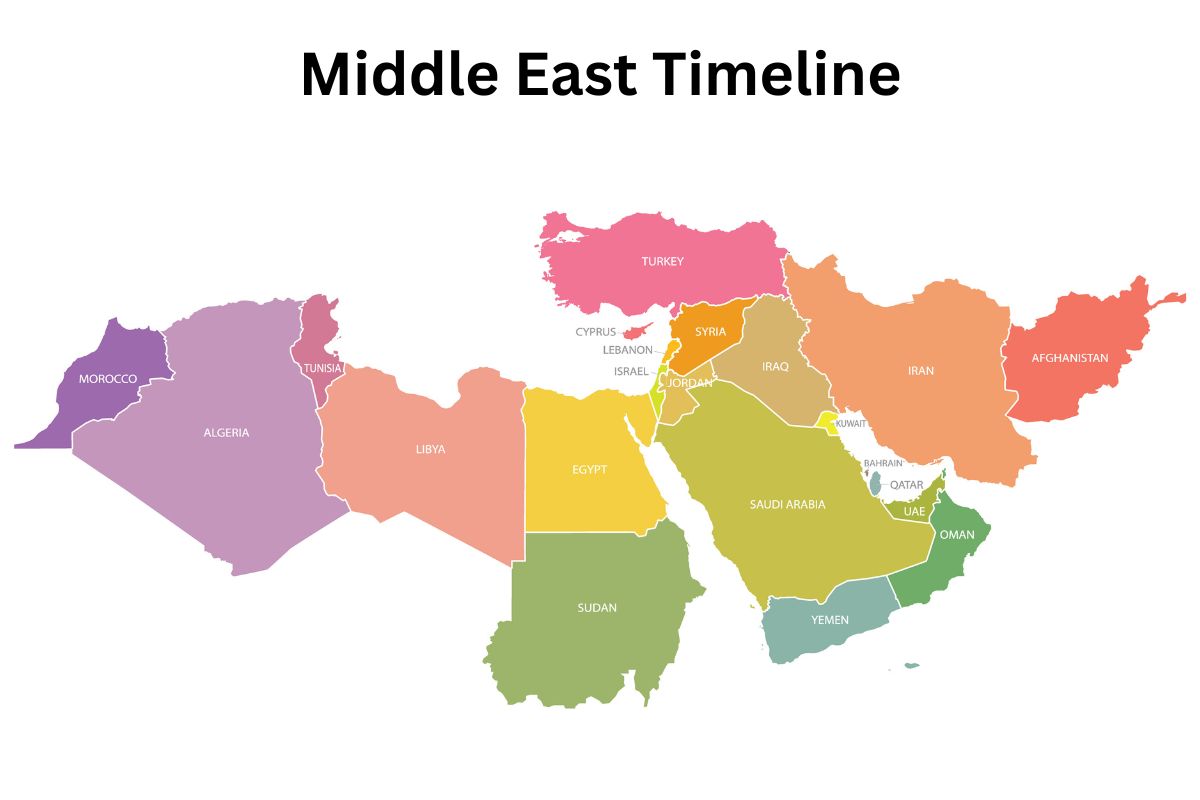
The Middle East is a transcontinental region located at the junction of Western Asia and northeastern Africa, generally encompassing the countries that lie between the eastern Mediterranean Sea and the Persian Gulf. Geographically, it typically includes Western Asian countries such as Saudi Arabia, Yemen, Oman, the United Arab Emirates, Qatar, Bahrain, Kuwait, Iraq, Jordan, Lebanon, Syria, Israel, and Palestine, as well as parts of North Africa, primarily Egypt. Some broader definitions also incorporate Turkey and Iran due to cultural, historical, and geopolitical ties. The region is characterized by its strategic position connecting Europe, Asia, and Africa, its arid and semi-arid climates, and its abundance of natural resources, particularly oil and gas reserves, which have made it central to global economic and political affairs.

A broader definition of the Middle East extends beyond the traditional core of Western Asia and northeastern Africa to include Turkey, the South Caucasus states of Armenia and Azerbaijan, and the countries of the Maghreb in North Africa—Morocco, Algeria, Tunisia, Libya, and Mauritania. This expanded conceptualization reflects not only geographical proximity but also historical, cultural, and political connections, including shared experiences of Ottoman and colonial influence, Islamic heritage, and trade networks linking North Africa, the Levant, and the Near East. Under this definition, the Middle East becomes a strategically and culturally diverse region bridging three continents, encompassing a wider array of climates, ethnicities, languages, and religious traditions, and highlighting the interwoven nature of geopolitical, economic, and social dynamics across its extended territory.

If we divide the region into varying confessional or alliance blocks we arrive at: 

  • the Arab League (28 states), 
  • Iranian-led Shi’a Axis, (Iran, Azerbaijan, & cantons within Lebanon, Iraq, Bahrain, Yemen)
  • the predominantly Sunni Gulf States
  • The Maghreb states (Egypt, Libya, Algeria, Tunesia, Morocco, Mauratnaia) 
  • Stateless Kurds (in Turkey, Syria, Iran, & Iraq)
  • Middle Eastern Christians in varying sects,  
  • Turkey 
  • Israel

In the Middle of what, East of who?

The Ziggurats of the Neolithic age tell a story.  Civilization began with the creation of castes and the centralization of power into early state systems. The cradle of all civilization began with specializations of labor, chaining early humanity to useful trades, and the conscription of worker slaves. The appointment of Kings. It began with tributes to unseen Gods, all-powerful oligarchs, and eventually a cast of priests to preside over mythology, then later religions, and later still over since, and this all served one thing: to prevent us from rebellion. The unnatural subjugation of all humanity into productive labor is not a unique story to Mesopotamia. This book is not about insurrection or economic development. It is not a rejection of ethnic identity or the work of atheists. What is clear: the status quo is dangerous to states and people inside them. 

It is chaotic uncertainty at best. The entire Middle East is awash in an endless war and has experienced every measure of barbaric atrocity. This state of modern warfare has proceeded without any actual peace since 1920, but the bloody chaos existed a long time before that. In perpetuity for as long as we have known. 

Every nation is highly vulnerable; every nation is perhaps also complicit in the killing fields today. The Western powers and Eastern powers have used us. They have handed us sophisticated weapons to murder each other in varying combinations while the great transnational corporations harvest the energy supplies in the ground. This has nothing to do with civilizational clashes or the competing interpretations of the Abrahamic religion. That is just the framework for our terrifying division, but not the cause of it. The Modern Middle East must cast off its own oligarchy, jail its own collaborators, we must cast off foreign domination, cast off ethnic particularism, and embrace peace on its own terms.  

It is not fully true that the tinderbox of the dying Ottoman Empire erupted in Palestine or can be cured from there. Nor can Turkey revive it. Or can Iran dictcate its Shi’a rivalist terms.  Nor is it true that the roads to Jerusalem from Cairo, Damascus, Karbala, Najaf, Mecca, Medina, and Tehran are all guarded by the now-flailing American empire. The mulipolar world of rising China and reviving Russia will treat the region in a different, but not necessarily better way. 

Not all our original sins of the region began with the Crusaders, the Mongols, the Ottomans, the Zionists, with meddling foreigners, and with our oil. Long before the Crusaders attacked from the West and the Mongols came from the East; we fought wars of the Ziggurats. We fought wars of city states. We fought wars against Romans. We fought wars between Sunni and Shi’a. We fought wars between rival Caliphs. We fought wars against unbelievers and true believers of esoteric sects.

The truth is that any so-called peace process is little more than a short-term buy-off if there is no structural framework to actually exist together. Allowing the hegemonic powers (American, the EU, China, and Russia) more time to take, to utilize what lies under our sands until it all runs out, and it will run out in the next several hundred years. We cannot and should not seek to perpetuate war on Israel; we should all be seeking to decouple the Jewish state from the foreign policy goals of the West. But also the Muslm states that are Western or Eastern semi-peripheral states; such as Egypt, Turkey, Saudi Arabia, and Iran. We should take accountability for what we have done to and with Palestinians as a whole, both as Israeli occupiers and Arab state hosts. We should validate the Kurdish question and acknowledge the rights of 40 million stateless people, who have been massacred, particularly in Iraq and Turkey. We should acknowledge that the Sunni-Shi’a cold war is also quite violent and divisive to the region. We should prevent starvation, human rights violations, and genocide in Palestine, but also in Syria,Yemen,.and Sudan (which is not part of the Middle East but deeply affected by it). In short, we must be accountable for what is the violence inflicted by colonialism/ neocolonialism, and what is the violence we are self-inflicting. Violence baked into the fabric of our poltical consciousness as a region. In Islam, hypocrisy is a high level of contradictory sin; we must take stock of where the fault lies with foreign meddling and where it lies with our own leaders’ violent impulses and failed policies. Yet, the treatise does not reject states. But presupposes they are violent, inefficient, repressive, and prone to Oligarchic capture.

There are many failures of the modern state system. Innumerous failures and predations to indict. But these are the boundaries were working with, the confines of power we are conglamorating if this scheme might proceed, it is a balance of nationalism, an alliance of regional geographies, and has to balance the authoritarian nature of states and armies, with the civil society and constitutional rights entitlements of citizens organized into cantons.

What is a state in the Modern Middle East? 

With the exceptions of Egypt, Israel, Turkey, and Iran (because they have certain historical permanence or at least longer periods of imagined identity); most states are modern inventions of Sykes-Picciot and nationalisms of convenience. Borders drawn up by foreign powers then codified in over 125 years of basically continuous warfare. 

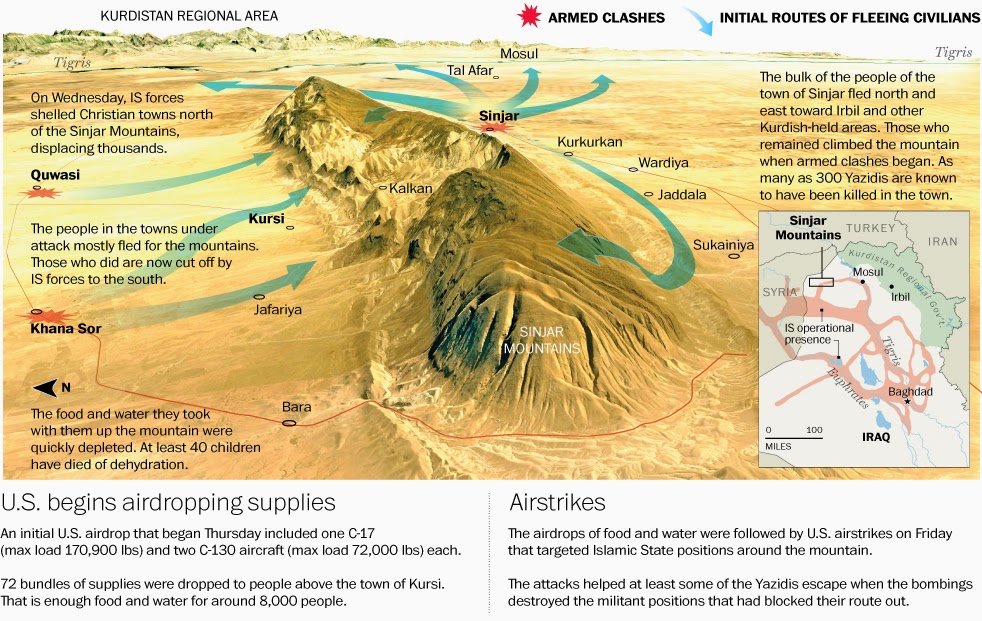
The Ottoman Turkish genocide of the Armenians, carried out by Kurds. The ethnic cleansing of Palestine carried out by Israelis. The Iraqi genocide of the Kurds carried by Saddam’s forces. The war between Iraq and Iran. The ISIS genocide on the Yazidis.

The Yemen civil war, the Lebanese Civil War, the Syrian Civil War, the Libyan Civil War. 

The most deadly engagements fought between Jews and Arabs, Christian Lebanese and Muslim Lebanese, Shi’a Iran against Sunni and Shi’a Iraq, the war between Turks and Kurds, the modern conflagrations in Algeria, Palestine, Yemen, Syria, and Libya. The spill over of these wars, into Sudan and Afghanistan.

What is Federalism is the Modern Middle East? 

It is to allow states greater regional autonomy in their governance by allowing for sub-unit/provincial governments where federal states can have their own civil administration, state laws, and state self-defense in the form of national guards. 

In the Middle Eastern context, federalism refers to a system in which power is divided between a central government and regional authorities, such as provinces, emirates, or autonomous territories. Unlike in Western democracies, where federalism often evolves from voluntary union or constitutional design, in the Middle East it tends to emerge as a conflict-resolution tool—a way to manage deep sectarian, ethnic, and tribal divisions within states that were often shaped by colonial borders rather than shared identity. Federalism in this region is therefore less about political philosophy and more about pragmatic power-sharing in fragile or post-conflict societies.

Historically, most Middle Eastern states developed under highly centralized, often authoritarian governments that concentrated power in the capital. This structure marginalized peripheral regions and minority groups, fueling recurring tensions. When these centralized states fractured—through wars, revolutions, or foreign interventions—federalism was sometimes proposed as a way to preserve unity while granting autonomy. The most prominent example is Iraq, which adopted a federal constitution after 2003 that recognized the Kurdistan Regional Government as an autonomous entity within a single Iraqi state. This arrangement sought to balance power among Kurds, Sunnis, and Shiites, though it remains contentious. Another example is the United Arab Emirates, a federation of seven emirates that maintains stability through monarchical power-sharing rather than democracy—making it a rare case of successful, non-democratic federalism. Proposals for federal systems have also appeared in Syria, Yemen, and Libya, where decentralization has been discussed as a means to end prolonged civil wars, though these plans have yet to take hold.

Despite its appeal as a peace mechanism, federalism in the Middle East faces major obstacles. Deep sectarian mistrust, weak institutions, and the enduring culture of centralized authority make it difficult to implement effectively. Many political elites fear that federalism will lead to partition, while external powers—such as Iran, Saudi Arabia, and Turkey—often manipulate internal divisions for their own regional agendas. As a result, federalism in the region is frequently perceived as foreign-imposed or a prelude to fragmentation rather than a step toward stable governance.

In essence, Middle Eastern federalism is less an ideological system than a pragmatic survival strategy. It seeks to balance competing identities and distribute power in states where national unity is fragile. While in theory it could promote local governance, accountability, and reduced conflict over resources, in practice it remains a contested and unstable experiment—a reflection of the region’s complex interplay between unity, autonomy, and enduring historical divisions.

What are Cantons? 

A means to organize a more localized civil administration in highly diverse societies with a tendency to wage protracted civil wars. Which have come out of the many wars but do not need to wait for a war to form structures. In fact it is more desirable for the existing states to undertake federalism, then to dissolve into further warfare. 

Cantons do not have to geographic they can also be communal; the main benefit of canton level sub-organization to the the federalized state is to allow community organization on civil society lines, allow for local decision making on community life, and allow peoples of common affinity to organize their lives on those traditions and values.

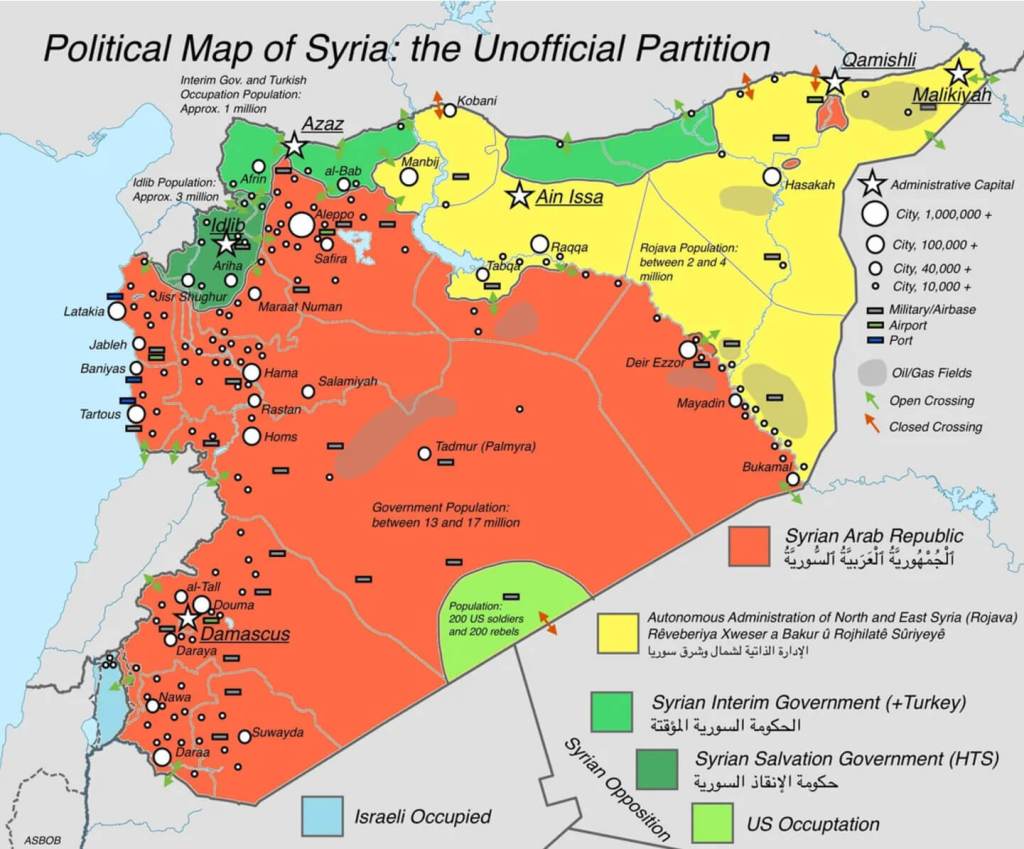
For instance, in Lebanon, the idea of cantonization became prominent during the 1975–1990 civil war, when the country effectively split into Christian, Muslim, and Druze-controlled territories. Although the Taif Agreement later re-centralized the state, Lebanon still operates through an informal sectarian power-sharing system that resembles a confessional version of cantonal autonomy. In Syria, after the 2011 uprising, the country fragmented into several zones of control: Kurdish self-governed areas in the north and northeast (often described as “cantons” by their organizers), Assad regime territory, and opposition or Islamist enclaves. The Kurdish-led administration explicitly used the term “cantons” to describe regions like Afrin, Kobane, and Jazira, which were united under the Autonomous Administration of North and East Syria (AANES)—a model inspired by decentralized and participatory governance rather than ethnic nationalism.

In Iraq, the term is less commonly used, but the reality is similar: the Kurdistan Regional Government (KRG) and Shi’a and Sunni-dominated provinces function as quasi-cantons within a weak federal framework. Similarly, in Yemen and Libya, ongoing wars have produced competing governments and territorial zones—effectively cantonized states divided by militia control, tribal loyalty, and external patronage.

Thus, in the Middle East, “cantons” are rarely peaceful administrative entities. They are instead manifestations of state disintegration or attempts to manage diversity through localized autonomy. While some scholars and diplomats propose cantonization as a conflict-resolution mechanism—for example, suggesting a canton-based solution for Syria, Yemen, or Palestine—risks entrenching division, legitimizing warlords, and formalizing partition. In essence, Middle Eastern cantons represent a hybrid between governance and survival, where local communities govern themselves amid the collapse or weakness of the central state.

Middle East (core countries – 20) 

MASHRIQ

BILAD AL-SHAM  (Egypt & Levant)

  1. Egypt
  2. Lebanon
  3. Syria
  4. Israel
  5. Palestine
  6. Jordan

BILAD AL-RAFIDAIN WA FARIS

  1. Iran
  2. Iraq

KHALIJ  (Gulf States)

  1. Bahrain
  2. Kuwait
  1. Oman
  2. Qatar
  3. Saudi Arabia
  4. United Arab Emirates
  5. Yemen

MAGHREB (Northwest Africa)

  1. Libya
  2. Algeria
  3. Tunisia
  4. Morocco 
  5. Mauritania

Total (core Middle East): 20 states 


Middle East Semi-Peripheral

  1. Turkey
  2. Iran
  3. Egypt
  4. Israel
  5. Saudi Arabia

Middle East Peripheral

  1. Cyprus
  2. Azerbaijan
  3. Georgia
  4. Armenia
  5. Sudan
  6. Afghanistan

Middle East Non-State Cantons

  • Kurdistan-Iraq (KRG-Bashur)
  • Kurdistan-Syria (Rojava)
  • Houthi Territories-Yemen
  • Palestine Gaza
  • Palestine West Bank
  • Druze in Syria
  • Hezbollah in Lebanon 

= 27 countries total

Egypt, Jordan, and briefly the PLO were all bought off to make an awkward peace with Israel with American development aid dollars. In recent years, the UAE, Morocco, Bahrain, Sudan, and, one day soon, Saudi Arabia most likely are paid to recognize Israel because the Americans and Europeans use Israel in Palestine as a forward operating base. 

They use it as a litmus test of their hegemony. Just as the Russians used Syria until its total collapse and still use Iran in some agreed to forms. The Iranians and Israelis have their specific confessional interests, and of course, they have their own regional goals; but without external arms and subsidies, they could not sustain such aggressive posturing and mount such an adventuristic foreign policy. The Israeli military machine is funded by the United States, and the Iranian one (and the Assad regime in Syria before it collapsed) partially by Russia and China, though to the same effect: perpetuating adventuristic and militant regional foreign policy.

The capital inputs for development or military aid allow the Saudi Arabian and UAE to sustain devastating intervention in Yemen. They subsidize Israeli hyper-militarization and the Palestinian occupation, but they also subsidize Hezbollah, Hamas, and Shiite militia forces. It is hard to imagine such horrific localized wars without the foreign powers subsidizing them. 

The road between both halves of Jerusalem/Al-Quds runs in fact to the mountains of Kurdistan. To a people without a state, who by historical circumstance were in the last 40 years trained to fight by the leftist Palestinians and trained to reorganize by Zionists. Who, although speaking 11 dialects of Kurdish, are linguistically and culturally most like the Persian Iranians. The Iranians, who are the only existential threat to Israel, still have over 40,000 Jewish citizens and share a version of Shi’a faith with the Lebanese, Yemenis, Bahrainis, and Iraqis and a language with the Afghans; fight East and West via these proxies.  

Finally, Egypt is a nation that subsists on Western aid, but revolution is always below the surface. Jordan is actually over 60-70% Palestinian, and without American and Israeli support, could not exist as a country. 

So, it is not the coexistence of Israel in Palestine that is the linchpin of regional peace. Yet in warfare, they have drawn in all the actors that are needed to make a Hudna, or a lasting ceasefire for the Israelis to ally with the two other powers that ensure the Confederation can raise its flags; Iran and Egypt. Which is to say, the historic enemies of the Jews. Nations such as Egypt and the Babylonian and Assyrian Empires did attempt to obliterate the Jews, then the “Eivree” or Hebrews. “Jews’ is a word invented by Romans, as there is no J sound in Hebrew or Aramaic. 

Although all our people learn and think in several thousand-year segments. Although we find almost unceasing war records no matter what empire or confederation was in power. The point of unity for the nations of this proposed Confederation is the historical legitimacy and self-awareness of monotheistic, desert tribes that absolutely no outsider or insider to the region could subjugate completely. This does not make an argument that Palestinians are Canaanites, the Lebanese Phoenicians, or that Jews should not be called Jews but are the 20-30% intermixed survivors of the Israelite tribes Dan, Yehuda, and Levy; Eivri, or Yehudeans. Or that of the 13 million worldwide population of descendants of the Jews, as few as 5 million are remotely even practicing the religion. Which is speculated.  

Palestine is an open wound. It is with the latest round of fighting in Gaza evidently a genocide. Over 65,000 people have died so far.  It shall be remembered to all that over 4 million have died in Sudan, so far. Over 630,000 were killed in the Syrian Civil War (mostly by the Russian-backed Assad regime), and the war between Saudi Arabia and the UAE and the Houthis has led to the deaths of over 377,000 people, that we know of.  

It is a wild deception that the so-called Islamic State (ISIS), Daesh, has its origins in any normally accepted version of Islam. Its goals were allegedly divinely inspired in prophecy. Its defeat will be no means bring an end to this type of Wahabi Salafist insurgency, exported in petro-dollars from the Gulf. ISIS was an entity controlled by, supplied by, and supported by Türkiye, Saudi Arabia, Qatar, and Pakistan’s intelligence services. That is one theory, another that was Ba’athist intelligence and varying Al Qaeda offshoots, using messianic fervor and rhetoric. If not for the Coalition forces, particularly the US, the French, the British, the Kurdish SDF, Iran, Russia, Hezbollah, and Iraqi PMF, they very well might have conquered the entire Middle East. How close they came is understood only by those who were there on the ground.

It is time now for the coming generation of the Middle East to take steps to prevent the interventions of all types of foreign power, the meddling of the great powers, as well as to contain the regressive impulses of our varying theocracies. In short, the road to an actual long-lasting peace is not through the conquest of states, the dispersion of the Jews yet again, or doubling down on depper religious zeal and fundamentalisms! 

The road to peace is in fact not peace; it is instead about ceasefire, and separation into stable units, but not embracing the chauvinistic nationalism of outsiders, particularly the meddling of the East and the West: NATO-aligned neocrusaders, Russian-aligned neocrusaders, and rising China hungry for all resources of all types. We do not have to commit to anything with these actors. But we must enter a confederation strong enough to repel foreign aggression, stamp out internal fundamentalism, stamp out ethnic conflicts, and secure the ceasefire. Secure a framework of civil and human rights acceptable to the diversity of religions, and of course, prevent the indefinite traffic of weapons and currency for access to the finite resources of gas and oil.  The Muslim world is obsessively fixated on Palestine because it is an open wound, it is a blatant ongoing human rights violation, a violent occupation, and because it instills a crusader-like, colonial force in our midst that is not fully Western, but also not fully Middle Eastern. As long as Israel has no alignment in culture, trade, and security, it will remain a destabilizing entity. One that, in any projection of isolation, resistance, demographic shift, BDS, international divestment/ shaming, has 200 nuclear missiles. Its Jewish population in religious identity and political imagination is indigenous to the Middle East. Removing it, secularizing it, demilitarizing it, or refusing to deal with it is political imagination. The highest level of human rights and civil rights safeguards one can deliver to Palestinians is an Israel and Palestine fully integrated into the region. The Western media and the Muslim streets obsessively focuses on Palestine because:  

It is an open wound with ongoing human rights violations that antagoize and grieve the very heart and soul of the region. 

(a) The Israelis, despite being mostly Jewish, are at least half European or Slavic in roots and appearance (approx. 2 million are Ashkenazi/ European and 4 million are Sephardic/ Mizrahi), so aesthetically it triggers the latent crusader imagination. Were their no real and imagined Arab enemy the Jews might fight yet another civil war for the soul of thier state. It is deeply baked into Chrisitian theology the Jews must gather again in Israel before their Christian messiah returns. The war in Palestine-Israel is thus deeply and subconsciously understood by Western minds as theological and geostrategic. 

(b) Israel is, without a single doubt, is a manifestation of several thousand years of collective trauma experienced by the Jewish people into being a modern Outremer: a military colony that Europe and America rely on for regional control. There is not a realistic scenario where the Jews will lose a military confrontation. They will not pack up and leave. There is a highly realistic scenario they will lose lose a demographic one. The birthrates of Palestinians already place them above 20% of Israeli passport holders. 

It cannot be denied that both the West and East have not been short on Muslim proxy clients. Pahlavi Iran until 1979. The U.S. bases in Qatar, the UAE, Kuwait, and Turkey. Russia once heavily invested in Egypt until it went to America, and also Syria until the Assad regime fell in 2024.  

The abomination of Wahabi Salafist extremist Saudi Arabia, as well as each of the Petro-States of the Gulf. Unique in a world where race is the most essential passport to privilege, of 8-9 million Israelites, 3 million look fully European. For the greater part of 800 years since being butchered by Crusaders, culminating in the holocaust, the Jews have, or at least the Ashkenazi in charge of Israel, decided they will collaborate with Christian Europe against their Semitic cousins, the people of the region they were expelled from by the Romans 1,900 years ago. 

The Shi’a also know a great deal about enduring persecutions. Iran and the Shi’a have many characteristics developed adjacent to the Jews. Particularly, a feeling of their backs against a wall, then the sea. A feeling of a need for a vigilant ethno state. The world’s oldest groups of Christians, the Armenians, Assyrians, and Maronites, have survived endless wars by retreating to the mountains. The Sunni are being held hostage between secularism and regressive fundamentalism; Egypt, Türkiye, and Pakistan are caught between those feelings. The contradictions of Saudi Arabia and the Gulf States are lost on no one. 

The three intrinsic imperialists are external profiteers who secure themselves from endless war. They steal resources and direct efforts toward maldevelopment: USA-NATO, the Russian Federation, and eventually the People’s Republic of China. (Though their imperial footprint is still light). 

The initial geography behind which a Middle Eastern Confederation can be birthed, formed, and fortified. Broken into federal units within exisitg states, then administered by canton level governance. 

Lebanon- 4 cantons

  • Sunni
  • Shi’a
  • Christian
  • Druze

Palestine-Israel- 2 cantons

  • Judean
  • Palestinian

Jordan-2 cantons

  • Hashimite 
  • Palestinian

Syria- 4 cantons

  • Kurdish (SDF)
  • Sunni Arab
  • Alawite
  • Druze

Iraq- 3 cantons

  • Shi’a Arab
  • Sunni Arab
  • Kurdish (PUK/KDP)

Iran- 5 cantons

  • Shi’a Persian
  • Azeri
  • Kurdish
  • Baloch
  • Lur 

Second Phase

Turkey, Armenia, Kurdistan regions.

Gulf States & Saudi Arabia.

For the skeptics let us draw on the fact that America is under 300 years old. The complete reliance on fossil fuels for transport and trade is less than 200 years old. All of Europe exhibited mass violence and religious atrocity for around 2,000 + years, and the nations of the Middle East have produced all Western religions, writing, science, and literacy dating back perhaps 3,000 years. Essential to this document is an understanding that we are proposing the confederation of peoples who have lived beside each other in relative non-violence for as long as recorded history existed, and only the interventions of Crusaders, Mongols, and European imperialists have escalated conditions to perpetual war and genocide. 

Realignment is suggested. Five pillars, keystone nations if you will, that if realigned, restore the Palestinians and also the Israelis to their lost homeland indefinitely and return the Jews to being a people of the Middle East. With the realignment of Israel away from her European mixed tribes, abusers of over two thousand years back to the tent of her blood; then there are only four nations left that can sow widespread death, extremism, and disorder, and they, Iran, Saudi Arabia, Pakistan, and Türkiye, will have to be managed one by one. The five intrinsic incubators of regional instability and endless war behind which the Middle Eastern resources are divided up and plundered: Israel, Iran, Saudi Arabia, Türkiye, and Pakistan. Each with an external pipeline of funds and trade linking back to a hegemonic power. The semi-peripheral powers of the Middle East. 

We, the peoples of the Middle East, comprising all peoples listed above and all indigenous communities acknowledge the history of millennia-long coexistence, conflict, trade, and cultural exchange. The region has endured cycles of war, conquest, displacement, and foreign interference. It is the imperative of survival, dignity, and justice that motivates this treatise.

Chapter I: Principles of Survival and Peace

  1. Principle of Non-Annihilation: No party possesses absolute capacity to destroy another; hence, the continuation of conflict is neither inevitable nor desirable.
  2. Principle of Diverse Society: Peoples must establish arrangements permitting ethically and religiously divergent communities to coexist while preserving autonomy, identity, and historical heritage.
  3. Ceasefire Imperative: Immediate cessation of hostilities is mandatory. External actors benefiting from ongoing conflict must be neutralized in policy and practice.

Chapter II: Recognition of Indigenous Sovereignty

  1. All peoples retain sovereignty over ancestral lands or lands where they are received. Their civil, poltical, economic, culturalm and social human rights will be affirmed in the formation of governance cantons in federalized states.
  2. Political and territorial arrangements must respect cultural, ethnic, and religious distinctions.
  • State boundaries will be altered to reflect demographic realities and avoid further armed conflicts.
  • State governance will be remodaled to a Federal system of sub units called Cantons, inside Federalized States, bound in a Confederation.
  1. Historical grievances shall not preclude functional coexistence; legal recognition of past injustices shall guide reconciliation mechanisms.

Chapter III: Formation of the Middle Eastern Confederation

  1. Structure: The Confederation shall comprise autonomous cantons existing inside the state frameworks, each preserving ethnic, linguistic, and religious governance within a shared federal framework.
  2. Administrative Capitals: Cairo, Jerusalem-Al Quds, Beirut, Damascus, Baghdad, Mecca, Diyarbakir, Istanbul, and Tehran.
  3. Legal Framework:
    • A Federal structure for existing states will be established on regional or confessional lines to propagate the terms of the Confederation.
  • Cantons can form based on shared ethnicity, religion, or logical geography
  • Cantons have a civil administration and a series of democratic term based councils that sent delegates to a Federal State level Assembly.
  • Like an American state with a national guard and its own constitution and taxation powers.
  • The elected leadership of several cantons form a Federal State Assemby of a geographic unit of the country (nation state).
  • The nation State will have a unicameral Congress/Parliment/Majalis which in turn elects Confederation level Reprentatives (like representatives to the EU).
  • The Confederation is a voluntary association of existing states that share a framework of free travel, free trade, triparte taxation, a Confederation wide civil service, and miliary security cooperation agreements.
  • A referendum of cantons can asl to withdraw from the Confderation obligations
  • The target goal is ten years to integrate all the miliary forces  
  • Each State wiil adopt a Federal framework transferring certain civil administration and taxation responsibilities to a Canton Administation.
  • One or several Cantons will comprise a Federal unit of an existing State.
  • Each State will adopt constitutional amendments enshrining a civil code of the cantons, the availability to seek justice under that code or religious courts
  • Cantons can propagate a Modal Civic Code with variations for local religious law
  • Human rights law shall supersede all local or religious law where conflict arises.
  • Human rights law shall be derived from existing Human right treaties.
  • Citizens retain the right to relocate between cantons or exit the Confederation entirely by a popular vote.
  • Cantonal legislation may govern internal religious matters provided compliance with federal legal standards.
  • A unified supreme judiciary shall arbitrate disputes between cantons and states.

Chapter IV: Governance and Civil Service

  1. Rotational Leadership: Leadership positions across cantons shall rotate to ensure equitable representation.
  2. Civil Institutions: Shared civil services shall administer education, healthcare, and infrastructure.
  3. Defense and Security:
    • A coordinated defense council shall maintain sovereignty and internal stability.
    • Military and police forces shall operate under confederal oversight while respecting cantonal autonomy.
    • No foreign powers will be allowed miltarya bases in the region.
    • The Confederation will draft an collectively maintain a unified multinational defense force.

Chapter V: Engagement with External Powers

  1. The Confederation shall maintain non-alignment with foreign powers.
  2. No external power shall dictate domestic policy, supply advanced weaponry, or manipulate regional conflicts.
  3. Strategic self-reliance shall be developed in energy, defense, and civil administration.

Chapter VI: Strategic Objectives

  1. Arrest cycles of conflict across the region through structured separation and collaboration.
  • Priorities include pacficiaiton  of protradcted conflicts in Yemen, Syria, Libya, & Israel-Palestine
  1. Secure survival and autonomy of all indigenous peoples.
  2. Establish a legally binding and historically informed framework for peace and cooperation through a regiona Human Rights Court.
  3. Prepare for post-conflict sustainability: energy, economic stability, and civil resilience.

Chapter VII: Immediate Measures

  1. Initiate a region-wide ceasefire framework within six months.
  2. Convene representatives from all states, militai, cantons, and indigenous communities to formalize governance structures.
  3. Draft a constitution codifying rights, responsibilities, and federal oversight.
  4. Establish mechanisms for dispute resolution and conflict prevention.

FRAMEWORK
This treatise is not a theoretical abstraction. It is a practical, legally grounded roadmap for survival, dignity, and justice in the Middle East. It acknowledges history, respects diversity, and insists on immediate action. The formation of a Middle Eastern Confederation is the sole viable mechanism to halt ongoing cycles of destruction and secure the future of its peoples.

A confederated alliance of states and self-governing cantons that must find a common cause for separation and economic development, intrinsically linked to a series of strategic agreements between Arabs, Persian, Judeans and all of all religious confessions, and Kurds of all political types. Not factoring in whether they have states or are not recognized by the world state system.” 

  1. The Confederation shall be founded by the peoples of nations, not by states. The geographic boundaries are contingent upon the peoples who reside in the Maghreb, Middle, and Near East. Specifically, the fertile crescent with geopolitical implications from Tunisia to the west, to Kashmir in the East, to Sudan in the south, and the Caucuses. But rooted deeply in accords between Israel, Palestine, Shi’a Iran, Lebanon, and the Parties of the Kurds.    
  2. The Confederation shall be based on ethnic cantons that will be self-governed by religious law, civil law, or tribal custom but all cantons must be Universal Human Rights law-abiding; which is to allow the exit from any community of those that wish to live under secular civil law. 
  3. The Confederation shall be based on democratic autonomy; thus, a co-gendered leadership, a census, and a system of voting and elections must be in place to implement religious laws that are binding throughout a canton.    
  4. The Confederation shall conscript and maintain a unified Defense Force and Civil Service that, through 3 years of military or civil duty deploy diverse forces amid the Confederation to foster shared values in a complex and diverse society. 
  5. The ethno-civil administrative capitals of the Confederation pending cessation of military conflict shall be Cairo, Jerusalem-Al Quds, Beirut, Damascus, Baghdad, Mecca, Diyarbakir, Istanbul, and Tehran. 
  6. The Israelis and Palestinians are not the key elements of actualizing the Confederation, but they are capable of indefinitely destabilizing the effort to form the alliance and must be specifically managed. 
  7. The Israeli, Iranian, Saudi, and Turkish agreement is the only way to militarily secure the confederation. 
  8. The Kurds (in civil society/ ideology), Shi’a (in security), Lebanese (in trade), and Israeli (in technology, but certainly all sectors) have specific developmental technology as well as governance systems that are integral to this project. 
  9. The Confederation shall pursue non-alignment. 
  10. The Confederation shall enshrine into law and fiercely defend universal human rights, and all other canton level legal configurations will be subordinate to that code. 

There are critical security, international relations, and domestic crisis issues that threaten the very existence of the Israeli and Palestinian peoples much more so than the ongoing, comparatively low-intensity occupation of the Palestinian zones of control in the West Bank and blighted Gaza. The region at large is in an acute state of political and social unrest; the governments of Somalia, Afghanistan, Tunisia, Libya, Iraq, Syria, Egypt, and Yemen have fallen resulting in foreign occupations, civil wars, and general anarchy. Shi’a Iran and Sunni Saudi Arabia are at proxy war throughout the Muslim world. 

Many will object to us describing Israel as a “Jewish military Colony”, and object to calling the separation barrier the “Apartheid Wall” but linguistics and agreement of a shared paradigm are vital to the success of this committee’s objectives. We assure you the credentials of our core research team from Israel are sufficiently grounded in lived experiences of both the intelligence service and defense forces; while our Palestinian team’s Jihadist and patriotic background would be of little question. 

Chaos and revolution are spreading while security, what little there was, is unraveling. All of this was acutely exacerbated by the 2001 & 2003 American invasions of Afghanistan and Iraq; resulting in the virtual anarchic non-governance of both countries today. And of course, the Israeli treatment of the Palestinians is an open wound that festers, then bleeds out. 

This treatise has been researched and written by a group of Judeans, Arabs, Israelis, Palestinians, and Kurds concerned with the collective survival of their respective peoples as they occupy and are occupied in the heart of this massive, unending conflict. There is very little hope of this macros-regional war or micro-peace settlement between Israel and Palestine being resolved on the level of government. Palestinians have two competing governments; Hamas and Fatah; Israel has a coalition government but is controlled as a military oligarchy on the behest of Ashkenazi Judaism and the foreign policy goals of the United States of America.  

For the approximately 16 million humans living in Greater Israel/ Historic Palestine; the varying scenarios are not optimistic in the slightest.  

Peace is improbable, demographics are not favorable to the 5-6 million categorized Jews and beyond the religious overtone of the landmarks described by three world religions as ‘holy land’; Israel is also a nuclear-armed semi-peripheral power aligned completely and dependent on financially a Jewish Lobby and interest in the United States which cultivates the specific and direct interests of two intractable groups; the US military-industrial complex and the 2-3 million Ashkenazi (European) Israeli Jews; which enjoy a standard of living inside the Jewish colony markedly different from the Jews of other ethnic backgrounds. 

There has been ceaseless warfare in the Maghreb and Middle East since 1920, shortly after the fall of the Ottoman Empire. The false consciousness of the invented Nationalism. All the scenarios discussed in the treatise are inseparable from the conflict between the Israelis and the Palestinians, but it is naïve and European to link the peace of the region to our specific peace. A peace that will never be under the dynamics of the current situation, the minuscule size of the land, and endless regional intrigue. Arms and aid money, for control of energy resources. 

Thus, we concern ourselves in this first manuscript with Israelis (of all religions and ethnicities) and Palestinians (of all demographics). We are concerned with the broader course of humanity, but this has been authored to ensure that regardless of humanities general course; there will always be Palestinians, and there will always be Jews; and if there are to be “Israelis” an identity that is less than 85 years old; we must engage in radical steps to subvert the course of the mainstream Zionist project; delink ourselves of Euro-American hegemony and stop the inevitable slaughter of our collective peoples. 

“A new level of atrocity is coming; in fact, it has very much arrived.” 

Between October 7th, 2023, and the January 2025 ceasefire the Palestinians killed around 1,700 Israelis, the Israelis killed around 75,000 Palestinians (and counting) and over 5,000 Lebanese. Some portions had weapons, and many did not. 

Palestinian demographics will increase to above 50% inside the green line which they trend toward (currently the reality is something like 7 million Arabs to 8 million Jews + others), and or if Israel uses a nuclear weapon of which it has over 500. Or Israel is sucked into or provokes a war with Iran. Or any number of scenarios with state collapse, proxy war, Saudi and Iranian warfare, and further misadventures with enormous cost in-human life. To stop the final floodgates from opening, to address the broad systemic internal contradictions of the Israeli state and to secure a viable Middle Eastern Confederation, a radical policy of reorientation must begin with a realistic assessment of the only other three parties on the ground besides Memshala Yisrael3 which can broker regional stability. Israel must deal directly with Hamas, Fatah, Kurdish Parties, and most importantly the Islamic Republic of Iran. Only an uneasy truce and alliance of this kind can focus policy and praxis on awakening the consciousness of the Sunni Arab majority. 

“It is no longer a question of moralizing the conflict, obsessing over past failures, or temporarily abating a cycle of degenerating violence. Or conducting more banal and expensive anthropological studies on identity.”  

In the Israeli Knesset, amid the Palestinian resistance factions, among the various Persian & Arab power brokers and the para-state organizations on the ground (and in the Diaspora) all realize that neither by sheer will nor by force of arms can they destroy one another. Blame for the modern quagmire that is the Middle East may fall squarely on the post-colonial powers of Europe and the United States for the proliferation of arms without stipulation or control. However, the new reality is that if the third Hebrew Commonwealth of Israel is to survive; if a Palestinian State is to be brought into being; as well as if any measure of regional stability is to be achieved, radical and unorthodox steps must be taken to close the breach. The breach is not simply a result of Israeli defense against Arab aggression, or vice versa; it is a breach in the foundation of the modern security calculus. All parties involved must become more attuned to the heightened stakes via lessons in history and sound political science.   

This treatise offers an objective analysis of the Harakat al-Muqawama al-Islamiyah to advocate for its recognition as a viable partner, not in immediate peace; but in implementation of separation, economic development, and most importantly; Hudna4. It makes a fundamental case for supporting Kurdish national ambitions in Türkiye, Iraq, and Syria. We advocate for a full and lasting partnership between Israel and the revolutionary Shi’a government in Iran. But we envision and call for something much more powerful. 

To claim that Memshala Israel has secured its borders, or contained conventional military threats to its existence is to say that glass is made from sand. The process by which glass is made from sand renders the base substance unalterably changed and requires the release of energy through fire and heat to yield something far more unstable than its original form. While the cousins of Ishmael and Yitzhak, the Israelis, and Palestinians, are indeed two peoples intractably bound to a single, tiny piece of land, they are met with a recurring problem. The Israeli public and government (currently) lack the will to commit genocide. The Palestinian Resistance factions cannot (currently) procure or introduce a means to mass murder that will not render their own homeland a house of ash. 

Surely whispered even openly said in both camps is the notion that it would not be ‘objectionable’ for the other and their kind to be ‘pushed into the sea’ or ‘dumped on the other side of the Jordan.’ The survivors of the Shoah5 cannot (yet) bring themselves to this, nor would international opinion condone genocide in the Holy Land today. As for the Palestinians, pushing the Jews into the sea has more to do with rhetoric than ability, conscience, or even intention. The ancestors of both races defended the holy land against the Christian Crusaders locked arm in arm.  

There are over 1,400 years of precedent for relatively peaceful co-existence and less than 100 to the absolute contrary6. Anyone telling you otherwise has a vested interest in your ignorance. Even the death toll of the First Intifada (estimated at 421 Israeli/1,549 Palestinian7) and the bloodier melee of the Second Intifada, which included suicide bombers and collective punishment, cost only 1,062 Israeli and 5,500 Palestinian lives8. The invasion of the Gaza Strip in 2008 resulted in 13 Israeli and 1,417 Palestinians9. In the ongoing Gaza Wars in 2010-2015, an estimated 100 Israelis and over 5,000 Palestinians have lost their lives. Approximately 1,300 Israelis and 50,000 Palestinians have died in the latest war. 

Between 2015 and 2023 multiple rounds of fighting in Gaza killed several thousands of Palestinians and a few dozen Israelis. In the same period, the Syrian Civil War killed over 500,000 people.  That means that in the entirety of the Palestinian Israeli conflict beginning in 1948; less than 50,000 people have cumulatively died, comparatively to all other ethnic conflicts that is a footnote, a statistic. The body count of the Palestinian-Israel civil war is comparatively low when compared with other global ethnic conflicts like those waged in Sri Lanka, Sudan, Burundi, Rwanda, Chechnya, Iraq, Afghanistan, Yemen, Syria, and Ukraine.   

Then in under two years the Jewish State killed over 70,000 Palestinians in retaliation for the brutal killing on October 7th of 1,200 Israelis. 

Hamas, and the ideas behind them, i.e. the Muslim Brotherhood,  must be directly engaged as the only viable partner capable of securing Palestinian temporary acceptance of the third Hebrew Commonwealth and thereby securing the Jewish National home by buying both sides more time for ultimate reconciliation before more desperate measures are introduced. (Most no longer believe that is the truth on the ground, as of July 2025 Hamas is reeling). 

 The Three Parties of Kurdistan (PKK, PUK, KDP) must be supported aggressively by both people overtly and covertly. Shi’a Iran is the only semi-peripheral power both sides can count on, as all other states besides Egypt are European inventions; and Egypt is an incredibly unstable place locked between a US-backed military dictatorship and the Muslim Brotherhood. The road to peace does not run through Jerusalem/ Al-Quds, but without a full ceasefire between the Judeans and Palestinians no other keystone ally, tribe, or faction can be aligned to the program to build up a Middle East Confederation in our lifetimes.  

“The window of achieving political and military victory within our lifetimes is an ever-narrowing window. If we falter, if we squander possibility in the name of imagined identity and unseen gods; all will be lost. All our people no matter what they pray to, will be facing annihilation together.”  

“We ask you to read these documents carefully and go back to your factions, parties, organizations, armies, and places of worship to testify on the nature of this plan.”  

By the best calculations of our Party, we have a window of less than 200 years before the oil reserves run out, but under 40 years to achieve the Confederation on the terms of the many peoples of our nation. There is nothing in anyone’s scripture that calls for this endless warfare. There is nothing that tells us there must be homogenous practice or uniform belief. 

The road to peace is in fact not peace; it is instead about ceasefire, and separation into stable units but not embracing the chauvinistic nationalism of outsiders; particularly the meddling of the East and the West: NATO aligned crusaders, Russian aligned crusaders, and rising China hungry for all resources of all types. We do not have to commit to anything with these actors. But we must enter a confederation strong enough to repel foreign aggression, stamp out internal fundamentalism, stamp out ethnic conflicts, and secure the ceasefire. Secure a framework of civil and human rights acceptable to the diversity of religions and of course, prevent the indefinite traffic of weapons and currency for access to the finite resources of gas and oil.  

The academia, the media, and the West obsessively have focused on Palestine, because:  

(a) The Israelis, despite being mostly Jewish are at least half European or Slavic in appearance (approx. 2 million are Ashkenazi/ European and 4 million are Sephardic/ Mizrahi) so aesthetically it triggers the latent crusader imagination.  

(b) Israel is without a single doubt a manipulation of several thousand years of collective trauma experienced by the Jewish people into being a modern Outremer: a colony that Europe and America rely on for regional control. But while accepting or refuting that statement; it cannot be denied that so was Pahlavi Iran until 1979. So has been Jordan and Egypt, and the abomination of Wahabi Salafist extremist Saudi Arabia; as well as each of the Petro-States of the Gulf. Unique in a world where race is the most essential passport to privilege; of 8-9 million Israelites: 3 million look fully European. For the greater part of 800 years since being butchered by Crusaders culminating in the holocaust; the Jews have, or at least the Ashkenazi in charge of Israel decided they will collaborate with Christian Europe against their Semitic cousins, the people of the region they were expelled from by Romans 1,900 years ago. 

The Shi’a also knows a great deal about enduring persecution. Iran and the Shi’a have many characteristics like the Jews. Particularly a feeling of their backs against a wall, then the sea. The world’s oldest groups of Christians; the Armenians, Assyrians, and Maronites have survived endless wars by retreating to the mountains. The Sunni are being held hostage between secularism and regressive fundamentalism; Egypt, Türkiye, and Pakistan are caught between those feelings. The contradictions of Saudi Arabia and the Gulf States are lost on no one. 

Thus, an unusual realignment is suggested. Five pillars, keystone nations if you will, that if realigned restore the Israelis to their lost homeland indefinitely and return the Jews to being a people of the Middle East. With the realignment of Israel away from her European mixed tribes, abusers of over two thousand years back to the tent of her blood; then there are only four nations left that can sow widespread death, extremism, and disorder and they; Iran, Saudi Arabia, Pakistan, and Türkiye will be managed one by one.  

       The five intrinsic incubators of regional instability and endless war behind which the Middle Eastern resources are divided up and plundered: Israel, Iran, Saudi Arabia, Türkiye, and Pakistan. Each with an external pipeline of funds and trade linking back to hegemonic power. The semi-peripheral powers of the Middle East. 

The three intrinsic imperialists are external profiteers who secure themselves from endless war. They steal resources and direct efforts toward Maldevelopment: USA-NATO, Russian Federation, and eventually the People’s Republic of China. (Though their imperial footprint is still light). 

The initial geography behind which a Middle Eastern Confederation can be birthed, formed, and fortified: Israel, Palestine, Jordan, Egypt, Sudan, Syria, Lebanon, Iran, Iraq, Türkiye, Armenia, Kurdistan, Saudi Arabia, Afghanistan, Pakistan, and the Kashmir. 

For the skeptics let us draw on the fact that America is under 300 years old. The complete reliance on fossil fuels for transport and trade is less than 100 years. All of Europe exhibited mass violence and religious atrocity for around 2,000 + years and the nations of the Middle East have produced all Western religions, writing, science, and literacy dating back perhaps 3,000 years. Essential to this document is an understanding that we are proposing the confederation of peoples who have lived beside each other in relative non-violence for as long as recorded history existed, and only the interventions of Crusaders, Mongols, and European imperialists have escalated conditions to perpetual war and genocide. 

The road between both halves of Jerusalem to Al-Quds runs in fact to the mountains of Kurdistan. To a people without a state, who by historical circumstance were in the last 40 years trained to fight by Palestinians and trained to organize by Zionists. Who, although speaking 11 dialects of Kurdish, are linguistically and culturally most like the Persian Iranians. The Iranians, who are the only existential threat to Israel, still have over 40,000 Jewish citizens and share a version of Shi’a faith with the Lebanese, Yemenis, Bahrainis, and Iraqis and a language with the Afghans; fight East and West via these Proxies.  Finally, Egypt is a nation that subsists on Western aid, but revolution is always below the surface. Jordan is over 60-70% Palestinian and without American and Israeli support could not exist as a country. 

So, it is not the coexistence of Israel in Palestine that is the lynchpin of peace. Yet in warfare, they have drawn in all the actors that are needed to make a Hudna, or a lasting ceasefire for the Israelis to ally with the two other powers that ensure the Confederation can raise its flags; Iran and Egypt. Which is to say the historic enemies of the Jews. Nations such as Egypt and the Babylonian and Assyrian Empires did attempt to obliterate the Jews, then the “Eivree” or Hebrews. “Jews’ is a word invented by Romans, as there is no J sound in Hebrew or Aramaic. 

Although all our people learn and think in several thousand-year segments. Although we find almost unceasing war records no matter what empire or confederation was in power. The point of unity for the nations of this proposed Confederation is the historical legitimacy and self-awareness of monotheistic, desert tribes that absolutely no outsider or insider to the region could subjugate completely. This does not make an argument that Palestinians are Canaanites, the Lebanese Phoenicians, or that Jews should not be called Jews but are the 20-30% intermixed survivors of the Israelite tribes Dan, Yehuda, and Levy; Eivri, or Yehudeans. Or that of the 13 million worldwide population of descendants of the Jews as few as 5 million are remotely even practicing the religion. Which is speculated.  

“Essentially speaking we are talking about a confederated alliance of states and self-governing cantons that must find a common cause for separation and economic development intrinsically linked to a series of strategic agreements between Judeans, Persians, Arabs of all religious confessions, and Kurds of all political types. Not factoring in whether they have states or are not recognized by the world state system.” 

  1. The Confederation shall be founded by the peoples of nations, not by states. The geographic boundaries are contingent upon the peoples who reside in the Maghreb, Middle, and Near East. Specifically, the fertile crescent with geopolitical implications from Tunisia to the west, to Kashmir in the East, to Sudan in the south, and the Caucuses. But rooted deeply in accords between Israel, Palestine, Shi’a Iran, Lebanon, and the Parties of the Kurds.    
  2. The Confederation shall be based on ethnic cantons that will be self-governed by religious law, civil law, or tribal custom but all cantons must be Universal Human Rights law-abiding; which is to allow the exit from any community of those that wish to live under secular civil law. 
  3. The Confederation shall be based on democratic autonomy; thus, a co-gendered leadership, a census, and a system of voting and elections must be in place to implement religious laws that are binding throughout a canton.    
  4. The Confederation shall conscript and maintain a unified Defense Force and Civil Service that through 3 years of military or civil duty deploy diverse forces amid the Confederation to foster shared values in a complex and diverse society. 
  5. The ethno-civil administrative capitals of the Confederation pending cessation of military conflict shall be Cairo, Jerusalem-Al Quds, Beirut, Damascus, Baghdad, Mecca, Diyarbakir, Istanbul, and Tehran. 
  6. The Israelis and Palestinians are not the key elements of actualizing the Confederation, but they are capable of indefinitely destabilizing the effort to form the alliance and must be specifically managed. 
  7. The Israeli, Iranian, Saudi, and Turkish agreement is the only way to militarily secure the confederation. 
  8. The Kurds (in civil society/ ideology), Shi’a (in security), Lebanese (in trade), and Israeli (in technology, but certainly all sectors) have specific developmental technology as well as governance systems that are integral to this project. 
  9. The Confederation shall pursue non-alignment. 
  10. The Confederation shall enshrine into law and fiercely defend universal human rights, and all other canton level legal configurations will be subordinate to that code. 

There are critical security, international relations, and domestic crisis issues that threaten the very existence of the Israeli and Palestinian peoples much more so than the ongoing, comparatively low-intensity occupation of the Palestinian zones of control in the West Bank and blighted Gaza. The region at large is in an acute state of political and social unrest; the governments of Somalia, Afghanistan, Tunisia, Libya, Iraq, Syria, Egypt, and Yemen have fallen resulting in foreign occupations, civil wars, and general anarchy. Shi’a Iran and Sunni Saudi Arabia are at proxy war throughout the Muslim world. 

Many will object to us describing Israel as a “Jewish military Colony”, and object to calling the separation barrier the “Apartheid Wall” but linguistics and agreement of a shared paradigm are vital to the success of this committee’s objectives. We assure you the credentials of our core research team from Israel are sufficiently grounded in lived experiences of both the intelligence service and defense forces; while our Palestinian team’s Jihadist and patriotic background would be of little question. 

Chaos and revolution are spreading while security, what little there was, is unraveling. All of this was acutely exacerbated by the 2001 & 2003 American invasions of Afghanistan and Iraq; resulting in the virtual anarchic non-governance of both countries today. And of course, the Israeli treatment of the Palestinians is an open wound that festers, then bleeds out. 

This treatise has been researched and written by a group of Judeans, Arabs, Israelis, Palestinians, and Kurds concerned with the collective survival of their respective peoples as they occupy and are occupied in the heart of this massive, unending conflict. There is very little hope of this macros-regional war or micro-peace settlement between Israel and Palestine being resolved on the level of government. Palestinians have two competing governments; Hamas and Fatah; Israel has a coalition government but is controlled as a military oligarchy on the behest of Ashkenazi Judaism and the foreign policy goals of the United States of America.  

For the approximately 16 million humans living in Greater Israel/ Historic Palestine; the varying scenarios are not optimistic in the slightest.  

Peace is improbable, demographics are not favorable to the 5-6 million categorized Jews and beyond the religious overtone of the landmarks described by three world religions as ‘holy land’; Israel is also a nuclear-armed semi-peripheral power aligned completely and dependent on financially a Jewish Lobby and interest in the United States which cultivates the specific and direct interests of two intractable groups; the US military-industrial complex and the 2-3 million Ashkenazi (European) Israeli Jews; which enjoy a standard of living inside the Jewish colony markedly different from the Jews of other ethnic backgrounds. 

There has been ceaseless warfare in the Maghreb and Middle East since 1920, shortly after the fall of the Ottoman Empire. The false consciousness of the invented Nationalism. All the scenarios discussed in the treatise are inseparable from the conflict between the Israelis and the Palestinians, but it is naïve and European to link the peace of the region to our specific peace. A peace that will never be under the dynamics of the current situation, the minuscule size of the land, and endless regional intrigue. Arms and aid money, for control of energy resources. 

Thus, we concern ourselves in this first manuscript with Israelis (of all religions and ethnicities) and Palestinians (of all demographics). We are concerned with the broader course of humanity, but this has been authored to ensure that regardless of humanities general course; there will always be Palestinians, and there will always be Jews; and if there are to be “Israelis” an identity that is less than 85 years old; we must engage in radical steps to subvert the course of the mainstream Zionist project; delink ourselves of Euro-American hegemony and stop the inevitable slaughter of our collective peoples. 

“A new level of atrocity is coming; in fact, it has very much arrived.” 

Between October 7th, 2023, and the January 2025 ceasefire the Palestinians killed around 1,700 Israelis, the Israelis killed around 75,000 Palestinians (and counting) and over 5,000 Lebanese. Some portions had weapons, and many did not. 

Palestinian demographics will increase to above 50% inside the green line which they trend toward (currently the reality is something like 7 million Arabs to 8 million Jews + others), and or if Israel uses a nuclear weapon of which it has over 500. Or Israel is sucked into or provokes a war with Iran. Or any number of scenarios with state collapse, proxy war, Saudi and Iranian warfare, and further misadventures with enormous cost in-human life. To stop the final floodgates from opening, to address the broad systemic internal contradictions of the Israeli state and to secure a viable Middle Eastern Confederation, a radical policy of reorientation must begin with a realistic assessment of the only other three parties on the ground besides Memshala Yisrael3 which can broker regional stability. Israel must deal directly with Hamas, Fatah, Kurdish Parties, and most importantly the Islamic Republic of Iran. Only an uneasy truce and alliance of this kind can focus policy and praxis on awakening the consciousness of the Sunni Arab majority. 

“It is no longer a question of moralizing the conflict, obsessing over past failures, or temporarily abating a cycle of degenerating violence. Or conducting more banal and expensive anthropological studies on identity.”  

In the Israeli Knesset, amid the Palestinian resistance factions, among the various Persian & Arab power brokers and the para-state organizations on the ground (and in the Diaspora) all realize that neither by sheer will nor by force of arms can they destroy one another. Blame for the modern quagmire that is the Middle East may fall squarely on the post-colonial powers of Europe and the United States for the proliferation of arms without stipulation or control. However, the new reality is that if the third Hebrew Commonwealth of Israel is to survive; if a Palestinian State is to be brought into being; as well as if any measure of regional stability is to be achieved, radical and unorthodox steps must be taken to close the breach. The breach is not simply a result of Israeli defense against Arab aggression, or vice versa; it is a breach in the foundation of the modern security calculus. All parties involved must become more attuned to the heightened stakes via lessons in history and sound political science.   

This treatise offers an objective analysis of the Harakat al-Muqawama al-Islamiyah to advocate for its recognition as a viable partner, not in immediate peace; but in implementation of separation, economic development, and most importantly; Hudna4. It makes a fundamental case for supporting Kurdish national ambitions in Türkiye, Iraq, and Syria. We advocate for a full and lasting partnership between Israel and the revolutionary Shi’a government in Iran. But we envision and call for something much more powerful. 

To claim that Memshala Israel has secured its borders, or contained conventional military threats to its existence is to say that glass is made from sand. The process by which glass is made from sand renders the base substance unalterably changed and requires the release of energy through fire and heat to yield something far more unstable than its original form. While the cousins of Ishmael and Yitzhak, the Israelis, and Palestinians, are indeed two peoples intractably bound to a single, tiny piece of land, they are met with a recurring problem. The Israeli public and government (currently) lack the will to commit genocide. The Palestinian Resistance factions cannot (currently) procure or introduce a means to mass murder that will not render their own homeland a house of ash. 

Surely whispered even openly said in both camps is the notion that it would not be ‘objectionable’ for the other and their kind to be ‘pushed into the sea’ or ‘dumped on the other side of the Jordan.’ The survivors of the Shoah5 cannot (yet) bring themselves to this, nor would international opinion condone genocide in the Holy Land today. As for the Palestinians, pushing the Jews into the sea has more to do with rhetoric than ability, conscience, or even intention. The ancestors of both races defended the holy land against the Christian Crusaders locked arm in arm.  

There are over 1,400 years of precedent for relatively peaceful co-existence and less than 100 to the absolute contrary6. Anyone telling you otherwise has a vested interest in your ignorance. Even the death toll of the First Intifada (estimated at 421 Israeli/1,549 Palestinian7) and the bloodier melee of the Second Intifada, which included suicide bombers and collective punishment, cost only 1,062 Israeli and 5,500 Palestinian lives8. The invasion of the Gaza Strip in 2008 resulted in 13 Israeli and 1,417 Palestinians9. In the ongoing Gaza Wars in 2010-2015, an estimated 100 Israelis and over 5,000 Palestinians have lost their lives. Approximately 1,300 Israelis and 50,000 Palestinians have died in the latest war. 

Between 2015 and 2023 multiple rounds of fighting in Gaza killed several thousands of Palestinians and a few dozen Israelis. In the same period, the Syrian Civil War killed over 500,000 people.  That means that in the entirety of the Palestinian Israeli conflict beginning in 1948; less than 50,000 people have cumulatively died, comparatively to all other ethnic conflicts that is a footnote, a statistic. The body count of the Palestinian-Israel civil war is comparatively low when compared with other global ethnic conflicts like those waged in Sri Lanka, Sudan, Burundi, Rwanda, Chechnya, Iraq, Afghanistan, Yemen, Syria, and Ukraine.   

Then in under a year the Jewish State killed over 75,000 Palestinians in retaliation for the brutal killing on October 7th of 1,200 Israelis. 

Hamas must be directly engaged as the only viable partner capable of securing Palestinian temporary acceptance of the third Hebrew Commonwealth and thereby securing the Jewish National home by buying both sides more time for ultimate reconciliation before more desperate measures are introduced. (Most no longer believe that is the truth on the ground, as of July 2025 Hamas is reeling). 

 The Three Parties of Kurdistan (PKK, PUK, KDP) must be supported aggressively by both people overtly and covertly. Shi’a Iran is the only semi-peripheral power both sides can count on, as all other states besides Egypt are European inventions; and Egypt is an incredibly unstable place locked between a US-backed military dictatorship and the Muslim Brotherhood. The road to peace does not run through Jerusalem/ Al-Quds, but without a full ceasefire between the Judeans and Palestinians no other keystone ally, tribe, or faction can be aligned to the program to build up a Middle East Confederation in our lifetimes.  

“The window of achieving political and military victory within our lifetimes is an ever-narrowing window. If we falter, if we squander possibility in the name of imagined identity and unseen gods; all will be lost. All our people no matter what they pray to, will be facing annihilation together.”  

“We ask you to read these documents carefully and go back to your factions, parties, organizations, armies, and places of worship to testify on the nature of this plan.”  

By the best calculations of our Party, we have a window of less than 200 years before the oil reserves run out, but under 40 years to achieve the Confederation on the terms of the many peoples of our nation. There is nothing in anyone’s scripture that calls for this endless warfare. There is nothing that tells us there must be homogenous practice or uniform belief. 

“We are going to use thin, durable, and yet fully understandable code.” We are going to use metaphors inside the allegories. We will fight on the low roads and high roads and from the mountains. We will not contradict myths or religious tenets; we will not offer science as a new kind of positivist God. “We call on all patriots to mount a defense of our realm. The barbarians are not just inside the gates; they have taken over most of our states and their governments.” 

What is to be Won

What is to be Won 

SUPER UNIONS & WORKERS PARTIES 

Walter Sebastian Adler 

Background ……………………………………………………………………………………………………………………2 

Literature Review…………………………………………………………………………………………………………….3 

ANALYSIS……………………………………………………………………………………………………………………..6 

POLICY RECOMENDATIONS…………………………………………………………………………………………..8 

501(c)3 Organizations…………………………………………………………………………………………………….8 

501(c)4 Organizations……………………………………………………………………………………………………9

Consolidate the Public & Private Sector……………………………………………………………………………13 

One Union per Industry………………………………………………………………………………………………….10 

Membership for all Workers……………………………………………………………………………………………15 

Direct Benefits of Mutual Aid and Protection…………………………………………………………………….16 

Comprehensive Campaigns…………………………………………………………………………………………….19 

War of Attrition……………………………………………………………………………………………………………..21 

Theories of Change………………………………………………………………………………………………………..22 

Implementation……………………………………………………………………………………………………………..24 

Implications…………………………………………………………………………………………………………………..25 

Conclusion…………………………………………………………………………………………………………………..26 

Bibliography………………………………………………………………………………………………………………….27

Cases Cited……………………………………………………………………………………………………………………30 

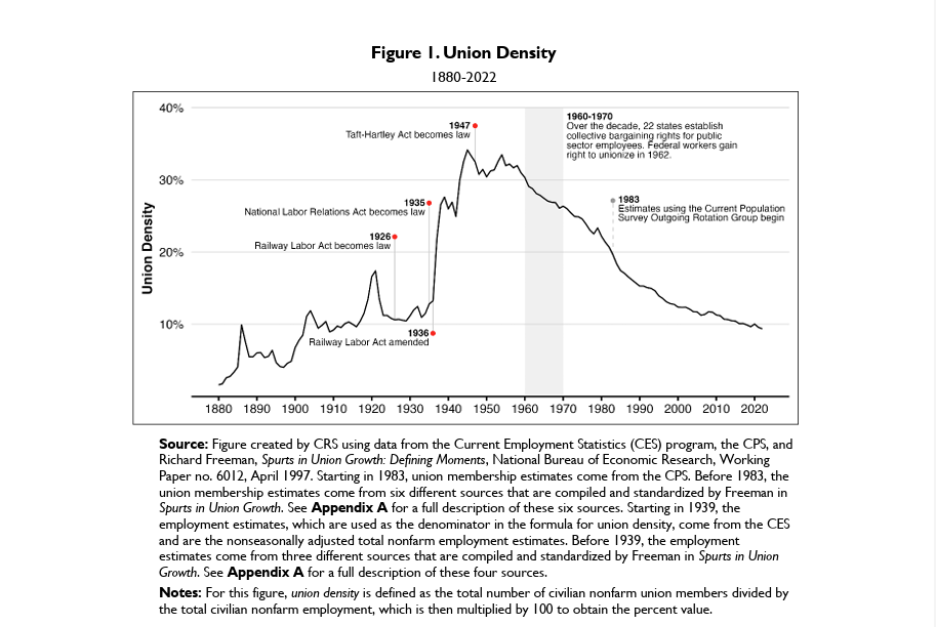
Background 

Despite renewed interest in unionization efforts at companies like Starbucks and Amazon, organized labor remains in total decline. Fewer than 9% of American workers hold union membership, and public perception of unions remains mixed at best, with many associating them with “corruption, inefficiency, and entitlement”. Right-to-work laws in 26 states, along with severe restrictions on public-sector strikes and bargaining in 39 states, further suppress labor power. While union-busting legislation, hyper-individualism, and globalization have all played a role, unions themselves have struggled to modernize and remain relevant to today’s workforce. Strict financial and legal constraints on 501(c)(5) trade unions1 hinder their ability to effectively mobilize workers, adapt new strategies, and expand their influence. 

The average full-time American worker earns $1,192.002 per week. A modest income considering annual inflation, the high costs of living, taxes which consume 10-24% of one’s earnings3, and the decline of employer-provided benefits like 401(K) matching, paid sick leave, paid family care, subsidized healthcare, and perpetuity pensions4. This directly corresponds with the globalization of manufacturing and production to the lowest wages and most unregulated working conditions overseas, i.e. “the race to the bottom”. There is also a buffering of the classes in the form of an ill-defined “Middle Class”, an aspirational “Managerial-Professional Class”, and around 33% of U.S. citizens are beneficiaries of our robust regressive welfare state5. Income inequality in the USA remains radical6. We continue to live in a fully segregated economic apartheid state where the races and also the classes, for the most part, occupy different worlds, infrastructures, and realities. 

However, the most definitive set of nails in the coffin of organized labor is the National Labor Relations Act (hereafter NLRA) itself. It is in the very nature of this law and its amendments to slow down labor militancy, neuter the righteous rage of the working class, and drown unfair labor practices in the bathtub of legalese. In short, a system of lethargy by design; the NLRB exists in past and present form to limit tactics available for workers to leverage our power. One might track the decline of union density from the very passage of the Taft Hartley Amendments7 to the NLRA in 1947.    

Around 91% of American workers are at-will employees, meaning they can be dismissed without cause, pursuant to employment law norms. Millions of undocumented, incarcerated, and literal slave laborers (trafficked into sex work and agriculture largely) exist outside any substantive labor law protections8. Not well covered under the NLRA, should they even navigate how to engage with it. Many are in highly exploitative invisible servitudes. The dominant ideology, (i.e. neoliberal or conservative brand free market capitalism) suggests “unions are outdated,” and “unions are inefficient.” With only 9% of U.S. workers unionized9 one might see unions as either “ineffective,” “flawed” or perhaps “casualties of a deliberate campaign to turn back hard-won labor rights.” Such as what is outlined in Agenda 47/Project 2025. Consquently, the World Bank thinks around 50% of the workers on earth work for under $5.50 per day. Many “union jobs” have been outsourced to nations that break strikes at gun point and have no actual rule of law, much less effective labor law. Or fully authoritarian states where workers will do what they are told, when they are told. 

Literature Review 

The highly flawed, structural issues baked within the National Labor Relations Act (NLRA) extend beyond the Taft-Hartley amendments, reinforcing deep worker divisions (“The National Labor Relations Board: A Critical Evaluation” by Michael C. Harper). Most American workers do not identify as part of a “Working Class” but instead as individuals, who “by their own merits” navigate a labor market aspiring to an imagined middle-class status. Banerjee et al., Unions Are Not Only Good for Workers remind us that in many categories of civics, wages, and well-being: union density directly correlates to gains for all working people. 

The most impactful legal defeat in recent years was Janus v. AFSCME, 585 U.S. 878 (2018), forcing all public employees to individually consent to union membership/dues check off. In Starbucks Corporation v. McKinney, No. 23-367 the U.S. Supreme Court imposed a stricter standard on the NLRB when seeking preliminary injunctions, potentially making it more challenging for the agency to obtain immediate relief against employers accused of unfair labor practices during union organizing efforts. There are “right-to-work” laws currently in 26 states (Benjamin I. SachsCompulsory Unionism” and Its Critics: The National Right to Work Committee, Teacher Unions, and the Defeat of Labor Law Reform in 1978, Pacific Historical Review 81 (2009).), The National Labor Relations Board (NLRB) operates with frustrating inefficiency (The NLRB’s Dysfunctional Role in Protecting Workers” by Richard B. Freeman), failing to penalize unfair labor practices (Failing Workers: The National Labor Relations Board and the Decline of Union Power” by Charlie Moret), failing to protect workers engaged in collective action, or empower them toward substantive mutual aid and protection (see The Decline of the National Labor Relations Board and Its Impact on Workers’ Rights” by Anne Marie Lofaso).  NLRB decisions swing wildly based on political appointments (“The Labor Board: Politics and Policies of the National Labor Relations Board” by William B. Gould IV), creating an unpredictable landscape for labor rights. Board agents often display ideological bias or act as bureaucratic functionaries rather than neutral enforcers of the law.  

There are no punitive damages for ULPs (NLRB v. Fansteel Metallurgical Corp. (1939). Republic Steel Corp. v. NLRB, 311 U.S. 7 (1940), NLRB v. Gullett Gin Co., 340 U.S. 361 (1951), Therefore, there are also few incentives besides credible threat of strike, slow down, or deep public shaming/ negative publicity to deter employer abuses (see Seth D. Harris et al., Modern Labor Law in the Private and Public Sectors: Cases and Materials (3d ed. 2021) at 415-426), also see Jane McAleveyA Collective Bargain: Unions, Organizing, and the Fight for Democracy (Ecco 2020). Additionally, restrictive definitions of who qualifies as an “employee” limit organizing potential (Cynthia L. EstlundThe Ossification of American Labor Law (2002)), see NLRB v. United Insurance Co. of America, 390 U.S. 254 (1968), Nationwide Mutual Insurance Co. v. Darden, 503 U.S. 318 (1992), see SuperShuttle DFW, Inc., 367 NLRB No. 75 (2019) while dividing workers by trade and sector—especially between private and public employment—benefits only those in power (Stephen LernerThree Steps to Reorganizing and Rebuilding the Labor Movement: Building New Strength and Unity for All Working Families, LABOR NOTES (Dec. 2002)).  

For oligarchs, corporations, and their policymakers, “industrial peace” is synonymous with suppressing labor activism while maintaining high consumption and tax revenue cycles. Repression and corporate activism against organized labor is as American as apple pie, see Rosemary Feurer & Chad Pearson, eds., Against Labor: How U.S. Employers Organized to Defeat Union Activism (Univ. of Ill. Press 2017). Policy considerations should be drawn from an understanding of the basis of the sector divisions, how workers are fundamentally compensated; the public tax base vs. corporate capital. On Public/ Private sector union differences and common causes found in Seth D. Harris et al., Modern Labor Law in the Private and Public Sectors: Cases and Materials (3d ed. 2021). The differences are rooted mostly in labor law jurisdictions, employment classifications, and the basis of tax allocations. There are valuable theories of worker centered organizing read in Eric Blanc. We Are the Union, (2023). Ruth Milkman & Kim Voss eds., Rebuilding Labor: Organizing and Organizers in the New Union Movement (Cornell Univ. Press 2004); importantly No Shortcuts: Organizing For Power In The New Gilded Age by Jane F. Mcalevey. These emphasize social movement unionism, organizing the most vulnerable, and the embrace of comprehensive campaigns. David Madland, a senior fellow at the Center for American Progress, emphasizes the role of sectoral bargaining in achieving a more equitable economy. In his book Re-Union, he advocates for a labor system that includes enhanced rights for workers and greater sectoral bargaining to complement workplace-level negotiations. 

Studies exploring the importance of Sectoral bargaining, see Kate AndriasUnion Rights for All: Toward Sectoral Bargaining in the United States, in The Cambridge Handbook of U.S. Labor Law: Reviving American Labor for a Twenty-First Century Economy (Richard Bales & Charlotte Garden eds., Cambridge Univ. Press 2020). Important bargaining ideas in general are found in Jane F. McAlevey & Abby Lawlor, Rules to Win By: Power and Participation in Union Negotiations (Oxford Univ. Press 2023). 

There are also several important international organizations one must be familiar with to see the viability of some of these proposed policies; which when taken as a whole transform more normative 501(c)5 labor unions into something more hybrid, durable, and akin to a “multi-structure-social movement,” than a mere bargaining agent, or stale, visionless business union.  Specifically, we draw your attention to the unique messaging styles, organizing methods, and social service provision structures of the Industrial Workers of the World (hereafter IWW)10, the “New General Workers Federation” (hereafter HISTADRUT11), BRAC12, and 1199SEIU Healthcare Workers East (hereafter 1199). An overview of 1199SEIU organizing can be found in Upheaval in the Quiet Zone by Leon Fink & Brian Greenberg and Moe Foner, Not for Bread Alone: A Memoir (Cornell Univ. Press 2002). These present a durable best practice modal of an industrial union in the health sector.; their success links concepts of wall-to-wall industrial organizing, successful lobbying, and social movement mobilization. The primary concept drawn from the IWW, is the prototypical idea of one big union (revolutionary industrial unionism), eliminating artificial divides of the working class, in rapid rise and rapid fall, see We Shall Be All: A History of the Industrial Workers of the World by Melvyn Dubofsky and The Industrial Workers of the World: Its First 100 Years: 1905 Through 2005 by Thompson and Bekken. Compared and contrasted to Histadrut, is the only union to ever form a state, see Zeev Sternhell, The Founding Myths of Israel: Nationalism, Socialism, and the Making of the Jewish State (David Maisel trans., Princeton Univ. Press 1998), also see Adam M. Howard, Sewing the Fabric of Statehood: Garment Unions, American Labor, and the Establishment of the State of Israel (ILR Press 2017), and Jonathan Preminger, Labor in Israel: Beyond Nationalism and Neoliberalism (Cornell Univ. Press 2017). 

A synopsis of BRACs economic ideas can be read in Freedom from Want: The Remarkable Success Story of BRAC, the Global Grassroots Organization That’s Winning the Fight Against Poverty, by Ian Smillie. BRAC is an organization that is simultaneously engaged in mass organizing, development, microfinance, education, and social enterprise. It is not a trade union at all, but instead the world’s largest NGO offering highly diverse social services, see BRAC–An Enabling Structure for Social and Economic Development (IESE Business School, 2011). 

Analysis 

The solution to attrition, NLRB adjudication delay, ideological oscillation, anti-union legislation, and corporate refusal to bargain in good faith is to mount cost effective, worker driven comprehensive campaigns.  

Trade unions today face existential challenges in retention, engagement, mobilization, and worker consciousness. Many workers no longer see unions as instruments for societal change or even as effective negotiators for better wages and benefits. Many blue-collar jobs have been moved overseas where the wages drop exponentially, and labor laws are worth the papers they are printed on. A large portion of the U.S. sentiment, particularly in the South, see unions in a far more negative light; “gangsters and communists.” Structural changes and bold visionary reimagining can reverse this trend. A worker always wins by affiliating with a union13 so why are we where we are? This fundamental question shapes the future of organized labor in the Americas. What can the individual worker gain and what clear victories can be collectively won to reset an imbalance which is rooted in our national laws and codified in a disguised, but actual class system? Union membership is in rapid decline. Unions must evolve to survive. 

To increase our political and public influence, unions should establish 501(c)(3) organizations for hardship relief and public advocacy, as well as 501(c)(4) lobbying arms that reduce dependence on professional lobbyists. Trade-specific councils overlapping with other unions can enhance coordination, while involvement in these auxiliary structures should be incentivized. More aggressive tactics—such as graduated slowdowns, strikes, and public pressure—should be used earlier in negotiations, tailored to employer behavior. Unions must also support worker-owned businesses, offer direct services like childcare and legal aid, and prioritize retaining membership through job transitions. Consolidation of weak locals or underperforming entities should be pursued to build stronger, more effective unions across entire industries. Through a stratagem of “backwards and forwards linkages” unions must not only organize “wall to wall,” and on an industrial basis, but we must also organize in relation to adjacent industry, adjacent sector, and across supply chains.  

This policy paper proposes critical reforms to strengthen union structures and organizational strategies. Comprehensive campaigns are usually massively expensive; this paper proposes how to reduce those costs. Unions should unify public and private sector locals within the same trades to foster collective action, pattern bargaining, and mutual aid. Organizing should expand across adjacent industries using off-duty union members paid per diem, reducing reliance on full-time staff organizers. Membership should be open to per diem and undocumented workers, with separate units and training pathways to integrate them into union-covered jobs. Union membership should extend beyond current employment status, creating tiered systems of affiliation and solidarity. 

To revitalize trade unionism, labor organizations must overcome not only external opposition but also internal atrophy. As important as not being divided by sector, it is an understanding that each workforce, if not workplace, has a distinct culture. There must be clear shifts to defeat sector divides, as well as a unique voice and vision cultivated by very different terms and conditions in each workplace. We must shift our approach to one that fosters greater engagement, broader worker solidarity (inter-union, inter-sector), and a clear vision for labor’s role in modern society. Or unions face oblivion in a rapacious world economy fully tilted toward corporate power, individualism, and greed. 

“In order to recruit new members on a scale that would be required to significantly rebuild union power, unions must fundamentally alter their internal organizational practices. This means creating more organizer positions on the staff; developing programs to teach current members how to handle the tasks involved in resolving shop-floor grievances; and building programs that train members to participate fully in the work of external organizing. Such a reorientation entails redefining the very meaning of union membership from a relatively passive stance toward one of continuous active engagement.” Ruth Milkman & Kim Voss eds., Rebuilding Labor: Organizing and Organizers in the New Union Movement (Cornell Univ. Press 2004). 

With no credible threat, the employing class acts with utter impunity. American trade unions, which in 2025 represent less than 9% of the workforce, face serious existential challenges. With most American workers actually existing in the “Lower Middle Class”, lacking true job security, decent benefits, and legal protections, the need for strong, organized labor is more urgent than ever. The failure of labor laws and enforcement agencies like the NLRB to protect workers only underscores the importance of revitalized union activism and solidarity across sectors. Despite decades of attacks through legislation, ideology, and corporate pressure, unions are beginning to stir again, with organizing efforts at companies like Starbucks and Amazon signaling a renewed fighting spirit. To reclaim their power, unions must reconnect with workers’ daily realities, build cross-sector unity, and offer a compelling vision for economic justice and workplace democracy.  

POLICY RECOMENDATIONS 

This policy paper suggests essential shifts in structures and organizing frameworks. Though each of these are subject to exhaustive research and discourse, this paper will focus on eight key policy recommendations related to legal structures and campaign strategies. The importance of Public-Private Sector unity in collective action and the development of allied-aligned c-structure entities to achieve a wider range of tactics and worker engagement, being the recommendations of greatest importance. 

(1) Establish 501(c)3 organizations for mutual aid and protection 

Unions should set up 501(c)3 adjacent organizations for (i) worker hardship support frameworks, (ii) to increase public sympathy, (iii) to engage the press more effectively, and (iv) circumvent some, if not most, of the NLRA bans on secondary activity. A legal framework for MUTUAL AID AND PROTECTION. 501(c)3 entities are tax deductible, grant eligible, and can perform a wide range of charitable activities, peer support, and hardship help grant making. There are specific tight caps on what they can spend on either lobbying, or direct labor organizing. They cannot endorse candidates or take partisan positions. They cannot commit resources of volunteer activity too heavily, or openly in partisan politics, or a direct labor dispute. They are by no means neutral.  

The legal definition of a 501(c)(3) organization is found in Section 501(c)(3) of the Internal Revenue Code (IRC). It defines a 501(c)(3) as follows: 

“Corporations, and any community chest, fund, or foundation, organized and operated exclusively for religious, charitable, scientific, testing for public safety, literary, or educational purposes, or to foster national or international amateur sports competition… or for the prevention of cruelty to children or animals, no part of the net earnings of which inures to the benefit of any private shareholder or individual, no substantial part of the activities of which is carrying on propaganda, or otherwise attempting, to influence legislation (except as otherwise provided in subsection (h)), and which does not participate in, or intervene in (including the publishing or distributing of statements), any political campaign on behalf of (or in opposition to) any candidate for public office.” 

Internal Revenue Code § 501(c)(3)14 

  • Outlines the requirements for tax exemption: must be “organized and operated exclusively” for exempt purposes (charitable, educational, etc.). 
  • Prohibits private inurement and private benefit, and limits lobbying and political activity. 

However, if it is the stated purpose of the 501(c)3 to support a specific type (not group) of workers and their families, raise public awareness of issues that relate to the specific classification of workers, prior to the outbreak of a strike, picket or labor action the lines a blurred, except in the areas of 501(c)3 spending related directly to LOBBYING, or LABOR ORGANZING, which must be minimal activity, or via Form 5768 Expenditure Test; If elected, allows a specific expenditure cap based on total budget (e.g., up to 20% of a budget under $500,000). The union has to facilitate the start-up of these new entities long before a dispute begins and has to have a framework for supporting them without dominating them, which is hard and runs counter to human nature. Legally speaking, the union CAN fully control the c3 if its officers do not, and even its officers can hold board positions except for those of treasurer and president. The 501(c)5 thus, can develop the brand, bylaws, strategic vision AND can donate to the entity, but some clear conflict of interest procedures must be developed, see I.R.S., Exempt Organizations Technical Guide TG 58: Charitable Organizations and Political Campaign Intervention (rev. Apr. 2021).   

The 501(c)3 is bound by an explicit tax-exempt purpose, and there cannot be substantial mission creep via overt political lobbying, or direct labor activism far off that mission or the status will be revoked. See “Nonprofit Advocacy and the Law” (Alliance for Justice), which explains how labor advocacy must be “educational, not partisan or adversarial.” That does not mean that a 501(c)3 cannot take substantial public stances related to its mission. There must be some legal, structural distance between the union 501(c)5 and the c3.  

There must be AT LEAST:  

  • Unique President/ Treasurer. 
  • Separate Executive Officers. 
  • Should be a public, private, third sector composed leadership.  
  • Separate websites/ communications platforms. 
  • Separate bank accounts. 
  • Caps on how much political or labor activity spending can occur, usually 10-20% is risky without FORM 5768. 
  • Beneficiaries cannot be only the members of the organization. 

Primary benefits: operation of tax-free social services, accessing grant money, developing positive soft power from hardship support, capable of giving tax deductible incentives for contributions that a UNION 501(c)5 CANNOT. This can be a big tent for confidence building between multiple unions exploring a merger. Now you can manage strike funds/ lay off funds in more sophisticated financial manner then a 501(c)5 can. You can circumvent many (but not all) bans on secondary activity during labor impasse, particularly what can be said to media and public. You can operate social services for members and non-union members of the industry you wish to organize as a gateway to union membership, if that is explicit in the 501(c)3 mission. You can absorb non-citizens with less scrutiny than a regular union can. 

In general, the 501(c)3 process can take 1-2 years and there must be adequate evidence and documentation for the IRS, by audit and by minutes that the group meets a distinct public benefit and is properly structured and engaged in work related to its mission. Labor organizing-adjacent activities are highly restricted for tax-exempt organizations. Any involvement that significantly supports union activities: such as coordinating directly with unions, funding strikes, or aiding in negotiations, may be seen as benefiting private interests, thus violating the requirement to serve the public good. However, activities like educating workers about their rights or conducting impartial policy research are typically acceptable as they align with public benefit. To prevent conflict of interests and loss of the 501(c)3 status, likely by charges of unfair labor practice brought by employers in a dispute: THE NEXT LAYER IS THE 501(c)4. 

It is highly advantageous strategically for a 501(c)3 to partner with or be founded alongside a 501(c)4. They can emanate from the same council the public/private union convenes; they must have unique presidents, treasurers, website, bank accounts from the c5, and each other.  The practical implication is to train workers in more sophisticated modes of “mutual aid and protection”, as well as to provide the nucleus of social service support systems union should offer not contingent on employer contribution. 

(2) Establish 501(c)4 organizations for concerted activity 

Unions should set up 501(c)4 civic league-social welfare organizations for greater political impact, for a range of wider activist/ organizer capability, and to rely less on paid lobbyists which have a use but are not as effective as direct constituent mobilization and worker voting blocks. Such entities can mobilize worker votes, can engage in effective lobbying for budget allocations, and develop industry wide protections.  

The legal definition of a 501(c)(4) organization is found in the Internal Revenue Code, specifically15

“Civic leagues or organizations not organized for profit but operated exclusively for the promotion of social welfare, or local associations of employees the membership of which is limited to the employees of a designated person or persons in a particular municipality, and the net earnings of which are devoted exclusively to charitable, educational, or recreational purposes.” 

Neither Congress nor the IRS has formally defined the terms “civic league” or “social welfare” under § 501(c)(4). However, courts have offered interpretations. In United States v. Pickwick Electric Membership Corp., the court described a civic organization as citizens working together to promote the community’s general welfare. Similarly, C.I.R. v. Lake Forest, Inc. referred to such groups as community-based movements. In Erie Endowment v. United States, the court emphasized that while defining “civic organization” is challenging, it must aim to achieve broad community goals. Importantly a 501(c)4 can be partisan, can be engaged in activist organizing efforts, and can more aggressively engage in secondary activity. It is far more effective to mobilize the votes of our workers into a local block in municipal elections and primaries, than to rely only on professional lobbyists to lobby. Basically, a legal framework for CONCERTED ACTIVITY16. (see NLRB v. Washington Aluminum Co., 370 U.S. 9 (1962). Meyers Indus., Inc. (Meyers I), 268 N.L.R.B. 493 (1984); Meyers Indus., Inc. (Meyers II), 281 N.L.R.B. 882 (1986), enforced, 835 F.2d 1481 (D.C. Cir. 1987); NLRB v. City Disposal Sys., Inc., 465 U.S. 822 (1984); Alstate Maint., LLC, 367 N.L.R.B. No. 68 (Jan. 11, 2019).) 

“Educational activities” under IRC § 501(c)(4) are interpreted using similar standards applied to § 501(c)(3) organizations. These activities must generally be conducted in a nonpartisan way. According to IRS regulations, “educational” means providing instruction that improves individual capabilities or informs the public on topics beneficial to society.  An organization may still qualify as educational even if it promotes a specific viewpoint, as long as it offers a balanced and factual presentation that allows the audience to form their own conclusions. Examples include public forums, panel discussions, and lectures aimed at informing the community. 

“IRC 501(c)(4) provides, in part, for the exemption from federal income taxation of civic leagues or organizations not organized for profit but operated exclusively for the promotion of social welfare.1 Section 1.501(c)(4)-1(a)(2)(i) of the Income Tax Regulations states that an organization will be considered to be operated exclusively for social welfare purposes if it is primarily engaged in promoting in some way the common good and general welfare of the people of the community, i.e. primarily for the purpose of bringing about civic betterments and social improvements. An organization is not operated exclusively for the promotion of social welfare within the meaning of section 501(c)(4) if its primary activity is carrying on a business with the general public in a manner similar to organizations that are operated for profit. Treas. Reg. Section 1.501(c)(4)1(a)(2)(ii).” see Internal Revenue Serv., G. Social Welfare: What Does It Mean? How Much Private Benefit Is Permissible? What Is a Community?, at 2. 

The worker storytelling process, the worker as a voters/constituent, is highly effective, and also costs less than hiring a lobbyist. The practical implication is to train workers to have political understanding, mobilized for voter turnout. This apparatus can also augment all manner of public visibility. This is the entity that can: 

  • Accommodate the political action objective of multiple allied unions. 
  • Lobby with no caps on finances. 
  • Set up SuperPAC funds. 
  • Mobilize voters in blocs. 
  • Develop legislation that benefits the union membership. 
  • Can absorb members, non-citizens, per diems, and non-NLRA bound category of workers that are not directly employed at a unionized workplace. 

Social welfare organizations were first granted federal income tax exemption under the Revenue Act of 1913, although the legislative record provides little explanation for this policy. Over time, Internal Revenue Code (IRC) § 501(c)(4) has been applied as a kind of fallback category for organizations that do not fit neatly within other tax-exempt classifications but still lack the defining traits of taxable entities. This interpretation has been supported by IRS administrative guidance and case law. Under IRC § 501(c)(4), “civic leagues and similar organizations not operated for profit can qualify for tax exemption if they are operated exclusively for the promotion of social welfare.” According to Treasury regulations, an organization meets this requirement if it is “primarily engaged in activities that promote the common good and general welfare of the community.” This “primarily engaged” standard relies on a facts and circumstances analysis, evaluating aspects such as the organization’s use of funds, employee and volunteer time, facilities, and the purposes of its various activities.  

This standard differs notably from that of IRC § 501(c)(3), which requires an organization to be operated “exclusively” for exempt purposes, meaning only an insubstantial part of its activities may be non-exempt.  

The distinction between “primary” and “insubstantial” is critical. While § 501(c)(4) organizations have more leeway to engage in nonexempt activities (such as lobbying), whether they qualify still depends on a holistic analysis of their operations. Relevant examples, such as Rev. Rul. 74-361 and Rev. Rul. 68-45, illustrate how the IRS evaluates the balance of exempt versus nonexempt functions in determining whether an organization primarily promotes social welfare, see “M. Political Organizations and IRC 501(c)(4)” by Raymond Chick and Amy Henchey at 5. What we are in essence doing is developing a practical framework to merge common trade industrial unions, clubs, or associations into one allied entity (a super-union) through practical cooperation along the lines of stacked, allied, yet legally non-conflicting tax exempt 501C entities, with distinct purposes and spheres of activity that is synergistic, but not centrally directed by the union alone. It is not a coalition; it is a small constellation of legal entities that have a specific synergistic purpose.  

  • General Coordinating Committee of allied leadership. 
  • Joint Council specific to logical groups of trades and those community interests they impact at the very least involving a public sector union, a private sector union, and community-based organizations as appropriate made up of delegates. 
  • Public Advocacy Council 501(c)3– mobilizing hardship help for workers of a type of field/trade/industrial grouping of labor no matter what sector which makes appeals to the public for varying work grievance or bargaining goal decided upon.  
  • Political Action Committee 501(c)4– mobilizing worker votes within a type of field/trade/industry no matter what sector. 
  • Holding Company to manage a portfolio of worker owned or union owned enterprises. 
  • voluntary association with no legal status to direct volunteer activity that falls outside any of the c3, c4, c5 mandated spheres. Some activities need plausible deniability.  
  • law firm to supervise this and maintain the spheres of activity, along with its audits and annual filing. 

Both types of entities can also absorb third sector workers. The most modest example of this methodology is Local 501(c)5 representing primarily public-school teachers and Local 501(c)5 representing private school teachers; form a joint council which sets up 10 to 20 overlapping bargaining goals. This is their Collective Bargaining Objectives (of both sectors). They then agree to fund and staff a 501(c)3 for charitable help to teachers and encouraging public respect and support of education; then a 501(c)4 to encourage local politicians to help fund and support their industry. There are now 4 types of organization aligned behind the CBO goals; and both the c3, and c4 can provide support for both new organizing into the 2 union. As importantly any of the 4 entities can provide membership and benefits to the third sector worker without that worker being an employee under the NLRA, a local State code, or even a citizen.  

The goal of this “confidence building” is to unify wall to wall, i.e. all the workers in the institutes of the primary trade; in a stacked public/private c5, and joint c3 charity and c4 lobby serving the whole allied work force.  

The initial goals of the lobbying division are to:  

  • Help our friends, get our opponents and neutrals out of elected office.  
  • Educate workers on which politicians support their interests. 
  • Rank local politicians on responsiveness to workers issues. 
  • Mobilize union voters.   
  • Make local elected officials responsive to labor related issues. 

The long-term goals of the lobbying division are to:  

  • Run pro-worker candidates in primaries
  • Draft and pass laws that protect worker rights. 
  • Increase the enforcement of worker rights/protections on the state level. 
  • Repeal Taft Hartley. 
  • Repeal anti-union/ union avoidance State laws   
  • Expand the NLRA to all classifications of workers.  
  • Reform the NLRB to be efficient in processing charges and claims.  
  • Enact powers of punitive damages for ULPs. 

(3) Consolidate Public and Private sector unions 

Unions must consolidate public and private sector unions of the same class of trades into unified associations for collective action, pattern bargaining, and mutual aid.  

There is no U.S. Supreme Court ruling that directly authorizes or prohibits the merger of public and private sector unions. However, federal law, specifically the National Labor Relations Act (NLRA), does not bar unions from representing both groups. Public-sector labor relations are governed by state laws, which can vary widely—some states may impose restrictions, while others allow broader union representation. In practice, several major unions represent both sectors, such as SEIU, AFSCME, and UFCW. These unions operate across legal boundaries by ensuring they follow distinct rules for each sector. While such arrangements are legally possible, unions must carefully manage different bargaining rights and regulatory frameworks to remain compliant. 

The NLRA applies as said to the majority of the private sector. State labor laws apply to the public sector. Varying Federal and State health, safety, employment regulations apply to all sectors, citizen worker or undocumented worker alike. It is obviously harder to figure out much of that safety net as an at least hidden undocumented worker, and when exploited you have no real substantive remedies (Kate Andrias, Union Rights for All). Incarcerated workers have almost no rights to speak of. Actual Slavery, though banned under the 13th amendment, remains quite intact. But almost everyone pays taxes of some form. The only actual difference between a public, private, or third sector worker is by what revenue stream their employer is compensating them for their work. Work is therefore an ecosystem. Public-sector labor relations are primarily governed by state laws, which can vary significantly. Some states may have restrictions or specific requirements for public-sector unions, affecting their ability to merge with or be represented by unions that also represent private-sector workers, see Harris et al., Modern Labor Law in the Private and Public Sectors: Cases and Materials (3d ed. 2021) at 1316. 

Private sector workers are taxed alongside public sector workers, but public sector workers are compensated with those tax dollars, which in theory support essential public services that allow for capital and enterprise to thrive. We have almost 500 years of proof we cannot allow the employing class to run unchecked. We have almost 100 years of proof that eliminating the private sector and consolidating the economy under a single party, one public sector state is regressive, violent, unfree, and also very bad economics.    

There is a general sense that certain services are “essential by law”, to be funded by the tax base and provided by career civil servants; such as police, fire, sanitation, education, utilities, and public hospitals/health services. The same forces that decimated the American labor movement, push a regime of privatization; the further fissure of the work force; lobbying for state sub-contracting of essential services to private firms. It is in the public sector where a far larger percentage of workers are unionized (32.2%-per Dept. Of Labor). Public sector jobs, in general, are more stable, less competitive, offer more benefits, and pay generally lower wages than the private sector.  Most private sector workers are “employees” under the NLRA (still excluding several million workers)17, while most public sector workers are “employees” under a state labor code (Modern Labor Law at 89). The fundamental issue is the formation of durable alliance of confidence building and mutual aid between the relevant labor unions of the private and public sector. Where 90% of the country is non-union; in general, this is about the public sector union forming a partnership or salting and seeding18 into the private or third sector.   

(4) One Union per Industry with the aim of sectoral bargaining. 

Sectoral bargaining needs to be the order of the day19. The public and private unions of a particular industry must work harmoniously and then seek to merge. These council need to be accessible, on and offline, they need to develop strategic alliances with non-unions; i.e. all the stakeholders that an industry affects. These councils should not before symbolic co-endorsement and back-patting, echo chambers, they should be to seed and salt the entirety of an industry.   

We are wasting a lot of time trying to pry individual contracts out of the hands of each separate employer (Cemex Construction Materials Pacific, LLC, cited as 372 NLRB No. 130 (2023). Unions should set up all industry specific councils that overlap with other unions and encourage/ incentivize membership on 501c committees to increase involvement. But the goal has to be a merger, we do not need or want competing worker organizations that can make separate deals with management and be pitted against each other. 

We must map and chart all existing Canadian, American, Caribbean, and Mexican organzied labor by three classifications: private sector, public sector, and a third sector (all those not covered under the NLRA, or a local state labor code thus needing special protection to be outlined). Once mapped-charted; it will be clearer if there are overlapping industries which hold both a private and public work force, and if relevant who represents them currently. Those fields with public/private competition or at least dual provision of services should be focused on. The intuitive next step is the “seeding” of a structure which can allow for the coordination of both founding unions’ goals, codified in a joint program, i.e. collective bargain objectives. Meeting all three sectors unique conditions/ arrangements/deployment of work, having to do with divergences in employment funding modal. The tax base (public), private capital (private), and a wide swath of vulnerable fields (domestic work, sex work, agriculture, undocumented trades ect.) which are sometimes public funded, largely private funded, often in an informal economy but always exploited (Hoffman Plastic Compounds, Inc. v. NLRB, 535 U.S. 137 (2002)).   

“Unions often focus on easy targets and hot shops, organizing workers in various sectors unrelated to their core industry. To offset membership losses, they expand into areas like public service, healthcare, and manufacturing. However, this generalist approach weakens their effectiveness, as they struggle to make significant changes in industries where they represent only a small portion of workers. This masks the growing weakness in their core sectors,” see Lerner, Three Steps to Reorganizing and Rebuilding the Labor Movement at 7.) 

Unions should seek consolidation of entire industries via merger of existing entities or actively raiding locals that make no demonstrable gains for their workers. There should not be multiple amalgamated locals clustered in an industry like pop-up shops, these entities are an embarrassment and at best are incompetent. At worst connected to organzied crime. Eliminating non-credible corner store locals is always a strategic imperative. 

To effectively organize and empower millions of workers, the labor movement must consolidate into a smaller number of large, sector-based unions, (see Lerner, Three Steps to Reorganizing and Rebuilding the Labor Movement at 5). The current structure of 66 fragmented and overlapping unions hinders coordinated growth. While many union leaders seek survival by diversifying into multiple industries, this strategy often weakens worker power. Instead, labor must reorganize into unified, well-resourced sectoral unions that are strategically focused on winning gains for workers in their industries. These unions should collaborate within a stronger federation that sets collective strategies and ensures accountability in carrying them out. 

(5) Membership open to all workers not limited to “employees”

In 1954 Union membership in the USA peaked at around 35% of the available labor force.20 As said, the NLRA is not on the side of the working class. The price of industrial peace is always worker rights attrition. Unions should deliberately represent workers not inherently covered under the Act, per diem workers specifically and undocumented workers generally, organized into separate units21

 Using the structures outlined we should invite any worker, any person, citizen or not, who will pay dues or show willingness to be trained and find work to become a “member”. Membership should not be based purely on being employed at a union site, nor should one have to wait to “be certified” by the NLRB to be a member. Nor should dues be the only way to achieve membership. We should make it easier to join, and easier to stay when you leave your union employment. If this cannot be properly executed vie the c5 it can certainly be worked out in the c3 and c4. Under the NLRA, several categories of workers are not considered employees and are therefore excluded from its protections22. There should not be an aristocracy of labor, there should not be arbitrary divisions. Nationalism is anathema to class struggle. The IWW was particularly open to worker affiliation, it should not be based on having been hired into a closed shop or having had to do all the work or organizing oneself; an individual should be able to join a union as an Indvidual worker.    

This is a humanitarian imperative, but it is also a strategic issue of representing those that other elements of organized labor have ignored. Working people, which when develop a consciousness of their class and situation; recognize they do in fact share a shared relationship of subservience and alienation. They share a common experience of dependency on the employing class to have organized the capital, structures, and circumstances that make their employment, their ability to feed their families possible. Now, to what degree socialists tell us this antagonism need result in revolutionary violence, is perhaps a matter of just looking at the last 100 years, but from the perspective of a conscious worker: they trade their time and labor fora wage, that is generally disproportionate to the profits the employer earns but having organized the venture. But sewing class hatreds has not born practical fruit. The violence revolutionaries tend to unleash has thus so far installed authoritarian factions in power with little regard for human life, much less workers’ rights, human rights, any rights. The real lesson of the last 100 years of struggle between the parties of the working class and various kings, aristocrats, robber barons, churches, states and capitalists are that once you begin killing people, it is often hard to stop the chain reaction of violence this causes, which irrespective of its moral injuries; is highly consciousness lowering and rarely works to empower anyone when protracted. I personally do think we all wish to live under Russian or Chinese rule, societies shaped in every single way by the unleashed “revolutionary worker state”. 

The humanitarian imperative of the labor movement is not based on revolutionary violence or “utopian schemes”. None of those schemes have born fruit in 100 years as they played out in almost every nation on earth. The objective of a union, a democratic union, is to provide a structure for concerted activity, for mutual aid and protection, on behalf of the working class. It is our imperative to take in workers, who individually are vulnerable and isolated, lacking agency, lacking choices. It is our job to train and empower them to be able to harness collective power for action. We should develop a means to train these workers in skills/credentials needed at union work sites. Union membership should not be wholly contingent on employment at a union job; there should be other tiers/ types of membership. We want lifetime union membership; we want entire families enrolled. We want union membership to take on a new significance and pride. We cannot complete with nationalism or religion, but we should try since neither of those two will act in tangible solidarity, in the way a democratic union can. 

(6) Provide Direct Benefits 

The power to bargain collectively will never be as powerful as the ability to provide actual services to one’s members. This is where hybrid entities such as HISTADRUT and BRAC come into our analysis. Again, HISTADRUT is a trade union federation and BRAC is Neither are pure labor organizations. Arguably, HISTADRUT is the largest trade union in Israel and BRAC the largest NGO on earth. Both began with similar ideas about poverty alleviation through mass movements, both have long proclaimed commitments to workers empowerment, human rights, and social justice. Today, BRAC is one of the largest employers and social service providers in Bangladesh and (16 other nations), HISTADRUT is the largest union in Israel. Whatever you may think of their actual politics; both are veritable tool kits to see what types of services can be organzied at the c3 or c5 level to win actual hearts and minds.  

Most of the time, 501(c)5 union dues pay for new organizing, mobilizations of existing members, union administration, legal, and bargaining services. Where lobbying happens, it is usually via the paid services of lobby group augmented by union member volunteers. Direct services are either weak, or not nearly as beneficial as what the employer agrees to pay into. In general, your union dues pay for union administration not for direct benefits. If you were to offer benefits you need to pay for them, which would mean raising dues.  

Using the 501(c)3-charitable foundation, 501(c)4-advocate lobby, 501(c)c5-union architecture we begin developing a more serious way to provide mutual aid and protection WHILE engaged in more sophisticated concerted activity. The stack of c3, c4, c5 is the nucleolus to making workers power more durable. Unions today engage in collective bargaining inside a NLRA framework we will never properly win, because it is a loaded game set up by lawyers for workers to fail. Instead, we look at the tool kits, “the architecture” of emancipatory development well established by HISTADRUT & BRAC in particular: the union begins to develop our own networks of social services. Our own political power base. Our own economy of workers cooperatives. We have one less set of things to wrench out of the greedy claws of the employing class; we as the union, or confederation of unions begin providing the kinds of services that in the past had to be begged for and bargained away for. Be it the employer’s agreement to wages or state largesse in the public sector; we do better to bargain larger deals (sectorally). We need to have a far bolder vision of what a union provides its members. And how it actually empowers their involvement. Unions should provide direct services and have greater capacity for political power which translates to laws the union/ and workers live under.  

The Histadrut, established in 1920 as the main labor organization for Jewish workers in Palestine (later Israel), has been a central force in the country’s labor, economic, and social development. Initially formed to represent laborers, it grew rapidly, and by 1985 had over 1.5 million eligible voters. Though originally exclusive to Jews, it began admitting Arab members in 1953. Uniquely, the Histadrut functioned not only as a labor union but also as one of Israel’s largest employers through its holding company, Hevrat HaOvdim, “Society of Workers”; operating businesses across banking, insurance, construction, agriculture, and publishing. The organization played a major role in establishing Israel’s welfare state. It created and ran Kupat Holim, the largest healthcare provider before state oversight, and offered pensions, social services, and housing. The Histadrut also contributed to cultural and educational life through schools, public lectures, and publishing houses like Am Oved. It supported cooperative agricultural communities like kibbutzim and moshavim, helping market their products. Though some of its roles have shifted, the Histadrut remains committed to improving the economic and social welfare of Israeli workers. In 1994, the Histadrut shifted focus to core union activities after new leadership took over and began shedding its non-union assets. A year later, Israel’s National Health Insurance Law ended Clalit Health plan’s exclusive ties to the Histadrut, leading to a massive drop in union membership from 1.8 million to about 200,000 and a sharp loss in revenue, forcing the sale of major assets. Today it has around 800,000 members a quarter of which are Arab.  

BRAC, established in 1970, is the world’s largest NGO. It provides a wide range of social services aimed at reducing poverty and empowering marginalized communities, particularly in Asia and Africa. Its flagship Ultra-Poor Graduation program offers assets, skills training, healthcare, and financial support to help the most vulnerable achieve sustainable livelihoods. BRAC operates one of the largest non-formal education systems, especially targeting girls and rural children, and runs BRAC University in Bangladesh. Through a vast network of community health workers, it delivers essential health services, including maternal care and immunizations. BRAC also offers collateral-free microfinance loans to support small entrepreneurs, particularly women. Its social enterprises, such as Aarong, promote fair trade and employment across sectors like agriculture, dairy, and retail. Youth empowerment programs provide safe spaces, mentorship, and vocational training, while BRAC’s disaster response efforts focus on emergency relief and long-term recovery. Collectively, these services reflect BRAC’s integrated model to tackle poverty from multiple angles. BRAC operates social services for over 100 million beneficiaries in 13 countries23

Unions should enable worker education, entrepreneurship and small business development (individual or cooperative). Unions should manage Healthplans, pensions, and scholarship funds. The “gangster” union trope is the “Teamster tough guy” who demands the boss pay for your kids’ school or twists the arm with a strike until the boss pays you; but it is still the boss paying and the gangster making threats. Here, HISTADRUT and BRAC saw that power is derived not only by threat, or credible threat; it is derived by what organization can provide for human needs while fighting for human wants. HISTADRUT, in the name of labor Zionism/ social democracy AND BRAC in the name of emancipatory development/human rights literally formed banks, land funds, universities, medical services, micro-credit, agricultural cooperatives, small business developments, and BOTH, albeit HISTADRUT in a colonizing venture, and BRAC in a humanitarian international development mode; they build non-state infrastructure frankly unheard of by any non-state, non-religious entity. Today, whatever you may think of the Israeli occupation in Palestine, or the fragility of Bangladesh and its rampant poverty; I ask you look beyond the rhetoric and the politics and see the methodology. This can be defined beyond a taxation classification, beyond incorporated designation. The architecture and rhetoric are second to the direct benefits offered in their massive sets of social programs. These social programs are without a doubt the bedrock of maintaining member engagement and support.  Hiring halls, training, childcare, and legal services are fairly common in modern unions today. We need to develop more mechanisms to retain worker membership when they resign, retire, or are terminated. 

1199SEIU has a robust hiring hall and worker training system. In general, there is well developed system to have the union find you a union job, and funds to up-skill/up-credential once in the union. It also has varying schemes to keep one’s health benefits and pension between different employers. In general, 1199 as an industrial healthcare union is not interested in any worker not linked to the health field for membership but does get involved in many varying adjacent political issues; such as “fight for $15” minimum wage and varying issues around health funding. The IWW never had a serious benefits system besides “mutual aid,” which like anarchist mutual aid everywhere is generally disorganized and inefficient. All the groups listed (except for the IWW, which barely exists today except in skeletal nostalgic form) possess varying funds and scholarships for workers and children of workers to gain important skills and education. But there is not much thought or planning on how to retain them in the loyal orbit of the movement once they gain the agency to become “actually middle to upper middle class.” With NYSNA Nurses (NPs) making over 170K and an IAFF Firefighter who after his 22-year pension begins at age 42 opens a hardware store chain and now makes 440K; are these people still in the actual working class? Do they retain any incentive to pay union dues and support the organization that benefited them while they worked for others? 

BRAC and HISTADRUT both understand that not every worker wishes to work for someone else forever, and absorbing all types of talent back into the organization has staffing limits. 1199 is good at identifying leadership talent in delegates and promoting them to organizers, offices and VPs. But BRAC/ HISTADRUT both fully understand some of the limitations, if not all of the limitations of collectivization and socialist ideal. Some people wish only for good jobs and safe conditions, a pension on which to retire, and others have entrepreneurial spirit that the union should not lose to Managerial-Professional Class. Thus, it should be noted that BRAC and HISTADRUT developed banks to make loans/microloans, set up holding companies for social/ and regular enterprise, and make business loans to their members and beneficiaries. It would be better to develop a humane and ethical small-medium business class from workers than wish to work for themselves, then hemorrhage educated or ambitious people from one’s movement, or have them as ally, where not most unions will lose them when they graduate. This perhaps is the cognitive dissonance required to be speaking in one white paper about IWW’s spirit, Histadrut’s parallel state infrastructure, 1199’s industrial organizing, and BRAC’s poverty alleviation programs; but they inform structures not ideology nor policy. These four specific organizations have pioneered very different modes by which the working class and the poor develop power.  

(7) Organize Comprehensive Campaigns 

All future organizing must involve and be led by actual workers. A Comprehensive Campaign is an advanced labor organizing strategy that goes beyond traditional methods by incorporating research, community coalition-building, media publicity, political and regulatory engagement, and both economic and legal pressure. These multifaceted efforts aim to strengthen collective bargaining or unionization efforts by mobilizing support from a wide range of allies and leveraging multiple pressure points on employers. Though rooted in the U.S. where unions face fewer legal protections and cultural support than in Europe comprehensive campaigns are becoming increasingly relevant globally, as employers adopt American-style union-avoidance tactics. While these campaigns remain relatively rare in the U.S. due to their high cost and complexity, more unions are investing in the capacity to deploy them, viewing comprehensive strategies as essential to adapting to the evolving global labor environment (Bronfenbrenner & Hickey, Winning is Possible: Successful Union Organizing in the United States, 24 Multinational Monitor 6 (2003) the core elements are: 

1) Adequate and Appropriate staff and financial resources;   

2) Strategic Targeting;   

3) Active and Representative rank-and-file organizing committees;   

4) Active Participation of member volunteer organizers;   

5) Person-to-Person contact inside and outside the workplace;  

6) Benchmarks and Assessments to monitor union support and set thresholds for moving ahead with the campaign;   

7) an Emphasis on Issues which Resonate in the workplace and in the community;   

8) Creative, escalating internal pressure tactics involving members in the workplace;  

9) Creative, escalating external pressure tactics involving members outside the workplace, locally, nationally, and/or internationally; and   

10) Building for the first contract during the organizing campaign. 

“Backwards and Forwards Linkage” in BRAC’s jargon; is the ownership of different units of production, supply, and retail throughout a supply chain. For our policy organizing purposes this means unionizing up and down a supply chain. Which necessitates the consolidation of unions by industry, and consolidation of the public and private sector into one labor union, albeit with separate bargaining & legal divisions; as the NLRA and State Labor Codes do not contain the same processes.  

The base is your own industry (private and public sectors of it) 

  • There should only be ONE UNION PER INDUSTRY 
  • Followed by whatever other classifications of employee work in the bargaining units when defined 
  • Followed by non-union shops of the same type of industry 
  • The secondary target sets are the next 2-3 adjacent industries 

Such as warehouse workers to truckers to longshoreman to sailors. Such as hospital nurses to EMS to nursing homes staff to medical supply companies to pharmacies. The tertiary target sets are individual workers of unskilled, semi-skilled trades that are aided by the union in filling vacancies at bargain unit sites or send to school for skilled/ semi-skilled training to fill in a unionized job site of need. Unions should organize adjacent industries24 using workers not employed at those specific job sites; paid organizer staff should be greatly increased25with a far greater utilization of off duty union members/delegates paid per diems for short engagements. Unionized workers should be paid per diem to engage with workers of the same industry and different plants/bases/companies. Using workers to organize fellow workers is far more effective than the use of paid organizers alone. To achieve a cost-effective comprehensive campaign a union will need to have consolidated, set up a council for the industry to enlist additional coalition partners. As well as developed its c3/c4/c5 capability. Efforts like that require a COMPREHENSIVE CAMPAIGN. Which requires much higher levels of planning. 

This fundamentally means wall to wall + adjacent industry organizing. Which is well accepted in principle, but not well actualized. Low hanging fruit organizing, i.e. units under 25-50 workers has been seen without any result in Starbucks (Starbucks Corporation v. McKinney, No. 23-367); the Teamsters have not successfully won a better contract at Amazon, and Starbucks has resisted bargaining with unionized stores brought under a joint employer farmwork. There are continued limitations on union organizers entering work sites, see Lechmere, Inc. v. NLRB, 502 U.S. 527 (1992), see Cedar Point Nursery v. Hassid, 141 S. Ct. 2063 (2021). Amazon has filed multiple lawsuits aiming to challenge the NLRB’s authority and delay unionization efforts. These legal actions are part of a broader strategy to contest the legitimacy of union representation and the NLRB’s enforcement capabilities. 

There is an obvious paranoia and active threat of retaliation against the key/lead organizers of a campaign who are actual employees. There is an exaggeration of insider/ outsider, but really only an insider (an employee) can be fired. The suggestion is to use union members (on a per diem basis) to organize workers of the same trade/ classification type, at sites they do not work at.  

Organizing Departments should be expanded, and more money should be spent on utilizing more sophisticated modes, which means hiring more expertise driven staff, but at the core of the comprehensive campaign is the involvement of the lay worker, and volunteerism has hard limits with the working class. So, organizing departments should develop systems of hour pay so workers can be used effectively as front-line communicators of the benefits of unionization. There is a time and a place for the quintessential “wiley-socialist wobbly”, there is a place for the “honed labor maven”, but the starring role in a comprehensive campaign is the fellow worker of your same field, extolling the benefits of industrial democracy as well as explains the nuts and bolts. Explaining their “feelings about the union” is more important than sharp comms propaganda, tight scripted catch phrases, and rhetoric. That is because the working class recognizes their own, and each work force does have a unique style and jargon. There is a place still for a professional organizer. There is room for mavens. But to see women and men of your own trade, class, and profession explain what the “union feels like”; that is akin as to why story telling is far more effective tool than power points. 

(8) Wage a War of Attrition 

Every single worker that we bring into a union will be getting a chance for a better wage, stronger benefits, and dignity at work. We are not being defeated in the streets, we were defeated between 1935 and 1947, when we lost via the legal framework of our rights the reality of credible threat. Every single union job replaced with at-will employment is a step towards serfdom. It’s taking too long to organize certification and too long to win the first contract. Humans are self-interested, risk adverse, and seek to maximize pleasure and minimize pain. The working class is uniquely responsible for the productivity of society. The basic calculation of the capitalist system is that the working class must be kept working as long as possible, while paid as little as possible, subject to some liberal ideas in “developed nations” only. Before unions, there were children in the mines, 100-hour work weeks, no safety regulations, and company towns, i.e. Company fiefs. The balance the NLRA struck was that we would avoid class war, general strikes, and revolution by bureaucratizing the rights of working people.    

The way organized labor was reduced to 9% in the USA was through systematic conservative lobbying, union avoidance laws, and NLRA bureaucratic processes that make it too hard to organize, bargain, and fight.  

Unions should be prepared to engage in public pressure, economic pressure, slowdowns, work to code, and strikes sooner in the bargaining cycle and deploy more aggressive economic tactics than mere pickets early on, perhaps prior to any negotiations. These tactics should also be pattern escalation tactics proportional to company bad faith, surface bargaining, and ULPS. It is highly stressed that the elements of a comprehensive campaign are in place to allow full utilization of all necessary tactics of secondary activity, launched from the structures of the c4 and voluntary association. Union members and the public should be educated, primed, and ready to boycott goods of primary, secondary, and tertiary supply line corporations. We must rewire our whole thinking. It is not in fact about the credible threat of withholding one’s labor to leverage for a better hand out at bargaining. That is the actual thinking of a business union. The hard rewire is that we are not just looking for safe jobs with good benefits. We are not just looking for real human rights and actual worker dignity. We are looking to re-order the priorities and the power structures of a society, and the international order of things. How can we fundamentally tolerate the “middle class” life for one set of workers, while in the same city another group are subjugated. While right over an artificial and invisible border, the conditions are far worse. The natural inclination of both the neoliberal and conservative capitalist is to move production to the lowest bid. Union jobs cost more than export processing zone jobs, or sweat shop jobs, and therefore it is never about certification of just one shop here or there; not just about contracts. Not about simply moving the needle on wages and benefits. 

The war of attrition we are speaking of needs to be multi-dimensional and fought on numerous fronts. The benefit of a well-planned comprehensive campaign is that it engages in all sorts of maneuvers, in all sorts of walks of life of a given society. It is not enough to get our 30-60% of a bargaining unit if we are not in fact empowering workers to have a new thinking about unions, civics, class, and society. We are not simply looking for pork-chop politics, liberal laws, and higher wages; we are looking on developing a new kind of working-class organization that makes organized labor be the at the forefront of social change, political change, and how workers think about themselves in society. 

The war of attrition is not just about counting cards and striking a good bargain. It is about how Indvidual people feel about the worth of our own labor. It is about truly developing a mode of free life, human rights oriented, and democratic in character where people maintain individual liberty, but finally develop some actual sense of collective good, of communal living, not like a hippy commune, not like socialism; not see in jargon and ideology. Instead, the union is not only workers banding together for “mutual aid and protection”, not just about our “concerted activity” to bargain. It is not just about the cards in the shop, or the pickets in the streets; it is about modeling a new time of values and a more evolved level of civic participation. 

Waging a war of attrition between the working class and employing class got most of the IWW leadership jailed, deported, or killed by 1920. “One cannot bargain with a lion when your head is in its mouth” paraphrasing Churchill. We have plainly seen in the last 100 years that all attempts to “seize the means of production” end in bloodshed and tyranny. The war of attrition then is not about what labor can wrestle from the employing class, or what can it seize. It is about to what degree we can organize our structures properly so that the union and its allied entities can deny the employing class the ability to maintain our alienation, subjugation, and dependency.       

Each worker brought into a union, or a “super-union” described is citizen of labor, a participant in a living organization that will do more than perhaps one’s own government does in the realm of meeting needs and actualizing wants. The war of attrition is still perhaps for the next 100 years the same as before, one woman, one man at a time, card by card, increasing the strength of collective action. The study of 1199SEIU, informs the realities of what a union does in one sector to survive if not thrive, but 1199 is only 450,000 workers in a nation of 335 million, it’s parent federation the SEIU under 2 million union members. But 1199 shows a best set of practices of what is and survives, as a business union. But looking at Histadrut and BRAC we see ways that social services are delivered without dependency. Looking at IWW we see a spirit of rebellion that if we lose, shed, hide we are purely a transactional affair. The Union must be on the war footing, as the working class is always under siege. But if we truly begin to build the kind of structures that shift dependency away from the employing class and the state, we begin to win the war of attrition, because it is not about what we can take. It is about the alternatives and opportunities we can provide.    

THEORIES OF CHANGE 

  1. ALWAYS PRO-WORKER concerted activity, “organized for mutual and protection”, and engaged in what can only be described as “the most low-budget/cost-effective/ democratic comprehensive campaigns in history. 
  • Actual readiness to put workers above union brands.  
  • Actual investment in the training of a union membership that values democratic participation, civic involvement, and feel real solidarity with fellow workers in other trades.  
  • Worker led, worker mobilized industrial democracy. 
  • Democracy has to be taught and regularly engaged in. 
  1. ONE UNION PER INDUSTRY 
  • Actual willingness to cooperate and consolidate unions. 
  1. SECTORIAL BARGAINING PREFFERED 
  1. FALSE NECESSITARIAN 
  • Human Rights Oriented. 
  • Rejection of all meaningless ideology. 
  • Rejection of left/right, liberal/conservative, loaded historical jargon.  
  • Reject any affiliation with any party.  
  • There are compatible liberal and conservative approaches to all social policies (Oberto Ungar). 
  1. REJECT THE PRIMACY AND IMPORTANCE OF THE NLRA/ NLRB PROCESS 
  1. DEMOCRATIC CONFEDERALISM 
  • Actual use, empowerment, and training in civics and use/value of democracy. 
  • Actual commitment to Democracy, democratic autonomy 
  • Always drawing leadership from the rank and file. 
  • Councils for trades, councils for sectors, council for industries. 
  • QUOTA DIVERSITY– not fake liberal DEI, quota driven balance of identities in all levels of the organization 
  1. ADVOCACY VIA ACTAUL WORKERS POWER: Not the other way around. Workers educated, trained, and empowered to lead their unions. 
  • Always pro-worker. 
  • Always organize the most vulnerable workers. 
  1. SOLIDARITY: IMPROVE CULTURE/ MORALE/ SURVIVAL/RETENTION VIA “MUTUAL AID AND PROTECTION” 
  • Hardship Help with seeding 501c3s. 
  • Providing more direct benefits. 
  • EDUCATIONAL DEVELOPMENT/ ELEVATION– hiring halls and skill building 
  1. COMPREHENSIVE CAMPAIGN– low to no budget comprehensive campaigns using the joint council, using the c3, c4, c5 stack. 
  1. BACKWARDS AND FORWARDS LINKAGE IN ORGANZING 
  1. LEGISLATIVE CHANGE 
  • Lobbying for essential funding/ increased scope 
  • One code of law for all workers 
  • Running Workers Party candidates 
  1. CREDIBLE THREAT DOCTRINE 
  • Always prepared for a strike, boycott, or action. 
  • Always ready to strike in the first 3 months of bargaining first contract. 
  • Always ready to escalate. 
  • Always able to mobilize secondary activity via the affiliated groups on the joint council. 
  • Ready to mobilize the private sector in strike when the public sector isn’t legally allowed to. 
  1. FOSTER PUBLIC SYMPATHY AND UNDERSTANDING– appealing to the public we serve to support us/ also via the press. 
  1. WORKER SUPPLIED CONTENT ON ALLIED MEDIA– allowing workers to tell their own stories online, to each other, to the public, to increase our trade visibility. 

IMPLEMENTATION 

Stage Zero: COALTION OF THE WILLING, there will be a rejection of the plan by most big unions, so the first step is the buy in, at least for exploring the tactics/structures of a private sector union and a public sector union, and at least the due diligence of at least trying to engage their locals in the planning. We will likely find few actual partners and, in all likelihood, must begin by engaging workers directly.  

Stage One:  

SUPERSEEDING– setting up hybrid public/private/community structures that allow for higher levels of worker support services, higher levels of political education/ legislative action, and set up the basics of a comprehensive campaign for the industry which can operate complete unrestricted by NLRA bans on secondary activity (NLRB v. Fruit & Vegetable Packers (Tree Fruits), 377 U.S. 58 (1964), National Woodwork Manufacturers Association v. NLRB, 386 U.S. 612 (1967), Longshoremen v. Allied International, Inc., 456 U.S. 212 (1982).  

Stage Two:  

SUPERSALTING– organizing union members/organizers to not only take jobs in companies one plans to unionize, but also taking employment in varying 501c3/501c4 entities that the union wants to learn from or have interest in enlisting into the joint council. With a particular focus on infiltration and organization of agricultural workers, domestic workers, sex workers, and railway/airline workers.  

Stage Three:  

SUPER-UNIONS: one per industry representing the public and private sector of the industry with willingness to absorb and train NON-NLRA covered workers. This consolidation should attempt to be voluntary and democratic but should not hesitate to raid smaller amalgamated locals with histories of non-performance on behalf of their members. Note: a “super-union” does not mean a union of large size; it means a c5 augmented with a c3, and c4. 

Stage Four: PILOTS 

Mounting a series of demonstration campaigns along critical industry supply lines. Such as public and private education; such as public and private healthcare; such as organizing in a traditionally non-union southern work force using the c3/c4 to lead into a c5. Such as training organizers to form c3, c4 units inside no NLRA covered work forces. NOTE: a pilot would be about unionizing all types/classification of workers in one geography in one industry. 

Stage Five: CAMPAIGNS 

Replicating on a larger scale campaign with a focus on up to four adjacent industries aligned in one comprehensive campaign. Such as trucking/sanitation, farming/groceries, schools (public + private), and healthcare (public + private).  NOTE: a comprehensive campaign at scale would be several sectors, several adjacent industries, over a larger geography. 

IMPLICATIONS 

What are the pros and cons? The main pro is that this is expected to greatly increase union density. It will make the unions more central to American life and increase the bargaining power we have via larger industrial unions leveraging industry wide concessions.  

The main con is that it deeply changes the economics and power centers of a trade union taking on new costs and responsibilities, as well as workers who don’t have the same protections the NLRA offers bonified “employees”.  We also run the risk of trading the 63+ national AFL CIO unions for 9 to 10 that are bloated bureaucracies that capitulate more readily to corporate interests. Alot of this policy also assumes that rank and file workers will make time and effort to adopt these structures, which are dominated at the present time by the Professional Managerial Class. It is also important to note that the radical IWW barely still exists 120 years after formation. The Histadrut was highly culpable in the displacement of Arab workers and likely has characteristics unique to a Jewish context. BRAC is far more like a mega NGO, and a bank than it is like a social movement. 1199SEIU has very unique advantage of being a healthcare union, which occupies a uniquely important place in the economy and imagination. So, none of the four groups have typical worker demographics/ dispositions in 2025. Anarchism and Socialism are fully marginal ideologies. Palestine is in literally amid war crimes and instability. Bangladesh is one of the poorest countries on earth and its going under water. You will see IWW members at punk rock concerts, but what contracts have they won lately? 1199SEIU is alone the closest local example and they have not taken any steps to consolidate their industry, or to engage the public sector. There are legal and structural reasons for this.       

What is feasible?  

For the AFL-CIO or SOC to sponsor a demonstration campaign using organizers and union members from the big four. If mainstream organzied labor rejects this fully, form worker led council, c3, and c4s first then see which of the big four will absorb workers from the effort, but this mode is less desirable as it puts more learning curve on workers and will create ‘parties’ within existing unions. 

What are the predictable outcomes?  

At the time of writing in 2025 there are 63 unions in the AFL-CIO. The best-case scenario initial outcome would be to get buy in from one large private sector union and one large public sector union to carry out a timebound, heavily monitored and evaluated comprehensive campaign pilot. Such as a local of AFSCME and a local of SEIU partnering in an urban work force. For general reference, we will want to identify the 4 largest American labor organizations.26 

Which include the National Education Association (NEA), the Service Employees International Union (SEIU), the International Brotherhood of Teamsters (IBT); and the American Federation of State, County, and Municipal Employees (AFSCME), which represents public sector workers across various government agencies and services. These unions are among the most influential in the U.S., with significant organizing power and political impact. Each has deeply entrenched interests and should all be expected to initially reject the totality of this policy plan. In the next 50 years most of the Teamsters will be replaced by robots. As will many roles in the SEIU. For the forceable future most, Americans will want human teachers, medical workers, and public servants.  

CONCLUSION 

The working class and the employing class have at least one thing very much in common, it is that neither has figured out how to exist without each other. Try as either side might, over the last 300 years it remains clear that “worker self-management” devolves into a highly unproductive blood bath, see all experiments with socialism, (Hobsbawm, The Age of Extremes, The Black Book of Communism, Stéphane Courtois, et al), which all failed. In general, so far, the parties of the working class are as ruthless as the capitalists when in power and there are virtually no examples of competitive and efficient workers cooperatives on an industrial scale. 

On the other hand, neither globalization nor automation have allowed the employing class to fully replace, outsource, or employ fully at will, i.e. restore widespread serfdom and slavery. Without democratic super-unions, without organized labor we would have children in mines, 80-hour weeks, and zero labor protections. Like much of the world actually still has if you consider it. Quite like what corporations seek out- when they move jobs abroad. 

In the same thinking that a public and private sector worker have more in common with each other than with an employer, for ages Communists have asked the working class to have more in common with each other, than with the nation state, or sky-pie religion. That also largely has failed. And how do we know it “failed”: because there are only 5 communist parties running states in 2025: (China, North Korea, Laos, Vietnam, and Cuba) and none of them are actually still socialist, except for perhaps Cuba. Which is on the verge of bankruptcy and collapse and can barely keep the national power grid on. The Union, as we today still understand “the union”, is dying out as it is not evolving in form and function. The working class is still highly vulnerable and outright exploited in most of the world. This paper does not ask for the Titanic to be raised and for seas to part; nor is it a love letter to defeated ideology. We ask what is left of the labor movement to take a chance on a demonstration campaign and see if the “juice is worth the squeeze.”   

We were once told “we had nothing to lose buy our chains”; then the chains developed in different forms, different dependencies, in differing contexts. The unions and labor laws of today are still a type of chain. We do not have to gamble our lives on ideas about things we have never seen proven; we should instead invest in proving ideas that we have seen partially work. The emancipation of the working class has nothing to do with bigger, better unions, better laws. It has everything to do with empowerment. If the working woman and man look to the union as provider, protector, and means for advancement the union itself is a means to win. If the union is an actual service provider, an employer, a political mobilizer, a party, one invests in what provides one actual meeting of needs, attainment of wants; and above all else: makes our lives and work have dignity.        

Bibliography 

Kate Andrias, Union Rights for All: Toward Sectoral Bargaining in the United States, in The Cambridge Handbook of U.S. Labor Law: Reviving American Labor for a Twenty-First Century Economy (Richard Bales & Charlotte Garden eds., Cambridge Univ. Press 2020). 

Kate Andrias, Sectoral Bargaining in the United States, in The Cambridge Handbook of Labor and Democracy (Angela B. Cornell & Mark Barenberg eds., Cambridge Univ. Press 2022). 

Asha Banerjee et al., Unions Are Not Only Good for Workers, They’re Good for Communities and for Democracy: High Unionization Levels Are Associated with Positive Outcomes Across Multiple Indicators of Economic, Personal, and Democratic Well-Being (Econ. Policy Inst. Dec. 15, 2021). 

Eric Blanc, We Are the Union: How Worker-to-Worker Organizing Is Revitalizing Labor and Winning Big (2023). 

BRAC – An Enabling Structure for Social and Economic Development (IESE Business School, 2011). 

Rami Ginat & Daniel Blatman, British Trade Unions, the Labour Party, and Israel’s Histadrut (Palgrave Macmillan 2021). 

Kate Bronfenbrenner & Robert Hickey, Winning is Possible: Successful Union Organizing in the United States, 24 Multinational Monitor 6 (2003). 

Raymond Chick & Amy Henchey, M. Political Organizations and IRC 501(c)(4), in Exempt Organizations Technical Instruction Program for FY 1995 (Internal Revenue Serv., 1995), https://www.irs.gov/pub/irs-tege/eotopicm95.pdf

Paul F. Clark, John T. Delaney & Ann C. Frost eds., Collective Bargaining in the Private Sector (Cornell Univ. Press 2002). 

City Univ. of New York Sch. of Labor & Urban Studies, The State of the Unions 2024 (2024), available at https://slu.cuny.edu/wp-content/uploads/2024/08/The-State-of-the-Unions-2024.pdf

Stéphane Courtois et al., The Black Book of Communism: Crimes, Terror, Repression (Jonathan Murphy trans., Harvard Univ. Press 1999). 

Melvyn Dubofsky, We Shall Be All: A History of the Industrial Workers of the World (abridged ed., Univ. of Ill. Press 2000). 

Rosemary Feurer & Chad Pearson, eds., Against Labor: How U.S. Employers Organized to Defeat Union Activism (Univ. of Ill. Press 2017).   

Moe Foner, Not for Bread Alone: A Memoir (Cornell Univ. Press 2002). 

Leon Fink & Brian Greenberg, Upheaval in the Quiet Zone: 1199SEIU and the Politics of Health Care Unionism (2d ed. Univ. of Ill. Press 2009). 

Richard Freeman, Spurts in Union Growth: Defining Moments, National Bureau of Economic Research, Working Paper no. 6012, April 1997 (hereinafter, Spurts in Union Growth, 1997.) 

Richard B. Freeman, The NLRB’s Dysfunctional Role in Protecting Workers, in The Labor Movement in the 21st Century: Challenges and Opportunities (Columbia Univ. Press 2010). 

Walter Galenson, Split Corporatism in Israel (SUNY Press 1992). 

William B. Gould IV, The Labor Board: Politics and Policies of the National Labor Relations Board (Univ. of Cal. Press 1979). 

William B. Gould IV, The Labor Board: Politics and Policies of the National Labor Relations Board (MIT Press 1985). 

Michael C. Harper, The National Labor Relations Board: A Critical Evaluation, 36 Labor Law Journal 253 (1985). 

Seth D. Harris et al., Modern Labor Law in the Private and Public Sectors: Cases and Materials (3d ed. 2021). 

Eric Hobsbawm, The Age of Extremes: A History of the World, 1914–1991 (Vintage Books  

1996). 

Adam M. Howard, Sewing the Fabric of Statehood: Garment Unions, American Labor, and the Establishment of the State of Israel (ILR Press 2017). 

Internal Revenue Code § 501(c)(3), 26 U.S.C. § 501(c)(3) (2024). 

Internal Revenue Serv., G. Social Welfare: What Does It Mean? How Much Private Benefit Is Permissible? What Is a Community?, in Exempt Organizations Technical Instruction Program for FY 1981 (1981), https://www.irs.gov/pub/irs-tege/eotopicg81.pdf

 
I.R.S., Exempt Organizations Technical Guide TG 58: Charitable Organizations and Political Campaign Intervention (rev. Apr. 2021), https://www.irs.gov/pub/irs-tege/tg58.pdf. 

Michael L. Katz, The National Labor Relations Board in the Trump Era: A Constitutional and Political Critique, 50 Industrial Relations Research Association 120 (2019). 

Ian Kullgren, Infighting at Labor Board Paralyzes Its Operations, Politico (Apr. 18, 2018), https://www.politico.com/story/2018/04/18/national-labor-relations-board-infighting-529688

Jamelle Bouie, This is What Happens When Workers Don’t Control Their Own Lives (December 14, 2021) https://www.nytimes.com/2021/12/14/opinion/tornadoes-mayfield-amazon.html 

Samuel Kurland, Cooperative Palestine: The Story of Histadrut (Arco Publishing Co. 1947). 

Stephen Lerner, Three Steps to Reorganizing and Rebuilding the Labor Movement: Building New Strength and Unity for All Working Families, LABOR NOTES (Dec. 2002), https://labornotes.org/2002/12/three-steps-reorganizing-and-rebuilding-labor-movement-building-new-strength-and-unity-all

Anne Marie Lofaso, The Decline of the National Labor Relations Board and Its Impact on Workers’ Rights, 29 Workplace Rights Review 185 (2018). 

Jonathan Preminger, Labor in Israel: Beyond Nationalism and Neoliberalism (Cornell Univ. Press 2017). 

David Madland, Re-Union: How Bold Labor Reforms Can Repair, Revitalize, and Reunite the United States (ILR Press 2021). 

Jane F. McAlevey, No Shortcuts: Organizing for Power in the New Gilded Age (Oxford Univ. Press 2016). 

Jane McAlevey, A Collective Bargain: Unions, Organizing, and the Fight for Democracy (Ecco 2020). 

Jane F. McAlevey & Abby Lawlor, Rules to Win By: Power and Participation in Union Negotiations (Oxford Univ. Press 2023). 

Ruth Milkman & Kim Voss eds., Rebuilding Labor: Organizing and Organizers in the New Union Movement (Cornell Univ. Press 2004). 

Charlie Moret, Failing Workers: The National Labor Relations Board and the Decline of Union Power, 45 Labor Studies Journal 31 (2020). 

Thomas Piketty, Capital in the Twenty-First Century (Arthur Goldhammer trans., Belknap Press 2017). 

Nicholas A. Pittner, Better Bargaining: Navigating the Minefield of Public Sector Collective Bargaining (Bookbaby 2021). 

Benjamin I. Sachs, “Compulsory Unionism” and Its Critics: The National Right to Work Committee, Teacher Unions, and the Defeat of Labor Law Reform in 1978, 78 Pacific Historical Review 81 (2009). 

Ian Smillie, Freedom from Want: The Remarkable Success Story of BRAC, the Global Grassroots Organization That’s Winning the Fight Against Poverty (Kumarian Press 2009). 

Zeev Sternhell, The Founding Myths of Israel: Nationalism, Socialism, and the Making of the Jewish State (David Maisel trans., Princeton Univ. Press 1998). 

Fred W. Thompson & Jon Bekken, The Industrial Workers of the World: Its First One Hundred Years: 1905 Through 2005 (Industrial Workers of the World 2006). 

CASES REFERENCES 

  • NLRB v. Fansteel Metallurgical Corp., 306 U.S. 240 (1939) 
  • Republic Steel Corp. v. NLRB, 311 U.S. 7 (1940).  
  • United States v. Pickwick Elec. Membership Corp., 158 F.2d 272 (6th Cir. 1946). 
  • NLRB v. Gullett Gin Co., 340 U.S. 361 (1951). 
  • NLRB v. Washington Aluminum Co., 370 U.S. 9 (1962). 
  • C.I.R. v. Lake Forest, Inc., 305 F.2d 814 (4th Cir. 1962). 
  • Erie Endowment v. United States, 316 F.2d 151 (3d Cir. 1963). 
  • NLRB v. Fruit & Vegetable Packers (Tree Fruits), 377 U.S. 58 (1964) 
  • National Woodwork Manufacturers Association v. NLRB, 386 U.S. 612 (1967). 
  • NLRB v. United Insurance Co. of America, 390 U.S. 254 (1968). 
  • Longshoremen v. Allied International, Inc., 456 U.S. 212 (1982). 
  • NLRB v. City Disposal Sys., Inc., 465 U.S. 822 (1984) 
  • Meyers Indus., Inc. (Meyers I), 268 N.L.R.B. 493 (1984). 
  • Meyers Indus., Inc. (Meyers II), 281 N.L.R.B. 882 (1986), enforced, 835 F.2d 1481 (D.C. Cir. 1987). 
  • Nationwide Mutual Insurance Co. v. Darden, 503 U.S. 318 (1992) 
  • Lechmere, Inc. v. NLRB, 502 U.S. 527 (1992). 
  • Hoffman Plastic Compounds, Inc. v. NLRB, 535 U.S. 137 (2002). 
  • Janus v. AFSCME, 585 U.S. 878 (2018). 
  • SuperShuttle DFW, Inc., 367 NLRB No. 75 (2019). 
  • Alstate Maint., LLC, 367 N.L.R.B. No. 68 (Jan. 11, 2019). 
  • Cedar Point Nursery v. Hassid, 141 S. Ct. 2063 (2021). 
  • Cemex Construction Materials Pacific, LLC, cited as 372 NLRB No. 130 (2023). 
  • Starbucks Corporation v. McKinney, No. 23-367 (2023). 

MEC-Prelude I

THE RISE OF THE MIDDLE EAST CONFEDERATION 

(THE DEFENSES) 

Rabûna Konfederasyona Rojhilata Navîn 

صعود اتحاد الشرق الأوسط 

Compiled reports from the Committee of Public Safety for the Middle East; also, from the Committee for General Security; and the Club Cordeliers; as typed and translated by Walter Sebastian Adler (in American English) and Polina Mazaeva (in Russian); with assistance from TEV DEM (Movement for Democratic Society) and the Democratic Union Party.     

ADLER S WALT 

EMMA SOLOMON 

AVINADAV DEBUTELIERS 

KAVEH ASHURI 

Reduced and translated to American English 

PRELUDE I  

اربيل 

ERBIL,” “ARBIL,” “HEWLER,”  

BASHUR, IRAQ, 2014ce 

*** 

“The order to evacuate Erbil was given just an hour ago. But we evidently have ignored it.” My Kalashnikov, out from the trunk of my car, lies on the bar. A sense of grim theatre.  

How many Cheta (bandits) (“Deash”) are advancing, closing in from the West on the “world’s longest continually inhabited City”? It could be several thousand of them coming, the satellite pictures suggest. 

We are at the precipice of civilization. At a hotel roof bar in the world’s oldest, continuously inhabited city. Just me, a good looking shall we call it “Dutch journalist?” My new friend and associate, “Abu Hamza”, is a Kurdish patriot from the City of Kirkuk. “Never turn down a fight city”. Now in the hands of the PUK faction of Kurds, but for how long? It has a lot of oil. Also, with us, the last remaining waiter; perhaps a plant from The Party, chain smoking and watching the telescreen nervously. I hold an important book, well more of a rhetorical report on ‘capitalist modernity’. The title, the Kurds seems to change the title all the time; the Defenses, the Prison Writings; now the latest edition from Suly; “The Rise of the Middle East Confederation.” 

“Total chaos tonight,” says Abu Hamza1. Whose actual name is Alacan. A sullen serious Kurd in his mid-twenties.  

Just outside the city, to the Southwest, in the darkness are gathering hordes. Bearded men in black hoods, capable of unlimited violence. Many thousands of them. Actually? allegedly? Who knows? Not coalition military intelligence. With belt fed machine guns mounted on pickup trucks and ferociously sharp blades. The horde is at the gates. “Daesh”, “ISIS” is here. The city is understandably in total panic. Tens of Thousands have already fled for the mountains.      

It is called “Arbil, or Erbil” by the Arabs and “Hewler” by the Kurds. The citadel is looped by ring roads. And thus, from the air it looks like a target. Newly paved, well-lit highways link hotels to malls to mosques to shopping centers. This is a city on the very edge of oblivion. Each tower, each pylon, each bolt, each cocktail; 6,000 years of human civilization brought to the full hilt. To the Maximum. 

The alleged defense of the city will be managed by three factions of Kurdish militia. Two from the Peshmerga; the KDP who control the city and the the PUK several hundred trucked in from Sulaymaniyah. Some number, a few hundred PKK stay behinds will dig in for some guerrilla style hit and run and hold out as they do with little regard for their own safety. 

 Some number of CIA, how many who know, will involve themselves with directing air strikes around using the hotels as sniper points, and fighting ring by ring. The last point of defense will be the Citadel at the center.  

The CIA is coordinating with the KDP and PUK, although many have fled. PUK has just arrived. The PKK is coordinating with the PUK, as they typically do, but not the KDP.   

On the second innermost highway ring, of the 1,000 Meter Road, atop the Dedeman Hotel. Here we find a mixed-race European Justine. Her last name is slightly different on several official documents. It’s a little hard to pronounce. She sits for twilight libation. “If the defenses don’t hold and the air strikes don’t materialize, it’s gonna be a real dry town fast.”  

A contextual report on the Crisis in Greater Kurdistan.” From Case Officer Justine Tomas Falafarian to her colleagues in the Kurdistan Workers Party. On the eve of the battle for Erbil.  

 ABU HAMZA 

The temperature went over 114 degrees today in Erbil City Streets. I am on the roof of a newly erected brutalist slab housing tower on the One Thousand Meter Ring Road to the southeast of Hewler. I took a little break. To watch the last lights of the sun dip below the low range to the West of the world’s oldest continuously inhabited city. The whole roof is lit up in white lights. I will continue the broadcast. Any hour now we’ll be going over the border into what’s left of Syria. Into Rojava. Into a Revolution inside a grisly Civil War whose outcome is very much still up in the air. If Erbil falls tonight, sooner than later hopefully.  

Abu Hamza looks a little, shall we say, a real fucking dower. Probably calculating just how indefensible the city is, based on how many Peshmerga militia have fled, or will soon flee. 

 JUSTINE TOMAS FALAFARIAN 

“When you open your paper, turn on your TV, or boot up your smartphone and attempt to understand what is happening; you are already tuned into people paid well to validate a view you already had!” 

One such view is that there is a war going on between Islam and the mainly Christian Eastern & Western Bloc that affects China too. Both Russia and the United States have been poorly managing Wahhabi-Salafist terror in their countries since long before the Cold War supposedly ended in 1991. The United States by funding it and Russia by committing war crimes against whoever deploys it against them or their interests. China has been battling Islamic separatists that wish to section off 1/5 of its country to the Northwest in Xinjiang province. Perhaps what you tune into tells you it’s all some massive clash of civilizations. This ridiculous idea was popularized by Samuel Huntington in 1992. Other writers and pundits declare the events all part of a long-running proxy war extending past when Francis Fukuyama ended history after the Cold War. If you’re deeply religious, and much of the human race is, you might periodically wonder if this is the end of time. As humans have wondered many, many times before. Neither the media nor the thought leaders nor your religious intuitions are paid by telling the truth. They are paid because you like how they interpret horrifying, unpredictable events for youYou subscribe to their interpretations because they assist you in rationalizing, wholly irrational human behavior, predatory government malfeasance, and social policies that enable a virtually endless war.  

From your house of worship or via your TV screen you might try to rationalize what’s happening here in the killing fields of the Middle East through the prism of your respective prophet’s scriptures or favorite pundit’s words. The news is a nasty circular addiction. A part of religion is a repetitive act of denial. You almost must always deny that vast portions of the rest of your species are even loved or protected by God. This allows a dynamic whereby you systematically begin to not care as much about whole blocks of other humans, based on something you must have faith is real, but cannot be proved by science or reason. So, in many regards, any group of religious practitioners that equate Godly protection to a set of scriptures is always probably re-written and re-translated by a fallible man. It is implicit to accept the belief that your hands are washed off much of humanity’s manifest suffering. But the wretched of the earth are statistically Muslim, Christian, Buddhist, and Hindu in relatively equal proportions. But let’s look at the flood of violence from this phase of the longest war today. Let us try to be dispassionate! Objective and rational, without losing our solidarity or our souls.   

I can only assure you on the political science and international development level it is wholly rational what is happening in the world today. Outside of wars for diminishing resources, prophetic revelations, and clashing civilizations. It is the product of high-level planning and the absence of low-level care. We might extend that to the human tragedy generally and the Middle East Highly specifically.    

“The steak is just as tender in New York, London, Geneva, Paris, Rome, Berlin, Beijing, Shanghai, St. Petersburg, and Moscow!”  

The politicians in these places and those who manage them live in a similar style of home. People who own energy companies, big financial firms, manage banks, own arms, or information tech companies; their mansions and yachts have similar styles and elite luxury amenities. The suits that their businessmen wear is of similar styles and fine materials. The sports cars their kids drive is all around the same speeds, and costs since luxury items are all price fixed. The women for sale in all three power blocks have the same price tags and services for sale.  

Thank G-d the “Cold War” is supposedly over because, for a cold war, a kind of hot series of medium-scale wars, civil wars, and highly bloody armed events occurred in almost every single country on earth between 1945 and 1991. Although most respective national histories are total propaganda by omission, it has been agreed in the West that Communism was soundly disproven and defeated and of course, the West allegedly ended history and “won.” But the Pax American of 1989 to 2001 was short-lived. We are supposedly all very democratic in the West. We have Republican or Parliamentary governments with generally only two major opposing parties and free-market economies. The Russians supposedly are that thing called Democracy as well. After all the looting that happened in the gangland 90s under the Shock Doctrines. Nigeria will tell you it is a democracy and so will a lot of other people. It is hard to find a Kurdish political party without the word Democracy in it. The absolute most war town, brutal, depraved place on earth is called the Democratic Republic of Congo.  

We all have highly Managed-Democracies. Scripted even. They are managed differently in Russia than in the West. Also, generally with two parties of angry, loud ambitious lawyers, technocrats and oligarchs trying their hands at populism. In European social democracies, after looting the entire earth, they raised taxes and funded social services. Well certainly in Russia with only one relevant Party Yedinaya Rossiya (United Russia), democracy is slightly easier to implement. In Russia, the Communist Party is still the second-biggest party. Anyone effectively opposing United Russia or even writing about it in a negative way is promptly killed. Its corruption is referred to as the “party of crooks and thieves.” But most Russians agree that Vladimir Putin has restored security and dignity to Russia. America is a back-and-forth two-party state, and Russia is a multiple-party, one-party state. Designer consumer goods are readily available in both places. Russians as the losers of the Cold War are demographically poorer than Americans, but Russians have higher rates of university graduation and literacy. Both have pretty enormous domestic reserves of fossil fuels. This is why their ferocious Middle Eastern proxy war cannot be just about oil at all. 

China has a strong one-party state, and it is run by the Communist Party. Its impressive economic growth since embracing State Capitalism in 1986 has propelled it to be a clear contender to Western Hegemony. China is disinterested in both military interventions and experiments in the Middle East. All three powers have increasing energy needs that America and Russia can meet within their borders and China cannot, who therefore has elected to colonize every country in Africa. However, energy resources; oil and natural gas, are the engines of both war and development. 

America in 2017 has willing proxies in Egypt, Jordan, and Israel. Its base for all Central Command, Military operations is in Qatar. The U.S. invaded Iraq in 2003, as some may recall. It mostly withdrew in 2011 but returned to contain ISIS in 2014. Saudi Arabia and all the Gulf States are Western oil clients, but all of them have intrinsic ties to the propagation of radical Islam. 

Russia has a long-term client relationship with Syria and its only Mediterranean naval base there. Along with Crimea which it annexed in 2014 on the black sea, this is one of only two warm-water ports. The key Russian regional ally is Iran. Iran because of the American invasion of Iraq controls everything in Iraq that is not Iraqi Kurdistan, the Sunni Triangle, and the remains of the ISIS-held areas (Ar Raqqah, Anbar, Al-Hawijja, Deir-Ez-Zor). Most people here call them Daesh, the pejorative using the acronym. 

For over 2/3rds of humanity, the very events critical to their respective, overlapping, and at times contradictory faiths took place in Egypt, the Levant, and Mesopotamia. For followers of Zoroastrianism, Judaism, Christianity, Islam, Baha’i, and numerous sub-sects of each, this is where their very prophets were all born, raised, and communicated with the source. From the very moment, according to their own religious texts, that the Israelites arrived out of Egypt there has never, except for several long authoritarian periods of Islamic Caliphate rule, been one even year of continuous peace. The Crusades were a several hundred-year series of barbaric attempts to establish a genocidal, white supremacist Roman Catholic foothold in an area only slightly larger than modern Israel. When not seeking to expand Islam into ¼ of the earth or repulsing Christian incursions; the Abbasids, the Umayyads, and the Ottomans were fighting constant wars with Mongol hordes, each other, or the long-running Sunni v. Shia wars.      

There is nothing that can be written academically or rhetorically, presented on any medium to give the West or the East a new conscience. It is now a simple matter of public record that the developed world has accepted that the only obligations it has to the maldeveloped world is periodic mitigation. Famines, wars, floods, and disease epidemics are to be poorly managed by direct aid. Multilateral efforts through the United Nations are to be the extent of collaboration. NGOs will proliferate as donor trends determine. Regular military intervention will remove or shore up state systems intrinsically hostile to any of the three centers of global power; named Washington, Moscow and Beijing. 

The World Wars and Cold War’s brought humanity closer than it ever has come to total self-destruction. But there was nothing particularly stable about the Pax-Americana from 1991 to 2001. The Russian and Chinese embrace of free-market capitalism has not altered in the slightest way how they maneuver as states toward their citizens and world. Albeit with fewer disasters, periods of social engineering. There is nothing particularly comforting about the Chinese hegemony when it fully arrives.  

Consistent for nearly 100 years has been the Middle Eastern theater of a war that changes locations, ideologies, factions, and names. But it is all in fact a singular ongoing war.  

If we accept the validity of real politics being intrinsically hostile and equity in the international order; if we excuse every type of growing human rights violation as explained in the national interest; the center cannot hold. The earth has only so much capacity for economic pillage. The weapons of war are exponentially more destructive. The exodus to the West is overwhelming. We cannot prove a broad conspiracy, nor do we have to. We cannot confirm or deny that something in human nature is self-interested, violent, and cruel. But we can truly verify a coherent, consistent willingness for wealthy nations to prey on the developing ones and keep them deliberately dependent and maldeveloped.   

The Middle East has been in flames since 1919, and it is irresponsible to pretend that it has something to do with civilization, religion, or cultural clashes. It fundamentally has to do with two forces pushing from the East and the West toward an energy resource. But that is simplistic since both the United States and Russia have some of the largest proven reserves under their own territory. A Middle Eastern market for the weapons needed for constant warfare is a vital aspect. Both the Western and Eastern Blocs are seeking to control the oil in the ground and sell the dozens of Middle Eastern players’ advanced and simple tools for defense but mostly more killing. The various holy sites for the numerous religious believers convolute the basic thesis but are the third pillar of the equation. If there were no oil, there would be no willingness to arm so many opposing players. Observe Somalia where Muslims are in a desert and no Western powers really care until high-profile piracy occurs.  

Were there no arms racing there could only be very small wars. Without political actors in Moscow as well as Washington, London and Berlin there could not be such a cauldron of bloodshed. There have been countless stated rationales for intervention, proxy arming, and invasion. It is nearly impossible to convince the democracies they ever did anything to escalate this. The war with the Islamic State has become a focal point, almost an obsession for everyone, but it is the latest manifestation of a long-running problem.  

Before there was ever such a thing as the Islamic State in Iraq and Syria; the usual pundits and politicians screamed Cold War. Then East and West heavily armed everyone. Israel then tripled its landmass, Syria became the Russian proxy, and Egypt changed opportunistically sides. Next, they screamed about the containment of the Iranian Revolution rather than the West-armed Saddam Hussain. A gruesome eight-year war later Iraq genocided the Kurds. During this period to give the USSR their own Vietnam, the Saudis, Pakistanis, and Americans created Al-Qaeda and turned then Communist Afghanistan into the ungovernable Islamist warzone it is today. Then Saddam annexed Kuwait, and the West invaded. Several atrocities against Shi’a and Kurds later he remained in power. The pundits screamed loudest  after September 11th, 2001, and the Global War on Terror began. Russian atrocities in Chechnya in the 1990,s where ne in four or seven Chechens was killed, were replied to with the 2002 Beslan and 2004 Ord Nost Hostage crisis. Hundreds of innocent Russian hostages died in both events. An estimated 40,000 people had died in Chechnya in two wars that leveled the separatist state. Most regimes including Israel saw waves of protest in 2011 over domestic grievances and inequality during the Arab Spring. Virtually all regimes besides Tunisia quelled the uprisings. Civil War broke out in Libya and Syria. By 2014 Afghanistan, Iraq, Libya, Yemen, and Syria were all in total unrest, ashes, and anarchy. The corrupt military dictatorship of Egypt had been overthrown, then restored with U.S. intervention. Saudi Arabia and Iran were fighting proxy wars all over the region.  

 ABU HAMZA 

Turkey has clearly logistically enabled the creation of a Sunni-oriented, Wahhabi Salafist ultra-fundamentalist Jihadist entity which took the world by complete surprise. Saudi Arabia has long provided it with a hateful Sunni version of Islam. Qatari actors gave their sophisticated propaganda and branding. Pakistani intelligence coordinated it as they had in Yemen and Afghanistan2.” 

Then, the so-called “Islamic State” took dozens of Syrian and Iraqi cities including Mosul, which had come dangerously close to taking Baghdad, before being turned back by Iranian coordinated militias and Kurdish Democratic Confederalists. The Peshmerga and the Iraqi military had fled in varying ways exposing civilians to atrocity.  But allegedly quite a lot of these Sunni tribes people liked living under the Islamic State’s brand of non-state governance! It validated their identity; it gave them something big and powerful to believe in. But now they are near the brink of annihilation. It is actually not important to indict who thought up the Islamic State, and who planned it. Some say the Gulf States, some say Iran, Israel, and the West. The evidence though is clear that Turkey, Saudi Arabia, and Qatar all fueled its development, and Pakistan has the only intelligence service capable of working out the variables. It is fucking childlike to believe it was created by Islamists and Ba’athist officers in U.S. custody. 

It can be difficult to figure out what is happening “out here in the Middle East”. It can become an abstraction of alien cultures, conflicts, and ethnic configurations that are easily blurred to an uncaring or untrained eye. It is hard to get your head around how the alleged cradle of human civilization became such an everlasting intractable bloodbath. Perhaps it is only the responsibility of the Western audience to know what is happening because the collateral of the carnage is spilling over into their European and American cities. No one will perhaps admit that, but yes. And it is also important to render the Middle East more human because the weapons distributed here are from the West or Russia. The oil being pumped is being bought and sold by Western or Russian firms.  Most people living in the West don’t actually know what Kurdistan is, but that doesn’t say so much as most people in the West don’t know where a lot of things are. I would go so far as to say the majority don’t care.  

Most probably won’t admit that they didn’t know that the Kurdish ethnic group existed until 2014. It was not until various pundits made it clear “the Kurds” were actively fighting the Islamic State did anyone ever hear about things like the Peshmerga, the People’s Protection Units (YPG), or about Kurds in general. The perversity and violence of ISIS kept it in the headlines for the past three years and the Kurdish issue has increasingly been at the forefront of understating geopolitics in the region.  

Particularly because Iraqi Kurdistan, administered by the Kurdish Regional Government as an autonomous area since 2003 is set to hold its next referendum vote for independence on September 27th, 2017. And it is sitting on top of the fifth-largest proven crude oil reserve on earth. No one should totally wash their hands of what happens in the Middle East because its conflicts are fought with Western and Russian weapons, paid for by American and Russian tax dollars. The companies pumping out the oil are largely Western or Russian-based firms.  

 JUSTINE 

There are in fact a lot of players, but all of them fall into four big tents; Western Allies led by the United States Military and Coalition forces. Russian Allies most prominently Syria and Iran. Gulf Sunni Client States claim they are Western Allies but can be linked to the Islamic State through one or two acts of deductive reasoning. And the 40 million Kurds spread across Turkey, Iran, Iraq, and Syria. The Kurds, who are the world’s largest stateless people are seeking some viable means to safeguard their long-abused community and of course, get rich off the oil under their Iraqi territory. 

 “I plan to be very repetitive with names and places that matter Heval!”  

Or the places that have more than one name so the reader can try and learn them. There are a lot of overlapping players, a lot of acronyms, national interests, international interests, and underlying religious and ethnic antagonisms that go back thousands of years. There is a very long history of desert prophecy. This is certainly the land of Zoroaster, Abraham, Bab & Bahaullah (Iran); Moses (Egypt), Jesus (Israel/Palestine), and Muhammed (Saudi Arabia). Well documented and repetitive ethnic killing is the reality of life here for over 4,000 years punctuated by foreign occupations, colonies, and Islamic empires. Devastating foreign invasions on behalf of Mongolia and Europe altered the entire composition of the region; culturally, politically, and genetically. There is deep-rooted tribalism which has to be understood as a means of both loyalty and social organization. There are monarchies created by Europeans to crown their favored Bedouins as oil clients. There was the re-birth of the Jewish State for the third time in three thousand years. There was the re-birth of the revolutionary Shi’a State in Iran which carries a similar sense of Messianic optimism and zealous indoctrination to preserve for Shi’a what the Jewish one does for Jews. There is absolutely a more recent history since 1947 of several large and also small wars and protracted atrocities. Such as those experienced by the Palestinians at the hands of almost everyone in the region. You could rightfully say with a straight face that since the collapse of the Ottoman Empire in 1919; there has been a constant war playing out inside every single country in the region.  

The Western Media’s linguistic and cultural detachment from these antagonistic protagonists borders on being crude Orientalism. An anti-Islamism mixed with a thirst for covering and sensationalizing bloodshed. The fact that suicide bombs are regularly going off in Western cities has made everything more immediate, more visceral. But it is undeniable now that some of the biggest beneficiaries of being Western petrol-colony clients (Saudi Arabia, United Arab Emirates, Qatar, Bahrain, and Oman) can be linked to funding and supporting Wahhabi Salafist doctrines when not being caught outright funding the Islamic State. Frankly, enduring miserable heat doesn’t help anything. While obsessing, that is the word I would use; obsessing about the regions 5 million Jews and 7 million Palestinians of Greater Israel, West Bank and Gaza take up a lot of printed word on the subject. The enduring issue, the issue that everyone needs to become more fluent in, is the question of Kurdistan.  

Beyond the wars, the ceaseless violence and the conservative, most intolerant, male-dominated nature of Middle Eastern society in general; and Arab, Kurdish and Persian society in particular. All anthropological and political variants are made worse by what I would call claustrophobia. A feeling of being trapped in small spaces disguised as holy lands with nowhere to really go. Or fear of impending genocide, which affects all the players out here, and there are many. As I did not write this article for academics, let me paint with broad brushstrokes a paragraph on demographics.  

 ABU HAMZA 

There are 35-40 million Kurds mostly spread across Turkey, Iran, Iraq, and Syria. They are mostly Sunni Muslims., There are two primary types of Muslims; Sunni and Shi’a which differ in a range of practices and beliefs but are mostly divided over who was the rightful successor of the Prophet Muhamad. The Shi’a declared it was Muhammad’s cousin and son-in-law Ali and have been historically persecuted by the Sunni caliphates and rulers. Sunni Islam, which is the majority sectarian faction of global Islam (say 70-90%) Shi’ism is the smaller (say 10-20%) faction of the Ummah or Global Muslim community which is about 1/3 of humanity.  

Kurds are also the world’s largest stateless people. Linguistically, culturally, spiritually, and often militarily Kurds are a great deal like Persians.   

The nation of Iran has been a Revolutionary Shiite Islamic State since 1979, and is about 65% Persian, or say 50% of its 80 million people. There are also 9-10 million Kurds living there. While they are certainly not free from Iranian Sharia law; they are generally better treated than everywhere else in their historic lands of settlement. In Iraq, a genocide called Anfal happened in 1988 which brutally killed 180,000 Kurds. In Turkey Kurds and Turks have been in an open civil war since 1984. In Syria, Arabization campaigns and forced resettlement made them third-class citizens. Iran had an anti-Western, anti-Shah revolution in 1979. The United States promptly armed U.S. client Saddam Hussain to the teeth. Then sold guns secretly to Iran in the Iran-Contra Affair. While North Korea, Libya, and Israel all sold arms and secretly advised the Iranians. An 8-year war occurred in the style of World War I with trenches and poison gas where over a million people were killed. In the last days of the war, Saddam Hussain ordered Al-Anfal or the systematic killing of 180,000 Kurdish Iraqis. 

The nation that used to be Iraq was ruled by Saddam Hussain and the Ba’ath Party until 2003 when the US successfully “liberated” it. Only the Kurds would call it liberation as both the Shi’a and Sunni Iraqi Arabs both for the most part utterly hate the United States. The Shi’a have gained the most politically speaking. The Ba’ath party which was nominally Arab-Socialism but really a one-man dictatorship is also found in Syria. It is the political party of President Bashar al-Assad, who is an Alawite, but we will come back to that. It is certainly neither irrational nor poorly documented that historically everyone out here has at one point tried to annihilate each other. As most of the groups out here have at one point or are actively today trying to obliterate each other. None of this is helped by the obvious fact that the biggest Western powers & Russia cannot and will not allow control of natural resources under Iraq, Iran, Saudi Arabia, and the Gulf States to go unspoken for. Or be nationalized. Or be made inaccessible by virtually endless conflict. 

Sometime around 0300-0400 there were mechanized sounds, the rumbling of the Hord, the incursion advancing. Followed by endless bombardments of death from above. The coalition airstrikes light up the wastelands. These Cheta scum, these ISIS bandits are blown apart just sixteen kilometers from the outermost ring road. Unbeknownst to them the city was virtually defenseless, all the Pesh Merga and most of the civilians had completely fled for their lives. If not for the aggressive Coalition airstrikes, Erbil would have fallen to Daesh in mere hours. 

MEC-AI-S-XXXIII

SCENE (XXXIII)  

Paris, France, 2015 ce 

***  

HEVAL PILING 

I am a comrade and have always been a comrade, that is that. That is all.” 

My name is “the Tiger” or “Piling” in Kurdish. The Arabs have given me another name, but it is top secret. I later went on to kill many men in Deir-Ez Zor with the Dragunov sniper rifle I was given. I speak fluent Kurmanji so I was put in a Kadro unit. Party lifers who have sworn total allegiance to ‘the Revolution’ and Serok Apo. “Fanatics for the cause”, like me, actually. I grew up on the outskirts of Paris. In one of those “Arab ghettos”, you always see the riots happening in. I am of African descent thus I am not treated exactly like a French man. When I deployed to Rojava with the volunteers my family was harassed weekly. I was accused of joining Daesh and preparing for terrorism. The entire time I was there serving, I was stressed. So very stressed. The security service kept telling my Mom I was a “traitor to France”. France is one of countries with strict policies on entering the Y.P.G. as a volunteer. Like Britain they make your life a living hell and try confiscating your passport on reentry. 

All people, in La Resistance,” which is to say le People’s Protection Units (Y.P.G.) and Women’s Protection Units (Y.P.J.), will give you only a Kurdish guerrilla name,” says Heval Piling of Paris, France. He is the son of African immigrants that have settled in the outskirts of the French capital. Some are given their “heval name” by the P.K.K. cadros during the smuggle crossing from the base of the Qandil mountain over le Tigris River into northeast Syria’s Jazeera Canton. Others are given their nom de guerre in the first few days of their arrival at the guerrilla Academy near Qerechow. Some gain it beforehand through their affiliation with Kurdish Movement in Europe. There are probably under 100 names used. 20 of them are quite common and they are frequently recycled. 

The training base is located amid the levers, pumps and minoring systems of the Ruemelin oil fields77, the original base and 22 foreign volunteers and Y.P.G./Y.P.J. fighters were incinerated in Turkish airstrikes which occurred in early May. You are given a first name and can choose your last name. And this is who you are while fighting for the “Revolution in Rojava”.   

My code name means ‘The Tiger’. I heard a story before I left for Syria from a tall anarchist, code named Heval Firat. I am very paranoid about any press coverage or even photographs the French police are already harassing my family. I am a black so I will not be treated the same as other French. I am already under suspicion. 

Heval Firat told me that after his first tour of six months he came back and held a small meeting of radicals. He told them of his time in Rojava and encouraged them to go experience the revolution themselves. He was arrested two days later. Clearly, an informant was in the meeting. He was charged with terrorism and recruitment of terrorists. His passport was confiscated, and it took him a year to travel to Rojava because getting it back was such meird. (Such shit).  

Abdullah Ocalan’s face is absolutely everywhere in Rojava we have read. The sly, chubby brilliant revolutionary beaming out at us all from his prison cell in Imrili, should he still be alive. He is perhaps not alive. The Turkish fascists have held him hostage and tortured him since 1999. But this is his party and his revolution. One must accept the cult of Apo (which means uncle) because his leadership allowed miracles for the Kurdistan Workers Party (P.K.K.); yes ‘our P.K.K.’ survived the Cold War and is the last resistance movement left to challenge the West and its puppet Turkey. We are asked to read his books and understand his thinking before we enter the Y.P.G. because this is a revolutionary militia. We are fighting for far more than the destruction of Daesh! 

I am an Anarcho-Syndicalist and a Platformist78. My group in France and Russian has sent to the Y.P.G. to make an assessment about its capabilities and Rojava’s potential for survival against the Turkish army once Daesh is eradicated. Groups like M.L.K.P.79 have for years used Rojava as a training ground and contributed hundreds of fighters to the cause. Not as many as the Jihadists certainly. But it is thought that more than half of the 500 volunteers were Turkish nationals with the M.L.K.P. I am to discover if my group can make a base here like they do. I am to discover if the Turks will just burn this whole revolutionary effort to the ground.   

PILING 

“I am very excited to join the armed struggle.”  

It is inspiring what the Kurds have done since the Siege of Kobane when they were almost annihilated. Of course, the U.S. airstrikes saved them. Of course, as soon as ISIS is finished the Turks will sweep south to mop up this cordon of resistance the P.K.K. has built via its Syrian arm the P.Y.D. We are probably the last wave of foreigners that will go in. The logistics will get worse and the fight with Turkey will not be the same as the fight with Jihadists in Daesh. 

I am good with a rifle. I know the language. They will respect me more because I have taken the time to learn Kurmanji, the other volunteers always complain how shut out they are by language. Firat managed to get his passport back and not be charged with terrorism. He arrived in Rojava a few months before me and went back to his Suikast80 unit. Heval Firat encouraged me to come, though I was not at the fatefully infiltrated meeting where all the potential was discovered, charged and shook up to step down. 

The number 500 is very small. Embarrassing even; the M.L.K.P. is a disciplined Turkish communist group who has taken on over 100 Shahids81. They have a deep alliance with the Party. But my structure has sent me to make the same deal. Can Rojava hold out long enough to export revolution? Can volunteers survive long enough to return to fight in the West? These are the questions I must answer. And while I’m away French police will make my mother very upset and afraid. They will basically terrorize her. Besides from Firat the Anarchist82 and Piling, the Tiger; there were several other French of note who prepared to cross into Rojava or were already inside. We know them only by their assigned Kurdish names. Heval Serhat was a lawyer and a petite aristocrat. Proudly French he prepared for adventure not revolution. He was there to kill Daesh-ISIS and avenge his terrorized homeland. France had over all endured the most of Daesh terror.  

They sure underestimated what effect these well-choreographed executions would have on the hyper-plugged-in West. If anything, it got them invaded with greater speed. 

Serhat was not named Serhat yet, nor was he even trying to join the Y.P.G. He was not a leftist and was hoping to link up with a famous Spanish fascist who had made a name for himself in Sinjar with the YBS. Unlike the YPG, he wouldn’t have to deal with all the ideological bullshit he was told. Serhat was a dandy; handsome and conservative. The struggle of his life before he got to the killing fields may have been the challenge of law school examinations. Some women may have broken his heart once. 

A stranger to military or Islamist danger, Sher was “a Parisian waiter with socialist family values”. He had less qualms with the left being a leftist and was eager to join the YPG. His English was almost non-existent as was his Arabic and Kurdish, but he was eager to battle ISIS. Sher was a communist but not in any party. He had fired a rifle before and assumed he proved to be a good enough shot. 

Neither Heval Sher nor Heval Serhat were eager to battle the Turks. They were aware that they were coming in on the tail end of the counter-ISIS operation. Raqqa, Mosul and the rest would all fall one after another by the wintertime. And after that all acknowledged the Americans would abandon its Kurdish and Shiite allies. The Turks would then move in to crush the revolution in Rojava and kill anything in their path. These were the discussed eventualities. 

This was going to be the last time volunteers could get in easily, and fight ISIS, as they would be finished soon and the border sealed up for a time. 

PILING 

After the struggle for Der Ez Zore and Raqqa, everyone will be fighting against Turkey.” What made the period of our deployment most uncertain was a combination of factors. First, ISIS was annihilated in Raqqa and on the run in Deir Ez-Zor. Second, the Russian Syrian-backed army and the Y.P.G. were racing on either side of the Euphrates River to seize more territory. So far most of the largest river cities were in the hands of the Syrian Regime and most of the oil was in our hands. Tension was building, sometimes erupting into firefights; since no one realistically believes the Assad Regime will tolerate Federal Rojava. At the same time, Türkiye is ready to attack Afrin Canton at any time, seizing the Western most Canton before we can fight our way through Syrian Jihadists in Al Qaeda to close the gap. And everyone knows our U.S. allies will abandon us as soon as ISIS is vanquished. Thirdly, the impending Kurdish referendum will provoke the Iraqi Army to seize border crossings in Sinjar and Northwest of Dokuk, making betting people and supplies into Rojava even harder. 

The biggest uncertainty is what will happen when ISIS is inevitably defeated. But it’s not that uncertain really. Turkey, the second largest military in N.A.T.O. will immediately attack us and try and crush the revolution. Any of us are still here to face them. We will all most likely be killed. C’est la vie. This is the risk of real change. This is the Resistance of our time, so we say. The historic event that will shape the movement for real change for the next thousand years. 

Only a full coward would loudly profess these coffee house revolutionary views, these most noble of aspirations for the brotherhood of all mankind; then, when pressed to relinquish the luxury and safety of the West! They turn their back on defending a real revolution!” 

Not I comrade, not I, No Pasdaran! “These Turkish bastards will not pass.” 

MEC-AI-S-XXXII

SCENE (XXXII)  

Birmingham, United Kingdom, 2016 ce 

***  

In grim Birmingham, U.K. sometime in late of 2016, two British Hevals meet in a bleak coffee shop with no phones to say hello, goodbye, and hash out some final details for their upcoming deployment into Rojava. 

“My government name is not relevant to you, Hevalin, as they say.” Havalin is the plural of Hevals, my man and multiple friends. Says Heval Erdal, a cheeky British Jew of left-wing leanings with many Kurdish friends. He sits with his old friend Ana Montgomery Campbell from Lewes, U.K. who later died a Martyr in the defense of Afrin Canton. The British pipeline begins in Birmingham. Actually, hundreds of ISIS Islamists had been recruited from Birmingham. Literally many hundreds. 

“You may call me by my Kurdish guerrilla name, “Heval Erdal”. I’m lanky and have a highly disarming grin, so say the ladies. I’m just having a kid, which is to say a laugh; the ladies don’t say anything like that. I’m British clearly, but also a cheeky part Jew. It’s not a very well thought out part to be honest. Don’t practice any of it. I became active in the Kurdish movement protesting Turkish arms deals and attending cultural events at the centers. My working-class British city had literally hundreds of Jihadists who took off for the Middle East and joined Daesh. Fuck all mate, hundreds! They took wee kids and wives with them. They thought it was the end of times. Well, it had end of times properties, I’ll give it that.” So, I was always a ‘wee activist’ with politics of the progressive kind, but I love them Kurds man! They’re so awesome. Humble, principled mountain people. Leftists. Warriors. Love um! Sometime in August of 2016 I made up my mind to travel to Kurdistan and join up with the People’s Protection Units; the famous and glorious Y.P.G.71

So, I worked a bit more than usual. I saved up about 2,000 quid and there I had a chance to ask the right questions about who to contact, literally just an email address called YPG REVOLUTION, and I answered a bunch of questions for them. Then I was approved to go. It didn’t take nearly as long as lots of chaps complained. Britain has the second largest contribution of foreign fighters to Y.P.G./Y.P.J. right after Turkish leftists.  

But life happens, you have a girlfriend you can’t bring, and you have an apartment you can’t just leave. You also have a bit of fear in you. No one wants to die! Unless you’re one of these Jihadist tossers. You make various excuses. Well not me, I don’t worry about dying. I had a pretty boring apartment. My job was bullocks. We all have bollocksy jobs, so it made it easier to leave mine and go, knowing how much I hated my current situation in what Kurds call Capitalist Modernity. Also, there were brave Hevals who went in earlier, when things were more desperate and asymmetrical.    

I had become friendly with Heval Helen Qerechow, whose British name was Ana Campbell via the various protests and Kurdish events. She was far more ideological than I was. She was what we called later a ‘true believer’, a highly committed young revolutionary. Me, I just wanted to kill Daesh, and the Turkish fascists. I wasn’t stupid to the politics mind you, but I was more of the fighterly mind set. I had set myself on a warpath. I grew up working class and I would die working class, and revolution would never come home to the U.K., but if I could contribute well to the Y.P.G. and aid the Kurdish resistance then I would feel like I was a man of my word. All these years yelling about arms deals and Turkish coups all didn’t ever do much, but it was how you made friends with Hevals and aspiring Hevals. Heval in Kurdish means comrade/friend. It’s what movement people call each other affectionately and ideologically.  

They had met just one weekend before herself deployment to Syria. I went out with Ana, and we talked a little bit about what we were risking and why we were risking it. She went in to Rojava about five months before me. This was maybe on the eve of. 

“I’m all in the game mate, I’m just all about it. As an anarchist and as a human, this is the real deal as I see it,” Ana declared. 

“I mean eye to eye my sis, I agree,” I tells her. 

“I mean as a woman and as an activist this seems so big, so important, how could we ever just go on and ignore this and act like we have and validity to our own fight?” Ana always talked in big questions, rhetorical like ones for circular thinking. 

“I mean are you scared?” she asks me, “I’m not scared at all.” 

“No, not scared to die. Maybe scared to be tortured or maimed, but all part of a revolution I guess,” I reply. 

“You must be brave. Everyone is watching us. The Kurds and the vultures, you know they want to make up stories about why we went out there, going out there to die in a foreign war, a Kurdish war! It’s our war, it’s the last stand for idealism.” 

It’s pathetic so few leftists are going, have gone,” I say. 

“No, it’s up to us to be an example of trustworthy European leftists and what we can contribute. Everything must be about possibility not fear!” 

“You’re a shining star,” I tell her. 

“Serok Apo72 says that Women’s leadership is what saved the P.K.K. in Qandil and has saved the Rojava revolution.” 

“Well surely it has,” I just agree with her now because I’m not ever one to argue with her on either Feminism or what Serok Apo said. She’s very ideological and I am not, so it’s easy to avoid contentious bickering. 

“I’m so happy we’re both finally going,” she says. 

“Yeah, good times,” I reply. 

“We probably won’t see each other that often. The Y.P.J.73 has its own separate structures. How do you feel about that? I think I prefer the old way when we were all together.” 

“I think I read they need to be able to tell the conservative Kurdish village fathers their daughters aren’t getting banged out in the P.K.K., and also because Kurdish Women’s Movement wants their own self-governing spaces.” 

“Yeah, both. But anyway, we will meet up for tea and have long fireside talks about ideology like you love so much,” she smiles.  

So, I was scheduled to begin the Academy in Qerechow74 in August of 2017. I had booked a direct flight to Erbil from Heathrow. Ana was in the class before me for the Y.P.J.; Women’s Protection Units, the co-gendered women’s structure. We had both been arrested several times scuffling with the Turkish security service at this demo or that. Never had any challenging times either of us. Well, why should we have? We were fighting for Kurdish Freedom, for peoples’ freedom; against fascists and Islamic terrorists, the kind that lived in Birmingham and migrated to Syria with their families for the war. 

Now my motives were pure, but they were not purely ideological. Apo did not make me do it! I just felt that Daesh was a heinous evil. I felt the Turks to be true aggressors. And I wanted to avenge the fact that so many people from my city had headed over to the enemy. An enemy which throws homos off roof tops. Kidnaps and sex enslave young women. Commits genocide! And until Operation Inherent Resolve75 I.S.I.S. was gradually taking over the entire Middle East into their “Caliphate”.  

“So, I packed my bag and joined the international volunteers!”  About five months later Anya went down to Rojava to join the Y.P.J. The proud, inglorious 500 or 600 so who ended up with the Y.P.G. and its various affiliated structures. The embarrassingly low turnout compared to the well over 40,000 Jihadists who turned out to join I.S.I.S. is a matter of leftist defeat, human cowardice, ineptitude of Kurdish propaganda, and the psychological barriers of joining a violent shit show that no one is clearly ever going to win. Her last words before she left England were the same last words, she said to me before she was blown apart on the Afrin Front. The phrase has a couple of meanings to the Hevals. “Onwards to invincible victory,” or “Victory is certain ”, or in Kurmanji, “Serkaften!” 

To which I replied “Serchevan76.” On the eyes!  

Within the next year Heval Errdal’s entire family would be arrested in the United Kingdom and charged with aiding terrorists financially and Anna Campbell would be dead, martyred in a Turkish airstrike. 

Treatise on the Formation of a Middle Eastern Confederation

Treatise on the Formation of a Middle Eastern Confederation

Preamble

Arabs, Persians (Iranians), Kurds (including Kurmanji, Sorani, and Zaza speakers), Turks, Azeris, Assyrians (Syriacs, Chaldeans, Arameans), Armenians, Circassians, Chechens, Druze, Yazidis, Bedouins, Berbers, Copts, Samaritans, Palestinians, Jews (Sephardic, Mizrahi, Ashkenazi, Beta Israel, Karaite), Maronites, Lebanese, Syriacs, Chaldeans, Mandaeans, Baháʼís, Alawites, Shi’a Muslims, Sunni Muslims, Turkmens, Baluch, Pashtuns, Lurs, Georgians, Greeks, Roma, Tatars, Shabaks, Mhallami, Dom, Nubians, Fang, Armenians of Cilicia and Anatolia, Kurds of Yazidi and Shafi’i traditions, Assyrian Christians of Nineveh Plain and Tur Abdin, Arab Christians (Melkite, Orthodox, Latin, Maronite), Samaritans of Nablus, Druze of Lebanon, Syria, and Israel, Circassian tribes of the Levant, Chechen communities in Jordan and Syria, Jews of Yemenite, Iraqi, Iranian, and Syrian origin, Baháʼí communities from Iran, Lurs of western Iran, Qashqai and other nomadic tribes of Iran, Baluch of southeastern Iran and Pakistan, Turkmen of Iraq and Syria, Afro-Arabs along the Arabian Peninsula and Egypt, various Bedouin tribes across the Arabian Desert, Aramaic-speaking communities in Syria and Iraq, Mhallami of Turkey and Lebanon, Dom and Romani groups scattered across the Levant, Nubians of southern Egypt and northern Sudan, and smaller scattered minorities such as the Talysh, Tats, Kurds of Kermanshah, Guran, and Feyli, Pontic Greeks, Assyrian Catholics, Armenian Catholics, and other historical or nearly extinct groups across Iran, Iraq, Syria, Lebanon, Jordan, Israel, Palestine, Egypt, Turkey, the Gulf States, and the Caucasus region.

None of us needs to be pro-peace on essentially unjust terms. We are pro-survival. Pro-stability. Pro-living our lives with dignity. We are invested in the possibility that the birth of the Confederation will stop the flow of blood throughout our lands. We have all been taught an endless amount of mythology, based on extraordinarily little tangible evidence. It suggests that what occurred between the Tigris and Euphrates, and what occurred down the Nile, was “progress”. It suggests civilization, and later religion, and even later science, all emanate from our peoples and our lands. Perhaps some of that is valid lore, but today in 2025, we are stuck in a period of perpetual war, state collapse, revolution, and widespread violence accelerated by foreign brokered weapons and aid.  

Our many tribes, clans, confessional sects, our many peoples, are people who remember old ways and old customs back thousands of years. Peoples rooted in venerable traditions and lived religions. People who descend from the bloodlines of prophets, visionaries, and visceral authors of the word of God.  With our stiff necks and incredible stubbornness to ever relinquish our sense of identity or core beliefs. We all live with memories and tribulations going back several thousand years. But atrocities are escalating, violence is accelerating, and we have gone from civilizational greatness to utter chaos, war, and genocidal practices. 

It is not in our interests to keep fighting even if we have no will to make immediate peace. For we have no ability, or perhaps, actual willingness to completely destroy each other. But that assumption weakens each passing year. There have been atrocities in Lebanon, Turkey, Iraq, Syria, Yemen, and Palestine. There has been over a hundred years of continuous regional war. Between us and outsiders, between us and ourselves. Perhaps were are so wildy diverse as a region it is hard to accept who is ‘our people’, who is ‘a stranger’. Who is of the book, who is of the land, who has always been here, and who migrates, was removed, or came back. We must now find a completely new way to live on our wildly different terms and conditions. For thousands of years, our peoples, very different peoples, gathered at the crossroads of the world. Or were born here in the shifting sands of trade, or warfare, and of revelation. We all traded, we all intermarried, we have all made shifting alliances. We have raided, we have fled, we waged great and small wars. We conquered, converted, pillaged, assimilated, massacred, and made a total fitna of these lands. We have shared blood, overlapped our laguages, prayed one way then prayed another. But none of our differing peoples have killed in the numbers we now kill with weapons from outside our sphere. Weapons, technology, and funding that we have been granted by the great powers, who once sought to control our holy sites, now who seek our oil, our gas, and persue raw hegemony. 

This is a treatise co-written by the People of the Book, but also those who came before these books, and after those books, and those who never believed in a religion at all.  It is pieced together and translated differently by the Zoroastrians, and the Judeans; by the Persians, by Arabs, and Phoenicians, by the Kurds; by the Palestinians living as citizens in exile or in camps as refugees. By Assyrians and Druze, by Shi’a, by Sunni, by Orthodox and Latin Christians. By Yemenites, Chechens, Assyrians, Armenians, Maronites, Sunni and Shi’a Lebanese, Jordanians and Syrian Arabs, Alawites, and Georgians as well. All who wish to see lasting peace, and if not peace, a separation of belligerents, a tempering of state violence, the irons heels of dictators, and a long-term ceasefire. Where the region may trade, heal, and develop ourselves. If not peace, if not better understanding, then trade and normality. Civility in wildly diverse societies. All the people in our region have suffered enough. To survive the wars of the last four thousand years, to stop the wars of tomorrow from occurring:  “Enough! Ceasefire.” But that must be a building block to confederation; courts, trade agreements, transnational civil service, and collective defense, not dictated or dominated by the foreign policy of the meddling great powers. We must build our long-needed confidence apart. Let us separate into our respective camps and return to our ancestral lands or be in those lands where we are welcomed. Let us confederate and forever defeat the meddling of outside nations that speak of “peace” but trade in arms, and reduce us to all barbarism!” These authors and practitioners of a fourth track diplomacy call for an end to false, wasteful ideas of Western or Eastern peace. An end to all outside invasions. If we cannot pray in the same ways or all speak the same languages, this is no actual impediment to declaring HOLLIS! HUDNA! From our many flags, let us become a Middle East Confederation from the Western Maghreb to the Indus River. 

A Regional Framework Defined

The Middle East is a transcontinental region located at the junction of Western Asia and northeastern Africa, generally encompassing the countries that lie between the eastern Mediterranean Sea and the Persian Gulf. Geographically, it typically includes Western Asian countries such as Saudi Arabia, Yemen, Oman, the United Arab Emirates, Qatar, Bahrain, Kuwait, Iraq, Jordan, Lebanon, Syria, Israel, and Palestine, as well as parts of North Africa, primarily Egypt. Some broader definitions also incorporate Turkey and Iran due to cultural, historical, and geopolitical ties. The region is characterized by its strategic position connecting Europe, Asia, and Africa, its arid and semi-arid climates, and its abundance of natural resources, particularly oil and gas reserves, which have made it central to global economic and political affairs.

A broader definition of the Middle East extends beyond the traditional core of Western Asia and northeastern Africa to include Turkey, the South Caucasus states of Armenia and Azerbaijan, and the countries of the Maghreb in North Africa—Morocco, Algeria, Tunisia, Libya, and Mauritania. This expanded conceptualization reflects not only geographical proximity but also historical, cultural, and political connections, including shared experiences of Ottoman and colonial influence, Islamic heritage, and trade networks linking North Africa, the Levant, and the Near East. Under this definition, the Middle East becomes a strategically and culturally diverse region bridging three continents, encompassing a wider array of climates, ethnicities, languages, and religious traditions, and highlighting the interwoven nature of geopolitical, economic, and social dynamics across its extended territory.

If we divide the region into varying confessional or alliance blocks we arrive at: 

  • the Arab League (28 states), 
  • Iranian-led Shi’a Axis, (Iran, Azerbaijan, & cantons within Lebanon, Iraq, Bahrain, Yemen)
  • the predominantly Sunni Gulf States
  • The Maghreb states (Egypt, Libya, Algeria, Tunesia, Morocco, Mauratnaia) 
  • Stateless Kurds (in Turkey, Syria, Iran, & Iraq)
  • Middle Eastern Christians in varying sects,  
  • Turkey 
  • Israel

In the Middle of what, East of who?

The Ziggurats of the Neolithic age tell a story.  Civilization began with the creation of castes and the centralization of power into early state systems. The cradle of all civilization began with specializations of labor, chaining early humanity to useful trades, and the conscription of worker slaves. The appointment of Kings. It began with tributes to unseen Gods, all-powerful oligarchs, and eventually a cast of priests to preside over mythology, then later religions, and later still over since, and this all served one thing: to prevent us from rebellion. The unnatural subjugation of all humanity into productive labor is not a unique story to Mesopotamia. This book is not about insurrection or economic development. It is not a rejection of ethnic identity or the work of atheists. What is clear: the status quo is dangerous to states and people inside them. 

It is chaotic uncertainty at best. The entire Middle East is awash in an endless war and has experienced every measure of barbaric atrocity. This state of modern warfare has proceeded without any actual peace since 1920, but the bloody chaos existed a long time before that. In perpetuity for as long as we have known. 

Every nation is highly vulnerable; every nation is perhaps also complicit in the killing fields today. The Western powers and Eastern powers have used us. They have handed us sophisticated weapons to murder each other in varying combinations while the great transnational corporations harvest the energy supplies in the ground. This has nothing to do with civilizational clashes or the competing interpretations of the Abrahamic religion. That is just the framework for our terrifying division, but not the cause of it. The Modern Middle East must cast off its own oligarchy, jail its own collaborators, we must cast off foreign domination, cast off ethnic particularism, and embrace peace on its own terms.  

It is not fully true that the tinderbox of the dying Ottoman Empire erupted in Palestine or can be cured from there. Nor can Turkey revive it. Or can Iran dictcate its Shi’a rivalist terms.  Nor is it true that the roads to Jerusalem from Cairo, Damascus, Karbala, Najaf, Mecca, Medina, and Tehran are all guarded by the now-flailing American empire. The mulipolar world of rising China and reviving Russia will treat the region in a different, but not necessarily better way. 

Not all our original sins of the region began with the Crusaders, the Mongols, the Ottomans, the Zionists, with meddling foreigners, and with our oil. Long before the Crusaders attacked from the West and the Mongols came from the East; we fought wars of the Ziggurats. We fought wars of city states. We fought wars against Romans. We fought wars between Sunni and Shi’a. We fought wars between rival Caliphs. We fought wars against unbelievers and true believers of esoteric sects.

The truth is that any so-called peace process is little more than a short-term buy-off if there is no structural framework to actually exist together. Allowing the hegemonic powers (American, the EU, China, and Russia) more time to take, to utilize what lies under our sands until it all runs out, and it will run out in the next several hundred years. We cannot and should not seek to perpetuate war on Israel; we should all be seeking to decouple the Jewish state from the foreign policy goals of the West. But also the Muslm states that are Western or Eastern semi-peripheral states; such as Egypt, Turkey, Saudi Arabia, and Iran. We should take accountability for what we have done to and with Palestinians as a whole, both as Israeli occupiers and Arab state hosts. We should validate the Kurdish question and acknowledge the rights of 40 million stateless people, who have been massacred, particularly in Iraq and Turkey. We should acknowledge that the Sunni-Shi’a cold war is also quite violent and divisive to the region. We should prevent starvation, human rights violations, and genocide in Palestine, but also in Syria,Yemen,.and Sudan (which is not part of the Middle East but deeply affected by it). In short, we must be accountable for what is the violence inflicted by colonialism/ neocolonialism, and what is the violence we are self-inflicting. Violence baked into the fabric of our poltical consciousness as a region. In Islam, hypocrisy is a high level of contradictory sin; we must take stock of where the fault lies with foreign meddling and where it lies with our own leaders’ violent impulses and failed policies. Yet, the treatise does not reject states. But presupposes they are violent, inefficient, repressive, and prone to Oligarchic capture.

There are many failures of the modern state system. Innumerous failures and predations to indict. But these are the boundaries were working with, the confines of power we are conglamorating if this scheme might proceed, it is a balance of nationalism, an alliance of regional geographies, and has to balance the authoritarian nature of states and armies, with the civil society and constitutional rights entitlements of citizens organized into cantons.

What is a state in the Modern Middle East? 

With the exceptions of Egypt, Israel, Turkey, and Iran (because they have certain historical permanence or at least longer periods of imagined identity); most states are modern inventions of Sykes-Picciot and nationalisms of convenience. Borders drawn up by foreign powers then codified in over 125 years of basically continuous warfare. 

The Ottoman Turkish genocide of the Armenians, carried out by Kurds. The ethnic cleansing of Palestine carried out by Israelis. The Iraqi genocide of the Kurds carried by Saddam’s forces. The war between Iraq and Iran. The ISIS genocide on the Yazidis.

The Yemen civil war, the Lebanese Civil War, the Syrian Civil War, the Libyan Civil War. 

The most deadly engagements fought between Jews and Arabs, Christian Lebanese and Muslim Lebanese, Shi’a Iran against Sunni and Shi’a Iraq, the war between Turks and Kurds, the modern conflagrations in Algeria, Palestine, Yemen, Syria, and Libya. The spill over of these wars, into Sudan and Afghanistan.

What is Federalism is the Modern Middle East? 

It is to allow states greater regional autonomy in their governance by allowing for sub-unit/provincial governments where federal states can have their own civil administration, state laws, and state self-defense in the form of national guards. 

In the Middle Eastern context, federalism refers to a system in which power is divided between a central government and regional authorities, such as provinces, emirates, or autonomous territories. Unlike in Western democracies, where federalism often evolves from voluntary union or constitutional design, in the Middle East it tends to emerge as a conflict-resolution tool—a way to manage deep sectarian, ethnic, and tribal divisions within states that were often shaped by colonial borders rather than shared identity. Federalism in this region is therefore less about political philosophy and more about pragmatic power-sharing in fragile or post-conflict societies.

Historically, most Middle Eastern states developed under highly centralized, often authoritarian governments that concentrated power in the capital. This structure marginalized peripheral regions and minority groups, fueling recurring tensions. When these centralized states fractured—through wars, revolutions, or foreign interventions—federalism was sometimes proposed as a way to preserve unity while granting autonomy. The most prominent example is Iraq, which adopted a federal constitution after 2003 that recognized the Kurdistan Regional Government as an autonomous entity within a single Iraqi state. This arrangement sought to balance power among Kurds, Sunnis, and Shiites, though it remains contentious. Another example is the United Arab Emirates, a federation of seven emirates that maintains stability through monarchical power-sharing rather than democracy—making it a rare case of successful, non-democratic federalism. Proposals for federal systems have also appeared in Syria, Yemen, and Libya, where decentralization has been discussed as a means to end prolonged civil wars, though these plans have yet to take hold.

Despite its appeal as a peace mechanism, federalism in the Middle East faces major obstacles. Deep sectarian mistrust, weak institutions, and the enduring culture of centralized authority make it difficult to implement effectively. Many political elites fear that federalism will lead to partition, while external powers—such as Iran, Saudi Arabia, and Turkey—often manipulate internal divisions for their own regional agendas. As a result, federalism in the region is frequently perceived as foreign-imposed or a prelude to fragmentation rather than a step toward stable governance.

In essence, Middle Eastern federalism is less an ideological system than a pragmatic survival strategy. It seeks to balance competing identities and distribute power in states where national unity is fragile. While in theory it could promote local governance, accountability, and reduced conflict over resources, in practice it remains a contested and unstable experiment—a reflection of the region’s complex interplay between unity, autonomy, and enduring historical divisions.

What are Cantons? 

A means to organize a more localized civil administration in highly diverse societies with a tendency to wage protracted civil wars. Which have come out of the many wars but do not need to wait for a war to form structures. In fact it is more desirable for the existing states to undertake federalism, then to dissolve into further warfare. 

Cantons do not have to geographic they can also be communal; the main benefit of canton level sub-organization to the the federalized state is to allow community organization on civil society lines, allow for local decision making on community life, and allow peoples of common affinity to organize their lives on those traditions and values.

For instance, in Lebanon, the idea of cantonization became prominent during the 1975–1990 civil war, when the country effectively split into Christian, Muslim, and Druze-controlled territories. Although the Taif Agreement later re-centralized the state, Lebanon still operates through an informal sectarian power-sharing system that resembles a confessional version of cantonal autonomy. In Syria, after the 2011 uprising, the country fragmented into several zones of control: Kurdish self-governed areas in the north and northeast (often described as “cantons” by their organizers), Assad regime territory, and opposition or Islamist enclaves. The Kurdish-led administration explicitly used the term “cantons” to describe regions like Afrin, Kobane, and Jazira, which were united under the Autonomous Administration of North and East Syria (AANES)—a model inspired by decentralized and participatory governance rather than ethnic nationalism.

In Iraq, the term is less commonly used, but the reality is similar: the Kurdistan Regional Government (KRG) and Shi’a and Sunni-dominated provinces function as quasi-cantons within a weak federal framework. Similarly, in Yemen and Libya, ongoing wars have produced competing governments and territorial zones—effectively cantonized states divided by militia control, tribal loyalty, and external patronage.

Thus, in the Middle East, “cantons” are rarely peaceful administrative entities. They are instead manifestations of state disintegration or attempts to manage diversity through localized autonomy. While some scholars and diplomats propose cantonization as a conflict-resolution mechanism—for example, suggesting a canton-based solution for Syria, Yemen, or Palestine—risks entrenching division, legitimizing warlords, and formalizing partition. In essence, Middle Eastern cantons represent a hybrid between governance and survival, where local communities govern themselves amid the collapse or weakness of the central state.

Middle East (core countries – 20) 

MASHRIQ

BILAD AL-SHAM  (Egypt & Levant)

  1. Egypt
  2. Lebanon
  3. Syria
  4. Israel
  5. Palestine
  6. Jordan

BILAD AL-RAFIDAIN WA FARIS

  1. Iran
  2. Iraq

KHALIJ  (Gulf States)

  1. Bahrain
  2. Kuwait
  1. Oman
  2. Qatar
  3. Saudi Arabia
  4. United Arab Emirates
  5. Yemen

MAGHREB (Northwest Africa)

  1. Libya
  2. Algeria
  3. Tunisia
  4. Morocco 
  5. Mauritania

Total (core Middle East): 20 states 


Middle East Semi-Peripheral

  1. Turkey
  2. Iran
  3. Egypt
  4. Israel
  5. Saudi Arabia

Middle East Peripheral

  1. Cyprus
  2. Azerbaijan
  3. Georgia
  4. Armenia
  5. Sudan
  6. Afghanistan

Middle East Non-State Cantons

  • Kurdistan-Iraq (KRG-Bashur)
  • Kurdistan-Syria (Rojava)
  • Houthi Territories-Yemen
  • Palestine Gaza
  • Palestine West Bank
  • Druze in Syria
  • Hezbollah in Lebanon 

= 27 countries total

Egypt, Jordan, and briefly the PLO were all bought off to make an awkward peace with Israel with American development aid dollars. In recent years, the UAE, Morocco, Bahrain, Sudan, and, one day soon, Saudi Arabia most likely are paid to recognize Israel because the Americans and Europeans use Israel in Palestine as a forward operating base. 

They use it as a litmus test of their hegemony. Just as the Russians used Syria until its total collapse and still use Iran in some agreed to forms. The Iranians and Israelis have their specific confessional interests, and of course, they have their own regional goals; but without external arms and subsidies, they could not sustain such aggressive posturing and mount such an adventuristic foreign policy. The Israeli military machine is funded by the United States, and the Iranian one (and the Assad regime in Syria before it collapsed) partially by Russia and China, though to the same effect: perpetuating adventuristic and militant regional foreign policy.

The capital inputs for development or military aid allow the Saudi Arabian and UAE to sustain devastating intervention in Yemen. They subsidize Israeli hyper-militarization and the Palestinian occupation, but they also subsidize Hezbollah, Hamas, and Shiite militia forces. It is hard to imagine such horrific localized wars without the foreign powers subsidizing them. 

The road between both halves of Jerusalem/Al-Quds runs in fact to the mountains of Kurdistan. To a people without a state, who by historical circumstance were in the last 40 years trained to fight by the leftist Palestinians and trained to reorganize by Zionists. Who, although speaking 11 dialects of Kurdish, are linguistically and culturally most like the Persian Iranians. The Iranians, who are the only existential threat to Israel, still have over 40,000 Jewish citizens and share a version of Shi’a faith with the Lebanese, Yemenis, Bahrainis, and Iraqis and a language with the Afghans; fight East and West via these proxies.  

Finally, Egypt is a nation that subsists on Western aid, but revolution is always below the surface. Jordan is actually over 60-70% Palestinian, and without American and Israeli support, could not exist as a country. 

So, it is not the coexistence of Israel in Palestine that is the linchpin of regional peace. Yet in warfare, they have drawn in all the actors that are needed to make a Hudna, or a lasting ceasefire for the Israelis to ally with the two other powers that ensure the Confederation can raise its flags; Iran and Egypt. Which is to say, the historic enemies of the Jews. Nations such as Egypt and the Babylonian and Assyrian Empires did attempt to obliterate the Jews, then the “Eivree” or Hebrews. “Jews’ is a word invented by Romans, as there is no J sound in Hebrew or Aramaic. 

Although all our people learn and think in several thousand-year segments. Although we find almost unceasing war records no matter what empire or confederation was in power. The point of unity for the nations of this proposed Confederation is the historical legitimacy and self-awareness of monotheistic, desert tribes that absolutely no outsider or insider to the region could subjugate completely. This does not make an argument that Palestinians are Canaanites, the Lebanese Phoenicians, or that Jews should not be called Jews but are the 20-30% intermixed survivors of the Israelite tribes Dan, Yehuda, and Levy; Eivri, or Yehudeans. Or that of the 13 million worldwide population of descendants of the Jews, as few as 5 million are remotely even practicing the religion. Which is speculated.  

Palestine is an open wound. It is with the latest round of fighting in Gaza evidently a genocide. Over 65,000 people have died so far.  It shall be remembered to all that over 4 million have died in Sudan, so far. Over 630,000 were killed in the Syrian Civil War (mostly by the Russian-backed Assad regime), and the war between Saudi Arabia and the UAE and the Houthis has led to the deaths of over 377,000 people, that we know of.  

It is a wild deception that the so-called Islamic State (ISIS), Daesh, has its origins in any normally accepted version of Islam. Its goals were allegedly divinely inspired in prophecy. Its defeat will be no means bring an end to this type of Wahabi Salafist insurgency, exported in petro-dollars from the Gulf. ISIS was an entity controlled by, supplied by, and supported by Türkiye, Saudi Arabia, Qatar, and Pakistan’s intelligence services. That is one theory, another that was Ba’athist intelligence and varying Al Qaeda offshoots, using messianic fervor and rhetoric. If not for the Coalition forces, particularly the US, the French, the British, the Kurdish SDF, Iran, Russia, Hezbollah, and Iraqi PMF, they very well might have conquered the entire Middle East. How close they came is understood only by those who were there on the ground.

It is time now for the coming generation of the Middle East to take steps to prevent the interventions of all types of foreign power, the meddling of the great powers, as well as to contain the regressive impulses of our varying theocracies. In short, the road to an actual long-lasting peace is not through the conquest of states, the dispersion of the Jews yet again, or doubling down on depper religious zeal and fundamentalisms! 

The road to peace is in fact not peace; it is instead about ceasefire, and separation into stable units, but not embracing the chauvinistic nationalism of outsiders, particularly the meddling of the East and the West: NATO-aligned neocrusaders, Russian-aligned neocrusaders, and rising China hungry for all resources of all types. We do not have to commit to anything with these actors. But we must enter a confederation strong enough to repel foreign aggression, stamp out internal fundamentalism, stamp out ethnic conflicts, and secure the ceasefire. Secure a framework of civil and human rights acceptable to the diversity of religions, and of course, prevent the indefinite traffic of weapons and currency for access to the finite resources of gas and oil.  The Muslim world is obsessively fixated on Palestine because it is an open wound, it is a blatant ongoing human rights violation, a violent occupation, and because it instills a crusader-like, colonial force in our midst that is not fully Western, but also not fully Middle Eastern. As long as Israel has no alignment in culture, trade, and security, it will remain a destabilizing entity. One that, in any projection of isolation, resistance, demographic shift, BDS, international divestment/ shaming, has 200 nuclear missiles. Its Jewish population in religious identity and political imagination is indigenous to the Middle East. Removing it, secularizing it, demilitarizing it, or refusing to deal with it is political imagination. The highest level of human rights and civil rights safeguards one can deliver to Palestinians is an Israel and Palestine fully integrated into the region. The Western media and the Muslim streets obsessively focuses on Palestine because:  

It is an open wound with ongoing human rights violations that antagoize and grieve the very heart and soul of the region. 

(a) The Israelis, despite being mostly Jewish, are at least half European or Slavic in roots and appearance (approx. 2 million are Ashkenazi/ European and 4 million are Sephardic/ Mizrahi), so aesthetically it triggers the latent crusader imagination. Were their no real and imagined Arab enemy the Jews might fight yet another civil war for the soul of thier state. It is deeply baked into Chrisitian theology the Jews must gather again in Israel before their Christian messiah returns. The war in Palestine-Israel is thus deeply and subconsciously understood by Western minds as theological and geostrategic. 

(b) Israel is, without a single doubt, is a manifestation of several thousand years of collective trauma experienced by the Jewish people into being a modern Outremer: a military colony that Europe and America rely on for regional control. There is not a realistic scenario where the Jews will lose a military confrontation. They will not pack up and leave. There is a highly realistic scenario they will lose lose a demographic one. The birthrates of Palestinians already place them above 20% of Israeli passport holders. 

It cannot be denied that both the West and East have not been short on Muslim proxy clients. Pahlavi Iran until 1979. The U.S. bases in Qatar, the UAE, Kuwait, and Turkey. Russia once heavily invested in Egypt until it went to America, and also Syria until the Assad regime fell in 2024.  

The abomination of Wahabi Salafist extremist Saudi Arabia, as well as each of the Petro-States of the Gulf. Unique in a world where race is the most essential passport to privilege, of 8-9 million Israelites, 3 million look fully European. For the greater part of 800 years since being butchered by Crusaders, culminating in the holocaust, the Jews have, or at least the Ashkenazi in charge of Israel, decided they will collaborate with Christian Europe against their Semitic cousins, the people of the region they were expelled from by the Romans 1,900 years ago. 

The Shi’a also know a great deal about enduring persecutions. Iran and the Shi’a have many characteristics developed adjacent to the Jews. Particularly, a feeling of their backs against a wall, then the sea. A feeling of a need for a vigilant ethno state. The world’s oldest groups of Christians, the Armenians, Assyrians, and Maronites, have survived endless wars by retreating to the mountains. The Sunni are being held hostage between secularism and regressive fundamentalism; Egypt, Türkiye, and Pakistan are caught between those feelings. The contradictions of Saudi Arabia and the Gulf States are lost on no one. 

The three intrinsic imperialists are external profiteers who secure themselves from endless war. They steal resources and direct efforts toward maldevelopment: USA-NATO, the Russian Federation, and eventually the People’s Republic of China. (Though their imperial footprint is still light). 

The initial geography behind which a Middle Eastern Confederation can be birthed, formed, and fortified. Broken into federal units within exisitg states, then administered by canton level governance. 

Lebanon- 4 cantons

  • Sunni
  • Shi’a
  • Christian
  • Druze

Palestine-Israel- 2 cantons

  • Judean
  • Palestinian

Jordan-2 cantons

  • Hashimite 
  • Palestinian

Syria- 4 cantons

  • Kurdish (SDF)
  • Sunni Arab
  • Alawite
  • Druze

Iraq- 3 cantons

  • Shi’a Arab
  • Sunni Arab
  • Kurdish (PUK/KDP)

Iran- 5 cantons

  • Shi’a Persian
  • Azeri
  • Kurdish
  • Baloch
  • Lur 

Second Phase

Turkey, Armenia, Kurdistan regions.

Gulf States & Saudi Arabia.

For the skeptics let us draw on the fact that America is under 300 years old. The complete reliance on fossil fuels for transport and trade is less than 200 years old. All of Europe exhibited mass violence and religious atrocity for around 2,000 + years, and the nations of the Middle East have produced all Western religions, writing, science, and literacy dating back perhaps 3,000 years. Essential to this document is an understanding that we are proposing the confederation of peoples who have lived beside each other in relative non-violence for as long as recorded history existed, and only the interventions of Crusaders, Mongols, and European imperialists have escalated conditions to perpetual war and genocide. 

Realignment is suggested. Five pillars, keystone nations if you will, that if realigned, restore the Palestinians and also the Israelis to their lost homeland indefinitely and return the Jews to being a people of the Middle East. With the realignment of Israel away from her European mixed tribes, abusers of over two thousand years back to the tent of her blood; then there are only four nations left that can sow widespread death, extremism, and disorder, and they, Iran, Saudi Arabia, Pakistan, and Türkiye, will have to be managed one by one. The five intrinsic incubators of regional instability and endless war behind which the Middle Eastern resources are divided up and plundered: Israel, Iran, Saudi Arabia, Türkiye, and Pakistan. Each with an external pipeline of funds and trade linking back to a hegemonic power. The semi-peripheral powers of the Middle East. 

We, the peoples of the Middle East, comprising all peoples listed above and all indigenous communities acknowledge the history of millennia-long coexistence, conflict, trade, and cultural exchange. The region has endured cycles of war, conquest, displacement, and foreign interference. It is the imperative of survival, dignity, and justice that motivates this treatise.

Chapter I: Principles of Survival and Peace

  1. Principle of Non-Annihilation: No party possesses absolute capacity to destroy another; hence, the continuation of conflict is neither inevitable nor desirable.
  2. Principle of Diverse Society: Peoples must establish arrangements permitting ethically and religiously divergent communities to coexist while preserving autonomy, identity, and historical heritage.
  3. Ceasefire Imperative: Immediate cessation of hostilities is mandatory. External actors benefiting from ongoing conflict must be neutralized in policy and practice.

Chapter II: Recognition of Indigenous Sovereignty

  1. All peoples retain sovereignty over ancestral lands or lands where they are received. Their civil, poltical, economic, culturalm and social human rights will be affirmed in the formation of governance cantons in federalized states.
  2. Political and territorial arrangements must respect cultural, ethnic, and religious distinctions.
  • State boundaries will be altered to reflect demographic realities and avoid further armed conflicts.
  • State governance will be remodaled to a Federal system of sub units called Cantons, inside Federalized States, bound in a Confederation.
  1. Historical grievances shall not preclude functional coexistence; legal recognition of past injustices shall guide reconciliation mechanisms.

Chapter III: Formation of the Middle Eastern Confederation

  1. Structure: The Confederation shall comprise autonomous cantons existing inside the state frameworks, each preserving ethnic, linguistic, and religious governance within a shared federal framework.
  2. Administrative Capitals: Cairo, Jerusalem-Al Quds, Beirut, Damascus, Baghdad, Mecca, Diyarbakir, Istanbul, and Tehran.
  3. Legal Framework:
    • A Federal structure for existing states will be established on regional or confessional lines to propagate the terms of the Confederation.
  • Cantons can form based on shared ethnicity, religion, or logical geography
  • Cantons have a civil administration and a series of democratic term based councils that sent delegates to a Federal State level Assembly.
  • Like an American state with a national guard and its own constitution and taxation powers.
  • The elected leadership of several cantons form a Federal State Assemby of a geographic unit of the country (nation state).
  • The nation State will have a unicameral Congress/Parliment/Majalis which in turn elects Confederation level Reprentatives (like representatives to the EU).
  • The Confederation is a voluntary association of existing states that share a framework of free travel, free trade, triparte taxation, a Confederation wide civil service, and miliary security cooperation agreements.
  • A referendum of cantons can asl to withdraw from the Confderation obligations
  • The target goal is ten years to integrate all the miliary forces  
  • Each State wiil adopt a Federal framework transferring certain civil administration and taxation responsibilities to a Canton Administation.
  • One or several Cantons will comprise a Federal unit of an existing State.
  • Each State will adopt constitutional amendments enshrining a civil code of the cantons, the availability to seek justice under that code or religious courts
  • Cantons can propagate a Modal Civic Code with variations for local religious law
  • Human rights law shall supersede all local or religious law where conflict arises.
  • Human rights law shall be derived from existing Human right treaties.
  • Citizens retain the right to relocate between cantons or exit the Confederation entirely by a popular vote.
  • Cantonal legislation may govern internal religious matters provided compliance with federal legal standards.
  • A unified supreme judiciary shall arbitrate disputes between cantons and states.

Chapter IV: Governance and Civil Service

  1. Rotational Leadership: Leadership positions across cantons shall rotate to ensure equitable representation.
  2. Civil Institutions: Shared civil services shall administer education, healthcare, and infrastructure.
  3. Defense and Security:
    • A coordinated defense council shall maintain sovereignty and internal stability.
    • Military and police forces shall operate under confederal oversight while respecting cantonal autonomy.
    • No foreign powers will be allowed miltarya bases in the region.
    • The Confederation will draft an collectively maintain a unified multinational defense force.

Chapter V: Engagement with External Powers

  1. The Confederation shall maintain non-alignment with foreign powers.
  2. No external power shall dictate domestic policy, supply advanced weaponry, or manipulate regional conflicts.
  3. Strategic self-reliance shall be developed in energy, defense, and civil administration.

Chapter VI: Strategic Objectives

  1. Arrest cycles of conflict across the region through structured separation and collaboration.
  • Priorities include pacficiaiton  of protradcted conflicts in Yemen, Syria, Libya, & Israel-Palestine
  1. Secure survival and autonomy of all indigenous peoples.
  2. Establish a legally binding and historically informed framework for peace and cooperation through a regiona Human Rights Court.
  3. Prepare for post-conflict sustainability: energy, economic stability, and civil resilience.

Chapter VII: Immediate Measures

  1. Initiate a region-wide ceasefire framework within six months.
  2. Convene representatives from all states, militai, cantons, and indigenous communities to formalize governance structures.
  3. Draft a constitution codifying rights, responsibilities, and federal oversight.
  4. Establish mechanisms for dispute resolution and conflict prevention.

FRAMEWORK
This treatise is not a theoretical abstraction. It is a practical, legally grounded roadmap for survival, dignity, and justice in the Middle East. It acknowledges history, respects diversity, and insists on immediate action. The formation of a Middle Eastern Confederation is the sole viable mechanism to halt ongoing cycles of destruction and secure the future of its peoples.

A confederated alliance of states and self-governing cantons that must find a common cause for separation and economic development, intrinsically linked to a series of strategic agreements between Arabs, Persian, Judeans and all of all religious confessions, and Kurds of all political types. Not factoring in whether they have states or are not recognized by the world state system.” 

  1. The Confederation shall be founded by the peoples of nations, not by states. The geographic boundaries are contingent upon the peoples who reside in the Maghreb, Middle, and Near East. Specifically, the fertile crescent with geopolitical implications from Tunisia to the west, to Kashmir in the East, to Sudan in the south, and the Caucuses. But rooted deeply in accords between Israel, Palestine, Shi’a Iran, Lebanon, and the Parties of the Kurds.    
  2. The Confederation shall be based on ethnic cantons that will be self-governed by religious law, civil law, or tribal custom but all cantons must be Universal Human Rights law-abiding; which is to allow the exit from any community of those that wish to live under secular civil law. 
  3. The Confederation shall be based on democratic autonomy; thus, a co-gendered leadership, a census, and a system of voting and elections must be in place to implement religious laws that are binding throughout a canton.    
  4. The Confederation shall conscript and maintain a unified Defense Force and Civil Service that, through 3 years of military or civil duty deploy diverse forces amid the Confederation to foster shared values in a complex and diverse society. 
  5. The ethno-civil administrative capitals of the Confederation pending cessation of military conflict shall be Cairo, Jerusalem-Al Quds, Beirut, Damascus, Baghdad, Mecca, Diyarbakir, Istanbul, and Tehran. 
  6. The Israelis and Palestinians are not the key elements of actualizing the Confederation, but they are capable of indefinitely destabilizing the effort to form the alliance and must be specifically managed. 
  7. The Israeli, Iranian, Saudi, and Turkish agreement is the only way to militarily secure the confederation. 
  8. The Kurds (in civil society/ ideology), Shi’a (in security), Lebanese (in trade), and Israeli (in technology, but certainly all sectors) have specific developmental technology as well as governance systems that are integral to this project. 
  9. The Confederation shall pursue non-alignment. 
  10. The Confederation shall enshrine into law and fiercely defend universal human rights, and all other canton level legal configurations will be subordinate to that code. 

There are critical security, international relations, and domestic crisis issues that threaten the very existence of the Israeli and Palestinian peoples much more so than the ongoing, comparatively low-intensity occupation of the Palestinian zones of control in the West Bank and blighted Gaza. The region at large is in an acute state of political and social unrest; the governments of Somalia, Afghanistan, Tunisia, Libya, Iraq, Syria, Egypt, and Yemen have fallen resulting in foreign occupations, civil wars, and general anarchy. Shi’a Iran and Sunni Saudi Arabia are at proxy war throughout the Muslim world. 

Many will object to us describing Israel as a “Jewish military Colony”, and object to calling the separation barrier the “Apartheid Wall” but linguistics and agreement of a shared paradigm are vital to the success of this committee’s objectives. We assure you the credentials of our core research team from Israel are sufficiently grounded in lived experiences of both the intelligence service and defense forces; while our Palestinian team’s Jihadist and patriotic background would be of little question. 

Chaos and revolution are spreading while security, what little there was, is unraveling. All of this was acutely exacerbated by the 2001 & 2003 American invasions of Afghanistan and Iraq; resulting in the virtual anarchic non-governance of both countries today. And of course, the Israeli treatment of the Palestinians is an open wound that festers, then bleeds out. 

This treatise has been researched and written by a group of Judeans, Arabs, Israelis, Palestinians, and Kurds concerned with the collective survival of their respective peoples as they occupy and are occupied in the heart of this massive, unending conflict. There is very little hope of this macros-regional war or micro-peace settlement between Israel and Palestine being resolved on the level of government. Palestinians have two competing governments; Hamas and Fatah; Israel has a coalition government but is controlled as a military oligarchy on the behest of Ashkenazi Judaism and the foreign policy goals of the United States of America.  

For the approximately 16 million humans living in Greater Israel/ Historic Palestine; the varying scenarios are not optimistic in the slightest.  

Peace is improbable, demographics are not favorable to the 5-6 million categorized Jews and beyond the religious overtone of the landmarks described by three world religions as ‘holy land’; Israel is also a nuclear-armed semi-peripheral power aligned completely and dependent on financially a Jewish Lobby and interest in the United States which cultivates the specific and direct interests of two intractable groups; the US military-industrial complex and the 2-3 million Ashkenazi (European) Israeli Jews; which enjoy a standard of living inside the Jewish colony markedly different from the Jews of other ethnic backgrounds. 

There has been ceaseless warfare in the Maghreb and Middle East since 1920, shortly after the fall of the Ottoman Empire. The false consciousness of the invented Nationalism. All the scenarios discussed in the treatise are inseparable from the conflict between the Israelis and the Palestinians, but it is naïve and European to link the peace of the region to our specific peace. A peace that will never be under the dynamics of the current situation, the minuscule size of the land, and endless regional intrigue. Arms and aid money, for control of energy resources. 

Thus, we concern ourselves in this first manuscript with Israelis (of all religions and ethnicities) and Palestinians (of all demographics). We are concerned with the broader course of humanity, but this has been authored to ensure that regardless of humanities general course; there will always be Palestinians, and there will always be Jews; and if there are to be “Israelis” an identity that is less than 85 years old; we must engage in radical steps to subvert the course of the mainstream Zionist project; delink ourselves of Euro-American hegemony and stop the inevitable slaughter of our collective peoples. 

“A new level of atrocity is coming; in fact, it has very much arrived.” 

Between October 7th, 2023, and the January 2025 ceasefire the Palestinians killed around 1,700 Israelis, the Israelis killed around 75,000 Palestinians (and counting) and over 5,000 Lebanese. Some portions had weapons, and many did not. 

Palestinian demographics will increase to above 50% inside the green line which they trend toward (currently the reality is something like 7 million Arabs to 8 million Jews + others), and or if Israel uses a nuclear weapon of which it has over 500. Or Israel is sucked into or provokes a war with Iran. Or any number of scenarios with state collapse, proxy war, Saudi and Iranian warfare, and further misadventures with enormous cost in-human life. To stop the final floodgates from opening, to address the broad systemic internal contradictions of the Israeli state and to secure a viable Middle Eastern Confederation, a radical policy of reorientation must begin with a realistic assessment of the only other three parties on the ground besides Memshala Yisrael3 which can broker regional stability. Israel must deal directly with Hamas, Fatah, Kurdish Parties, and most importantly the Islamic Republic of Iran. Only an uneasy truce and alliance of this kind can focus policy and praxis on awakening the consciousness of the Sunni Arab majority. 

“It is no longer a question of moralizing the conflict, obsessing over past failures, or temporarily abating a cycle of degenerating violence. Or conducting more banal and expensive anthropological studies on identity.”  

In the Israeli Knesset, amid the Palestinian resistance factions, among the various Persian & Arab power brokers and the para-state organizations on the ground (and in the Diaspora) all realize that neither by sheer will nor by force of arms can they destroy one another. Blame for the modern quagmire that is the Middle East may fall squarely on the post-colonial powers of Europe and the United States for the proliferation of arms without stipulation or control. However, the new reality is that if the third Hebrew Commonwealth of Israel is to survive; if a Palestinian State is to be brought into being; as well as if any measure of regional stability is to be achieved, radical and unorthodox steps must be taken to close the breach. The breach is not simply a result of Israeli defense against Arab aggression, or vice versa; it is a breach in the foundation of the modern security calculus. All parties involved must become more attuned to the heightened stakes via lessons in history and sound political science.   

This treatise offers an objective analysis of the Harakat al-Muqawama al-Islamiyah to advocate for its recognition as a viable partner, not in immediate peace; but in implementation of separation, economic development, and most importantly; Hudna4. It makes a fundamental case for supporting Kurdish national ambitions in Türkiye, Iraq, and Syria. We advocate for a full and lasting partnership between Israel and the revolutionary Shi’a government in Iran. But we envision and call for something much more powerful. 

To claim that Memshala Israel has secured its borders, or contained conventional military threats to its existence is to say that glass is made from sand. The process by which glass is made from sand renders the base substance unalterably changed and requires the release of energy through fire and heat to yield something far more unstable than its original form. While the cousins of Ishmael and Yitzhak, the Israelis, and Palestinians, are indeed two peoples intractably bound to a single, tiny piece of land, they are met with a recurring problem. The Israeli public and government (currently) lack the will to commit genocide. The Palestinian Resistance factions cannot (currently) procure or introduce a means to mass murder that will not render their own homeland a house of ash. 

Surely whispered even openly said in both camps is the notion that it would not be ‘objectionable’ for the other and their kind to be ‘pushed into the sea’ or ‘dumped on the other side of the Jordan.’ The survivors of the Shoah5 cannot (yet) bring themselves to this, nor would international opinion condone genocide in the Holy Land today. As for the Palestinians, pushing the Jews into the sea has more to do with rhetoric than ability, conscience, or even intention. The ancestors of both races defended the holy land against the Christian Crusaders locked arm in arm.  

There are over 1,400 years of precedent for relatively peaceful co-existence and less than 100 to the absolute contrary6. Anyone telling you otherwise has a vested interest in your ignorance. Even the death toll of the First Intifada (estimated at 421 Israeli/1,549 Palestinian7) and the bloodier melee of the Second Intifada, which included suicide bombers and collective punishment, cost only 1,062 Israeli and 5,500 Palestinian lives8. The invasion of the Gaza Strip in 2008 resulted in 13 Israeli and 1,417 Palestinians9. In the ongoing Gaza Wars in 2010-2015, an estimated 100 Israelis and over 5,000 Palestinians have lost their lives. Approximately 1,300 Israelis and 50,000 Palestinians have died in the latest war. 

Between 2015 and 2023 multiple rounds of fighting in Gaza killed several thousands of Palestinians and a few dozen Israelis. In the same period, the Syrian Civil War killed over 500,000 people.  That means that in the entirety of the Palestinian Israeli conflict beginning in 1948; less than 50,000 people have cumulatively died, comparatively to all other ethnic conflicts that is a footnote, a statistic. The body count of the Palestinian-Israel civil war is comparatively low when compared with other global ethnic conflicts like those waged in Sri Lanka, Sudan, Burundi, Rwanda, Chechnya, Iraq, Afghanistan, Yemen, Syria, and Ukraine.   

Then in under two years the Jewish State killed over 70,000 Palestinians in retaliation for the brutal killing on October 7th of 1,200 Israelis. 

Hamas must be directly engaged as the only viable partner capable of securing Palestinian temporary acceptance of the third Hebrew Commonwealth and thereby securing the Jewish National home by buying both sides more time for ultimate reconciliation before more desperate measures are introduced. (Most no longer believe that is the truth on the ground, as of July 2025 Hamas is reeling). 

 The Three Parties of Kurdistan (PKK, PUK, KDP) must be supported aggressively by both people overtly and covertly. Shi’a Iran is the only semi-peripheral power both sides can count on, as all other states besides Egypt are European inventions; and Egypt is an incredibly unstable place locked between a US-backed military dictatorship and the Muslim Brotherhood. The road to peace does not run through Jerusalem/ Al-Quds, but without a full ceasefire between the Judeans and Palestinians no other keystone ally, tribe, or faction can be aligned to the program to build up a Middle East Confederation in our lifetimes.  

“The window of achieving political and military victory within our lifetimes is an ever-narrowing window. If we falter, if we squander possibility in the name of imagined identity and unseen gods; all will be lost. All our people no matter what they pray to, will be facing annihilation together.”  

“We ask you to read these documents carefully and go back to your factions, parties, organizations, armies, and places of worship to testify on the nature of this plan.”  

By the best calculations of our Party, we have a window of less than 200 years before the oil reserves run out, but under 40 years to achieve the Confederation on the terms of the many peoples of our nation. There is nothing in anyone’s scripture that calls for this endless warfare. There is nothing that tells us there must be homogenous practice or uniform belief. 

The road to peace is in fact not peace; it is instead about ceasefire, and separation into stable units but not embracing the chauvinistic nationalism of outsiders; particularly the meddling of the East and the West: NATO aligned crusaders, Russian aligned crusaders, and rising China hungry for all resources of all types. We do not have to commit to anything with these actors. But we must enter a confederation strong enough to repel foreign aggression, stamp out internal fundamentalism, stamp out ethnic conflicts, and secure the ceasefire. Secure a framework of civil and human rights acceptable to the diversity of religions and of course, prevent the indefinite traffic of weapons and currency for access to the finite resources of gas and oil.  

The academia, the media, and the West obsessively have focused on Palestine, because:  

(a) The Israelis, despite being mostly Jewish are at least half European or Slavic in appearance (approx. 2 million are Ashkenazi/ European and 4 million are Sephardic/ Mizrahi) so aesthetically it triggers the latent crusader imagination.  

(b) Israel is without a single doubt a manipulation of several thousand years of collective trauma experienced by the Jewish people into being a modern Outremer: a colony that Europe and America rely on for regional control. But while accepting or refuting that statement; it cannot be denied that so was Pahlavi Iran until 1979. So has been Jordan and Egypt, and the abomination of Wahabi Salafist extremist Saudi Arabia; as well as each of the Petro-States of the Gulf. Unique in a world where race is the most essential passport to privilege; of 8-9 million Israelites: 3 million look fully European. For the greater part of 800 years since being butchered by Crusaders culminating in the holocaust; the Jews have, or at least the Ashkenazi in charge of Israel decided they will collaborate with Christian Europe against their Semitic cousins, the people of the region they were expelled from by Romans 1,900 years ago. 

The Shi’a also knows a great deal about enduring persecution. Iran and the Shi’a have many characteristics like the Jews. Particularly a feeling of their backs against a wall, then the sea. The world’s oldest groups of Christians; the Armenians, Assyrians, and Maronites have survived endless wars by retreating to the mountains. The Sunni are being held hostage between secularism and regressive fundamentalism; Egypt, Türkiye, and Pakistan are caught between those feelings. The contradictions of Saudi Arabia and the Gulf States are lost on no one. 

Thus, an unusual realignment is suggested. Five pillars, keystone nations if you will, that if realigned restore the Israelis to their lost homeland indefinitely and return the Jews to being a people of the Middle East. With the realignment of Israel away from her European mixed tribes, abusers of over two thousand years back to the tent of her blood; then there are only four nations left that can sow widespread death, extremism, and disorder and they; Iran, Saudi Arabia, Pakistan, and Türkiye will be managed one by one.  

       The five intrinsic incubators of regional instability and endless war behind which the Middle Eastern resources are divided up and plundered: Israel, Iran, Saudi Arabia, Türkiye, and Pakistan. Each with an external pipeline of funds and trade linking back to hegemonic power. The semi-peripheral powers of the Middle East. 

The three intrinsic imperialists are external profiteers who secure themselves from endless war. They steal resources and direct efforts toward Maldevelopment: USA-NATO, Russian Federation, and eventually the People’s Republic of China. (Though their imperial footprint is still light). 

The initial geography behind which a Middle Eastern Confederation can be birthed, formed, and fortified: Israel, Palestine, Jordan, Egypt, Sudan, Syria, Lebanon, Iran, Iraq, Türkiye, Armenia, Kurdistan, Saudi Arabia, Afghanistan, Pakistan, and the Kashmir. 

For the skeptics let us draw on the fact that America is under 300 years old. The complete reliance on fossil fuels for transport and trade is less than 100 years. All of Europe exhibited mass violence and religious atrocity for around 2,000 + years and the nations of the Middle East have produced all Western religions, writing, science, and literacy dating back perhaps 3,000 years. Essential to this document is an understanding that we are proposing the confederation of peoples who have lived beside each other in relative non-violence for as long as recorded history existed, and only the interventions of Crusaders, Mongols, and European imperialists have escalated conditions to perpetual war and genocide. 

The road between both halves of Jerusalem to Al-Quds runs in fact to the mountains of Kurdistan. To a people without a state, who by historical circumstance were in the last 40 years trained to fight by Palestinians and trained to organize by Zionists. Who, although speaking 11 dialects of Kurdish, are linguistically and culturally most like the Persian Iranians. The Iranians, who are the only existential threat to Israel, still have over 40,000 Jewish citizens and share a version of Shi’a faith with the Lebanese, Yemenis, Bahrainis, and Iraqis and a language with the Afghans; fight East and West via these Proxies.  Finally, Egypt is a nation that subsists on Western aid, but revolution is always below the surface. Jordan is over 60-70% Palestinian and without American and Israeli support could not exist as a country. 

So, it is not the coexistence of Israel in Palestine that is the lynchpin of peace. Yet in warfare, they have drawn in all the actors that are needed to make a Hudna, or a lasting ceasefire for the Israelis to ally with the two other powers that ensure the Confederation can raise its flags; Iran and Egypt. Which is to say the historic enemies of the Jews. Nations such as Egypt and the Babylonian and Assyrian Empires did attempt to obliterate the Jews, then the “Eivree” or Hebrews. “Jews’ is a word invented by Romans, as there is no J sound in Hebrew or Aramaic. 

Although all our people learn and think in several thousand-year segments. Although we find almost unceasing war records no matter what empire or confederation was in power. The point of unity for the nations of this proposed Confederation is the historical legitimacy and self-awareness of monotheistic, desert tribes that absolutely no outsider or insider to the region could subjugate completely. This does not make an argument that Palestinians are Canaanites, the Lebanese Phoenicians, or that Jews should not be called Jews but are the 20-30% intermixed survivors of the Israelite tribes Dan, Yehuda, and Levy; Eivri, or Yehudeans. Or that of the 13 million worldwide population of descendants of the Jews as few as 5 million are remotely even practicing the religion. Which is speculated.  

“Essentially speaking we are talking about a confederated alliance of states and self-governing cantons that must find a common cause for separation and economic development intrinsically linked to a series of strategic agreements between Judeans, Persians, Arabs of all religious confessions, and Kurds of all political types. Not factoring in whether they have states or are not recognized by the world state system.” 

  1. The Confederation shall be founded by the peoples of nations, not by states. The geographic boundaries are contingent upon the peoples who reside in the Maghreb, Middle, and Near East. Specifically, the fertile crescent with geopolitical implications from Tunisia to the west, to Kashmir in the East, to Sudan in the south, and the Caucuses. But rooted deeply in accords between Israel, Palestine, Shi’a Iran, Lebanon, and the Parties of the Kurds.    
  2. The Confederation shall be based on ethnic cantons that will be self-governed by religious law, civil law, or tribal custom but all cantons must be Universal Human Rights law-abiding; which is to allow the exit from any community of those that wish to live under secular civil law. 
  3. The Confederation shall be based on democratic autonomy; thus, a co-gendered leadership, a census, and a system of voting and elections must be in place to implement religious laws that are binding throughout a canton.    
  4. The Confederation shall conscript and maintain a unified Defense Force and Civil Service that through 3 years of military or civil duty deploy diverse forces amid the Confederation to foster shared values in a complex and diverse society. 
  5. The ethno-civil administrative capitals of the Confederation pending cessation of military conflict shall be Cairo, Jerusalem-Al Quds, Beirut, Damascus, Baghdad, Mecca, Diyarbakir, Istanbul, and Tehran. 
  6. The Israelis and Palestinians are not the key elements of actualizing the Confederation, but they are capable of indefinitely destabilizing the effort to form the alliance and must be specifically managed. 
  7. The Israeli, Iranian, Saudi, and Turkish agreement is the only way to militarily secure the confederation. 
  8. The Kurds (in civil society/ ideology), Shi’a (in security), Lebanese (in trade), and Israeli (in technology, but certainly all sectors) have specific developmental technology as well as governance systems that are integral to this project. 
  9. The Confederation shall pursue non-alignment. 
  10. The Confederation shall enshrine into law and fiercely defend universal human rights, and all other canton level legal configurations will be subordinate to that code. 

There are critical security, international relations, and domestic crisis issues that threaten the very existence of the Israeli and Palestinian peoples much more so than the ongoing, comparatively low-intensity occupation of the Palestinian zones of control in the West Bank and blighted Gaza. The region at large is in an acute state of political and social unrest; the governments of Somalia, Afghanistan, Tunisia, Libya, Iraq, Syria, Egypt, and Yemen have fallen resulting in foreign occupations, civil wars, and general anarchy. Shi’a Iran and Sunni Saudi Arabia are at proxy war throughout the Muslim world. 

Many will object to us describing Israel as a “Jewish military Colony”, and object to calling the separation barrier the “Apartheid Wall” but linguistics and agreement of a shared paradigm are vital to the success of this committee’s objectives. We assure you the credentials of our core research team from Israel are sufficiently grounded in lived experiences of both the intelligence service and defense forces; while our Palestinian team’s Jihadist and patriotic background would be of little question. 

Chaos and revolution are spreading while security, what little there was, is unraveling. All of this was acutely exacerbated by the 2001 & 2003 American invasions of Afghanistan and Iraq; resulting in the virtual anarchic non-governance of both countries today. And of course, the Israeli treatment of the Palestinians is an open wound that festers, then bleeds out. 

This treatise has been researched and written by a group of Judeans, Arabs, Israelis, Palestinians, and Kurds concerned with the collective survival of their respective peoples as they occupy and are occupied in the heart of this massive, unending conflict. There is very little hope of this macros-regional war or micro-peace settlement between Israel and Palestine being resolved on the level of government. Palestinians have two competing governments; Hamas and Fatah; Israel has a coalition government but is controlled as a military oligarchy on the behest of Ashkenazi Judaism and the foreign policy goals of the United States of America.  

For the approximately 16 million humans living in Greater Israel/ Historic Palestine; the varying scenarios are not optimistic in the slightest.  

Peace is improbable, demographics are not favorable to the 5-6 million categorized Jews and beyond the religious overtone of the landmarks described by three world religions as ‘holy land’; Israel is also a nuclear-armed semi-peripheral power aligned completely and dependent on financially a Jewish Lobby and interest in the United States which cultivates the specific and direct interests of two intractable groups; the US military-industrial complex and the 2-3 million Ashkenazi (European) Israeli Jews; which enjoy a standard of living inside the Jewish colony markedly different from the Jews of other ethnic backgrounds. 

There has been ceaseless warfare in the Maghreb and Middle East since 1920, shortly after the fall of the Ottoman Empire. The false consciousness of the invented Nationalism. All the scenarios discussed in the treatise are inseparable from the conflict between the Israelis and the Palestinians, but it is naïve and European to link the peace of the region to our specific peace. A peace that will never be under the dynamics of the current situation, the minuscule size of the land, and endless regional intrigue. Arms and aid money, for control of energy resources. 

Thus, we concern ourselves in this first manuscript with Israelis (of all religions and ethnicities) and Palestinians (of all demographics). We are concerned with the broader course of humanity, but this has been authored to ensure that regardless of humanities general course; there will always be Palestinians, and there will always be Jews; and if there are to be “Israelis” an identity that is less than 85 years old; we must engage in radical steps to subvert the course of the mainstream Zionist project; delink ourselves of Euro-American hegemony and stop the inevitable slaughter of our collective peoples. 

“A new level of atrocity is coming; in fact, it has very much arrived.” 

Between October 7th, 2023, and the January 2025 ceasefire the Palestinians killed around 1,700 Israelis, the Israelis killed around 75,000 Palestinians (and counting) and over 5,000 Lebanese. Some portions had weapons, and many did not. 

Palestinian demographics will increase to above 50% inside the green line which they trend toward (currently the reality is something like 7 million Arabs to 8 million Jews + others), and or if Israel uses a nuclear weapon of which it has over 500. Or Israel is sucked into or provokes a war with Iran. Or any number of scenarios with state collapse, proxy war, Saudi and Iranian warfare, and further misadventures with enormous cost in-human life. To stop the final floodgates from opening, to address the broad systemic internal contradictions of the Israeli state and to secure a viable Middle Eastern Confederation, a radical policy of reorientation must begin with a realistic assessment of the only other three parties on the ground besides Memshala Yisrael3 which can broker regional stability. Israel must deal directly with Hamas, Fatah, Kurdish Parties, and most importantly the Islamic Republic of Iran. Only an uneasy truce and alliance of this kind can focus policy and praxis on awakening the consciousness of the Sunni Arab majority. 

“It is no longer a question of moralizing the conflict, obsessing over past failures, or temporarily abating a cycle of degenerating violence. Or conducting more banal and expensive anthropological studies on identity.”  

In the Israeli Knesset, amid the Palestinian resistance factions, among the various Persian & Arab power brokers and the para-state organizations on the ground (and in the Diaspora) all realize that neither by sheer will nor by force of arms can they destroy one another. Blame for the modern quagmire that is the Middle East may fall squarely on the post-colonial powers of Europe and the United States for the proliferation of arms without stipulation or control. However, the new reality is that if the third Hebrew Commonwealth of Israel is to survive; if a Palestinian State is to be brought into being; as well as if any measure of regional stability is to be achieved, radical and unorthodox steps must be taken to close the breach. The breach is not simply a result of Israeli defense against Arab aggression, or vice versa; it is a breach in the foundation of the modern security calculus. All parties involved must become more attuned to the heightened stakes via lessons in history and sound political science.   

This treatise offers an objective analysis of the Harakat al-Muqawama al-Islamiyah to advocate for its recognition as a viable partner, not in immediate peace; but in implementation of separation, economic development, and most importantly; Hudna4. It makes a fundamental case for supporting Kurdish national ambitions in Türkiye, Iraq, and Syria. We advocate for a full and lasting partnership between Israel and the revolutionary Shi’a government in Iran. But we envision and call for something much more powerful. 

To claim that Memshala Israel has secured its borders, or contained conventional military threats to its existence is to say that glass is made from sand. The process by which glass is made from sand renders the base substance unalterably changed and requires the release of energy through fire and heat to yield something far more unstable than its original form. While the cousins of Ishmael and Yitzhak, the Israelis, and Palestinians, are indeed two peoples intractably bound to a single, tiny piece of land, they are met with a recurring problem. The Israeli public and government (currently) lack the will to commit genocide. The Palestinian Resistance factions cannot (currently) procure or introduce a means to mass murder that will not render their own homeland a house of ash. 

Surely whispered even openly said in both camps is the notion that it would not be ‘objectionable’ for the other and their kind to be ‘pushed into the sea’ or ‘dumped on the other side of the Jordan.’ The survivors of the Shoah5 cannot (yet) bring themselves to this, nor would international opinion condone genocide in the Holy Land today. As for the Palestinians, pushing the Jews into the sea has more to do with rhetoric than ability, conscience, or even intention. The ancestors of both races defended the holy land against the Christian Crusaders locked arm in arm.  

There are over 1,400 years of precedent for relatively peaceful co-existence and less than 100 to the absolute contrary6. Anyone telling you otherwise has a vested interest in your ignorance. Even the death toll of the First Intifada (estimated at 421 Israeli/1,549 Palestinian7) and the bloodier melee of the Second Intifada, which included suicide bombers and collective punishment, cost only 1,062 Israeli and 5,500 Palestinian lives8. The invasion of the Gaza Strip in 2008 resulted in 13 Israeli and 1,417 Palestinians9. In the ongoing Gaza Wars in 2010-2015, an estimated 100 Israelis and over 5,000 Palestinians have lost their lives. Approximately 1,300 Israelis and 50,000 Palestinians have died in the latest war. 

Between 2015 and 2023 multiple rounds of fighting in Gaza killed several thousands of Palestinians and a few dozen Israelis. In the same period, the Syrian Civil War killed over 500,000 people.  That means that in the entirety of the Palestinian Israeli conflict beginning in 1948; less than 50,000 people have cumulatively died, comparatively to all other ethnic conflicts that is a footnote, a statistic. The body count of the Palestinian-Israel civil war is comparatively low when compared with other global ethnic conflicts like those waged in Sri Lanka, Sudan, Burundi, Rwanda, Chechnya, Iraq, Afghanistan, Yemen, Syria, and Ukraine.   

Then in under a year the Jewish State killed over 75,000 Palestinians in retaliation for the brutal killing on October 7th of 1,200 Israelis. 

Hamas must be directly engaged as the only viable partner capable of securing Palestinian temporary acceptance of the third Hebrew Commonwealth and thereby securing the Jewish National home by buying both sides more time for ultimate reconciliation before more desperate measures are introduced. (Most no longer believe that is the truth on the ground, as of July 2025 Hamas is reeling). 

 The Three Parties of Kurdistan (PKK, PUK, KDP) must be supported aggressively by both people overtly and covertly. Shi’a Iran is the only semi-peripheral power both sides can count on, as all other states besides Egypt are European inventions; and Egypt is an incredibly unstable place locked between a US-backed military dictatorship and the Muslim Brotherhood. The road to peace does not run through Jerusalem/ Al-Quds, but without a full ceasefire between the Judeans and Palestinians no other keystone ally, tribe, or faction can be aligned to the program to build up a Middle East Confederation in our lifetimes.  

“The window of achieving political and military victory within our lifetimes is an ever-narrowing window. If we falter, if we squander possibility in the name of imagined identity and unseen gods; all will be lost. All our people no matter what they pray to, will be facing annihilation together.”  

“We ask you to read these documents carefully and go back to your factions, parties, organizations, armies, and places of worship to testify on the nature of this plan.”  

By the best calculations of our Party, we have a window of less than 200 years before the oil reserves run out, but under 40 years to achieve the Confederation on the terms of the many peoples of our nation. There is nothing in anyone’s scripture that calls for this endless warfare. There is nothing that tells us there must be homogenous practice or uniform belief. 

“We are going to use thin, durable, and yet fully understandable code.” We are going to use metaphors inside the allegories. We will fight on the low roads and high roads and from the mountains. We will not contradict myths or religious tenets; we will not offer science as a new kind of positivist God. “We call on all patriots to mount a defense of our realm. The barbarians are not just inside the gates; they have taken over most of our states and their governments.” 
MEC-A-1-S-XXVIII

S C E N E (XXVIII) 

   الحركة السرية  התנועה החשאית 

The Clandestine Movement and the Heller Accords 

MOUNTAINS OF WESTERN MASSACHUSETTS, U.S.A. 2015 

*** 

In the year 2013 Palestinian Yousef Bashir and Israeli American Sebastian Adonaev met at the Heller School for Social Policy and Research outside of Boston. In the bleak boony, burnt, grim, postindustrial river town called Waltham. By that time both had both American and Israeli passports. By that time both had been shot in the chest and eventually tortured at some point by the Israeli forces. Although wildly different men by temperament; they found a common voice in their joint writings. By 2015 they had called upon forty student delegates to hold a “Congress”, or Majlis, at camp in Western Massachusetts. 

The objective;  

To establish the infrastructure and draft the objectives necessary for an international clandestine movement to fight for human rights and defeat the Israeli Oligarchy with arms. Such was their prowess in organizing and zealous desire to see their people free from endless occupation and war. 

In the heart of the dense forest hills of Western Massachusetts, hidden away from prying eyes, lies a secluded cabin compound. Surrounded by towering trees and shrouded in a veil of secrecy, it stands as a sanctuary for those seeking refuge from the outside world. As dusk falls and shadows lengthen, a figure emerges from the depths of the forest, moving with purpose through the underbrush. Cloaked in darkness, they approach the cabin, their footsteps muffled by the soft carpet of fallen leaves. Inside, the cabin is bathed in the warm glow of flickering candlelight, casting dancing shadows upon the walls. Fire crackles in the stone hearth, sending tendrils of smoke curling into the night sky. The air is thick with the scent of wood smoke and pine, imbuing the space with a sense of ancient mystery. Seated around a weathered wooden table, bathed in the soft glow of candlelight, are forty figures; their faces obscured by the shadows. They speak in hushed tones, their words laden with significance, as they discuss matters of great import. Outside, the forest watches silently, its ancient trees bearing witness to the clandestine meeting unfolding within the cabin’s walls. The night is alive with the sound of rustling leaves and distant whispers, as if nature itself is conspiring to keep their secrets hidden.  

In this remote corner of the American world, far from the prying eyes of the university, the cabin hosts a congress which aims to become a beacon of hope for those who dare to defy convention and challenge the status quo. And as the meeting draws to a start and the delegates slip back inside, they take the batteries out of their phones and place them all in the trunk of a car; the cabin remains low tech and expedient, guarding its secrets from the world. The delegates sought to arrive at an analysis for the World System called “Democratic Confederalism”; and for the Middle East in particular; a Confederation to emerge from a new kind of struggle. 

The Russians call it “truth serum”, but really it was just black tea, cigarettes, alcohol, anxiety, sleep deprivation, and prevailing sense of destiny, tempered with desperation, and even though more than half of the forty delegates were not supposed to be drinking by their religious law, most eventually partook in some version of the truth serum. For truth into its innermost parts was perhaps only forty of us could craft a vision of the road to anywhere but mutual destruction. 

Sometimes we met in apartments. Sometimes in a class or a cafe. Sometimes in prison. Sometimes in bunkers. Sometimes using fake names. Sometimes using only, a Kunya.  It was untenable to spend extended periods of time together. The brutally imposed nature of our identities forced a divide that we felt somehow compelled to cross. The trust was just that low, at first. Who worked for who? Who would undercut whom; how much land was going to change hands. Who did it even belong to? What outside powers were manipulating us! This at first was a heavily tumultuous and relatively lubricated version of a series of meetings, which formed this unlikely, perhaps implausible treatise drafted (at first) by American and Israeli Zionists, Palestinian Patriots, and Kurdish rebels who wished all peoples to survive history and the endless war. As there was so little to agree on, we all decided we all needed more time, more space, more land, more miracles really.  

We needed more breathing space than a coastal ghetto the size of New Jersey. Or a sliver of land; a crushed open-air prison of varying dimensions. Less ghettos. Less tunneling. Less foreign arms. So, after 2014 we looked to the barricades of Rojava in Northern Syria where 4 million were fighting for their very lives surrounded by enemies. You could say stopped speaking about what was between the river and the sea; and looked to the vastness of the mountains.     

The palavers between 1999 and today were little talks about our region’s destiny. A place where they say civilization began yet has never seen any peace since the first Ziggurats were erected on forced labor. At these many meetings an idea was developed for a Confederation of allied states and cantons across the Middle East and Maghreb. The vision we began to develop was that the state system had failed us all, the Europeans had divided us arbitrarily. The Chinese, Russians, and Americans all seek what is below our sands with no regard for our lives. 

This vision was facilitated by copious amounts of tea. Endless cigarettes, Nagilah. Yelling, crying, fighting, making demands! And also, there was beer, rum, vodka, wine and liquor. There was screaming and fighting. Cutting each other off. Threats. There was death, there was dying, there was dancing in a circle. 

SEBSTIAN ADONAEV  

“And in many ways this entire idea is a type of madness. Crudely configured in this treatise, where dozens of factions’ delegates scribble in the margins in over ten languages: we try to make the sound of a circle, we try to arrive at a united front. For if we do not there will be nothing left of us. We will quite literally kill and fight until the very end.  

KAREEM AL-KHALIDI  

“The status quo of Israel in Palestine is not sustainable comrades!” Kareem Al-Khalidi yells banging his fist on the table. While there is anger in eyes, it is soulful anger. Righteous anger. The kind of anger white graduate students with big breasts can get behind. There was rumor he was sleeping with the Polish attaché to the road map. The solution process. Whatever it was billed at.  

Al-Khalidi continues, “There are critical security, international relations and domestic crisis issues that threaten the very existence of the Israeli and Palestinian peoples much more so than the ongoing, comparatively low intensity occupation of the Palestinian zones of control in the West Bank and blighted Gaza. The region at large is in an acute state of political and social unrest; the governments of Somalia, Afghanistan, Tunisia, Libya, Iraq, Syria, Egypt, and Yemen have fallen resulting in foreign occupations, civil wars and general anarchy. Shi’a Iran and Sunni Saudi Arabia are at proxy war throughout the Muslim world.” 

“He’s going to call us a Jewish Military colony again,” predicts Amitai Ben-Gross Ben-Gurion, the great, great, great grandson of Israel’s foremost labor Zionist founding father. And Al-Khalidi does “many will object to us describing Israel as a “Jewish military Colony”, object to calling the separation barrier “Apartheid Wall” but linguistics and agreement of a shared paradigm are vital to the success out this unit’s objectives. We assure you the credentials of our core research team from Israel is sufficiently grounded in lived experiences of both the intelligence service and defense forces; while our Palestinian team’s Jihadist and patriotic background would be of little question.” 

“None of us friends are very pro-peace, we are pro-survival!” Al-Khalidi notes adhesively. 

Everyone clinks their tea glass to “fuck peace!” 

Labriut! Fuck your peace,” exclaims Nasr the elder statesperson. He never drinks. Well, he drinks water anyway. He is wanted for terrorism and has experienced torture in Jordan, Israel, and the West Bank. “Fuck the stupid peace process up its tukass!” adds Sebastian Adoneav. 

NASR YACUB  

“Chaos and revolution are spreading while security, what little there was before, is unraveling fast. All of this was acutely exacerbated by the 2001 & 2003 American invasions of Afghanistan and Iraq; resulting in the virtual non-governance of both countries today,” says Adonaev. 

“This treatise has been researched and written by a group of Israelis and Palestinians who are concerned with the collective survival of their respective peoples as they occupy and are occupied in the heart of this massive, un-ending conflict. There is extraordinarily little hope of this macros-regional war or micro-peace settlement between Israel and Palestine being resolved on the level of government. Palestinians have two competing governments; Hamas and Fatah; Israel has a coalition government but is controlled as a military oligarchy on the behest of Ashkenazi Judaism and the foreign policy goals of the United States of America.”  

“The only way I can ever really bother to hang out with you is if the booze is flowing,” says Bashir to Amitai, “otherwise I would probably just want to shoot you, or blow you up. I wouldn’t kidnap you; you talk way too much. I’d cut off your tongue in under an hour dealing with you Habibi.” 

Now it is Sebastian Adonaev’s turn to ramble on about Palestine with five or six shots of Vodka in him, the truth serum doing its decent work! 

ADONAEV  

“For the approximately 13-16 million humans living in Greater Israel/ historic Palestine; the scenarios are not optimistic in the slightest. Peace is improbable, demographics are not favorable to the 5-6 million categorized Jews and beyond the religious overtone of the landmarks described by three world religions as ‘holy land’; Israel is also a nuclear armed semi-peripheral power aligned completely and dependent on financially a Jewish Lobby and interest in the United States which cultivates the specific and direct interests of two intractable groups; the US military-industrial complex and the 1-2 million Ashkenazi (European) Israeli Jews; which enjoy a standard of living inside the Jewish colony markedly different from the Jews of other ethnic backgrounds.” 

The Palestinians distrust Adonaev the very most because he offers a lot. In terms of both game theory and alcohol. But he is the most eyebrow raising Israelite in the pile. “They say he is a hard man to disappear,” says Nasr. 

“There has been ceaseless warfare in the Maghreb & Middle East since 2000. All the scenarios discussed in the treatise are inseparable from the conflict between the Israelis and the Palestinians, but it is naïve and European to link the peace of the region of our specific peace. A peace that will never, ever be,” he says. 

Bashir gives him a thumbs up.  

“Thus, we concern ourselves in this manuscript with Israelis (of all religions and ethnicities) and Palestinians (of all demographics). We are concerned with the broader course of humanity, but this has been authored to ensure that regardless of humanities general course; there will always be Palestinians, and there will always be Jews; and if there are to be “Israelis” an identity that is less than 76 years old; we must engage in radical steps to subvert the course of the mainstream Zionist project; delink ourselves of Euro-American hegemony and stop the inevitable slaughter of our collective peoples.” 

Time for another round is what Nasr’s eyes say. The elder statesman with graying hair smiles and motions for Al-Khalidi to take over reading. 

AL-KHALIDI  

“To stop the floodgates from opening, to address the broad systemic internal contradictions of the Israeli state and to secure the third Hebrew commonwealth, a radical policy of reorientation must begin with a realistic assessment of the only other three parties on the ground besides Memshala Yisrael61 which can broker regional stability. Muslim Brotherhood- Hamas. Kurdistan. Iran, yes, yes, I said it; Iran.” 

“The central thesis of this desperate drunken experimental treatise has two parts, as its authors are diametrically grounded in two opposing war camps; Political Islam and Zionism; both of which reflect deeply nuanced interpretations of their respective ideologies; but are wildly different in fundamental social policy.” 

EMMA SOLOMON  

Emma takes over reading, “Part One is that to safeguard Israel as a ‘Jewish National Home,’ some very fundamental assumptions on regional security and domestic policy must be altered to reflect new realities emerging on the ground. The most vital among them being recognition of the Harakat al-Muqawama al-Islamiyah (Islamic Resistance Movement/Hamas), Kurdistan Workers Party and Iranian Revolutionary Guard Corps as the only viable partners the State of Israel has to implement lasting détente, separation and a cessation to this prolonged conflict with an endgame result of peace.” 

Kareem Al-Khalidi reads Part Two; actualization of Palestinian human rights and opposition to occupation and apartheid is the only mechanism for survival that Jews, particularly non-white Jews must secure the survival of their people. 

“Why did you have to make it all micro-ethnic and shit,” Amitai asks Emma. 

“Because people need to stop lumping Israelis into one big bundle when it’s really the white Israelis and their relationships with the American Jews that make our work so impossible.” 

“Onwards to hudna!” exclaims Bashir who is lit up. Hudna means ceasefire, “We can agree at this bargain to only 30 years at a time.” 

Emma concludes the presentation, wine on her breathe, “this treatise is broken into nine Sections each with sub-segments utilized to illustrate the viability of the central thesis.”  

“Section One is a brief synopsis of the diversity and contradictions within the Palestinians and Jewish narratives with a focus on linguistics.” 

“That one is going to go well with red and white wine,” she says. 

“Section Two is a baseline on Hamas’ tactics and beliefs to establish how they have developed as a movement in relation to the Muslim Brotherhood, and Sunni political Islam.”  

“Section Three demonstrates Hamas’ evolution in response to failed Israeli tactics of counterinsurgency,” and “Section Four deals with the evolution of the Hamas’ military-political strategy over time.  

“Section five explains how these evolutions can be interpreted as establishing Hamas as a reliable partner for separation and economic development62 & is a resistance strategy for the Jewish and Palestinian diaspora. 

“Section Six outlines a strategy for bringing the long warring antagonistic protagonist factions to détente.” 

“Section Seven is the case for full Palestinian and Israeli support for Kurdistan,” she goes on. 

“Don’t forget to tell them about the proposed Palestinian space program,” Sebastian notes.  

“Section Eight is an outline of Iranian possibilities and their able proxy Hezbollah.” 

“Section Nine is a listing of all known relative players that must be brought into coalition to support the aims of the treatise.”  

“Sober and patiently,” says Nasr, “with some fear of Allah.” 

“And section Ten is about the Palestinian space program and why the United Nations should pay for it,” Emma concludes, “no, actually no matter how drunk I get I don’t ever want them to have a space program,” exclaims Sebastian Adon, “but your rocketeering abilities as a nation are strong.” 

“That was a joke, it’s about the emergence of a Middle East Confederation and a consolidation of military and civil service forces.” 

SOLOMON  

“Before we begin, I’m going to need to see Nasr take a sip of something,” announces Emma Solomon. 

“I’m a practicing Muslim. I’m not drinking anything besides your water and tea,” he responds. 

“I cannot believe that the only way to get any land out of you Jews was to ply you with liquor,” says M. Bashir shaking his head. 

“Yes, deplorable,” notes reformed terrorist Anya Layla who now attends Columbia University. 

“Are you really banging the UNDP attaché?” Amitai asks inappropriately. 

“Yes. Without a doubt I am. My sad story made her feel close to me. I exploited it for boat loads of sex,” smiles Bashir. 

“Well played. Shall we get to the manuscript then,” Sebastian suggests. 

“Fire away comrade Abu Yazan,” Nasr smiles, calling him by his made-up Arabic name he acquired fighting in Syria. 

Sebastian tilts back some red wine. 

“Ok, so let’s make sure everyone takes this drunken rambling serious style! Where is your drink Muhammed Abu Muhammed!” He is calling M. Nasr by a more colloquial name to butter him up.  

“Why do they call you Abu Yazan?” Anya Layla asks him. 

“I volunteered with the YPG in Syria towards the end of the ISIS intervention. I was dating a Russian woman who had a son named Yazan, so I called myself Abu Yazan and it was catchier for them then my Kunya, or my Kurdish guerrilla name or my Hebrew tribal name clearly.” 

“Interesting, so many names, like a devil.” 

“He’s no devil, worse, he’s an articulate trilingual Zionist! Like the original pioneers who caused the catastrophe, he probably doesn’t even dislike us,” notes M. Baagral. 

“It’s true, most of us don’t actually dislike any of you,” Amitai says. 

“Well, even with six of seven glasses of wine in me, I don’t like or trust any of your delegation. You’re all plotting away with land your grandparents stole. You stole it all.” 

NASR 

“It is no longer a question of moralizing the conflict, obsessing over past failures or temporarily abating a cycle of degenerating violence. Or conducting expensive anthropological studies on identity,” reads Nasr sober.  

“Both the Israeli Knesset, the Palestinian resistance factions, the various Persian & Arab power brokers and the para-state organizations on the ground (and in Diaspora) all realize that neither by sheer will nor by force of arms can they destroy one another. Blame for the modern quagmire that is the Middle East may fall squarely on the post-colonial powers of Europe and the United States for proliferation of arms without stipulation or control. However, the new reality is that if the third Hebrew Commonwealth of Israel is to survive; if a Palestinian State is to be brought into being; as well as if any measure of regional stability is to be achieved, radical and unorthodox steps must be taken to close the breach. The breach is not simply a result of Israeli defense against Arab aggression, or vice versa; it is a breach in the foundation of the modern security calculus. All parties involved must become more attuned to the heightened stakes via lessons of history and sound political science.”  

“This treatise offers an objective analysis of the Harakat al-Muqawama al-Islamiyya to advocate for its recognition as a viable partner, not in immediate peace; but in implementation of separation, economic development and most importantly; Hudna63. It makes a fundamental case for supporting Kurdish national ambitions in Turkey, Iraq and Syria. We advocate for a full and lasting partnership between Israel and the revolutionary Shi’a government in Iran. These are all fairly radical steps.” 

Emma pours Adon another glass of wine. She knows that he will give away too much if he isn’t counterbalanced by more hardline people. Sebastian reads, 

“To claim that Memshala Israel has secured its borders, or contained conventional military threats to its existence is to say that glass is made from sand. The process by which glass is made from sand renders the base substance un-alterably changed and requires much the release of energy through fire and heat to yield something far more unstable than its original form. While the cousins of Ishmael and Yitzhak, the Israelis and Palestinians, are indeed two peoples intractably bound to a single, tiny piece of land, they are met with a reoccurring problem. The Israeli public and government (currently) lack the will to commit genocide. The Palestinian Resistance factions cannot (currently) procure or introduce a means to mass murder that won’t render their own homeland a house of ash.” 

“Surely whispered in both camps are the notion that it would not be ‘objectionable’ for the other and their kind to be ‘pushed into the sea’ or ‘dumped on the other side of the Jordan.’ The survivors of the Shoah64 cannot (yet) bring themselves to this, nor would international opinion condone genocide in the Holy Land now. As for the Palestinians, pushing the Jews into the sea has more to do with rhetoric than ability, conscience or even intention. The ancestors of both races defended the holy land against the Christian Crusaders locked arm in arm.” 

“Do you really think Hamas and the Likud could ever possibly agree to any of this stuff, even one drop of it?” Malka Dror asks Amitai Ben Gurion. 

“No. Not at all. We’re completely wasting our time even having a drink with them,” he replies.  

“Is he about to make a big deal over low comparative body counts?” 

“Yup, exactly what he’s about to do.”  

ADONAEV 

“There are over 1,400 years of precedent for relatively peaceful co-existence and less than 100 to the contrary65. Anyone telling you otherwise has a personal stake in your ignorance.” 

“Even the death toll of the First Intifada (estimated at 421 Israeli/1,549 Palestinian66) and the bloodier melee of the Second Intifada, which included suicide bombers and collective punishment, cost only 1,062 Israeli and 5,500 Palestinian lives67. The invasion of the Gaza Strip in 2008 resulted in 13 Israeli and 1,417 Palestinians68. In the ongoing Gaza Wars in 2010-2015 an estimated 100 Israelis and over 5,000 Palestinians have lost their lives.”  

“That means that in the entirety of the Palestinian Israeli conflict beginning in 1948; less than 50,000 people have cumulatively died, comparatively to virtually all other ethnic conflicts that is a foot note, a statistic.” 

“The body count of the Palestinian Israel civil war is still comparatively low when compared with almost any other global ethnic conflicts like those waged in Sri Lanka, Sudan, Burundi, Rwanda, Syria, Ukraine, and Chechnya69.” 

The entire sober room seems to gawk at this statement. Which loosely was translated into Arabic and Hebrew as; this whole conflict is lame because you don’t kill enough of each other. 

Nasr sips his black tea with lemon. He was once poisoned by a Mossadnik cell about ten years ago with neurotransmitters. Had the Israeli commando cell not been arrested in Jordan he would never have gotten access to the antidote. Because Nasr and Sebastian are both cigarette smokers, the two of them have the most time to reflect on various things that emerge in drunken deliberation. Also, Nasr is completely sober, and Sebastian is impossible to get drunk. Especially since these sessions were his plot with Nasr’s approval and endorsement. The first rule and second rule of negotiate with Zionist terrorist club was to keep the talking going and allow the demographic realities to set in. These realities were accepted by both Sebastian and the progeny of the great Satan Amitai.  

AMITAI BEN GROSS 

“Hamas and the Muslim Brotherhood must be engaged as the only viable partner capable of securing Palestinian temporary acceptance of the third Hebrew Commonwealth and thereby securing the Jewish National home by buying both sides more time for ultimate reconciliation before more desperate measures are introduced. The Kurdistan Workers Party must be supported aggressively by both people overtly and covertly. Iran is the only semi-peripheral power both sides can count on, as all other states besides Egypt are European inventions; and Egypt is an incredibly unstable place locked between a US backed military dictatorship and the Muslim Brotherhood.”  

One time in the not-so-distant pass Sebastian Adon, who Arabs call Abu Yazan announced that he was “very difficult person to disappear”. The Palestinian Nasr Yacub saluted that because he too was hard to disappear. Then Sebastian spent about six weeks in involuntary detention. So really you could get to anyone in America, thought Nasr. 

Nasr is about twenty years older than the other delegates and, like Sebastian, took the whole process seriously, even if he objected to consuming alcohol. A lot of info on the delegates is unnecessary. Amitai was very well spoken for a 22-year-old and was biologically related to several Zionist heavy hitters. Emma was calm, cool and collective no matter how much she drank. Bashir really hated Jews no matter how much land they offered to give away because as a youth he was shot in the chest in Gaza. Emma had huge breasts, so no one wanted to offend her. Malka spoke with a Russian accent. Al-Khalidi came across like a spoiled diaspora intellectual. Anya and Baagral both looked like they were ready to take over an airplane on one hours’ notice.   

Mostly they all spent time together like tragic exiles in Sebastian’s rented townhouse. And the booze kept flowing as they all spoke about options, solutions, and possibilities. You could say the situation couldn’t get any worse, but that’s not correct. The underlying reality was that demographically the Palestinians already made up more than 20% of the population of Israel proper. Combining everyone in imagined Palestine there were 16 million persons, just under half Palestinian Muslims. What was there to drink about, especially since more than half of the Palestinian delegates are practicing observant Muslims? 

“I would have to be poisoned, then go completely mad before I agreed to give away one inch of our land,” states Nasr, “my faction will agree to nothing that divides up Palestine.” 

“We’re going to have to appear poisoned to not be killed by our own parties by giving away anything at all,” states Anya Layla.  

“If I have to poison all of you to get you to agree to a deal, of course I’m trained to do it,” says Sebastian Adon. 

“You sneaky Zionist dogs will pay for your crimes,” taunts Muhammed Bagraal.   

“Just calm your pretty face and lean in,” Sebastian replies, “we’re not here to write a manifesto, we are here to plan an act of war.” 

ADONAEV 

Discussion 1: What Judeans & Palestinians Believe 

You don’t eat pork, and we don’t eat pork, we’ve both been not eating pork for as long as we can remember, let’s just agree to disagree on everything and just not eat pork together,” hums Sebastian Adonaev. If all else fails that is the one thing historical and modern, they can agree to.  

Malka Dror looks very fucking bored. She has a daughter and a son in Bat Yam. She has very little reason to believe these antics will result in anything useful for the future. She objected to them even including discussion of a Palestinian Space Program, as it made the rest of the well thought out proposal, well completely bat shit crazy. It was enough that Sebastian and Bashir were feeding everyone booze and making peace plans. It was a little in-dignified that so much wine and vodka was needed each night just to get them to agree to anything. That said, this proposal was very different from others. Not just because of the sauce. 

“So, to establish a bar lev line across some intractable things I’d like us to both draw out lines into the past. You must accept two things from our perspective. If you invalidate them then we have nowhere to stand even with the drink flowing!” Malka says. 

“Ok, lay it on us,” states Bashir. 

“First, we were here two thousand years ago. We built temples, and we built roads. Maybe we took it from you when you were Caannities, or Philistines, or Phoenicians. Maybe it was a pricey swap. Maybe we should have stayed in Egypt.” 

“I personally reject you ever being in Egypt at all,” Nasr says, “but for the purpose of framing irrational land grabs, fine you all built the pyramids, whatever,” says Bashir. 

“Two, the holocaust actually, you know, happened. The Europeans actually tried to kill us all,” says Sebastian. 

“Maybe also. I’ll give you 100,000 casualties though, not 6 million,” says Nasr. 
“Come the fuck on, really guys? We’re doing this again with a straight face?” says Amitai. 

“Ok 1 million tops. I’ve seen a lot of YouTube videos saying even that is inflated!” states Anya Layla who has attended multiple truth conferences in Tehran.  

SOLOMON 

The Grand Narrative of Jews (Holocaust) 

“Alright, let’s be succinct. We all know the holocaust happened and how much you people love Hitler,” Emma says, “but let’s agree that it doesn’t matter whether it was 6 million people or 7 million people or just 10,000. Clearly, we Israelis want to count 8 million people as perished and clearly, we have a lot of good museums that substantiate that. The next time you guys go to your holocaust denying conference in Tehran, just remember we’re watching you. And we specifically frame it for you all to look fucking crazy and terroristical. That then aid, here is the grand narrative. The land is ours! We had it thousands of years ago and got booted by the Babylonians and then the Romans. We get that many of your descendants have been here for over 2,000 years farming olives and goat herding. We respect that your people were displaced in mass in the 1940’s and before that Jews and Muslims didn’t have any serious problems with each other. In fact, until we began re-settling Palestine, we appreciate that there were Jewish quarters in just about every Muslim city.”    

“That then said. Once 6 million people died in the gas and fire of Europe, once our new born homeland fought basically and endless war with all its neighbors for 70 years, well it was us against you,” Emma continues, “But, can we just state that your Arab brothers weren’t really going to give you Palestine, they expelled and massacred you in just about every country you settled in and never ever even considered naturalizing you.” 

“So, our perspective has three basic historical points; one, we had an empire here for hundreds of years. Two, the Europeans tried to kill us all and settling here was the direct result of that; we’re clearly not safe among white people. Third, no matter how much you or we drink, we’re not gonna get out of the ongoing war that we’ve been actively fighting since 1947. Just like you can’t lump us in with white colonizer movements we can’t lump you in with Pan-Arab national aspirations and armies.” 

“I don’t find any of those three points super hard to accept even if sober,” states Nasr. 

“I sure do,” mutters Anya Layla. 

Anya Layla Shubar is best known as a revolutionary sex symbol. Her photo was plastered all over posters of college leftists and the internet when she and three German communists took over an airplane and landed it in Uganda. That happened a while ago, but she still seemed hip, articulate, dangerous and relevant. 

“Yeah, I mean I can accept those three things with the unsaid caveat that clearly, we Palestinians are dealing with a sneaky, violent war like tribe called Hebrews. It seems to me that you have been trying to steal our land for like over 3,000 years!” says Bashir.  

If Sebastian and Amitai had put their finger on it, Bashir and Bagraal led the delegation, Nasr was the shrewd always sober elder statesman and Anya traded on her notoriety. Al-Khalidi traded off his notoriously well published father, a professor at Columbia. Noha Abdullah was the most moderate and spoke the least.  

By the Palestinian estimation clearly Amitai and Sebastian were in charge and Emma Solomon traded off her notoriety. Malka Dror was the least confrontational, but secretly most willing to place all Palestinians in concentration camps in Jordan. Sami Simonov never said much, it was assumed he was the agency man listening in on the monologues of war like factions.  

While people like Nasr, Emma and Anya all probably should have been in Israeli prison, this was seeds of peace initiate to grant ten scholarships to Israelis and Palestinians at Brandeis University. The drunken peace process was wholly informal and non-binding, which is why people like Bashir, Khalidi and Nasr in particular were not worried about being assassinated over the contents of their “Plan for Separation and Sustainable Economic Development, i.e. the Annex Plan, or the Heller Accords” called such because as we shall see both factions shared a pretty maximalist vision of Pal-Isra, Israelistine, Palestine, Israel, Palestine-Israel, Israel-Palestine or whatever else you thought to label the lands between the Jordan River to the sea. “Surely not Zion!” exclaims Amitai who is going to run for Knesset on the Labor-Shenui list after graduation. 

Palestine. That isn’t for debate,” says Bashir. 

“Agreed, we can’t just rename things to reflect realities on the ground,” interjects Emma Solomon. Emma is a uniquely Jewish terrorist. In previous years she had held much of the U.N. General Assembly hostage at gunpoint and been put on trial in Jerusalem for the latest dome of the rock bomb plot. She was a good-looking woman. Both she and Anya Layla were on a package deal, both had been sitting in prison at the time of the dialogue deal. While not all delegates corresponded neatly to big factions, some did. 

Amitai was in Shas; the Sephardic ultra-religious party. His decision to run on the Labor-Shenui List was purely because Shas was so intractable. His father was a big deal Jerusalem rabbi, and he had been ordained as a Hassidic rabbi prior to cutting off his beard and paias for graduate school. A product of his own calculations on perception, not any lull or lapse in religiosity.          

ANYA LAYLA 

The Grand Narrative of Palestinians (Catastrophe) 

Anya Layla begins, “We consider ourselves the Canaanites, Philistines, Moabites and Phoenicians; two tribes or many more that have been invaded by your people for most of recorded history. It doesn’t matter to me whether you came out of Iran or came out of Egypt. All I can say with any certainty was to attempt to counter and compliment your three points of grand narrative.” 

“The Nakba was a disaster manufactured amid the war like intentions of the Zionist cause. It robbed us of our historic land and established your Zionist entity in Palestine as boots on the ground. 

“Before we can arrive at any solution points, or list out proximate causes here are our three bottom line narrative positions. First, this is our land. We have been here for over 4,000 years, before your people even came to war like monotheism manifest destiny. Second, the fact that there was never a kingdom of Palestine or commonwealth of Palestine does not invalidate our historic rights to land we lived on and farmed prior to the Hebrew Israelite invasion, and throughout the intermittent periods of your exile.” 

“You were expelled multiple times, but we were not. Only in 1948 during the catastrophe did you manage to drive most of us into neighboring Arab nations. Third, never has one single so-called peace plan offered up a sustainable national territory. At the time of these deliberations, we control a shattered Bantustan of ghettoized cities and a bi-national Palestine; Gaza controlled by Hamas and West Bank administered by Fatah.” 

“So, to repeat back the three narrative points; one, your tribe was always the aggressor, two we inhabited the land for thousands of consecutive years and three everything you offer us is insulting and incapable of being a suitable national homeland.”    

“I remember when Mari Fitzduff of the Irish Republican Army taught us a well lubricated peace process was always required. But there is nothing subtle about the drinking happening amid the delegations,” states Malka Dror.  

“Yes, just the mere sound of the English language makes me imbibe,” says Al-Khalidi, “I think it makes it easier for me to spend time with you all knowing what sinister interests you all represent.” 

“You’re so fucking dramatic,” Emma Solomon replies. 

“Pass the Rum,” demands Anya Layla, “so I can lay down some objective proximate causes.” 

“The Nakba is our starting point, not the stupid Balfour Declaration. The catastrophe landed us into permanent exile and neutralized any viable territory for statehood. It also deeply traumatized us as a collective people and made resistance such a hardened part of our identity,” Anya explains.   

YOUSEF BASHIR 

Subjective Contrarian Logic 

“Ok,” says Bashir opening a beer, “I don’t agree to let them claim their historical reality of archeological digs and biblical maps. Fuck that. I insist we begin the narratives in 1948 when the ruthless, Soviet supplied Israeli Hagenah committed ethnic cleansing.” 

“Really, really?” Emma almost giggles. 

It is clear now that not only Nasr is abstaining from drink. So is Bagrall, who is rumored to be the un-official Hamas delegate. And Anya Layla can dispose of a cocktail over several hours while drinking water. In essence everyone is drinking, but no one is drunk. The alcohol is kind of this plausible deniability pretext, as if they couldn’t be there without a poison to clog their judgment.  

“I think only 500,000 Jews died in the Holocaust,” declares Nasr, “that is the plausible maximum.” 

“What,” Malka almost spits out her Rum and Coke. 

“1 million tops,” Bashir says. 

Part of Sebastian’s training as a negotiator is to agree with almost anything they say in the front load talks, to make sure they stay for the land deals. It’s a piece process really; a piece of this, a piece of that. 

“Can we please just admit that Jews flip the fuck out when you deny the number of holocaust victims, that’s something you must realize right?” Malka demands, “Am I right? Am I right?” 

“Sebastian doesn’t care I bet,” Emma accuses. 

“I medium care. I do not lose sleep over Holocaust denying. Who cares if Bashir thinks its half a million and I think its six million when the Europeans, Germans included, would just do it again. All I can try, and stress is that the world doesn’t begin in 1948 for us. I will acknowledge that some of our friends overestimate the significance of the Balfour Declaration, but how many Jews did England take in during the World War? I don’t care about their Holocaust denying if we can all agree it happened,” Sebastian says. 

“It happened because maybe, just maybe the Europeans were tired of your trying to control their banking sector and media?” Benny Bagraal asks. 

And nobody could really dignify that kind of anti-Semitism with a response. So, it received an awkward silence. 

“It’s because we murdered Jesus the Palestinian,” Emma finally says.  

Another awkward silence. 

“Ok, can we try and meet halfway on this?” Sebastian puts out there and Amitai, who is already dissociating from this whole debacle. 

“No, we probably can’t,” states Anya. 

“Can we all agree that Israelites conquered your land an exceptionally long time ago, held it for several hundred years, got exiled to Iran, then came back, then got fucked up by the Romans and exiled for nearly 2,000 years? Then the Europeans tried to kill a lot of us in the 1940’s so we returned to the Middle East and conquered your land again? After every Arab army in the vicinity of Palestine tried to ‘throw us into the sea’,” Sebastian suggests. An awkward silence. 

BENNY BAGRAAL 

“Listen here Zionist,” Bagraal cuts in, “We don’t agree to any of that. You invaded us, you drove us into exile and forced us into open air prison ghettos. You kill our leaders. You murder our youth in the streets! You bar us from our holy sites! All you want to do is talk about the past but fuck the past. It’s all about the present for us. All about the last child you murdered or the newest settlement you’re putting up. Fuck you’re Romans, your Persians, your three-thousand-year history of land grabbing. How about those olives?” 

“Enough of this tedious foreplay, let’s get into the Objective Proximate Causes then,” Emma says while fantasizing about summarily executing Benny Bagraal the Hamasnik in the head with a pistol. 

Objective Proximate Causes 

“Objective proximate causes are existential problems for both states and both peoples. As in for every square meter of West Bank territory absorbed into a settlement any future Palestinian state slowly ceases to lose ground,” explains Anya Layla. 

LAYLA  

“For every Arab Israeli (Palestinian) born inside Israel; the reality of the Jewish State begins to crumble. As revolutions break out all over the region, the overall security situation is deteriorating. Even Jews took to the streets in large numbers during the Arab Spring Period. Peace must always take a back seat to security and has always been punctuated with a new round of violent engagement. The following causes are understood on both sides as the primary provocations which trigger violence in the conflict,” says Anya Layla, “if we can’t agree to these, I suggest we consider calling this whole initiative off. We must try and adopt these, or we will not even really be having the same drunken conversation. The same dance in a circle.” 

SOLOMON 

“We need to get these on the table to make sure that despite the drinks we’re still talking to rational people who can sign off on critical international proposals,” says Emma. 

“Oh, trust me, we’re the sober ones most of the time,” says Noha Abdullah. 

“Actually, none of your team are ever sober emotionally even without the drinks. I cannot say I’ve ever met a calm cool collected Palestinian who isn’t about to cry or write a Poem,” chuckles Samy Simonov, who rarely ever talks. Samy like Malka are hardline Russian Israelis from Avigdor Lieberman’s Israel Betanyahu Party. Famous for offering to trade Israeli settlements for Palestinian villages in a land swap. 

NOHA ABDULLAH 

Noha Abdullah finally cuts in, “The Primary Root: Physical integrity of bi-national territory.” 

“This is clearly understood on both sides in relation to the highly limited size of territory both peoples lay their claim to. Pre-1967 Israel has a population of over 1.6 million Palestinian Arabs. East Jerusalem and the West Bank have been settled by over 650,150 Jews which hold an estimated 9% of West Bank territory. The issues most difficult to negotiate include not only Jerusalem; the capital claimed by both; or the ever-expanding settlements or the separation/apartheid barriers; but by where to draw borders so that a viable Palestine can exist alongside a secure Israel.” 

Noha has pretty brown hair. None of the delegates wear hijab or makeup. Anya Layla has lipstick on.  “Let us stress what you all already know. Were we to make some kind of permanent settlement today and sign it, the land mass of Palestine as it is currently divided up into ghettos will never be acceptable to establish a Palestinian homeland on. It’s a hot mess.”  

Primary Proximate Causes:  

Noha continues, “Each side holds an intractable bottom-line perspective making their distrust grow even deeper as their leaders fail to deliver peace, security or economic development. These core provocation issues and the policies taken on them most harm the ability to hold any meaningful negotiations for peace. What follows are the ten primary proximate causes which require corresponding Benefit Harm indicators we advocate for to monitor their resolution or disruption. Symmetric Indicators as explained in more detail later are the agreed to measurement systems for a specific proximate cause where belligerent sides in a conflict lay out specific provocation parameters.” 

“That’s technocratize for; these are 10 immediate causes of the warfare which are measurable and outside the stumbling points of historical narrative,” says Nasr, “According to a report by B’TSELEM (Sept., 2008), Access Denied, Israeli Measures to deny Palestinians access to land around settlements:  

“Israel has created in the Occupied Territories a regime of separation by discrimination, in which it runs separate legal systems, one for Israelis and the other for Palestinians, and under which the scope and nature of human-rights violations vary based on nationality. This system has led to the theft of hundreds of thousands of dunams of land to benefit the settlements and their residents”.  

AL-KHALIDI 

“First, let’s measure and address structural apartheid. While it has been useful rhetoric to compare Israeli policy with South Africa, the setup is slightly different,” Al-Khalidi explains. 

  1. Structural Apartheid: “Israelis are very loathed to be equated with South Africa and deeply fear the long-term ramifications of the nascent boycott, divestment, and sanction movement. Apartheid which is a crime against humanity is also the basis of the Israeli Arab conflict; structural attempts in Israel and the occupied territories to maintain Jewish privilege, especially Ashkenazi Jewish privilege over all other ethnic groups. Apartheid is measured and understood as explicit and implicit structural division for the purpose of fortifying ethnic privilege. The most obvious extensions of this Apartheid are the checkpoints, ethnic identity cards and the Security Barrier Walls,” explains Noha. 

“I object to using the term Apartheid,” Amitai states emphatically. 

“I do not,” says Emma, “clearly, we have a sophisticated system of separation in place. What is as interesting to me is the cultural-ethnic apartheid between Jews inside of Israel proper.” 

“Of course you would say something like that,” Anya notes, “I’m interested in dismantling your whole white settler apartheid state. I think millions of your own settler citizens might be with us on that one.”  

SOLOMON 

2. Jerusalem/Al-Quds Holy Sites: Both Israelis and Palestinians view Jerusalem/Al Quds as their capital. The Old City holds the most holy site to Judaism (Ha Kotel/ Western Wall of destroyed second temple) and the Dome of the Rock; the third holiest site in Islam. A periodic flashpoint for violence, Jerusalem/ Al Quds highlights a major issue between both sides. The Palestinians want full control of East Jerusalem, which was occupied by Jordan prior to the Six Day War in 1967. Israel has actively worked to expand the Jewish presence in East Jerusalem and environs to make its division impossible. All West Bank Palestinian Muslims under age 35 are restricted from entering the Dome of the Rock except on major holidays with permits. All Palestinian Israeli Jerusalem residents have access. All attempts to expand Jewish presence represent an explicit arena of contention. As do Arab or Jewish desecration and neglect  

LAYLA 

3. Settlement Expansion: Israeli settlements in the West Bank according to Israeli NGO B’Tselem occupy on 3% of West Bank territory but via security barriers and jurisdiction extend to a full 42% of administrative control (Yesha Council disputes this and states that the settlements take up 9.2 %, arguably on some of the best lands). This issue is one of the most glaring issues on the table as most international human rights bodies have repeatedly ruled that the Israeli settlements in the Palestinian territories have no legal basis and must be removed to pave the way for a viable Palestinian state to emerge. Despite such obvious refusal of the settlements Israel has ignored all UN resolutions and recommendations and planned for more settlements to be built on Palestinian lands. Israel unilaterally dissolved and destroyed its Gaza Strip settlements in 2005. There are currently upwards of 600,000 Israeli settlers in the West Bank and East Jerusalem. 

SOLOMON 

4. Access to Water: As of today, Israel has access to all the major water resources in the area some of which are in the Palestinian Territories. Most of the natural resources that go into the Palestinian areas are only allowed to go in under Israeli control and monitoring and this would be essential to be removed to allow the state of Palestine to grow and enjoy full and real sovereignty. 

LAYLA 

5. Refugees/Right to Return: in 1948 over 711,000 Palestinian refugees decided to flee their homes thinking that they could return in a matter of weeks or months after Israel’s defeat by the Arab armies. Others were forced out of their homes by the advancing Israeli army which forcibly evacuated of 500 villages. By leaving their homes they paved the way for the actual establishment of the state of Israel and paved the way for almost never returning to their homes. A sizable number of Palestinians did not flee and became the so-called “Arab Israelis” and today they are part of the Israeli society albeit as fourth-class citizens. Today the Refugees issue is being used for political use only as most of the Arab countries to refuse to give Palestinian refugees and rights or citizenships in order to support “the right of return” and Israel will never allow Palestinian to return as this would mean that the Jewish people would become a minority in their own Jewish land that they have fought so much in order to have. On the Jewish side, persons with one Jewish grandparent are covered under the existing right to return and are given an extensive benefit basket.  Today there are an estimated 6.9 million Palestinians living in some 60 refugee camps.  

LAYLA 

6. The Borders/ Palestinian State Recognition: The Israeli government has repeatedly stood against any idea of a true sovereign Palestinian state due to proclaimed existential security risks. According to Israel any Palestinian state will not be connected in terms of geography with limited air space and sea freedom making the idea of a state hopeless in the eyes of many Palestinians. In addition, there many Israeli restrictions relating to any future state for the Palestinian people such as any state would need to be without any army and even the polices forces would need to fully report its use of weapons. The state would also be forced to rely on Israeli utility companies; water works and be economically dependent for some time. 

SOLOMON 

7. US Military Aid: Israel was the recipient $2.775 billion in 2010, $3 billion in 2011, $3.07 billion in 2012 (and $3.15 billion per year from 2013-2018) while Israel’s defense budget is today around $23.5 billion. The United States and Israel engage in extensive intelligence sharing and defense research. The US also has the largest community of Jews outside of Israel. AIPAC, the Israel lobby in the United States has a disproportionate amount of influence over U.S. policy and the notion of the U.S. as an independent outside arbiter is naive. This military aid is seen as a major obstacle to negotiations and emboldens Israeli militarism.  

SOLOMON 

8. Demographic Changes: Israelis are acutely worried about demographic changes inside of Israel that will affect the state’s “Jewish Character” overall. 2 million Israeli citizens of Arab, Bedouin, Druze and Palestinian descent make up currently over 20 % of the population. Equally worrying is that out of an estimated 12 million people in greater Israel/ Palestine (Israel, Judea & Samaria/ West Bank/ Gaza), under Israeli jurisdiction (including 2.2 million in Gaza/2.7 million West Bank) only 5.6 million are classified as being fully Jewish. 

LAYLA 

9. Regional Instability: As various Arab governments erupt in civil strife and internal conflict Israel continues to worry about its own security in an environment rife with revolution, civil war and arms proliferation. Egypt’s 2011 revolution and subsequent coup brought Muslim Brotherhood in and then out of power; Hamas is the Palestinian branch of Muslim Brotherhood. Jordan, which is over 70% Palestinian, is Israel’s only remaining regional ally besides Türkiye which is growing also increasingly hostile. 

SOLOMON 

10. Bi-Partisan Palestine: Since the Palestinian civil war in 2006 Gaza Strip has been controlled by Hamas and the West Bank Palestinian Authority by Fatah. Hamas does not recognize Israel’s right to exist, and Fatah is viewed as corrupted. This has created two Palestine’s only one of which is willing to negotiate anything with the State of Israel and neither of which can enforce policy on the other.     

“These are the serious issues are the grievance that both sides hold against one another. This is a major point that can be far more important than Jerusalem, water, or even refugees. The hatred that both sides have for one another and the pain that each side caused the other are so deep that they cannot simply make any future agreements because of a true lack of any sense of trust or sincerity. There must be a true healing process to be formed that involves both sides with the focus on those who suffered because of the Israeli existence or the Palestinian presence in the Territories.”  

When these delegates had expressed their thoughts fully, at least enough for some longer pause, the Kurdish delegate Roj Zalla raised his hand to speak. 

ROJ ZALLA 

“Let me just say this. You all have your grievances; we also have grievances too. These grievances are all valid. They are intertwined. We all have spilled blood, and it has gone on for generations now. More blood will be shed. But what each delegate must convince their faction or party of; go back to your bases and capitals when this is done; We shed blood with weapons that the foreigners sell us. We are pitted against each other based on religions that all come from the same source. The belief in confederation; in democratic confederalism; is not about new states; it is about free life for all out peoples and the removal of the mechanisms that beget all the killing and wars.” 

“For this to all work you must think beyond religions, nationalism, you must think beyond factions and states.” 

MEC-A-1-S-XXV

SCENE (XXV) 

KIBBUTZ EIN DOR, State of Israel, 2001-ce 

*** 

“There are still 9,000 Jews who are loyal citizens of Iran”, Hadas tells me. 

Hadas Shimeon Naphtali drinks and smokes a lot and she, unlike so many, was actually born here. My “punk rock Persian”. Her parents fled persecution in Iran in the 50’s. They settled here in the North. Her Angliski, it gets worse the more she drinks, and she uses Farsi or Hebrew curses after every fourth word. She is some cross between a goth and a punk, a Persian or Jew depending on what she wants to do after you take her clothes off. This girl had gotten me into trouble before. Moaglie a kibbutz brat arse had some long-standing territorial claim on her. I was encroaching. He was her ex-boyfriend and wanted to beat me senseless when Johnny Yuma informed on me, buddying up to him to get better food and watch HBO with air conditioning. The scum fucker Yuma told him that Hadas was sweet on me. That lip-flapping, eluding bastard sent the jungle boy after me. The little ape threw a brick at my head and chased me with a shovel across the field into the village of Debriyiah. The kid was huge. Some villagers let me hide in their little mosque.  

I took this violent outburst of jealousy and its consequences as a sign to move after somebody turned my whole room inside out. One night I threw a brick through the jungle boy’s window and lit off a Molotov cocktail on his porch. ‘Little bitches are nothing but trouble,’ Hadas told me giggling after the fact.  Bruriya tells me to pack my bags and ‘get out of here!’ She refunds a couple hundred sheks from the Ulpan and washes her hands of me. The best way was to keep it internal and banish me before me or the jungle boy tried to kill each other. I caught the next southbound bus to Tel Aviv. I had not been there since the bombing. I was not cut out for what was left of collective living anyway. I had the phone numbers of my roommate, the wild chesty Hadas and Mr. Jones if I ever needed places to crash.  

The mood in Tel Aviv has grown a little bit darker now. But it is just me. The central bus station of Tel Aviv was still a maze of commerce and a madhouse failure in human trafficking. It was Grand Central Station with neither grandeur, elegance nor any discernable organization. It was like the Port Authority with five minutes to live. Increased security and soldiers swarmed the area.  ID and random bag checks were done on everyone coming or going. Arab Israelis and Yemenite or Moroccan Jews may as well have never put the identity cards back in their pockets. It was a kind of muted hysteria, not as edgy as being terrorized, but prepared to jump on anyone who looked suspicious. People were colder than normal. Everyone was more jumpy, more likely to curse out strangers and cut lines. Nothing had really changed except me. Except my perception of what is potentially dangerous. I keep my eyes peeled for bag bombs now and racially profile out my ass. Looking for dark skinned Disney villains. Having never met more than a small handful of Arabs in real life. I take a Sheroort, a mini-van cab, from the bus station to Jerusalem Beach. I always seem to wind up here under the Opera Towers. It seems open and safe.  

I drop my black rucksack and set up my art stand from the huge plywood piece near the foot de-sander sprinklers. It air-dried in about five minutes and so did I. The heat was something ridiculous in Celsius. I was soaked through and through. I affixed a large white tablecloth that I had expropriated from the kibbutz to the board and then taped my twenty-some-odd sketches to it. I dropped a handful of new Israeli shekels on my turquoise, bandana-wrapped archive sketchbook. I wedged a sign that some girl had made for me next to it, which said OMANOOT MAQHAR, ‘Resistance Art’ in Hebrew.  

With my makeshift art stand up and running, I sat in the shade and counted out my remaining shekels.  I have only had 280 left. I had few options for living free or cheap. The most rundown hostels cost 40-plus a night and we’re talking places you would only bring hookers to. I had to get some money and a roof over my head fast.  

Squatting isn’t really an option because of the heat and the robber junkies.  There was not really a squatter movement here in Israel, that is, unless you counted the several million Palestinians as a kind of squatter community, squatting their own homes now deemed illegal. The irony of this was not lost upon me. Only junkies in bombed out shit holes did not pay rent. They were constantly evicted. I didn’t want to live in that kind of situation.  

The boardwalk is empty because of the evil heat. A small girl came up to me with her mother and then ran off quickly. They only buy my sketches at night when they’re drunk. On a Thursday or a Friday, it would get busy, and I could do okay. Or at least that was what it was like when I was coming down just for weekends. They can’t seem to get an American selling political art here. They also really can’t get their heads around a New Yorker immigrating here. They spend more time trying to talk me out of moving to Israel than buying art. Only girls and tourists buy anything for more than ten NIS. They buy what hangs on the board sometimes quite inspired by one of my scribbles. I don’t put the time into these things that I did in London. A lot of them are photocopies of my archive colored in with pencils and sharpies.  

No wonder they thought I was crazy. Whatever AIPAC and the big US Jew lobby was doing, it worked, all the propaganda had worked. Israel is the single largest recipient of US aid on the planet. What it offers in intelligence or about anything seemed too negligible for the number of US dollars it receives each year. These are the subjects of lofty and opinionated books, but Israel seemed more like an outpost than a colony. Its claims toward both democracy and Westernness were highly exaggerated. Things are neither “Western” nor “Democratic” in the Holy Land.  

Arab rhetoricians liked to compare the ‘Zionist entity’ to the crusader state during the Middle Ages. That was weak, too. Except maybe that’s how it looks to everyone except us. Israel was clearly quite capable of fighting off joint amalgamations of Arab armies prior to the serious military aid that didn’t get started in earnest until after the war in 1956. The massive evangelical Christian support for Israel was geared to their Bible book of Revelations, based upon wishful thinking that the Jewish return would precede the end of days. The Evangelicals were thrilled about us coming home. The sooner we all returned home and were slaughtered, the sooner Jesus would return.  

This little outpost of 8 million people was also like a large open-air ghetto in the sands. And inside our ghetto wed built Palestinians a few smaller ones. This outpost oasis would always be armed, walled and holding out for reinforcements, which were never coming. The hundreds of millions of dollars in gun money and the immigrant waves of several thousand a year couldn’t outgun or out breed the Palestinian will for their nation to be liberated. We’d built our ghetto on top of someone else’s land. No matter how we justify it, that is how they see it. If it had been ours some thousands of years ago, that didn’t matter on the Arab or Muslim Street. They weren’t going anywhere, and neither were we. 

That an American artist would come here to draw was neither logical nor in line with the Israelite Dream. You did your army time and then moved on to New York via Bali or Europe if your finances allowed. If you got to America, you didn’t come back unless you came back rich. The Russians were just biding time. Their Zionist yearnings were in an entirely different language. If things had been shit for Jews in Russia, they were shit here too. Only Brighton Beach was paved in gold. For the Israeli kids it was in Williamsburg or DUMBO where these golden streets were to be found. They all just wanted out of here. They felt the walls beginning to chip.  

Draft dodging was not just on the rise; it was a supported subculture. These Refuseniks, as they were called, claimed insanity, or pacifism, or whatever they could. Most went to prison or fled the country. The ones who stayed were ruined. Doors were closed to them not only for vital state monies for healthcare and school, but also for thousands of upper middle-class jobs. You were marked as a traitor if you didn’t join the IDF because the whole outpost relied on the strength and violence of its young to hold the fort.  

The religious, or Dosiim as they were called derogatorily by my Russian friends, were exempt from the army and taxes too. Their role was to keep the ‘Jewish character’ of the state together. Maintain actual Jewish identity. They voted as a block and their SHAS party was always needed for any government coalition. This created a tremendous amount of religious baggage that was foisted upon the secular Jewish state. It impacted nearly every aspect of Israeli life. You couldn’t get married if you weren’t Jewish. You had to fly to Cyprus to consummate a marriage that was not halachically approved.  

Things are locked down on Shabbos. Not everything, but about everything outside of Tel Aviv. Russians and Arabs ran their stores and clubs, but the national bus and train lines went down for 24 hours. You could not find too many restaurants with pepperoni pizza. Technically you couldn’t have pigs on the territory of Israel, but Russians got around it with elevated sties. There were ways around everything, but the real result was divisions that had been growing in Israel since the mass waves of Sephardic Jews began showing up in the 50’s fleeing pogroms in Arab countries after the first two wars had gone so badly.  

The Mizrahim, as they were derogatively called by the Ashkenazim, the white European Israelis, looked like Arabs, spoke and thought in Arabic, ate foods like Arabs and to an outsider were indistinguishable culturally from Arabs. The Jews and Muslims had done well enough together for about 1600 years, far better than Jews had done living in Christian Europe. Their status as a “People of the Book” had protected them under the Islamic Shari’ah Law for hundreds of years. There was intermarriage as well as vast cultural exchange as Jews had been integrated throughout the Caliphates. This ended quite abruptly in 1948. Beat enough war drums and shed enough blood and now less than fifty years later, the Jews and Muslims will swear they have been enemies since creation. 

The Mizrahim demographically are quite diverse, but the largest contingents are the Jews from Yemen and Morocco. For decades the racial and cultural tensions drove the first schisms within the Jewish state. The constant state of war, however, never allowed these differences to be politically dangerous. There had been a Black Panther Party of Israel in the 1970’s, which fought discrimination. Eventually they were arrested or co-opted or forgotten about or ignored. When there’s a war every ten years and the survival of the state always seems to hang in the balance, these internal contradictions are swept under the great wool rug. Then came huge waves of Ethiopian Jews in the 70’s and there was a new other, one more racially pronounced and completely unaccustomed to living in a quasi-developed, industrial country. But better to be a nigger in the outpost than a nigger in a war zone. Ethiopia went up in the flames of civil war and the 20,000 odd Ethiopian Jews were lifted out and naturalized in Israel. They belonged to two great African tribes that had been practicing Judaism for over 2,000 years and were widely believed to be the lost tribe of Dan. My Russian friends call them DOS, or the Dosiim, which meant Blacks, but might as well have meant niggers. The Russians seemed to never play nice with Ethiopians. There were fights in the ghettos, fights in the schools, fights in the army, and fights in the clubs. I almost got the shit kicked out of me in front of Abulafiah trying to break up a Russian Ethiopian fisticuff right after I first arrived. 

The Russian flood began in 1989 when the wall came down and surged by the early nineties.  Any Russian with even the flimsiest claim to being the grandchild of a Jew came in swarms. All over the former Soviet Union as former party and KGB operators grabbed up turf, men and weapons, the fall of communism meant a mass exodus of a million so-called Russian Jews to Israel. Fleeing poverty, repression and anarchy, these Russians were called Barbarians by just about every other marginalized group as they packed ghettos all over the outpost to capacity right next to Sephardic, Ethiopian, and lower-class Ashkenazi groups like the Romanians. The adjustment to this new immigration was still underway. My closest friends here, like the now exploded and dead Roman, were the children of this new wave. They spoke English better than they spoke Hebrew because they tuned into MTV and VH-1 everyday having grown up cold-war, capitalist-culture deprived.  

There was another especially important demographic in our outpost. They were harder to count because they had so many kids they didn’t always report. They had their own ways and were as insular as they could be. A Tagliit Birth Right Israel guide would call them the Arab Israelis; but that was a fiction for tourists not attuned to demographics or statecraft. There are easily a million Arab Israelis or Palestinians living in Israel proper. They are the ones who never left. Some of them were Christians, like the inhabitants of the town of Nazareth and Acho. Many were not. No one wanted to call them Palestinians, but that’s what they called themselves. I had met a few on the tiyeled. They went out in packs because it was safer that way. They didn’t have to join the army, but they benefited by staying. They were hated by everyone else and suspected as a fifth column in this latest Intifada.  

There were two more subgroups of the so-called “Arab Israelis” with whom I had no contact: the Druze and the Bedui. You had to count them separately because even though they were Arab they had always sided with the Israeli state despite any silly claims at ethnic loyalties. The Bedouin were Sunni Muslim like the Palestinians, but their nomadic desert nature put them quite at odds with every Arab regime in the region. They were concentrated largely in settlements all over the Negev and periodically joined the army as trackers. They were very poor and were also well integrated into southern crime and smuggling out of Egypt. I hoped to meet one eventually. I’d never been to the south of Judea. The Druze were more ambiguous still because they practiced a highly secretive religion something like Hinduism and Islam mixed. They lived in little village citadels in the north in Lebanon and the Galilee. They were active supporters of the Jewish state, and many sent their children to the IDF. I was told that even if I did meet a Druze, they’d never tell me anything about their religion. They kept to the hills and to their own ways clandestino.   

So, our little outpost of 8-9 million souls. 11-12 when one includes all the Palestinians in the territories, had quite enough internal fighting simmering to add to the twenty-plus nations in the region that continued to swear to kill us, not to mention the two million Palestinians in the occupied territories.  There were internal contradictions of the inner city and the ghettos. I saw them clearly on the tiyeled. I drew pictures about them and about the need for unity even with the Palestinians at war with us. It was becoming obvious to me that this internal fighting would do in our outpost far sooner than some Arab army could. All this building hatred was exploding around us three or four times a week. A bus here, a bar there. Sometimes it was just a child with a Kalashnikov opening up on people in a market. The suicide bombing campaign was low intensity and high volume. There were never more than twenty fatalities per attack, but it was taking its toll. The Israelis would strike back with ‘smart bombs’ and checkpoints and road closures, but it stopped nothing. This thing was just getting started.  

Anya is the blondinette-streaked, raven-haired Russian really part Jewish Khazaki girl that I am fooling around with from the town of Pardes Hana. She tells me that it all started when Ariel Sharon and a huge armed escort made their way to the Temple Mount where the Dome of the Rock sits and demanded access to pray. A violent and terrifying fitna erupted within twenty minutes of the Prime Minister’s initial visit. It was this that had started the second Intifada. It must have begun less than a month since I first visited in 2000. Now, nine months later, the body count was in the thousands with daily retaliations. It was the bomber belt versus the F-15 fighter with their laser-guided rocket smart bombs that always knocked out the terrorists and nine families living near them. It was blood for blood and bullet for bullet, a test of wills as to who possessed the constitution to hold the outpost. 

The First Intifada began on 9 December 1987 in the Jabalia refugee camp after an Israeli truck driver collided with parked civilian vehicles, killing four Palestinian workers, three of whom were from the refugee camp. 1,962 Palestinians died in the uprising and 179 Israelis, between 1987 and 1993.         

I was working late on a Thursday when I saw something unusually gangster. Two carloads of Palestinians were careening down the highway that runs alongside the tiyeled at over 70 mph. They were each waving four huge red flags with the crescent of Islam upon them. Thirty Israeli police cars were pursuing them with sirens wailing. It was a high-speed chase over what might have just been a first amendment question at a high speed but was getting blown up into something more significant. It was indeed quite gangster so see these Arab bandits tearing down the highway repping their colors. They’d be very lucky if the Israelis didn’t open fire on them. I hoped to not see the end of it. It was brave, noble, more of a statement than exploding yourself in a club full of uninvolved high school kids. But that was naïve. Everyone was involved.  

One of the Israeli squad cars pulled off a pit maneuver on the rear vehicle and it spun out of control into a concrete barrier and flipped. The lead car took off out of site heading south toward the Dan Hotel and District Yaffo. A crowd gathered around the vehicle, and the police took positions with their pistols drawn. Some fat American tourists with handheld video cameras turned their attention from the three-card Monte stands to ‘the terrorists.’ A group of Russian youth swarmed the site, but not too close in case the people in the overturned car ‘exploded’ themselves.  

A young Arab man crawled out one of the broken windows. He dragged his buddy with him. The police started screaming in Hebrew for him to put his arms in the air. A policeman fired in the air. I think you only fire in the air in third world countries. The young Arab rebel’s hands and shirt were all bloodied up. He hadn’t let go of that flag.  

There were two more guys in the back who were pretty fucked up because they hadn’t been wearing seat belts. The paramedics arrived on the scene as well as a few more cop cars. A loudspeaker was telling everyone in Hebrew and English to get back in case the car was booby-trapped. Maybe it was because the fat Americans were filming. Maybe it was because he hated the sound of Hebrew. Maybe it was because English is the Modern Greek, the bloodied Arab rebel bellows:  

“Khaybar, Khaybar, ya yahud! Jaish Mohammed soufa ya-oud!!”  

He did not bellow it for an exceedingly long time. Some of the gawking Russian kids overran the security cordon and started kicking his face in. They tore him and his friend in the front seat apart.  The police beat the Russians back with riot sticks and pepper spray. Peace was eventually restored. Four young Arabs are soon in cuffs. Only one of them was conscious. The police called some ambulances for the four kids who could not really have been said to have been doing much more than speeding with the pride of the nation. 

MEC-A-1-S-XXIV

SCENE (XXIV) 

الأراضي التي يسيطر عليها تنظيم الدولة الإسلامية  

Raqqa City, ISIS Controlled Territory, former Syria, 2016 ce 

There remains an undisputed fact that from around the world many devout Muslims answered the call to raise the black flag and resurrect the caliphate. Some were devout and mentally ill, some devout and highly blood thirsty. Some were adventurers masquerading in devotion to a cause. Thus recounts the highly devout and sometimes decapitation look away prone mujahadeen Abdullah Shamil Abu-Idris. One of the over 45,000-50,000, maybe even 100,000 Sunni Muslim international volunteers to arrive in support of the Islamic State. The majority crossing from Turkey. Many with their families. 

The City of Raqqa at the height of the S.D.F. Counter-Offensive had around half a million people living in it and under it. Raqqah was re-developed by the Assad regime as one enormous bunker complex, a fallback base for the regime if Damascus fell. Which it nearly did. The capture of either Baghdad or Damascus, historic centers of Islam would have triggered in the global Muslim community a surge of foreign fighters. It would have subconsciously triggered a mighty unstoppable influx of support. 

ABU IDRIS 

My name is Abdullah Shamil Abu-Idris, or ‘Shamil Basayev’ as my name of the war. I’m named after a famous Chechen Mujahideen, freedom fighter killed in the liberation and resistance wars that happened in the Caucuses between 1994 and 2004. He was killed in an airstrike to his phone in 2006. I am Syrian, but to us Shamil is a real Muslim hero. He took on the Russians after all, the same barbarians we fight now on our southwestern front. Well anyway, the Russians eventually martyred Shamel. Allegedly also they killed 1 in 7 Chechens and raped 1 in 3 of all Chechen women. Which perhaps is why such a large contingent of foreign mujaheddin as Chechens. 

“There is a protracted siege now well underway of this Syrian Bunker Citadel, that historically changed hands many times; and it was clearly not going to end well. Not for the attackers, the defenders, or the 200,000 plus people trapped standing in between.” 

Not every single so-called ‘Daesh’ is an intimately, innately miserable, and allegedly evil person. Some are also Turkish spies, the mentally ill, bandits, thieves, adventurers, believers or also rapists. Some are on drugs; some are sadists and people with identity crises. Some just wanted to fuck concubines. Or impose themselves upon others. For many of the ten million people who found themselves within the ISIS zone of control, an area around the size of Great Britain; it is in fact a matter of devotion to Islam and the innate desire to restore the Caliphate. It is now the lesser of many evils. That is why in virtually every city that initially encountered ISIS with all but a few exceptions, there was no resistance at all. Many Sunni Arabs or Iraq and Syria just went along with it. 

G-d is Great!”, but his actions are often not understandable! Everywhere on earth the Ummah55 was trampled, suffering, crying out for the righteous to stand up to these Crusaders, these Shiite Apostates and their Zionist allies. That is what the Baghdadi Caliphate was set up to achieve. The defeat of the Kafirs and the glorious triumph of Sunni Islam. Real Islam, not the Islam of reformers, collaborationists, idolaters, and innovationists. Embracers of Shirk. The inevitable return of the Mahdi our redeemer. But, things have again completely fallen apart. We’re barely holding on now, surrounded by a united cohort of enemies.” As explained by the Jihadi Abdullah Abu-Idris a Syrian Arab from Medayiin captured and interrogated during the gruesome 9-month battle for Raqqah City. 

“At the height of the Caliphate following the death of the Prophet Mohammed, Abu as Salem, in 200 years our Ummah stretched from Spain to Indonesia, from the Balkans down to Africa. The Caliphate of Baghdadi, well it was allegedly the size of Great Britain, had some 12 million subjects and stretched from just west of Baghdad to just east of Damascus. The largest city, currently completely under siege was Mosul and the administrative capital also completely now surrounded by Kurdish hordes is Ar Raqqah.”    

There are barren beige rocky, earth dunes in every direction. Alongside the Euphrates River it is lush and periodically scenic, but less than three kilometers out; dust and despair. Ramadan has begun, but the infidels bombard us day and night. We are in full retreat on all sides. 

It is so hot, but of course I remember to make my prayers and keep my faith, because I am a Muslim first and foremost. I submit only to Allah, and I know the road I am on will lead me to paradise either in this world should we be victorious, or in the next should we fall as Martyrs. 

There remains a deep vacuum in the depiction of the war to explain the motivation of the 40,000-50,000 estimated Muslim volunteers who crossed the world, infiltrated Iraq & Syria, to defend the radical Caliphate led by Baghdadi. Humanizing these people is essential to making any basic arguments that ISIS had real grievances and framed reality in a way that spoke and speaks to a whole generation of Muslims. However, as complex the span of motives might have been, but 2017 most of them were dead and the coalition had encircled both Mosul and Raqqa City their dual capitals. If a Mahdi was coming, he is extremely late in the game. As rapidly as “the Caliphate” had risen and marched in every direction, its forces were now obliterated. Of course, it was this hardcore of foreign fighters that held out the longest, with their families, with nowhere to run or hide. 

Now, we fight the Russians and Hezbollah from the South and the Kurds from the North. In Mosul, the Shiites surround us. The American airstrikes have completely tilted the battlefield against us.  

There are not that many of us left. Perhaps 5,000 fighters, in the beginning it seemed we were sanctified and invisible, mujahedeen arriving from around the world. There is a distinctive dread of impending defeat. The Kafirs56 have bombed all out cities and given weapons to the Kurds and Shi’ites who are our resolute enemies. 

“I never got much enthusiasm from a public beheading.” I’m a good Muslim, so I never got down on the excesses happening under the mantle of the Caliphate. I came with my wife and two children from Chechnya. Clearly the Ummah is under attack in every corner of the globe and the Caliphate here was such an obvious form of resistance. The endless be-headings, gruesome public burnings and sex slaves were a little much for me. Over tea, some of us would go so far as to say it was the actual undoing of the entire Islamic State project this very well publicized brutality. Throwing homosexuals off the roof tops, well everyone had a chuckle about it, but really, we should not have televised all that stuff. 

Now, Mosul and Raqqa are completely besieged and we’re all going to fight to the death. Raqqah City was rather beautiful once. The Caliphate was nothing like all the slaughter and terrorism on the media, though we made that media, and we made that terrorism. What people will never understand, the Kafrs I mean, is that we all actually want a caliphate. We want women protected in the home. We want non-believers regulated paying the Demi tax57. We want alcohol and cigarettes banned. We want mandatory prayer five times a day. It’s Islamic to want these things. The Kurds are all secular communists, so we killed them. The Shi’a are treacherous hypocrites, so we killed them. The Yazidis are devil worshipers, so we massacred them in Sinjar and made their women sex slaves. I didn’t do any of that. I arrived in 2016. It was beginning to crumble apart, but I had faith in the Caliphate. Well of course I still do have faith that the will of Allah is highly complicated, and this grand setback is all part of a larger clash, a cosmic war. Of course, Islam will triumph in the end, because that is what the prophet declared. But, for now, things look bleak. 

“I mean, how many generations of Muslims must fall to these crusaders before we restore the true religion of Islam? This is about resistance to the genocide of Muslims. Albeit strange that the leaders live in mansions and drive sports cars. Strange that none of the Imams are very learned. Strange that Turkish and Saudi money is all over the place in rumors, but all the ISIS leaders met in an American prison.” 

Frankly, life here is not a lot better or a lot worse that in fascist Russia. I would say that for my family all things are comparable, or were until Raqqah was besieged. Now, I suppose we will all die here at the murderous hands of Kurdish communist armies.   

I think it is good to die for Islam, but maybe for the sake of my family we will try and get through the lines and cross down the river to Al-Mayadeen. The last stand against the invading Kurdish army will be in the Deir-Ez-Zor Province, deep in the desert along the Euphrates River valley. 

The Western Media dehumanizes Muslims and makes us look fanatical, but after our people are massacred in every single nation on earth and the West declares explicit war on our religion, what exactly is the moderate position? There isn’t one. 

I was young when the towers came down, but it was appropriate. The C.I.A. and its Zionist allies have toppled the governments of Iraq, Afghanistan, Libya and Syria. They are remaking the Middle East for the good of Israel and oil corporations. The fact that their alliance against is one of Shiites and Kurds speaks to how they will stop at nothing, arm anyone to destroy Islamic law and governance. The great hypocrites are the Saudis for while they secretly send us money and clerics, they live off the glut of American petroleum trade.  

This project, the Caliphate had contradictions of course. But it was popular to many and most under its rule. Sunnis welcomed a protecting force with so much instability in Syria and Iraq. Iraq has fallen to the Persian Kafirs who fight us with Iranian help in Mosul. We are better warriors than the Shi’a or Kurds, but we don’t have air power. This is why we are now losing the war town by town, street by street. I will likely not get out of Raqqah, but I will fight and die with the brothers for the Islamic State. I know that at least for me and my Muslim brothers, this is very historical and important. At least 40,000, maybe far more, of us came to support this, thus it is not the cult of Baghdadi or extremism. It is legitimate and essential to Sunni that this survives, whatever the odds. 

I am of course willing to battle the Kafirs to protect true Islam! That is in the Qur’an. That is what Jihad is. War is terrible, the war in Syria is very awful. But we didn’t start the war. The war is a product of the big game between Russia and America. Everyone is clear on that. The Shiites side with Russia because of oil interests and politics. The Kurds side with America, because everyone hates their seditious plans.  

Look, I am not so violent! I’m not so “radicalized”. I am against the traffic of sex slaves, the fast cars, and big houses of the nepotistic leadership. I would like to sometimes have a drink or two, sometimes. I had bacon in Russia, it was very tasty. You will never understand why this was important to us, but it was very important to us. For my generation it was almost cataclysmic. As if the Prophet himself might show up any day now. But in the end, he did not. And the coalition airstrikes took their bloody toll. The waves of Kurdish fighters ground down out defenses. Though I will meet a martyr’s death out here, I must say that the Caliphate and the rise of ISIS was enthralling to all the billion or more believers. Everywhere on earth Muslims are being massacred. Everywhere we are impoverished and abused. If like others I had sat this all out and watched, it on a TV screen, I would not have lived up to my own beliefs about Allah and my faith and my religion. 

Later on, they beat me badly for many days. Then eventually I was executed in a ditch. I cannot really confirm or deny that there were any virgins where I went because I do not want to upset any of the tens of thousands of Islamic martyrs who resisted the Kurdish infidels, Shiite apostates, and Western Crusader forces. But when I died, I was just dead, with no bells, whistles, virgins, or rivers of milk, or of red wine. The only virgins were the Kurdish and Yazidi girls they all abused. And death came to most of us ether from the American planes above, or the pickup trucks of light infantry fighting under the banner of Abdullah Ocalan.  

As of now in 2025, nearly 10,000 ISIS fighters are in custody with the Syrian Democratic Forces (SDF) in northeast Syria. This includes approximately 5,000 Syrian fighters, 3,000 Iraqi fighters, and 2,000 foreign fighters. Additionally, there are about 60,000 mostly women and children in concentration camps under the care of the SDF. 

MEC-A-1-S-XXII

S C E N E (XXII) 

The Academy at Mt. Qerechow,  

Rojava-Syria, 2017-ce 

Mount Karachok, near Derik — Northern Syria 

The mountain was quiet that morning. Wind moved through the scrub and the olive groves in small, reverent gestures. A battered radio played a folk song in the kitchen of the outpost — the voice of a woman long dead, singing about apricots and exile. The fighters of the YPJ and YPG sat cross-legged on sandbags, smoking thin cigarettes, pouring tea into tin cups gone black with soot. Sarya, a woman of thirty-four, watched the sunrise with suspicion. Her eyes were hard, dark, cracked at the edges like drought land. She had fought at Raqqa, at Ras al-Ayn, at Sinjar. She didn’t smile anymore. She sharpened her bayonet out of habit, not need. 

The radio signal broke at 05:16. 

The first indication was not sound but absence — the birds stopped chirping. Then came the whistle. Not a missile yet. The jets — F-16s, likely from Incirlik — streaked overhead like gods with no face. By the time the fighters looked up, it was too late. 

The first missile struck the communications tower. The sky turned white. 

The second struck the armory. That was when the bodies began to fall. 

Sarya was thrown backward by the blast wave. When she stood, her ears were full of cotton and the ground was singing. Smoke poured from what had once been the command hut. She could hear nothing but a high, constant ringing and her own heartbeat. She stepped over a corpse she didn’t recognize — it had no face. A girl with braids screamed for her leg, which was somewhere she could not see. 

Another missile came, this one guided by heat. It found the generator station and split it open like fruit. Flames crawled up the cliffside. The olive grove lit like parchment. The air was thick with gunpowder, cordite, burned hair. 

They fired back, of course — a Soviet-era anti-air battery that hadn’t worked since Afrin. It exploded after two minutes of trying. 

Some ran for the tunnels. Some didn’t make it. Some simply lay down, face to the sky, and waited. 

By 05:43, Mount Karachok was a crater. 

The Turkish warplanes circled once more, as if admiring their work, then vanished east into the horizon, toward the steel dawn over Mardin. The silence that followed was unnatural. Not peace — just absence. Sarya found the radio again. It was melted. She sat down amid the rubble and lit another cigarette with shaking hands. The wind carried ash across the stones. Far below, in the villages, no one moved. They had heard the metal birds and knew better than to look up. 

She smoked, and waited for orders. There were none. 

*** 

Jansher is a mustached bear of a man, clad in a forest green multicam uniform gesticulating all his lessons with his animated hands. He is the Georgian born Kadro entrusted with ideological training of incoming foreign fighters aiding the revolution in Rojava. “A few hours ago, the Turkish State rocket bombed our training academy on the plateau of Mt. Qerechow.”  

Eighteen Hevals perished then and there in the barrage, some of them newly arrived foreign volunteers. Five Peshmerga also died in the strikes. They were visiting us for tea. The training base has been moved down the ridge into the oil pumping facility. It is unclear what makes the new location safer. A new batch of internationals has just arrived from Sulaymaniyah. The lessons and training must continue.   

JANSHER 

People were being massacred and sold into sexual slavery. Gang rapes and decapitations were gleefully being streamed live. What exactly would you have done?” recounts Heval Jansher the intellectual Georgian Kadro responsible for the ideological and historical training of new Internationalist volunteers. 

“We came down from the mountains in convoys of pickup trucks, semi-armored school buses and on foot. We moved in fearless columns, committing perhaps half of our remaining beleaguered armed forces. Tens of thousands of Yazidi men, women and children were huddling helplessly and exposed in the Shengal mountains. Without our intervention all their men would have been massacred and their women sold off in markets. In Kobane around this same time Daesh has surrounded our Syrian Kurdish brothers and sisters and were on the verge of wiping us off the ground in North Syria. At that time ISIS was 30 miles from Baghdad and 100 miles from Damascus. Everyday hundreds of foreign fanatics joined them. Entering easily with the help of the Turkish state.” 

We broke through the Turkish lines and along with American airstrikes saved Kobane from destruction. We literally saved the lives of over 50,000 Yazidis trapped in the Sinjar facing Daesh genocide. We took up positions in Kirkuk awaiting an inevitable Daesh or Iraqi Army attack.”  

Sometimes we changed out of our baggy green guerrilla uniforms into those of local forces or simply took the uniform off. Without the Party, without the People’s Defense Forces which bolstered every Y.P.G./Y.P.J. position there would have been no one for the Americans to arm as it would have all been Islamic State territory. 

It is possible that the P.K.K., the Kurdistan Workers Party did some very nasty things internally and externally during its forty-year war with the Turkish State. Certainly, there were both internal purges of real and imagined counter revolutionaries as well as deliberate attacks on civilians, but war is war, and war is very brutal on absolutely everyone. 

The P.K.K. was trained in war by the Palestinians in the Bekaa Valley of Lebanon in the 1970’s. There is a historic sympathy that the Party has to the cause of Palestine as a thankful result of this early collaboration. It is completely unacknowledged, and unsubstantiated that the Russians also trained the P.K.K. But that’s who was hanging out in the Bekaa Valley in the 1980’s. Palestinian guerrillas. Iranian special forces. Lebanese Shiite partisans. Russian spies. 

The P.K.K. got openly involved in the fight against ISIS first in Kobane and then in Sinjar. It can be said in unambiguous terms that without the leadership of the Party, assisted by coalition air power the revolution in Rojava would not have survived the Islamic State onslaught. Abdullah Ocalan has been in prison since 1999.  

A variety of tactical and ideological innovations have had to be made for us to survive. However, the adaptation of Democratic Confederalism is not a publicity stunt or mere revisionism. The Party has had to adapt; Ocalan has helped us find the context to adapt. Without his leadership, the P.K.K. would not have withstood the tumultuous collapse of global state socialism in the 1990s. 

The Revolution in Rojava is of course a product of Party discipline and functionally speaking there is extraordinarily little difference between the Y.P.G./Y.P.J. and the People’s Defense Forces51 of the P.K.K., most of the Y.P.G./Y.P.J. commanders are P.K.K. cadres. 

In the insurrection against the Turkish State which began in this phase in 1984, over 50,000 people died and most of them were Kurds. If nasty, brutal violent things such as burying people alive, executing busloads of Turkish civil servants, carrying out suicide bombings, periodically purging the ranks of real or accused counter revolutionaries. 

But even though we are declared a terrorist organization because Turkey is so important to N.A.T.O. and the Kurdish issue is so intractable, the U.S. led coalition of course used the Y.P.G./Y.P.J. dressed up as the Syrian Democratic Forces to annihilate ISIS. The Turkish state had a daily telephone riot with their American counterparts. No one was stupid. Everyone knew every dollar, every rifle and every bit of training given to the Syrian Democratic Forces which was over 60% Kurdish Y.P.G./Y.P.J. anyway would be routed to the P.K.K. when the war with ISIS was over and the fighting resumed in earnest between the Kurdish allies and Turkish Army. But, in 2015 after Kobane there was no other reliable ally on the ground and the Turks had to wait for the dust to settle. In Kobane the tide was turned for ISIS and the S.D.F. became the default U.S. Coalition proxy in Syria. Between 2015 and 2018 the S.D.F. smashed ISIS towns and cities from the North and the Assad Regime aided by the Russians hit them from the West. With no friends, under attack in every direction the once seemingly invincible Jihadists of Daesh were defeated, falling back to Ar-Raqqah and holes in the desert to hide. The Regime forces, Hezbollah, the S.D.F., the P.K.K. the Coalition, the Iraqi Army, the Iranian Revolutionary Guards and the al-Hashid ash-Sha’bi Popular Mobilization Forces52 we all ground them under our boot heels on all sides. Now only Deir Ez-Zor is left to liberate. But once these Cheta Daesh are temporarily defeated, isolated, trampled on and crushed in some shitty desert town that will change nothing. The Saudi funded and Pakistani spread Wahabbi-Salfist53 virus. By no means will this war be over any time soon. 

By year 2014 around the time that the Y.P.G./ Y.P.J. militia, assisted heavily by the P.K.K.’s People’s Defense Forces, the K.D.P. Peshmerga and the Coalition airstrikes were battling their way out of the ISIS siege in Kobane, effectively cementing for five years an American led Coalition- leftist Kurdish alliance and changing the dynamics of the Civil War in the North of Syria completely. But no one was stupid, not Turkey, not Daesh not the American Special Forces sent to arm and coordinate airstrikes with us. There are acrimony upon acronyms, there were shells of meaningless letters to make the American Congress feel better about releasing military aid. No one Heval was completely stupid. We all knew that the very minute Daesh was defeated we’d be alone and that all these enemies and friends knew the truth. That nothing happening politically or militarily in North Syria would be decided except by the Party.  

The P.K.K. Our Party, the Kurdistan Workers Party! To the Turks we are nefarious terrorists. They want to hunt us down and kill us all. For we are an existential threat to the Turkish State. All states, really Hevals.  They convinced America and Europe to adopt that line. To the Kurdish people the premier Party of Resistance to oppression and total annihilation as coherent people. The very last defense against seemingly triumphant Capitalist Modernity. The only military force capable of defeating I.S.I.S. on the ground. An entity that is outside the immediate theatre of war, except for Russia and China, still very much considered a terror group by the West and N.A.T.O. forces of which the Turkish State contributes the second largest military force. Over 250,000 combatants. 

No one in their wildest dreams can imagine that when the smoke clears and ash settles that the first Democratic Confederalist polity, safeguarding some 4-5 million people, will be allowed to survive. But for now, the total rubble of what was left from the siege of Kobane has in defiance been rebuilt in the sprawl of white brutalist two to six story dwellings, buttressing in defiance the long white wall and treacherous minefield the Turks built across the entire northern border.   

Says Heval Commander Cancer, pronounced ‘Jansher’ the Guerrilla from his notes: 

JANSHER 

“Actually, I tried to prepare them for a lifestyle of revolutionary militancy. Kill the enemy. Kill the enemy before the enemy can airstrike, bombard, capture, execute, torture or disappear you and your friends. I don’t think they all got it. The training was just too short. They retained much of their Western bourgeoisie privileges. They thought it would maybe be like a movie. It’s a shame the British woman died, she was the one with possibly the very most revolutionary potential, for a foreigner excluding the Germans. That’s all I can say about that, Heval.” Heval is the Kurdish Kurmanji word for friend, or comrade. In case you had forgotten that. Sometimes I find it best to repeat myself repeatedly to make sure you’re paying attention. I was born in Georgia. I’m not even ethnically Kurdish, actually. 

Within the Kurdish movement there is a tendency to imbibe a rather endless amount of black tea. A tendency to have poor sleeping habits. A tendency to chain smoke. But they also light their own cigarettes. To let another light your cigarette is ideologically suspect. Sometimes, the Party has debated on banning cigarette smoking, like it has alcohol, drugs, sex, romance, having kids, having a family, contacting your immediate family and acquiring any material things beyond what fits in a ruck sack, in service of the war effort. However, being a revolutionary militant is quite stressful actually. And there sure are a lot of things that can kill you faster than a cigarette. A whole lot of things, actually. 

“The legend goes that in a meeting in a tea house in the village of Lice near Diyarbakir City, on November 25th of 1978 a group of young students lead by Abdullah Ocalan founded the Kurdistan Workers Party and launched a revolution unlike anything the world had ever seen before it,” explains Heval Jansher. A guerrilla in good standing with the Party. Good standing means trust. Good standing means not being a Pizkarek; a problem. They need to be platformed, as we say. Bad standing means re-education, prolonged isolation, or indefinite detention. Eventually, if nothing else seems to work, it means a bullet and an unmarked grave. We are not fucking around. There is a revolution to defend. When this is over, every sacrifice, every shahid will have allowed the birth of a new world from the ashes of the old. But if we fail, there is more at stake than the deliverance of Kurdish national autonomy. There is more at stake than redemption of a flailing old idea about liberty, equality, and democracy. If we survive in the coming years. If we finally secure the Rojava Revolution so many have died for as martyrs. These ideas will spread like wildfire. If we are vanquished, “human rights” will be buried here with us.     

MEC-A-1-S-XXI

S C E N E (XXI) 

سنجار 

Shengal (Sinjar), Iraq, 2014 ce 

*** 

On August 3, 2014, ISIS attacked Sinjar. Yazidis are hunted like animals. Men were lined up and shot. Women and girls, some as young as nine, were sold as slaves. Boys were stolen, forced to fight, or die. Thousands fled to Mount Sinjar, trapped under the sun without food or water. Many perished before help came. Mass graves fill the region. Survivors live in ruins or camps, haunted by the names of the missing. “Genocide on the Holy Mountain. The men are executed. The women and children all enslaved.” 

“We woke up with dreams of life. By nightfall, everything was ash.” 

Bahaa Ilyas and Roza Saeed Al-Qaidi are Yazidi activists. These are their words. Taken from reports made right after the genocide: 

“The sun greeted me as I woke on the morning of 3 August 2014. I was a researcher at the University of Duhok, 200 miles from Sinjar. It was to be a joyful day as I was waiting – first for my salary, and then for Roza, my then-fiancée. Roza and I had plans to go shopping for our engagement party, which was to take place a few days later. We were excited, our future now starting to unfurl before us. We have not felt that way again since.” 

“As Roza and I waited at the bank, uneasy murmurs started around us, and phones began to ring. My phone vibrated; a friend was calling. ISIS has attacked Sinjar, he said frantically. Time stopped as the news took hold of us. Roza phoned her sister who was at her home on the outskirts of Duhok. Her sister told her that videos were being published online of ISIS fighters in Sinjar, and that there was news of killings of Yazidis in the streets. I called another friend, a Yazidi man in a village in Sinjar, who described ISIS vehicles with banners and heavy artillery driving past his home. My mother who was in my family’s town of Bashiqa, also called to say she had heard that ISIS was slaughtering Yazidi men and taking away women. Yazidis are fleeing,” she said, urgently. 

“I withdrew as much cash as I could and ran outside to flag down a car to take me to my mother in Bashiqa. Roza waited for a bus to take her to her family’s village outside of Duhok. We said goodbye tearfully, but quickly. We were not sure when we would see each other again. I made my way to my town, into which ISIS had not yet advanced. My entire family was put into the cars and drove to Lalesh, the Yazidi holy site near Duhok. Concerned that ISIS would advance to Lalesh, women and children were then driven by car to Duhok. Some of my uncles and myself followed on foot. Two days later, ISIS occupied Bashiqa. My family survived, but thousands of Yazidis in Sinjar did not.” 

“The Yazidis are a religious minority that has existed for millennia. With less than a million individuals, most of us live in the Kurdish Region of Iraq. Other Yazidi communities live in Syria, Turkey, Russia, Armenia, and Georgia, as well as farther afield, in Germany, the US and elsewhere. The Yazidi faith descends from the ancient religions of Mesopotamia, and today we believe in the one God. That the Yazidis are a pre-Judaic religion and so are not ‘People of the Book’, has long motivated the political, economic and social marginalization of our community.” 

“At various points throughout our history, attempts have been made to wipe us out– we regularly refer to the ‘73 genocides’ that we have suffered. Prior to the ISIS attack, it was the Ottoman Turks who had made the most successful attempt. Misunderstandings of our faith are deeply rooted, and it is not uncommon for people to casually – and wrongly – refer to us as ‘devil worshippers’ or ‘those who worship stones’. ISIS founded its genocidal attack on these old prejudices.” 

“In the early hours of the morning of 3 August 2014, while I was still asleep in Duhok, ISIS fighters left their bases in Iraq and Syria and moved towards the Sinjar region in northwest Iraq, close to the Iraqi Syrian border. Hundreds of villages are spread out around the base of Mount Sinjar, with one main town, Sinjar town, huddled at the base of the southeastern side of the mountain. Mount Sinjar, an arid 100-kilometre-long mountain range, forms the region’s heart. Before the ISIS attacks, the majority of the region’s inhabitants were Yazidis, with a smaller number of Sunni Arabs. The relationship between the Yazidi and Arab communities, who lived together in Sinjar town and in some of the other villages, was built on friendship and neighborly relations that extended across generations.” 

“ISIS attack on Sinjar came two months after they occupied Mosul in June 2014. It was quickly apparent that the Yazidis were their target, our existence perceived to be a stain on their so-called caliphate. Some families fled into the Kurdish Region of Iraq. Others escaped to the upper slopes of Mount Sinjar, where they were besieged by ISIS. Thousands were trapped under Iraq’s August sun, with no shade, water, food or medical care. Hundreds died on the mountain before the Syrian Kurdish forces, operating under the cover of Iraqi and American airstrikes, rescued the survivors.”  

“ISIS captured thousands of Yazidis in their villages or on the roads during their attempt to flee. Within 72 hours, most of the villages had been emptied, with the exception of Kocho, which ISIS did not vacate its residents until 15 August 2014. Upon capture, ISIS fighters separated Yazidi men and adolescent boys from their families. All the men and boys were executed, often by a shot to the back of the head. Their families were sometimes made to watch. ISIS fighters then moved the Yazidi women and children deeper into ISIS-controlled territory where they were registered. ISIS took note of the ages of the women and girls over the age of 9:  whether they were married or not; whether they had children and, if so, how many. In short, they were pricing them.” 

“Yazidi women and girls have been sold and resold into sexual slavery, beaten, starved and forced into labor in the homes of ISIS fighters. ISIS does not permit the sale of Yazidis to non-ISIS members, but the money to be made is enough for fighters to risk their own lives breaching this rule. Fighters sell women and children back to their families for tens of thousands of US dollars. Yazidi families are selling all they have, and borrowing more, to buy back their women and children from the men who raped and tortured them. There has been tremendous media attention on Yazidi women and girls who have been enslaved – but there has been little attempt to understand how the crimes ISIS commits against our women and girls fit into the group’s attempts to destroy our community. The Yazidi women and girls held by ISIS are not ‘sex slaves.’ They are genocide survivors, and for those who did not survive, they are victims.” 

“Boys over the age of 7 are taken from their mothers and forced into ISIS training camps, where they are indoctrinated and taught to fight. Some have died fighting on ISIS’s frontlines. It has been difficult to locate the boys and rescue them.” 

“As ISIS-controlled territory in Iraq and Syria came under aerial attack by the US-led coalition, Yazidi captives, trapped in fighters’ houses and on ISIS military bases, were reportedly among the casualties. As the ‘caliphate’ crumbled, ISIS fighters fled, taking the captured Yazidi women and children with them. Their fate and whereabouts remain unknown.” 

“Today, I am back living in Duhok and working as a research assistant on the LSE Middle East Centre’s project ‘Documenting Yazidi Victims of ISIS’. The project aims to build a consolidated database of Yazidi victims by age, gender, location and crime(s) suffered, using rigorous demographic techniques modelled on the methodology accepted by the International Criminal Tribunal for the former Yugoslavia. Our team will – with the consent of the survivors and their communities – create and organize data collected for use in accountability proceedings, identification of remains in mass graves, humanitarian interventions, community-building, and broader advocacy. It is specifically envisaged, and is an integral aspect of the methodological planning, that the documentation project will play a significant role in achieving justice for Yazidis against the crimes committed against them by ISIS. The data will ground existing advocacy for accountability processes in national, regional and international courts and tribunals. Once courts or tribunals seize the cases, the documentation project’s data will provide reliable information of high probative value for use before various existing and future accountability processes. I am proud to be part of this effort.” 

“For the Yazidis who have survived, most of us now live in displaced people’s camps, unfinished buildings and in rented accommodation in the Kurdish Region of Iraq. A small number have received asylum in Germany, Sweden, Canada and elsewhere. Others, in their desperation to find safety, have fled on dinghies to Greece. Some, including people I know, have drowned in the Mediterranean. A few have taken the risk and returned to Sinjar, which – though destroyed – is now under the control of the Iraqi central government. The region, littered with IEDs, is not yet safe. Mass graves holding the remains of Yazidis are regularly uncovered. There is a need for forensic preservation and analysis and more generally for reconstruction. Living with dignity in Sinjar remains a challenge.” 

“The Yazidis continue to hope for the rescue and return of the women and children still held by ISIS. We hold out hope that some of the Yazidi men captured have survived and might also be reunited with their families. We have survived, for now, ISIS’s attempt to destroy us, but we remain a deeply traumatized community in need of support: psycho-social support, educational and livelihood initiatives, including those specifically aimed at increasing female social and economic independence, forensic documentation of mass graves, reconstruction, including infrastructure for potable water, healthcare and education – our list is long. But if I were to summarize, I would say the Yazidi community, displaced from Sinjar and desirous to return, needs three things: assured security, justice for the crimes committed against us and recognition of the genocide. The prejudices against our community must be uprooted and made to wither in the light. This requires the calling of the crime committed against us by its true name.” 

“The morning, I awoke thinking about my engagement belonging to a more innocent time, one to which Roza and I cannot return. This morning, I sat in front of my computer. On its screen are the names of thousands and thousands of Yazidis.”   

“They are categorized: killed, kidnapped, missing. I know they, like me, they once woke up looking forward to the day ahead of them.” 

Report by:  

Bahaa Ilyas is a Yazidi activist who has been in close contact with internally displaced people through different agencies and organizations since 2014. Currently, he is a researcher on the LSE Middle East Centre’s ‘Documenting Yazidi Victims of ISIS’ project. 

Roza Saeed Al-Qaidi is a Yazidi activist. Since ISIS’ attacks on the Yazidis in August 2014, she has been involved in humanitarian aid and has interviewed Yazidi survivors, particularly women and girls who had been sexually enslaved by ISIS fighters, on behalf of several different organizations. 

*** 

As Further explains the fixer “Abu Hamza”, the assumed Kunya49 of a Kurdish businessman fixer named Alacan Al-Biban of Kirkuk City, fixer, artist, gentleman, man about town in Erbil.  

ABU HAMZA 

The Yazidis live in and around a holy mountain called Jabal Sinjar. It lies along the Syrian Iraqi border 80 kilometers West from Mosul in the Nineveh Governorate. Their holiest site called Lalish, the tomb of their avatar for the Peacock Angel50Tawuse Melek”, Sheikh Adi ibn Musafir is found between three mountains. The Arafat, the Misat and the Hizrat.”    

On the highest peak of Jabal Sinjar is the Chel Mera Temple. “The Temple of Forty Men”. The temple is so ancient no one remembers how it got that name, but it is believed forty men were buried there. The Yazidis have three hereditary castes; the Murids, the Sheikhs and the Pirs. In some ways their beliefs are linked to Sufism and Zoroastrianism.  They believe in reincarnation and forbid intermarriage with other groups. Although some claim they have holy books called the Kiteba Cilwe (Book of Revelation) and Mishefa Res (Black Book), there is great reason to believe these are forgeries created in 1911-1913 and virtually all Yazidi religious theology is a chain or oral transmission called Qawls; hymns with cryptic allusions and supporting stories.   

The Yazidis are ethnically and linguistically Kurdish. They speak Kurmanji, like the Kurds of Syria and Turkey. They are concentrated in Northwestern Iraq in a highly mountainous area called Sinjar by the Arabs or Shengal, by the Kurds. They are monotheistic, Gnostic religion. Over the years Sunni Muslim Arabs have typically accused them of devil worship, because of their belief in a pea cock fire angel. In 1414 their sacred Lalish was razed. In 1640, Ottoman Turks carried out a pogrom killing around 5,000 of them. In 1892 Turkish Ottoman Sultan Abdulhamid II mass conscripted the men to eradicate their faith. In 1974-1975 Saddam Hussein deported Yazidis and re-settled Arabs in Sinjar. Around 137 Yazidi villages were destroyed. In 2007 there was a Jihadi campaign of bus bombings, kidnappings and terrorism that left as many as 300 Yazidis death and over 1,500 injured. In 2009 Al-Qaeda used a series of truck bombs in Sinjar to kill upwards of 500 Yazidis in Qahtaniya and al-Jazira. So, Turks and Arabs killing Yazidi is as Sunni Islamic as tea and shawarma.  

The story of the woman being fed, oh yes, fed, her one-year-old son. A later story. 

In August of 2014 “Those who run from death”, the KDP Peshmerga, abandoned their positions and allowed almost all of Shengal to fall to ISIS without firing a shot. ISIS then began a rapid campaign of summary execution, forced conversions, sex slaving and out right genocide. On August 3rd, 2014, ISIS captured the holy city of Sinjar. A massacre began. Over 200,000 Yazidis fled into the surrounding mountainside. 50,000 of them were trapped on Mt. Sinjar, exposed to the elements with ISIS bandits raping and murdering their family and friends. ISIS Cheta shot 70 to 90 men in Quiniyah Village, 360 in Harden village. 200 Yazidis were lined up and shot in Sinjar city. 60 to 70 killed in Ramadi Jabal. 50 in Dhola village, 100 in Khana Sor and 200 more on the road between Adaniaya and Jazeera. Dozens in al-Shimal village and more on the road from Matu to Jabal Sinjar. Women were gang raped. Children were buried alive. In most cases the Yazidi girls and women were separated for rape and sex traffic to various ISIS held cities. Old women were summarily shot.  

Using rape as a weapon of war Daesh bandits had gynecologists examine their captives to set slave prices based on virginity. They were treated like cattle. There were online price indexes. Sales on Telegram, Facebook, and WhatsApp. Prices varied. Between $2,000.00 and $10,000.00. Less than 5 women escaped. Many died in captivity or allied bombardment. 

The Sinjar Mountains are over 100 km long-range running east to west. The lower western segment in Syria and eastern higher segment in Iraq. The range is viewed as sacred by the Yazidis who consider them the place where Noah’s ark came to rest. On August 8th the United States President Barack Obama ordered airstrikes against ISIS in Sinjar. Air strikes and mass supply drops for the Yazidis hiding there. While PKK light infantry breaks through the ISIS lines and guide thousands of trapped, injured, starving Yazidis off the holy mountain.  

ABU HAMZA 

The 50,000 Yazidi besieged on top of Mount Sinjar began to die from hunger and thirst and exposure to the elements. On August 10th P.K.K. and Y.P.G. guerrillas, with truck mounted heavy machine guns supported by mobile light infantry charges, broke the ISIS siege and began guiding Yazidis to refugee camps and shelter. Some were evacuated by the Peshmerga via Cezanne and Telkocher roads to Dohuk, Iraq-K.R.G. Though the majority broke out with the P.K.K.-Y.P.G. safe corridor to Rojava.  

They fought most of the rescue operations from pick-up trucks or on foot. With small backpacks which mostly had been loaded with extra magazines and hand-grenades, canteens of water and sometimes a few cans of Mortadella. Or canned olives or whatever was left before they shipped out. Clad in green baggy green fatigues, the PKK made a rapid incursion through ISIS-held territory to launch the largest humanitarian evacuation of the war, saving the lives of tens of thousands of civilians hiding on the mountain.  By August 8th most of the remaining Yazidis had been evacuated by the P.K.K. to the K.R.G. areas and Rojava.  On August 10th airstrikes opened a passage for another P.K.K. evacuation into Syria of some additional 20,000 to 30,000 Yazidis. But there were still around 10,000 trapped on the mountain by 13th August receiving airdrops of food and water from the coalition forces. Eventually, the guerrillas got almost everybody still alive out alive.    

On August 15th there was a large massacre in Kojo. Over 80 men were killed outright. The entire male population of Khocho, around 400 men were butchered. Around 1,000 women and children were abducted for sex slavery. In Tal Afar 200 Yazidi were shot at the prison. A report in late September concluded over 5,000 Yazidis had been exterminated. Several thousand, perhaps as many as 7,000-10,800 women and girls were carried off to Mosul, Raqqa and other ISIS strongholds.  The confirmation of the missing versus the dead has not been cleared up yet and will not be for many years.  

Repeated raids by P.K.K. commandos rescued 51 Yazidis in March and 53 in April. Most of the abducted women and girls are still missing, having been living in brutal, in-human slavery for over four years. Most have been presumed dead. Mass graves keep being found all over the liberated areas.  

“From time to time a young woman, an escapee, jumps off Mt. Sinjar. That will probably go on for many years to come, a dark disturbed pattern in a community wholly unaccustomed to this level of barbarism” explains Alacan, known mostly to outsiders and journalists as “Abu Hamza”.  “They were all mentally and physically abused by the vile bearded Chetta in ways we cannot ever possibly comprehend. That few can even bear to hear. Fewer still wish to talk about.”  

MEC-A-1-S-XIX

S C E N E (XIX)  

קיבוץ עין דור 

KIBBUTZ EIN DOR, State of Israel, 2001-ce 

*** 

The very first Kibbutzim were built out of both practicalities, and a socialistic feeling that many of the early Zionists arrived with from old Europe. It is correct to assume most of the early founders, pioneers, resetters; resettlers; were Ashkenazim from Eastern Europe; where material conditions for the Jew were far worse than Western Europe. Until the 1930’s when they would become fairly bad in both Europes. Mostly Ashkenazim, but not wholly. Certainly, one can see an overwhelming majority of white Jews in the early Zionist congress, its structures of settlement, and its proto-military formations. That is wholly because the Sephardim and Mizrahim; were without a doubt more integrated into the Muslim world. Their position was without a doubt one of being tolerated, but it was an integral toleration; written into the Quran as the word of G-d. In Europe; a series of inquisitions, blood libels, persecutions, expulsions, culminating in the Holocaust of 6-7 million. 7, as the Germans didn’t count infants and children in many of their extermination counts.  Yet, today, on the Arab street, it doesn’t matter how many Hitlers forces eliminated, “it was not enough”. The kibbutz was an attempt to remake the world, in a settler Zionist leftist infused fashion. It was a project to transform the ghetto Jew of Europe, the Jew of the Pale, into the Judean of his heritage. It was practical as it was about maximizing labor, in an egalitarian fashion. It was also infused with the socialist ideas of Europe. The USSR had been born in 1917. Many of its architects were Jewish, though not all certainly. There was a feeling in the mind of the early pioneers that they were recreating a world, but most of them were not religious, so they drew intellectual and moral supports from a long-gone warrior past; Moses and the exodus, Esther and Mordecai, Hanukkah and the Hasmoneans, Bar Kokhba and the three wars with Rome, a time before the exile and wandering. Not necessarily grounded at all in the scrolls. Fused to that; the core value of Tikkun Olam; the Jewish duty to remake the world in a moral light. The left progressive manifestation of manifest destiny or being “chosen”. What that became in practice was all the early architecture; the structures of the new Jewish state that came into being in 1948. The kibbutzim, hundreds of them; were incubators of the new state. Perhaps more than half were left, and the other half were right; Moshavim; farms of tenancy in common, as opposed to collective ownership and utopian values.  

Now what was in no way consistent was to what degree the early settlements incubated tolerance and acceptance of the Palestinians. The people that had been on the land for at least as long as the Judeans had been expelled from it; sometime between 66CE-136CE. 

There were three very bloody wars with Rome, and then all of us who survived were marched out into protracted slavery. From 136CE until the beginning of organized Zionist re-settlement beginning in 1897, of course a lot of wholesale misery befell the Judean people. Alot of brutal violence, expulsion, discrimination, pogroms and butchery in Europe. Between 136ce and 1948 when the Jewish state was re-established, people lived in Palestine. Whether Palestine was ever a state, for it never was, does not negate the multi-generational settlement of Arabs into the land. Perhaps some were once Canaanites, or Philistines, but it hardly matters. Either under varying caliphates or Ottoman rule; the Arabs of Palestine never ceased to exist.  

  It is not well known amongst the modern Arab street, or anti-Zionist student protesters that Theodore Herzl, Zionist founding father and ideologue, longed to live alongside the Arab. Sought Jewish redemption as an integral part of the Middle East. It is not well known by Jews that Ben-Gurion, the labor left founding father of the third Jewish commonwealth planned and executed ethnic cleansing. While the right-wing Revisionist counterweight, whose legacy informs Netanyahu and Likud Party; sought to live alongside Palestinians in a far larger Palestine than anyone else though possible. Jews are literate and we all somewhat study history. The very nature of the Talmud is legal reasoning. That cannot be fully said for the Arab street. But it doesn’t matter anymore. The violence which began in Palestinian riots in 1916, has basically not stopped cycling to this very day. The Israelis speak of Independence War, the Suez War of 1956, the 6 Day War of 1967, the Yom Kippur War of 1973, the Lebanon wars from 1978 until 2000. The first Intifada, the second one we are in now. But it’s a non-stop vile bloody endless war. The rest of the Middle East has in the same period been at war, either with Israel, or with each other. With each death, a changing of our nature as people. Until no one can see anything besides the defensive posture of endless war. To that end Israel has acquired 200 something nuclear missiles.  

The first man you see die; it is a consciousness lowering experience. With each death you experience you become tainted, you become stranger. This is magnified 100-fold the first time you kill.” 

The Kibbutz has many books in its library, and in my free time I suppose I gave myself a second glance into my people’s imagined history. Which like any history of any people is full of justification and mythology, yet with two Jews one might fight five opinions and six organizations, and argumentation with each other at length, also in one’s own head. A running self-doubt about the destiny of the so-called chosen people by G-d, also anxiety about what it took to survive for so many thousands of years. And in our scrolls, in our own books, we have built an entire paradigm about the feasts of survival, the fasts of our many massacres. The veritable film industry around the Holocaust, large Hollywood violins playing for us alone. It was never one tragedy. Never one moment of doubt. It was a vast and unusual mythology about how we survived all that, and what if anything is our duty now, to our own nation and to others.  

Death of any form, you cannot unsee it, and you cannot ever forget it. Usually, if it is someone close to you, you can also never forgive it. And thus, in this small place, no bigger than Al New Jersey, that cycle has played out since 1916 accelerating mass inter-communal violence with new intensification.” 

There in explains Israel and the soul of the Jew. For when in the last 2,000 years was not the Jew being hunted, or expelled, or persecuted, or exposed to concentrations of death and dying. That is then our obsession with history, or another way to say a canon of near miraculous survival. The Jew, if anything, is literate and a literate person can read and retain history. But for nearly 2,000 years the Jewish nation was stateless, unable to practice many skills. So, the Jew became adept at working with their brain. True, but also devising a means to survive outside of, if not with the state hostile to Jewish existence. Because the Jews were also always frequently expelled by Christian powers, they evolved a wide range of portable skills and portable non-state structures. 

Ironically, though the last 100 years would have one believe the Jews and Muslims are locked in eternal conflict this is wholly false. Jews were not maltreated, massacred, and genocided in Islamic lands, for the most part. It was not until the re-conquest of Palestine that animus boiled over. Yet, death and dying, now killing seems baked into the Jewish nation. The state of Israel is then a pressure cooker. For it is mostly undisputed that European gas chambers and killing fields took the lives of 6-7 million Jews. That event, that event was an instance of dramatic evolution. It cannot be said Israel was founded because of the Holocaust, or by its survivors. Nor should it be overlooked what one might have had to do to survive the holocaust.     

The stories we tell our children and venerate to each other in our holidays are also about what we had to do to survive Egypt; kill their first born on Passover. Assyria; fight a brutal guerilla war on Hanukkah. The story of Purim is how we sent a beauty to bed the king and get permission to massacre tens of thousands of our Persian enemies. Lag be Omar symbolizes the tens of thousands the Romans massacred in our three wars with them. This is all crude, but it is also somewhat true. Perhaps we the Judeans are as good at killing as we are at running to not be killed. Jabotinsky famously once said that we should not hold ourselves to any higher standard than any other nation. Israelis it seems have learned that lesson well. 

The aggregation of all events in the last 2,500 years was a crude mechanism converting a learned race of rabbis, high priests, and peasants, into, what we are today. What did not kill us made us very capable of survival. Some of those were prayers of the chosen, some is our zeal. Was the survival perhaps of the worst of Europe’s Jews, or Jews that so hideously misshaped in the furnace; did they still have a Jewish soul? The most Zionist and pioneering of Jews had left Europe before 1939. The millions of Jews who had lived in Muslim nations for over 2,000 years had a different type of soul too. But all ended up in the new state, or should we say, third try at a Jewish commonwealth in Palestine. Or would be just say, third try at a Jewish state. 

The lived experience of historic persecution has then made us smart, innovative and perhaps also more recently capable of a great violence that was evident in our past, but dormant for nearly 1,900 years. We pride ourselves on our doctors and lawyers, our musicians, scientists, architects, politicians, and bankers. But we should read in our own holidays and feasts as a remembrance of an innate zealotry. A unique and often psychotic refusal to assimilate or compromise. Such events in our history like the exodus, but then also the invasion of Cannan. The intrigues of Purim, but also the massacre of tens of thousands when sanctioned by the king who married our Esther.       

I am two hours late to work back at the kibbutz on Sunday morning. You get what you pay for, as they say. I show up for my duty on Yards and Gardens hung over, un-showered, and looking a bit vacant. My supervisor Mr. Jones saw the blood on my khaki shirt and the terrible look in my eyes. He sent me to go sleep it off. He did not ask, nor did I mention. He knew or he did not. I did not say anything about the Dolphinarium to anyone.  

When I eventually woke up back in Ein Dor, the Associated Press told the world. I crashed out in my cot and slept hard. Remembering my training, I began to immediately dissociate everything I had seen. Allowing the willed dreams to become new memories. 

The next day I climb Mt. Tabor after Ulpan class as the sun is setting with what seemed like the only person about my age on the kibbutz, a young Persian Jew named Hadas Naphtali from the nearby village of Ramat Ishai. She claims to be “an anarchist” and practitioner of “black voodoo magic”. We borrowed a copy of the Tenach from the kibbutz library. We say extraordinarily little as I follow her up the mountain, really a large hill. We watch darkness overtake the valley from the top of the mount. She begins to read, her nearly D’s and her tease have me fully under her spell. She is bad, as they say in Brooklyn.    

It was an interesting Biblical passage she recounted describing how King Saul consulted with the wizard woman from Ein Dor before his fatal battle on the Gilboa. King Saul had persecuted spiritual people during his Kingdom, so no wonder she was afraid of the King. Although he came to the meeting disguised, the witch recognized him. Saul required her services to get a sign about the future he would face in the crucial battle the next day against the Philistines. King Saul brought back the ghost of the recently dead prophet Samuel; however, Samuel did not deliver a positive outcome of the battle. Indeed, King Saul died on the next day. 

It was at Ein Dor that King Saul learned of the fate of Israel as well as his own on the next day, which he was completely powerless to stop. His own G-d was silent. In the silence he put fatal trust in the witch of Ein Dor. And now so did I. 

Hadas Shimeon Naphtali, part Persian, part ravishing. She was born here. She reads my palm. The valley’s Arab villages and the electric glow of Kibbutz Ein Dor flickered in the twilight. Hadas turns over my hand examining the lines of my palm. Suddenly she bites the thick my right hand below the thumb, bites it hard. I wrenched my hand back. 

“The spirits will watch over you, but maybe G-d is indifferent,’ she whispers to me, ‘Take precautions, because nothing for you is totally written by G-d. You could be undone on Tisha’bav, or one day they will you be a Messiah. The angels encircle you, but the djinn too. They will strike at you on the day you are the happiest.” Real witch talk. “You’re an epicenter of spiritual war, no one knows how it it ends,” she tells me. 

My hand still smarts from where she just bit into me. Do not let a witch bite you, old Haitian Voodoo saying. Who really knows what is in their bite? 

“What’s all that all supposed to mean?” I asked her. 

“Nothing is written for you when G-d writes the chapters of the year for others. That you’re just foreign sexy and I like you and the sounds you make. We should get the fuck out of this country before it all blows up around us,” she tells me, “What are we doing here,” she asks me, “take me to your homeland America! To Newyorkgrad. There is nothing good for us here in the long run. Only a slow death or a fast death.” 

This is our homeland.” 

Is it? Do we have new rights the Arabs no longer have?” 

“There are many other Arab nations.” 

“There should be no nations! No states. It is all a trick on us,” she says. 

“We have been through hell everywhere else.” 

“It’s not true. Thats what they taught you in Hebrew school, but it’s not true! The Arabs and Persians never did anything to us. We had no reason to war with them for 100 years.” 

“They started the war.” 

“It doesn’t matter Zachariah who starts a war. States and kings start wars. Not regular people. No one asked the Palestinians to live here, they just have lived here for thousands of years. This is their land as well. They farmed it. They built homes. They lived here while we rotted in Europes ghettos. But my family comes from Persia. They never had issues with us. There are still 20,000 Iranian Jews living safely in Iran.” 

“They kicked them out of everywhere else.” 

“Did they? Depends on what books you read, I guess. Maybe some left on their own. Some were tricked into coming. Some got kicked out later.” 

“We should have a state of our own.” 

“No. All states are oppressive. All nations are built on death and lies.” 

“Where did you learn all this,” I ask her. 

“Books in the Kibbutz library and my parents.” 

“I like it here,” I tell her. 

“You haven’t seen shit.” 

“Show me everything.” 

“I’ll show you as much as I can.” 

“It’s a very small place. I have been dreaming of being here all my life.” 

“There is so much violence happening here. Behind walls, in plain sight. I was born here, so it is my home now. I am Jewish like you are Jewish, so we are home. But it all has a cost. A cost to keep our many enemies at bay. Life here is not like the kibbutz, it is hard to poor here. It’s hard in the cities. Most people are not so well off. There are many cracks you will see soon. Don’t glamorize this land, and don’t die for anyone’s state.”  

She takes my hand again. 

“Kiss me hard and let’s go to America, ok.” 

She kisses me quite hard and says, “A war unlike any of the ones before is coming.” 

*** 

I do not mention the bombing to either Hadas or my compatriots of the North American Social Club. But they could see I had sunk into depression. I stopped attending Ulpan class and began to drink more heavily. Yuma began to taunt me, or at least that is how I perceived it.  

Sometime in mid-June a new girl from Ramat Ishai, a small town twenty minutes to the north had moved onto the kibbutz after fighting with her mother about curfew. She hadn’t even unpacked her bags before I took her on a picnic, got drunk in the cornfields, and fucked her in the ass on the floor of her shower. She had black voodoo magic, next thing I knew we were taking nature hikes, and she was interpreting dreams. That was Hadas, punk and exotic. Not at all content with her life in “this colony”, as she called it sometimes. 

Danny Callahan and I grow closer. Danny became a sort of older brother to me, following in an extensive line of slightly older men. After a while we dropped out of the North American Social Club altogether to spend time with our respectively cute native flings. After a day in the yards, we often sat on our own porch watching Debriyiah and sipping from big bottles of frosty cold Coke. I always snared a few liters whenever I ventured off the kibbutz. We’d pontificate about these wonderful desert women. He was set to marry one this time next year. Danny is teaching me to freestyle rap, to rap off the top of my head. I was always something of a makeshift romantic poet, and Danny told me this would be yet another tool I might use to communicate my message. I had sense shared with him both my past and my subversive ideals. Back in LA Danny was a regular at open mikes in various hip clubs. In America I would have laughed at this, but this was the Middle East. You clung to what you were before on some gut level. He gave me my first hip-hop CD by an outfit called LATYRX

I will tell Danny more about my “revolutionary wanderings”. He nods approvingly at most of it and wished me luck as many slightly older men had done before him. He assures me that I’ll never be out of work here. “Something is always broken or exploding or burning down. The trouble is it’s a small place, so they can and will catch you eventually.”  

We rarely talk about the Palestinians, what they want or what should be done about them. Danny tells me he thinks that they had more right to this land than he or I did. After all, they have nowhere else to go. “Their only fallback position is more death and more forced exile.”  

Danny is not a Jew at all, but had claimed his grandmother was one to get an immigration VISA. He would be off to the Army in September once he completed the Ulpan program.  He was 26, which put him at the age for active service. I had neither renewed my soon-to-expire tourist visa nor made any real strides toward official Alleya. Even Johnny Yuma had gotten his Todat Zhoot, which entitled him to some cash and subsidies from the government.  

Danny tells me that even though I was a far more bonified Jew with my candle lighting rituals and my intermittent prayers, or demonstrably crazy, I would be looking at three years’ service in the Defense forces.  It wasn’t even theoretically legal for a 17-year-old to be bopping about Israel with no guide or family, but no one ever called me on this. My freedom of movement would be further curtailed with registration. As I’d be quickly conscripted. Mr. Jones, my South African foreman in Yards and Gardens told me to catch the next flight out of here. “Go back to America, kid. This whole place is falling apart. In the heat of violence to eventually be swallowed by the sands. There is no actual future for you here.”  

I am getting a lot of advice about my future. Through it all Danny remains mostly neutral. In his cool, collected cold California old stoner way, he says that “I should take all the time I need to decide.  

He urges me to: “Flee the shelter of this stupid boring insular kibbutz and see more of the real country. See what is really happening here, the good, the bad, and the real. Better now than when they stick you with a rifle to defend it. Then give your children a rifle, and their children after them.  

Alot to see in a very small place.”  

It is all rather good advice. Eventually, I must take some of it. 

“Did you know that in Tel Aviv you can order women from your phone like a pizza,” he tells me. 

“That’s very futuristic,” I reply. 

“The world is very wide, and this war is very old, and once you really get involved in the defense, and the killing, your youthful and high minded, human rights ideas won’t hold water. Soldiers do not have the luxury of having opinions or questioning the logic of a war. To live here we have to basically pick a side. I have come to terms with that, but I don’t think you have at all.” 

Blog at WordPress.com.

Up ↑