The Brooklyn labor ghetto at night smells like rum smoked chicken, like muscle cars and also like marijuana and or just a rotting refuse; the aura blown up into the heavens by the heating exhaust steams.
ADONAEV
On my 32nd birthday, everyone assumes I will soon die in the Syrian Civil War. So, my birthday is actually very well attended and unfolds with lots of cocaine, alcohol, and dancing over four venues well into the next day’s dawn. Everyone toasts to everything! Often to me! Often to whatever they warble! I wake up with Martina in Harlem.
It was by far the single largest birthday I have ever had and seems as though I had many friends and allies. But a year later, if I survived the war, none of these people would care or be around when needed. They had lives occupied with varying struggles that left no room for human solidarity. These friends are always there to drink my food and eat my wine, to hear about adventures but not really ever get involved for the most part. Having no real culture of my own, at some point I adopted elements of Trinidadian and Russian cultures, both which place tremendous value and veneration on the birthday ritual. I would even go so far to say that West Indians and Post Soviets treat the birthday as a sort of celebratory holiday, trumped only by weddings, funerals and for Trinidadian Carnivals. I had this feeling on my 33rd birthday, that very few people knew or cared if I was alive inside. Did not know how to react to my intention to head off to Syria. I had the feeling for my family any day in January could do, and that preparing a meal like any other meal, with a cake, was adequate. Now, were I a homeless drug addict, or a person of exceptionally low social and moral character, perhaps I should feel tremendous gratitude that I have a family, that I am being given some food and also a cake. I am a very ungrateful wretched person. However, my birthday is on the 30th not the 23rd, and to me it is offensive and borderline insulting that my family would sort of ambush me with a birthday eight days early largely based on my brother’s flight plans. Because that is exactly what happened, it was a Potemkin birthday for the sake of my brother who I had not seen in 2 years. As for most others, without social media I’m sure few really knew when it was. And so with the world’s smallest violin in my hand I undertook to spend it completely alone, or partially alone since both Alan and Martina had discovered it and in their own ways cultures and obligations understood the importance of a birthday ritual. Without any real plan the guest list ballooned to over fifty people. None of which approved of my upcoming travel plans. Martina was the first person to ever publish my writing, while perhaps a poem or short story or two had appeared in varying poorly circulated underground presses, this was not any more auspicious, but I was certainly more widely read. Martina is a Bulgarian journalist and real estate agent now. I see her once a year. There was nothing going on here except sympathy. Just before I drove back to my Brooklyn safe house at 5 am dawn, I was doing some coke off her inner leg.
Sometimes late at night from a safe house in the borough of Brooklyn Sebastian Adonaev will read from one of his manuscripts and post it to the internet, for whoever might be listening. Really no one was listening, maybe Polina, depending on what time of night. These were futile, desperate calls for attention. For validation. For reaction. Since, in the United States the cause of anti-capitalism was for the most part soundly defeated many decades in the past. The man had some relative sympathy, but not exactly a sympathizer base which he might have cultivated more effectively over the years. Which might have resulted in a short little burst of terrorism, truncated of course by the all-pervasive American security state. What held him back were all the repeated hospitalizations, which came nearly every year. Invalidating his mind and probably also his message. This never seemed to deviate from a meme of communism and human rights, but by the age of 33, he had only a few people willing to listen to even just 1 minute of his message. His few friends left take him in small smei-annual doses.
Sebastian Adonaev reads:
“Sometimes, old friend, I cry from my own weakness.” I bash my Jew face against various mirrors around town angered by my own lack of force, lack of seed, and lack of ability to carry my band more truly into glorious and successful battle. I beat my frail fists on concrete walls which always win! I ask my God why it entrusted me with anything at all. For I am so small and so unable it seems to be a good fighter, an adequate lover, or a good leader, or a good son, or a good husband to Adelina, a good much of anything. I started the game with such a strong position but have not leveraged that to advance my people and cause, even protect those I loved the most!
Then I remember my actual role, not the role my mad ego ascribes. I am but one single partial partisan. One isolated man with such true friends.
I am commanding, a funny word “commanding”, more appropriate term coordinating for can one even give orders to a volunteer? A force that numbers at any given time no more than ten to maybe twenty women and men. And no God nor man nor foreign government gave us marching orders; well at times a Russian woman gave me some directions, but only when at most desperate and bleak junctures, I had no counsel to turn to. But I brought almost all this chaos upon my house unaided! But this is hardly a wide conspiracy. But looking into my own soul I am not doing this for God or man, I am not simply avenging my losses, nor am I simply working off a duty to act. No, no; I am self-propelled and highly lucky. I am doing this because my eyes see fire. I am doing this because I have seen the view from the top of the Mountain, I have seen the killing fields too.
“I have a great empathy with my kind. I wish good to triumph over callous and well-planned evil!”
And the responsibilities that impressed me by the old leadership, they were small bits. And I say to myself that if our little band with no weapons and no training and no funding and the protection provided us only by our passports and various skin tones could do so much! Still, we did accomplish a range of small things in the Americas and beyond. We took over buildings, organized demonstrations, built unions, and operated a substantial underground press. If we could build youth brigades and lay cells across four continents; if we could operate clandestine supply chains, raise tens of thousands in equipment and supplies, conduct hundreds of underground political trainings, infiltrate major city civil service organizations, if we could smuggle activists and trainers into distant countries uninvited and opposed by the government. If we could do all of this with no outside support and do it with keeping all our partisans out of long-term prison and have only buried three men in seventeen years of war under questionable circumstances. Well perhaps we are all still young and the war shows no sign of being over. Perhaps we have a small latent talent for freedom fighting and if not killed or imprisoned could with a little guidance grow more professional.
And we have not killed one single person in seventeen years, in fact we have with our own hands saved the lives of thousands and counting.
“I’ve always said he has a fucking ton of potential! For good, for self or for evil, wherever his own heart sends him,” Goldy once declared.
So, really as was explained to me then in 2012 before the uprising in Brooklyn by my confidant Goldy Andreavna; I could either surrender, collaborate or be utterly destroyed. But as she gauged my nature was highly American, she guessed correctly I would never tolerate a life of collaboration, so thus death or some impossible victory were the only moves coming.
“I have been imprisoned twenty times.” My brothers and sisters have never allowed them to take me for long. Each time they have chained me to beds, administered electricity, loaded me with drugs, asked millions of stupid questions to attempt to make me alter my perspective, denounce my own logic. I have observed members of the band lose their very homes and their livelihoods and their freedom and their health. I have seen men thrown through Plexiglas glass windows. We have been held in cages and tortured. The deaths of Mcgaffey, Becker and Black were all sudden, violent, and unexplained. I remember little Paul behind bars, I remember harassment and humiliation of Comrade Vik, I remember how much was sacrificed vainly in the name of this struggle. This struggle which absorbs my beingness as though it were the love of a woman, but I am a zealot. I am not good at anything but this. I am in love with my entire people and I have resolved that it would be better to be killed, to lose my privileges of skin and class, than to live in a world where a tiny vile few make the lives of the many, the lives of all I know and love a wretched grinding torture. Truly a half-life.
“I cry sometimes, no longer in the presence of any others.” Goldy mocked me so each time I failed to be a man. I cry because the horror is so vast and the injustice so great. And I have but ten to twenty partisans, several with wives and children. I worry that I am not going to be able to shoulder this struggle, that I lead my closest to sedition and doom. I worry I do not have the moral fortitude, the calm patience of humble leadership, the organizational skills, the funds we will need, the weapons, the uniforms, the petrol, the Planes, the will. For I am a man, and I am seduced sometimes by wanting a good life, wanting to walk away. This is not your fight, she said, “no one asked you to struggle!”!
“Friends, they torture me once a year.” They tell me I have an unstable mind. They drag me away repeatedly. I am grateful for such friends as you, who refuse to accept surrender. Who knows that we can win the war! I wanted to tell you all, see what we do with just ten women and men. You have that many fighters too. Here we all are at the top of the mountain, assembled in the ghettos encircling the Isle of Man.
“I loved her so much. Maybe only one or two of you know what I am talking about. They took from me the only thing a man should care about.”
“I’m thankful for the resistance.” I am thankful for our little Otriad in Brooklyn. For the cells in Chicago, Philly, Baltimore, and DC. The underground in Moldova, Cambodia, Haiti and occupied Israel. I am grateful to Commander Saint Reed in Mosul, and Commander Bonhomie in Port Au Prince. Inspired deeply by the teachings of Solomon and DeBuitléirs. I love my family and my wife; I hope this is the year we go pro. She is a million miles away, but she can hear me. She can see me. She liked me better before I found Communism, liked me better before I rediscovered my religion. She even liked my used suits better than the battered blue uniform I wear now.
I raise glass to the East, for somewhere out there I hope she is waiting for me, waiting for us to win. I raise my glass, I look my men and women in the eyes when I toast, Long live the resistance, God protect the bloodline of the prophets and the Meshiaak84and the Mahdi. God keeps us moving along the straight path, not the path of those who are cowards, or those who have been lost and led astray.”
For those of you who are joining us from home, for those listening from the trenches, from the fields or from the big house, or as servants in the towers.
“I am a comrade and have always been a comrade, that is that. That is all.”
My name is “the Tiger” or “Piling” in Kurdish. The Arabs have given me another name, but it is top secret. I later went on to kill many men in Deir-Ez Zor with the Dragunov sniper rifle I was given. I speak fluent Kurmanji so I was put in a Kadro unit. Party lifers who have sworn total allegiance to ‘the Revolution’ and Serok Apo. “Fanatics for the cause”, like me, actually. I grew up on the outskirts of Paris. In one of those “Arab ghettos”, you always see the riots happening in. I am of African descent thus I am not treated exactly like a French man. When I deployed to Rojava with the volunteers my family was harassed weekly. I was accused of joining Daesh and preparing for terrorism. The entire time I was there serving, I was stressed. So very stressed. The security service kept telling my Mom I was a “traitor to France”. France is one of countries with strict policies on entering the Y.P.G. as a volunteer. Like Britain they make your life a living hell and try confiscating your passport on reentry.
All people, in “La Resistance,” which is to say lePeople’s Protection Units (Y.P.G.) and Women’s Protection Units (Y.P.J.), will give you only a Kurdish guerrilla name,” says Heval Piling of Paris, France. He is the son of African immigrants that have settled in the outskirts of the French capital. Some are given their “heval name” by the P.K.K. cadros during the smuggle crossing from the base of the Qandil mountain over le Tigris River into northeast Syria’s Jazeera Canton. Others are given their nom de guerre in the first few days of their arrival at the guerrilla Academy near Qerechow. Some gain it beforehand through their affiliation with Kurdish Movement in Europe. There are probably under 100 names used. 20 of them are quite common and they are frequently recycled.
The training base is located amid the levers, pumps and minoring systems of the Ruemelin oil fields77, the original base and 22 foreign volunteers and Y.P.G./Y.P.J. fighters were incinerated in Turkish airstrikes which occurred in early May. You are given a first name and can choose your last name. And this is who you are while fighting for the “Revolution in Rojava”.
My code name means ‘The Tiger’. I heard a story before I left for Syria from a tall anarchist, code named HevalFirat. I am very paranoid about any press coverage or even photographs the French police are already harassing my family. I am a black so I will not be treated the same as other French. I am already under suspicion.
Heval Firat told me that after his first tour of six months he came back and held a small meeting of radicals. He told them of his time in Rojava and encouraged them to go experience the revolution themselves. He was arrested two days later. Clearly, an informant was in the meeting. He was charged with terrorism and recruitment of terrorists. His passport was confiscated, and it took him a year to travel to Rojava because getting it back was such meird. (Such shit).
Abdullah Ocalan’s face is absolutely everywhere in Rojava we have read. The sly, chubby brilliant revolutionary beaming out at us all from his prison cell in Imrili, should he still be alive. He is perhaps not alive. The Turkish fascists have held him hostage and tortured him since 1999. But this is his party and his revolution. One must accept the cult of Apo (which means uncle) because his leadership allowed miracles for the Kurdistan Workers Party (P.K.K.); yes ‘our P.K.K.’ survived the Cold War and is the last resistance movement left to challenge the West and its puppet Turkey. We are asked to read his books and understand his thinking before we enter the Y.P.G. because this is a revolutionary militia. We are fighting for far more than the destruction of Daesh!
I am an Anarcho-Syndicalist and a Platformist78. My group in France and Russian has sent to the Y.P.G. to make an assessment about its capabilities and Rojava’s potential for survival against the Turkish army once Daesh is eradicated. Groups like M.L.K.P.79 have for years used Rojava as a training ground and contributed hundreds of fighters to the cause. Not as many as the Jihadists certainly. But it is thought that more than half of the 500 volunteers were Turkish nationals with the M.L.K.P. I am to discover if my group can make a base here like they do. I am to discover if the Turks will just burn this whole revolutionary effort to the ground.
PILING
“I am very excited to join the armed struggle.”
It is inspiring what the Kurds have done since the Siege of Kobane when they were almost annihilated. Of course, the U.S. airstrikes saved them. Of course, as soon as ISIS is finished the Turks will sweep south to mop up this cordon of resistance the P.K.K. has built via its Syrian arm the P.Y.D. We are probably the last wave of foreigners that will go in. The logistics will get worse and the fight with Turkey will not be the same as the fight with Jihadists in Daesh.
I am good with a rifle. I know the language. They will respect me more because I have taken the time to learn Kurmanji, the other volunteers always complain how shut out they are by language. Firat managed to get his passport back and not be charged with terrorism. He arrived in Rojava a few months before me and went back to his Suikast80unit. Heval Firat encouraged me to come, though I was not at the fatefully infiltrated meeting where all the potential was discovered, charged and shook up to step down.
The number 500 is very small. Embarrassing even; the M.L.K.P. is a disciplined Turkish communist group who has taken on over 100 Shahids81. They have a deep alliance with the Party. But my structure has sent me to make the same deal. Can Rojava hold out long enough to export revolution? Can volunteers survive long enough to return to fight in the West? These are the questions I must answer. And while I’m away French police will make my mother very upset and afraid. They will basically terrorize her. Besides from Firat the Anarchist82 and Piling, the Tiger; there were several other French of note who prepared to cross into Rojava or were already inside. We know them only by their assigned Kurdish names. Heval Serhat was a lawyer and a petite aristocrat. Proudly French he prepared for adventure not revolution. He was there to kill Daesh-ISIS and avenge his terrorized homeland. France had over all endured the most of Daesh terror.
They sure underestimated what effect these well-choreographed executions would have on the hyper-plugged-in West. If anything, it got them invaded with greater speed.
Serhat was not named Serhat yet, nor was he even trying to join the Y.P.G. He was not a leftist and was hoping to link up with a famous Spanish fascist who had made a name for himself in Sinjar with the YBS. Unlike the YPG, he wouldn’t have to deal with all the ideological bullshit he was told. Serhat was a dandy; handsome and conservative. The struggle of his life before he got to the killing fields may have been the challenge of law school examinations. Some women may have broken his heart once.
A stranger to military or Islamist danger, Sher was “a Parisian waiter with socialist family values”. He had less qualms with the left being a leftist and was eager to join the YPG. His English was almost non-existent as was his Arabic and Kurdish, but he was eager to battle ISIS. Sher was a communist but not in any party. He had fired a rifle before and assumed he proved to be a good enough shot.
Neither Heval Sher nor Heval Serhat were eager to battle the Turks. They were aware that they were coming in on the tail end of the counter-ISIS operation. Raqqa, Mosul and the rest would all fall one after another by the wintertime. And after that all acknowledged the Americans would abandon its Kurdish and Shiite allies. The Turks would then move in to crush the revolution in Rojava and kill anything in their path. These were the discussed eventualities.
This was going to be the last time volunteers could get in easily, and fight ISIS, as they would be finished soon and the border sealed up for a time.
PILING
“After the struggle for Der Ez Zore and Raqqa, everyone will be fighting against Turkey.” What made the period of our deployment most uncertain was a combination of factors. First, ISIS was annihilated in Raqqa and on the run in Deir Ez-Zor. Second, the Russian Syrian-backed army and the Y.P.G. were racing on either side of the Euphrates River to seize more territory. So far most of the largest river cities were in the hands of the Syrian Regime and most of the oil was in our hands. Tension was building, sometimes erupting into firefights; since no one realistically believes the Assad Regime will tolerate Federal Rojava. At the same time, Türkiye is ready to attack Afrin Canton at any time, seizing the Western most Canton before we can fight our way through Syrian Jihadists in Al Qaeda to close the gap. And everyone knows our U.S. allies will abandon us as soon as ISIS is vanquished. Thirdly, the impending Kurdish referendum will provoke the Iraqi Army to seize border crossings in Sinjar and Northwest of Dokuk, making betting people and supplies into Rojava even harder.
The biggest uncertainty is what will happen when ISIS is inevitably defeated. But it’s not that uncertain really. Turkey, the second largest military in N.A.T.O. will immediately attack us and try and crush the revolution. Any of us are still here to face them. We will all most likely be killed. C’est la vie. This is the risk of real change. This is the Resistance of our time, so we say. The historic event that will shape the movement for real change for the next thousand years.
“Only a full coward would loudly profess these coffee house revolutionary views, these most noble of aspirations for the brotherhood of all mankind; then, when pressed to relinquish the luxury and safety of the West! They turn their back on defending a real revolution!”
Not I comrade, not I, No Pasdaran! “These Turkish bastards will not pass.”
In grim Birmingham, U.K. sometime in late of 2016, two British Hevals meet in a bleak coffee shop with no phones to say hello, goodbye, and hash out some final details for their upcoming deployment into Rojava.
“My government name is not relevant to you, Hevalin, as they say.” Havalin is the plural of Hevals, my man and multiple friends. Says Heval Erdal, a cheeky British Jew of left-wing leanings with many Kurdish friends. He sits with his old friend Ana Montgomery Campbell from Lewes, U.K. who later died a Martyr in the defense of Afrin Canton. The British pipeline begins in Birmingham. Actually, hundreds of ISIS Islamists had been recruited from Birmingham. Literally many hundreds.
“You may call me by my Kurdish guerrilla name, “Heval Erdal”. I’m lanky and have a highly disarming grin, so say the ladies. I’m just having a kid, which is to say a laugh; the ladies don’t say anything like that. I’m British clearly, but also a cheeky part Jew. It’s not a very well thought out part to be honest. Don’t practice any of it. I became active in the Kurdish movement protesting Turkish arms deals and attending cultural events at the centers. My working-class British city had literally hundreds of Jihadists who took off for the Middle East and joined Daesh. Fuck all mate, hundreds! They took wee kids and wives with them. They thought it was the end of times. Well, it had end of times properties, I’ll give it that.” So, I was always a ‘wee activist’ with politics of the progressive kind, but I love them Kurds man! They’re so awesome. Humble, principled mountain people. Leftists. Warriors. Love um! Sometime in August of 2016 I made up my mind to travel to Kurdistan and join up with the People’s Protection Units; the famous and glorious Y.P.G.71.
So, I worked a bit more than usual. I saved up about 2,000 quid and there I had a chance to ask the right questions about who to contact, literally just an email address called YPG REVOLUTION, and I answered a bunch of questions for them. Then I was approved to go. It didn’t take nearly as long as lots of chaps complained. Britain has the second largest contribution of foreign fighters to Y.P.G./Y.P.J. right after Turkish leftists.
But life happens, you have a girlfriend you can’t bring, and you have an apartment you can’t just leave. You also have a bit of fear in you. No one wants to die! Unless you’re one of these Jihadist tossers. You make various excuses. Well not me, I don’t worry about dying. I had a pretty boring apartment. My job was bullocks. We all have bollocksy jobs, so it made it easier to leave mine and go, knowing how much I hated my current situation in what Kurds call Capitalist Modernity. Also, there were brave Hevals who went in earlier, when things were more desperate and asymmetrical.
I had become friendly with Heval Helen Qerechow, whose British name was Ana Campbell via the various protests and Kurdish events. She was far more ideological than I was. She was what we called later a ‘true believer’, a highly committed young revolutionary. Me, I just wanted to kill Daesh, and the Turkish fascists. I wasn’t stupid to the politics mind you, but I was more of the fighterly mind set. I had set myself on a warpath. I grew up working class and I would die working class, and revolution would never come home to the U.K., but if I could contribute well to the Y.P.G. and aid the Kurdish resistance then I would feel like I was a man of my word. All these years yelling about arms deals and Turkish coups all didn’t ever do much, but it was how you made friends with Hevals and aspiring Hevals. Heval in Kurdish means comrade/friend. It’s what movement people call each other affectionately and ideologically.
They had met just one weekend before herself deployment to Syria. I went out with Ana, and we talked a little bit about what we were risking and why we were risking it. She went in to Rojava about five months before me. This was maybe on the eve of.
“I’m all in the game mate, I’m just all about it. As an anarchist and as a human, this is the real deal as I see it,” Ana declared.
“I mean eye to eye my sis, I agree,” I tells her.
“I mean as a woman and as an activist this seems so big, so important, how could we ever just go on and ignore this and act like we have and validity to our own fight?” Ana always talked in big questions, rhetorical like ones for circular thinking.
“I mean are you scared?” she asks me, “I’m not scared at all.”
“No, not scared to die. Maybe scared to be tortured or maimed, but all part of a revolution I guess,” I reply.
“You must be brave. Everyone is watching us. The Kurds and the vultures, you know they want to make up stories about why we went out there, going out there to die in a foreign war, a Kurdish war! It’s our war, it’s the last stand for idealism.”
“It’s pathetic so few leftists are going, have gone,” I say.
“No, it’s up to us to be an example of trustworthy European leftists and what we can contribute. Everything must be about possibility not fear!”
“You’re a shining star,” I tell her.
“Serok Apo72 says that Women’s leadership is what saved the P.K.K. in Qandil and has saved the Rojava revolution.”
“Well surely it has,” I just agree with her now because I’m not ever one to argue with her on either Feminism or what Serok Apo said. She’s very ideological and I am not, so it’s easy to avoid contentious bickering.
“I’m so happy we’re both finally going,” she says.
“Yeah, good times,” I reply.
“We probably won’t see each other that often. The Y.P.J.73 has its own separate structures. How do you feel about that? I think I prefer the old way when we were all together.”
“I think I read they need to be able to tell the conservative Kurdish village fathers their daughters aren’t getting banged out in the P.K.K., and also because Kurdish Women’s Movement wants their own self-governing spaces.”
“Yeah, both. But anyway, we will meet up for tea and have long fireside talks about ideology like you love so much,” she smiles.
So, I was scheduled to begin the Academy in Qerechow74 in August of 2017. I had booked a direct flight to Erbil from Heathrow. Ana was in the class before me for the Y.P.J.; Women’s Protection Units, the co-gendered women’s structure. We had both been arrested several times scuffling with the Turkish security service at this demo or that. Never had any challenging times either of us. Well, why should we have? We were fighting for Kurdish Freedom, for peoples’ freedom; against fascists and Islamic terrorists, the kind that lived in Birmingham and migrated to Syria with their families for the war.
Now my motives were pure, but they were not purely ideological. Apo did not make me do it! I just felt that Daesh was a heinous evil. I felt the Turks to be true aggressors. And I wanted to avenge the fact that so many people from my city had headed over to the enemy. An enemy which throws homos off roof tops. Kidnaps and sex enslave young women. Commits genocide! And until Operation Inherent Resolve75 I.S.I.S. was gradually taking over the entire Middle East into their “Caliphate”.
“So, I packed my bag and joined the international volunteers!” About five months later Anya went down to Rojava to join the Y.P.J. The proud, inglorious 500 or 600 so who ended up with the Y.P.G. and its various affiliated structures. The embarrassingly low turnout compared to the well over 40,000 Jihadists who turned out to join I.S.I.S. is a matter of leftist defeat, human cowardice, ineptitude of Kurdish propaganda, and the psychological barriers of joining a violent shit show that no one is clearly ever going to win. Her last words before she left England were the same last words, she said to me before she was blown apart on the Afrin Front. The phrase has a couple of meanings to the Hevals. “Onwards to invincible victory,” or “Victory is certain ”, or in Kurmanji, “Serkaften!”
To which I replied “Serchevan76.” On the eyes!
Within the next year Heval Errdal’s entire family would be arrested in the United Kingdom and charged with aiding terrorists financially and Anna Campbell would be dead, martyred in a Turkish airstrike.
Treatise on the Formation of a Middle Eastern Confederation
Preamble
Arabs, Persians (Iranians), Kurds (including Kurmanji, Sorani, and Zaza speakers), Turks, Azeris, Assyrians (Syriacs, Chaldeans, Arameans), Armenians, Circassians, Chechens, Druze, Yazidis, Bedouins, Berbers, Copts, Samaritans, Palestinians, Jews (Sephardic, Mizrahi, Ashkenazi, Beta Israel, Karaite), Maronites, Lebanese, Syriacs, Chaldeans, Mandaeans, Baháʼís, Alawites, Shi’a Muslims, Sunni Muslims, Turkmens, Baluch, Pashtuns, Lurs, Georgians, Greeks, Roma, Tatars, Shabaks, Mhallami, Dom, Nubians, Fang, Armenians of Cilicia and Anatolia, Kurds of Yazidi and Shafi’i traditions, Assyrian Christians of Nineveh Plain and Tur Abdin, Arab Christians (Melkite, Orthodox, Latin, Maronite), Samaritans of Nablus, Druze of Lebanon, Syria, and Israel, Circassian tribes of the Levant, Chechen communities in Jordan and Syria, Jews of Yemenite, Iraqi, Iranian, and Syrian origin, Baháʼí communities from Iran, Lurs of western Iran, Qashqai and other nomadic tribes of Iran, Baluch of southeastern Iran and Pakistan, Turkmen of Iraq and Syria, Afro-Arabs along the Arabian Peninsula and Egypt, various Bedouin tribes across the Arabian Desert, Aramaic-speaking communities in Syria and Iraq, Mhallami of Turkey and Lebanon, Dom and Romani groups scattered across the Levant, Nubians of southern Egypt and northern Sudan, and smaller scattered minorities such as the Talysh, Tats, Kurds of Kermanshah, Guran, and Feyli, Pontic Greeks, Assyrian Catholics, Armenian Catholics, and other historical or nearly extinct groups across Iran, Iraq, Syria, Lebanon, Jordan, Israel, Palestine, Egypt, Turkey, the Gulf States, and the Caucasus region.
None of us needs to be pro-peace on essentially unjust terms. We are pro-survival. Pro-stability. Pro-living our lives with dignity. We are invested in the possibility that the birth of the Confederation will stop the flow of blood throughout our lands. We have all been taught an endless amount of mythology, based on extraordinarily little tangible evidence. It suggests that what occurred between the Tigris and Euphrates, and what occurred down the Nile, was “progress”. It suggests civilization, and later religion, and even later science, all emanate from our peoples and our lands. Perhaps some of that is valid lore, but today in 2025, we are stuck in a period of perpetual war, state collapse, revolution, and widespread violence accelerated by foreign brokered weapons and aid.
Our many tribes, clans, confessional sects, our many peoples, are people who remember old ways and old customs back thousands of years. Peoples rooted in venerable traditions and lived religions. People who descend from the bloodlines of prophets, visionaries, and visceral authors of the word of God. With our stiff necks and incredible stubbornness to ever relinquish our sense of identity or core beliefs. We all live with memories and tribulations going back several thousand years. But atrocities are escalating, violence is accelerating, and we have gone from civilizational greatness to utter chaos, war, and genocidal practices.
It is not in our interests to keep fighting even if we have no will to make immediate peace. For we have no ability, or perhaps, actual willingness to completely destroy each other. But that assumption weakens each passing year. There have been atrocities in Lebanon, Turkey, Iraq, Syria, Yemen, and Palestine. There has been over a hundred years of continuous regional war. Between us and outsiders, between us and ourselves. Perhaps were are so wildy diverse as a region it is hard to accept who is ‘our people’, who is ‘a stranger’. Who is of the book, who is of the land, who has always been here, and who migrates, was removed, or came back. We must now find a completely new way to live on our wildly different terms and conditions. For thousands of years, our peoples, very different peoples, gathered at the crossroads of the world. Or were born here in the shifting sands of trade, or warfare, and of revelation. We all traded, we all intermarried, we have all made shifting alliances. We have raided, we have fled, we waged great and small wars. We conquered, converted, pillaged, assimilated, massacred, and made a total fitna of these lands. We have shared blood, overlapped our laguages, prayed one way then prayed another. But none of our differing peoples have killed in the numbers we now kill with weapons from outside our sphere. Weapons, technology, and funding that we have been granted by the great powers, who once sought to control our holy sites, now who seek our oil, our gas, and persue raw hegemony.
This is a treatise co-written by the People of the Book, but also those who came before these books, and after those books, and those who never believed in a religion at all. It is pieced together and translated differently by the Zoroastrians, and the Judeans; by the Persians, by Arabs, and Phoenicians, by the Kurds; by the Palestinians living as citizens in exile or in camps as refugees. By Assyrians and Druze, by Shi’a, by Sunni, by Orthodox and Latin Christians. By Yemenites, Chechens, Assyrians, Armenians, Maronites, Sunni and Shi’a Lebanese, Jordanians and Syrian Arabs, Alawites, and Georgians as well. All who wish to see lasting peace, and if not peace, a separation of belligerents, a tempering of state violence, the irons heels of dictators, and a long-term ceasefire. Where the region may trade, heal, and develop ourselves. If not peace, if not better understanding, then trade and normality. Civility in wildly diverse societies. All the people in our region have suffered enough. To survive the wars of the last four thousand years, to stop the wars of tomorrow from occurring: “Enough! Ceasefire.” But that must be a building block to confederation; courts, trade agreements, transnational civil service, and collective defense, not dictated or dominated by the foreign policy of the meddling great powers. We must build our long-needed confidence apart. Let us separate into our respective camps and return to our ancestral lands or be in those lands where we are welcomed. Let us confederate and forever defeat the meddling of outside nations that speak of “peace” but trade in arms, and reduce us to all barbarism!” These authors and practitioners of a fourth track diplomacy call for an end to false, wasteful ideas of Western or Eastern peace. An end to all outside invasions. If we cannot pray in the same ways or all speak the same languages, this is no actual impediment to declaring HOLLIS! HUDNA! From our many flags, let us become a Middle East Confederation from the Western Maghreb to the Indus River.
A Regional Framework Defined
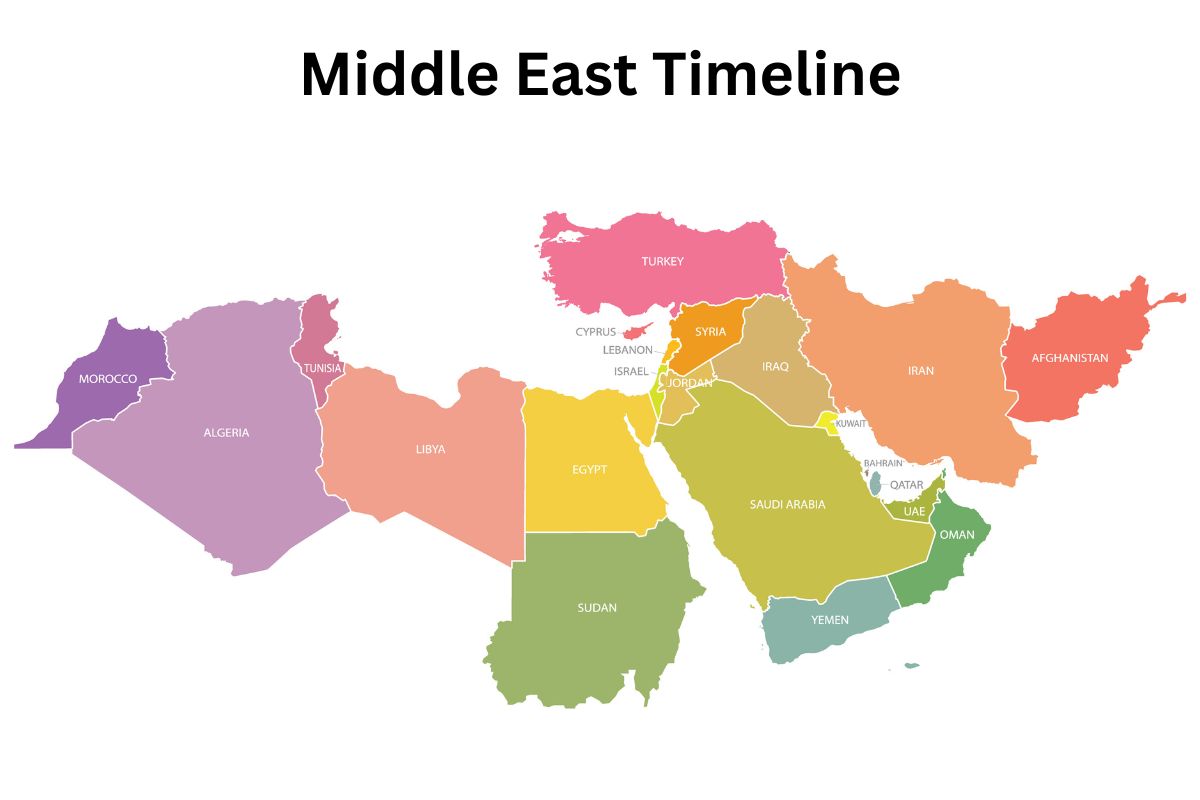
The Middle East is a transcontinental region located at the junction of Western Asia and northeastern Africa, generally encompassing the countries that lie between the eastern Mediterranean Sea and the Persian Gulf. Geographically, it typically includes Western Asian countries such as Saudi Arabia, Yemen, Oman, the United Arab Emirates, Qatar, Bahrain, Kuwait, Iraq, Jordan, Lebanon, Syria, Israel, and Palestine, as well as parts of North Africa, primarily Egypt. Some broader definitions also incorporate Turkey and Iran due to cultural, historical, and geopolitical ties. The region is characterized by its strategic position connecting Europe, Asia, and Africa, its arid and semi-arid climates, and its abundance of natural resources, particularly oil and gas reserves, which have made it central to global economic and political affairs.
A broader definition of the Middle East extends beyond the traditional core of Western Asia and northeastern Africa to include Turkey, the South Caucasus states of Armenia and Azerbaijan, and the countries of the Maghreb in North Africa—Morocco, Algeria, Tunisia, Libya, and Mauritania. This expanded conceptualization reflects not only geographical proximity but also historical, cultural, and political connections, including shared experiences of Ottoman and colonial influence, Islamic heritage, and trade networks linking North Africa, the Levant, and the Near East. Under this definition, the Middle East becomes a strategically and culturally diverse region bridging three continents, encompassing a wider array of climates, ethnicities, languages, and religious traditions, and highlighting the interwoven nature of geopolitical, economic, and social dynamics across its extended territory.
If we divide the region into varying confessional or alliance blocks we arrive at:
The Maghreb states (Egypt, Libya, Algeria, Tunesia, Morocco, Mauratnaia)
Stateless Kurds (in Turkey, Syria, Iran, & Iraq)
Middle Eastern Christians in varying sects,
Turkey
Israel
In the Middle of what, East of who?
The Ziggurats of the Neolithic age tell a story. Civilization began with the creation of castes and the centralization of power into early state systems. The cradle of all civilization began with specializations of labor, chaining early humanity to useful trades, and the conscription of worker slaves. The appointment of Kings. It began with tributes to unseen Gods, all-powerful oligarchs, and eventually a cast of priests to preside over mythology, then later religions, and later still over since, and this all served one thing: to prevent us from rebellion. The unnatural subjugation of all humanity into productive labor is not a unique story to Mesopotamia. This book is not about insurrection or economic development. It is not a rejection of ethnic identity or the work of atheists. What is clear: the status quo is dangerous to states and people inside them.
It is chaotic uncertainty at best. The entire Middle East is awash in an endless war and has experienced every measure of barbaric atrocity. This state of modern warfare has proceeded without any actual peace since 1920, but the bloody chaos existed a long time before that. In perpetuity for as long as we have known.
Every nation is highly vulnerable; every nation is perhaps also complicit in the killing fields today. The Western powers and Eastern powers have used us. They have handed us sophisticated weapons to murder each other in varying combinations while the great transnational corporations harvest the energy supplies in the ground. This has nothing to do with civilizational clashes or the competing interpretations of the Abrahamic religion. That is just the framework for our terrifying division, but not the cause of it. The Modern Middle East must cast off its own oligarchy, jail its own collaborators, we must cast off foreign domination, cast off ethnic particularism, and embrace peace on its own terms.
It is not fully true that the tinderbox of the dying Ottoman Empire erupted in Palestine or can be cured from there. Nor can Turkey revive it. Or can Iran dictcate its Shi’a rivalist terms. Nor is it true that the roads to Jerusalem from Cairo, Damascus, Karbala, Najaf, Mecca, Medina, and Tehran are all guarded by the now-flailing American empire. The mulipolar world of rising China and reviving Russia will treat the region in a different, but not necessarily better way.
Not all our original sins of the region began with the Crusaders, the Mongols, the Ottomans, the Zionists, with meddling foreigners, and with our oil. Long before the Crusaders attacked from the West and the Mongols came from the East; we fought wars of the Ziggurats. We fought wars of city states. We fought wars against Romans. We fought wars between Sunni and Shi’a. We fought wars between rival Caliphs. We fought wars against unbelievers and true believers of esoteric sects.
The truth is that any so-called peace process is little more than a short-term buy-off if there is no structural framework to actually exist together. Allowing the hegemonic powers (American, the EU, China, and Russia) more time to take, to utilize what lies under our sands until it all runs out, and it will run out in the next several hundred years. We cannot and should not seek to perpetuate war on Israel; we should all be seeking to decouple the Jewish state from the foreign policy goals of the West. But also the Muslm states that are Western or Eastern semi-peripheral states; such as Egypt, Turkey, Saudi Arabia, and Iran. We should take accountability for what we have done to and with Palestinians as a whole, both as Israeli occupiers and Arab state hosts. We should validate the Kurdish question and acknowledge the rights of 40 million stateless people, who have been massacred, particularly in Iraq and Turkey. We should acknowledge that the Sunni-Shi’a cold war is also quite violent and divisive to the region. We should prevent starvation, human rights violations, and genocide in Palestine, but also in Syria,Yemen,.and Sudan (which is not part of the Middle East but deeply affected by it). In short, we must be accountable for what is the violence inflicted by colonialism/ neocolonialism, and what is the violence we are self-inflicting. Violence baked into the fabric of our poltical consciousness as a region. In Islam, hypocrisy is a high level of contradictory sin; we must take stock of where the fault lies with foreign meddling and where it lies with our own leaders’ violent impulses and failed policies. Yet, the treatise does not reject states. But presupposes they are violent, inefficient, repressive, and prone to Oligarchic capture.
There are many failures of the modern state system. Innumerous failures and predations to indict. But these are the boundaries were working with, the confines of power we are conglamorating if this scheme might proceed, it is a balance of nationalism, an alliance of regional geographies, and has to balance the authoritarian nature of states and armies, with the civil society and constitutional rights entitlements of citizens organized into cantons.
What is a state in the Modern Middle East?
With the exceptions of Egypt, Israel, Turkey, and Iran (because they have certain historical permanence or at least longer periods of imagined identity); most states are modern inventions of Sykes-Picciot and nationalisms of convenience. Borders drawn up by foreign powers then codified in over 125 years of basically continuous warfare.
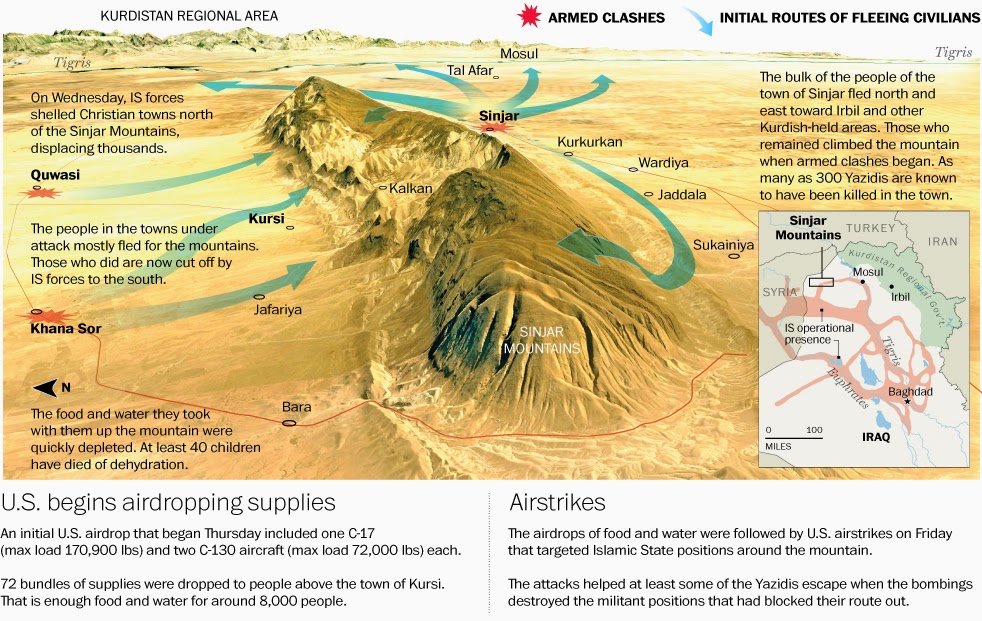
The Ottoman Turkish genocide of the Armenians, carried out by Kurds. The ethnic cleansing of Palestine carried out by Israelis. The Iraqi genocide of the Kurds carried by Saddam’s forces. The war between Iraq and Iran. The ISIS genocide on the Yazidis.
The Yemen civil war, the Lebanese Civil War, the Syrian Civil War, the Libyan Civil War.
The most deadly engagements fought between Jews and Arabs, Christian Lebanese and Muslim Lebanese, Shi’a Iran against Sunni and Shi’a Iraq, the war between Turks and Kurds, the modern conflagrations in Algeria, Palestine, Yemen, Syria, and Libya. The spill over of these wars, into Sudan and Afghanistan.
What is Federalism is the Modern Middle East?
It is to allow states greater regional autonomy in their governance by allowing for sub-unit/provincial governments where federal states can have their own civil administration, state laws, and state self-defense in the form of national guards.
In the Middle Eastern context, federalism refers to a system in which power is divided between a central government and regional authorities, such as provinces, emirates, or autonomous territories. Unlike in Western democracies, where federalism often evolves from voluntary union or constitutional design, in the Middle East it tends to emerge as a conflict-resolution tool—a way to manage deep sectarian, ethnic, and tribal divisions within states that were often shaped by colonial borders rather than shared identity. Federalism in this region is therefore less about political philosophy and more about pragmatic power-sharing in fragile or post-conflict societies.
Historically, most Middle Eastern states developed under highly centralized, often authoritarian governments that concentrated power in the capital. This structure marginalized peripheral regions and minority groups, fueling recurring tensions. When these centralized states fractured—through wars, revolutions, or foreign interventions—federalism was sometimes proposed as a way to preserve unity while granting autonomy. The most prominent example is Iraq, which adopted a federal constitution after 2003 that recognized the Kurdistan Regional Government as an autonomous entity within a single Iraqi state. This arrangement sought to balance power among Kurds, Sunnis, and Shiites, though it remains contentious. Another example is the United Arab Emirates, a federation of seven emirates that maintains stability through monarchical power-sharing rather than democracy—making it a rare case of successful, non-democratic federalism. Proposals for federal systems have also appeared in Syria, Yemen, and Libya, where decentralization has been discussed as a means to end prolonged civil wars, though these plans have yet to take hold.
Despite its appeal as a peace mechanism, federalism in the Middle East faces major obstacles. Deep sectarian mistrust, weak institutions, and the enduring culture of centralized authority make it difficult to implement effectively. Many political elites fear that federalism will lead to partition, while external powers—such as Iran, Saudi Arabia, and Turkey—often manipulate internal divisions for their own regional agendas. As a result, federalism in the region is frequently perceived as foreign-imposed or a prelude to fragmentation rather than a step toward stable governance.
In essence, Middle Eastern federalism is less an ideological system than a pragmatic survival strategy. It seeks to balance competing identities and distribute power in states where national unity is fragile. While in theory it could promote local governance, accountability, and reduced conflict over resources, in practice it remains a contested and unstable experiment—a reflection of the region’s complex interplay between unity, autonomy, and enduring historical divisions.
What are Cantons?
A means to organize a more localized civil administration in highly diverse societies with a tendency to wage protracted civil wars. Which have come out of the many wars but do not need to wait for a war to form structures. In fact it is more desirable for the existing states to undertake federalism, then to dissolve into further warfare.
Cantons do not have to geographic they can also be communal; the main benefit of canton level sub-organization to the the federalized state is to allow community organization on civil society lines, allow for local decision making on community life, and allow peoples of common affinity to organize their lives on those traditions and values.
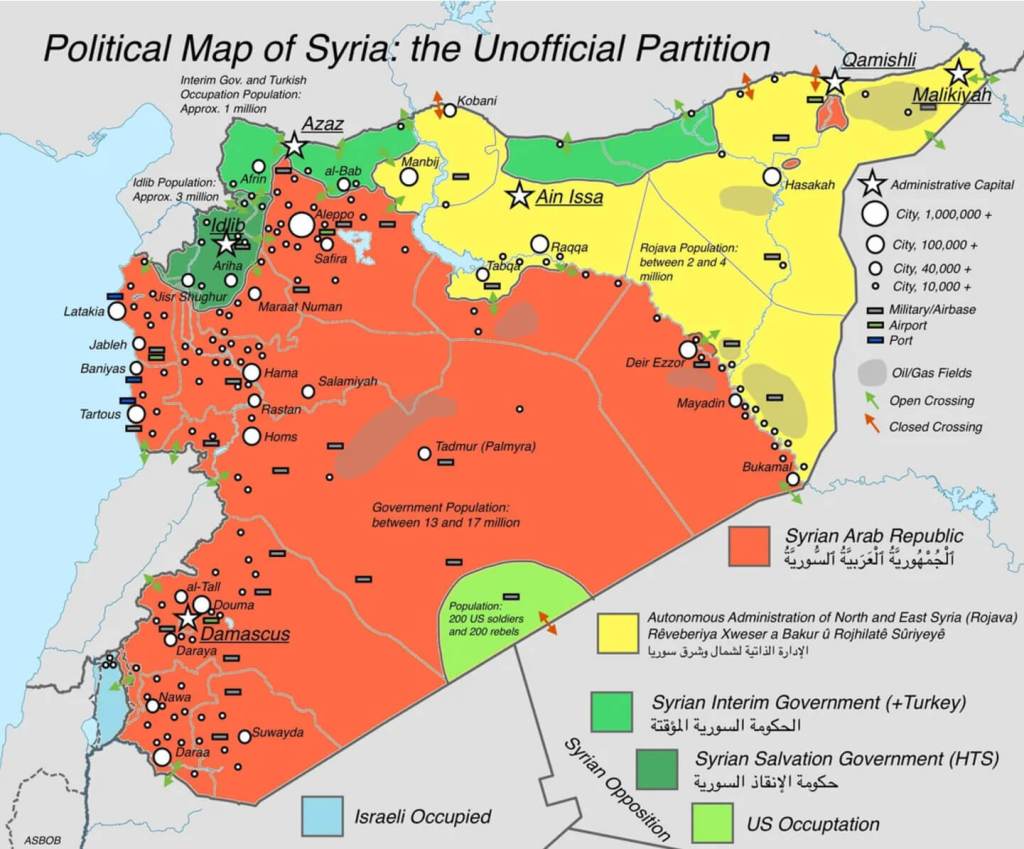
For instance, in Lebanon, the idea of cantonization became prominent during the 1975–1990 civil war, when the country effectively split into Christian, Muslim, and Druze-controlled territories. Although the Taif Agreement later re-centralized the state, Lebanon still operates through an informal sectarian power-sharing system that resembles a confessional version of cantonal autonomy. In Syria, after the 2011 uprising, the country fragmented into several zones of control: Kurdish self-governed areas in the north and northeast (often described as “cantons” by their organizers), Assad regime territory, and opposition or Islamist enclaves. The Kurdish-led administration explicitly used the term “cantons” to describe regions like Afrin, Kobane, and Jazira, which were united under the Autonomous Administration of North and East Syria (AANES)—a model inspired by decentralized and participatory governance rather than ethnic nationalism.
In Iraq, the term is less commonly used, but the reality is similar: the Kurdistan Regional Government (KRG) and Shi’a and Sunni-dominated provinces function as quasi-cantons within a weak federal framework. Similarly, in Yemen and Libya, ongoing wars have produced competing governments and territorial zones—effectively cantonized states divided by militia control, tribal loyalty, and external patronage.
Thus, in the Middle East, “cantons” are rarely peaceful administrative entities. They are instead manifestations of state disintegration or attempts to manage diversity through localized autonomy. While some scholars and diplomats propose cantonization as a conflict-resolution mechanism—for example, suggesting a canton-based solution for Syria, Yemen, or Palestine—risks entrenching division, legitimizing warlords, and formalizing partition. In essence, Middle Eastern cantons represent a hybrid between governance and survival, where local communities govern themselves amid the collapse or weakness of the central state.
Middle East (core countries – 20)
MASHRIQ
BILAD AL-SHAM (Egypt & Levant)
Egypt
Lebanon
Syria
Israel
Palestine
Jordan
BILAD AL-RAFIDAIN WA FARIS
Iran
Iraq
KHALIJ (Gulf States)
Bahrain
Kuwait
Oman
Qatar
Saudi Arabia
United Arab Emirates
Yemen
MAGHREB (Northwest Africa)
Libya
Algeria
Tunisia
Morocco
Mauritania
Total (core Middle East): 20 states
Middle East Semi-Peripheral
Turkey
Iran
Egypt
Israel
Saudi Arabia
Middle East Peripheral
Cyprus
Azerbaijan
Georgia
Armenia
Sudan
Afghanistan
Middle East Non-State Cantons
Kurdistan-Iraq (KRG-Bashur)
Kurdistan-Syria (Rojava)
Houthi Territories-Yemen
Palestine Gaza
Palestine West Bank
Druze in Syria
Hezbollah in Lebanon
= 27 countries total
Egypt, Jordan, and briefly the PLO were all bought off to make an awkward peace with Israel with American development aid dollars. In recent years, the UAE, Morocco, Bahrain, Sudan, and, one day soon, Saudi Arabia most likely are paid to recognize Israel because the Americans and Europeans use Israel in Palestine as a forward operating base.
They use it as a litmus test of their hegemony. Just as the Russians used Syria until its total collapse and still use Iran in some agreed to forms. The Iranians and Israelis have their specific confessional interests, and of course, they have their own regional goals; but without external arms and subsidies, they could not sustain such aggressive posturing and mount such an adventuristic foreign policy. The Israeli military machine is funded by the United States, and the Iranian one (and the Assad regime in Syria before it collapsed) partially by Russia and China, though to the same effect: perpetuating adventuristic and militant regional foreign policy.
The capital inputs for development or military aid allow the Saudi Arabian and UAE to sustain devastating intervention in Yemen. They subsidize Israeli hyper-militarization and the Palestinian occupation, but they also subsidize Hezbollah, Hamas, and Shiite militia forces. It is hard to imagine such horrific localized wars without the foreign powers subsidizing them.
The road between both halves of Jerusalem/Al-Quds runs in fact to the mountains of Kurdistan. To a people without a state, who by historical circumstance were in the last 40 years trained to fight by the leftist Palestinians and trained to reorganize by Zionists. Who, although speaking 11 dialects of Kurdish, are linguistically and culturally most like the Persian Iranians. The Iranians, who are the only existential threat to Israel, still have over 40,000 Jewish citizens and share a version of Shi’a faith with the Lebanese, Yemenis, Bahrainis, and Iraqis and a language with the Afghans; fight East and West via these proxies.
Finally, Egypt is a nation that subsists on Western aid, but revolution is always below the surface. Jordan is actually over 60-70% Palestinian, and without American and Israeli support, could not exist as a country.
So, it is not the coexistence of Israel in Palestine that is the linchpin of regional peace. Yet in warfare, they have drawn in all the actors that are needed to make a Hudna, or a lasting ceasefire for the Israelis to ally with the two other powers that ensure the Confederation can raise its flags; Iran and Egypt. Which is to say, the historic enemies of the Jews. Nations such as Egypt and the Babylonian and Assyrian Empires did attempt to obliterate the Jews, then the “Eivree” or Hebrews. “Jews’ is a word invented by Romans, as there is no J sound in Hebrew or Aramaic.
Although all our people learn and think in several thousand-year segments. Although we find almost unceasing war records no matter what empire or confederation was in power. The point of unity for the nations of this proposed Confederation is the historical legitimacy and self-awareness of monotheistic, desert tribes that absolutely no outsider or insider to the region could subjugate completely. This does not make an argument that Palestinians are Canaanites, the Lebanese Phoenicians, or that Jews should not be called Jews but are the 20-30% intermixed survivors of the Israelite tribes Dan, Yehuda, and Levy; Eivri, or Yehudeans. Or that of the 13 million worldwide population of descendants of the Jews, as few as 5 million are remotely even practicing the religion. Which is speculated.
Palestine is an open wound. It is with the latest round of fighting in Gaza evidently a genocide. Over 65,000 people have died so far. It shall be remembered to all that over 4 million have died in Sudan, so far. Over 630,000 were killed in the Syrian Civil War (mostly by the Russian-backed Assad regime), and the war between Saudi Arabia and the UAE and the Houthis has led to the deaths of over 377,000 people, that we know of.
It is a wild deception that the so-called Islamic State (ISIS), Daesh, has its origins in any normally accepted version of Islam. Its goals were allegedly divinely inspired in prophecy. Its defeat will be no means bring an end to this type of Wahabi Salafist insurgency, exported in petro-dollars from the Gulf. ISIS was an entity controlled by, supplied by, and supported by Türkiye, Saudi Arabia, Qatar, and Pakistan’s intelligence services. That is one theory, another that was Ba’athist intelligence and varying Al Qaeda offshoots, using messianic fervor and rhetoric. If not for the Coalition forces, particularly the US, the French, the British, the Kurdish SDF, Iran, Russia, Hezbollah, and Iraqi PMF, they very well might have conquered the entire Middle East. How close they came is understood only by those who were there on the ground.
It is time now for the coming generation of the Middle East to take steps to prevent the interventions of all types of foreign power, the meddling of the great powers, as well as to contain the regressive impulses of our varying theocracies. In short, the road to an actual long-lasting peace is not through the conquest of states, the dispersion of the Jews yet again, or doubling down on depper religious zeal and fundamentalisms!
The road to peace is in fact not peace; it is instead about ceasefire, and separation into stable units, but not embracing the chauvinistic nationalism of outsiders, particularly the meddling of the East and the West: NATO-aligned neocrusaders, Russian-aligned neocrusaders, and rising China hungry for all resources of all types. We do not have to commit to anything with these actors. But we must enter a confederation strong enough to repel foreign aggression, stamp out internal fundamentalism, stamp out ethnic conflicts, and secure the ceasefire. Secure a framework of civil and human rights acceptable to the diversity of religions, and of course, prevent the indefinite traffic of weapons and currency for access to the finite resources of gas and oil. The Muslim world is obsessively fixated on Palestine because it is an open wound, it is a blatant ongoing human rights violation, a violent occupation, and because it instills a crusader-like, colonial force in our midst that is not fully Western, but also not fully Middle Eastern. As long as Israel has no alignment in culture, trade, and security, it will remain a destabilizing entity. One that, in any projection of isolation, resistance, demographic shift, BDS, international divestment/ shaming, has 200 nuclear missiles. Its Jewish population in religious identity and political imagination is indigenous to the Middle East. Removing it, secularizing it, demilitarizing it, or refusing to deal with it is political imagination. The highest level of human rights and civil rights safeguards one can deliver to Palestinians is an Israel and Palestine fully integrated into the region. The Western media and the Muslim streets obsessively focuses on Palestine because:
It is an open wound with ongoing human rights violations that antagoize and grieve the very heart and soul of the region.
(a) The Israelis, despite being mostly Jewish, are at least half European or Slavic in roots and appearance (approx. 2 million are Ashkenazi/ European and 4 million are Sephardic/ Mizrahi), so aesthetically it triggers the latent crusader imagination. Were their no real and imagined Arab enemy the Jews might fight yet another civil war for the soul of thier state. It is deeply baked into Chrisitian theology the Jews must gather again in Israel before their Christian messiah returns. The war in Palestine-Israel is thus deeply and subconsciously understood by Western minds as theological and geostrategic.
(b) Israel is, without a single doubt, is a manifestation of several thousand years of collective trauma experienced by the Jewish people into being a modern Outremer: a military colony that Europe and America rely on for regional control. There is not a realistic scenario where the Jews will lose a military confrontation. They will not pack up and leave. There is a highly realistic scenario they will lose lose a demographic one. The birthrates of Palestinians already place them above 20% of Israeli passport holders.
It cannot be denied that both the West and East have not been short on Muslim proxy clients. Pahlavi Iran until 1979. The U.S. bases in Qatar, the UAE, Kuwait, and Turkey. Russia once heavily invested in Egypt until it went to America, and also Syria until the Assad regime fell in 2024.
The abomination of Wahabi Salafist extremist Saudi Arabia, as well as each of the Petro-States of the Gulf. Unique in a world where race is the most essential passport to privilege, of 8-9 million Israelites, 3 million look fully European. For the greater part of 800 years since being butchered by Crusaders, culminating in the holocaust, the Jews have, or at least the Ashkenazi in charge of Israel, decided they will collaborate with Christian Europe against their Semitic cousins, the people of the region they were expelled from by the Romans 1,900 years ago.
The Shi’a also know a great deal about enduring persecutions. Iran and the Shi’a have many characteristics developed adjacent to the Jews. Particularly, a feeling of their backs against a wall, then the sea. A feeling of a need for a vigilant ethno state. The world’s oldest groups of Christians, the Armenians, Assyrians, and Maronites, have survived endless wars by retreating to the mountains. The Sunni are being held hostage between secularism and regressive fundamentalism; Egypt, Türkiye, and Pakistan are caught between those feelings. The contradictions of Saudi Arabia and the Gulf States are lost on no one.
The three intrinsic imperialists are external profiteers who secure themselves from endless war. They steal resources and direct efforts toward maldevelopment: USA-NATO, the Russian Federation, and eventually the People’s Republic of China. (Though their imperial footprint is still light).
The initial geography behind which a Middle Eastern Confederation can be birthed, formed, and fortified. Broken into federal units within exisitg states, then administered by canton level governance.
Lebanon- 4 cantons
Sunni
Shi’a
Christian
Druze
Palestine-Israel- 2 cantons
Judean
Palestinian
Jordan-2 cantons
Hashimite
Palestinian
Syria- 4 cantons
Kurdish (SDF)
Sunni Arab
Alawite
Druze
Iraq- 3 cantons
Shi’a Arab
Sunni Arab
Kurdish (PUK/KDP)
Iran- 5 cantons
Shi’a Persian
Azeri
Kurdish
Baloch
Lur
Second Phase
Turkey, Armenia, Kurdistan regions.
Gulf States & Saudi Arabia.
For the skeptics let us draw on the fact that America is under 300 years old. The complete reliance on fossil fuels for transport and trade is less than 200 years old. All of Europe exhibited mass violence and religious atrocity for around 2,000 + years, and the nations of the Middle East have produced all Western religions, writing, science, and literacy dating back perhaps 3,000 years. Essential to this document is an understanding that we are proposing the confederation of peoples who have lived beside each other in relative non-violence for as long as recorded history existed, and only the interventions of Crusaders, Mongols, and European imperialists have escalated conditions to perpetual war and genocide.
Realignment is suggested. Five pillars, keystone nations if you will, that if realigned, restore the Palestinians and also the Israelis to their lost homeland indefinitely and return the Jews to being a people of the Middle East. With the realignment of Israel away from her European mixed tribes, abusers of over two thousand years back to the tent of her blood; then there are only four nations left that can sow widespread death, extremism, and disorder, and they, Iran, Saudi Arabia, Pakistan, and Türkiye, will have to be managed one by one. The five intrinsic incubators of regional instability and endless war behind which the Middle Eastern resources are divided up and plundered: Israel, Iran, Saudi Arabia, Türkiye, and Pakistan. Each with an external pipeline of funds and trade linking back to a hegemonic power. The semi-peripheral powers of the Middle East.
We, the peoples of the Middle East, comprising all peoples listed above and all indigenous communities acknowledge the history of millennia-long coexistence, conflict, trade, and cultural exchange. The region has endured cycles of war, conquest, displacement, and foreign interference. It is the imperative of survival, dignity, and justice that motivates this treatise.
Chapter I: Principles of Survival and Peace
Principle of Non-Annihilation: No party possesses absolute capacity to destroy another; hence, the continuation of conflict is neither inevitable nor desirable.
Principle of Diverse Society: Peoples must establish arrangements permitting ethically and religiously divergent communities to coexist while preserving autonomy, identity, and historical heritage.
Ceasefire Imperative: Immediate cessation of hostilities is mandatory. External actors benefiting from ongoing conflict must be neutralized in policy and practice.
Chapter II: Recognition of Indigenous Sovereignty
All peoples retain sovereignty over ancestral lands or lands where they are received. Their civil, poltical, economic, culturalm and social human rights will be affirmed in the formation of governance cantons in federalized states.
Political and territorial arrangements must respect cultural, ethnic, and religious distinctions.
State boundaries will be altered to reflect demographic realities and avoid further armed conflicts.
State governance will be remodaled to a Federal system of sub units called Cantons, inside Federalized States, bound in a Confederation.
Historical grievances shall not preclude functional coexistence; legal recognition of past injustices shall guide reconciliation mechanisms.
Chapter III: Formation of the Middle Eastern Confederation
Structure: The Confederation shall comprise autonomous cantons existing inside the state frameworks, each preserving ethnic, linguistic, and religious governance within a shared federal framework.
A Federal structure for existing states will be established on regional or confessional lines to propagate the terms of the Confederation.
Cantons can form based on shared ethnicity, religion, or logical geography
Cantons have a civil administration and a series of democratic term based councils that sent delegates to a Federal State level Assembly.
Like an American state with a national guard and its own constitution and taxation powers.
The elected leadership of several cantons form a Federal State Assemby of a geographic unit of the country (nation state).
The nation State will have a unicameral Congress/Parliment/Majalis which in turn elects Confederation level Reprentatives (like representatives to the EU).
The Confederation is a voluntary association of existing states that share a framework of free travel, free trade, triparte taxation, a Confederation wide civil service, and miliary security cooperation agreements.
A referendum of cantons can asl to withdraw from the Confderation obligations
The target goal is ten years to integrate all the miliary forces
Each State wiil adopt a Federal framework transferring certain civil administration and taxation responsibilities to a Canton Administation.
One or several Cantons will comprise a Federal unit of an existing State.
Each State will adopt constitutional amendments enshrining a civil code of the cantons, the availability to seek justice under that code or religious courts
Cantons can propagate a Modal Civic Code with variations for local religious law
Human rights law shall supersede all local or religious law where conflict arises.
Human rights law shall be derived from existing Human right treaties.
Citizens retain the right to relocate between cantons or exit the Confederation entirely by a popular vote.
Cantonal legislation may govern internal religious matters provided compliance with federal legal standards.
A unified supreme judiciary shall arbitrate disputes between cantons and states.
Chapter IV: Governance and Civil Service
Rotational Leadership: Leadership positions across cantons shall rotate to ensure equitable representation.
Civil Institutions: Shared civil services shall administer education, healthcare, and infrastructure.
Defense and Security:
A coordinated defense council shall maintain sovereignty and internal stability.
Military and police forces shall operate under confederal oversight while respecting cantonal autonomy.
No foreign powers will be allowed miltarya bases in the region.
The Confederation will draft an collectively maintain a unified multinational defense force.
Chapter V: Engagement with External Powers
The Confederation shall maintain non-alignment with foreign powers.
No external power shall dictate domestic policy, supply advanced weaponry, or manipulate regional conflicts.
Strategic self-reliance shall be developed in energy, defense, and civil administration.
Chapter VI: Strategic Objectives
Arrest cycles of conflict across the region through structured separation and collaboration.
Priorities include pacficiaiton of protradcted conflicts in Yemen, Syria, Libya, & Israel-Palestine
Secure survival and autonomy of all indigenous peoples.
Establish a legally binding and historically informed framework for peace and cooperation through a regiona Human Rights Court.
Prepare for post-conflict sustainability: energy, economic stability, and civil resilience.
Chapter VII: Immediate Measures
Initiate a region-wide ceasefire framework within six months.
Convene representatives from all states, militai, cantons, and indigenous communities to formalize governance structures.
Draft a constitution codifying rights, responsibilities, and federal oversight.
Establish mechanisms for dispute resolution and conflict prevention.
FRAMEWORK This treatise is not a theoretical abstraction. It is a practical, legally grounded roadmap for survival, dignity, and justice in the Middle East. It acknowledges history, respects diversity, and insists on immediate action. The formation of a Middle Eastern Confederation is the sole viable mechanism to halt ongoing cycles of destruction and secure the future of its peoples.
A confederated alliance of states and self-governing cantons that must find a common cause for separation and economic development, intrinsically linked to a series of strategic agreements between Arabs, Persian, Judeans and all of all religious confessions, and Kurds of all political types. Not factoring in whether they have states or are not recognized by the world state system.”
The Confederation shall be founded by the peoples of nations, not by states. The geographic boundaries are contingent upon the peoples who reside in the Maghreb, Middle, and Near East. Specifically, the fertile crescent with geopolitical implications from Tunisia to the west, to Kashmir in the East, to Sudan in the south, and the Caucuses. But rooted deeply in accords between Israel, Palestine, Shi’a Iran, Lebanon, and the Parties of the Kurds.
The Confederation shall be based on ethnic cantons that will be self-governed by religious law, civil law, or tribal custom but all cantons must be Universal Human Rights law-abiding; which is to allow the exit from any community of those that wish to live under secular civil law.
The Confederation shall be based on democratic autonomy; thus, a co-gendered leadership, a census, and a system of voting and elections must be in place to implement religious laws that are binding throughout a canton.
The Confederation shall conscript and maintain a unified Defense Force and Civil Service that, through 3 years of military or civil duty deploy diverse forces amid the Confederation to foster shared values in a complex and diverse society.
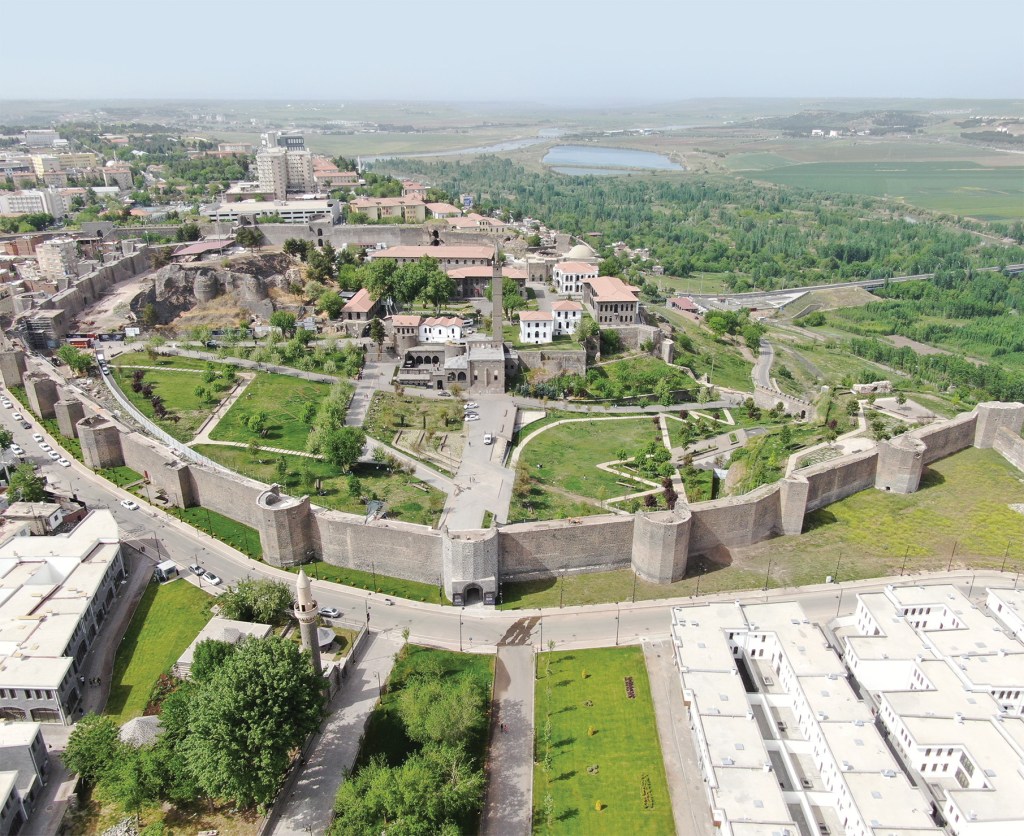
The ethno-civil administrative capitals of the Confederation pending cessation of military conflict shall be Cairo, Jerusalem-Al Quds, Beirut, Damascus, Baghdad, Mecca, Diyarbakir, Istanbul, and Tehran.
The Israelis and Palestinians are not the key elements of actualizing the Confederation, but they are capable of indefinitely destabilizing the effort to form the alliance and must be specifically managed.
The Israeli, Iranian, Saudi, and Turkish agreement is the only way to militarily secure the confederation.
The Kurds (in civil society/ ideology), Shi’a (in security), Lebanese (in trade), and Israeli (in technology, but certainly all sectors) have specific developmental technology as well as governance systems that are integral to this project.
The Confederation shall pursue non-alignment.
The Confederation shall enshrine into law and fiercely defend universal human rights, and all other canton level legal configurations will be subordinate to that code.
There are critical security, international relations, and domestic crisis issues that threaten the very existence of the Israeli and Palestinian peoples much more so than the ongoing, comparatively low-intensity occupation of the Palestinian zones of control in the West Bank and blighted Gaza. The region at large is in an acute state of political and social unrest; the governments of Somalia, Afghanistan, Tunisia, Libya, Iraq, Syria, Egypt, and Yemen have fallen resulting in foreign occupations, civil wars, and general anarchy. Shi’a Iran and Sunni Saudi Arabia are at proxy war throughout the Muslim world.
Many will object to us describing Israel as a “Jewish military Colony”, and object to calling the separation barrier the “Apartheid Wall” but linguistics and agreement of a shared paradigm are vital to the success of this committee’s objectives. We assure you the credentials of our core research team from Israel are sufficiently grounded in lived experiences of both the intelligence service and defense forces; while our Palestinian team’s Jihadist and patriotic background would be of little question.
Chaos and revolution are spreading while security, what little there was, is unraveling. All of this was acutely exacerbated by the 2001 & 2003 American invasions of Afghanistan and Iraq; resulting in the virtual anarchic non-governance of both countries today. And of course, the Israeli treatment of the Palestinians is an open wound that festers, then bleeds out.
This treatise has been researched and written by a group of Judeans, Arabs, Israelis, Palestinians, and Kurds concerned with the collective survival of their respective peoples as they occupy and are occupied in the heart of this massive, unending conflict. There is very little hope of this macros-regional war or micro-peace settlement between Israel and Palestine being resolved on the level of government. Palestinians have two competing governments; Hamas and Fatah; Israel has a coalition government but is controlled as a military oligarchy on the behest of Ashkenazi Judaism and the foreign policy goals of the United States of America.
For the approximately 16 million humans living in Greater Israel/ Historic Palestine; the varying scenarios are not optimistic in the slightest.
Peace is improbable, demographics are not favorable to the 5-6 million categorized Jews and beyond the religious overtone of the landmarks described by three world religions as ‘holy land’; Israel is also a nuclear-armed semi-peripheral power aligned completely and dependent on financially a Jewish Lobby and interest in the United States which cultivates the specific and direct interests of two intractable groups; the US military-industrial complex and the 2-3 million Ashkenazi (European) Israeli Jews; which enjoy a standard of living inside the Jewish colony markedly different from the Jews of other ethnic backgrounds.
There has been ceaseless warfare in the Maghreb and Middle East since 1920, shortly after the fall of the Ottoman Empire. The false consciousness of the invented Nationalism. All the scenarios discussed in the treatise are inseparable from the conflict between the Israelis and the Palestinians, but it is naïve and European to link the peace of the region to our specific peace. A peace that will never be under the dynamics of the current situation, the minuscule size of the land, and endless regional intrigue. Arms and aid money, for control of energy resources.
Thus, we concern ourselves in this first manuscript with Israelis (of all religions and ethnicities) and Palestinians (of all demographics). We are concerned with the broader course of humanity, but this has been authored to ensure that regardless of humanities general course; there will always be Palestinians, and there will always be Jews; and if there are to be “Israelis” an identity that is less than 85 years old; we must engage in radical steps to subvert the course of the mainstream Zionist project; delink ourselves of Euro-American hegemony and stop the inevitable slaughter of our collective peoples.
“A new level of atrocity is coming; in fact, it has very much arrived.”
Between October 7th, 2023, and the January 2025 ceasefire the Palestinians killed around 1,700 Israelis, the Israelis killed around 75,000 Palestinians (and counting) and over 5,000 Lebanese. Some portions had weapons, and many did not.
Palestinian demographics will increase to above 50% inside the green line which they trend toward (currently the reality is something like 7 million Arabs to 8 million Jews + others), and or if Israel uses a nuclear weapon of which it has over 500. Or Israel is sucked into or provokes a war with Iran. Or any number of scenarios with state collapse, proxy war, Saudi and Iranian warfare, and further misadventures with enormous cost in-human life. To stop the final floodgates from opening, to address the broad systemic internal contradictions of the Israeli state and to secure a viable Middle Eastern Confederation, a radical policy of reorientation must begin with a realistic assessment of the only other three parties on the ground besides Memshala Yisrael3which can broker regional stability. Israel must deal directly with Hamas, Fatah, Kurdish Parties, and most importantly the Islamic Republic of Iran. Only an uneasy truce and alliance of this kind can focus policy and praxis on awakening the consciousness of the Sunni Arab majority.
“It is no longer a question of moralizing the conflict, obsessing over past failures, or temporarily abating a cycle of degenerating violence. Or conducting more banal and expensive anthropological studies on identity.”
In the Israeli Knesset, amid the Palestinian resistance factions, among the various Persian & Arab power brokers and the para-state organizations on the ground (and in the Diaspora) all realize that neither by sheer will nor by force of arms can they destroy one another. Blame for the modern quagmire that is the Middle East may fall squarely on the post-colonial powers of Europe and the United States for the proliferation of arms without stipulation or control. However, the new reality is that if the third Hebrew Commonwealth of Israel is to survive; if a Palestinian State is to be brought into being; as well as if any measure of regional stability is to be achieved, radical and unorthodox steps must be taken to close the breach. The breach is not simply a result of Israeli defense against Arab aggression, or vice versa; it is a breach in the foundation of the modern security calculus. All parties involved must become more attuned to the heightened stakes via lessons in history and sound political science.
This treatise offers an objective analysis of the Harakat al-Muqawama al-Islamiyah to advocate for its recognition as a viable partner, not in immediate peace; but in implementation of separation, economic development, and most importantly; Hudna4. It makes a fundamental case for supporting Kurdish national ambitions in Türkiye, Iraq, and Syria. We advocate for a full and lasting partnership between Israel and the revolutionary Shi’a government in Iran. But we envision and call for something much more powerful.
To claim that Memshala Israel has secured its borders, or contained conventional military threats to its existence is to say that glass is made from sand. The process by which glass is made from sand renders the base substance unalterably changed and requires the release of energy through fire and heat to yield something far more unstable than its original form. While the cousins of Ishmael and Yitzhak, the Israelis, and Palestinians, are indeed two peoples intractably bound to a single, tiny piece of land, they are met with a recurring problem. The Israeli public and government (currently) lack the will to commit genocide. The Palestinian Resistance factions cannot (currently) procure or introduce a means to mass murder that will not render their own homeland a house of ash.
Surely whispered even openly said in both camps is the notion that it would not be ‘objectionable’ for the other and their kind to be ‘pushed into the sea’ or ‘dumped on the other side of the Jordan.’ The survivors of the Shoah5 cannot (yet) bring themselves to this, nor would international opinion condone genocide in the Holy Land today. As for the Palestinians, pushing the Jews into the sea has more to do with rhetoric than ability, conscience, or even intention. The ancestors of both races defended the holy land against the Christian Crusaders locked arm in arm.
There are over 1,400 years of precedent for relatively peaceful co-existence and less than 100 to the absolute contrary6. Anyone telling you otherwise has a vested interest in your ignorance. Even the death toll of the First Intifada (estimated at 421 Israeli/1,549 Palestinian7) and the bloodier melee of the Second Intifada, which included suicide bombers and collective punishment, cost only 1,062 Israeli and 5,500 Palestinian lives8. The invasion of the Gaza Strip in 2008 resulted in 13 Israeli and 1,417 Palestinians9. In the ongoing Gaza Wars in 2010-2015, an estimated 100 Israelis and over 5,000 Palestinians have lost their lives. Approximately 1,300 Israelis and 50,000 Palestinians have died in the latest war.
Between 2015 and 2023 multiple rounds of fighting in Gaza killed several thousands of Palestinians and a few dozen Israelis. In the same period, the Syrian Civil War killed over 500,000 people. That means that in the entirety of the Palestinian Israeli conflict beginning in 1948; less than 50,000 people have cumulatively died, comparatively to all other ethnic conflicts that is a footnote, a statistic. The body count of the Palestinian-Israel civil war is comparatively low when compared with other global ethnic conflicts like those waged in Sri Lanka, Sudan, Burundi, Rwanda, Chechnya, Iraq, Afghanistan, Yemen, Syria, and Ukraine.
Then in under two years the Jewish State killed over 70,000 Palestinians in retaliation for the brutal killing on October 7th of 1,200 Israelis.
Hamas must be directly engaged as the only viable partner capable of securing Palestinian temporary acceptance of the third Hebrew Commonwealth and thereby securing the Jewish National home by buying both sides more time for ultimate reconciliation before more desperate measures are introduced. (Most no longer believe that is the truth on the ground, as of July 2025 Hamas is reeling).
The Three Parties of Kurdistan (PKK, PUK, KDP) must be supported aggressively by both people overtly and covertly. Shi’a Iran is the only semi-peripheral power both sides can count on, as all other states besides Egypt are European inventions; and Egypt is an incredibly unstable place locked between a US-backed military dictatorship and the Muslim Brotherhood. The road to peace does not run through Jerusalem/ Al-Quds, but without a full ceasefire between the Judeans and Palestinians no other keystone ally, tribe, or faction can be aligned to the program to build up a Middle East Confederation in our lifetimes.
“The window of achieving political and military victory within our lifetimes is an ever-narrowing window. If we falter, if we squander possibility in the name of imagined identity and unseen gods; all will be lost. All our people no matter what they pray to, will be facing annihilation together.”
“We ask you to read these documents carefully and go back to your factions, parties, organizations, armies, and places of worship to testify on the nature of this plan.”
By the best calculations of our Party, we have a window of less than 200 years before the oil reserves run out, but under 40 years to achieve the Confederation on the terms of the many peoples of our nation. There is nothing in anyone’s scripture that calls for this endless warfare. There is nothing that tells us there must be homogenous practice or uniform belief.
The road to peace is in fact not peace; it is instead about ceasefire, and separation into stable units but not embracing the chauvinistic nationalism of outsiders; particularly the meddling of the East and the West: NATO aligned crusaders, Russian aligned crusaders, and rising China hungry for all resources of all types. We do not have to commit to anything with these actors. But we must enter a confederation strong enough to repel foreign aggression, stamp out internal fundamentalism, stamp out ethnic conflicts, and secure the ceasefire. Secure a framework of civil and human rights acceptable to the diversity of religions and of course, prevent the indefinite traffic of weapons and currency for access to the finite resources of gas and oil.
The academia, the media, and the West obsessively have focused on Palestine, because:
(a) The Israelis, despite being mostly Jewish are at least half European or Slavic in appearance (approx. 2 million are Ashkenazi/ European and 4 million are Sephardic/ Mizrahi) so aesthetically it triggers the latent crusader imagination.
(b) Israel is without a single doubt a manipulation of several thousand years of collective trauma experienced by the Jewish people into being a modern Outremer: a colony that Europe and America rely on for regional control. But while accepting or refuting that statement; it cannot be denied that so was Pahlavi Iran until 1979. So has been Jordan and Egypt, and the abomination of Wahabi Salafist extremist Saudi Arabia; as well as each of the Petro-States of the Gulf. Unique in a world where race is the most essential passport to privilege; of 8-9 million Israelites: 3 million look fully European. For the greater part of 800 years since being butchered by Crusaders culminating in the holocaust; the Jews have, or at least the Ashkenazi in charge of Israel decided they will collaborate with Christian Europe against their Semitic cousins, the people of the region they were expelled from by Romans 1,900 years ago.
The Shi’a also knows a great deal about enduring persecution. Iran and the Shi’a have many characteristics like the Jews. Particularly a feeling of their backs against a wall, then the sea. The world’s oldest groups of Christians; the Armenians, Assyrians, and Maronites have survived endless wars by retreating to the mountains. The Sunni are being held hostage between secularism and regressive fundamentalism; Egypt, Türkiye, and Pakistan are caught between those feelings. The contradictions of Saudi Arabia and the Gulf States are lost on no one.
Thus, an unusual realignment is suggested. Five pillars, keystone nations if you will, that if realigned restore the Israelis to their lost homeland indefinitely and return the Jews to being a people of the Middle East. With the realignment of Israel away from her European mixed tribes, abusers of over two thousand years back to the tent of her blood; then there are only four nations left that can sow widespread death, extremism, and disorder and they; Iran, Saudi Arabia, Pakistan, and Türkiye will be managed one by one.
The five intrinsic incubators of regional instability and endless war behind which the Middle Eastern resources are divided up and plundered: Israel, Iran, Saudi Arabia, Türkiye, and Pakistan. Each with an external pipeline of funds and trade linking back to hegemonic power. The semi-peripheral powers of the Middle East.
The three intrinsic imperialists are external profiteers who secure themselves from endless war. They steal resources and direct efforts toward Maldevelopment: USA-NATO, Russian Federation, and eventually the People’s Republic of China. (Though their imperial footprint is still light).
The initial geography behind which a Middle Eastern Confederation can be birthed, formed, and fortified: Israel, Palestine, Jordan, Egypt, Sudan, Syria, Lebanon, Iran, Iraq, Türkiye, Armenia, Kurdistan, Saudi Arabia, Afghanistan, Pakistan, and the Kashmir.
For the skeptics let us draw on the fact that America is under 300 years old. The complete reliance on fossil fuels for transport and trade is less than 100 years. All of Europe exhibited mass violence and religious atrocity for around 2,000 + years and the nations of the Middle East have produced all Western religions, writing, science, and literacy dating back perhaps 3,000 years. Essential to this document is an understanding that we are proposing the confederation of peoples who have lived beside each other in relative non-violence for as long as recorded history existed, and only the interventions of Crusaders, Mongols, and European imperialists have escalated conditions to perpetual war and genocide.
The road between both halves of Jerusalem to Al-Quds runs in fact to the mountains of Kurdistan. To a people without a state, who by historical circumstance were in the last 40 years trained to fight by Palestinians and trained to organize by Zionists. Who, although speaking 11 dialects of Kurdish, are linguistically and culturally most like the Persian Iranians. The Iranians, who are the only existential threat to Israel, still have over 40,000 Jewish citizens and share a version of Shi’a faith with the Lebanese, Yemenis, Bahrainis, and Iraqis and a language with the Afghans; fight East and West via these Proxies. Finally, Egypt is a nation that subsists on Western aid, but revolution is always below the surface. Jordan is over 60-70% Palestinian and without American and Israeli support could not exist as a country.
So, it is not the coexistence of Israel in Palestine that is the lynchpin of peace. Yet in warfare, they have drawn in all the actors that are needed to make a Hudna, or a lasting ceasefire for the Israelis to ally with the two other powers that ensure the Confederation can raise its flags; Iran and Egypt. Which is to say the historic enemies of the Jews. Nations such as Egypt and the Babylonian and Assyrian Empires did attempt to obliterate the Jews, then the “Eivree” or Hebrews. “Jews’ is a word invented by Romans, as there is no J sound in Hebrew or Aramaic.
Although all our people learn and think in several thousand-year segments. Although we find almost unceasing war records no matter what empire or confederation was in power. The point of unity for the nations of this proposed Confederation is the historical legitimacy and self-awareness of monotheistic, desert tribes that absolutely no outsider or insider to the region could subjugate completely. This does not make an argument that Palestinians are Canaanites, the Lebanese Phoenicians, or that Jews should not be called Jews but are the 20-30% intermixed survivors of the Israelite tribes Dan, Yehuda, and Levy; Eivri, or Yehudeans. Or that of the 13 million worldwide population of descendants of the Jews as few as 5 million are remotely even practicing the religion. Which is speculated.
“Essentially speaking we are talking about a confederated alliance of states and self-governing cantons that must find a common cause for separation and economic development intrinsically linked to a series of strategic agreements between Judeans, Persians, Arabs of all religious confessions, and Kurds of all political types. Not factoring in whether they have states or are not recognized by the world state system.”
The Confederation shall be founded by the peoples of nations, not by states. The geographic boundaries are contingent upon the peoples who reside in the Maghreb, Middle, and Near East. Specifically, the fertile crescent with geopolitical implications from Tunisia to the west, to Kashmir in the East, to Sudan in the south, and the Caucuses. But rooted deeply in accords between Israel, Palestine, Shi’a Iran, Lebanon, and the Parties of the Kurds.
The Confederation shall be based on ethnic cantons that will be self-governed by religious law, civil law, or tribal custom but all cantons must be Universal Human Rights law-abiding; which is to allow the exit from any community of those that wish to live under secular civil law.
The Confederation shall be based on democratic autonomy; thus, a co-gendered leadership, a census, and a system of voting and elections must be in place to implement religious laws that are binding throughout a canton.
The Confederation shall conscript and maintain a unified Defense Force and Civil Service that through 3 years of military or civil duty deploy diverse forces amid the Confederation to foster shared values in a complex and diverse society.
The ethno-civil administrative capitals of the Confederation pending cessation of military conflict shall be Cairo, Jerusalem-Al Quds, Beirut, Damascus, Baghdad, Mecca, Diyarbakir, Istanbul, and Tehran.
The Israelis and Palestinians are not the key elements of actualizing the Confederation, but they are capable of indefinitely destabilizing the effort to form the alliance and must be specifically managed.
The Israeli, Iranian, Saudi, and Turkish agreement is the only way to militarily secure the confederation.
The Kurds (in civil society/ ideology), Shi’a (in security), Lebanese (in trade), and Israeli (in technology, but certainly all sectors) have specific developmental technology as well as governance systems that are integral to this project.
The Confederation shall pursue non-alignment.
The Confederation shall enshrine into law and fiercely defend universal human rights, and all other canton level legal configurations will be subordinate to that code.
There are critical security, international relations, and domestic crisis issues that threaten the very existence of the Israeli and Palestinian peoples much more so than the ongoing, comparatively low-intensity occupation of the Palestinian zones of control in the West Bank and blighted Gaza. The region at large is in an acute state of political and social unrest; the governments of Somalia, Afghanistan, Tunisia, Libya, Iraq, Syria, Egypt, and Yemen have fallen resulting in foreign occupations, civil wars, and general anarchy. Shi’a Iran and Sunni Saudi Arabia are at proxy war throughout the Muslim world.
Many will object to us describing Israel as a “Jewish military Colony”, and object to calling the separation barrier the “Apartheid Wall” but linguistics and agreement of a shared paradigm are vital to the success of this committee’s objectives. We assure you the credentials of our core research team from Israel are sufficiently grounded in lived experiences of both the intelligence service and defense forces; while our Palestinian team’s Jihadist and patriotic background would be of little question.
Chaos and revolution are spreading while security, what little there was, is unraveling. All of this was acutely exacerbated by the 2001 & 2003 American invasions of Afghanistan and Iraq; resulting in the virtual anarchic non-governance of both countries today. And of course, the Israeli treatment of the Palestinians is an open wound that festers, then bleeds out.
This treatise has been researched and written by a group of Judeans, Arabs, Israelis, Palestinians, and Kurds concerned with the collective survival of their respective peoples as they occupy and are occupied in the heart of this massive, unending conflict. There is very little hope of this macros-regional war or micro-peace settlement between Israel and Palestine being resolved on the level of government. Palestinians have two competing governments; Hamas and Fatah; Israel has a coalition government but is controlled as a military oligarchy on the behest of Ashkenazi Judaism and the foreign policy goals of the United States of America.
For the approximately 16 million humans living in Greater Israel/ Historic Palestine; the varying scenarios are not optimistic in the slightest.
Peace is improbable, demographics are not favorable to the 5-6 million categorized Jews and beyond the religious overtone of the landmarks described by three world religions as ‘holy land’; Israel is also a nuclear-armed semi-peripheral power aligned completely and dependent on financially a Jewish Lobby and interest in the United States which cultivates the specific and direct interests of two intractable groups; the US military-industrial complex and the 2-3 million Ashkenazi (European) Israeli Jews; which enjoy a standard of living inside the Jewish colony markedly different from the Jews of other ethnic backgrounds.
There has been ceaseless warfare in the Maghreb and Middle East since 1920, shortly after the fall of the Ottoman Empire. The false consciousness of the invented Nationalism. All the scenarios discussed in the treatise are inseparable from the conflict between the Israelis and the Palestinians, but it is naïve and European to link the peace of the region to our specific peace. A peace that will never be under the dynamics of the current situation, the minuscule size of the land, and endless regional intrigue. Arms and aid money, for control of energy resources.
Thus, we concern ourselves in this first manuscript with Israelis (of all religions and ethnicities) and Palestinians (of all demographics). We are concerned with the broader course of humanity, but this has been authored to ensure that regardless of humanities general course; there will always be Palestinians, and there will always be Jews; and if there are to be “Israelis” an identity that is less than 85 years old; we must engage in radical steps to subvert the course of the mainstream Zionist project; delink ourselves of Euro-American hegemony and stop the inevitable slaughter of our collective peoples.
“A new level of atrocity is coming; in fact, it has very much arrived.”
Between October 7th, 2023, and the January 2025 ceasefire the Palestinians killed around 1,700 Israelis, the Israelis killed around 75,000 Palestinians (and counting) and over 5,000 Lebanese. Some portions had weapons, and many did not.
Palestinian demographics will increase to above 50% inside the green line which they trend toward (currently the reality is something like 7 million Arabs to 8 million Jews + others), and or if Israel uses a nuclear weapon of which it has over 500. Or Israel is sucked into or provokes a war with Iran. Or any number of scenarios with state collapse, proxy war, Saudi and Iranian warfare, and further misadventures with enormous cost in-human life. To stop the final floodgates from opening, to address the broad systemic internal contradictions of the Israeli state and to secure a viable Middle Eastern Confederation, a radical policy of reorientation must begin with a realistic assessment of the only other three parties on the ground besides Memshala Yisrael3which can broker regional stability. Israel must deal directly with Hamas, Fatah, Kurdish Parties, and most importantly the Islamic Republic of Iran. Only an uneasy truce and alliance of this kind can focus policy and praxis on awakening the consciousness of the Sunni Arab majority.
“It is no longer a question of moralizing the conflict, obsessing over past failures, or temporarily abating a cycle of degenerating violence. Or conducting more banal and expensive anthropological studies on identity.”
In the Israeli Knesset, amid the Palestinian resistance factions, among the various Persian & Arab power brokers and the para-state organizations on the ground (and in the Diaspora) all realize that neither by sheer will nor by force of arms can they destroy one another. Blame for the modern quagmire that is the Middle East may fall squarely on the post-colonial powers of Europe and the United States for the proliferation of arms without stipulation or control. However, the new reality is that if the third Hebrew Commonwealth of Israel is to survive; if a Palestinian State is to be brought into being; as well as if any measure of regional stability is to be achieved, radical and unorthodox steps must be taken to close the breach. The breach is not simply a result of Israeli defense against Arab aggression, or vice versa; it is a breach in the foundation of the modern security calculus. All parties involved must become more attuned to the heightened stakes via lessons in history and sound political science.
This treatise offers an objective analysis of the Harakat al-Muqawama al-Islamiyah to advocate for its recognition as a viable partner, not in immediate peace; but in implementation of separation, economic development, and most importantly; Hudna4. It makes a fundamental case for supporting Kurdish national ambitions in Türkiye, Iraq, and Syria. We advocate for a full and lasting partnership between Israel and the revolutionary Shi’a government in Iran. But we envision and call for something much more powerful.
To claim that Memshala Israel has secured its borders, or contained conventional military threats to its existence is to say that glass is made from sand. The process by which glass is made from sand renders the base substance unalterably changed and requires the release of energy through fire and heat to yield something far more unstable than its original form. While the cousins of Ishmael and Yitzhak, the Israelis, and Palestinians, are indeed two peoples intractably bound to a single, tiny piece of land, they are met with a recurring problem. The Israeli public and government (currently) lack the will to commit genocide. The Palestinian Resistance factions cannot (currently) procure or introduce a means to mass murder that will not render their own homeland a house of ash.
Surely whispered even openly said in both camps is the notion that it would not be ‘objectionable’ for the other and their kind to be ‘pushed into the sea’ or ‘dumped on the other side of the Jordan.’ The survivors of the Shoah5 cannot (yet) bring themselves to this, nor would international opinion condone genocide in the Holy Land today. As for the Palestinians, pushing the Jews into the sea has more to do with rhetoric than ability, conscience, or even intention. The ancestors of both races defended the holy land against the Christian Crusaders locked arm in arm.
There are over 1,400 years of precedent for relatively peaceful co-existence and less than 100 to the absolute contrary6. Anyone telling you otherwise has a vested interest in your ignorance. Even the death toll of the First Intifada (estimated at 421 Israeli/1,549 Palestinian7) and the bloodier melee of the Second Intifada, which included suicide bombers and collective punishment, cost only 1,062 Israeli and 5,500 Palestinian lives8. The invasion of the Gaza Strip in 2008 resulted in 13 Israeli and 1,417 Palestinians9. In the ongoing Gaza Wars in 2010-2015, an estimated 100 Israelis and over 5,000 Palestinians have lost their lives. Approximately 1,300 Israelis and 50,000 Palestinians have died in the latest war.
Between 2015 and 2023 multiple rounds of fighting in Gaza killed several thousands of Palestinians and a few dozen Israelis. In the same period, the Syrian Civil War killed over 500,000 people. That means that in the entirety of the Palestinian Israeli conflict beginning in 1948; less than 50,000 people have cumulatively died, comparatively to all other ethnic conflicts that is a footnote, a statistic. The body count of the Palestinian-Israel civil war is comparatively low when compared with other global ethnic conflicts like those waged in Sri Lanka, Sudan, Burundi, Rwanda, Chechnya, Iraq, Afghanistan, Yemen, Syria, and Ukraine.
Then in under a year the Jewish State killed over 75,000 Palestinians in retaliation for the brutal killing on October 7th of 1,200 Israelis.
Hamas must be directly engaged as the only viable partner capable of securing Palestinian temporary acceptance of the third Hebrew Commonwealth and thereby securing the Jewish National home by buying both sides more time for ultimate reconciliation before more desperate measures are introduced. (Most no longer believe that is the truth on the ground, as of July 2025 Hamas is reeling).
The Three Parties of Kurdistan (PKK, PUK, KDP) must be supported aggressively by both people overtly and covertly. Shi’a Iran is the only semi-peripheral power both sides can count on, as all other states besides Egypt are European inventions; and Egypt is an incredibly unstable place locked between a US-backed military dictatorship and the Muslim Brotherhood. The road to peace does not run through Jerusalem/ Al-Quds, but without a full ceasefire between the Judeans and Palestinians no other keystone ally, tribe, or faction can be aligned to the program to build up a Middle East Confederation in our lifetimes.
“The window of achieving political and military victory within our lifetimes is an ever-narrowing window. If we falter, if we squander possibility in the name of imagined identity and unseen gods; all will be lost. All our people no matter what they pray to, will be facing annihilation together.”
“We ask you to read these documents carefully and go back to your factions, parties, organizations, armies, and places of worship to testify on the nature of this plan.”
By the best calculations of our Party, we have a window of less than 200 years before the oil reserves run out, but under 40 years to achieve the Confederation on the terms of the many peoples of our nation. There is nothing in anyone’s scripture that calls for this endless warfare. There is nothing that tells us there must be homogenous practice or uniform belief.
“We are going to use thin, durable, and yet fully understandable code.” We are going to use metaphors inside the allegories. We will fight on the low roads and high roads and from the mountains. We will not contradict myths or religious tenets; we will not offer science as a new kind of positivist God. “We call on all patriots to mount a defense of our realm. The barbarians are not just inside the gates; they have taken over most of our states and their governments.”
In the year 2013 Palestinian Yousef Bashir and Israeli American Sebastian Adonaev met at the Heller School for Social Policy and Research outside of Boston. In the bleak boony, burnt, grim, postindustrial river town called Waltham. By that time both had both American and Israeli passports. By that time both had been shot in the chest and eventually tortured at some point by the Israeli forces. Although wildly different men by temperament; they found a common voice in their joint writings. By 2015 they had called upon forty student delegates to hold a “Congress”, or Majlis, at camp in Western Massachusetts.
The objective;
To establish the infrastructure and draft the objectives necessary for an international clandestine movement to fight for human rights and defeat the Israeli Oligarchy with arms. Such was their prowess in organizing and zealous desire to see their people free from endless occupation and war.
In the heart of the dense forest hills of Western Massachusetts, hidden away from prying eyes, lies a secluded cabin compound. Surrounded by towering trees and shrouded in a veil of secrecy, it stands as a sanctuary for those seeking refuge from the outside world. As dusk falls and shadows lengthen, a figure emerges from the depths of the forest, moving with purpose through the underbrush. Cloaked in darkness, they approach the cabin, their footsteps muffled by the soft carpet of fallen leaves. Inside, the cabin is bathed in the warm glow of flickering candlelight, casting dancing shadows upon the walls. Fire crackles in the stone hearth, sending tendrils of smoke curling into the night sky. The air is thick with the scent of wood smoke and pine, imbuing the space with a sense of ancient mystery. Seated around a weathered wooden table, bathed in the soft glow of candlelight, are forty figures; their faces obscured by the shadows. They speak in hushed tones, their words laden with significance, as they discuss matters of great import. Outside, the forest watches silently, its ancient trees bearing witness to the clandestine meeting unfolding within the cabin’s walls. The night is alive with the sound of rustling leaves and distant whispers, as if nature itself is conspiring to keep their secrets hidden.
In this remote corner of the American world, far from the prying eyes of the university, the cabin hosts a congress which aims to become a beacon of hope for those who dare to defy convention and challenge the status quo. And as the meeting draws to a start and the delegates slip back inside, they take the batteries out of their phones and place them all in the trunk of a car; the cabin remains low tech and expedient, guarding its secrets from the world. The delegates sought to arrive at an analysis for the World System called “Democratic Confederalism”; and for the Middle East in particular; a Confederation to emerge from a new kind of struggle.
The Russians call it “truth serum”, but really it was just black tea, cigarettes, alcohol, anxiety, sleep deprivation, and prevailing sense of destiny, tempered with desperation, and even though more than half of the forty delegates were not supposed to be drinking by their religious law, most eventually partook in some version of the truth serum. For truth into its innermost parts was perhaps only forty of us could craft a vision of the road to anywhere but mutual destruction.
Sometimes we met in apartments. Sometimes in a class or a cafe. Sometimes in prison. Sometimes in bunkers. Sometimes using fake names. Sometimes using only, a Kunya. It was untenable to spend extended periods of time together. The brutally imposed nature of our identities forced a divide that we felt somehow compelled to cross. The trust was just that low, at first. Who worked for who? Who would undercut whom; how much land was going to change hands. Who did it even belong to? What outside powers were manipulating us! This at first was a heavily tumultuous and relatively lubricated version of a series of meetings, which formed this unlikely, perhaps implausible treatise drafted (at first) by American and Israeli Zionists, Palestinian Patriots, and Kurdish rebels who wished all peoples to survive history and the endless war. As there was so little to agree on, we all decided we all needed more time, more space, more land, more miracles really.
We needed more breathing space than a coastal ghetto the size of New Jersey. Or a sliver of land; a crushed open-air prison of varying dimensions. Less ghettos. Less tunneling. Less foreign arms. So, after 2014 we looked to the barricades of Rojava in Northern Syria where 4 million were fighting for their very lives surrounded by enemies. You could say stopped speaking about what was between the river and the sea; and looked to the vastness of the mountains.
The palavers between 1999 and today were little talks about our region’s destiny. A place where they say civilization began yet has never seen any peace since the first Ziggurats were erected on forced labor. At these many meetings an idea was developed for a Confederation of allied states and cantons across the Middle East and Maghreb. The vision we began to develop was that the state system had failed us all, the Europeans had divided us arbitrarily. The Chinese, Russians, and Americans all seek what is below our sands with no regard for our lives.
This vision was facilitated by copious amounts of tea. Endless cigarettes, Nagilah. Yelling, crying, fighting, making demands! And also, there was beer, rum, vodka, wine and liquor. There was screaming and fighting. Cutting each other off. Threats. There was death, there was dying, there was dancing in a circle.
SEBSTIAN ADONAEV
“And in many ways this entire idea is a type of madness. Crudely configured in this treatise, where dozens of factions’ delegates scribble in the margins in over ten languages: we try to make the sound of a circle, we try to arrive at a united front. For if we do not there will be nothing left of us. We will quite literally kill and fight until the very end.
KAREEM AL-KHALIDI
“The status quo of Israel in Palestine is not sustainable comrades!” Kareem Al-Khalidi yells banging his fist on the table. While there is anger in eyes, it is soulful anger. Righteous anger. The kind of anger white graduate students with big breasts can get behind. There was rumor he was sleeping with the Polish attaché to the road map. The solution process. Whatever it was billed at.
Al-Khalidi continues, “There are critical security, international relations and domestic crisis issues that threaten the very existence of the Israeli and Palestinian peoples much more so than the ongoing, comparatively low intensity occupation of the Palestinian zones of control in the West Bank and blighted Gaza. The region at large is in an acute state of political and social unrest; the governments of Somalia, Afghanistan, Tunisia, Libya, Iraq, Syria, Egypt, and Yemen have fallen resulting in foreign occupations, civil wars and general anarchy. Shi’a Iran and Sunni Saudi Arabia are at proxy war throughout the Muslim world.”
“He’s going to call us a Jewish Military colony again,” predicts Amitai Ben-Gross Ben-Gurion, the great, great, great grandson of Israel’s foremost labor Zionist founding father. And Al-Khalidi does “many will object to us describing Israel as a “Jewish military Colony”, object to calling the separation barrier “Apartheid Wall” but linguistics and agreement of a shared paradigm are vital to the success out this unit’s objectives. We assure you the credentials of our core research team from Israel is sufficiently grounded in lived experiences of both the intelligence service and defense forces; while our Palestinian team’s Jihadist and patriotic background would be of little question.”
“None of us friends are very pro-peace, we are pro-survival!” Al-Khalidi notes adhesively.
Everyone clinks their tea glass to “fuck peace!”
“Labriut! Fuck your peace,” exclaims Nasr the elder statesperson. He never drinks. Well, he drinks water anyway. He is wanted for terrorism and has experienced torture in Jordan, Israel, and the West Bank. “Fuck the stupid peace process up its tukass!” adds Sebastian Adoneav.
NASR YACUB
“Chaos and revolution are spreading while security, what little there was before, is unraveling fast. All of this was acutely exacerbated by the 2001 & 2003 American invasions of Afghanistan and Iraq; resulting in the virtual non-governance of both countries today,” says Adonaev.
“This treatise has been researched and written by a group of Israelis and Palestinians who are concerned with the collective survival of their respective peoples as they occupy and are occupied in the heart of this massive, un-ending conflict. There is extraordinarily little hope of this macros-regional war or micro-peace settlement between Israel and Palestine being resolved on the level of government. Palestinians have two competing governments; Hamas and Fatah; Israel has a coalition government but is controlled as a military oligarchy on the behest of Ashkenazi Judaism and the foreign policy goals of the United States of America.”
“The only way I can ever really bother to hang out with you is if the booze is flowing,” says Bashir to Amitai, “otherwise I would probably just want to shoot you, or blow you up. I wouldn’t kidnap you; you talk way too much. I’d cut off your tongue in under an hour dealing with you Habibi.”
Now it is Sebastian Adonaev’s turn to ramble on about Palestine with five or six shots of Vodka in him, the truth serum doing its decent work!
ADONAEV
“For the approximately 13-16 million humans living in Greater Israel/ historic Palestine; the scenarios are not optimistic in the slightest. Peace is improbable, demographics are not favorable to the 5-6 million categorized Jews and beyond the religious overtone of the landmarks described by three world religions as ‘holy land’; Israel is also a nuclear armed semi-peripheral power aligned completely and dependent on financially a Jewish Lobby and interest in the United States which cultivates the specific and direct interests of two intractable groups; the US military-industrial complex and the 1-2 million Ashkenazi (European) Israeli Jews; which enjoy a standard of living inside the Jewish colony markedly different from the Jews of other ethnic backgrounds.”
The Palestinians distrust Adonaev the very most because he offers a lot. In terms of both game theory and alcohol. But he is the most eyebrow raising Israelite in the pile. “They say he is a hard man to disappear,” says Nasr.
“There has been ceaseless warfare in the Maghreb & Middle East since 2000. All the scenarios discussed in the treatise are inseparable from the conflict between the Israelis and the Palestinians, but it is naïve and European to link the peace of the region of our specific peace. A peace that will never, ever be,” he says.
Bashir gives him a thumbs up.
“Thus, we concern ourselves in this manuscript with Israelis (of all religions and ethnicities) and Palestinians (of all demographics). We are concerned with the broader course of humanity, but this has been authored to ensure that regardless of humanities general course; there will always be Palestinians, and there will always be Jews; and if there are to be “Israelis” an identity that is less than 76 years old; we must engage in radical steps to subvert the course of the mainstream Zionist project; delink ourselves of Euro-American hegemony and stop the inevitable slaughter of our collective peoples.”
Time for another round is what Nasr’s eyes say. The elder statesman with graying hair smiles and motions for Al-Khalidi to take over reading.
AL-KHALIDI
“To stop the floodgates from opening, to address the broad systemic internal contradictions of the Israeli state and to secure the third Hebrew commonwealth, a radical policy of reorientation must begin with a realistic assessment of the only other three parties on the ground besides Memshala Yisrael61which can broker regional stability. Muslim Brotherhood-Hamas. Kurdistan. Iran, yes, yes, I said it; Iran.”
“The central thesis of this desperate drunken experimental treatise has two parts, as its authors are diametrically grounded in two opposing war camps; Political Islam and Zionism; both of which reflect deeply nuanced interpretations of their respective ideologies; but are wildly different in fundamental social policy.”
EMMA SOLOMON
Emma takes over reading, “Part One is that to safeguard Israel as a ‘Jewish National Home,’ some very fundamental assumptions on regional security and domestic policy must be altered to reflect new realities emerging on the ground.The most vital among them being recognition of the Harakat al-Muqawama al-Islamiyah (Islamic Resistance Movement/Hamas), Kurdistan Workers Party and Iranian Revolutionary Guard Corps as the only viable partners the State of Israel has to implement lasting détente, separation and a cessation to this prolonged conflict with an endgame result of peace.”
KareemAl-Khalidi reads Part Two; actualization of Palestinian human rights and opposition to occupation and apartheid is the only mechanism for survival that Jews, particularly non-white Jews must secure the survival of their people.
“Why did you have to make it all micro-ethnic and shit,” Amitai asks Emma.
“Because people need to stop lumping Israelis into one big bundle when it’s really the white Israelis and their relationships with the American Jews that make our work so impossible.”
“Onwards to hudna!” exclaims Bashir who is lit up. Hudna means ceasefire, “We can agree at this bargain to only 30 years at a time.”
Emma concludes the presentation, wine on her breathe, “this treatise is broken into nine Sections each with sub-segments utilized to illustrate the viability of the central thesis.”
“Section One is a brief synopsis of the diversity and contradictions within the Palestinians and Jewish narratives with a focus on linguistics.”
“That one is going to go well with red and white wine,” she says.
“Section Two is a baseline on Hamas’ tactics and beliefs to establish how they have developed as a movement in relation to the Muslim Brotherhood, and Sunni political Islam.”
“Section Three demonstrates Hamas’ evolution in response to failed Israeli tactics of counterinsurgency,” and “Section Four deals with the evolution of the Hamas’ military-political strategy over time.
“Section five explains how these evolutions can be interpreted as establishing Hamas as a reliable partner for separation and economic development62 & is a resistance strategy for the Jewish and Palestinian diaspora.
“Section Six outlines a strategy for bringing the long warring antagonistic protagonist factions to détente.”
“Section Seven is the case for full Palestinian and Israeli support for Kurdistan,” she goes on.
“Don’t forget to tell them about the proposed Palestinian space program,” Sebastian notes.
“Section Eight is an outline of Iranian possibilities and their able proxy Hezbollah.”
“Section Nine is a listing of all known relative players that must be brought into coalition to support the aims of the treatise.”
“Sober and patiently,” says Nasr, “with some fear of Allah.”
“And section Ten is about the Palestinian space program and why the United Nations should pay for it,” Emma concludes, “no, actually no matter how drunk I get I don’t ever want them to have a space program,” exclaims Sebastian Adon, “but your rocketeering abilities as a nation are strong.”
“That was a joke, it’s about the emergence of a Middle East Confederation and a consolidation of military and civil service forces.”
SOLOMON
“Before we begin, I’m going to need to see Nasr take a sip of something,” announces Emma Solomon.
“I’m a practicing Muslim. I’m not drinking anything besides your water and tea,” he responds.
“I cannot believe that the only way to get any land out of you Jews was to ply you with liquor,” says M. Bashir shaking his head.
“Yes, deplorable,” notes reformed terrorist Anya Layla who now attends Columbia University.
“Are you really banging the UNDP attaché?” Amitai asks inappropriately.
“Yes. Without a doubt I am. My sad story made her feel close to me. I exploited it for boat loads of sex,” smiles Bashir.
“Well played. Shall we get to the manuscript then,” Sebastian suggests.
“Fire away comrade Abu Yazan,” Nasr smiles, calling him by his made-up Arabic name he acquired fighting in Syria.
Sebastian tilts back some red wine.
“Ok, so let’s make sure everyone takes this drunken rambling serious style! Where is your drink Muhammed Abu Muhammed!” He is calling M. Nasr by a more colloquial name to butter him up.
“Why do they call you Abu Yazan?” Anya Layla asks him.
“I volunteered with the YPG in Syria towards the end of the ISIS intervention. I was dating a Russian woman who had a son named Yazan, so I called myself Abu Yazan and it was catchier for them then my Kunya, or my Kurdish guerrilla name or my Hebrew tribal name clearly.”
“Interesting, so many names, like a devil.”
“He’s no devil, worse, he’s an articulate trilingual Zionist! Like the original pioneers who caused the catastrophe, he probably doesn’t even dislike us,” notes M. Baagral.
“It’s true, most of us don’t actually dislike any of you,” Amitai says.
“Well, even with six of seven glasses of wine in me, I don’t like or trust any of your delegation. You’re all plotting away with land your grandparents stole. You stole it all.”
NASR
“It is no longer a question of moralizing the conflict, obsessing over past failures or temporarily abating a cycle of degenerating violence. Or conducting expensive anthropological studies on identity,” reads Nasr sober.
“Both the Israeli Knesset, the Palestinian resistance factions, the various Persian & Arab power brokers and the para-state organizations on the ground (and in Diaspora) all realize that neither by sheer will nor by force of arms can they destroy one another. Blame for the modern quagmire that is the Middle East may fall squarely on the post-colonial powers of Europe and the United States for proliferation of arms without stipulation or control. However, the new reality is that if the third Hebrew Commonwealth of Israel is to survive; if a Palestinian State is to be brought into being; as well as if any measure of regional stability is to be achieved, radical and unorthodox steps must be taken to close the breach. The breach is not simply a result of Israeli defense against Arab aggression, or vice versa; it is a breach in the foundation of the modern security calculus. All parties involved must become more attuned to the heightened stakes via lessons of history and sound political science.”
“This treatise offers an objective analysis of the Harakat al-Muqawama al-Islamiyya to advocate for its recognition as a viable partner, not in immediate peace; but in implementation of separation, economic development and most importantly; Hudna63. It makes a fundamental case for supporting Kurdish national ambitions in Turkey, Iraq and Syria. We advocate for a full and lasting partnership between Israel and the revolutionary Shi’a government in Iran. These are all fairly radical steps.”
Emma pours Adon another glass of wine. She knows that he will give away too much if he isn’t counterbalanced by more hardline people. Sebastian reads,
“To claim that Memshala Israel has secured its borders, or contained conventional military threats to its existence is to say that glass is made from sand. The process by which glass is made from sand renders the base substance un-alterably changed and requires much the release of energy through fire and heat to yield something far more unstable than its original form. While the cousins of Ishmael and Yitzhak, the Israelis and Palestinians, are indeed two peoples intractably bound to a single, tiny piece of land, they are met with a reoccurring problem. The Israeli public and government (currently) lack the will to commit genocide. The Palestinian Resistance factions cannot (currently) procure or introduce a means to mass murder that won’t render their own homeland a house of ash.”
“Surely whispered in both camps are the notion that it would not be ‘objectionable’ for the other and their kind to be ‘pushed into the sea’ or ‘dumped on the other side of the Jordan.’ The survivors of the Shoah64 cannot (yet) bring themselves to this, nor would international opinion condone genocide in the Holy Land now. As for the Palestinians, pushing the Jews into the sea has more to do with rhetoric than ability, conscience or even intention. The ancestors of both races defended the holy land against the Christian Crusaders locked arm in arm.”
“Do you really think Hamas and the Likud could ever possibly agree to any of this stuff, even one drop of it?” Malka Dror asks Amitai Ben Gurion.
“No. Not at all. We’re completely wasting our time even having a drink with them,” he replies.
“Is he about to make a big deal over low comparative body counts?”
“Yup, exactly what he’s about to do.”
ADONAEV
“There are over 1,400 years of precedent for relatively peaceful co-existence and less than 100 to the contrary65. Anyone telling you otherwise has a personal stake in your ignorance.”
“Even the death toll of the First Intifada (estimated at 421 Israeli/1,549 Palestinian66) and the bloodier melee of the Second Intifada, which included suicide bombers and collective punishment, cost only 1,062 Israeli and 5,500 Palestinian lives67. The invasion of the Gaza Strip in 2008 resulted in 13 Israeli and 1,417 Palestinians68. In the ongoing Gaza Wars in 2010-2015 an estimated 100 Israelis and over 5,000 Palestinians have lost their lives.”
“That means that in the entirety of the Palestinian Israeli conflict beginning in 1948; less than 50,000 people have cumulatively died, comparatively to virtually all other ethnic conflicts that is a foot note, a statistic.”
“The body count of the Palestinian Israel civil war is still comparatively low when compared with almost any other global ethnic conflicts like those waged in Sri Lanka, Sudan, Burundi, Rwanda, Syria, Ukraine, and Chechnya69.”
The entire sober room seems to gawk at this statement. Which loosely was translated into Arabic and Hebrew as; this whole conflict is lame because you don’t kill enough of each other.
Nasr sips his black tea with lemon. He was once poisoned by a Mossadnik cell about ten years ago with neurotransmitters. Had the Israeli commando cell not been arrested in Jordan he would never have gotten access to the antidote. Because Nasr and Sebastian are both cigarette smokers, the two of them have the most time to reflect on various things that emerge in drunken deliberation. Also, Nasr is completely sober, and Sebastian is impossible to get drunk. Especially since these sessions were his plot with Nasr’s approval and endorsement. The first rule and second rule of negotiate with Zionist terrorist club was to keep the talking going and allow the demographic realities to set in. These realities were accepted by both Sebastian and the progeny of the great Satan Amitai.
AMITAI BEN GROSS
“Hamas and the Muslim Brotherhoodmust be engaged as the only viable partner capable of securing Palestinian temporary acceptance of the third Hebrew Commonwealth and thereby securing the Jewish National home by buying both sides more time for ultimate reconciliation before more desperate measures are introduced. The Kurdistan Workers Party must be supported aggressively by both people overtly and covertly. Iran is the only semi-peripheral power both sides can count on, as all other states besides Egypt are European inventions; and Egypt is an incredibly unstable place locked between a US backed military dictatorship and the Muslim Brotherhood.”
One time in the not-so-distant pass Sebastian Adon, who Arabs call Abu Yazan announced that he was “very difficult person to disappear”. The Palestinian Nasr Yacub saluted that because he too was hard to disappear. Then Sebastian spent about six weeks in involuntary detention. So really you could get to anyone in America, thought Nasr.
Nasr is about twenty years older than the other delegates and, like Sebastian, took the whole process seriously, even if he objected to consuming alcohol. A lot of info on the delegates is unnecessary. Amitai was very well spoken for a 22-year-old and was biologically related to several Zionist heavy hitters. Emma was calm, cool and collective no matter how much she drank. Bashir really hated Jews no matter how much land they offered to give away because as a youth he was shot in the chest in Gaza. Emma had huge breasts, so no one wanted to offend her. Malka spoke with a Russian accent. Al-Khalidi came across like a spoiled diaspora intellectual. Anya and Baagral both looked like they were ready to take over an airplane on one hours’ notice.
Mostly they all spent time together like tragic exiles in Sebastian’s rented townhouse. And the booze kept flowing as they all spoke about options, solutions, and possibilities. You could say the situation couldn’t get any worse, but that’s not correct. The underlying reality was that demographically the Palestinians already made up more than 20% of the population of Israel proper. Combining everyone in imagined Palestine there were 16 million persons, just under half Palestinian Muslims. What was there to drink about, especially since more than half of the Palestinian delegates are practicing observant Muslims?
“I would have to be poisoned, then go completely mad before I agreed to give away one inch of our land,” states Nasr, “my faction will agree to nothing that divides up Palestine.”
“We’re going to have to appear poisoned to not be killed by our own parties by giving away anything at all,” states Anya Layla.
“If I have to poison all of you to get you to agree to a deal, of course I’m trained to do it,” says Sebastian Adon.
“You sneaky Zionist dogs will pay for your crimes,” taunts Muhammed Bagraal.
“Just calm your pretty face and lean in,” Sebastian replies, “we’re not here to write a manifesto, we are here to plan an act of war.”
ADONAEV
Discussion 1: What Judeans & Palestinians Believe
“You don’t eat pork, and we don’t eat pork, we’ve both been not eating pork for as long as we can remember, let’s just agree to disagree on everything and just not eat pork together,” hums Sebastian Adonaev. If all else fails that is the one thing historical and modern, they can agree to.
Malka Dror looks very fucking bored. She has a daughter and a son in Bat Yam. She has very little reason to believe these antics will result in anything useful for the future. She objected to them even including discussion of a Palestinian Space Program, as it made the rest of the well thought out proposal, well completely bat shit crazy. It was enough that Sebastian and Bashir were feeding everyone booze and making peace plans. It was a little in-dignified that so much wine and vodka was needed each night just to get them to agree to anything. That said, this proposal was very different from others. Not just because of the sauce.
“So, to establish a bar lev line across some intractable things I’d like us to both draw out lines into the past. You must accept two things from our perspective. If you invalidate them then we have nowhere to stand even with the drink flowing!” Malka says.
“Ok, lay it on us,” states Bashir.
“First, we were here two thousand years ago. We built temples, and we built roads. Maybe we took it from you when you were Caannities, or Philistines, or Phoenicians. Maybe it was a pricey swap. Maybe we should have stayed in Egypt.”
“I personally reject you ever being in Egypt at all,” Nasr says, “but for the purpose of framing irrational land grabs, fine you all built the pyramids, whatever,” says Bashir.
“Two, the holocaust actually, you know, happened. The Europeans actually tried to kill us all,” says Sebastian.
“Maybe also. I’ll give you 100,000 casualties though, not 6 million,” says Nasr. “Come the fuck on, really guys? We’re doing this again with a straight face?” says Amitai.
“Ok 1 million tops. I’ve seen a lot of YouTube videos saying even that is inflated!” states Anya Layla who has attended multiple truth conferences in Tehran.
SOLOMON
The Grand Narrative of Jews (Holocaust)
“Alright, let’s be succinct. We all know the holocaust happened and how much you people love Hitler,” Emma says, “but let’s agree that it doesn’t matter whether it was 6 million people or 7 million people or just 10,000. Clearly, we Israelis want to count 8 million people as perished and clearly, we have a lot of good museums that substantiate that. The next time you guys go to your holocaust denying conference in Tehran, just remember we’re watching you. And we specifically frame it for you all to look fucking crazy and terroristical. That then aid, here is the grand narrative. The land is ours! We had it thousands of years ago and got booted by the Babylonians and then the Romans. We get that many of your descendants have been here for over 2,000 years farming olives and goat herding. We respect that your people were displaced in mass in the 1940’s and before that Jews and Muslims didn’t have any serious problems with each other. In fact, until we began re-settling Palestine, we appreciate that there were Jewish quarters in just about every Muslim city.”
“That then said. Once 6 million people died in the gas and fire of Europe, once our new born homeland fought basically and endless war with all its neighbors for 70 years, well it was us against you,” Emma continues, “But, can we just state that your Arab brothers weren’t really going to give you Palestine, they expelled and massacred you in just about every country you settled in and never ever even considered naturalizing you.”
“So, our perspective has three basic historical points; one, we had an empire here for hundreds of years. Two, the Europeans tried to kill us all and settling here was the direct result of that; we’re clearly not safe among white people. Third, no matter how much you or we drink, we’re not gonna get out of the ongoing war that we’ve been actively fighting since 1947. Just like you can’t lump us in with white colonizer movements we can’t lump you in with Pan-Arab national aspirations and armies.”
“I don’t find any of those three points super hard to accept even if sober,” states Nasr.
“I sure do,” mutters Anya Layla.
Anya Layla Shubar is best known as a revolutionary sex symbol. Her photo was plastered all over posters of college leftists and the internet when she and three German communists took over an airplane and landed it in Uganda. That happened a while ago, but she still seemed hip, articulate, dangerous and relevant.
“Yeah, I mean I can accept those three things with the unsaid caveat that clearly, we Palestinians are dealing with a sneaky, violent war like tribe called Hebrews. It seems to me that you have been trying to steal our land for like over 3,000 years!” says Bashir.
If Sebastian and Amitai had put their finger on it, Bashir and Bagraal led the delegation, Nasr was the shrewd always sober elder statesman and Anya traded on her notoriety. Al-Khalidi traded off his notoriously well published father, a professor at Columbia. Noha Abdullah was the most moderate and spoke the least.
By the Palestinian estimation clearly Amitai and Sebastian were in charge and Emma Solomon traded off her notoriety. Malka Dror was the least confrontational, but secretly most willing to place all Palestinians in concentration camps in Jordan. Sami Simonov never said much, it was assumed he was the agency man listening in on the monologues of war like factions.
While people like Nasr, Emma and Anya all probably should have been in Israeli prison, this was seeds of peace initiate to grant ten scholarships to Israelis and Palestinians at Brandeis University. The drunken peace process was wholly informal and non-binding, which is why people like Bashir, Khalidi and Nasr in particular were not worried about being assassinated over the contents of their “Plan for Separation and Sustainable Economic Development, i.e. the Annex Plan, or the Heller Accords” called such because as we shall see both factions shared a pretty maximalist vision of Pal-Isra, Israelistine, Palestine, Israel, Palestine-Israel, Israel-Palestine or whatever else you thought to label the lands between the Jordan River to the sea. “Surely not Zion!” exclaims Amitai who is going to run for Knesset on the Labor-Shenui list after graduation.
“Palestine. That isn’t for debate,” says Bashir.
“Agreed, we can’t just rename things to reflect realities on the ground,” interjects Emma Solomon. Emma is a uniquely Jewish terrorist. In previous years she had held much of the U.N. General Assembly hostage at gunpoint and been put on trial in Jerusalem for the latest dome of the rock bomb plot. She was a good-looking woman. Both she and Anya Layla were on a package deal, both had been sitting in prison at the time of the dialogue deal. While not all delegates corresponded neatly to big factions, some did.
Amitai was in Shas; the Sephardic ultra-religious party. His decision to run on the Labor-Shenui List was purely because Shas was so intractable. His father was a big deal Jerusalem rabbi, and he had been ordained as a Hassidic rabbi prior to cutting off his beard and paias for graduate school. A product of his own calculations on perception, not any lull or lapse in religiosity.
ANYA LAYLA
The Grand Narrative of Palestinians (Catastrophe)
Anya Layla begins, “We consider ourselves the Canaanites, Philistines, Moabites and Phoenicians; two tribes or many more that have been invaded by your people for most of recorded history. It doesn’t matter to me whether you came out of Iran or came out of Egypt. All I can say with any certainty was to attempt to counter and compliment your three points of grand narrative.”
“The Nakba was a disaster manufactured amid the war like intentions of the Zionist cause. It robbed us of our historic land and established your Zionist entity in Palestine as boots on the ground.
“Before we can arrive at any solution points, or list out proximate causes here are our three bottom line narrative positions. First, this is our land. We have been here for over 4,000 years, before your people even came to war like monotheism manifest destiny. Second, the fact that there was never a kingdom of Palestine or commonwealth of Palestine does not invalidate our historic rights to land we lived on and farmed prior to the Hebrew Israelite invasion, and throughout the intermittent periods of your exile.”
“You were expelled multiple times, but we were not. Only in 1948 during the catastrophe did you manage to drive most of us into neighboring Arab nations. Third, never has one single so-called peace plan offered up a sustainable national territory. At the time of these deliberations, we control a shattered Bantustan of ghettoized cities and a bi-national Palestine; Gaza controlled by Hamas and West Bank administered by Fatah.”
“So, to repeat back the three narrative points; one, your tribe was always the aggressor, two we inhabited the land for thousands of consecutive years and three everything you offer us is insulting and incapable of being a suitable national homeland.”
“I remember when Mari Fitzduff of the Irish Republican Army taught us a well lubricated peace process was always required. But there is nothing subtle about the drinking happening amid the delegations,” states Malka Dror.
“Yes, just the mere sound of the English language makes me imbibe,” says Al-Khalidi, “I think it makes it easier for me to spend time with you all knowing what sinister interests you all represent.”
“You’re so fucking dramatic,” Emma Solomon replies.
“Pass the Rum,” demands Anya Layla, “so I can lay down some objective proximate causes.”
“The Nakba is our starting point, not the stupid Balfour Declaration. The catastrophe landed us into permanent exile and neutralized any viable territory for statehood. It also deeply traumatized us as a collective people and made resistance such a hardened part of our identity,” Anya explains.
YOUSEF BASHIR
Subjective Contrarian Logic
“Ok,” says Bashir opening a beer, “I don’t agree to let them claim their historical reality of archeological digs and biblical maps. Fuck that. I insist we begin the narratives in 1948 when the ruthless, Soviet supplied Israeli Hagenah committed ethnic cleansing.”
“Really, really?” Emma almost giggles.
It is clear now that not only Nasr is abstaining from drink. So is Bagrall, who is rumored to be the un-official Hamas delegate. And Anya Layla can dispose of a cocktail over several hours while drinking water. In essence everyone is drinking, but no one is drunk. The alcohol is kind of this plausible deniability pretext, as if they couldn’t be there without a poison to clog their judgment.
“I think only 500,000 Jews died in the Holocaust,” declares Nasr, “that is the plausible maximum.”
“What,” Malka almost spits out her Rum and Coke.
“1 million tops,” Bashir says.
Part of Sebastian’s training as a negotiator is to agree with almost anything they say in the front load talks, to make sure they stay for the land deals. It’s a piece process really; a piece of this, a piece of that.
“Can we please just admit that Jews flip the fuck out when you deny the number of holocaust victims, that’s something you must realize right?” Malka demands, “Am I right? Am I right?”
“Sebastian doesn’t care I bet,” Emma accuses.
“I medium care. I do not lose sleep over Holocaust denying. Who cares if Bashir thinks its half a million and I think its six million when the Europeans, Germans included, would just do it again. All I can try, and stress is that the world doesn’t begin in 1948 for us. I will acknowledge that some of our friends overestimate the significance of the Balfour Declaration, but how many Jews did England take in during the World War? I don’t care about their Holocaust denying if we can all agree it happened,” Sebastian says.
“It happened because maybe, just maybe the Europeans were tired of your trying to control their banking sector and media?” Benny Bagraal asks.
And nobody could really dignify that kind of anti-Semitism with a response. So, it received an awkward silence.
“It’s because we murdered Jesus the Palestinian,” Emma finally says.
Another awkward silence.
“Ok, can we try and meet halfway on this?” Sebastian puts out there and Amitai, who is already dissociating from this whole debacle.
“No, we probably can’t,” states Anya.
“Can we all agree that Israelites conquered your land an exceptionally long time ago, held it for several hundred years, got exiled to Iran, then came back, then got fucked up by the Romans and exiled for nearly 2,000 years? Then the Europeans tried to kill a lot of us in the 1940’s so we returned to the Middle East and conquered your land again? After every Arab army in the vicinity of Palestine tried to ‘throw us into the sea’,” Sebastian suggests. An awkward silence.
BENNY BAGRAAL
“Listen here Zionist,” Bagraal cuts in, “We don’t agree to any of that. You invaded us, you drove us into exile and forced us into open air prison ghettos. You kill our leaders. You murder our youth in the streets! You bar us from our holy sites! All you want to do is talk about the past but fuck the past. It’s all about the present for us. All about the last child you murdered or the newest settlement you’re putting up. Fuck you’re Romans, your Persians, your three-thousand-year history of land grabbing. How about those olives?”
“Enough of this tedious foreplay, let’s get into the Objective Proximate Causes then,” Emma says while fantasizing about summarily executing Benny Bagraal the Hamasnik in the head with a pistol.
Objective Proximate Causes
“Objective proximate causes are existential problems for both states and both peoples. As in for every square meter of West Bank territory absorbed into a settlement any future Palestinian state slowly ceases to lose ground,” explains Anya Layla.
LAYLA
“For every Arab Israeli (Palestinian) born inside Israel; the reality of the Jewish State begins to crumble. As revolutions break out all over the region, the overall security situation is deteriorating. Even Jews took to the streets in large numbers during the Arab Spring Period. Peace must always take a back seat to security and has always been punctuated with a new round of violent engagement. The following causes are understood on both sides as the primary provocations which trigger violence in the conflict,” says Anya Layla, “if we can’t agree to these, I suggest we consider calling this whole initiative off. We must try and adopt these, or we will not even really be having the same drunken conversation. The same dance in a circle.”
SOLOMON
“We need to get these on the table to make sure that despite the drinks we’re still talking to rational people who can sign off on critical international proposals,” says Emma.
“Oh, trust me, we’re the sober ones most of the time,” says Noha Abdullah.
“Actually, none of your team are ever sober emotionally even without the drinks. I cannot say I’ve ever met a calm cool collected Palestinian who isn’t about to cry or write a Poem,” chuckles Samy Simonov, who rarely ever talks. Samy like Malka are hardline Russian Israelis from Avigdor Lieberman’s Israel Betanyahu Party. Famous for offering to trade Israeli settlements for Palestinian villages in a land swap.
NOHA ABDULLAH
Noha Abdullah finally cuts in, “ThePrimary Root:Physical integrity of bi-national territory.”
“This is clearly understood on both sides in relation to the highly limited size of territory both peoples lay their claim to. Pre-1967 Israel has a population of over 1.6 million Palestinian Arabs. East Jerusalem and the West Bank have been settled by over 650,150 Jews which hold an estimated 9% of West Bank territory. The issues most difficult to negotiate include not only Jerusalem; the capital claimed by both; or the ever-expanding settlements or the separation/apartheid barriers; but by where to draw borders so that a viable Palestine can exist alongside a secure Israel.”
Noha has pretty brown hair. None of the delegates wear hijab or makeup. Anya Layla has lipstick on. “Let us stress what you all already know. Were we to make some kind of permanent settlement today and sign it, the land mass of Palestine as it is currently divided up into ghettos will never be acceptable to establish a Palestinian homeland on. It’s a hot mess.”
Primary Proximate Causes:
Noha continues, “Each side holds an intractable bottom-line perspective making their distrust grow even deeper as their leaders fail to deliver peace, security or economic development. These core provocation issues and the policies taken on them most harm the ability to hold any meaningful negotiations for peace. What follows are the ten primary proximate causes which require corresponding Benefit Harm indicators we advocate for to monitor their resolution or disruption. Symmetric Indicators as explained in more detail later are the agreed to measurement systems for a specific proximate cause where belligerent sides in a conflict lay out specific provocation parameters.”
“That’s technocratize for; these are 10 immediate causes of the warfare which are measurable and outside the stumbling points of historical narrative,” says Nasr, “According to a report by B’TSELEM (Sept., 2008), Access Denied, Israeli Measures to deny Palestinians access to land around settlements:
“Israel has created in the Occupied Territories a regime of separation by discrimination, in which it runs separate legal systems, one for Israelis and the other for Palestinians, and under which the scope and nature of human-rights violations vary based on nationality. This system has led to the theft of hundreds of thousands of dunams of land to benefit the settlements and their residents”.
AL-KHALIDI
“First, let’s measure and address structural apartheid. While it has been useful rhetoric to compare Israeli policy with South Africa, the setup is slightly different,” Al-Khalidi explains.
Structural Apartheid: “Israelis are very loathed to be equated with South Africa and deeply fear the long-term ramifications of the nascent boycott, divestment, and sanction movement. Apartheid which is a crime against humanity is also the basis of the Israeli Arab conflict; structural attempts in Israel and the occupied territories to maintain Jewish privilege, especially Ashkenazi Jewish privilege over all other ethnic groups. Apartheid is measured and understood as explicit and implicit structural division for the purpose of fortifying ethnic privilege. The most obvious extensions of this Apartheid are the checkpoints, ethnic identity cards and the Security Barrier Walls,” explains Noha.
“I object to using the term Apartheid,” Amitai states emphatically.
“I do not,” says Emma, “clearly, we have a sophisticated system of separation in place. What is as interesting to me is the cultural-ethnic apartheid between Jews inside of Israel proper.”
“Of course you would say something like that,” Anya notes, “I’m interested in dismantling your whole white settler apartheid state. I think millions of your own settler citizens might be with us on that one.”
SOLOMON
2. Jerusalem/Al-Quds Holy Sites: Both Israelis and Palestinians view Jerusalem/Al Quds as their capital. The Old City holds the most holy site to Judaism (Ha Kotel/ Western Wall of destroyed second temple) and the Dome of the Rock; the third holiest site in Islam. A periodic flashpoint for violence, Jerusalem/ Al Quds highlights a major issue between both sides. The Palestinians want full control of East Jerusalem, which was occupied by Jordan prior to the Six Day War in 1967. Israel has actively worked to expand the Jewish presence in East Jerusalem and environs to make its division impossible. All West Bank Palestinian Muslims under age 35 are restricted from entering the Dome of the Rock except on major holidays with permits. All Palestinian Israeli Jerusalem residents have access. All attempts to expand Jewish presence represent an explicit arena of contention. As do Arab or Jewish desecration and neglect
LAYLA
3. Settlement Expansion: Israeli settlements in the West Bank according to Israeli NGO B’Tselem occupy on 3% of West Bank territory but via security barriers and jurisdiction extend to a full 42% of administrative control (Yesha Council disputes this and states that the settlements take up 9.2 %, arguably on some of the best lands). This issue is one of the most glaring issues on the table as most international human rights bodies have repeatedly ruled that the Israeli settlements in the Palestinian territories have no legal basis and must be removed to pave the way for a viable Palestinian state to emerge. Despite such obvious refusal of the settlements Israel has ignored all UN resolutions and recommendations and planned for more settlements to be built on Palestinian lands. Israel unilaterally dissolved and destroyed its Gaza Strip settlements in 2005. There are currently upwards of 600,000 Israeli settlers in the West Bank and East Jerusalem.
SOLOMON
4. Access to Water: As of today, Israel has access to all the major water resources in the area some of which are in the Palestinian Territories. Most of the natural resources that go into the Palestinian areas are only allowed to go in under Israeli control and monitoring and this would be essential to be removed to allow the state of Palestine to grow and enjoy full and real sovereignty.
LAYLA
5. Refugees/Right to Return: in 1948 over 711,000 Palestinian refugees decided to flee their homes thinking that they could return in a matter of weeks or months after Israel’s defeat by the Arab armies. Others were forced out of their homes by the advancing Israeli army which forcibly evacuated of 500 villages. By leaving their homes they paved the way for the actual establishment of the state of Israel and paved the way for almost never returning to their homes. A sizable number of Palestinians did not flee and became the so-called “Arab Israelis” and today they are part of the Israeli society albeit as fourth-class citizens. Today the Refugees issue is being used for political use only as most of the Arab countries to refuse to give Palestinian refugees and rights or citizenships in order to support “the right of return” and Israel will never allow Palestinian to return as this would mean that the Jewish people would become a minority in their own Jewish land that they have fought so much in order to have. On the Jewish side, persons with one Jewish grandparent are covered under the existing right to return and are given an extensive benefit basket. Today there are an estimated 6.9 million Palestinians living in some 60 refugee camps.
LAYLA
6. The Borders/ Palestinian State Recognition: The Israeli government has repeatedly stood against any idea of a true sovereign Palestinian state due to proclaimed existential security risks. According to Israel any Palestinian state will not be connected in terms of geography with limited air space and sea freedom making the idea of a state hopeless in the eyes of many Palestinians. In addition, there many Israeli restrictions relating to any future state for the Palestinian people such as any state would need to be without any army and even the polices forces would need to fully report its use of weapons. The state would also be forced to rely on Israeli utility companies; water works and be economically dependent for some time.
SOLOMON
7. US Military Aid: Israel was the recipient $2.775 billion in 2010, $3 billion in 2011, $3.07 billion in 2012 (and $3.15 billion per year from 2013-2018) while Israel’s defense budget is today around $23.5 billion. The United States and Israel engage in extensive intelligence sharing and defense research. The US also has the largest community of Jews outside of Israel. AIPAC, the Israel lobby in the United States has a disproportionate amount of influence over U.S. policy and the notion of the U.S. as an independent outside arbiter is naive. This military aid is seen as a major obstacle to negotiations and emboldens Israeli militarism.
SOLOMON
8. Demographic Changes: Israelis are acutely worried about demographic changes inside of Israel that will affect the state’s “Jewish Character” overall. 2 million Israeli citizens of Arab, Bedouin, Druze and Palestinian descent make up currently over 20 % of the population. Equally worrying is that out of an estimated 12 million people in greater Israel/ Palestine (Israel, Judea & Samaria/ West Bank/ Gaza), under Israeli jurisdiction (including 2.2 million in Gaza/2.7 million West Bank) only 5.6 million are classified as being fully Jewish.
LAYLA
9. Regional Instability: As various Arab governments erupt in civil strife and internal conflict Israel continues to worry about its own security in an environment rife with revolution, civil war and arms proliferation. Egypt’s 2011 revolution and subsequent coup brought Muslim Brotherhood in and then out of power; Hamas is the Palestinian branch of Muslim Brotherhood. Jordan, which is over 70% Palestinian, is Israel’s only remaining regional ally besides Türkiye which is growing also increasingly hostile.
SOLOMON
10. Bi-Partisan Palestine: Since the Palestinian civil war in 2006 Gaza Strip has been controlled by Hamas and the West Bank Palestinian Authority by Fatah. Hamas does not recognize Israel’s right to exist, and Fatah is viewed as corrupted. This has created two Palestine’s only one of which is willing to negotiate anything with the State of Israel and neither of which can enforce policy on the other.
“These are the serious issues are the grievance that both sides hold against one another. This is a major point that can be far more important than Jerusalem, water, or even refugees. The hatred that both sides have for one another and the pain that each side caused the other are so deep that they cannot simply make any future agreements because of a true lack of any sense of trust or sincerity. There must be a true healing process to be formed that involves both sides with the focus on those who suffered because of the Israeli existence or the Palestinian presence in the Territories.”
When these delegates had expressed their thoughts fully, at least enough for some longer pause, the Kurdish delegate Roj Zalla raised his hand to speak.
ROJ ZALLA
“Let me just say this. You all have your grievances; we also have grievances too. These grievances are all valid. They are intertwined. We all have spilled blood, and it has gone on for generations now. More blood will be shed. But what each delegate must convince their faction or party of; go back to your bases and capitals when this is done; We shed blood with weapons that the foreigners sell us. We are pitted against each other based on religions that all come from the same source. The belief in confederation; in democratic confederalism; is not about new states; it is about free life for all out peoples and the removal of the mechanisms that beget all the killing and wars.”
“For this to all work you must think beyond religions, nationalism, you must think beyond factions and states.”
The mountain was quiet that morning. Wind moved through the scrub and the olive groves in small, reverent gestures. A battered radio played a folk song in the kitchen of the outpost — the voice of a woman long dead, singing about apricots and exile. The fighters of the YPJ and YPG sat cross-legged on sandbags, smoking thin cigarettes, pouring tea into tin cups gone black with soot. Sarya, a woman of thirty-four, watched the sunrise with suspicion. Her eyes were hard, dark, cracked at the edges like drought land. She had fought at Raqqa, at Ras al-Ayn, at Sinjar. She didn’t smile anymore. She sharpened her bayonet out of habit, not need.
The radio signal broke at 05:16.
The first indication was not sound but absence — the birds stopped chirping. Then came the whistle. Not a missile yet. The jets — F-16s, likely from Incirlik — streaked overhead like gods with no face. By the time the fighters looked up, it was too late.
The first missile struck the communications tower. The sky turned white.
The second struck the armory. That was when the bodies began to fall.
Sarya was thrown backward by the blast wave. When she stood, her ears were full of cotton and the ground was singing. Smoke poured from what had once been the command hut. She could hear nothing but a high, constant ringing and her own heartbeat. She stepped over a corpse she didn’t recognize — it had no face. A girl with braids screamed for her leg, which was somewhere she could not see.
Another missile came, this one guided by heat. It found the generator station and split it open like fruit. Flames crawled up the cliffside. The olive grove lit like parchment. The air was thick with gunpowder, cordite, burned hair.
They fired back, of course — a Soviet-era anti-air battery that hadn’t worked since Afrin. It exploded after two minutes of trying.
Some ran for the tunnels. Some didn’t make it. Some simply lay down, face to the sky, and waited.
By 05:43, Mount Karachok was a crater.
The Turkish warplanes circled once more, as if admiring their work, then vanished east into the horizon, toward the steel dawn over Mardin. The silence that followed was unnatural. Not peace — just absence. Sarya found the radio again. It was melted. She sat down amid the rubble and lit another cigarette with shaking hands. The wind carried ash across the stones. Far below, in the villages, no one moved. They had heard the metal birds and knew better than to look up.
She smoked, and waited for orders. There were none.
***
Jansher is a mustached bear of a man, clad in a forest green multicam uniform gesticulating all his lessons with his animated hands. He is the Georgian born Kadro entrusted with ideological training of incoming foreign fighters aiding the revolution in Rojava. “A few hours ago, the Turkish State rocket bombed our training academy on the plateau of Mt. Qerechow.”
Eighteen Hevals perished then and there in the barrage, some of them newly arrived foreign volunteers. Five Peshmerga also died in the strikes. They were visiting us for tea. The training base has been moved down the ridge into the oil pumping facility. It is unclear what makes the new location safer. A new batch of internationals has just arrived from Sulaymaniyah. The lessons and training must continue.
JANSHER
“People were being massacred and sold into sexual slavery. Gang rapes and decapitations were gleefully being streamed live. What exactly would you have done?” recounts Heval Jansher the intellectual Georgian Kadro responsible for the ideological and historical training of new Internationalist volunteers.
“We came down from the mountains in convoys of pickup trucks, semi-armored school buses and on foot. We moved in fearless columns, committing perhaps half of our remaining beleaguered armed forces. Tens of thousands of Yazidi men, women and children were huddling helplessly and exposed in the Shengal mountains. Without our intervention all their men would have been massacred and their women sold off in markets. In Kobane around this same time Daesh has surrounded our Syrian Kurdish brothers and sisters and were on the verge of wiping us off the ground in North Syria. At that time ISIS was 30 miles from Baghdad and 100 miles from Damascus. Everyday hundreds of foreign fanatics joined them. Entering easily with the help of the Turkish state.”
“We broke through the Turkish lines and along with American airstrikes saved Kobane from destruction. We literally saved the lives of over 50,000 Yazidis trapped in the Sinjar facing Daesh genocide. We took up positions in Kirkuk awaiting an inevitable Daesh or Iraqi Army attack.”
Sometimes we changed out of our baggy green guerrilla uniforms into those of local forces or simply took the uniform off. Without the Party, without the People’s Defense Forces which bolstered every Y.P.G./Y.P.J. position there would have been no one for the Americans to arm as it would have all been Islamic State territory.
It is possible that the P.K.K., the Kurdistan Workers Party did some very nasty things internally and externally during its forty-year war with the Turkish State. Certainly, there were both internal purges of real and imagined counter revolutionaries as well as deliberate attacks on civilians, but war is war, and war is very brutal on absolutely everyone.
The P.K.K. was trained in war by the Palestinians in the Bekaa Valley of Lebanon in the 1970’s. There is a historic sympathy that the Party has to the cause of Palestine as a thankful result of this early collaboration. It is completely unacknowledged, and unsubstantiated that the Russians also trained the P.K.K. But that’s who was hanging out in the Bekaa Valley in the 1980’s. Palestinian guerrillas. Iranian special forces. Lebanese Shiite partisans. Russian spies.
The P.K.K. got openly involved in the fight against ISIS first in Kobane and then in Sinjar. It can be said in unambiguous terms that without the leadership of the Party, assisted by coalition air power the revolution in Rojava would not have survived the Islamic State onslaught. Abdullah Ocalan has been in prison since 1999.
A variety of tactical and ideological innovations have had to be made for us to survive. However, the adaptation of Democratic Confederalism is not a publicity stunt or mere revisionism. The Party has had to adapt; Ocalan has helped us find the context to adapt. Without his leadership, the P.K.K. would not have withstood the tumultuous collapse of global state socialism in the 1990s.
The Revolution in Rojava is of course a product of Party discipline and functionally speaking there is extraordinarily little difference between the Y.P.G./Y.P.J. and the People’s Defense Forces51 of the P.K.K., most of the Y.P.G./Y.P.J. commanders are P.K.K. cadres.
In the insurrection against the Turkish State which began in this phase in 1984, over 50,000 people died and most of them were Kurds. If nasty, brutal violent things such as burying people alive, executing busloads of Turkish civil servants, carrying out suicide bombings, periodically purging the ranks of real or accused counter revolutionaries.
But even though we are declared a terrorist organization because Turkey is so important to N.A.T.O. and the Kurdish issue is so intractable, the U.S. led coalition of course used the Y.P.G./Y.P.J. dressed up as the Syrian Democratic Forces to annihilate ISIS. The Turkish state had a daily telephone riot with their American counterparts. No one was stupid. Everyone knew every dollar, every rifle and every bit of training given to the Syrian Democratic Forces which was over 60% Kurdish Y.P.G./Y.P.J. anyway would be routed to the P.K.K. when the war with ISIS was over and the fighting resumed in earnest between the Kurdish allies and Turkish Army. But, in 2015 after Kobane there was no other reliable ally on the ground and the Turks had to wait for the dust to settle. In Kobane the tide was turned for ISIS and the S.D.F. became the default U.S. Coalition proxy in Syria. Between 2015 and 2018 the S.D.F. smashed ISIS towns and cities from the North and the Assad Regime aided by the Russians hit them from the West. With no friends, under attack in every direction the once seemingly invincible Jihadists of Daesh were defeated, falling back to Ar-Raqqah and holes in the desert to hide. The Regime forces, Hezbollah, the S.D.F., the P.K.K. the Coalition, the Iraqi Army, the Iranian Revolutionary Guards and the al-Hashid ash-Sha’bi Popular Mobilization Forces52 we all ground them under our boot heels on all sides. Now only Deir Ez-Zor is left to liberate. But once these Cheta Daesh are temporarily defeated, isolated, trampled on and crushed in some shitty desert town that will change nothing. The Saudi funded and Pakistani spread Wahabbi-Salfist53 virus. By no means will this war be over any time soon.
By year 2014 around the time that the Y.P.G./ Y.P.J. militia, assisted heavily by the P.K.K.’s People’s Defense Forces, the K.D.P. Peshmerga and the Coalition airstrikes were battling their way out of the ISIS siege in Kobane, effectively cementing for five years an American led Coalition- leftist Kurdish alliance and changing the dynamics of the Civil War in the North of Syria completely. But no one was stupid, not Turkey, not Daesh not the American Special Forces sent to arm and coordinate airstrikes with us. There are acrimony upon acronyms, there were shells of meaningless letters to make the American Congress feel better about releasing military aid. No one Heval was completely stupid. We all knew that the very minute Daesh was defeated we’d be alone and that all these enemies and friends knew the truth. That nothing happening politically or militarily in North Syria would be decided except by the Party.
The P.K.K. Our Party, the Kurdistan Workers Party! To the Turks we are nefarious terrorists. They want to hunt us down and kill us all. For we are an existential threat to the Turkish State. All states, really Hevals. They convinced America and Europe to adopt that line. To the Kurdish people the premier Party of Resistance to oppression and total annihilation as coherent people. The very last defense against seemingly triumphant Capitalist Modernity. The only military force capable of defeating I.S.I.S. on the ground. An entity that is outside the immediate theatre of war, except for Russia and China, still very much considered a terror group by the West and N.A.T.O. forces of which the Turkish State contributes the second largest military force. Over 250,000 combatants.
No one in their wildest dreams can imagine that when the smoke clears and ash settles that the first Democratic Confederalist polity, safeguarding some 4-5 million people, will be allowed to survive. But for now, the total rubble of what was left from the siege of Kobane has in defiance been rebuilt in the sprawl of white brutalist two to six story dwellings, buttressing in defiance the long white wall and treacherous minefield the Turks built across the entire northern border.
Says Heval Commander Cancer, pronounced ‘Jansher’ the Guerrilla from his notes:
JANSHER
“Actually, I tried to prepare them for a lifestyle of revolutionary militancy. Kill the enemy. Kill the enemy before the enemy can airstrike, bombard, capture, execute, torture or disappear you and your friends. I don’t think they all got it. The training was just too short. They retained much of their Western bourgeoisie privileges. They thought it would maybe be like a movie. It’s a shame the British woman died, she was the one with possibly the very most revolutionary potential, for a foreigner excluding the Germans. That’s all I can say about that, Heval.” Heval is the Kurdish Kurmanji word for friend, or comrade. In case you had forgotten that. Sometimes I find it best to repeat myself repeatedly to make sure you’re paying attention. I was born in Georgia. I’m not even ethnically Kurdish, actually.
Within the Kurdish movement there is a tendency to imbibe a rather endless amount of black tea. A tendency to have poor sleeping habits. A tendency to chain smoke. But they also light their own cigarettes. To let another light your cigarette is ideologically suspect. Sometimes, the Party has debated on banning cigarette smoking, like it has alcohol, drugs, sex, romance, having kids, having a family, contacting your immediate family and acquiring any material things beyond what fits in a ruck sack, in service of the war effort. However, being a revolutionary militant is quite stressful actually. And there sure are a lot of things that can kill you faster than a cigarette. A whole lot of things, actually.
“The legend goes that in a meeting in a tea house in the village of Lice near Diyarbakir City, on November 25th of 1978 a group of young students lead by Abdullah Ocalan founded the Kurdistan Workers Party and launched a revolution unlike anything the world had ever seen before it,” explains Heval Jansher. A guerrilla in good standing with the Party. Good standing means trust. Good standing means not being a Pizkarek; a problem. They need to be platformed, as we say. Bad standing means re-education, prolonged isolation, or indefinite detention. Eventually, if nothing else seems to work, it means a bullet and an unmarked grave. We are not fucking around. There is a revolution to defend. When this is over, every sacrifice, every shahid will have allowed the birth of a new world from the ashes of the old. But if we fail, there is more at stake than the deliverance of Kurdish national autonomy. There is more at stake than redemption of a flailing old idea about liberty, equality, and democracy. If we survive in the coming years. If we finally secure the Rojava Revolution so many have died for as martyrs. These ideas will spread like wildfire. If we are vanquished, “human rights” will be buried here with us.
On August 3, 2014, ISIS attacked Sinjar. Yazidis are hunted like animals. Men were lined up and shot. Women and girls, some as young as nine, were sold as slaves. Boys were stolen, forced to fight, or die. Thousands fled to Mount Sinjar, trapped under the sun without food or water. Many perished before help came. Mass graves fill the region. Survivors live in ruins or camps, haunted by the names of the missing. “Genocide on the Holy Mountain. The men are executed. The women and children all enslaved.”
“We woke up with dreams of life. By nightfall, everything was ash.”
Bahaa Ilyas and Roza Saeed Al-Qaidi are Yazidi activists.These are their words. Taken from reports made right after the genocide:
“The sun greeted me as I woke on the morning of 3 August 2014. I was a researcher at the University of Duhok, 200 miles from Sinjar. It was to be a joyful day as I was waiting – first for my salary, and then for Roza, my then-fiancée. Roza and I had plans to go shopping for our engagement party, which was to take place a few days later. We were excited, our future now starting to unfurl before us. We have not felt that way again since.”
“As Roza and I waited at the bank, uneasy murmurs started around us, and phones began to ring. My phone vibrated; a friend was calling. ISIS has attacked Sinjar, he said frantically. Time stopped as the news took hold of us. Roza phoned her sister who was at her home on the outskirts of Duhok. Her sister told her that videos were being published online of ISIS fighters in Sinjar, and that there was news of killings of Yazidis in the streets. I called another friend, a Yazidi man in a village in Sinjar, who described ISIS vehicles with banners and heavy artillery driving past his home. My mother who was in my family’s town of Bashiqa, also called to say she had heard that ISIS was slaughtering Yazidi men and taking away women. Yazidis are fleeing,” she said, urgently.
“I withdrew as much cash as I could and ran outside to flag down a car to take me to my mother in Bashiqa. Roza waited for a bus to take her to her family’s village outside of Duhok. We said goodbye tearfully, but quickly. We were not sure when we would see each other again. I made my way to my town, into which ISIS had not yet advanced. My entire family was put into the cars and drove to Lalesh, the Yazidi holy site near Duhok. Concerned that ISIS would advance to Lalesh, women and children were then driven by car to Duhok. Some of my uncles and myself followed on foot. Two days later, ISIS occupied Bashiqa. My family survived, but thousands of Yazidis in Sinjar did not.”
“The Yazidis are a religious minority that has existed for millennia. With less than a million individuals, most of us live in the Kurdish Region of Iraq. Other Yazidi communities live in Syria, Turkey, Russia, Armenia, and Georgia, as well as farther afield, in Germany, the US and elsewhere. The Yazidi faith descends from the ancient religions of Mesopotamia, and today we believe in the one God. That the Yazidis are a pre-Judaic religion and so are not ‘People of the Book’, has long motivated the political, economic and social marginalization of our community.”
“At various points throughout our history, attempts have been made to wipe us out– we regularly refer to the ‘73 genocides’ that we have suffered. Prior to the ISIS attack, it was the Ottoman Turks who had made the most successful attempt. Misunderstandings of our faith are deeply rooted, and it is not uncommon for people to casually – and wrongly – refer to us as ‘devil worshippers’ or ‘those who worship stones’. ISIS founded its genocidal attack on these old prejudices.”
“In the early hours of the morning of 3 August 2014, while I was still asleep in Duhok, ISIS fighters left their bases in Iraq and Syria and moved towards the Sinjar region in northwest Iraq, close to the Iraqi Syrian border. Hundreds of villages are spread out around the base of Mount Sinjar, with one main town, Sinjar town, huddled at the base of the southeastern side of the mountain. Mount Sinjar, an arid 100-kilometre-long mountain range, forms the region’s heart. Before the ISIS attacks, the majority of the region’s inhabitants were Yazidis, with a smaller number of Sunni Arabs. The relationship between the Yazidi and Arab communities, who lived together in Sinjar town and in some of the other villages, was built on friendship and neighborly relations that extended across generations.”
“ISIS attack on Sinjar came two months after they occupied Mosul in June 2014. It was quickly apparent that the Yazidis were their target, our existence perceived to be a stain on their so-called caliphate. Some families fled into the Kurdish Region of Iraq. Others escaped to the upper slopes of Mount Sinjar, where they were besieged by ISIS. Thousands were trapped under Iraq’s August sun, with no shade, water, food or medical care. Hundreds died on the mountain before the Syrian Kurdish forces, operating under the cover of Iraqi and American airstrikes, rescued the survivors.”
“ISIS captured thousands of Yazidis in their villages or on the roads during their attempt to flee. Within 72 hours, most of the villages had been emptied, with the exception of Kocho, which ISIS did not vacate its residents until 15 August 2014. Upon capture, ISIS fighters separated Yazidi men and adolescent boys from their families. All the men and boys were executed, often by a shot to the back of the head. Their families were sometimes made to watch. ISIS fighters then moved the Yazidi women and children deeper into ISIS-controlled territory where they were registered. ISIS took note of the ages of the women and girls over the age of 9: whether they were married or not; whether they had children and, if so, how many. In short, they were pricing them.”
“Yazidi women and girls have been sold and resold into sexual slavery, beaten, starved and forced into labor in the homes of ISIS fighters. ISIS does not permit the sale of Yazidis to non-ISIS members, but the money to be made is enough for fighters to risk their own lives breaching this rule. Fighters sell women and children back to their families for tens of thousands of US dollars.Yazidi families are selling all they have, and borrowing more, to buy back their women and children from the men who raped and tortured them. There has been tremendous media attention on Yazidi women and girls who have been enslaved – but there has been little attempt to understand how the crimes ISIS commits against our women and girls fit into the group’s attempts to destroy our community. The Yazidi women and girls held by ISIS are not ‘sex slaves.’ They are genocide survivors, and for those who did not survive, they are victims.”
“Boys over the age of 7 are taken from their mothers and forced into ISIS training camps, where they are indoctrinated and taught to fight. Some have died fighting on ISIS’s frontlines. It has been difficult to locate the boys and rescue them.”
“As ISIS-controlled territory in Iraq and Syria came under aerial attack by the US-led coalition, Yazidi captives, trapped in fighters’ houses and on ISIS military bases, were reportedly among the casualties. As the ‘caliphate’ crumbled, ISIS fighters fled, taking the captured Yazidi women and children with them. Their fate and whereabouts remain unknown.”
“Today, I am back living in Duhok and working as a research assistant on the LSE Middle East Centre’s project ‘Documenting Yazidi Victims of ISIS’. The project aims to build a consolidated database of Yazidi victims by age, gender, location and crime(s) suffered, using rigorous demographic techniques modelled on the methodology accepted by the International Criminal Tribunal for the former Yugoslavia. Our team will – with the consent of the survivors and their communities – create and organize data collected for use in accountability proceedings, identification of remains in mass graves, humanitarian interventions, community-building, and broader advocacy. It is specifically envisaged, and is an integral aspect of the methodological planning, that the documentation project will play a significant role in achieving justice for Yazidis against the crimes committed against them by ISIS. The data will ground existing advocacy for accountability processes in national, regional and international courts and tribunals. Once courts or tribunals seize the cases, the documentation project’s data will provide reliable information of high probative value for use before various existing and future accountability processes. I am proud to be part of this effort.”
“For the Yazidis who have survived, most of us now live in displaced people’s camps, unfinished buildings and in rented accommodation in the Kurdish Region of Iraq. A small number have received asylum in Germany, Sweden, Canada and elsewhere. Others, in their desperation to find safety, have fled on dinghies to Greece. Some, including people I know, have drowned in the Mediterranean. A few have taken the risk and returned to Sinjar, which – though destroyed – is now under the control of the Iraqi central government. The region, littered with IEDs, is not yet safe. Mass graves holding the remains of Yazidis are regularly uncovered. There is a need for forensic preservation and analysis and more generally for reconstruction. Living with dignity in Sinjar remains a challenge.”
“The Yazidis continue to hope for the rescue and return of the women and children still held by ISIS. We hold out hope that some of the Yazidi men captured have survived and might also be reunited with their families. We have survived, for now, ISIS’s attempt to destroy us, but we remain a deeply traumatized community in need of support: psycho-social support, educational and livelihood initiatives, including those specifically aimed at increasing female social and economic independence, forensic documentation of mass graves, reconstruction, including infrastructure for potable water, healthcare and education – our list is long.But if I were to summarize, I would say the Yazidi community, displaced from Sinjar and desirous to return, needs three things: assured security, justice for the crimes committed against us and recognition of the genocide. The prejudices against our community must be uprooted and made to wither in the light. This requires the calling of the crime committed against us by its true name.”
“The morning, I awoke thinking about my engagement belonging to a more innocent time, one to which Roza and I cannot return. This morning, I sat in front of my computer. On its screen are the names of thousands and thousands of Yazidis.”
“They are categorized: killed, kidnapped, missing. I know they, like me, they once woke up looking forward to the day ahead of them.”
Report by:
Bahaa Ilyas is a Yazidi activist who has been in close contact with internally displaced people through different agencies and organizations since 2014. Currently, he is a researcher on the LSE Middle East Centre’s ‘Documenting Yazidi Victims of ISIS’ project.
Roza Saeed Al-Qaidi is a Yazidi activist. Since ISIS’ attacks on the Yazidis in August 2014, she has been involved in humanitarian aid and has interviewed Yazidi survivors, particularly women and girls who had been sexually enslaved by ISIS fighters, on behalf of several different organizations.
***
As Further explains the fixer “Abu Hamza”, the assumed Kunya49 of a Kurdish businessman fixer named Alacan Al-Biban of Kirkuk City, fixer, artist, gentleman, man about town in Erbil.
ABU HAMZA
“The Yazidis live in and around a holy mountain called Jabal Sinjar. It lies along the Syrian Iraqi border 80 kilometers West from Mosul in the Nineveh Governorate. Their holiest site called Lalish, the tomb of their avatar for the Peacock Angel50 “Tawuse Melek”, Sheikh Adi ibn Musafir is found between three mountains. The Arafat, the Misat and the Hizrat.”
On the highest peak of Jabal Sinjar is the Chel Mera Temple. “The Temple of Forty Men”. The temple is so ancient no one remembers how it got that name, but it is believed forty men were buried there. The Yazidis have three hereditary castes; the Murids, the Sheikhs and the Pirs. In some ways their beliefs are linked to Sufism and Zoroastrianism. They believe in reincarnation and forbid intermarriage with other groups. Although some claim they have holy books called the Kiteba Cilwe (Book of Revelation) and Mishefa Res (Black Book), there is great reason to believe these are forgeries created in 1911-1913 and virtually all Yazidi religious theology is a chain or oral transmission called Qawls; hymns with cryptic allusions and supporting stories.
The Yazidis are ethnically and linguistically Kurdish. They speak Kurmanji, like the Kurds of Syria and Turkey. They are concentrated in Northwestern Iraq in a highly mountainous area called Sinjar by the Arabs or Shengal, by the Kurds. They are monotheistic, Gnostic religion. Over the years Sunni Muslim Arabs have typically accused them of devil worship, because of their belief in a pea cock fire angel. In 1414 their sacred Lalish was razed. In 1640, Ottoman Turks carried out a pogrom killing around 5,000 of them. In 1892 Turkish Ottoman Sultan Abdulhamid II mass conscripted the men to eradicate their faith. In 1974-1975 Saddam Hussein deported Yazidis and re-settled Arabs in Sinjar. Around 137 Yazidi villages were destroyed. In 2007 there was a Jihadi campaign of bus bombings, kidnappings and terrorism that left as many as 300 Yazidis death and over 1,500 injured. In 2009 Al-Qaeda used a series of truck bombs in Sinjar to kill upwards of 500 Yazidis in Qahtaniya and al-Jazira. So, Turks and Arabs killing Yazidi is as Sunni Islamic as tea and shawarma.
The story of the woman being fed, oh yes, fed, her one-year-old son. A later story.
In August of 2014 “Those who run from death”, the KDP Peshmerga, abandoned their positions and allowed almost all of Shengal to fall to ISIS without firing a shot. ISIS then began a rapid campaign of summary execution, forced conversions, sex slaving and out right genocide. On August 3rd, 2014, ISIS captured the holy city of Sinjar. A massacre began. Over 200,000 Yazidis fled into the surrounding mountainside. 50,000 of them were trapped on Mt. Sinjar, exposed to the elements with ISIS bandits raping and murdering their family and friends. ISIS Cheta shot 70 to 90 men in Quiniyah Village, 360 in Harden village. 200 Yazidis were lined up and shot in Sinjar city. 60 to 70 killed in Ramadi Jabal. 50 in Dhola village, 100 in Khana Sor and 200 more on the road between Adaniaya and Jazeera. Dozens in al-Shimal village and more on the road from Matu to Jabal Sinjar. Women were gang raped. Children were buried alive. In most cases the Yazidi girls and women were separated for rape and sex traffic to various ISIS held cities. Old women were summarily shot.
Using rape as a weapon of war Daesh bandits had gynecologists examine their captives to set slave prices based on virginity. They were treated like cattle. There were online price indexes. Sales on Telegram, Facebook, and WhatsApp. Prices varied. Between $2,000.00 and $10,000.00. Less than 5 women escaped. Many died in captivity or allied bombardment.
The Sinjar Mountains are over 100 km long-range running east to west. The lower western segment in Syria and eastern higher segment in Iraq. The range is viewed as sacred by the Yazidis who consider them the place where Noah’s ark came to rest. On August 8th the United States President Barack Obama ordered airstrikes against ISIS in Sinjar. Air strikes and mass supply drops for the Yazidis hiding there. While PKK light infantry breaks through the ISIS lines and guide thousands of trapped, injured, starving Yazidis off the holy mountain.
ABU HAMZA
The 50,000 Yazidi besieged on top of Mount Sinjar began to die from hunger and thirst and exposure to the elements. On August 10th P.K.K. and Y.P.G. guerrillas, with truck mounted heavy machine guns supported by mobile light infantry charges, broke the ISIS siege and began guiding Yazidis to refugee camps and shelter. Some were evacuated by the Peshmerga via Cezanne and Telkocher roads to Dohuk, Iraq-K.R.G. Though the majority broke out with the P.K.K.-Y.P.G. safe corridor to Rojava.
They fought most of the rescue operations from pick-up trucks or on foot. With small backpacks which mostly had been loaded with extra magazines and hand-grenades, canteens of water and sometimes a few cans of Mortadella. Or canned olives or whatever was left before they shipped out. Clad in green baggy green fatigues, the PKK made a rapid incursion through ISIS-held territory to launch the largest humanitarian evacuation of the war, saving the lives of tens of thousands of civilians hiding on the mountain. By August 8th most of the remaining Yazidis had been evacuated by the P.K.K. to the K.R.G. areas and Rojava. On August 10th airstrikes opened a passage for another P.K.K. evacuation into Syria of some additional 20,000 to 30,000 Yazidis. But there were still around 10,000 trapped on the mountain by 13th August receiving airdrops of food and water from the coalition forces. Eventually, the guerrillas got almost everybody still alive out alive.
On August 15th there was a large massacre in Kojo. Over 80 men were killed outright. The entire male population of Khocho, around 400 men were butchered. Around 1,000 women and children were abducted for sex slavery. In Tal Afar 200 Yazidi were shot at the prison. A report in late September concluded over 5,000 Yazidis had been exterminated. Several thousand, perhaps as many as 7,000-10,800 women and girls were carried off to Mosul, Raqqa and other ISIS strongholds. The confirmation of the missing versus the dead has not been cleared up yet and will not be for many years.
Repeated raids by P.K.K. commandos rescued 51 Yazidis in March and 53 in April. Most of the abducted women and girls are still missing, having been living in brutal, in-human slavery for over four years. Most have been presumed dead. Mass graves keep being found all over the liberated areas.
“From time to time a young woman, an escapee, jumps off Mt. Sinjar. That will probably go on for many years to come, a dark disturbed pattern in a community wholly unaccustomed to this level of barbarism”explains Alacan, known mostly to outsiders and journalists as “Abu Hamza”. “They were all mentally and physically abused by the vile bearded Chetta in ways we cannot ever possibly comprehend. That few can even bear to hear. Fewer still wish to talk about.”
Recounts Heval Oldivan Amraz, also known in some certain circles as “Comrade Moving Target.”
HEVAL OLDIVAN AMRAZ
“I found myself as a young man in Diyarbakir City, the place we long call ‘Ahmed’, the future capital of all Kurdistan.” The black walled citadel of Bakur. The proud capital city of a nation that doesn’t exist, yet.” And the wicked Turkish boots do grind the necks and general spirit of the people all around us. “A poetic if not fully epic place!” An ancient citadel of giant black stone walls and total martial law. A town of prisons, stories, heroes and valiance in the epoch of the Kurdish people. Little wine bars, a thriving literary scene. It cannot decide whether to be eastern or western, Turkish or Kurdish. The epicenter of a great revolt, or the dystopian mockery of the full-blown repression of a colonizing power forcing a boot heel on our neck. As Kurdistan is a powerful and long repressed enduring idea, that idea is becoming a reality on the barricades here and in a long running fight in the mountains. An imagined community of over forty million souls who are wrongfully, shamefully divided between the imposed nation states of Turkey, Syria, Iraq and Iran all things have two names, all things are both real and imposed upon us. As if to be a Kurd requires an act of insanity, and an act of double thinking. A persistent zealous fight to make the world acknowledge our rights and identity. To admit we have a right to survive as a nation beset with enemies on all sides.
AMRAZ
“Following the Turkish military coup of 1980, the Kurdish language was prohibited in public and private life. The prison of Diyarbakir filled up and the endless wails of rape and torture propelled the movement to full mobilization and to take up arms again.
Diyarbakir, which in my people’s tradition is also called “Ahmed”, has now swollen to nearly 4 million people since the eradication and ethnic cleansing of over 5,000 Kurdish villages in the great ranges of mountains to the east. The primary battlegrounds between the Party and the Turkish State. Growing up there, there was of course no Kurdish allowed in school, no Kurdish books or music except deep underground. Were it within the Turkish State’s power, we would not even have Kurdish names! We would admit to being backwards people of “Mountain Turks”. I was born in the year of the largest, latest and greatest uprising. And although since the days of the Medes there have been “one thousand sighs and one thousand failed revolts”, this uprising was to be completely different.
In 1984 Abdullah Ocalan and the Kurdistan Workers Party simultaneously attacked three Turkish army posts and police stations in Bakur and announced the beginning of the revolution. For the next thirty years, almost without pause the P.K.K. and its armed guerrillas would battle the Turkish military across Bakur, the name we call the Turkish occupied zone of Kurdistan which means “the North”. Over 50,000 would die, mostly Kurds actually. The Turks would engage in vast acts of scorched earth barbarism and we in the Party would eventually turn to outright terror. In the end, most of the deaths were Kurdish civilians. In the end the only liberated ground was a handful of villages deep in the mountains of North Iraq, the Qandil.
Now, ‘Heval Amraz’ is of course not my original name. It is the name given to me by the guerrillas of the P.K.K. when I joined the Party. By that time, we were fully surrounded in Qandil being attacked on all sides and death seemed certain. Total defeat as well. Our great leader had been kidnapped in Kenya. Major leaders of the movement including the brother of Abdullah Ocalan, Osman, had completely betrayed us. Our own Iraqi Kurdish brothers in the K.D.P. and P.U.K.-Peshmerga were collaborating with Turkey and America to annihilate us.
“How do I tell you, my story? What does it really matter? How does this even begin or end for an outsider? For people who do not even know where Kurdistan begins or ends, or even care.” As Türkiye is a N.A.T.O.45 ally, and no matter what it says or does, will remain a beneficiary of great power largesse.
AMRAZ
“I cannot tell you my real name of course. I cannot speak for the Party, nor can I fully disclose the depth of my hope and my hate to a stranger. I can only speak to a feeling shared on differing levels by thirty to forty million Kurds.”
I will try to say something for the benefit of doubt, that non-Kurds could care about us so much that they would come to our land by the hundreds. To fight and die alongside us not simply fighting in resistance to Islamic radicalism, genocide and repression, but also because they grasp the larger idea. The total and utter radicalism and implications of Abdullah Ocalan’s vision. The survival of the revolution rests not in securing a Kurdish State, but instead in exporting these ideas abroad. To make the blood of the martyrs raise the flood waters of all mankind and provide a blueprint for liberation.
Of course, we began as communists, we began admiring the Cubans and it was the Russians and Palestinians that first trained armed resistance in the early days in the Bekaa Valley of Lebanon. But we are not Communists or Nationalists anymore. Our thinking on the subject of liberation has evolved. The Cuban connection and the Palestinians connection are very real and enduring parts of the story.
But, when we all almost died on the mountain top, surrounded and out gunned in 2000 there were no Cubans, or Russians or Palestinians to help us as they were all defeated or fully besieged. By some miracle, or just by sheer will the Party survived. And the 1989 defeat of Communism internationally required us to climb higher, dig deeper to criticize and self-criticize. To adopt an evolution in our thinking. With our ranks decimated, the armed struggle in a complete stalemate, declared a terrorist organization by almost every European country; we evolved. The revolution could not ever be won with arms and ideology alone. Nor could we secure Kurdistan while every other nation on earth embraced “Capitalist Modernity”. To secure our victory and survival as a people in Bakur, Bashur, Rojhelat and Rojava we would embrace the ideas of a Jewish anarchist from Vermont, as re-interpreted in prison by Ocalan and implemented by the new largely female leadership of the Party. This methodology called “Democratic Confederalism”, adopted by the Party in 2004 would soon find actual expression in Rojava. The Wild West of Kurdistan, the North most area of Syria. In 2014 when the Civil War broke out the Party and its allied militias seized control of major towns and cities across Syria abandoned by the Assad regime.
AMRAZ
“Thus, we came down from the mountains, out of the underground and prepared to make a stand in Rojava where the radicals of the Islamic State were terrorizing our people and butchering everyone in their path.”
“If we go back to the mountains, it will signal only our isolation and defeat.” Also, they have drones now to hit us in the mountains. If we hold these cities, if we showcase that we are fighting to defend not just for Kurds but for Arabs, Assyrians, Yazidis, Circassians, Chechens and the Turkmen too; if we show that Democratic Confederalism is the solution, the way ahead for all oppressed peoples; then others will join us. And like the Nowruz46 mountain fires this uprising will eventually spread everywhere! There is a historic destiny to our revolution. To be victorious where all others failed!
A most dramatic pause.
Out of habit, Comrade Moving Target lights a cigarette and pours himself a cup of black tea. On the walls of the small office set up at the training base, which is also his room, Comrade Amraz looks the heroic dead, the Shahids, in the eyes. Or death in the eyes? Or both. As the posters of the martyrs plaster all the walls and the war expands everywhere around us.
At the Green Village Outpost contact line our tabor is told to dig in. So, for a few days we helped sandbag and fortify what appear like the accommodations of now long fled oil workers. Something green and modern looking in the bleak oil lands of Der Ez Zor province. An oasis in the wastelands north of the Euphrates. The Turkish Army is coming. For every step Isis takes in retreat, the Turkish state prepares its forces to crush us.
SEBASTIAN ADONAEV
“Sometimes I close my eyes and remember your lips.”Late into the long trips home. I had no home; it was your home only. Only my ugly little flats around the Brooklyn Soviet. Rented in desperation, vulnerability, an admission of poverty. And I will never go back to that humiliating life. I will never see you again, or see Russia, or Cuba, or Mehanata or any other type of slavery life. Your lips and whispers are still lingering Goldy, Goldy. It will forever remain. Now deployed about ten days ago to the Southern front near Omar Fields. Daesh is nearly finished, they say. Assigned first to Tabor Shihad Lawrence, five quickly die by sniper fire and mines in the very first night of the operation. The race to liberate all of Syria’s oil from Isis before the Regime, Russians, and Hezbollah can.
The twenty international volunteers are all drifting in different directions. They, our Kurdish handlers, prefer we not all die at the same time. There are supposedly around 500 international fighters who came to fight in Rojava, mostly from the U.S. and Europe, also Türkiye. But numbers and time to the Kurds mean absolutely nothing. So maybe there are 500, or maybe just 50. “Who knows Heval, who knows!” It is generally believed that in total 500 served and 40-50 remain in the autonomous region.
“Daesh is nearly defeated, but you cannot kill a poisonous idea.”The Islamic State once size of Great Britain at its maximal, poised to take Baghdad and Damascus is reduced to the wastelands of the deep desert and a strong of indefensible towns along the Euphrates River southeast. From the North the Syrian Democratic Forces supported by the Western Coalition advance. We are part of that force. On the other side of the Euphrates the Russian Army, Lebanese Hezbollah, and the Syrian Army advance. We all try and not shoot at each other, at least until ISIS is finished. Over the border in Iraq ISIS has been largely crushed; the Shi’a Popular Mobilization Forces, the Iraqi Army, the Iranian Pasdaran, and Western advisors and various Special forces have all but driven ISIS from Iraq back to the Syrian border.
The name I have been given is Heval Kawa Zivistan which means “Comrade Black Smith Winter.” I am a Paramedic in civilian life and therefore one of the highest medically trained foreigners in the brigade. Heval Shoresh from Brooklyn, I have known him since childhood. He has a child back in America. I judge him for being here were it really my right to judge other people. But this place and this revolution are irresistible to us both. He is a gardener back home. Here he carries a heavy-duty long-range, high-power rifle called a Dastun which is about twice his size. Hard to aim.
There is Heval Sasson from Austria. He was an EMT who once travelled with his girlfriend all over Africa on a motorcycle. He is quiet, ideological, principled, and socialist in disposition. With also is Scottish Heval Ciya a former British solider. Also, the mad man career criminal kicked out of the French foreign Legion called Heval Shivan, who although he claims he was also a British solider cannot hit a target with an AK to save his reputation. He has not let up for many days talking about the Order of the Knights Templar, talking about the Knights of Malta; actually, engaged in an unending pressure of speech manic diatribe about the new crusades, that we are allegedly in. There’s also Heval Azad from Albania, something of a gypsy, a bespeckeld intellectual; an anarchist of course. There is also a French Legionnaire of enormous size, a giant. He is called Heval Gabar and speaks only of the Legion, revealing nothing of his life. He is not very well liked by the other internationals. There is also a young kid who looks not more than 16 but is allegedly 18. His name is allegedly Max. One of the few held back in the Academy because of minor injury. He is dubbed “Heval Maslum”, but everyone just calls him Max. And that is how he introduces himself. He is allegedly from Salem, Oregon. No matter what seems to happen he just repeats, “I don’t care.”
After the 5 Arab conscripts were blown apart the first night, they broke the internationals not smaller groupings. Ciya and Shivan were sent to a YPG Cadro Tabor based on being British military they were sent to the front. Soresh, Maslum, Gabar were merged into an Arab unit and sent to the front. Sasson and I were attached to the Kurdish Red Crescent outpost in the Naqta in Omar Fields. Gabar and Maslum dubbed “pizkereks” or problem makers, were sent to guard a fox hole on the edge of some useless “liberated village”. No one knew where Heval Azad was sent, but Albanians are very tough crafty bunker people.
“He will turn up and be just fine!” Heval Sasson says, ever an Austrian optimist. “But he just as easily could have stepped on a mine and blown off a leg or been hit by sniper bullets. Many of the Internationals that died, it seemed died from stepping where they shouldn’t step, on some mine, or, getting cut down by sniper fire.
***
Then night came and Sasson and I were quartered in a farmhouse. The commander invited us over to the field command for tea. The mood was the war with Daesh was over and very soon we would all be fighting Türkiye in the north and or Assad’s forces right over the river. The Commander is named Heval Azadi. They cycle out the same 50 Kurdish code names for everyone seems like. The commander in very broken English invites us for customary black Tea in one of the many pillow rooms they like to build. Command rooms with wall to floor pillows are par for the course.
“Trump say, no more guns for YPG,” he tells us the SDF is the brand the YPG uses to appear more inclusive, a little less Apoist, a little more not directly in the chain of command of the PKK, but the commanders almost always say YPG or PKK, there’s a lot of little acronyms for small armies out here. The YPG, or the People’s Defense Forces make up 80% of the SDF; the Syrian Democratic Forces. All the best commanders are Turkish Kurds, PKK trained. Some don’t conceal their cross affiliations very seriously, but almost all do not wear the green PKK uniforms, instead wear YPG-SDF cammo. But it in their walk.
“Daesh finished in Iraq. Two towns left,” Azadi tells us.
“Twenty-four little Gundes to take along the river,” he says. A Gunde is Kurdish for a small indefensible village.
“In Moscow, the PKK make a deal with regime,” he says, regime meaning Assad and Syrian Army, “Iran, regime, Russian make deal on autonomy and oil rights.”
We are engaged in an operation to seize Syria’s oil fields, Sasson had explained. There were not many ISIS fighters left after Mosul and Raqqah fell. This is all now about who can take as many oil fields as possible to negotiate the final settlements. This seems to discourage Heval Sasson.
“Really all that is left now, “says Commander, “NUSRA Front and HDS in Idlib.”
“Al Qaeda’s Syrian brand,” Sasson tells me.
“The PKK is making a deal in Moscow; we will end up making terms with Assad. The HDS, the Nusra, the Deash all the Islamist proxies in Idlib, Bab and Jarabulus City they must be eliminated to close the gap.”
“Closing-the-Gap” we learned in the Academy was about pushing through the Islamists into Turkish Hatay Province to gain sea access for Rojava. The Gap also being closing the lines between Afrin and Kobane. Afrin Canton is hard to resupply and will be the first thing the Turks attack.
“As soon as Deash war is over Turkey will attack, you will fight with Turkey?” They all wanted to know that. Would we all stay and fight the second biggest army in NATO?
“Of course we will,” Kawa claims, but Sasson knows suicide is also problematic when they return to their homelands. In fact, it is well known that many of the prior volunteers, of which there were only maybe two thousand over the past ten years; they did not adjust well here or there. But this was an antidote. Some did multiple tours, others died in other foreign lands for lesser causes.
“When Daesh is done there will be no ceasefire. Turkey will attack immediately. 45% of all Syria is now in Rojava. In SDF hands. Türkiye will waste no time,” says Heval Baran from Germany. Baran had set out to join the PKK, but after 6 months on the mountain they sent him to the YPG. The Germans are the best suited of the internationals to adjust to Kadro life, but Baran said simply; “I don’t really want to give up women.” The life of a Kadro is one without any material things, no attachments, not sex no marriage. Life of total dedication to “the struggle”.
We all speculated about “Fighting the Turks near Afrin” while in the Academy. It will be slaughtered. A cadro boasts that “We have peace deals with USA and with Russia maybe also China!” But the dependency on the U.S. airpower is very real.
“The Regime will not ever accept Rojava in any form, it is just too weak to defeat it right now.”
“Russia will never abandon the regime,” someone says in Kurdish.
“It is like America and Israel; you have Syria and Russia. The Regime gives Russian Mediterranean Seaport access; the Regime is only alive because of Russia and Iran.”
“There are many factors. Russian is loyal, America is not. When Daesh is over there will be no more guns, no more air support.”
“How many Western volunteers do you think are still in Rojava,” Sasson asks the commander.
“40, maybe even much less,” the Commander says. “50,000 came to fight for Daesh, over time 2,000 came to help the SDF. 1,500 leftists from Türkiye and 500 from the West. Now, in country still, 50 maybe.” “The airports in Erbil and Slemani are still shut down because of the independence referendum. For now, you are here to stay. Who knows what will happen? PJAK is now fighting in Iran again. Soon more fighting between Iraqi Army and Peshmerga. And Türkiye! They are coming trust me heval.”
Goldy wrote that she might have to marry her rich ugly patron. Polina wrote she is leaving me since I am “on the other side of the planet now” Chanie is “back with Charlie”, so probably I will never hear from her again. Anya Noori, my attaché, sent me some news from Baghdad. “They are arresting Western volunteers without good paperwork coming back from Rojava. Slemani and Erbil airports are down everyone must go out from Baghdad.” But I have good paperwork. I called my parents the other day. An Arab had sold me a Syrian SIM card. They seem proud that I am here. I hope I can hold it together and reach ‘the mountaintop.’ There, if I am open-minded, I will finally understand the truth; in its innermost parts.
Like in my dreams, the “EMT Program of Kurdistan” is just a means to an end. And after thought, the G.C.C. is barely useful or functional any more out here. My so-called state-side partners Andrew, Forti, Jessica, the lawyer Matthew Smith, and Ovid all have defected and left me out here with no help. Can I count on David Smith, Kaveh, Jonah, or Dr. Wagner, probably not or only for a little while?
Everything here is an assault on my senses! Daily, I must learn ideology, discipline, war, Arabic, Kurmanji, keep Sasson and I from stepping on mines, dying in airstrikes, getting enough water. Sasson has said he is willing to help me run the EMT program if only we can get authorization to do so. The Kurds do not believe in time, they do not believe in space, and they do not believe in relying on foreigners. They do seem to believe concurrently in American led coalition airpower.
The others we trained with, the twenty, are all dispersed to different positions. Ten to Afrin and ten to Der Ez Zore. They must choose their own adventures in Rojava. I do hope that Soresh stays alive for the sake of his 6-year-old child and young wife. Ciya and Sasson signed the G.C.C. paperwork, the cover contracts that they will claim later to the government of Austria and Scottland that when they did out here was purely medical. But it’s not so much if they stay 6 months to train in an EMT program; it’s more will the war end to allow the time and space to justify one. It’s impossible to know how far up the mountain any of us will go. Heval Barron was there for almost a year. The German heval said little good or bad about it, he barely says much.
So many ways to die out here. We or most of the 2,000, or 500, or 40 shared a noble goal. Defeat Daesh, defend the Revolution in Rojava. In the meantime, Sasson and I have been training Arab fighters in life saving skills. We try to stay sane. I am sure I will have to use this AK-47 before this is all over. The thought does not bother me, but I do not delight in the thought of any killing.
Today, a villager “gundi” handed me their sick infant, and I listened to its lungs and heart and helped prepare some Pedialyte mix. The child was sick but dehydrated and stable, the Arab comrades keep telling people an American doctor is in the camp. But even in Syria I am still just a paramedic not a doctor at all. So much responsibility is on my shoulders. They all have varying medical issues. Infected toes, rotting death, abdominal pains. I do what I can. The Party purchased me a huge rolling duffle bag of medications and medical supplies. So, we stay as busy as we can.
I daydream and hope Goldy thinks about me more than sometimes, but probably only Chanie does when she is allowed to. Goldy sometimes WhatsApp’s me cute photos and sometimes Anya, the attaché flirts from Baghdad. I have been sending Chanie letters via the U.S. Special Forces were run into coming through the camps. I realize that G-d or no G-d, Abdullah Ocalan is writing about a universal truth. This is the last stand. The last chance we will ever have or get again.
“Deash is all wiped out,” the Commander repeats, “BUT THE TURKISH ARMY IS COMING FOR SURE. To burn all we have built to the ground,” he sighs, “Serkaften, we will fight them too!”
We all have a lot more bleeding left to do no matter what happens. It’s sometimes hard to imagine where the war begins and how it all ends.
“It was only that we believed that in this transience, this short human life, it was preferable to die on one’s feet moving towards a just idea. Moving in solidarity, in defense of the powerless. Then it would be to die on our backs or our knees, half-lives, shuffling along like zombies. Always asleep. With meaningless, un-free lives wasted. Lives were spent like wallowing serfs and base slaves.”
Have you ever had an amazing noble idea in your head? That simply refused to translate itself or find traction in reality? Have you ever risked everything, sacrificed absolutely everything for such an idea? Myopically, almost psychotically pushing forward in the face of a stubborn, intractable cruel reality. When you can, bring yourself to do that. To engage in nothing short of overwhelming zealotry. Pursuing a new reality, a reality where the vast suffering of this world is mitigated. Where the chaos and carnage and daily humiliation that is the lot of most humans is undone by rights, by hope, by heroism. That is called the “motivation for the fight”.
It has been a very long hard bloody road to the mountains and back from them. From Manhattan to Jerusalem to Havana. All the trips to the City of Port-Au-Prince. To Greater Boston. Back to Brooklyn then to Russia. Across Russia on a train then into the Middle East to fight in Rojava27. Iraq, Turkey, Syria and Egypt and then back to the Big Apple again. Riding on the backs of armored trucks and flying carpets. On horses, on tanks, on airships. Over the great rivers and through the woods. Mountains beyond mountains beyond mountains. With stopovers where all civilization has come to a resolute end in the Fertile Crescent. Smoldering villages. Enormous cities razed to the very foundations. Once historic places, simply crushed and undone. Burning down river by river shore to deep sands of desolation. A revolution within a civil war within an endless third world war. A place called Kurdistan which exists not on maps but in the hearts and dreams of perhaps forty million stateless, long oppressed people. Engaged in a very long fight for their right to exist.
How do you make any sense of such carnage to people that were not there? How do you make an enjoyable narrative about bloody chaos? Articulate ideas that when they become facts on the ground, have vast contradictions. Have improbable capability to survive.
My name is Sebastian Adonaev, but the Kurds named me “Blacksmith Winter”, or Kawa Zivistan. The Arabs needed to name me too in a way familiar to them, so they called me “Abu Yazan”. Because my then-part-girlfriend, part-confident Polina has a son named Yazan. I was 33 when I was deployed but looked and felt a bit younger. I felt brave or stupid enough to volunteer for a war. At the most desperate heights of the conflict, which would end up killing over 500,000 people, there was a cry for some extra hands, some Hamsas. Every side called up all available reinforcements. Just before Baghdad almost fell, the mostly Shiite al-Hashid ash-Shabi Popular Mobilization Forces called up half a million Iraqis to hold I.S.I.S. back. The Assad Regime enlisted thousands of Russians, Iranian and Lebanese Hezbollah28 to fight Daesh and other Sunni rebel factions aligned with ISIS, Al Qaeda, the Free Syrian Army brands and the Al Qaeda reboot H.T.S. The so-called Islamic State took in over 40,000 foreign fighters and the mostly Kurdish forces in the “Syrian Democratic Forces” enlisted just 500. I fought alongside the Iraqi Special Operations Forces in Iraq and for the Syrian Democratic Forces, in the Y.P.G. Militia defending the idea of Rojava in Syria. I contributed very few bullets, mostly serving as combat medic during my time there. Mostly stopping hemorrhage and carrying the wounded to ambulances. Mostly trying to train people to save lives at a time when almost everyone wanted to kill.
“After defeating the so-called “Islamic State” as a force holding any territory, the United States military all but completely abandoned their Kurdish allies and Turkey invaded Rojava. Yet, she did not fall.” We who survived to talk about the Syrian Civil War, we often found there were not easy words to describe what we took part in. At least not in English. This is a story grounded in history and ideology. The tale of a stateless people spread over 4 nations, over 40 million strong. This is a love song after a series of hard fucks in Spanish and some love making in Russian. This is a Post-Soviet Lullaby, written in Imperial English about Western privileges. I have heard on the wire that the Turkish Army is fully mobilizing to crush Rojava. A fully modern army of well over 435,000 soldiers. That Anya is losing her mind in Baghdad and Anna Campbell, that optimistic young woman I once gave hand grenades to, well she died in an airstrike in Afrin29. Here I am in Capitalist Modernity’s very heartland and loving embrace. Doing nothing useful for Kurdistan. Just writing stupid love songs. Composing vain self-serving propaganda plays.
I am not sure exactly what I am supposed to hide and what I can give away.I’m very detached from Western thinking, so I don’t know what makes compelling propaganda in the West anyway. The sly and looming enemy knows most of our real names, and frankly there were many informants amongst us, it is simply a matter of sad fact that to get their passports back many of the French and British volunteers gave us away. Not to snitch jacket, but with a little lean on anyone can make a person flip. Really, there were not that many of us internationalists to keep track of. As the mad China-man Heval Andok said, “the hard drives containing our data were barely even secured and this place is awash in spies.” Our overall numbers were estimated to be around 500 strong of which around 50 later perished. Mostly in combat, some in a wave of alleged suicides. We were small enough therefore for the various security services to keep track of.
So, what is the actual purpose of this little manuscript? It is certainly not to glorify or denigrate volunteers. I think it’s brave we went there but I don’t think we changed a single thing. Perhaps we were all only there to bear witness that the revolution had even happened. It is surely not my aim to give away military secrets and name names, because I am many things but not a Josh, a ‘donkey ass betrayer’. Suffice to say the CIA, MI630 and the MIT.31 have all our names.
HEVAL JANSHER
What is an Ideology?
SECTION (II)
A lecture delivered in Rojava, 2017
“An ideology is a body of theory explaining social, historical, economic and political relationships. Based on the writings of varying social theorists, philosophers and economists ideology establishes a paradigm of reality and change (a rationale for how change comes about in the world), advocates systems of governance (structures of rule both local and international), outlines social policy (specific laws that establish societal norms) and codifies relationships between individuals, societies, corporations, and states. An ideology explains, or tries to explain the chaos in the world of the real.”
“Everyone has some kind of Political Paradigm. Normally established by their parents, early education and religious values, or by the media sources of their state. An ideology is more scientific than a paradigm, more dogmatic than basic learned political values and beliefs. An ideology uses elements of history to establish a narrative. This narrative is then cultivated to introduce new values, new modes of behavior and new ways of understanding reality. By not having an ideology, or paradigm most people become frustrated, and then religious. Which is to say they absolve themselves of this world and imagine justice and peace only in another world, which absolutely no one has come back from to verify.”
“Thus all ideology relies on establishing its own “Subjective Version of History”, its own interpretation of largely unknown previous epochs, current events and future possibilities.”
“Those who control the past, control the future: those who control the present, control the past.”
Eric Blair (George Orwell), British Political Novelist, 1984.
HEVAL JANSHER
“I heard some comrades sang like little opera singers to get their European passports back. All speculation, no one can actually say. Americans, you have the easiest deal. After ISIS32 is finished, maybe it will not be so black and white, fighting a N.A.T.O. ally and what not.”
Assisting a revolution for stateless democracy, women’s emancipation and social ecology in the heart of the war-torn Middle East. ‘Heval Ciya’33 the Scotsman always used to say that the 231 Sniper Unit changed the entire game, but only the United States and the Coalition airstrikes probably, certainly did. When the last of the under 2,500 U.S. Special Forces leave the Turks will invade in force and try to undo everything. There’s a story we heard about a Y.P.G.34 Euro volunteer vacationing in Turkey immediately after his tour. He was of course arrested and will serve life in prison. He probably should have made better choices for leave and decompression. There are lots of crazy people here. You must be little crazy to travel halfway across the earth to enlist in a revolution inside a bloody brutal civil war amid a great power confrontation placing Russia and Iran directly against the United States and N.A.T.O35. I was told by ‘Heval Jansher’, pronounced” Heval JAN-SHER” the Georgian Y.P.G. guerrilla commander who helped train us that, if I survive the war I should “write something about Rojava that does justice to the over 12,000 martyrs. That does justice to the cause of Kurdistan36. Honors Abdullah Ocalan37 and upholds the values of the revolution.” That it should humanize this resistance struggle inside a revolution inside a civil war inside a great game for the Middle East. Speak knowingly in English about the solution process for a beautiful and liberated future time.
JANSHER
“Maybe Heval, just make it a kind of strange fucked up love story! Call it; A MIDDLE EASTERN WESTERN!Then allude to something grand and wholly revolutionary!”
Jansher joked with me over cigarettes and endless black tea. He probably would never have cursed publicly. As he was living a life of “unlimited modesty”. So, I hope this account manages some of that, compiling the oral history, experiences and many martyrdoms shared amongst the approximate 500-600 foreign Y.P.G./Y.P.J./I.F.B.38 Internationalist fighters. At the very least I’d like to capture what it was that made us enlist in this hell to take part, to fight and die and kill and try and help, to be less than a footnote in the epic tale of Kurdistan. But still a part, of a part, or something very epic.
JANSHER
“It must be a love story, or they will never make a movie about it, comrade! To the West without a Movie, it is perhaps like this struggle is not even happening at all.”
But he also said things like:
“A ‘real revolutionist’ has no love except for his or her people. Any romantic love, or sexual yearning is a bourgeois luxury. For civilians, actually. A Kadro moves beyond the physical temptations of life, not because they are sinful or weak. They are just weakening to a revolutionary militant. Distracting the focus, one must maintain motivation for our fight”.
“Our love story is for the Resistance of the Age” he used to say, but then Heval Jansher also laughed and noted that Heval Actor Jake Gyllenhaal was then already shopping around a script where he plays an anarchist falling in love for a beautiful Y.P.J. fighter and another action exploitation of the Y.P.J. was coming out soon in France.
JANSHER
“But that will likely not go anywhere useful. By the time it comes out we will all be dead, or have achieved victory, actually.” He always punctuates or punctuates his thoughts with “actually”.
JANSHER
You see Heval, in real life we would probably platform and deport this stupid volunteer and the Y.P.J. comrade, she would be shamed and sent briefly to prison” Heval Jansher told me. A famous saying states that the “Kurds have no friends besides the mountains.” Well, that’s no longer completely true. The 600 who served and the 45 who died besides the 12,000 Kurdish and Arab martyrs of the battle to defeat ISIS and defend the Rojava Revolution will live forever in the Kurdish tradition, since in Kurdistan ‘Martyrs never die’. Shahid Namarin.
These were the kinds of “little talks” we had at theQerechow Academy. Like a father and son seated on the floor of a small office, in a tiny outpost at the end of the world.
That said, this is not a love story at all. It’s not even “a Middle Eastern Western”. The revolution itself has hardly been secured. The struggle is hardly over. The iron heel and might of the Turkish army looms right over the border to the North. Ready to descend quickly and murder us all. Undo everything that has been fought for against the so-called Islamic State. The Forces of the bloody dictator Assad backed by the Russian army and Hezbollah dig into the south of the Euphrates River. The collaborationist Iraqi Kurdish K.D.P. Peshmerga, the Iranian supported Hashid Ashabi popular mobilization forces, the Shi’a dominated Iraqi Army and all manners of Iranian revolutionary guards to the southeast in Sinjar. To the West the Jihadists of Al Qaeda’s latest rebrand and Islamists of different types in Idlib.
ADONAEV
“Enemies of the revolution on every single side!”
In fulfilling my promises, I will present our little part of the story as the defense has only just begun. Everything might be wiped away before you even paid attention to the vastness and hope of it. I worry, no, sadly I expect that long before this manuscript is ever published anywhere, all will be lost. My remaining Hevals will all likely be killed. The Turkish Army will roll over the border and everyone will be slaughtered. This isn’t speculation, since it has happened many times before.
“It is said that the Israeli genocide of the Palestinians is inevitable to keep the Israeli and Palestinians working classes subjected; but the Turkish genocide of the Armenians and Kurds was/is literally so we do not exist.” Well, the Party put a stop to all those plans.
JANSHER
In fulfilling my obligations as your ideological instructor, not just in the pulling of a trigger or the flinging of a grenade the words of Abdullah Ocalan, from the pages of the Defenses:
Principles of Democratic Confederalism
The right of self-determination of the people includes the right to a state of their own. However, the foundation of a state does not increase the freedom of a people. The system of the United Nations which is based on nation-states has remained inefficient. Meanwhile, nation-states have become serious obstacles to any social development. Democratic confederalism is the contrasting paradigm of the oppressed people.
Democratic confederalism is a non-state social paradigm. It is not controlled by a state. At the same time, democratic confederalism is the cultural organizational blueprint of a democratic nation.
Democratic confederalism is based on grass-roots participation. Its decision-making processes lie with the communities. Higher levels only serve the coordination and implementation of the will of the communities that send their delegates to the general assemblies. For a limited space of time, they are both mouthpieces and executive institutions. However, the basic power of decision rests with the local grass-roots institutions.
In the Middle East, democracy cannot be imposed by the capitalist system and its imperial powers which only damage democracy. The propagation of grass-roots democracy is elementary. It is the only approach that can cope with diverse ethnical groups, religions, and class differences. It also goes together well with the traditional confederate structure of the society.
Democratic confederalism in Kurdistan is an anti-nationalist movement as well. It aims at realizing the right of self-defense of the people by the advancement of democracy in all parts of Kurdistan without questioning the existing political borders. Its goal is not the foundation of a Kurdish nation-state. The movement intends to establish federal structures in Iran, Turkey, Syria, and Iraq that are open to all Kurds and at the same time form an umbrella confederation for all four parts of Kurdistan.
The historical, comical, and even anecdotal way you know “the Jew is back in Beirut”is his appearance at Monir’s on the most Western reach of the Corniche wrapping way into Ras Beirut. The very most western point of the Corniche is the literal turning point on “the people’s boardwalk” stretching dozens of kilometers where you begin to leave Western Sunni Beirut and enter southwest Shi’a Beirut. Tracksuits and mustaches. Shiite tricks and the of twelve Palestinian refugee camps.
Did I hear you say, “a Jew is back in Beirut?!With any surprise in my voice?” explains Monir Senior, the owner of the Fruits of the Sea Restaurant. If he is back, well, great trouble is coming.
“There are at least 40 Jews still in Beirut!” says a man who looks like could be in Hamas or could just be a regular Middle-aged Sunni. Hamas is Arabic for Zeal; and is the infamous Palestinian arm of the Muslim Brotherhood that has just orchestrated the action of October 7th; in which 1,200 Israelis lost their lives in Jihad or Pogrom, or terrorism; depends on one’s sensibilities. The man has a bulge in his suit for a shooter to perch. He has a shabby suit. “Which is 40 too many if you ask me!”
“There are not 40! Just 25, and all loyal Lebanese to the core.”
“The Party of God just agreed to help pay for the great synagogue renovations!” exclaims someone in Hezbollah having their late lunch with a deluge of tea and cigarettes.
“Paid for by Iran!” The Hamas man yells back.
The Jew was made familiar with the Monir family having served with his son in the Mosul Offensive of 2017, and thus the Monir Shop was the one familiar lynchpin the Jew ever has, tying the world of alive and now, to the world of endless and ephemeral. The speculative world he uniquely and often peers into. He is of course “capable of becoming a blue-purple smoke” and then he’s gone! They say the Jew has great powers. That is what they always say for sure. Power to steal and to heal, with mere words.”
They say “the Jew always appears in a green suit, in a pop and puff and mystical whiff of blue-purple smoke. Out of nowhere!” And so he has now; in the dead of winter. In the nights before Christmas. Which in Beirut means one minute it is sunny beach weather, and the next a torrential downpour flooding the roads putting cars under water. The Jew sits in the middle of the room amid everybody’s tables, so everyone can see his face. And a little light goes on.
SEBASTIAN ADONAEV
“Now looking back, the first thing I should have done was walk into Monir’s on the Corniche, ask the manager for the owner, and tell him I fought with his son Monir during the Isis wars.”
His son Monir Jr. and I were part of a special international tabor attached to the Iraqi Special Forces units in the battle of Mosul. We used to patch up the varying combatants and civilians blown apart in the crossfire. Stabilize them until they can get extracted 10 or 20 km away toward a distant field hospital. Usually NGO, WHO, or Shiite Hashidashabi Popular Mobilization Forces field hospitals. Unless we found the bruises under the right arm, from firing a Kalashnikov, and we’d know they were Isis and they’d be snatched off the operating table to be tortured or summarily shot in the head and then dumped in the river. Monir is Christian Lebanese; his family is Maronite. We used to spend our leave time in outer ring Erbil flirting with Iranian prostitutes but being too broke to pay for one.
The salary for an internationalist volunteer in a tabor is $250 a month in faceless dinar, with unlimited Arnette or sometimes Gauloise cigarettes, three square Iraqi collective meals eating with your hands; and “a place at the table with Jesus” as Monir used to say.
Now any friend of Monir the Jr. was a friend for the life of Monir the Senior, but I never even opened my mouth in Monir’s except to ask for a menu and order some seafood stew. And a Coke, but there is only Pepsi in Lebanon! Any idiot knows that. Why was the Jew making such culturally insensitive rookie mistakes? Maybe he is nervous? Maybe it’s just performance anxiety?
You can tell the coming weather of winter by the appearance of the Jew. Is he being rushed by something? Why does he order a Coke, there’s no Coke in Lebanon. Does he make a war fellow embrace Monir Jr, working in the Kitchen? Is he in the Kitchen in this reality? Is Monir still studying in Australia? Does he sit with a stranger inviting him for a smoke? Does he sit on the right with Hamas or the left with Hezbollah? Is he going to get kidnapped and cut into lots of little pieces?
HAMAS MEN
“Gotta get a good look at his face to tell the coming weather.”
So, when the Jew sits down, they turn on a little light. Not too bright. Because the Jew comes to Beirut every single year and he may have evolved. How much blue smoke? What kind of shoes? What makes this new green suit? Is he dressed like a PKK again? What’s PKK again? The Kurdish resistance of Qandil; the Kurdistan Workers Party that trained him. Well, it looks like it was rushed and sloppy training if you ask the Party of God.
This year, in 2024; at least most agree to that. The Jew doesn’t make small talk or reunion with Monir Senior. Shockingly, he seems to ignore everything. Who is or isn’t even at the restaurant? The Jew doesn’t seem to care about establishing the human connection. He seems rushed, and they all agree. In the Middle East only a foreigner is ever rushed.
“The Jew of Beirut is out of season.” No one even knew he was coming this, Winter. No one even suspected it. He asks for a cigarette from a patron who obliges him. A neutral. He doesn’t make eye contact with the Hamas men, or the Hezbollah men. “My son is an electrical engineer in Massachusetts,” says the man he bummed the original smoke from, “We love you Americans.” “You being here makes me feel safer!”
The Jew nods. He is a little American. So, they can love him a little. I suppose in some round about logic if shit were about to hit the fan, if the invasion was immanent an American wouldn’t be out for lunch on the Corniche.
ADONAEV
What I do now is very important, but mostly only to me.No one is really watching me as closely as me. They’re all watching me order a so-called Seafood stew and a Coke that doesn’t even exist. Watching me ignore the manager and owner, no entitlements. No attachments. No OUTS, and also no INS. I have never been here before. But maybe I have. Retrace your steps. Don’t let her down again. Don’t let your Vice President Yaelle D’Arrigo down, or your little secretary Karessa Abe who you are claiming you love so much. Or at least use it as an acid test for your own alleged morality.
“They teach you in suicide intervention prevention training that offering an imbibing a glass of cold water is grounding; it’s a break in the tension.”
No one brings him any water. In the New York Grad “cultural context”, that’s a sign you’re not welcome here. Not out of disrespect, but because it might influence his very next move. Might change the weather. No one moves any time faster than in pure Middle Eastern time; slower than slow as hell at all times like you live in a desert. Although nothing at all about Lebanon is like a desert. Until something explodes? Or does graciousness take over?
The patron families don’t stare; they ignore him completely. But the Hamas men stare. How does he know they are Hamas men? The vibe is the vibe is the vibe. Hamas men have better suits than the men at the Hezbollah table. And why are these factions both at Monir’s? Because Israelis are about to invade Lebanon; it’s going to start World War Three. This will happen any minute, any hour now, or at least by the end of the week.
YELIZAVETA ALEKSANDROVNA KOTLYAROVA
(Inside his head)
“Show them you’re not afraid to live or to die for me!”
ADONAEV
What I do now is particularly important. They are all watching me order a Seafood stew and a Coke that doesn’t exist. They only have Pepsi in Lebanon. An American tourist, out of season. It is near wartime. Hamas means Resistance shortened to Zeal and Hezbollah means Party of God.
HAMAS MEN
“The Americans pay for the Zionist war so he should die, in my humble opinion,” says one.
“But maybe he could make a good hostage?” another one suggests.
“Most of the ones under Gaza are already dead!”
HEZBOLLAH MEN
“This is a funny scenario, almost a little obscene. We were here to talk to Hamas. What’s this Jew doing here, who does he work for. What interests are served by him being here. B for Bravery, but also a highly incorrect approach to doing any real negotiating.”
“They think they own the whole world,” one says.
“DO-YOU-WANT-ANOTHER-CIGARETTE-MR.-AMERICAN?” one asks him in loud English. And so, he takes one. Nods a thank you/Shokran, and he does a heart-tap-to-salute. The heart tap salute he learned from the Kurds, both hands to the heart, and a left-handed salute showing modesty, and gratitude together.
HAMAS MEN
“You used to be able to tell the weather by the running of the Jew, but it’s very very sunny right now.”
“Like summer in December!”
“Lure him out to the back somehow?”
“Hit him in the head?”
HEZBOLLAH MEN
“This is not funny.”
“DO-YOU-WANT-ANOTHER-CIGARETTE-AMERICAN?” one asks him again in English. He takes another one. He then offers them his business card in gold and brown leaf. It says GCC which stands for ‘General Coordinating Committee’. Coordinating what, and for whom?
“Who trained this person?”
“No one trained him.”
“Why is he really here then? Why at this time?”
“To negotiate off channels?”
“No, he’s nobody. Nobody is protecting him he’s here wide out in the open.”
“Leave it all alone.”
The Jew of Beirut didn’t appear in blue purple smoke, poof! He did not have on such bad shoes, but they were bad for walking twenty kilometers on the Corniche from Christian Achrafieh out here. “Clarkes he prefers.” Chafing his heels. His suit is like a green PKK officer if they had officers, which they do not, just comrade friends. Just a hundred thousand friends in the hills with Kalashnikovs.
HEZBOLLAH MEN
“I think you should take your leave Mr. American Tourist. No one stocks Coke-A-Cola here.”
TheHezbollah men nod, and the Jew gets up and leaves the place. Not having done more than smoke 3 cigarettes and washed his hands. No one in Hezbollah has any interest in a dead American right now. No one in Hezbollah has an interest in a dead American ever. The Jew leaves his card with the two tables of so-called terrorists. “Maybe it’s all confabulation and he’s not leaving a card with anyone besides some middle-aged Lebanese tough guys in a famous seafood cafe that real terrorists wouldn’t be in anyways.” “Pure confabulation, real rooky type moves.”
YELIZAVETA
“This isn’t a movie. You’re gonna get your fucking Jew fingernails pulled, or your eyes put out,” Yelizaveta tells him. Then, the Jew takes leave but turns hard right and keeps walking, down the Corniche southbound, walking and walking toward the Shi’a control zone.
Retrace your steps. Walk to the end of the Boardwalk where the Ferris wheels are. When you see them, it should start to look familiar. Like when we were at the AUB in the 70’s. You will find me in the Shatila Refugee camp. I will stop time for you.
***
So, he walks the Corniche until he comes to a place where it looks like the people are sealed inside. There he can see heavy duty checkpoints with armed guards and barbed wire and soviet looking block housing. But Yelizaveta or no Yelizaveta, he can’t just blag his way inside, and this was his first day back in Beirut. You can’t get into a Palestinian Refugee camp kind of state of mind on your very first day back in Beirut. It’s pushy, even for a Jew from New York. The Jew of Beirut is only pushy when it comes to life-or-death situations. And those are right around the corner to be sure.
***
Kaveh Ashuri is burly, Assyrian, Iranian, Persian, American. He goes into town before Yosef Bashir because he wants to see an old, intractable flame. He wants to enjoy the city for a couple days before they get to work, even if he has to stop time. So, he stops time. More on that process later.
The sun dips below the horizon, painting the sky in hues of fiery orange and soft lilac, signaling the awakening of Beirut’s vibrant nightlife. In the heart of the city, where the ancient metropolis melded seamlessly with modernity, lay a labyrinth of narrow streets and bustling boulevards that came alive after dark. It was a city where time seemed to blur, and the past whispered through the cracks of its ancient walls, intertwining with the pulsating energy of the present.
Open mic night for stringed instruments.
Amidst the maze of alleys and cobblestone paths, nestled a quaint café; its walls adorned with eclectic graffiti and flickering lanterns casting a warm glow. The scent of freshly brewed coffee mingled with the sweet aroma of shisha smoke, creating an intoxicating ambiance that drew in locals and wanderers alike. At a corner table, bathed in the soft glow of candlelight, sat Anya Layla Noori, her dark curls cascading over her shoulders as she sipped on a cup of rich Arabic coffee. Her eyes, the color of warm honey, sparkled with a mixture of excitement and anticipation as she awaited her rendezvous with destiny. Across the room, amidst a lively group of patrons, stood Kaveh Ashuri, posing as a musician with fingers that danced effortlessly across the strings of his oud. His soulful melodies filled the air, weaving a tapestry of enchantment that transported the listeners to distant lands and forgotten dreams.
As the night wore on, Beirut revealed its true essence, a melting pot of cultures and traditions, where East met West and ancient metropolises embraced the modern world. Lebanese, Syrians, Palestinians, and expatriates from every corner of the globe mingled effortlessly, their laughter and chatter blending into a symphony of harmony. Amid this vibrant tapestry, Layla’s eyes met Kaveh’s across the crowded room, and in that fleeting moment, time stood still. It was as if the universe conspired to bring them together, two souls destined to collide amidst the chaos of Beirut’s nocturnal embrace.
With a shy smile, Kaveh made his way towards Layla, his heart pounding with anticipation. In her presence, he felt a sense of belonging, as if he had finally found the missing piece of his soul amidst the cacophony of the city. Their conversation flows effortlessly, as they exchange stories of their lives, their dreams, and their deepest desires. In each other’s presence, they found solace and understanding, a connection that transcended language and culture.
As the night drew to a close, Kaveh took Layla’s hand in his own, his eyes searching hers for a flicker of doubt. But in the depths of her gaze, he found only certainty; a silent promise of a future yet to unfold. Together, they ventured out into the streets of Beirut, their footsteps echoing against the ancient walls as they embraced the magic of the night. In this city of contradictions and complexities, they found love, a beacon of light amidst the darkness, illuminating their path towards an uncertain yet exhilarating future. “Are you still Pasdaran,” she asks him? “Well, I guess so,” he says, “but realistically now we are all falling in line with the Party of God and Workers.” “So, Bashir and Sebastian are finally in Beirut,” she asks. “Yes, it has all been given the green light,” Kaveh replies.
“Let me begin by saying that the Jew of Beirut is kind!”
So, if anyone ever accused this man of madness, hijackings, robbery, or vice, or immoral acts of cavorting with criminals and whores, all would be fast to say, it is not true. That is not this man! And, they would say, “Go throughout our city asking questions because this man came to us at a tough and strange time with a giving of his whole self.” He employed, deployed his whole heart and naked soul and opened his pockets on the streets of Beirut for us to see into him. He was in some ways the finest of his kind, in other ways, a crude foreigner, but he was indeed filled with “old soul” and we saw what he said and did; clearly. Well, he has loveable madness.
They say here, that “the Roots of the Righteous will grow like a cedar in Lebanon” and he did immediately. He flourished, he wilted, and he died three whole times in just forty days for us, to impress us; or almost impress us. Or just to impress upon us that his soul is an old soul, his roots, are from here. Or at least next door.
The Jew of Beirut has a name of course and that name is Sebastian Adonaev. His Kunya is “Abu Yazan,” because at some time during the Isis Wars, he took on the name of the illegitimate half-Druze son of his ex-romantic partner Polina Mazaeva. He also has a Kurdish name if you can even believe such robust internationalism: Kawa Zivistan; the blacksmith of winter; from his time serving in the YPG14. A Kurdish militia he served with in Syria. But we trusted and mostly still trust him. Though not completely with marrying our daughters, unless of course, he converts to Islam or Christianity depending which faction he wants to marry into. He is not wealthy or internationally famous to marry a Druze. Even if he were, we would all trust him even less, and kind of frown on those kinds of unions. Those people think they all come back, that makes them a little fancy if you ask around.
As we tried and recalled the speed of it all in an existential moment, he fell out of the sky into our laps and eventually hearts. Yet, this man was coming to know us, in our hardest times since the civil conflict. He sought to know not only about our current dire straits, but our epic past and a possible, yet improbable glorious future! He was not pursuing “unique experiences” instead he pursued a life he did not get to lead, at least not yet. An old saying of Kahil Gibran: “If I was not born Lebanese, I would have pursued it!”
The Jew of Beirut is a paramedic by trade. Which means at least he is good with his hands when it matters the most. Existing somewhere between a doctor and a bandit. That causes him to want to help anyone and everyone all at once, as well as have an eye for certain details. And so, he encountered us too, as a partly trained lawyer and a full-blown poet, a partisan commander of sorts in his left labor movement, a painter and a life lover; a hustler, a lover, a wide talker; in multilingualism so basically already in a sense fully Lebanese!? No, of course not, but he exudes the energy we have in us as a people surely. A laugh in the face of terrible odds, a free life with style.
They say the Jews are a people with no roots, a drifting trickster people. But as his tribe is known for, he tried to make himself valuable. And valuable we would certainly later declare him to be. A real Bonafide “Middle Eastern gentleman;” “one of us.” Though which faction could claim him?
No one knows precisely how many Jews are left in Lebanon. Maybe ten, maybe forty, maybe just one. But they are certainly one of eighteen classified and protected identities. So, all of them are welcome here in some form! If they are not part of a Zionist invader plot. Preferably if they convert to any of the 17 other confessions before marrying anyone. That would be preferred.
They say, “he is writing something about us.” Trying to translate some shall we call it Eastern-Western-Middle Eastern poetry? Something about a “confederation from the Maghreb to the Indus”; talk of a noble mad man.
When they finally arrested the Jew wandering around the working-class Shi’a neighborhood called Chiya he did not know where he was, did not even know what he was. He certainly did not have any “so-called EMT program” in mind at that point.
“A promising idea for a vacation was somewhere with a beach, and they do not hate Americans openly and do not want to immediately kill Jews. A bad idea is a place where just being you makes you a threat to a potentially considerable number of the natives, to several of the population; where being you could get you in trouble. Troubles such as when a citizen patrol stops you and an off-duty cop puts you in handcuffs. And natives are going in pockets for papers.”
“You’re making us look bad!” Yells Yaelle D’Arrigo in his head. Yaelle is his “new Vice President back in the States” and his voice of reason and constraint out here via a portable. Her role as “acting President” while he travels to Lebanon speaks to who he thinks he can trust, and “Sicilian Puerto Rican also Israeli” Yaelle D’Arrigo is stone cold tough, she had been in the service and he mostly trusts her instincts. But she cannot help him now.
They cuff him from the front, which means they don’t really think he’s an actual threat and they go in his pockets and take out his wallet which sort of proves he’s a well-meaning tourist and not an ill meaning spy; since the wallet confirms he’s a paramedic from the city of New York, and an American not an Israeli.
“Is he drunk?” the off-duty cop asks in French.
“I cannot believe you got arrested already,” says Yaelle in his head, “In Chiya of all places. Making our team look terrible!”
“Why are you here?” the off-duty cop asks. A small crowd had formed, “why are you here in Beirut?!”
“You’re making us look bad,” says Yaelle in his head. Then there is another voice inside his head, where it comes from and who it speaks for no one knows yet:
“If you want to save Yaelle’s life you have to ROAR! KUJUCHAGULIA!and throw this law man across the very pavement; and beat his fucking ass!” Then: “do something really extra fucking crazy so they have to tie you to a chair and disregard you, long enough to escape”, says a voice in his head.
“That is if you want Yaelle to live, if you do not care about the lives of your friends then just go quietly. They are gonna throw little Karessa of a plane with no parachute and splatter her on Martyr Square.” And then you fight your way through the unbreathing gloom!
In his head he wonders if everyone here is just an actor, gathered at dusk, watching him in hand cuffs. He is in one of those sensitivity training villages like in Jordan filled with actors playing Arab civilians. A teaching movement. The off-duty cop slaps him, “Why are you knocking on people’s doors man!”
In Chiya, Beirut the Shiite part of town. He sees a mental of the CIA pushing his little Asian girlfriend Karessa Abe out a plane cargo for and she explodes on the ground of Martyr Square like a red pasta coconut. Of course he does not want anything to happen to his friends.
He yells” “!KUJICHAGULIA!” And throws all his weight at the off-duty copper knocking them both on the ground then he takes off running down the poorly paved street, unlit boulevard howling into the night.
“You’re definitely making us look bad!” shouts big breasted Yaelle in his head.
“Why are you going to Beirut!” Karessa cried the night he left. She begged him not to go. She knew it was potentially a one-way trip. As he runs through the Beirut night, still in cuffs down the unlit streets of Chiya, all he can think about, all he can picture is that there are different layers to the world, and he is crossing over into an uncharted realm. As if, as if, in this world of layers you could take a deep breath, and drop yourself into a subverted reality, a whole other plane of being. And in the movement, in the passing through to the other side if you retained your perspective, you could learn something, even teach something to people that see and live in only one reality of their own creation. And it was if, almost if, you could look into the very eyes of G-d.
***
Yousef Bashir arrives in Beirut and checks into the seedy, but not ever dirty Lancaster Hotel in Raouche, Beirut right on the Corniche.
Why did he pick that hotel; it has good sized bathtubs, a working generator, tubs with warm water and truly minimal security. No working lobby or hall cameras. And it is close to the 3 camps they will liberate, or, open up first.
Back in 2013 Sebastian gave a lift to Yousef Bashir in a white Honda civic. It was a small courtesy but also a chance to engage. It was fall and the two of them were in graduate school. Yousef, to author the greatest defense of Palestinian statehood so far written as essay, pamphlet, and film, and Sebastian to redeem Zionism by shedding its ethnic particularism and focusing on its tactics applied to wider humanity. Yousef was shot in the chest as a boy by the IDF, saved at Hadassa Hospital and went to Seeds of Peace Summer programs, but you will never forget who shot you in the chest. Sebastian had discovered a Jewish identity through the Holocaust and had later traveled to Palestine and Israel 5 times, the second one to work on a Palestinian Ambulance, the fifth time to be arrested and deported for having too many Arab friends.
When they met at Brandeis it was neither the first rodeo, small talking, and big plotting with the imagined enemy. Yousef considered Sebastian incredibly unique in that he despised the Israeli Oligarchy with the same venom as Bashir despised the occupation, but both arrived in the end at a plan.
It was not big enough to cut up Palestine, hardly bigger than 2 hours across and 8 top to bottom. There was no room to divide a single Dunham. They instead should look across the region and question the validity of any of the borders. Was not Jordan 70% Palestinian, therefore also Palestine? Was Egypt Unable to part with Sinai? Were Lebanon and Syria still whole states? Why not then have all of them as one Confederation; that was all Grad school taught either of them.
An old Palestinian saying, “Patience in a catastrophe. If someone displaces you. Pushes all your people off their lands. Ruins your homeland and renames it in a foreign script. Coverts olive fields into a citadel of war. Put your people in camps and cages. Then shoots you in the chest like a child. You never forgive and you never forget them, how much you hate them, even if they put your ass back together from bones and ash. You wait. Wait nine generations if you must. Then you murder their child in front of them. You make them fear you more than they have the will to cling to your soil. As long as that all takes.”
“Are you talking about my people or your people,” Sebastian once asked him.
“I am talking about my people,” Bashir replies.
“But it takes more than two people to dance in a circle.”