MEC-AI-S-XXXIII

SCENE (XXXIII)  

Paris, France, 2015 ce 

***  

HEVAL PILING 

I am a comrade and have always been a comrade, that is that. That is all.” 

My name is “the Tiger” or “Piling” in Kurdish. The Arabs have given me another name, but it is top secret. I later went on to kill many men in Deir-Ez Zor with the Dragunov sniper rifle I was given. I speak fluent Kurmanji so I was put in a Kadro unit. Party lifers who have sworn total allegiance to ‘the Revolution’ and Serok Apo. “Fanatics for the cause”, like me, actually. I grew up on the outskirts of Paris. In one of those “Arab ghettos”, you always see the riots happening in. I am of African descent thus I am not treated exactly like a French man. When I deployed to Rojava with the volunteers my family was harassed weekly. I was accused of joining Daesh and preparing for terrorism. The entire time I was there serving, I was stressed. So very stressed. The security service kept telling my Mom I was a “traitor to France”. France is one of countries with strict policies on entering the Y.P.G. as a volunteer. Like Britain they make your life a living hell and try confiscating your passport on reentry. 

All people, in La Resistance,” which is to say le People’s Protection Units (Y.P.G.) and Women’s Protection Units (Y.P.J.), will give you only a Kurdish guerrilla name,” says Heval Piling of Paris, France. He is the son of African immigrants that have settled in the outskirts of the French capital. Some are given their “heval name” by the P.K.K. cadros during the smuggle crossing from the base of the Qandil mountain over le Tigris River into northeast Syria’s Jazeera Canton. Others are given their nom de guerre in the first few days of their arrival at the guerrilla Academy near Qerechow. Some gain it beforehand through their affiliation with Kurdish Movement in Europe. There are probably under 100 names used. 20 of them are quite common and they are frequently recycled. 

The training base is located amid the levers, pumps and minoring systems of the Ruemelin oil fields77, the original base and 22 foreign volunteers and Y.P.G./Y.P.J. fighters were incinerated in Turkish airstrikes which occurred in early May. You are given a first name and can choose your last name. And this is who you are while fighting for the “Revolution in Rojava”.   

My code name means ‘The Tiger’. I heard a story before I left for Syria from a tall anarchist, code named Heval Firat. I am very paranoid about any press coverage or even photographs the French police are already harassing my family. I am a black so I will not be treated the same as other French. I am already under suspicion. 

Heval Firat told me that after his first tour of six months he came back and held a small meeting of radicals. He told them of his time in Rojava and encouraged them to go experience the revolution themselves. He was arrested two days later. Clearly, an informant was in the meeting. He was charged with terrorism and recruitment of terrorists. His passport was confiscated, and it took him a year to travel to Rojava because getting it back was such meird. (Such shit).  

Abdullah Ocalan’s face is absolutely everywhere in Rojava we have read. The sly, chubby brilliant revolutionary beaming out at us all from his prison cell in Imrili, should he still be alive. He is perhaps not alive. The Turkish fascists have held him hostage and tortured him since 1999. But this is his party and his revolution. One must accept the cult of Apo (which means uncle) because his leadership allowed miracles for the Kurdistan Workers Party (P.K.K.); yes ‘our P.K.K.’ survived the Cold War and is the last resistance movement left to challenge the West and its puppet Turkey. We are asked to read his books and understand his thinking before we enter the Y.P.G. because this is a revolutionary militia. We are fighting for far more than the destruction of Daesh! 

I am an Anarcho-Syndicalist and a Platformist78. My group in France and Russian has sent to the Y.P.G. to make an assessment about its capabilities and Rojava’s potential for survival against the Turkish army once Daesh is eradicated. Groups like M.L.K.P.79 have for years used Rojava as a training ground and contributed hundreds of fighters to the cause. Not as many as the Jihadists certainly. But it is thought that more than half of the 500 volunteers were Turkish nationals with the M.L.K.P. I am to discover if my group can make a base here like they do. I am to discover if the Turks will just burn this whole revolutionary effort to the ground.   

PILING 

“I am very excited to join the armed struggle.”  

It is inspiring what the Kurds have done since the Siege of Kobane when they were almost annihilated. Of course, the U.S. airstrikes saved them. Of course, as soon as ISIS is finished the Turks will sweep south to mop up this cordon of resistance the P.K.K. has built via its Syrian arm the P.Y.D. We are probably the last wave of foreigners that will go in. The logistics will get worse and the fight with Turkey will not be the same as the fight with Jihadists in Daesh. 

I am good with a rifle. I know the language. They will respect me more because I have taken the time to learn Kurmanji, the other volunteers always complain how shut out they are by language. Firat managed to get his passport back and not be charged with terrorism. He arrived in Rojava a few months before me and went back to his Suikast80 unit. Heval Firat encouraged me to come, though I was not at the fatefully infiltrated meeting where all the potential was discovered, charged and shook up to step down. 

The number 500 is very small. Embarrassing even; the M.L.K.P. is a disciplined Turkish communist group who has taken on over 100 Shahids81. They have a deep alliance with the Party. But my structure has sent me to make the same deal. Can Rojava hold out long enough to export revolution? Can volunteers survive long enough to return to fight in the West? These are the questions I must answer. And while I’m away French police will make my mother very upset and afraid. They will basically terrorize her. Besides from Firat the Anarchist82 and Piling, the Tiger; there were several other French of note who prepared to cross into Rojava or were already inside. We know them only by their assigned Kurdish names. Heval Serhat was a lawyer and a petite aristocrat. Proudly French he prepared for adventure not revolution. He was there to kill Daesh-ISIS and avenge his terrorized homeland. France had over all endured the most of Daesh terror.  

They sure underestimated what effect these well-choreographed executions would have on the hyper-plugged-in West. If anything, it got them invaded with greater speed. 

Serhat was not named Serhat yet, nor was he even trying to join the Y.P.G. He was not a leftist and was hoping to link up with a famous Spanish fascist who had made a name for himself in Sinjar with the YBS. Unlike the YPG, he wouldn’t have to deal with all the ideological bullshit he was told. Serhat was a dandy; handsome and conservative. The struggle of his life before he got to the killing fields may have been the challenge of law school examinations. Some women may have broken his heart once. 

A stranger to military or Islamist danger, Sher was “a Parisian waiter with socialist family values”. He had less qualms with the left being a leftist and was eager to join the YPG. His English was almost non-existent as was his Arabic and Kurdish, but he was eager to battle ISIS. Sher was a communist but not in any party. He had fired a rifle before and assumed he proved to be a good enough shot. 

Neither Heval Sher nor Heval Serhat were eager to battle the Turks. They were aware that they were coming in on the tail end of the counter-ISIS operation. Raqqa, Mosul and the rest would all fall one after another by the wintertime. And after that all acknowledged the Americans would abandon its Kurdish and Shiite allies. The Turks would then move in to crush the revolution in Rojava and kill anything in their path. These were the discussed eventualities. 

This was going to be the last time volunteers could get in easily, and fight ISIS, as they would be finished soon and the border sealed up for a time. 

PILING 

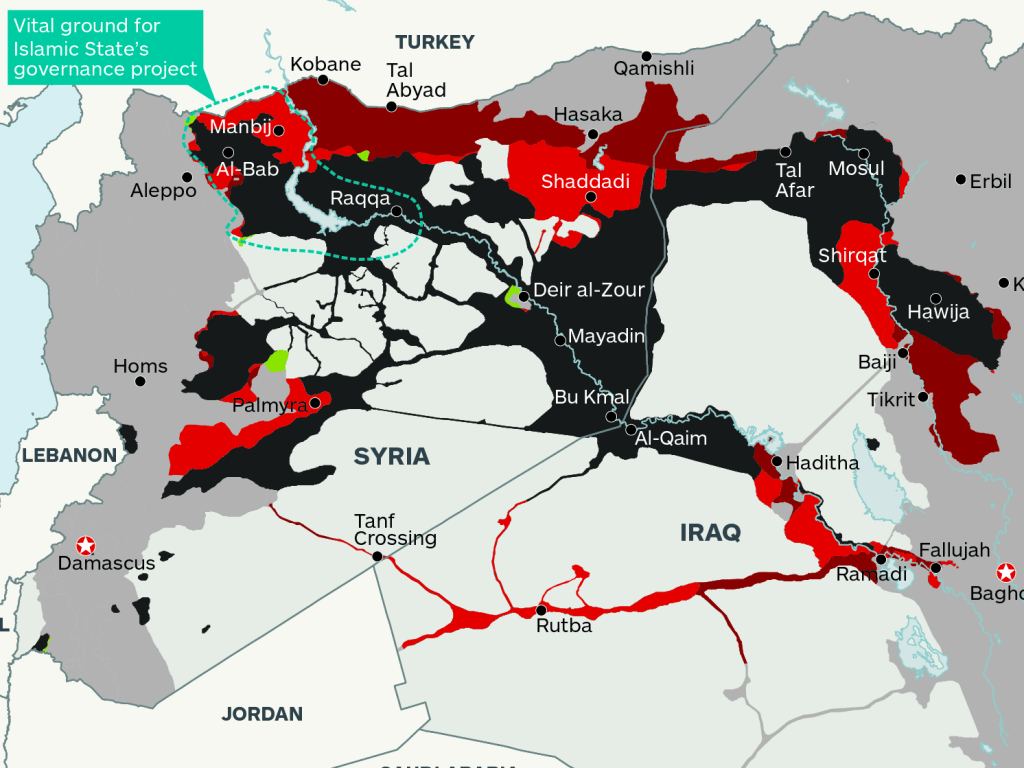
After the struggle for Der Ez Zore and Raqqa, everyone will be fighting against Turkey.” What made the period of our deployment most uncertain was a combination of factors. First, ISIS was annihilated in Raqqa and on the run in Deir Ez-Zor. Second, the Russian Syrian-backed army and the Y.P.G. were racing on either side of the Euphrates River to seize more territory. So far most of the largest river cities were in the hands of the Syrian Regime and most of the oil was in our hands. Tension was building, sometimes erupting into firefights; since no one realistically believes the Assad Regime will tolerate Federal Rojava. At the same time, Türkiye is ready to attack Afrin Canton at any time, seizing the Western most Canton before we can fight our way through Syrian Jihadists in Al Qaeda to close the gap. And everyone knows our U.S. allies will abandon us as soon as ISIS is vanquished. Thirdly, the impending Kurdish referendum will provoke the Iraqi Army to seize border crossings in Sinjar and Northwest of Dokuk, making betting people and supplies into Rojava even harder. 

The biggest uncertainty is what will happen when ISIS is inevitably defeated. But it’s not that uncertain really. Turkey, the second largest military in N.A.T.O. will immediately attack us and try and crush the revolution. Any of us are still here to face them. We will all most likely be killed. C’est la vie. This is the risk of real change. This is the Resistance of our time, so we say. The historic event that will shape the movement for real change for the next thousand years. 

Only a full coward would loudly profess these coffee house revolutionary views, these most noble of aspirations for the brotherhood of all mankind; then, when pressed to relinquish the luxury and safety of the West! They turn their back on defending a real revolution!” 

Not I comrade, not I, No Pasdaran! “These Turkish bastards will not pass.” 

MEC-A-1-S-XXI

S C E N E (XXI) 

سنجار 

Shengal (Sinjar), Iraq, 2014 ce 

*** 

On August 3, 2014, ISIS attacked Sinjar. Yazidis are hunted like animals. Men were lined up and shot. Women and girls, some as young as nine, were sold as slaves. Boys were stolen, forced to fight, or die. Thousands fled to Mount Sinjar, trapped under the sun without food or water. Many perished before help came. Mass graves fill the region. Survivors live in ruins or camps, haunted by the names of the missing. “Genocide on the Holy Mountain. The men are executed. The women and children all enslaved.” 

“We woke up with dreams of life. By nightfall, everything was ash.” 

Bahaa Ilyas and Roza Saeed Al-Qaidi are Yazidi activists. These are their words. Taken from reports made right after the genocide: 

“The sun greeted me as I woke on the morning of 3 August 2014. I was a researcher at the University of Duhok, 200 miles from Sinjar. It was to be a joyful day as I was waiting – first for my salary, and then for Roza, my then-fiancée. Roza and I had plans to go shopping for our engagement party, which was to take place a few days later. We were excited, our future now starting to unfurl before us. We have not felt that way again since.” 

“As Roza and I waited at the bank, uneasy murmurs started around us, and phones began to ring. My phone vibrated; a friend was calling. ISIS has attacked Sinjar, he said frantically. Time stopped as the news took hold of us. Roza phoned her sister who was at her home on the outskirts of Duhok. Her sister told her that videos were being published online of ISIS fighters in Sinjar, and that there was news of killings of Yazidis in the streets. I called another friend, a Yazidi man in a village in Sinjar, who described ISIS vehicles with banners and heavy artillery driving past his home. My mother who was in my family’s town of Bashiqa, also called to say she had heard that ISIS was slaughtering Yazidi men and taking away women. Yazidis are fleeing,” she said, urgently. 

“I withdrew as much cash as I could and ran outside to flag down a car to take me to my mother in Bashiqa. Roza waited for a bus to take her to her family’s village outside of Duhok. We said goodbye tearfully, but quickly. We were not sure when we would see each other again. I made my way to my town, into which ISIS had not yet advanced. My entire family was put into the cars and drove to Lalesh, the Yazidi holy site near Duhok. Concerned that ISIS would advance to Lalesh, women and children were then driven by car to Duhok. Some of my uncles and myself followed on foot. Two days later, ISIS occupied Bashiqa. My family survived, but thousands of Yazidis in Sinjar did not.” 

“The Yazidis are a religious minority that has existed for millennia. With less than a million individuals, most of us live in the Kurdish Region of Iraq. Other Yazidi communities live in Syria, Turkey, Russia, Armenia, and Georgia, as well as farther afield, in Germany, the US and elsewhere. The Yazidi faith descends from the ancient religions of Mesopotamia, and today we believe in the one God. That the Yazidis are a pre-Judaic religion and so are not ‘People of the Book’, has long motivated the political, economic and social marginalization of our community.” 

“At various points throughout our history, attempts have been made to wipe us out– we regularly refer to the ‘73 genocides’ that we have suffered. Prior to the ISIS attack, it was the Ottoman Turks who had made the most successful attempt. Misunderstandings of our faith are deeply rooted, and it is not uncommon for people to casually – and wrongly – refer to us as ‘devil worshippers’ or ‘those who worship stones’. ISIS founded its genocidal attack on these old prejudices.” 

“In the early hours of the morning of 3 August 2014, while I was still asleep in Duhok, ISIS fighters left their bases in Iraq and Syria and moved towards the Sinjar region in northwest Iraq, close to the Iraqi Syrian border. Hundreds of villages are spread out around the base of Mount Sinjar, with one main town, Sinjar town, huddled at the base of the southeastern side of the mountain. Mount Sinjar, an arid 100-kilometre-long mountain range, forms the region’s heart. Before the ISIS attacks, the majority of the region’s inhabitants were Yazidis, with a smaller number of Sunni Arabs. The relationship between the Yazidi and Arab communities, who lived together in Sinjar town and in some of the other villages, was built on friendship and neighborly relations that extended across generations.” 

“ISIS attack on Sinjar came two months after they occupied Mosul in June 2014. It was quickly apparent that the Yazidis were their target, our existence perceived to be a stain on their so-called caliphate. Some families fled into the Kurdish Region of Iraq. Others escaped to the upper slopes of Mount Sinjar, where they were besieged by ISIS. Thousands were trapped under Iraq’s August sun, with no shade, water, food or medical care. Hundreds died on the mountain before the Syrian Kurdish forces, operating under the cover of Iraqi and American airstrikes, rescued the survivors.”  

“ISIS captured thousands of Yazidis in their villages or on the roads during their attempt to flee. Within 72 hours, most of the villages had been emptied, with the exception of Kocho, which ISIS did not vacate its residents until 15 August 2014. Upon capture, ISIS fighters separated Yazidi men and adolescent boys from their families. All the men and boys were executed, often by a shot to the back of the head. Their families were sometimes made to watch. ISIS fighters then moved the Yazidi women and children deeper into ISIS-controlled territory where they were registered. ISIS took note of the ages of the women and girls over the age of 9:  whether they were married or not; whether they had children and, if so, how many. In short, they were pricing them.” 

“Yazidi women and girls have been sold and resold into sexual slavery, beaten, starved and forced into labor in the homes of ISIS fighters. ISIS does not permit the sale of Yazidis to non-ISIS members, but the money to be made is enough for fighters to risk their own lives breaching this rule. Fighters sell women and children back to their families for tens of thousands of US dollars. Yazidi families are selling all they have, and borrowing more, to buy back their women and children from the men who raped and tortured them. There has been tremendous media attention on Yazidi women and girls who have been enslaved – but there has been little attempt to understand how the crimes ISIS commits against our women and girls fit into the group’s attempts to destroy our community. The Yazidi women and girls held by ISIS are not ‘sex slaves.’ They are genocide survivors, and for those who did not survive, they are victims.” 

“Boys over the age of 7 are taken from their mothers and forced into ISIS training camps, where they are indoctrinated and taught to fight. Some have died fighting on ISIS’s frontlines. It has been difficult to locate the boys and rescue them.” 

“As ISIS-controlled territory in Iraq and Syria came under aerial attack by the US-led coalition, Yazidi captives, trapped in fighters’ houses and on ISIS military bases, were reportedly among the casualties. As the ‘caliphate’ crumbled, ISIS fighters fled, taking the captured Yazidi women and children with them. Their fate and whereabouts remain unknown.” 

“Today, I am back living in Duhok and working as a research assistant on the LSE Middle East Centre’s project ‘Documenting Yazidi Victims of ISIS’. The project aims to build a consolidated database of Yazidi victims by age, gender, location and crime(s) suffered, using rigorous demographic techniques modelled on the methodology accepted by the International Criminal Tribunal for the former Yugoslavia. Our team will – with the consent of the survivors and their communities – create and organize data collected for use in accountability proceedings, identification of remains in mass graves, humanitarian interventions, community-building, and broader advocacy. It is specifically envisaged, and is an integral aspect of the methodological planning, that the documentation project will play a significant role in achieving justice for Yazidis against the crimes committed against them by ISIS. The data will ground existing advocacy for accountability processes in national, regional and international courts and tribunals. Once courts or tribunals seize the cases, the documentation project’s data will provide reliable information of high probative value for use before various existing and future accountability processes. I am proud to be part of this effort.” 

“For the Yazidis who have survived, most of us now live in displaced people’s camps, unfinished buildings and in rented accommodation in the Kurdish Region of Iraq. A small number have received asylum in Germany, Sweden, Canada and elsewhere. Others, in their desperation to find safety, have fled on dinghies to Greece. Some, including people I know, have drowned in the Mediterranean. A few have taken the risk and returned to Sinjar, which – though destroyed – is now under the control of the Iraqi central government. The region, littered with IEDs, is not yet safe. Mass graves holding the remains of Yazidis are regularly uncovered. There is a need for forensic preservation and analysis and more generally for reconstruction. Living with dignity in Sinjar remains a challenge.” 

“The Yazidis continue to hope for the rescue and return of the women and children still held by ISIS. We hold out hope that some of the Yazidi men captured have survived and might also be reunited with their families. We have survived, for now, ISIS’s attempt to destroy us, but we remain a deeply traumatized community in need of support: psycho-social support, educational and livelihood initiatives, including those specifically aimed at increasing female social and economic independence, forensic documentation of mass graves, reconstruction, including infrastructure for potable water, healthcare and education – our list is long. But if I were to summarize, I would say the Yazidi community, displaced from Sinjar and desirous to return, needs three things: assured security, justice for the crimes committed against us and recognition of the genocide. The prejudices against our community must be uprooted and made to wither in the light. This requires the calling of the crime committed against us by its true name.” 

“The morning, I awoke thinking about my engagement belonging to a more innocent time, one to which Roza and I cannot return. This morning, I sat in front of my computer. On its screen are the names of thousands and thousands of Yazidis.”   

“They are categorized: killed, kidnapped, missing. I know they, like me, they once woke up looking forward to the day ahead of them.” 

Report by:  

Bahaa Ilyas is a Yazidi activist who has been in close contact with internally displaced people through different agencies and organizations since 2014. Currently, he is a researcher on the LSE Middle East Centre’s ‘Documenting Yazidi Victims of ISIS’ project. 

Roza Saeed Al-Qaidi is a Yazidi activist. Since ISIS’ attacks on the Yazidis in August 2014, she has been involved in humanitarian aid and has interviewed Yazidi survivors, particularly women and girls who had been sexually enslaved by ISIS fighters, on behalf of several different organizations. 

*** 

As Further explains the fixer “Abu Hamza”, the assumed Kunya49 of a Kurdish businessman fixer named Alacan Al-Biban of Kirkuk City, fixer, artist, gentleman, man about town in Erbil.  

ABU HAMZA 

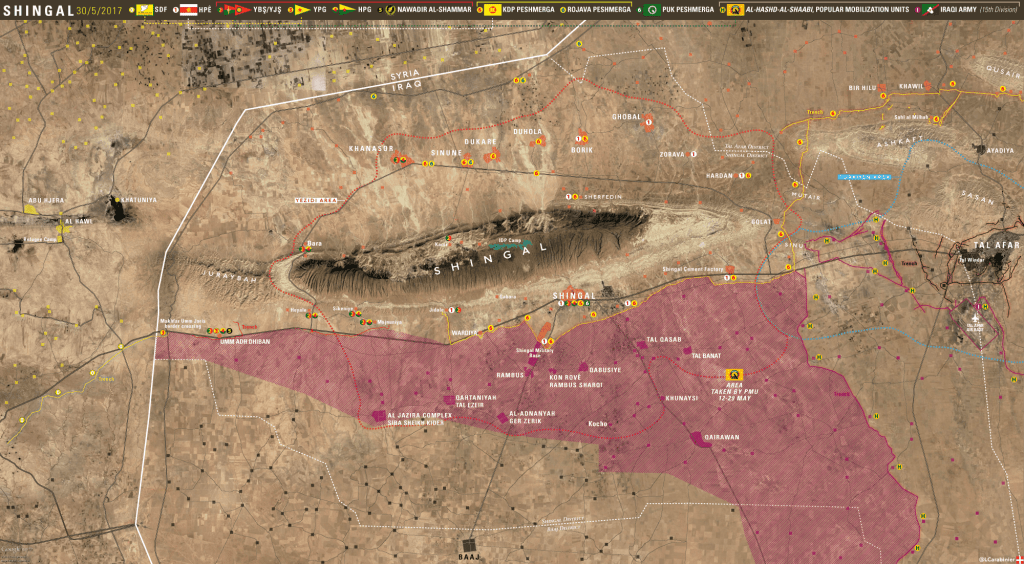
The Yazidis live in and around a holy mountain called Jabal Sinjar. It lies along the Syrian Iraqi border 80 kilometers West from Mosul in the Nineveh Governorate. Their holiest site called Lalish, the tomb of their avatar for the Peacock Angel50Tawuse Melek”, Sheikh Adi ibn Musafir is found between three mountains. The Arafat, the Misat and the Hizrat.”    

On the highest peak of Jabal Sinjar is the Chel Mera Temple. “The Temple of Forty Men”. The temple is so ancient no one remembers how it got that name, but it is believed forty men were buried there. The Yazidis have three hereditary castes; the Murids, the Sheikhs and the Pirs. In some ways their beliefs are linked to Sufism and Zoroastrianism.  They believe in reincarnation and forbid intermarriage with other groups. Although some claim they have holy books called the Kiteba Cilwe (Book of Revelation) and Mishefa Res (Black Book), there is great reason to believe these are forgeries created in 1911-1913 and virtually all Yazidi religious theology is a chain or oral transmission called Qawls; hymns with cryptic allusions and supporting stories.   

The Yazidis are ethnically and linguistically Kurdish. They speak Kurmanji, like the Kurds of Syria and Turkey. They are concentrated in Northwestern Iraq in a highly mountainous area called Sinjar by the Arabs or Shengal, by the Kurds. They are monotheistic, Gnostic religion. Over the years Sunni Muslim Arabs have typically accused them of devil worship, because of their belief in a pea cock fire angel. In 1414 their sacred Lalish was razed. In 1640, Ottoman Turks carried out a pogrom killing around 5,000 of them. In 1892 Turkish Ottoman Sultan Abdulhamid II mass conscripted the men to eradicate their faith. In 1974-1975 Saddam Hussein deported Yazidis and re-settled Arabs in Sinjar. Around 137 Yazidi villages were destroyed. In 2007 there was a Jihadi campaign of bus bombings, kidnappings and terrorism that left as many as 300 Yazidis death and over 1,500 injured. In 2009 Al-Qaeda used a series of truck bombs in Sinjar to kill upwards of 500 Yazidis in Qahtaniya and al-Jazira. So, Turks and Arabs killing Yazidi is as Sunni Islamic as tea and shawarma.  

The story of the woman being fed, oh yes, fed, her one-year-old son. A later story. 

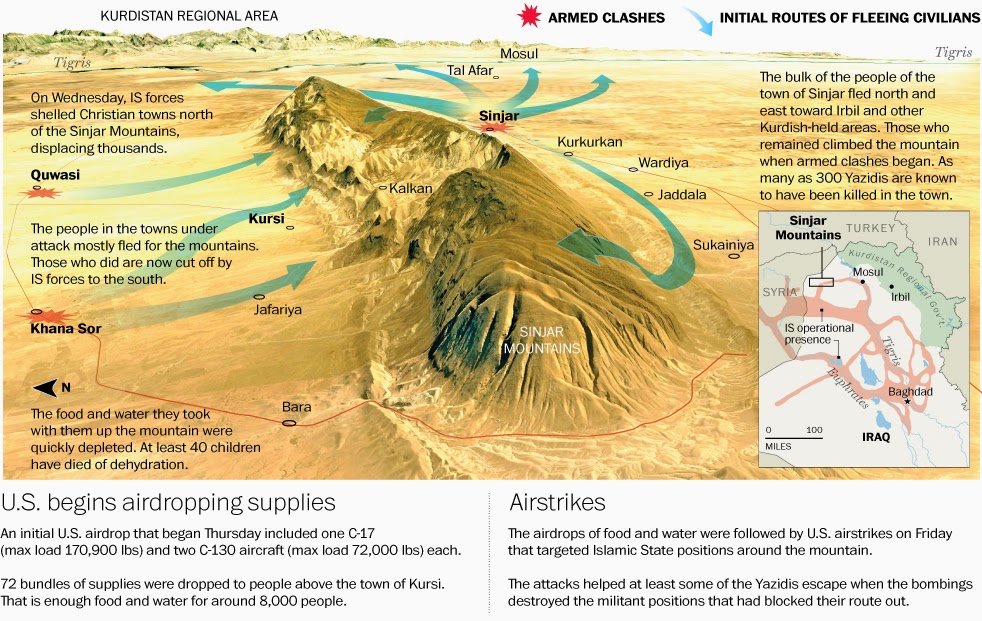
In August of 2014 “Those who run from death”, the KDP Peshmerga, abandoned their positions and allowed almost all of Shengal to fall to ISIS without firing a shot. ISIS then began a rapid campaign of summary execution, forced conversions, sex slaving and out right genocide. On August 3rd, 2014, ISIS captured the holy city of Sinjar. A massacre began. Over 200,000 Yazidis fled into the surrounding mountainside. 50,000 of them were trapped on Mt. Sinjar, exposed to the elements with ISIS bandits raping and murdering their family and friends. ISIS Cheta shot 70 to 90 men in Quiniyah Village, 360 in Harden village. 200 Yazidis were lined up and shot in Sinjar city. 60 to 70 killed in Ramadi Jabal. 50 in Dhola village, 100 in Khana Sor and 200 more on the road between Adaniaya and Jazeera. Dozens in al-Shimal village and more on the road from Matu to Jabal Sinjar. Women were gang raped. Children were buried alive. In most cases the Yazidi girls and women were separated for rape and sex traffic to various ISIS held cities. Old women were summarily shot.  

Using rape as a weapon of war Daesh bandits had gynecologists examine their captives to set slave prices based on virginity. They were treated like cattle. There were online price indexes. Sales on Telegram, Facebook, and WhatsApp. Prices varied. Between $2,000.00 and $10,000.00. Less than 5 women escaped. Many died in captivity or allied bombardment. 

The Sinjar Mountains are over 100 km long-range running east to west. The lower western segment in Syria and eastern higher segment in Iraq. The range is viewed as sacred by the Yazidis who consider them the place where Noah’s ark came to rest. On August 8th the United States President Barack Obama ordered airstrikes against ISIS in Sinjar. Air strikes and mass supply drops for the Yazidis hiding there. While PKK light infantry breaks through the ISIS lines and guide thousands of trapped, injured, starving Yazidis off the holy mountain.  

ABU HAMZA 

The 50,000 Yazidi besieged on top of Mount Sinjar began to die from hunger and thirst and exposure to the elements. On August 10th P.K.K. and Y.P.G. guerrillas, with truck mounted heavy machine guns supported by mobile light infantry charges, broke the ISIS siege and began guiding Yazidis to refugee camps and shelter. Some were evacuated by the Peshmerga via Cezanne and Telkocher roads to Dohuk, Iraq-K.R.G. Though the majority broke out with the P.K.K.-Y.P.G. safe corridor to Rojava.  

They fought most of the rescue operations from pick-up trucks or on foot. With small backpacks which mostly had been loaded with extra magazines and hand-grenades, canteens of water and sometimes a few cans of Mortadella. Or canned olives or whatever was left before they shipped out. Clad in green baggy green fatigues, the PKK made a rapid incursion through ISIS-held territory to launch the largest humanitarian evacuation of the war, saving the lives of tens of thousands of civilians hiding on the mountain.  By August 8th most of the remaining Yazidis had been evacuated by the P.K.K. to the K.R.G. areas and Rojava.  On August 10th airstrikes opened a passage for another P.K.K. evacuation into Syria of some additional 20,000 to 30,000 Yazidis. But there were still around 10,000 trapped on the mountain by 13th August receiving airdrops of food and water from the coalition forces. Eventually, the guerrillas got almost everybody still alive out alive.    

On August 15th there was a large massacre in Kojo. Over 80 men were killed outright. The entire male population of Khocho, around 400 men were butchered. Around 1,000 women and children were abducted for sex slavery. In Tal Afar 200 Yazidi were shot at the prison. A report in late September concluded over 5,000 Yazidis had been exterminated. Several thousand, perhaps as many as 7,000-10,800 women and girls were carried off to Mosul, Raqqa and other ISIS strongholds.  The confirmation of the missing versus the dead has not been cleared up yet and will not be for many years.  

Repeated raids by P.K.K. commandos rescued 51 Yazidis in March and 53 in April. Most of the abducted women and girls are still missing, having been living in brutal, in-human slavery for over four years. Most have been presumed dead. Mass graves keep being found all over the liberated areas.  

“From time to time a young woman, an escapee, jumps off Mt. Sinjar. That will probably go on for many years to come, a dark disturbed pattern in a community wholly unaccustomed to this level of barbarism” explains Alacan, known mostly to outsiders and journalists as “Abu Hamza”.  “They were all mentally and physically abused by the vile bearded Chetta in ways we cannot ever possibly comprehend. That few can even bear to hear. Fewer still wish to talk about.”  

MEC-A-1-S-XIX

S C E N E (XIX)  

קיבוץ עין דור 

KIBBUTZ EIN DOR, State of Israel, 2001-ce 

*** 

The very first Kibbutzim were built out of both practicalities, and a socialistic feeling that many of the early Zionists arrived with from old Europe. It is correct to assume most of the early founders, pioneers, resetters; resettlers; were Ashkenazim from Eastern Europe; where material conditions for the Jew were far worse than Western Europe. Until the 1930’s when they would become fairly bad in both Europes. Mostly Ashkenazim, but not wholly. Certainly, one can see an overwhelming majority of white Jews in the early Zionist congress, its structures of settlement, and its proto-military formations. That is wholly because the Sephardim and Mizrahim; were without a doubt more integrated into the Muslim world. Their position was without a doubt one of being tolerated, but it was an integral toleration; written into the Quran as the word of G-d. In Europe; a series of inquisitions, blood libels, persecutions, expulsions, culminating in the Holocaust of 6-7 million. 7, as the Germans didn’t count infants and children in many of their extermination counts.  Yet, today, on the Arab street, it doesn’t matter how many Hitlers forces eliminated, “it was not enough”. The kibbutz was an attempt to remake the world, in a settler Zionist leftist infused fashion. It was a project to transform the ghetto Jew of Europe, the Jew of the Pale, into the Judean of his heritage. It was practical as it was about maximizing labor, in an egalitarian fashion. It was also infused with the socialist ideas of Europe. The USSR had been born in 1917. Many of its architects were Jewish, though not all certainly. There was a feeling in the mind of the early pioneers that they were recreating a world, but most of them were not religious, so they drew intellectual and moral supports from a long-gone warrior past; Moses and the exodus, Esther and Mordecai, Hanukkah and the Hasmoneans, Bar Kokhba and the three wars with Rome, a time before the exile and wandering. Not necessarily grounded at all in the scrolls. Fused to that; the core value of Tikkun Olam; the Jewish duty to remake the world in a moral light. The left progressive manifestation of manifest destiny or being “chosen”. What that became in practice was all the early architecture; the structures of the new Jewish state that came into being in 1948. The kibbutzim, hundreds of them; were incubators of the new state. Perhaps more than half were left, and the other half were right; Moshavim; farms of tenancy in common, as opposed to collective ownership and utopian values.  

Now what was in no way consistent was to what degree the early settlements incubated tolerance and acceptance of the Palestinians. The people that had been on the land for at least as long as the Judeans had been expelled from it; sometime between 66CE-136CE. 

There were three very bloody wars with Rome, and then all of us who survived were marched out into protracted slavery. From 136CE until the beginning of organized Zionist re-settlement beginning in 1897, of course a lot of wholesale misery befell the Judean people. Alot of brutal violence, expulsion, discrimination, pogroms and butchery in Europe. Between 136ce and 1948 when the Jewish state was re-established, people lived in Palestine. Whether Palestine was ever a state, for it never was, does not negate the multi-generational settlement of Arabs into the land. Perhaps some were once Canaanites, or Philistines, but it hardly matters. Either under varying caliphates or Ottoman rule; the Arabs of Palestine never ceased to exist.  

  It is not well known amongst the modern Arab street, or anti-Zionist student protesters that Theodore Herzl, Zionist founding father and ideologue, longed to live alongside the Arab. Sought Jewish redemption as an integral part of the Middle East. It is not well known by Jews that Ben-Gurion, the labor left founding father of the third Jewish commonwealth planned and executed ethnic cleansing. While the right-wing Revisionist counterweight, whose legacy informs Netanyahu and Likud Party; sought to live alongside Palestinians in a far larger Palestine than anyone else though possible. Jews are literate and we all somewhat study history. The very nature of the Talmud is legal reasoning. That cannot be fully said for the Arab street. But it doesn’t matter anymore. The violence which began in Palestinian riots in 1916, has basically not stopped cycling to this very day. The Israelis speak of Independence War, the Suez War of 1956, the 6 Day War of 1967, the Yom Kippur War of 1973, the Lebanon wars from 1978 until 2000. The first Intifada, the second one we are in now. But it’s a non-stop vile bloody endless war. The rest of the Middle East has in the same period been at war, either with Israel, or with each other. With each death, a changing of our nature as people. Until no one can see anything besides the defensive posture of endless war. To that end Israel has acquired 200 something nuclear missiles.  

The first man you see die; it is a consciousness lowering experience. With each death you experience you become tainted, you become stranger. This is magnified 100-fold the first time you kill.” 

The Kibbutz has many books in its library, and in my free time I suppose I gave myself a second glance into my people’s imagined history. Which like any history of any people is full of justification and mythology, yet with two Jews one might fight five opinions and six organizations, and argumentation with each other at length, also in one’s own head. A running self-doubt about the destiny of the so-called chosen people by G-d, also anxiety about what it took to survive for so many thousands of years. And in our scrolls, in our own books, we have built an entire paradigm about the feasts of survival, the fasts of our many massacres. The veritable film industry around the Holocaust, large Hollywood violins playing for us alone. It was never one tragedy. Never one moment of doubt. It was a vast and unusual mythology about how we survived all that, and what if anything is our duty now, to our own nation and to others.  

Death of any form, you cannot unsee it, and you cannot ever forget it. Usually, if it is someone close to you, you can also never forgive it. And thus, in this small place, no bigger than Al New Jersey, that cycle has played out since 1916 accelerating mass inter-communal violence with new intensification.” 

There in explains Israel and the soul of the Jew. For when in the last 2,000 years was not the Jew being hunted, or expelled, or persecuted, or exposed to concentrations of death and dying. That is then our obsession with history, or another way to say a canon of near miraculous survival. The Jew, if anything, is literate and a literate person can read and retain history. But for nearly 2,000 years the Jewish nation was stateless, unable to practice many skills. So, the Jew became adept at working with their brain. True, but also devising a means to survive outside of, if not with the state hostile to Jewish existence. Because the Jews were also always frequently expelled by Christian powers, they evolved a wide range of portable skills and portable non-state structures. 

Ironically, though the last 100 years would have one believe the Jews and Muslims are locked in eternal conflict this is wholly false. Jews were not maltreated, massacred, and genocided in Islamic lands, for the most part. It was not until the re-conquest of Palestine that animus boiled over. Yet, death and dying, now killing seems baked into the Jewish nation. The state of Israel is then a pressure cooker. For it is mostly undisputed that European gas chambers and killing fields took the lives of 6-7 million Jews. That event, that event was an instance of dramatic evolution. It cannot be said Israel was founded because of the Holocaust, or by its survivors. Nor should it be overlooked what one might have had to do to survive the holocaust.     

The stories we tell our children and venerate to each other in our holidays are also about what we had to do to survive Egypt; kill their first born on Passover. Assyria; fight a brutal guerilla war on Hanukkah. The story of Purim is how we sent a beauty to bed the king and get permission to massacre tens of thousands of our Persian enemies. Lag be Omar symbolizes the tens of thousands the Romans massacred in our three wars with them. This is all crude, but it is also somewhat true. Perhaps we the Judeans are as good at killing as we are at running to not be killed. Jabotinsky famously once said that we should not hold ourselves to any higher standard than any other nation. Israelis it seems have learned that lesson well. 

The aggregation of all events in the last 2,500 years was a crude mechanism converting a learned race of rabbis, high priests, and peasants, into, what we are today. What did not kill us made us very capable of survival. Some of those were prayers of the chosen, some is our zeal. Was the survival perhaps of the worst of Europe’s Jews, or Jews that so hideously misshaped in the furnace; did they still have a Jewish soul? The most Zionist and pioneering of Jews had left Europe before 1939. The millions of Jews who had lived in Muslim nations for over 2,000 years had a different type of soul too. But all ended up in the new state, or should we say, third try at a Jewish commonwealth in Palestine. Or would be just say, third try at a Jewish state. 

The lived experience of historic persecution has then made us smart, innovative and perhaps also more recently capable of a great violence that was evident in our past, but dormant for nearly 1,900 years. We pride ourselves on our doctors and lawyers, our musicians, scientists, architects, politicians, and bankers. But we should read in our own holidays and feasts as a remembrance of an innate zealotry. A unique and often psychotic refusal to assimilate or compromise. Such events in our history like the exodus, but then also the invasion of Cannan. The intrigues of Purim, but also the massacre of tens of thousands when sanctioned by the king who married our Esther.       

I am two hours late to work back at the kibbutz on Sunday morning. You get what you pay for, as they say. I show up for my duty on Yards and Gardens hung over, un-showered, and looking a bit vacant. My supervisor Mr. Jones saw the blood on my khaki shirt and the terrible look in my eyes. He sent me to go sleep it off. He did not ask, nor did I mention. He knew or he did not. I did not say anything about the Dolphinarium to anyone.  

When I eventually woke up back in Ein Dor, the Associated Press told the world. I crashed out in my cot and slept hard. Remembering my training, I began to immediately dissociate everything I had seen. Allowing the willed dreams to become new memories. 

The next day I climb Mt. Tabor after Ulpan class as the sun is setting with what seemed like the only person about my age on the kibbutz, a young Persian Jew named Hadas Naphtali from the nearby village of Ramat Ishai. She claims to be “an anarchist” and practitioner of “black voodoo magic”. We borrowed a copy of the Tenach from the kibbutz library. We say extraordinarily little as I follow her up the mountain, really a large hill. We watch darkness overtake the valley from the top of the mount. She begins to read, her nearly D’s and her tease have me fully under her spell. She is bad, as they say in Brooklyn.    

It was an interesting Biblical passage she recounted describing how King Saul consulted with the wizard woman from Ein Dor before his fatal battle on the Gilboa. King Saul had persecuted spiritual people during his Kingdom, so no wonder she was afraid of the King. Although he came to the meeting disguised, the witch recognized him. Saul required her services to get a sign about the future he would face in the crucial battle the next day against the Philistines. King Saul brought back the ghost of the recently dead prophet Samuel; however, Samuel did not deliver a positive outcome of the battle. Indeed, King Saul died on the next day. 

It was at Ein Dor that King Saul learned of the fate of Israel as well as his own on the next day, which he was completely powerless to stop. His own G-d was silent. In the silence he put fatal trust in the witch of Ein Dor. And now so did I. 

Hadas Shimeon Naphtali, part Persian, part ravishing. She was born here. She reads my palm. The valley’s Arab villages and the electric glow of Kibbutz Ein Dor flickered in the twilight. Hadas turns over my hand examining the lines of my palm. Suddenly she bites the thick my right hand below the thumb, bites it hard. I wrenched my hand back. 

“The spirits will watch over you, but maybe G-d is indifferent,’ she whispers to me, ‘Take precautions, because nothing for you is totally written by G-d. You could be undone on Tisha’bav, or one day they will you be a Messiah. The angels encircle you, but the djinn too. They will strike at you on the day you are the happiest.” Real witch talk. “You’re an epicenter of spiritual war, no one knows how it it ends,” she tells me. 

My hand still smarts from where she just bit into me. Do not let a witch bite you, old Haitian Voodoo saying. Who really knows what is in their bite? 

“What’s all that all supposed to mean?” I asked her. 

“Nothing is written for you when G-d writes the chapters of the year for others. That you’re just foreign sexy and I like you and the sounds you make. We should get the fuck out of this country before it all blows up around us,” she tells me, “What are we doing here,” she asks me, “take me to your homeland America! To Newyorkgrad. There is nothing good for us here in the long run. Only a slow death or a fast death.” 

This is our homeland.” 

Is it? Do we have new rights the Arabs no longer have?” 

“There are many other Arab nations.” 

“There should be no nations! No states. It is all a trick on us,” she says. 

“We have been through hell everywhere else.” 

“It’s not true. Thats what they taught you in Hebrew school, but it’s not true! The Arabs and Persians never did anything to us. We had no reason to war with them for 100 years.” 

“They started the war.” 

“It doesn’t matter Zachariah who starts a war. States and kings start wars. Not regular people. No one asked the Palestinians to live here, they just have lived here for thousands of years. This is their land as well. They farmed it. They built homes. They lived here while we rotted in Europes ghettos. But my family comes from Persia. They never had issues with us. There are still 20,000 Iranian Jews living safely in Iran.” 

“They kicked them out of everywhere else.” 

“Did they? Depends on what books you read, I guess. Maybe some left on their own. Some were tricked into coming. Some got kicked out later.” 

“We should have a state of our own.” 

“No. All states are oppressive. All nations are built on death and lies.” 

“Where did you learn all this,” I ask her. 

“Books in the Kibbutz library and my parents.” 

“I like it here,” I tell her. 

“You haven’t seen shit.” 

“Show me everything.” 

“I’ll show you as much as I can.” 

“It’s a very small place. I have been dreaming of being here all my life.” 

“There is so much violence happening here. Behind walls, in plain sight. I was born here, so it is my home now. I am Jewish like you are Jewish, so we are home. But it all has a cost. A cost to keep our many enemies at bay. Life here is not like the kibbutz, it is hard to poor here. It’s hard in the cities. Most people are not so well off. There are many cracks you will see soon. Don’t glamorize this land, and don’t die for anyone’s state.”  

She takes my hand again. 

“Kiss me hard and let’s go to America, ok.” 

She kisses me quite hard and says, “A war unlike any of the ones before is coming.” 

*** 

I do not mention the bombing to either Hadas or my compatriots of the North American Social Club. But they could see I had sunk into depression. I stopped attending Ulpan class and began to drink more heavily. Yuma began to taunt me, or at least that is how I perceived it.  

Sometime in mid-June a new girl from Ramat Ishai, a small town twenty minutes to the north had moved onto the kibbutz after fighting with her mother about curfew. She hadn’t even unpacked her bags before I took her on a picnic, got drunk in the cornfields, and fucked her in the ass on the floor of her shower. She had black voodoo magic, next thing I knew we were taking nature hikes, and she was interpreting dreams. That was Hadas, punk and exotic. Not at all content with her life in “this colony”, as she called it sometimes. 

Danny Callahan and I grow closer. Danny became a sort of older brother to me, following in an extensive line of slightly older men. After a while we dropped out of the North American Social Club altogether to spend time with our respectively cute native flings. After a day in the yards, we often sat on our own porch watching Debriyiah and sipping from big bottles of frosty cold Coke. I always snared a few liters whenever I ventured off the kibbutz. We’d pontificate about these wonderful desert women. He was set to marry one this time next year. Danny is teaching me to freestyle rap, to rap off the top of my head. I was always something of a makeshift romantic poet, and Danny told me this would be yet another tool I might use to communicate my message. I had sense shared with him both my past and my subversive ideals. Back in LA Danny was a regular at open mikes in various hip clubs. In America I would have laughed at this, but this was the Middle East. You clung to what you were before on some gut level. He gave me my first hip-hop CD by an outfit called LATYRX

I will tell Danny more about my “revolutionary wanderings”. He nods approvingly at most of it and wished me luck as many slightly older men had done before him. He assures me that I’ll never be out of work here. “Something is always broken or exploding or burning down. The trouble is it’s a small place, so they can and will catch you eventually.”  

We rarely talk about the Palestinians, what they want or what should be done about them. Danny tells me he thinks that they had more right to this land than he or I did. After all, they have nowhere else to go. “Their only fallback position is more death and more forced exile.”  

Danny is not a Jew at all, but had claimed his grandmother was one to get an immigration VISA. He would be off to the Army in September once he completed the Ulpan program.  He was 26, which put him at the age for active service. I had neither renewed my soon-to-expire tourist visa nor made any real strides toward official Alleya. Even Johnny Yuma had gotten his Todat Zhoot, which entitled him to some cash and subsidies from the government.  

Danny tells me that even though I was a far more bonified Jew with my candle lighting rituals and my intermittent prayers, or demonstrably crazy, I would be looking at three years’ service in the Defense forces.  It wasn’t even theoretically legal for a 17-year-old to be bopping about Israel with no guide or family, but no one ever called me on this. My freedom of movement would be further curtailed with registration. As I’d be quickly conscripted. Mr. Jones, my South African foreman in Yards and Gardens told me to catch the next flight out of here. “Go back to America, kid. This whole place is falling apart. In the heat of violence to eventually be swallowed by the sands. There is no actual future for you here.”  

I am getting a lot of advice about my future. Through it all Danny remains mostly neutral. In his cool, collected cold California old stoner way, he says that “I should take all the time I need to decide.  

He urges me to: “Flee the shelter of this stupid boring insular kibbutz and see more of the real country. See what is really happening here, the good, the bad, and the real. Better now than when they stick you with a rifle to defend it. Then give your children a rifle, and their children after them.  

Alot to see in a very small place.”  

It is all rather good advice. Eventually, I must take some of it. 

“Did you know that in Tel Aviv you can order women from your phone like a pizza,” he tells me. 

“That’s very futuristic,” I reply. 

“The world is very wide, and this war is very old, and once you really get involved in the defense, and the killing, your youthful and high minded, human rights ideas won’t hold water. Soldiers do not have the luxury of having opinions or questioning the logic of a war. To live here we have to basically pick a side. I have come to terms with that, but I don’t think you have at all.” 

MEC-A-1-S-xvii

S C E N E (XVII)  

بيروت 

BEIRUT, 1932ce 

*** 

Counting people is a sensitive matter in any country, often fraught with fraud, gerrymandering, hatred, as well as bold lies. Total made up numbers” No one is interested in upsetting the balance of theft and power. For that is when shooting, stealing, and raping starts. The war. The civil war took 140,000 to 170,000 lives but no one, especially not the Maronites, want to admit that the new facts on the ground have nothing in common with the ethno-religious confessional system in place. It is typically a system that benefits the Chrisitan and the Sunni elites, at the expense of the Shi’a in general and the placation of the Druze who make up 5-10% of the population. Were one a betting man or a trained anthropologist; the Christian numbers are down from war emigration and the Shi’a numbers are way up from having large family sizes (6-9 children). There are also as many as 478,000 Sunni Palestinians absolutely no one wants to naturalize and as many as 1-2 million Syrian refugees, but only 780,000 are registered with the UN relief agencies. They Syrians have always come and gone for freely, like and awkward armed big sibling. To the South Israel has a long history of invading and occupying, and sometimes getting the President killed (Bachir Pierre Gemayel in 1982). To the Northeast Syria has a long history of invading, occupying, and sometimes killing the President (Rafic Hariri in 2005). 

They say countries with no working census are the real free countries and Lebanon hasn’t had one since 1932. But what does it mean to be “free” if all other parts of life are totally insecure? What does it mean to be counted if the numbers are all lies? It’s unnatural to be counting people like chattel and it’s completely prohibited in Judaism. Surely the State of Israel obsessively counts people every single day. The trouble is, the Lebanese went and fixed these invented numbers of 1932 to their Confessional Quota system, with Maronite Christians, Sunni, Shia, and Druze all getting lion shares of the system. Based upon the old National Pact47 and the Taif Accords which “ended the war”, although most districts are mixed; this system allows for a kind of political horse trading that makes Lebanon a very fragile country to govern. 

The Quota system slots key political and bureaucratic seats to specific ethno-religious groups. Remittances and smuggling make up a large unknown portion of the GDP, which could be above 40-45%. No one really knows. The Lebanese also offer boutique medical and legal services to much of the Middle East. There are 42 universities. Tourism makes up much of the rest followed by banking (which used to do better than tourism i=until the sector imploded in hyperinflation), real estate, and construction, money laundering, food processing, wine, jewelry, cement, textiles, mineral and chemical products, wood and furniture products, oil refining, and metal fabricating. You can know that as a maven trader or look it up on the CIA Fact book, but in general all numbers are inventions here.  

Now, a clever idea for your next vacation; somewhere with a real sunny beach and a lot of bang for your the fucking dollar. Somewhere they do not openly hate the Americans and want to put them in bags or bags on their heads. A bad idea; various places with ethno-religious rocket exchanges going on every day. Also perhaps places that use quota systems to link ethnic group factions, of which there are 18 listed, to seats of theft and power. Also, the quotas are fixed to parliamentary posts, top military commands, trade institutions, civic leagues, and as a result all Lebanese are living on a mountainous powder keg with valueless currency. The default is that there is not one Lebanon, but instead at least 5. Possibly 18. That’s Lebanon in gross geopolitical simplification in case you didn’t catch that. That’s not all of Lebanon, just a very problematic part of the most obvious of problematic parts of it. Of course, it doesn’t capture “the Lebanese Soul” which was a 5,000-10,000-year journey to materialize, at least. They don’t all hate Americans for sure of course and don’t all want to put them in bags. Putting some one ina bag is not very hospitable and they have done well to stop doing that since the 1980’s. Though many still do. In the 1970s and 1980s kidnapping was a major industry of grievance where at one point 147 American and European hostages were hidden all over Beirut. Perhaps kidnapping people is an advanced form of hospitality, and it was all dictated by Iran, who knows. 

Since the very minute, the Jew purchased his plane tickets it was like a secret to be kept. You see, there are things you tell your friends, and then there are things you hold inside because if you tell your friends they will think you are crazy and try to stop you from doing anything important or interesting in life.  So, Sebastian, later known as the “Jew of Beirut”, didn’t tell that many people about his plans to go to Lebanon. Also, those he told, he made it out like well deserved “reckless adventurism” to the wild Middle East. Not like there was a whole fully baked reimagined plan, the kind of plan the Jew knew best. 

“You see that was something well know about their people; the ability to hold multitudes of contradictory information in the head; believe all of it to have truth; and formulate plans from the data flowing through.” Of course, all smart people can do this, not unique to Jews. 

You see, the Jew of Beirut rarely acts without acting in concert, which is to say, he manifests a specific line of conspiracy wherever he goes. A fusion of human rights populism, Middle Eastern particularism; and pontification on the love of free life! He has detractors but mostly curious if not enthusiastic supporters. After some time living and working in New York Grad he had ingratiated himself to many people. He’d become a well-known person in certain circles. He was like a mayor of his work force. A person with some connections and agency beyond himself. Even if always filled with self-doubt. He had some things to build on therefore some things to barter or totally lose. Or perhaps he was only important to one person only, his secretary Karessa Abe, arguably the only person that ever really loved him. And he squandered it all the time by never really being a suitable partner to her. Never cheating but never being available enough. She is more than a decade younger than him and them ain’t in the old country anymore. He is President of a Harikaat, a movement of ambulance workers seeking much better conditions. It was somewhere between a charity, a lobby, a union, and Hezbollah without God. He was also a law student. He has thoroughly studied the Zionist idea and found it to be, through a Kurdish lens, a universal idea about how rights are won and secured. 

So, being a President of a quasi-underground, reasonably militant labor association devoted to the wellbeing of EMS workers, he figured for the right price some of them could be lured to Lebanon to carry out some basic training. But this was a background thought. The kind of training everyone needs; EMT training; when can’t the world benefit from having a few more EMTs around? Spoken like or thought about like the thinking of a career EMT? Perhaps. Perhaps. Perhaps. The plans of a Jew lawyer paramedic. It’s hard to make small talk when your mind is wide enough to see much of the world moving at the same time. But the world cries out for help, so sending more Paramedics is only part logical. At least not really something many can oppose if they can figure out how to pay for it. So, the Jew of Beirut took off for more than adventure, for less than just a type of altruistic business deal. He wanted to find a way to cross over and remain there. He hadn’t totally considered how much that might hurt or offend other people; it was just a desperate act. 

Now desperate acts usually don’t have high degrees of planning, and although the Jews are known to be quite master planners, sometimes the best plans go very South. Once in 1975 the Israeli Military and some of the Lebanese Maronite Christians had a plot to reconfigure Lebanon48. It went really fucking south. The Israelis occupied a strip of southern Lebanon called the Security Zone for 22 years. In 2000 they unilaterally evacuated, and Hezbollah fully took over there, south Beirut, and the Bekaa Valley. The plan to restore Christian hegemony and unite Lebanon and Israel in an alliance, while driving out the PLO, well, all that failed. 

*** 

“The cultural and linguistic heritage of the Lebanese people is a blend of both indigenous Phoenician elements and the waves of foreign cultures that have come to rule the land and its people over the course of thousands of years.”  

In a 2013 interview, Pierre Zalloua, a Lebanese biologist pointed out that genetic variation preceded religious variation and divisions: “Lebanon already had well-differentiated communities with their own genetic peculiarities, but not significant differences, and religions came as layers of paint on top. There is no distinct pattern that shows that one community carries significantly more Phoenician than another.” 

“I’m going to give you a lot of great information; but I want you to focus in on just four primary factions; the Sunni; the Shi’a; the Maronites; and the Druze. 

Please see the Appendix: In Lebanon there are 18 officially recognized ethno-religious confessions which contribute to the rich diversity of the nation, and these include: 

  1. Alawites, a branch off the Shi’a who ritually drink wine and believe in reincarnation. Via the French and the Ba’ath Party this secretive ethnic minority came to control all of Syria; except for now in the years after the Isis War. Today, the Northeast of the country, north of the Euphrates River, is controlled by the Kurds, in an autonomous social experiment called Rojava. 
  1. Armenian Catholics: Ethnic Armenian Christians who accept the rule from Rome. They are very business oriented, but not natural Phoenician style global traders and they aggregate in Bourj Hammoud District of East Beirut. 
  1. Armenian Orthodox: Ethnic Armenian Christians following the Apostolic Church based in Vagharshapat, Armenia; one of the oldest branches of Oriental Orthodox Christianity. Culturally, culinarily, and aesthetically not much different than Armenian Catholics.  
  1. Assyrian Church of the East are following the Eastern Branch of Syriac Christianity not in communion with Oriental Orthodox Churches or Eastern Orthodox Church, nor Rome. Most of its practitioners are ethnic Assyrians, and its base is in Ankawa, Iraq a suburb of Erbil in the Kurdish controlled zone of the KRG; the quasi autonomous Northern third of Iraq.  
  1. Chaldean Catholics: are Assyrians who came into communion with Rome arising from a schism with the Church of the East. But they are not that much different than the Assyrians of Ankawa that did not bend to Rome. They are mainly descended from Iraqi Assyrians. 
  1. Coptic Orthodox are an Oriental Orthodox church based in Alexandria, Egypt who follow the Pope of Alexandria. Established by Mark the Apostle in the 1st century; also, an Eastern Oriental Church. Most of the Copts are descended from Egyptians. 
  1. * * Druze * *; An Abrahamic, monotheistic, syncretic, and ethnic religion whose main tenets are the unity of God and the belief in reincarnation and the eternity of the soul. Most Druze religious practices are kept highly secret. The Druze do not permit outsiders to convert to their religion. Marriage outside the Druze faith is rare and strongly discouraged. Concentrated in the Chouf mountains they have long been viewed as a king maker minority group, perhaps fourth largest on its own accord. There is a larger Druze population living in Syria and a smaller one than the Lebanese clans living in Northern Israel. 
  1. Greek Catholics: ethnic Greeks in communion with Rome. There were several failed attempts to repair the East-West Schism between Greek and Latin Christians: The Council of Bari in 1098, the Council of Lyon in 1274, and the Council of Florence in 1439. Subsequently, many individual Greeks, then under Ottoman rule, embraced communion with the Catholic Church. They typically followed the Roman Rite of the Latin Church, maintaining their parishes through contact and support mostly from the Venetians. 
  1. Greek Orthodox: are the second largest world Christian denomination using Greek in liturgical settings. Ethnically Greek. 
  1.  Islma’ilis: Sometimes called “Sevener Shi’a Islam”. The Isma’ili and the Shi’a Twelvers (the dominant Shi’a sect) both accept the same six initial Imams; the Isma’ili accept Isma’il ibn Jafar as the seventh Imam and none further. At one point the largest branch of Shi’a Islam it concentrates on a deeper more esoteric version of the religion. 
  1.  Jews: an Abrahamic, monotheistic precursor to both Christianity and Islam; also called Hebrews, Judeans, or Israelites. The Israelites emerged from within the Canaanite population to establish the Iron Age kingdoms of Israel and Judah. Judaism emerged from Yahwism, the religion of the Israelites. By the late 6th century BCE they had developed a theology considered by religious Jews to be the expression of a covenant with God established with the Israelites, their ancestors. The Babylonian captivity of Judahites following their kingdom’s destruction, the movement of Jewish groups around the Mediterranean in the Hellenistic period, and subsequent periods of conflict and violent dispersion, such as the Jewish–Roman wars, gave rise to the Jewish diaspora. The Jewish diaspora is a wide dispersion of Jewish communities across the world that have maintained their sense of Jewish history, identity and culture. There are thought to be under 10 Jews in all of Lebanon. To many that is too many. 
  1.  Roman Catholics: Arab followers of the Catholic Church, also known as the Roman Catholic Church, is the largest Christian church, with 1.4 billion baptized Catholics worldwide as of 2024. It is among the world’s oldest and largest international institutions, and has played a prominent role in the history and development of Western civilization. The core beliefs of Catholicism are found in the Nicene Creed. The Catholic Church teaches that it is the one, holy, catholic and apostolic church founded by Jesus Christ in his Great Commission, that its bishops are the successors of Christ’s apostles, and that the pope is the successor to Saint Peter, upon whom primacy was conferred by Jesus Christ. It maintains that it practices the original Christian faith taught by the apostles, preserving the faith infallibly through scripture and sacred tradition as authentically interpreted through the magisterium of the church. The Roman Rite and others of the Latin Church, the Eastern Catholic liturgies, and institutes such as mendicant orders, enclosed monastic orders and third orders reflect a variety of theological and spiritual emphases in the church. 
  1.  * * Maronites * *: third largest ethnic group in Lebanon; The Maronites derive their name from Saint Maron, a Syriac Christian whose followers migrated to the area of Mount Lebanon from their previous place of residence around the area of Antioch and established the nucleus of the Antiochene Syriac Maronite Church. The early Maronites were Hellenized Semites, natives of Byzantine Syria who spoke Greek and Syriac, yet identified with the Greek-speaking populace of Constantinople and Antioch. They were able to maintain an independent status in Mount Lebanon and its coastline after the Muslim conquest of the Levant, keeping their Christian religion, and even their distinct Lebanese Aramaic language. The Maronites are in full communion with Rome. Via the French they came to dominate the political and economic life of the colony; along with Sunni, Shi’a, and Druze still play the leading positions in modern Lebanon, although they have lost their plural majority to the Shiites. 
  1.  Protestants: largely Arab but also some in other confessions; protestants follow the theological tenets of the Protestant Reformation, a movement that began in the 16th century with the goal of reforming the Catholic Church from perceived errors, abuses, and discrepancies. The Reformation began in the Holy Roman Empire in 1517, when Martin Luther published his Ninety-five Theses as a reaction against abuses in the sale of indulgences by the Catholic Church, which purported to offer the remission of the temporal punishment of sins to their purchasers. The term, however, derives from the letter of protestation from German Lutheran princes in 1529 against an edict of the Diet of Speyer condemning the teachings of Martin Luther as heretical. In the 16th  century, Lutheranism spread from Germany into Denmark, Norway, Sweden, Finland, Latvia, Estonia, and Iceland. Calvinist churches spread in Germany, Hungary, the Netherlands, Scotland, Switzerland and France by Protestant Reformers such as John Calvin, Huldrych Zwingli and John Knox. The political separation of the Church of England from the Roman Catholic Church under King Henry VIII began Anglicanism, bringing England and Wales into this broad Reformation movement, under the leadership of reformer Thomas Cranmer, whose work forged Anglican doctrine and identity. 
  1.  * * Sunni * *: Sunni Islam is the largest branch of Islam, followed by 85–90% of the world’s Muslims, and simultaneously the largest religious denomination in the world. Its name comes from the word Sunnah, referring to the tradition of Muhammad. The differences between Sunni and Shi’a Muslims arose from a disagreement over the succession to Muhammad and subsequently acquired broader political significance, as well as theological and juridical dimensions. According to Sunni traditions, Muhammad left no successor and the participants of the Saqifah event appointed Abu Bakr as the next-in-line (the first caliph). This contrasts with the Shi’a view, which holds that Muhammad appointed his son-in-law and cousin Ali ibn Abi Talib as his successor. Many Lebanese Sunnis are war refugees from Palestine and Syria with strict controls on their work and movement. It is believed that there are 200,000 to 400,000 Palestinians in Lebanon; and perhaps as many as 2 million Syrian refugees. There are also Kurdish Sunni and Lebanese Arab Sunni. Taken as a whole the Sunni would likely be the second largest ethnic confessions after the Shi’a, largest with naturalization of the refugees.  
  1.  * * Shi’a * *: are the second-largest branch of Islam; 5%-10% of all Muslims. They believe that the Islamic prophet Muhammad designated ʿAlī ibn Abī Ṭālib as his successor (khalīfa) and the Imam (spiritual and political leader) after him, most notably at the event of Ghadir Khumm, but was prevented from succeeding Muhammad as the leader of the Muslims as a result of the choice made by some of Muhammad’s other companions at Saqifah. This view primarily contrasts with that of Sunni Islam, whose adherents believe that Muhammad did not appoint a successor before his death and consider Abū Bakr, who was appointed caliph by a group of senior Muslims at Saqifah, to be the first rightful (rāshidūn) caliph after Muhammad. Adherents of Shi’a Islam are called Shi’a Muslims or Shiites. The Shi’a are believed to make up a true plural majority of the population in Lebanon. Their largest representatives are Hezbollah, “the Party of God”, and Amal, a more secular expression. The Shi’a are heavily dominant in southern Beirut, the Bekaa Valley; and Southern Lebanon. 
  1.  Syriac Catholic: The Syriac Catholic Church traces its history and traditions to the early centuries of Christianity. Following the Chalcedonian Schism, the Church of Antioch became part of Oriental Orthodoxy and was known as the Syriac Orthodox Church, while a new Antiochian patriarchate was established to fill its place by those churches that accepted the Council of Chalcedon. The Syriac Catholic Church came into full communion with the Holy See and the modern Syriac Orthodox Church is the result of those that did not want to join the Catholic Church. Therefore, the Syriac Catholic Church is a continuation of the original Church of Antioch; though today are headquartered in Beirut. 
  1.  Syriac Orthodox: also known as West Syriac Church or West Syrian Church, officially known as the Syriac Orthodox Patriarchate of Antioch and All the East, and informally as “the Jacobite Church”, is an Oriental Orthodox church that branched from the Church of Antioch. The bishop of Antioch, known as the patriarch, heads the church and possesses apostolic succession through Saint Peter, according to sacred tradition. The church upholds Miaphysite doctrine in Christology, and employs the Liturgy of Saint James, associated with James the Just (also called James the Less and James, son of Alphaeus). Classical Syriac is the official and liturgical language of the church. The See of the church is in Damascus. 

These 18 confessions have lived on or near Mt. Lebanon maintained a diversity that topographically, defensively was lost in the lower levant by waves of invasion from every direction. “That is to say Lebanon is very defensible while Israel-Palestine is not.”  

These 18 groups are reflective of most surrounding Middle Eastern states; Israel being the only one with a Jewish Oligarchy and Iran being the only one with a Shi’a Oligarchy. Syria and Iraq, after the wars have been partitioned into Kurdish, Shi’a, and Sunni zones. There are of course hundreds if not thousands of break off, off shoot, or otherwise derivative sects of these 18; such as the universalist Baha’i, or the pre-Abrahamic Zoroastrianism. There are unique but derived sub sects like Samaritans or Yazidis.        

One explanation of the Lebanese diversity is that mountains are highly defensible, communities can historically retreat and hold ground; another is that “the Lebanese are more gracious than they war like. Even during the civil war, or the current border war; not a very large percentage of the population was under arms.” 

Many would like to shed the Confessional system and see it as a colonial anachronism (as well as how Syria dominates Lebanese affairs). The ruling elites of Lebanon prefer the status quo. As all ruling elites tend to do. 25 long years of civil war altered demographics but not the dominance of the four largest confessions. Maronites, Sunni, Shi’a and Druze each run de facto cantons, but no group is able or willing to fully impose itself on the other. A wise Shi’a leader Al-Sayyid Musa al-Sadr once observed Lebanon’s best protection was its “indigestibility”. “That is a quality that eventually obliges ambitious groups and governments to confront Lebanon as it is, and to accept that definitive solutions are far less likely than persistent contradictions. The Syrians certainly think so. And the Israelis would come to agree. One cannot actually conquer Lebanon, nor can one bring the Palestinians to forgive or forget one thing. 

MEC-A1-S8

S C E N E (VIII)  

ديريك 

Derik City, Syria-Rojava Region-Kurdistan, 2017ce 

Autonomous Administration of North and East Syria 

*** 

ADONAEV  

“It is not that any of us longed to die!”  

It was only that we believed that in this transience, this short human life, it was preferable to die on one’s feet moving towards a just idea. Moving in solidarity, in defense of the powerless. Then it would be to die on our backs or our knees, half-lives, shuffling along like zombies. Always asleep. With meaningless, un-free lives wasted. Lives were spent like wallowing serfs and base slaves.”   

Have you ever had an amazing noble idea in your head? That simply refused to translate itself or find traction in reality? Have you ever risked everything, sacrificed absolutely everything for such an idea? Myopically, almost psychotically pushing forward in the face of a stubborn, intractable cruel reality. When you can, bring yourself to do that. To engage in nothing short of overwhelming zealotry. Pursuing a new reality, a reality where the vast suffering of this world is mitigated. Where the chaos and carnage and daily humiliation that is the lot of most humans is undone by rights, by hope, by heroism. That is called the “motivation for the fight”.   

It has been a very long hard bloody road to the mountains and back from them. From Manhattan to Jerusalem to Havana. All the trips to the City of Port-Au-Prince. To Greater Boston. Back to Brooklyn then to Russia. Across Russia on a train then into the Middle East to fight in Rojava27. Iraq, Turkey, Syria and Egypt and then back to the Big Apple again. Riding on the backs of armored trucks and flying carpets. On horses, on tanks, on airships. Over the great rivers and through the woods. Mountains beyond mountains beyond mountains. With stopovers where all civilization has come to a resolute end in the Fertile Crescent. Smoldering villages. Enormous cities razed to the very foundations. Once historic places, simply crushed and undone. Burning down river by river shore to deep sands of desolation. A revolution within a civil war within an endless third world war. A place called Kurdistan which exists not on maps but in the hearts and dreams of perhaps forty million stateless, long oppressed people. Engaged in a very long fight for their right to exist.   

How do you make any sense of such carnage to people that were not there? How do you make an enjoyable narrative about bloody chaos? Articulate ideas that when they become facts on the ground, have vast contradictions. Have improbable capability to survive.   

My name is Sebastian Adonaev, but the Kurds named me “Blacksmith Winter”, or Kawa Zivistan. The Arabs needed to name me too in a way familiar to them, so they called me “Abu Yazan”. Because my then-part-girlfriend, part-confident Polina has a son named Yazan. I was 33 when I was deployed but looked and felt a bit younger. I felt brave or stupid enough to volunteer for a war. At the most desperate heights of the conflict, which would end up killing over 500,000 people, there was a cry for some extra hands, some Hamsas. Every side called up all available reinforcements. Just before Baghdad almost fell, the mostly Shiite al-Hashid ash-Shabi Popular Mobilization Forces called up half a million Iraqis to hold I.S.I.S. back.  The Assad Regime enlisted thousands of Russians, Iranian and Lebanese Hezbollah28 to fight Daesh and other Sunni rebel factions aligned with ISIS, Al Qaeda, the Free Syrian Army brands and the Al Qaeda reboot H.T.S. The so-called Islamic State took in over 40,000 foreign fighters and the mostly Kurdish forces in the “Syrian Democratic Forces” enlisted just 500. I fought alongside the Iraqi Special Operations Forces in Iraq and for the Syrian Democratic Forces, in the Y.P.G. Militia defending the idea of Rojava in Syria. I contributed very few bullets, mostly serving as combat medic during my time there. Mostly stopping hemorrhage and carrying the wounded to ambulances. Mostly trying to train people to save lives at a time when almost everyone wanted to kill.  

“After defeating the so-called “Islamic State” as a force holding any territory, the United States military all but completely abandoned their Kurdish allies and Turkey invaded Rojava. Yet, she did not fall.” We who survived to talk about the Syrian Civil War, we often found there were not easy words to describe what we took part in. At least not in English. This is a story grounded in history and ideology. The tale of a stateless people spread over 4 nations, over 40 million strong. This is a love song after a series of hard fucks in Spanish and some love making in Russian. This is a Post-Soviet Lullaby, written in Imperial English about Western privileges. I have heard on the wire that the Turkish Army is fully mobilizing to crush Rojava. A fully modern army of well over 435,000 soldiers. That Anya is losing her mind in Baghdad and Anna Campbell, that optimistic young woman I once gave hand grenades to, well she died in an airstrike in Afrin29. Here I am in Capitalist Modernity’s very heartland and loving embrace. Doing nothing useful for Kurdistan. Just writing stupid love songs. Composing vain self-serving propaganda plays. 

I am not sure exactly what I am supposed to hide and what I can give away. I’m very detached from Western thinking, so I don’t know what makes compelling propaganda in the West anyway. The sly and looming enemy knows most of our real names, and frankly there were many informants amongst us, it is simply a matter of sad fact that to get their passports back many of the French and British volunteers gave us away. Not to snitch jacket, but with a little lean on anyone can make a person flip. Really, there were not that many of us internationalists to keep track of. As the mad China-man Heval Andok said, “the hard drives containing our data were barely even secured and this place is awash in spies.” Our overall numbers were estimated to be around 500 strong of which around 50 later perished. Mostly in combat, some in a wave of alleged suicides. We were small enough therefore for the various security services to keep track of. 

So, what is the actual purpose of this little manuscript? It is certainly not to glorify or denigrate volunteers. I think it’s brave we went there but I don’t think we changed a single thing. Perhaps we were all only there to bear witness that the revolution had even happened. It is surely not my aim to give away military secrets and name names, because I am many things but not a Josh, a ‘donkey ass betrayer’. Suffice to say the CIA, MI630 and the MIT.31 have all our names. 

HEVAL JANSHER 

What is an Ideology? 

SECTION (II) 

A lecture delivered in Rojava, 2017 

“An ideology is a body of theory explaining social, historical, economic and political relationships. Based on the writings of varying social theorists, philosophers and economists ideology establishes a paradigm of reality and change (a rationale for how change comes about in the world), advocates systems of governance (structures of rule both local and international), outlines social policy (specific laws that establish societal norms) and codifies relationships between individuals, societies, corporations, and states. An ideology explains, or tries to explain the chaos in the world of the real.” 

“Everyone has some kind of Political Paradigm. Normally established by their parents, early education and religious values, or by the media sources of their state. An ideology is more scientific than a paradigm, more dogmatic than basic learned political values and beliefs. An ideology uses elements of history to establish a narrative. This narrative is then cultivated to introduce new values, new modes of behavior and new ways of understanding reality. By not having an ideology, or paradigm most people become frustrated, and then religious. Which is to say they absolve themselves of this world and imagine justice and peace only in another world, which absolutely no one has come back from to verify.” 

  “Thus all ideology relies on establishing its own “Subjective Version of History”, its own interpretation of largely unknown previous epochs, current events and future possibilities.”  

“Those who control the past, control the future: those who control the present, control the past.” 

Eric Blair (George Orwell), British Political Novelist, 1984. 

HEVAL JANSHER  

“I heard some comrades sang like little opera singers to get their European passports back. All speculation, no one can actually say. Americans, you have the easiest deal. After ISIS32 is finished, maybe it will not be so black and white, fighting a N.A.T.O. ally and what not.”  

Assisting a revolution for stateless democracy, women’s emancipation and social ecology in the heart of the war-torn Middle East. ‘Heval Ciya’33 the Scotsman always used to say that the 231 Sniper Unit changed the entire game, but only the United States and the Coalition airstrikes probably, certainly did. When the last of the under 2,500 U.S. Special Forces leave the Turks will invade in force and try to undo everything. There’s a story we heard about a Y.P.G.34 Euro volunteer vacationing in Turkey immediately after his tour. He was of course arrested and will serve life in prison. He probably should have made better choices for leave and decompression. There are lots of crazy people here. You must be little crazy to travel halfway across the earth to enlist in a revolution inside a bloody brutal civil war amid a great power confrontation placing Russia and Iran directly against the United States and N.A.T.O35
I was told by ‘Heval Jansher’, pronounced” Heval JAN-SHER” the Georgian Y.P.G. guerrilla commander who helped train us that, if I survive the war I should “write something about Rojava that does justice to the over 12,000 martyrs. That does justice to the cause of Kurdistan36. Honors Abdullah Ocalan37 and upholds the values of the revolution.” That it should humanize this resistance struggle inside a revolution inside a civil war inside a great game for the Middle East. Speak knowingly in English about the solution process for a beautiful and liberated future time. 

JANSHER  

“Maybe Heval, just make it a kind of strange fucked up love story! Call it; A MIDDLE EASTERN WESTERN! Then allude to something grand and wholly revolutionary!”  

Jansher joked with me over cigarettes and endless black tea. He probably would never have cursed publicly. As he was living a life of “unlimited modesty”. So, I hope this account manages some of that, compiling the oral history, experiences and many martyrdoms shared amongst the approximate 500-600 foreign Y.P.G./Y.P.J./I.F.B.38 Internationalist fighters. At the very least I’d like to capture what it was that made us enlist in this hell to take part, to fight and die and kill and try and help, to be less than a footnote in the epic tale of Kurdistan. But still a part, of a part, or something very epic. 

JANSHER  

It must be a love story, or they will never make a movie about it, comrade! To the West without a Movie, it is perhaps like this struggle is not even happening at all.”  

But he also said things like: 

A ‘real revolutionist’ has no love except for his or her people. Any romantic love, or sexual yearning is a bourgeois luxury. For civilians, actually. A Kadro moves beyond the physical temptations of life, not because they are sinful or weak. They are just weakening to a revolutionary militant. Distracting the focus, one must maintain motivation for our fight”.  

“Our love story is for the Resistance of the Age” he used to say, but then Heval Jansher also laughed and noted that Heval Actor Jake Gyllenhaal was then already shopping around a script where he plays an anarchist falling in love for a beautiful Y.P.J. fighter and another action exploitation of the Y.P.J. was coming out soon in France.  

JANSHER  

“But that will likely not go anywhere useful. By the time it comes out we will all be dead, or have achieved victory, actually.” He always punctuates or punctuates his thoughts with “actually”. 

JANSHER  

You see Heval, in real life we would probably platform and deport this stupid volunteer and the Y.P.J. comrade, she would be shamed and sent briefly to prison” Heval Jansher told me. A famous saying states that the “Kurds have no friends besides the mountains.” Well, that’s no longer completely true. The 600 who served and the 45 who died besides the 12,000 Kurdish and Arab martyrs of the battle to defeat ISIS and defend the Rojava Revolution will live forever in the Kurdish tradition, since in Kurdistan ‘Martyrs never die’. Shahid Namarin.  

These were the kinds of “little talks” we had at the Qerechow Academy. Like a father and son seated on the floor of a small office, in a tiny outpost at the end of the world.  

That said, this is not a love story at all. It’s not even “a Middle Eastern Western”. The revolution itself has hardly been secured. The struggle is hardly over. The iron heel and might of the Turkish army looms right over the border to the North. Ready to descend quickly and murder us all. Undo everything that has been fought for against the so-called Islamic State. The Forces of the bloody dictator Assad backed by the Russian army and Hezbollah dig into the south of the Euphrates River. The collaborationist Iraqi Kurdish K.D.P. Peshmerga, the Iranian supported Hashid Ashabi popular mobilization forces, the Shi’a dominated Iraqi Army and all manners of Iranian revolutionary guards to the southeast in Sinjar. To the West the Jihadists of Al Qaeda’s latest rebrand and Islamists of different types in Idlib.  

ADONAEV  

“Enemies of the revolution on every single side!”  

In fulfilling my promises, I will present our little part of the story as the defense has only just begun. Everything might be wiped away before you even paid attention to the vastness and hope of it. I worry, no, sadly I expect that long before this manuscript is ever published anywhere, all will be lost. My remaining Hevals will all likely be killed. The Turkish Army will roll over the border and everyone will be slaughtered. This isn’t speculation, since it has happened many times before.  

“It is said that the Israeli genocide of the Palestinians is inevitable to keep the Israeli and Palestinians working classes subjected; but the Turkish genocide of the Armenians and Kurds was/is literally so we do not exist.” Well, the Party put a stop to all those plans. 

JANSHER 

In fulfilling my obligations as your ideological instructor, not just in the pulling of a trigger or the flinging of a grenade the words of Abdullah Ocalan, from the pages of the Defenses: 

Principles of Democratic Confederalism  

  1. The right of self-determination of the people includes the right to a state of their own. However, the foundation of a state does not increase the freedom of a people. The system of the United Nations which is based on nation-states has remained inefficient. Meanwhile, nation-states have become serious obstacles to any social development. Democratic confederalism is the contrasting paradigm of the oppressed people.  
  1.  Democratic confederalism is a non-state social paradigm. It is not controlled by a state. At the same time, democratic confederalism is the cultural organizational blueprint of a democratic nation.  
  1.  Democratic confederalism is based on grass-roots participation. Its decision-making processes lie with the communities. Higher levels only serve the coordination and implementation of the will of the communities that send their delegates to the general assemblies. For a limited space of time, they are both mouthpieces and executive institutions. However, the basic power of decision rests with the local grass-roots institutions.  
  1.  In the Middle East, democracy cannot be imposed by the capitalist system and its imperial powers which only damage democracy. The propagation of grass-roots democracy is elementary. It is the only approach that can cope with diverse ethnical groups, religions, and class differences. It also goes together well with the traditional confederate structure of the society.  
  1.  Democratic confederalism in Kurdistan is an anti-nationalist movement as well. It aims at realizing the right of self-defense of the people by the advancement of democracy in all parts of Kurdistan without questioning the existing political borders. Its goal is not the foundation of a Kurdish nation-state. The movement intends to establish federal structures in Iran, Turkey, Syria, and Iraq that are open to all Kurds and at the same time form an umbrella confederation for all four parts of Kurdistan. 

MED-SCENE XXXIII 

SCENE XXXIII  

Paris, France, 2015ce 

***  

HEVAL PILING 

“I am a comrade and have always been a comrade, that is that. That is all.” 

Absolument tout moun, all people, in La Resistance,” which is to say le People’s Protection Units (Y.P.G.) and Women’s Protection Units (Y.P.J.), will give you only a Kurdish guerrilla name,” says Heval Piling of Paris, France. He is the son of African immigrants that have settled in the outskirts of the French capital. Some are given their “heval name” by the P.K.K. cadros during the smuggle crossing from the base of the Qandil mountain over le Tigris River into northeast Syria’s Jazeera Canton. Others are given their nom de guerre in the first few days of their arrival at the guerrilla Academy near Qerechow. Some gain it beforehand through their affiliation with Kurdish Movement in Europe. There are probably under 100 names used. 20 of them are quite common and they are frequently recycled. 

The training base is located amid the levers, pumps and minoring systems of the Ruemelin oil fields75, the original base and 22 foreign volunteers and Y.P.G./Y.P.J. fighters were incinerated in Turkish airstrikes which occurred in early May. 

You are given a first name and can choose your last name. And this is who you are while fighting for the “Revolution in Rojava”.   

My code name means ‘The Tiger’. I heard a story before I left for Syria from a tall anarchist, code named Heval Firat. I am very paranoid about any press coverage or even photographs the French police are already harassing my family. I am a black so I will not be treated the same as other French. I am already under suspicion. 

Heval Firat told me that after his first tour of six months he came back and held a small meeting of radicals. He told them of his time in Rojava and encouraged them to go experience the revolution themselves. He was arrested two days later. Clearly an informant was in the meeting. He was charged with terrorism and recruitment of terrorists. His passport was confiscated, and it took him a year to travel to Rojava because getting it back was such meird. (Such shit).  

I grew up on the outskirts of Paris. In one of those Arab ghettos, you always see the riots happening in. I am of African descent thus I am not treated exactly like a French man. When I deployed to Rojava with the volunteers my family was harassed weekly. I was accused of joining Daesh and preparing for terrorism. The entire time I was there serving, I was stressed. So very stressed. The security service kept telling my Mom I was a traitor to France. France is one of countries with strict policies on entering the Y.P.G. as a volunteer. Like Britain they make your life a living hell and try confiscating your passport on reentry. 

My name is “the Tiger” or Piling in Kurdish. The Arabs have given me another name, but it is top secret. I later went on to kill many men in Deir-Ez Zor with the Dragunov sniper rifle I was given. I speak fluent Kurmanji so I was put in a Kadro unit. Party lifers who have sworn total allegiance to ‘the Revolution’ and Serok Apo. Fanatics, like me. 

Abdullah Ocalan’s face is absolutely everywhere in Rojava we have read. The sly, chubby brilliant revolutionary beaming out at us all from his prison cell in Imrili, should he still be alive. He is perhaps not alive. The Turkish fascists have held him hostage and tortured him since 1999. But this is his party and his revolution. One must accept the cult of Apo (which means uncle) because his leadership allowed miracles for the Kurdistan Workers Party (P.K.K.); yes ‘our P.K.K.’ survived the Cold War and is the last resistance movement left to challenge the West and its puppet Turkey. We are asked to read his books and understand his thinking before we enter the Y.P.G. because this is a revolutionary militia. We are fighting for far more than the destruction of Daesh! 

I am an Anarcho-Syndicalist and a Platformist76. My group in France and Russian has sent to the Y.P.G. to make an assessment about its capabilities and Rojava’s potential for survival against the Turkish army once Daesh is eradicated. Groups like M.L.K.P.77 have for years used Rojava as a training ground and contributed hundreds of fighters to the cause. Not as many as the Jihadists certainly. But it is thought that more than half of the 500 volunteers were Turkish nationals with the M.L.K.P. I am to discover if my group can make a base here like they do. I am to discover if the Turks will just burn this whole revolutionary effort to the ground.   

PILING 

“I am very excited to join the armed struggle.”  

It is inspiring what the Kurds have done since the Siege of Kobane when they were almost annihilated. Of course, the U.S. airstrikes saved them. Of course, as soon as ISIS is finished the Turks will sweep south to mop up this cordon of resistance the P.K.K. has built via its Syrian arm the P.Y.D. We are probably the last wave of foreigners that will go in. The logistics will get worse and the fight with Turkey will not be the same as the fight with Jihadists in Daesh. 

I am good with a rifle. I know the language. They will respect me more because I have taken the time to learn Kurmanji, the other volunteers always complain how shut out they are by language. Firat managed to get his passport back and not be charged with terrorism. He arrived in Rojava a few months before me and went back to his Suikast78 unit. Heval Firat encouraged me to come, though I was not at the fatefully infiltrated meeting where all the potential was discovered, charged and shook up to step down. 

The number 500 is very small. Embarrassing even; the M.L.K.P. is a disciplined Turkish communist group who has taken on over 100 Shahids79. They have a deep alliance with the Party. But my structure has sent me to make the same deal. Can Rojava hold out long enough to export revolution? Can volunteers survive long enough to return to fight in the West? These are the questions I must answer. And while I’m away French police will make my mother very upset and afraid. They will basically terrorize her. Besides from Firat the Anarchist80 and Piling, the Tiger; there were several other French of note who prepared to cross into Rojava or were already inside. We know them only by their assigned Kurdish names. Heval Serhat was a lawyer and a petite aristocrat. Proudly French he prepared for adventure not revolution. He was there to kill Daesh-ISIS and avenge his terrorized homeland. France had over all endured the most of Daesh terror.  

They sure underestimated what effect these well-choreographed executions would have on the hyper-plugged-in West. If anything, it got them invaded with greater speed. 

Serhat was not named Serhat yet, nor was he even trying to join the Y.P.G. He was not a leftist and was hoping to link up with a famous Spanish fascist who had made a name for himself in Sinjar with the YBS. Unlike the YPG, he wouldn’t have to deal with all the ideological bullshit he was told. Serhat was a dandy; handsome and conservative. The struggle of his life before he got to the killing fields may have been the challenge of law school examinations. Some women may have broken his heart once. 

A stranger to military or Islamist danger, Sher was “a Parisian waiter with socialist family values”. He had less qualms with the left being a leftist and was eager to join the YPG. His English was almost non-existent as was his Arabic and Kurdish, but he was eager to battle ISIS. Sher was a communist but not in any party. He had fired a rifle before and assumed he proved to be a good enough shot. 

Neither Heval Sher nor Heval Serhat were eager to battle the Turks. They were aware that they were coming in on the tail end of the counter-ISIS operation. Raqqa, Mosul and the rest would all fall one after another by the wintertime. And after that all acknowledged the Americans would abandon its Kurdish and Shiite allies. The Turks would then move in to crush the revolution in Rojava and kill anything in their path. These were the discussed eventualities. 

This was going to be the last time volunteers could get in easily, and fight ISIS, as they would be finished soon and the border sealed up for a time. 

PILING 

“After this batch, everyone will be fighting against Turkey.” What made the period of our deployment most uncertain was a combination of factors. First, ISIS was annihilated in Raqqa and on the run in Deir Ez-Zor. Second, the Russian Syrian-backed army and the Y.P.G. were racing on either side of the Euphrates River to seize more territory. So far most of the largest river cities were in the hands of the Syrian Regime and most of the oil was in our hands. Tension was building, sometimes erupting into firefights; since no one realistically believes the Assad Regime will tolerate Federal Rojava. At the same time, Türkiye is ready to attack Afrin Canton at any time, seizing the Western most Canton before we can fight our way through Syrian Jihadists in Al Qaeda to close the gap. And everyone knows our U.S. allies will abandon us as soon as ISIS is vanquished. Thirdly, the impending Kurdish referendum will provoke the Iraqi Army to seize border crossings in Sinjar and Northwest of Dokuk, making betting people and supplies into Rojava even harder. 

The biggest uncertainty is what will happen when ISIS is inevitably defeated. But it’s not that uncertain really. Turkey, the second largest military in N.A.T.O. will immediately attack us and try and crush the revolution. Any of us are still here to face them. We will all most likely be killed. C’est la vie. This is the risk of real change. This is the Resistance of our time, so we say. The historic event that will shape the movement for real change for the next thousand years. 

“Only a full coward would loudly profess these coffee house revolutionary views, these most noble of aspirations for the brotherhood of all mankind; then, when pressed to relinquish the luxury and safety of the West! They turn their back on defending a real revolution!” 

Not I comrade, not I, Pasdaran! “These Turkish bastards will not pass.”

MEC-S C E N E (XVI) 

S C E N E (XVI) 

روج آفا 

Wastelands, Deir Ez-Zor  

Rojava, Syria, 2018ce 

*** 

The music blares away, and we huddled in the back of the long gun pick-up trucks bound for the river. The mop up operations of the several dozen Daesh hold out villages on the way to Hajin. 

Music has always been an important tool in mobilizing the masses, particularly during times of war, with the Syrian conflict no exception. This piece looks at the musical propaganda of three of the Syrian Civil War’s major non-state actors, namely the Partiya Yekîtiya Demokrat‎ (‘Democratic Union Party’, usually referred to by its Kurdish acronym, PYD), Hezbollah, and Daesh. I share a few observations about the role music has played in the political sphere of conflict. 

The Kurds do not have a nation-state, and one important element in the continuity of Kurdish identity is music. Since its inception, the PYD and its predecessor, the PKK, have been aware of the role of music as a tool to disseminate ideology. Both followers and militants themselves engage in musical production. Since the 1980s, PKK-linked radio and TV channels have broadcast the ideological discourse of the organization, usually through the medium of songs. Although folk music has historically been the dominant form, Western genres such as rap or rock are now also employed. These songs are also broadcast in Western media, often accompanied by images of female Kurdish militants holding weapons while singing. The organization consciously promotes this combination of imagery and music to differentiate itself from (male-dominated) Islamist groups. 

In general, the songs employ a set of recognizable themes. The most common theme is praise for notions of Kurdishness. Lyrics are often derived from poems that emphasize Kurdish identity, written by traditional Kurdish poets. This theme is unique to the PYD among the groups fighting in the Syrian Civil War, with frequent reference made to the Kurdish homeland, which the PYD attests is under colonial occupation. Other themes crop up repeatedly, such as songs commemorating and celebrating the war’s individual battles. The PYD/PKK have many songs about their successful resistance in Kobanî/Ayn al-Arab, against Daesh’s assault on the town. Finally, Kurdish songs are also written in praise of the group’s ‘martyrs’, as well as the organization’s imprisoned spiritual leader, Abdullah Öcalan. 

The Shi’a community in the Arab Middle East, which Hezbollah claims to represent, is another of the region’s ethno-religious groups without its own nation-state. In some respects, the use of music by Hezbollah resembles that of the PYD/PKK. A similar condition of ‘statelessness’ has put music at the forefront of identity formation for Hezbollah, yet there are also differences. First, a long-lasting ban on the Kurdish language in Turkey made singing in Kurdish highly political in itself for Kurds, but for Arab Shi’a, it is not the singing itself but the content that matters. Secondly, as a religious movement with important links to the Iranian regime, any music created by Hezbollah must fall within the limitations imposed by orthodox readings of Shi’a Islam and specifically the Iranian government’s understanding of it. These limitations include a ban on female voices in music and an opposition to Western musical forms

In the context of the Syrian Civil War, the themes of Hezbollah’s music mirror those of the PYD. The battles and victories of war are common themes. The most famous such song is ‘A’lan Nasrek be Yabroud’ (‘Announce the Victory of Yabroud’) by Ali Bereket. Similar to the Kobanî/Ayn al-Arab songs of the PYD, Bereket’s song is focused on militaristic success, praising Hezbollah’s previous victories in Syria in the battles of Al-Qusayr, Al-Nabek, and most importantly Yabroud

Hezbollah songs emphasizing the bravery and courage of militants are also abundant. While this theme is shared between Hezbollah and the PYD, the heroic figure of Öcalan is replaced by Hassan Nasrallah in Hezbollah songs. Themes also differ between these two camps. Hezbollah composes more songs on the theme of martyrdom, a tradition with a long history in Shi’a Islam. Another important theme in Hezbollah songs is Palestine. Employing this theme, Hezbollah salutes its greatest victory, the 2006 war, and by comparing its enemies in the Syrian Civil War to an ‘army of Jews’, it increases its popularity in the Middle East, where anti-Israel rhetoric is widespread. 

For Daesh, the most important type of music is the nasheed. In this musical form, a tambourine is the only instrument used, many references are made to the Qur’an, and solely male voices are allowed. Nasheeds are so common among both Shia and Sunni Islamist groups engaged in the war that they can be thought of as the soundtrack to the Syrian Civil War. One trait that separates nasheeds from the music of Hezbollah and the Kurdish movement is the plurality of the languages in which their lyrics are written: these include Arabic, Pashto, Bosnian, Kurdish, Flemish, German, and English. There are also various combinations of nasheeds with different musical genres. For example, Deso Dogg, a famous rapper from Germany who later joined Daesh and was killed in Syria, combined the classic nasheed form with hip hop. 

The nasheeds of Daesh share themes with the previous examples, such as bravery, mourning, and eulogy. Like Hezbollah, Daesh also has songs directed against Israel; however, they focus more on the religious content of the lyrics and quote directly from the Qur’an. Almost all nasheeds makes reference to an Islamic golden age. Like the PYD songs that declare their goal of saving Kurdistan from colonialists, the nasheeds of Daesh declare their aim as restoring the ‘glorious past of Islam’. To overcome the faith-related limitations that define the musical forms, producers of Daesh songs have used various tactics, such as adding sounds of swords and guns to the music. Special attention is paid to the online circulation of music videos. As of 2019, Daesh has lost most of its physical presence in Syria, but before that, while both Hezbollah and the PYD had more representatives and institutions outside of Syria, Daesh’s network was relatively narrow. Thus, they used the Internet to reach and attract masses and disseminate their political views. Many platforms, including YouTube, where music videos are shared and open for comment, acted as forums for them. 

Not all the musical battles of the Syrian Civil War are being fought by these three camps alone. Ibrahim Qashoush must be remembered in any discussion of the role of music in Syria. He was not bound to any political organization. Three days after he led crowds in Hama in singing ‘Yalla Erhal Ya Bashar’ (‘Get Out, Bashar’, addressed to the president of Syria) in July 2011, his body was found in the Asi River, his throat having been cut. His murder represents the first bullet fired in the battle of the music of the Syrian Civil War, but it was not to be the last.108 

The once-bustling village lay in ruins, its streets empty and silent save for the echoes of distant gunfire. It was here, amidst the crumbling buildings and deserted homes, that Ciya, a Scottish fighter with the YPG, and his men prepared for an intense close-quarters battle. The village, strategically important for both the YPG and ISIS, had become a focal point in the ongoing conflict. 

Ciya and his tabor, seasoned fighters who had seen their share of brutal engagements, had established a defensive position in a two-story building at the edge of the village. The structure, though dilapidated, offered a commanding view of the surrounding area and provided a relatively secure spot for their stand. The second-floor landing became their last line of defense. The building was surrounded by debris—collapsed walls, shattered windows, and overturned vehicles. The silence of the village was deceptive, as the calm was frequently broken by the distant sounds of ISIS movements and sporadic gunfire. The village’s eerie quiet only heightened the tension as Ciya and his men awaited the inevitable assault. 

As dusk fell, the quiet was shattered by the thunderous roar of ISIS fighters storming the village. Ciya, standing on the second-floor landing, peered through a shattered window, his eyes scanning the darkening landscape. The ISIS forces, numbering in the dozens, approached with a coordinated push, their shouts and commands piercing the silence. 

“Hold your positions!” Ciya barked to his men, who were already in position, their weapons trained on the advancing enemy. “We need to make every shot count.” 

The first wave of ISIS fighters surged forward, their rifles blazing as they attempted to breach the building. The YPG defenders, entrenched and resolute, returned fire with deadly precision. The close-quarters nature of the fight meant that every corner, every narrow passageway, became a potential battleground. Ciya’s experience and leadership shone through in the chaos. He moved swiftly between his men, offering encouragement and tactical guidance. The defenders on the second floor engaged the enemy with a mix of assault rifles, grenades, and improvised weapons. The close confines of the building, combined with the fighters’ skill, allowed them to inflict heavy casualties on the advancing ISIS forces. 

For hours, the battle raged on. The ISIS fighters, determined to take the building, pressed their attack with relentless ferocity. They attempted to breach the building using explosives and heavy machine guns, but Ciya and his men were prepared. They fought tenaciously, using the building’s layout to their advantage and engaging in brutal, close-quarters combat. 

Ciya’s leadership was evident as he coordinated his team’s efforts. He directed fire to key entry points, organized counterattacks, and provided covering fire as his men repositioned. The defenders’ discipline and teamwork allowed them to hold off numerous assaults, but the fight was far from easy. 

The building’s interior was a maze of narrow hallways and rooms, each one turning into a battleground. The second-floor landing, though still relatively secure, was under constant threat. The walls were pockmarked with bullet holes, and the floor was littered with spent shells and fragments of shattered glass. 

Despite the relentless assault, Ciya and his team managed to repel each wave of attackers. They utilized every bit of cover available, making use of the building’s structural weaknesses to create defensive advantages. Each member of the team performed with remarkable skill, turning the abandoned village into a fortress of resistance. 

As night deepened, the battle showed no signs of abating. The ISIS fighters, having taken heavy losses, seemed to grow more desperate. Ciya’s men, though exhausted, remained determined. Their unity and resolve were their greatest assets! Realizing the need for decisive action, Ciya ordered a series of well-coordinated counterattacks. They used the remaining grenades and explosive devices to create choke points and disrupt the enemy’s advances. The close-quarters nature of the battle meant that every move was critical, and Ciya’s tactical acumen played a crucial role in the defenders’ ability to hold their ground. After eight grueling hours of intense combat, the tide began to turn. The ISIS fighters, their ranks severely depleted and their morale waning, started to pull back. The defenders, though battered and weary, pressed their advantage, launching a final, aggressive push that forced the remaining attackers to retreat. 

As dawn broke over the abandoned village, Ciya and his men emerged from the building, their faces etched with exhaustion but also with a profound sense of achievement. The village, now eerily silent, bore the scars of the night’s fierce battle. The defenders had successfully held their position, repelling a determined and numerically superior enemy. 

Ciya surveyed the battlefield with a mixture of relief and pride. The cost of the battle had been high, but the determination and bravery of his team had turned the tide. The abandoned village, once a potential stronghold for ISIS, had been reclaimed through the courage and resilience of the YPG fighters. 

As the sun rose over the battered landscape, Ciya and his men began to assess the damage and tend to their wounded. The battle had been a testament to their skill and endurance, a fierce struggle that had tested their limits but ultimately reaffirmed their commitment to their cause. In the aftermath of the battle, the abandoned village stood as a stark reminder of the harsh realities of war and the unwavering resolve of those who fought to protect their land and their people. 

What is to be Won

What is to be Won 

Walter Sebastian Adler 

Background …………………………………………………………………………………………………………………………….2 

Literature Review…………………………………………………………………………………………………………….3 

ANALYSIS……………………………………………………………………………………………………………………………….6  

POLICY RECOMENDATIONS…………………………………………………………………………………….8 

501(c)3 Adjacent Organizations……………………………………………………………………………………..8 

Membership……………………………………………………………………………………………………………………9 

Direct Benefits……………………………………………………………………………………………………………………10 

Worker Skills, Education, Business development………………………………………………………………10 

501(c)4 Political Action…………………………………………………………………………………………………11 

Legislative Objectives…………………………………………………………………………………………………….12 

Consolidate Public & Private Sector………………………………………………………………………12 

One Union per Industry……………………………………………………………………………………………..13 

Sectoral Bargaining……………………………………………………………………………………………………….14 

Comprehensive Campaigns…………………………………………………………………………………….15 

Theories of Change……………………………………………………………………………………………………….17 

Implementation…………………………………………………………………………………………………………….18 

Implications…………………………………………………………………………………………………………………..19 

Conclusion………………………………………………………………………………………………………………….20 

Bibliography………………………………………………………………………………………………………………….21

Cases Cited…………………………………………………………………………………………………………………..24 

Background 

Despite renewed interest in unionization efforts at companies like Starbucks and Amazon, organized labor remains in total decline. Fewer than 9% of American workers hold union membership, and public perception of unions remains mixed at best, with many associating them with “corruption, inefficiency, and entitlement”. Right-to-work laws in 26 states, along with severe restrictions on public-sector strikes and bargaining in 39 states, further suppress labor power. While union-busting legislation, hyper-individualism, and globalization have all played a role, unions themselves have struggled to modernize and remain relevant to today’s workforce. Strict financial and legal constraints on 501(c)(5) trade unions hinder their ability to effectively mobilize workers, adapt new strategies, and expand their influence. 

The average full-time American worker earns $1,192.001 per week. A modest income considering the high costs of living, taxes which consume 10-24% of one’s earnings2, and the decline of employer-provided benefits like 401(K) matching, paid sick leave, paid family care, subsidized healthcare, and perpetuity pensions3. This directly corresponds with the globalization of manufacturing and production to the lowest wages and most unregulated working conditions overseas, i.e. “the race to the bottom”. There is also a buffering of the classes in the form of an ill-defined “Middle Class”, an aspirational “Managerial-Professional Class”, and a robust regressive welfare state. Income inequality in the USA is and remains radical4

However, the most definitive set of nails in the coffin of organzied labor is the National Labor Relations Act (hereafter NLRA) itself. It is in the very nature of this law and its amendments to slow down labor militancy, neuter the righteous rage of the working class, and drown unfair labor practices in the bathtub of legalese. In short, a system of lethargy by design; the NLRB exists in past and present form to limit tactics available for workers to leverage our power. One might track the decline of union density from the very passage of the Taft Hartley Amendments5 to the NLRA in 1947.    

Around 91% of American workers are at-will employees, meaning they can be dismissed without cause, pursuant to employment law norms. Millions of undocumented, incarcerated, and literal slave laborers (sex work and agriculture largely) exist outside any substantive labor law protections6. Not well covered under the NLRA, should they even navigate how to engage with it. Many are in highly exploitative invisible servitudes. The dominant ideology, (i.e. neoliberal or conservative brand free market capitalism) suggests “unions are outdated”, and “unions are inefficient”. With only 9% of U.S. workers unionized7. One might see unions as either “ineffective”, “flawed” or perhaps “casualties of a deliberate campaign to turn back hard-won labor rights”.  

Consquently, the World Bank thinks around 50% of the workers on earth work for under $5.50 per day. Many “union jobs” have been outsourced to nations that break strikes at gun point and have no actual rule of law. Or fully authoritarian states where workers will do what they are told, when they are told. 

Literature Review 

The highly flawed, structural issues baked within the National Labor Relations Act (NLRA) extend beyond the Taft-Hartley amendments, reinforcing deep worker divisions (“The National Labor Relations Board: A Critical Evaluation” by Michael C. Harper). Most American workers do not identify as part of a “Working Class” but instead as individuals, who “by their own merits” navigate a labor market aspiring to an imagined middle-class status. Banerjee et al., Unions Are Not Only Good for Workers remind us that in many categories of civics, wages, and well-being: union density directly correlates to gains for all working people. 

The most impactful legal defeat in recent years was Janus v. AFSCME, 585 U.S. 878 (2018), forcing all public employees to individually consent to union membership/dues check off. In Starbucks Corporation v. McKinney, No. 23-367 the U.S. Supreme Court imposed a stricter standard on the NLRB when seeking preliminary injunctions, potentially making it more challenging for the agency to obtain immediate relief against employers accused of unfair labor practices during union organizing efforts. There are “right-to-work” laws currently in 26 states (Benjamin I. Sachs, Compulsory Unionism” and Its Critics: The National Right to Work Committee, Teacher Unions, and the Defeat of Labor Law Reform in 1978, Pacific Historical Review 81 (2009).), The National Labor Relations Board (NLRB) operates with frustrating inefficiency (The NLRB’s Dysfunctional Role in Protecting Workers” by Richard B. Freeman), failing to penalize unfair labor practices (Failing Workers: The National Labor Relations Board and the Decline of Union Power” by Charlie Moret), failing to protect workers engaged in collective action, or empower them toward substantive mutual aid and protection (see The Decline of the National Labor Relations Board and Its Impact on Workers’ Rights” by Anne Marie Lofaso).  NLRB decisions swing wildly based on political appointments (“The Labor Board: Politics and Policies of the National Labor Relations Board” by William B. Gould IV), creating an unpredictable landscape for labor rights. Board agents often display ideological bias or act as bureaucratic functionaries rather than neutral enforcers of the law.  

There are no punitive damages for ULPs (NLRB v. Fansteel Metallurgical Corp. (1939). Republic Steel Corp. v. NLRB, 311 U.S. 7 (1940), NLRB v. Gullett Gin Co., 340 U.S. 361 (1951), Therefore, there are also few incentives besides credible threat of strike, slow down, or deep public shaming/ negative publicity to deter employer abuses (see Seth D. Harris et al., Modern Labor Law in the Private and Public Sectors: Cases and Materials (3d ed. 2021) at 415-426), also see Jane McAlevey, A Collective Bargain: Unions, Organizing, and the Fight for Democracy (Ecco 2020). 

Additionally, restrictive definitions of who qualifies as an “employee” limit organizing potential (Cynthia L. Estlund, The Ossification of American Labor Law (2002)), see NLRB v. United Insurance Co. of America, 390 U.S. 254 (1968), Nationwide Mutual Insurance Co. v. Darden, 503 U.S. 318 (1992), see SuperShuttle DFW, Inc., 367 NLRB No. 75 (2019) while dividing workers by trade and sector—especially between private and public employment—benefits only those in power (Stephen Lerner, Three Steps to Reorganizing and Rebuilding the Labor Movement: Building New Strength and Unity for All Working Families, LABOR NOTES (Dec. 2002)).  

For oligarchs, corporations, and their policymakers, “industrial peace” is synonymous with suppressing labor activism while maintaining high consumption and tax revenue cycles, repression and corporate activism against organzied labor is as American as apple pie, see Rosemary Feurer & Chad Pearson, eds., Against Labor: How U.S. Employers Organized to Defeat Union Activism (Univ. of Ill. Press 2017). Policy considerations should be drawn from an understanding of the basis of the sector division, i.e. how workers are fundamentally compensated; the public tax base vs. Private capital X on Public/ Private sector unions found in. The differences are rooted mostly in labor law jurisdictions, employment classifications, the basis of tax allocation. There are valuable theories of worker centered organizing that can read in Eric Blanc. We Are the Union, (2023). Ruth Milkman & Kim Voss eds., Rebuilding Labor: Organizing and Organizers in the New Union Movement (Cornell Univ. Press 2004). Importantly No Shortcuts: Organizing For Power In The New Gilded Age by Jane F. Mcalevey. These emphasize social movement unionism, organizing the most vulnerable, and the embrace of comprehensive campaigns. David Madland, a senior fellow at the Center for American Progress, emphasizes the role of sectoral bargaining in achieving a more equitable economy. In his book Re-Union, he advocates for a labor system that includes enhanced rights for workers and greater sectoral bargaining to complement workplace-level negotiations. 

Studies exploring the importance of Sectoral bargaining, see Kate Andrias, Union Rights for All: Toward Sectoral Bargaining in the United States, in The Cambridge Handbook of U.S. Labor Law: Reviving American Labor for a Twenty-First Century Economy (Richard Bales & Charlotte Garden eds., Cambridge Univ. Press 2020). Important bargaining ideas in general are found in Jane F. McAlevey & Abby Lawlor, Rules to Win By: Power and Participation in Union Negotiations (Oxford Univ. Press 2023). 

There are also several important international organizations one must be familiar with to see the viability of some these proposed policies; which when taken as whole transform more normative 501(c)5 labor unions into something more hybrid, more durable, and more akin to a “multi-structure-social movement” than a mere bargaining agent, or stale, visionless business union.  Specifically, we draw your attention to the unique messaging styles, organizing methods, and social service provision structures of the Industrial Workers of the Word (hereafter IWW)8, the “New General Workers Federation” (hereafter HISTADRUT9), BRAC10, and 1199SEIU Healthcare Workers East (hereafter 1199). An overview of 1199SEIU organizing can be found in Upheaval in the Quiet Zone by Leon Fink & Brian Greenberg. This presents a durable best practice modal of an industrial union in the health sector. Its success links concepts of wall-to-wall industrial organizing, successful lobbying, social movement mobilization.  The primary concept drawn from the IWW, is the prototypical idea of one big union (revolutionary industrial unionism), eliminating artificial divides of the working class, in rapid rise and rapid fall, see We Shall Be All: A History of the Industrial Workers of the World by Melvyn Dubofsky and The Industrial Workers of the World: Its First 100 Years: 1905 Through 2005 by Thompson  and Bekken. Compared and contrasted to Histadrut, which is arguably the only union to ever form a state, see Zeev Sternhell, The Founding Myths of Israel: Nationalism, Socialism, and the Making of the Jewish State (David Maisel trans., Princeton Univ. Press 1998), also see Adam M. Howard, Sewing the Fabric of Statehood: Garment Unions, American Labor, and the Establishment of the State of Israel (ILR Press 2017), and Jonathan Preminger, Labor in Israel: Beyond Nationalism and Neoliberalism (Cornell Univ. Press 2017). 

A synopsis of BRACs economic ideas can be read in Freedom From Want: The Remarkable Success Story of BRAC, the Global Grassroots Organization That’s Winning the Fight Against Poverty, by Ian Smillie. BRAC is an organization that is simultaneously engaged in mass organizing, development, microfinance, education, and social enterprise. It is not a trade union at all, but instead the world’s largest NGO offering highly diverse social services. 

Analysis 

The solution to attrition, NLRB adjudication delay, ideological oscillation, anti-union legislation, and corporate refusal to bargain in good faith is to mount cost effective, worker driven comprehensive campaigns.  

Trade unions today face existential challenges in retention, engagement, mobilization, and worker consciousness. Many workers no longer see unions as instruments for societal change or even as effective negotiators for better wages and benefits. Many blue-collar jobs have been moved overseas where the wages drop exponentially, and labor laws are worth the papers they are printed on. A large portion of the U.S. sentiment, particularly in the South, see unions in a far more negative light; “gangsters and communists”.  Structural changes and bold visionary reimagining can reverse this trend. A worker always wins by affiliating with a union11 so why are we where we are? This fundamental question shapes the future of organized labor in the Americas. What can the individual worker gain and what clear victories can be collectively won to reset an imbalance which it rooted in our laws and codified in class? Union membership is in rapid decline. Unions must evolve to survive. 

To increase our political and public influence, unions should establish 501(c)(3) organizations for hardship relief and public advocacy, as well as 501(c)(4) lobbying arms that reduce dependence on professional lobbyists. Trade-specific councils overlapping with other unions can enhance coordination, while involvement in these auxiliary structures should be incentivized. More aggressive tactics—such as graduated slowdowns, strikes, and public pressure—should be used earlier in negotiations, tailored to employer behavior. Unions must also support worker-owned businesses, offer direct services like childcare and legal aid, and prioritize retaining membership through job transitions. Consolidation of weak locals or underperforming entities should be pursued to build stronger, more effective unions across entire industries. Through a stratagem of “backwards and forwards linkages” unions must not only organize “wall to wall”, and on an industrial basis, but we must also organize in relation to adjacent industry, adjacent sector, and across supply chains.  

This policy paper proposes critical reforms to strengthen union structures and organizational strategies. Comprehensive campaigns are usually massively expensive; this paper proposes how to reduce those costs. Unions should unify public and private sector locals within the same trades to foster collective action, pattern bargaining, and mutual aid. Organizing should expand across adjacent industries using off-duty union members paid per diem, reducing reliance on full-time staff organizers. Membership should be opened to per diem and undocumented workers, with separate units and training pathways to integrate them into union-covered jobs. Union membership should extend beyond current employment status, creating tiered systems of affiliation and solidarity. 

To revitalize trade unionism, labor organizations must overcome not only external opposition but also internal atrophy(cite). As important as not being divided by sector is an understanding that each workforce, if not workplace, has a distinct culture. There must be clear shifts to defeat sector divides, as well as a unique voice and vision cultivated by very different terms and conditions in each workplace. Without a shift in approach, one that fosters greater engagement, broader worker solidarity (inter-union, inter-sector), and a clear vision for labor’s role in modern society, unions invite oblivion in an economy fully tilted toward corporate power. 

“In order to recruit new members on a scale that would be required to significantly rebuild union power, unions must fundamentally alter their internal organizational practices. This means creating more organizer positions on the staff; developing programs to teach current members how to handle the tasks involved in resolving shop-floor grievances; and building programs that train members to participate fully in the work of external organizing. Such a reorientation entails redefining the very meaning of union membership from a relatively passive stance toward one of continuous active engagement.” Ruth Milkman & Kim Voss eds., Rebuilding Labor: Organizing and Organizers in the New Union Movement (Cornell Univ. Press 2004). 

With no credible threat, the employing class acts with utter impunity. American trade unions, which in 2025 represent less than 10% of the work force, face serious existential challenges. With most American workers actually existing in the “Lower Middle Class”, lacking true job security, decent benefits, and legal protections, the need for strong, organized labor is more urgent than ever. The failure of labor laws and enforcement agencies like the NLRB to protect workers only underscores the importance of revitalized union activism and solidarity across sectors. Despite decades of attacks through legislation, ideology, and corporate pressure, unions are beginning to stir again, with organizing efforts at companies like Starbucks and Amazon signaling a renewed fighting spirit. To reclaim their power, unions must reconnect with workers’ daily realities, build cross-sector unity, and offer a compelling vision for economic justice and workplace democracy.  

This policy paper suggests essential shifts in structures and organizing frameworks. Though each of these are subject to exhaustive research and discourse, this paper will focus on five key policy recommendations related to legal structures and campaign strategies. The importance of Public-Private Sector unity in collective action and the development of allied-aligned c-structure entities to achieve a wider range of tactics and worker engagement, being the recommendations of greatest importance. 

Policy Recommendations 

(1) Unions should set up 501(c)3 Adjacent Organizations for worker hardship, increase appeals to public sympathy, engage the press more effectively and circumvent NLRA bans on secondary activity. 501(c)3 entities are tax deductible, grant eligible, and can perform a wide range of charitable activities, peer support, and hardship grant making. There are specific tight caps on what they can spend on either lobbying, or direct labor organizing. They cannot endorse candidates or take partisan positions.  

The union has to facilitate the start-up of these new entities and has to have a framework for supporting them without dominating them, which is hard and runs counter to human nature. Legally speaking the union CAN fully control the c3 if its officers do not, and even its officers can hold board positions except for those of treasurer and president. The 501(c)5 thus, can develop the brand, bylaws, strategic vision AND can donate to the entity, but some clear conflict of interest procedures must be developed. 

  • Unique President/ Treasurer 
  • Separate Executive Officers 
  • Should be a public, private, third sector composed leadership  
  • Separate websites 
  • Separate bank accounts 
  • Caps on how much political or labor activity spending can occur 

Primary benefits: operation of tax-free social services, accessing grant money, developing positive soft power from hardship support, capable of giving tax deductible incentives for contributions that a UNION 501(c)5 CANNOT. This can be tent for confidence building between multiple unions exploring a merger. Now you can manage strike funds/ lay off funds in more sophisticated financial manner then a 501(c)5 can. You can circumvent bans on secondary activity during labor impasse. You can operate social services for members and non-union members of the industry you wish to organize as a gateway to union membership. You can absorb non-citizens with less scrutiny than a regular union can. 

  1. Membership should not be limited to “employees”. Unions should deliberately represent workers not inherently covered under the Act, per diem workers specifically and undocumented workers generally, organized into separate units12

In 1954 Union membership in the USA peaked at around 35% of the available labor force13 As said, the NLRA is not on the side of the working class. The price of industrial peace is always worker rights attrition. 

 Using the structures outlined we should invite any worker, any person, citizen or not, who will pay dues or show willingness to be trained and find work to become a “member”. Membership should not be based purely on being employed at a union site, nor should one have to wait to “be certified” by the NLRB to be a member. Nor should dues be the only way to achieve membership. We should make it easier to join, and easier to stay when you leave your union employment. If this cannot be properly executed vie the c5 it can certainly be worked out in the c3 and c4. Under the NLRA, several categories of workers are not considered employees and are therefore excluded from its protections14. There should not be an aristocracy of labor, there should not be arbitrary divisions. Nationalism is anathema to class struggle.   

This is a humanitarian imperative, but it is also a strategic issue of representing those that other elements of organized labor have ignored. Working people, which when develop a consciousness of their class and situation; recognize they do in fact share a shared relationship of subservience and alienation as Karl Marx said. They share a common experience of dependency on the employing class to have organized the capital, structures, and circumstances that make their employment, their ability to feed their families possible. Now, to what degree socialists tell us this antagonism need result in revolutionary violence, is perhaps a matter of just looking at the last 100 years, but from the perspective of a conscious worker: they trade their time and labor fora wage, that is generally disproportionate to the profits the employer earns but having organized the venture. But sewing class hatreds has not born practical fruit. The violence revolutionaries tend to unleash has thus so far installed authoritarian factions in power with little regard for human life, much less workers’ rights, human rights, any rights. The real lesson of the last 100 years of struggle between the parties of the working class and various kings, aristocrats, robber barons, churches, states and capitalists is that once you begin killing people, it is often hard to stop. I personally do think we wish to live under Russian or Chinese rule, societies shaped in every single way by the unleashed “worker state”. 

The humanitarian imperative of the labor movement is not based on revolutionary violence or “utopian schemes”. None of those schemes have borne fruit in 100 years as they played out in almost every nation on earth. The objective of a union, a democratic union, is to provide a structure for concerted activity, for mutual aid and protection, on behalf of the working class. It is our imperative to take in workers, who individually are vulnerable and isolated, lacking agency, lacking choices. It is our job to train and empower them to be able to harness collective power for action.       

We should develop a means to train these workers in skills/credentials needed at union work sites. Union membership should not be wholly contingent on employment at a union job; there should be other tiers/ types of membership. We want lifetime union membership; we want entire families enrolled. We want union membership to take on a new significance and pride. We cannot complete with nationalism or religion, but we should try since neither of those two will act in tangible solidarity, in the way a democratic union can. 

(B) Unions should provide more direct benefits, such as hiring halls, training, childcare, and legal services and develop more mechanisms to retain worker membership when they resign or are terminated. 

The power to bargain collectively will never be as powerful as the ability to provide actual services to one’s members. This is where hybrid entities such as HISTADRUT and BRAC come into our analysis. Neither are pure labor organizations. Arguably, HISTADRUT is the largest trade union in Israel and BRAC the largest NGO on earth. Both began with similar ideas about poverty alleviation through mass movements, both have long proclaimed commitments to workers empowerment, human rights, and social justice. Today, BRAC is one of the largest employers and social service providers in Bangladesh and (16 other nations), HISTADRUT is the largest union in Israel. Whatever you may think of their actual politics; both are veritable tool kits to see what types of services can be organzied at the c3 or c5 level to win hearts and minds.  

The “gangster” union trope is the Teamster tough guy who demands the boss pay for your kids’ school or twists the arm with a strike until the boss pays you; but it is still the boss paying and the gangster making threats. Here, HISTADRUT and BRAC saw that power is derived not only by threat, or credible threat; it is derived by what organization can provide for human needs while fighting for human wants. HISTADRUT, in the name of labor Zionism/ social democracy AND BRAC in the name of emancipatory development/human rights literally formed banks, land funds, universities, medical services, micro-credit, agricultural cooperatives, small business developments, and BOTH, albeit HISTADRUT in a colonizing venture, and BRAC in a humanitarian international development mode; they build non-state infrastructure frankly unheard of by any non-state entity. Today, whatever you man think of the Israeli occupation in Palestine, or the fragility of Bangladesh and its rampant poverty; I ask you look beyond the rhetoric and the politics and see the methodology.     

Using the 501c3-cahritable foundation, c4-advocate lobby, c5-union architecture what I am advocating is to develop unions from being about collective bargaining inside a NLRA framework we will never properly win, because it is a loaded dive game set up by lawyers for workers to fail. Instead, we look at the tool kits, the architecture of emancipatory development well established by HISTADRUT, BRAC: a union begin to develop our own networks of social services, so we have one less think to wrench out of the greedy claws of the employing class; we as union, or confederation of unions begin providing the kinds of services that in the past had to be begged from employer wages, or state largesse.    

(C) Unions should enable worker education, entrepreneurship and small business development.  

All the groups listed (except for the IWW, which barely exists today in skeletal nostalgic form) possess varying funds and scholarships for workers and children of workers to gain important skills and education. But there is not much thought or planning on how to retain them in the loyal orbit of the movement once they gain the agency to become “upper middle class.”  

With NYSNA Nurses (NPs) making over 170K and an IAFF Firefighter who after his 22-year pension begins at age 42 opens a hardware store chain and now makes 440K; are these people still in the actual working class? Do they retain any incentive to pay union dues and support the organization that benefited them while they worked for others? 

1199 of has a robust hiring hall and worker training system, it also has varying schemes to keep one’s health benefits and pension between different employers.  

BRAC and HISTADRUT both understand that not every worker wishes to work for someone else forever, and absorbing all types of talent back into the organization has staffing limits. 1199 is good at identifying leadership talent in delegates and promoting them to organizers and VPs. But BRAC/ HISTADRUT both fully understand some of the limitations, if not all of the limitations of collectivization and socialist ideal. Some people wish only for good jobs and safe conditions, a pension on which to retire, and others have entrepreneurial spirit that the union should not lose to Managerial-Professional Class. Thus, it should be noted that BRAC and HISTADRUT make microloans, and business loans to their members and beneficiaries. It would be better to develop a humane and ethical small-medium business class from workers than wish to work for themselves, then hemorrhage educated people from one’s movement, or have them as ally, where not most unions will lose them when they graduate.    

It is highly advantageous strategically for a 501(c)3 to partner with a 501(c)4. They can emanate from the same council the public/private union convenes; they must have unique presidents, treasurers, website, bank accounts from the c5, and each other.  The practical implication is to train workers in more sophisticated modes of “mutual aid and protection”, as well as to provide the nucleus of social service support systems union should offer not contingent on employer contribution. 

(2) Unions should set up 501(c)4 Lobby organizations for greater political impact and rely less on paid lobbyists. Such entities can mobilize worker votes, engage in effective lobbying for budget allocations and industry wide protections. 

It is far more effective to mobilize the votes of your workers into a local block in municipal elections and primaries, than to rely only on professional lobbyists to lobby. The worker storytelling, the worker as constituent, is highly effective, and also costs less. The practical implication is to train workers to have political understanding, mobilized for voter turnout. This apparatus can also augment all manner of public visibility. This is the entity that can: 

  • Accommodate the political action objective of multiple allied unions 
  • Lobby with no caps on finances 
  • Set up SuperPAC funds 
  • Mobilize voters in blocs 
  • Develop legislation that benefits the union membership 
  • Can absorb members, non-citizens, per diems, and non-NLRA bound category of workers that are not directly employed at a unionized workplace 

What we are in essence doing is developing a practical framework to merge common trade industrial unions, clubs, or associations into one allied entity (a super-union) through practical cooperation. 

A Joint Council specific to logical groups of trades and those community interests they impact at the very least involving a public sector union, a private sector union, and community-based organizations as appropriate. 

A Public Advocacy Council 501(c)3– mobilizing hardship help for workers of a type of field/trade/industrial grouping of labor no matter what sector which makes appeals to the public for varying work grievance or bargaining goal decided upon.  

A Political Action Committee 501(c)4– mobilizing worker votes within a type of field/trade/industry no matter what sector. 

Both types of entities can also absorb third sector workers. The most modest example of this methodology is Local 501(c)5 representing primarily public-school teachers and Local 501(c)5 representing private school teachers; form a joint council which sets up 10 to 20 overlapping bargaining goals. This is their Collective Bargaining Objectives (of both sectors). They then agree to fund and staff a 501(c)3 for charitable help to teachers and encouraging public respect and support of education; then a 501(c)4 to encourage local politicians to help fund and support their industry. There are now 4 types of organization aligned behind the CBO goals; and both the c3, and c4 can provide support for both new organizing into the 2 union. As importantly any of the 4 entities can provide membership and benefits to the third sector worker without that worker being an employee under the NLRA, a local State code, or even a citizen.  

The ultimate goals of this confidence building are to unify wall to wall, i.e. all the workers in the institutes of the primary trade; in a stacked public/private c5, and joint c3 charity and c4 lobby serving the whole allied work force.  

The initial goals of the lobbying division are to:  

  • Help our friends, get our opponents and neutrals out of office.  
  • Educate workers on which politicians support their interests. 
  • Rank local politicians on responsiveness to workers issues. 
  • Mobilize union voters.   
  • Make local elected officials responsive to labor related issues. 

The specific macro goals of the lobbying division are to:  

  • Run pro-worker candidates in primaries
  • Draft and pass laws that protect workers rights. 
  • Increase the enforcement of workers rights/protections on the state level. 
  • Repeal Taft Hartley. 
  • Repeal anti-union/ union avoidance State laws   
  • Expand the NLRA to all classifications of workers.  
  • Reform the NLRB to be efficient in processing charges and claims.  
  • Enact powers of punitive damages for ULPs. 

(3) Unions should consolidate public and private sector unions of the same class of trades into unified associations for collective action, pattern bargaining, and mutual aid.  

There is no U.S. Supreme Court ruling that directly authorizes or prohibits the merger of public and private sector unions. However, federal law, specifically the National Labor Relations Act (NLRA), does not bar unions from representing both groups. Public-sector labor relations are governed by state laws, which can vary widely—some states may impose restrictions, while others allow broader union representation. In practice, several major unions represent both sectors, such as SEIU, AFSCME, and UFCW. These unions operate across legal boundaries by ensuring they follow distinct rules for each sector. While such arrangements are legally possible, unions must carefully manage different bargaining rights and regulatory frameworks to remain compliant. 

The NLRA applies as said to the majority of the private sector. State labor laws apply to the public sector. Varying Federal and State health, safety, employment regulations apply to all sectors, citizen worker or undocumented worker alike. It is obviously harder to figure out much of that safety net as an at least hidden undocumented worker, and when exploited you have no real substantive remedies (Kate Andrias, Union Rights for All). Incarcerated workers have almost no rights to speak of. Actual Slavery, though banned under the 13th amendment, remains quite intact. But almost everyone pays taxes of some form. 

The only actual difference between a public, private, or third sector worker is by what revenue stream their employer is compensating them for their work. Work is therefore an ecosystem. Public-sector labor relations are primarily governed by state laws, which can vary significantly. Some states may have restrictions or specific requirements for public-sector unions, affecting their ability to merge with or be represented by unions that also represent private-sector workers, see. 

Private sector workers are taxed alongside public sector workers, but public sector workers are compensated with those tax dollars, which in theory support essential public services that allow for capital and enterprise to thrive. We have almost 500 years of proof we cannot allow the employing class to run unchecked. We have almost 100 years of proof that eliminating the private sector and consolidating the economy under a single party, one public sector state is regressive, violent, unfree, and also very bad economics.    

There is a general sense that certain services are “essential”, to be funded by the tax base and provided by career civil servants; such as police, fire, sanitation, education, utilities, and public hospitals. The same forces that decimated the American labor movement, push a regime of privatization; the further fissure of the work force; lobbying for state sub-contracting of essential services to private firms. It is in the public sector where a far larger percentage of workers are unionized (32.2%-per Dept. Of Labor). Public sector jobs, in general, are more stable, less competitive, offer more benefits, and pay generally lower wages than the private sector.  Most private sector workers are “employees” under the NLRA (excluding several million persons)15, while most public sector workers are “employees” under a state labor code (Modern Labor Law at 89).  

Here, the fundamental issue is formation of durable alliance of confidence building and mutual aid between the relevant labor unions of the private and public sector. Where 90% of the country is non-union; in general, this is about the public sector union forming a partnership or salting and seeding16.   

(4) There should only be one union per industry and the aim of that union is sectoral bargaining. 

Sectoral bargaining needs to be the order of the day17. The public and private unions of a particular industry must work harmoniously and then seek to merge. These council need to be accessible, on and offline, they need to develop strategic alliances with non-unions; i.e. all the stakeholders that an industry affects. These councils should not before symbolic co-endorsement and back-patting, echo chambers, they should be to seed and salt the entirety of an industry.   

We are wasting a lot of time trying to pry individual contracts out of the hands of each separate employer (Cemex Construction Materials Pacific, LLC, cited as 372 NLRB No. 130 (2023). Unions should set up all industry specific councils that overlap with other unions and encourage/ incentivize membership on 501c committees to increase involvement. But the goal has to be a merger, we do not need or want competing worker organizations that can make separate deals with management and be pitted against each other. 

We must map and chart all existing Canadian, American, Carribean, and Mexican organzied labor by three classifications: private sector, public sector, and a third sector (all those not covered under the NLRA, or a local state labor code thus needing special protection to be outlined). Once mapped-charted; it will be clearer if there are overlapping industries which hold both a private and public work force, and if relevant who represents them currently. Those fields with discernible public/private competition or at least dual provision of services should be focused on. The intuitive next step is the “seeding” of a structure which can allow for the coordination of both founding unions’ goals, codified in a joint program, i.e. collective bargain objectives. Meeting all three sectors unique conditions/ arrangements/deployment of work, having to do with divergences in employment funding modal. 

Again; the tax base (public), private capital (private), and a wide swath of vulnerable fields (domestic work, sex work, agriculture, undocumented trades ect.) which are sometimes public funded, largely private funded, often in an informal economy but always exploited (Hoffman Plastic Compounds, Inc. v. NLRB, 535 U.S. 137 (2002)).  

“Unions often focus on easy targets and hot shops, organizing workers in various sectors unrelated to their core industry. To offset membership losses, they expand into areas like public service, healthcare, and manufacturing. However, this generalist approach weakens their effectiveness, as they struggle to make significant changes in industries where they represent only a small portion of workers. This masks the growing weakness in their core sectors,” see Lerner, Three Steps to Reorganizing and Rebuilding the Labor Movement at 7.) 

Unions should seek consolidation of entire industries via merger of existing entities or actively raiding locals that make no demonstrable gains for their workers.  

There should not be multiple amalgamated locals, these entities are an embarrassment and at best are incompetent. At worst connected to organzied crime. Eliminating non-credible corner store locals is always a strategic imperative. 

To effectively organize and empower millions of workers, the labor movement must consolidate into a smaller number of large, sector-based unions, (see Lerner, Three Steps to Reorganizing and Rebuilding the Labor Movement at 5). The current structure of 66 fragmented and overlapping unions hinders coordinated growth. While many union leaders seek survival by diversifying into multiple industries, this strategy often weakens worker power. Instead, labor must reorganize into unified, well-resourced sectoral unions that are strategically focused on winning gains for workers in their industries. These unions should collaborate within a stronger federation that sets collective strategies and ensures accountability in carrying them out. 

(5) All future organizing requires the deliberate use of COMPREHENSIVE CAMPAIGNS. All future organizing must involve and be led by actual workers.  

A Comprehensive Campaign is an advanced labor organizing strategy that goes beyond traditional methods by incorporating research, community coalition-building, media publicity, political and regulatory engagement, and both economic and legal pressure. These multifaceted efforts aim to strengthen collective bargaining or unionization efforts by mobilizing support from a wide range of allies and leveraging multiple pressure points on employers. Though rooted in the U.S. where unions face fewer legal protections and cultural support than in Europe comprehensive campaigns are becoming increasingly relevant globally, as employers adopt American-style union-avoidance tactics. While these campaigns remain relatively rare in the U.S. due to their high cost and complexity, more unions are investing in the capacity to deploy them, viewing comprehensive strategies as essential to adapting to the evolving global labor environment (Bronfenbrenner & Hickey, Winning is Possible: Successful Union Organizing in the United States, 24 Multinational Monitor 6 (2003);  

The core elements are: 

1) Adequate and Appropriate staff and financial resources;   

2) Strategic Targeting;   

3) Active and Representative rank-and-file organizing committees;   

4) Active Participation of member volunteer organizers;   

5) Person-to-Person contact inside and outside the workplace;  

6) Benchmarks and Assessments to monitor union support and set thresholds for moving ahead with the campaign;   

7) an Emphasis on Issues which Resonate in the workplace and in the community;   

8) Creative, escalating internal pressure tactics involving members in the workplace;  

9) Creative, escalating external pressure tactics involving members outside the workplace, locally, nationally, and/or internationally; and   

10) Building for the first contract during the organizing campaign 

“Backwards and Forwards Linkage” in BRAC’s jargon; is the ownership of different units of production, supply, and retail throughout a supply chain. For our policy organizing purposes this means unionizing up and down a supply chain. Which necessitates the consolidation of unions by industry, and consolidation of the public and private sector into one labor union, albeit with separate bargaining & legal divisions; as the NLRA and State Labor Codes do not contain the same processes.  

The base is your own industry (private and public sectors of it) 

  • There should only be ONE UNION PER INDUSTRY 
  • Followed by whatever other classifications of employee work in the bargaining units when defined 
  • Followed by non-union shops of the same type of industry 

The secondary target sets are the next 2-3 adjacent industries 

Such as warehouse workers to truckers to longshoreman to sailors. Such as hospital nurses to EMS to nursing homes staff to medical supply companies to pharmacies. The tertiary target sets are individual workers of unskilled, semi-skilled trades that are aided by the union in filling vacancies at bargain unit sites or send to school for skilled/ semi-skilled training to fill in a unionized job site of need. Unions should organize adjacent industries18 using workers not employed at those specific job sites; paid organizer staff should be greatly increased19, with a far greater utilization of off duty union members/delegates paid per diems for short engagements. Unionized workers should be paid per diem to engage with workers of the same industry and different plants/bases/companies. Using workers to organize fellow workers is far more effective than the use of paid organizers alone. To achieve a cost-effective comprehensive campaign a union will need to have consolidated, set up a council for the industry to enlist additional coalition partners. And developed its c3/c4 capability. Efforts like that require a COMPREHENSIVE CAMPAIGN. Which requires much higher levels of planning. 

Here, this fundamentally means wall to wall + adjacent industry organizing. Which is well accepted in principle, but not well actualized. Low hanging fruit organizing, i.e. units under 25-50 workers has been seen without any result in Starbucks (site). Insert number of stores brought under joint employer farmwork. Because there are continued limitations on union organizers entering work sites, see Lechmere, Inc. v. NLRB, 502 U.S. 527 (1992), see Cedar Point Nursery v. Hassid, 141 S. Ct. 2063 (2021).  

An obvious paranoia and active retaliation against the key/lead organizers of a campaign who are employees, the suggestion is to use union employees (on volunteer or per diem basis) to organize workers of same type.  

Organizing Departments should be expanded, and more money should be spent on utilizing more sophisticated modes, which means hiring more expertise driven staff, but at the core of the comprehensive campaign is the involvement of the lay worker, and volunteerism has hard limits with the working class. So, organizing departments should develop systems of hour pay so workers can be used effectively as front-line communicators of the benefits of unionization. There is a time and a place for the quintessential “wiley-socialist wobbly”, there is a place for the “honed labor maven”, but the starring role in a comprehensive campaign is the fellow worker of your same field, extolling the benefits of industrial democracy as well as explains the nuts and bolts. Explaining their “feelings about the union” is more important than sharp comms propaganda, tight scripted catch phrases, and rhetoric. That is because the working class recognizes their own, and each work force does have a unique style and jargon. There is a place still for a professional organizer. There is room for mavens. But to see women and men of your own trade, class, and profession explain what the “union feels like”; that is akin as to why story telling is far more effective tool than power points. 

Unions should be prepared to engage in public pressure, economic pressure, slowdowns, work to code, and strikes sooner in the bargaining cycle and deploy more aggressive economic tactics than mere pickets early on, perhaps prior to any negotiations. These tactics should also be pattern escalation tactics proportional to company bad faith, surface bargaining, and ULPS. 

It is highly stressed that the elements of a comprehensive campaign are in place to allow full utilization of all necessary tactics of secondary activity, launched from the structures of the c3 and c4.   

THEORIES OF CHANGE 

  1. ONE UNION PER INDUSTRY 
  1. SECTORIAL BARGAINING PREFFERED 
  1. FALSE NECESSITY- rejection of left/right, liberal/conservative, loaded historical jargon. Reject any affiliation with any party. There are compatible liberal and conservative approaches to social policy (Oberto Ungar). 
  1. REJECT THE PRIMACY AND IMPORTANCE OF THE NLRA/ NLRB PROCESS 
  1. DEMOCRATIC CONFEDERALISM 
  • Actual use, empowerment, and training in civics and democracy 
  • Human Rights Oriented 
  • Actual commitment to Democracy, democratic autonomy 
  • Always drawing leadership from the rank and file 
  • Councils for trades, councils for sectors, council for industries  
  • Worker led, worker mobilized industrial democracy 
  • ADVOCACY VIA WORKERS POWER: Workers educated, trained, and empowered to lead their unions. 
  • Always pro-worker 
  • Always organize the most vulnerable workers 
  • QUOTA DIVERSITY– not fake liberal DEI, quota driven balance of identities in all levels of the organization 
  1. SOLIDARITY: IMPROVE CULTURE/ MORALE/ SURVIVAL/RETENTION VIA “MUTUAL AID AND PROTECTION”- Hardship Help with seeding 501c3s. 
  1. ADVOCACY/ORGANZING/INDUSTRIAL DEMOCRACY- 1 strong union per industry. 
  1. COMPREHENSIVE CAMPAIGN– low to no budget comprehensive campaigns using the joint council, using the c3, c4, c5 stack. 
  1. BACKWARDS AND FORWARDS LINKAGE IN ORGANZING 
  1. LEGISLATIVE CHANGE– lobbying essential funding/ increased scope 
  • One code of law for all workers 
  1. EDUCATIONAL DEVELOPMENT/ ELEVATION– hiring halls and skill building 
  1. CREDIBLE THREAT DOCTRINE 
  • Always prepared for a strike, boycott, or action. 
  • Always ready to strike in the first 3 months of bargaining first contract. 
  • Always ready to escalate. 
  • Always able to mobilize secondary activity via the affiliated groups on the joint council 
  • Ready to mobilize the private sector in strike when the public sector isn’t legally allowed to 
  1. FOSTER PUBLIC SYMPATHY AND UNDERSTANDING– appealing to the public we serve to support us/ also via the press. 
  1. WORKER SUPPLIED CONTENT ON ALLIED MEDIA– allowing workers to tell their own stories online, to each other, to the public, to increase our trade visibility. 
  1. ALWAYS PRO-WORKER concerted activity, “organized for mutual and protection”, and engaged in what can only be described as “the most low-budget/cost-effective/ democratic comprehensive campaigns in history. 
  1. Actual readiness to put workers above union brands. Actual investment in the training of a union membership that values democratic participation, civic involvement, and feel real solidarity with fellow workers in other trades. Actual willingness to cooperate and consolidate unions, all a big if. 

Implementation 

Stage One:  

SUPERSEEDING– setting up hybrid public/private/community structures that allow for higher levels of worker support services, higher levels of political education/ legislative action, and set up the basics of a comprehensive campaign for the industry which can operate complete unrestricted by NLRA bans on secondary activity (NLRB v. Fruit & Vegetable Packers (Tree Fruits), 377 U.S. 58 (1964), National Woodwork Manufacturers Association v. NLRB, 386 U.S. 612 (1967), Longshoremen v. Allied International, Inc., 456 U.S. 212 (1982).  

Stage Two:  

SUPERSALTING– organizing union members/organizers to not only take jobs in companies one plans to unionize, but also taking employment in varying 501c3/501c4 entities that the union wants to learn from or have interest in enlisting into the joint council. With a particular focus on infiltration and organization of agricultural workers, domestic workers, sex workers, and railway/airline workers.  

Stage Three:  

SUPER-UNIONS: one per industry representing the public and private sector of the industry with willingness to absorb and train NON-NLRA covered workers. This consolidation should attempt to be voluntary and democratic but should not hesitate to raid smaller amalgamated locals with histories of non-performance on behalf of their members.  

Stage Four: PILOTS 

Mounting a series of demonstration campaigns along critical industry supply lines. Such as public and private education; such as public and private healthcare; such as organizing in a traditionally non-union southern work force using the c3/c4 to lead into a c5. Such as training organizers to form c3, c4 units inside no NLRA covered work forces. 

Stage Five: CAMPAIGNS 

Replicating on a larger scale campaign with a focus on up to four adjacent industries aligned in one comprehensive campaign. Such as trucking/sanitation, farming/groceries, schools (public + private), and healthcare (public + private).  

Implications 

What are the pros and cons?  

The main pro is that this is expected to greatly increase union density. It will make the unions more central to American life and increase the bargaining power we have via larger industrial unions leveraging industry wide concessions.  

The main con is that it deeply changes the economics and power centers of a trade union taking on new costs and responsibilities, as well as workers who don’t have the same protections the NLRA offers bonified “employees”.  We also run the risk of trading the 63+ national AFL CIO unions for 9 to 10 that are bloated bureaucracies that capitulate more readily to corporate interests. Alot of this policy also assumes that rank and file workers will make time and effort to adopt these structures, which are dominated at the present time by the Professional Managerial Class. It is also important to note that the radical IWW barely still exists 120 years after formation. The Histadrut was highly culpable in the displacement of Arab workers and likely has characteristics unique to a Jewish context. BRAC is far more like a mega NGO, and a bank than it is like a social movement. 1199SEIU has very unique advantage of being a healthcare union, which occupies a uniquely important place in the economy and imagination. So, none of the four groups have typical worker demographics/ dispositions in 2025. Anarchism and Socialism are fully marginal ideologies. Palestine is in literally amid war crimes and instability. Bangladesh is one of the poorest countries on earth and its going under water. You will see IWW members at punk rock concerts, but what contracts have they won lately? 1199SEIU is alone the closest local example and they have not taken any steps to consolidate their industry, or to engage the public sector. There are legal and structural reasons for this.         

What is feasible?  

For the AFL-CIO or SOC to sponsor a demonstration campaign using organizers and union members from the big four. 

What are the predictable outcomes? 

At the time of writing in 2025 there are 63 unions in the AFL-CIO. The best-case scenario initial outcome would be to get buy in from one large private sector union and one large public sector union to carry out a timebound, heavily monitored and evaluated comprehensive campaign pilot. 

Such as a local of AFSCME and a local of SEIU partnering in an urban work force. 

         In general reference, we will want to identify the 4 largest American labor organizations20Which include the National Education Association (NEA), the Service Employees International Union (SEIU), the International Brotherhood of Teamsters (IBT); and the American Federation of State, County, and Municipal Employees (AFSCME), which represents public sector workers across various government agencies and services.  

These unions are among the most influential in the U.S., with significant organizing power and political impact. Each has deeply entrenched interests and should all be expected to initially reject the totality of this policy plan. In the next 50 years most of the Teamsters will be replaced by robots. As will many roles in the SEIU. For the forceable future most, Americans will want human teachers, medical workers, and public servants.  

Conclusion 

The working class and the employing class have at least one thing very much in common, it is that neither has figured out how to exist without each other. Try as either side might, over the last 200 years it remains clear that worker self-management devolves into a highly unproductive blood bath, see all experiments with socialism, (Hobsbawm, The Age of Extremes, The Black Book of Communism, Stéphane Courtois, et al), which all failed. 

On the other hand, neither globalization nor automation have allowed the employing class to fully replace, outsource, or employ fully at will, i.e. restore widespread serfdom and slavery. Without democratic super-unions, without organized labor we would have children in mines, 80-hour weeks, and zero labor protections. Like much of the world actually still has if you consider it. Quite like what corporations seek out- when they move jobs abroad. 

In the same thinking that a public and private sector worker have more in common with each other than with an employer, for ages Communists have asked the working class to have more in common with each other, than with the nation state, or sky-pie religion. That also largely has failed.  The Union, as we today still understand the union, is dying out as it is not evolving in form and function. The working class is still highly vulnerable in most of the world. This paper does not ask for the Titanic to be raised and for seas to part; nor is it a love letter to defeated ideology. We ask what is left of the labor movement to take a chance on a demonstration campaigns and see if the juice is worth the squeeze.   

We were once told we had nothing to lose buy our chains; then the chains developed in different forms, in differing contexts. The unions and labor laws of today are still a type of chain. We do not have to gamble our lives on ideas about things we have never seen proven; we should instead invest in proving ideas that we have seen partially work. The emancipation of the working class has nothing to do with bigger, better unions, better laws. It has everything to do with empowerment. If the working woman and man look to the union as provider, protector, and means for advancement the union itself is a means to win. If the union is an actual service provider, an employer, a political mobilizer, a party, one invests in what provides one actual meeting of needs, attainment of wants; and above all else: makes our lives and work have dignity.        

Bibliography 

Kate Andrias, Union Rights for All: Toward Sectoral Bargaining in the United States, in The Cambridge Handbook of U.S. Labor Law: Reviving American Labor for a Twenty-First Century Economy (Richard Bales & Charlotte Garden eds., Cambridge Univ. Press 2020). 

Kate Andrias, Sectoral Bargaining in the United States, in The Cambridge Handbook of Labor and Democracy (Angela B. Cornell & Mark Barenberg eds., Cambridge Univ. Press 2022). 

Asha Banerjee et al., Unions Are Not Only Good for Workers, They’re Good for Communities and for Democracy: High Unionization Levels Are Associated with Positive Outcomes Across Multiple Indicators of Economic, Personal, and Democratic Well-Being (Econ. Policy Inst. Dec. 15, 2021). 

Eric Blanc, We Are the Union: How Worker-to-Worker Organizing Is Revitalizing Labor and Winning Big (2023). 

Rami Ginat & Daniel Blatman, British Trade Unions, the Labour Party, and Israel’s Histadrut (Palgrave Macmillan 2021). 

Kate Bronfenbrenner & Robert Hickey, Winning is Possible: Successful Union Organizing in the United States, 24 Multinational Monitor 6 (2003). 

Paul F. Clark, John T. Delaney & Ann C. Frost eds., Collective Bargaining in the Private Sector (Cornell Univ. Press 2002). 

City Univ. of New York Sch. of Labor & Urban Studies, The State of the Unions 2024 (2024), available at https://slu.cuny.edu/wp-content/uploads/2024/08/The-State-of-the-Unions-2024.pdf

Stéphane Courtois et al., The Black Book of Communism: Crimes, Terror, Repression (Jonathan Murphy trans., Harvard Univ. Press 1999). 

Melvyn Dubofsky, We Shall Be All: A History of the Industrial Workers of the World (abridged ed., Univ. of Ill. Press 2000). 

Leon Fink & Brian Greenberg, Upheaval in the Quiet Zone: 1199SEIU and the Politics of Health Care Unionism (2d ed. Univ. of Ill. Press 2009). 

Rosemary Feurer & Chad Pearson, eds., Against Labor: How U.S. Employers Organized to Defeat Union Activism (Univ. of Ill. Press 2017).   

Richard Freeman, Spurts in Union Growth: Defining Moments, National Bureau of Economic Research, Working Paper no. 6012, April 1997 (hereinafter, Spurts in Union Growth, 1997.) 

Richard B. Freeman, The NLRB’s Dysfunctional Role in Protecting Workers, in The Labor Movement in the 21st Century: Challenges and Opportunities (Columbia Univ. Press 2010). 

Walter Galenson, Split Corporatism in Israel (SUNY Press 1992). 

William B. Gould IV, The Labor Board: Politics and Policies of the National Labor Relations Board (Univ. of Cal. Press 1979). 

William B. Gould IV, The Labor Board: Politics and Policies of the National Labor Relations Board (MIT Press 1985). 

Michael C. Harper, The National Labor Relations Board: A Critical Evaluation, 36 Labor Law Journal 253 (1985). 

Seth D. Harris et al., Modern Labor Law in the Private and Public Sectors: Cases and Materials (3d ed. 2021). 

Eric Hobsbawm, The Age of Extremes: A History of the World, 1914–1991 (Vintage Books  

1996). 

Adam M. Howard, Sewing the Fabric of Statehood: Garment Unions, American Labor, and the Establishment of the State of Israel (ILR Press 2017). 

 
Michael L. Katz, The National Labor Relations Board in the Trump Era: A Constitutional and Political Critique, 50 Industrial Relations Research Association 120 (2019). 

Ian Kullgren, Infighting at Labor Board Paralyzes Its Operations, Politico (Apr. 18, 2018), https://www.politico.com/story/2018/04/18/national-labor-relations-board-infighting-529688

Jamelle Bouie, This is What Happens When Workers Don’t Control Their Own Lives (December 14, 2021) https://www.nytimes.com/2021/12/14/opinion/tornadoes-mayfield-amazon.html 

Samuel Kurland, Cooperative Palestine: The Story of Histadrut (Arco Publishing Co. 1947). 

Stephen Lerner, Three Steps to Reorganizing and Rebuilding the Labor Movement: Building New Strength and Unity for All Working Families, LABOR NOTES (Dec. 2002), https://labornotes.org/2002/12/three-steps-reorganizing-and-rebuilding-labor-movement-building-new-strength-and-unity-all

Anne Marie Lofaso, The Decline of the National Labor Relations Board and Its Impact on Workers’ Rights, 29 Workplace Rights Review 185 (2018). 

Jonathan Preminger, Labor in Israel: Beyond Nationalism and Neoliberalism (Cornell Univ. Press 2017). 

David Madland, Re-Union: How Bold Labor Reforms Can Repair, Revitalize, and Reunite the United States (ILR Press 2021). 

Jane F. McAlevey, No Shortcuts: Organizing for Power in the New Gilded Age (Oxford Univ. Press 2016). 

Jane McAlevey, A Collective Bargain: Unions, Organizing, and the Fight for Democracy (Ecco 2020). 

Jane F. McAlevey & Abby Lawlor, Rules to Win By: Power and Participation in Union Negotiations (Oxford Univ. Press 2023). 

Ruth Milkman & Kim Voss eds., Rebuilding Labor: Organizing and Organizers in the New Union Movement (Cornell Univ. Press 2004). 

Charlie Moret, Failing Workers: The National Labor Relations Board and the Decline of Union Power, 45 Labor Studies Journal 31 (2020). 

Thomas Piketty, Capital in the Twenty-First Century (Arthur Goldhammer trans., Belknap Press 2017). 

Nicholas A. Pittner, Better Bargaining: Navigating the Minefield of Public Sector Collective Bargaining (Bookbaby 2021). 

Benjamin I. Sachs, “Compulsory Unionism” and Its Critics: The National Right to Work Committee, Teacher Unions, and the Defeat of Labor Law Reform in 1978, 78 Pacific Historical Review 81 (2009). 

Ian Smillie, Freedom from Want: The Remarkable Success Story of BRAC, the Global Grassroots Organization That’s Winning the Fight Against Poverty (Kumarian Press 2009). 

Zeev Sternhell, The Founding Myths of Israel: Nationalism, Socialism, and the Making of the Jewish State (David Maisel trans., Princeton Univ. Press 1998). 

Fred W. Thompson & Jon Bekken, The Industrial Workers of the World: Its First One Hundred Years: 1905 Through 2005 (Industrial Workers of the World 2006). 

On Labor   https://onlabor.org 

Power at Work https://poweratwork.us/   

Labor Notes https://www.labornotes.org/ 

CASES References 

  • NLRB v. Fansteel Metallurgical Corp., 306 U.S. 240 (1939) 
  • Republic Steel Corp. v. NLRB, 311 U.S. 7 (1940).  
  • NLRB v. Gullett Gin Co., 340 U.S. 361 (1951). 
  • NLRB v. United Insurance Co. of America, 390 U.S. 254 (1968) 
  • NLRB v. Fruit & Vegetable Packers (Tree Fruits), 377 U.S. 58 (1964) 
  • National Woodwork Manufacturers Association v. NLRB, 386 U.S. 612 (1967) 
  • Longshoremen v. Allied International, Inc., 456 U.S. 212 (1982) 
  • Nationwide Mutual Insurance Co. v. Darden, 503 U.S. 318 (1992) 
  • Lechmere, Inc. v. NLRB, 502 U.S. 527 (1992). 
  • Hoffman Plastic Compounds, Inc. v. NLRB, 535 U.S. 137 (2002) 
  • Janus v. AFSCME, 585 U.S. 878 (2018) 
  • SuperShuttle DFW, Inc., 367 NLRB No. 75 (2019) 
  • Cedar Point Nursery v. Hassid, 141 S. Ct. 2063 (2021). 
  • Cemex Construction Materials Pacific, LLC, cited as 372 NLRB No. 130 (2023) 
  • Starbucks Corporation v. McKinney, No. 23-367 (2023) 

MEC-AI-SXXIII

SCENE (XXIII) 

الأراضي التي يسيطر عليها تنظيم الدولة الإسلامية  

Raqqa City, ISIS Controlled Territory, former Syria, 2016 ce 

Thus recounts the highly devout and sometimes decapitation look away prone mujahadeen Abdullah Shamil Abu-Idris. One of the over 45,000 Sunni Muslim volunteers to arrive in support of the Islamic State. 

ABU IDRIS 

“There is a protracted siege now well underway of this Syrian Bunker Citadel, that historically changed hands many times; and it was clearly not going to end well. Not for the attackers, the defenders, or the 200,000 plus people trapped standing in between.” 

Not every single so-called ‘Daesh’ is an intimately, innately miserable, and evil person. Some are also Turkish spies, the mentally ill, or rapists. Some are on drugs; some are sadists and people with identity crises. Some just wanted to fuck concubines. Or impose themselves upon others. For many of the ten million people who found themselves within the ISIS zone of control, an area around the size of Great Britain. It was the lesser of many evils. That is why in virtually every city that initially encountered ISIS with all but a few exceptions, there was no resistance at all.  

The City of Raqqa at the height of the S.D.F. Offensive had around half a million people living in it and under it. Raqqah was re-developed by the Assad regime as one enormous bunker complex, a fallback base for the regime if Damascus fell. Which it nearly did. The capture of either Baghdad or Damascus, historic centers of Islam would have triggered in the global Muslim community a surge of foreign fighters. It would have subconsciously triggered a mighty influx of support. 

“G-d is Great!”, but his actions are often in-understandable! Everywhere on earth the Ummah53 was trampled, suffering, crying out for the righteous to stand up to these Crusaders, these Shiite Apostates and their Zionist allies. That is what the Baghdadi Caliphate was set up to achieve. The defeat of the Kafirs and the glorious triumph of Sunni Islam. Real Islam, not the Islam of reformers, collaborationists, idolaters, and innovationists. Embracers of Shirk. The inevitable return of the Mahdi our redeemer. But, things have again completely fallen apart. We’re barely holding on now, surrounded by a united cohort of enemies.” As explained by the Jihadi Abdullah Abu-Idris a Syrian Arab from Medayiin captured and interrogated during the gruesome 9-month battle for Raqqah City. 

“At the height of the Caliphate following the death of the Prophet Mohammed, Abu as Salem, in 200 years our Ummah stretched from Spain to Indonesia, from the Balkans down to Africa. The Caliphate of Baghdadi, well it was allegedly the size of Great Britain, had some 12 million subjects and stretched from just west of Baghdad to just east of Damascus. The largest city, currently completely under siege was Mosul and the administrative capital also completely now surrounded by Kurdish hordes is Ar Raqqah.”    

There are barren beige rocky, earth dunes in every direction. Alongside the Euphrates River it is lush and periodically scenic, but less than three kilometers out; dust and despair. Ramadan has begun, but the infidels bombard us day and night. We are in full retreat on all sides. 

It is so hot, but of course I remember to make my prayers and keep my faith, because I am a Muslim. I submit only to Allah, and I know the road I am on will lead me to paradise either in this world should we be victorious, or in the next should we fall as Martyrs. 

There remains a deep vacuum in the depiction of the war to explain the motivation of the 40,000-50,000 estimated Muslim volunteers who crossed the world, infiltrated Iraq & Syria, to defend the radical Caliphate led by Baghdadi. Humanizing these people is essential to making any basic arguments that ISIS had real grievances and framed reality in a way that spoke and speaks to a whole generation of Muslims. However, as complex the span of motives might have been, but 2017 most of them were dead and the coalition had encircled both Mosul and Raqqa City their dual capitals. If a Mahdi was coming, he was extremely late in the game. As rapidly as “the Caliphate” had risen and marched in every direction, its forces were now obliterated. Of course, it was this hardcore of foreign fighters that held out the longest, with their families, with nowhere to run or hide. 

My name is Abdullah Shamil Abu-Idris, or ‘Shamil Basayev’ as my name of the war. I’m named after a famous Chechen Mujahideen, freedom fighter killed in the liberation and resistance wars that happened in the Caucuses between 1994 and 2004. He was killed in an airstrike to his phone in 2006. I am Syrian, but to us Shamil is a real Muslim hero. He took on the Russians after all, the same barbarians we fight now on our southwestern front. Well anyway, the Russians eventually martyred Shamel. Allegedly also they killed 1 in 7 Chechens and raped 1 in 3 of all Chechen women. Which perhaps is why such a large contingent of foreign mujaheddin as Chechens. 

Now, we fight the Russians and Hezbollah from the South and the Kurds from the North. In Mosul the Shiites surround us. The American airstrikes have completely tilted the battlefield against us.  

There are not that many of us left. Perhaps 5,000 fighters, in the beginning it seemed we were sanctified and invisible, mujahedeen arriving from around the world. There is a distinctive dread of impending defeat. The Kafirs54 have bombed all out cities and given weapons to the Kurds and Shi’ites who are our resolute enemies. 

“I never got much enthusiasm from a public beheading.” I’m a good Muslim, so I never got down on the excesses happening under the mantle of the Caliphate. I came with my wife and two children from Chechnya. Clearly the Ummah is under attack in every corner of the globe and the Caliphate here was such an obvious form of resistance. The endless be-headings, gruesome public burnings and sex slaves were a little much for me. Over tea, some of us would go so far as to say it was the actual undoing of the entire Islamic State project this very well publicized brutality. Throwing homosexuals off the roof tops, well everyone had a chuckle about it, but really we should not have televised all that stuff. 

Now, Mosul and Raqqa are completely besieged and we’re all going to fight to the death. Raqqah City was rather beautiful once. The Caliphate was nothing like all the slaughter and terrorism on the media, though we made that media, and we made that terrorism. What people will never understand, the Kafrs I mean, is that we all actually want a caliphate. We want women protected in the home. We want non-believers regulated paying the Demi tax55. We want alcohol and cigarettes banned. We want mandatory prayer five times a day. It’s Islamic to want these things. The Kurds are all secular communists, so we killed them. The Shi’a are treacherous hypocrites, so we killed them. The Yazidis are devil worshipers, so we massacred them in Sinjar and made their women sex slaves. I didn’t do any of that. I arrived in 2016. It was beginning to crumble apart, but I had faith in the Caliphate. Well of course I still do have faith that the will of Allah is highly complicated, and this grand set back is all part of a larger clash, a cosmic war. Of course, Islam will triumph in the end, because that is what the prophet declared. But, for now, things look bleak. 

“I mean, how many generations of Muslims must fall to these crusaders before we restore the true religion of Islam? This is about resistance to the genocide of Muslims. Albeit strange that the leaders live in mansions and drive sports cars. Strange that none of the Imams are very learned. Strange that Turkish and Saudi money is all over the place in rumors, but all the ISIS leaders met in an American prison.” 

Frankly, life here is not a lot better or a lot worse that in fascist Russia. I would say that for my family all things are comparable, or were until Raqqah was besieged. Now, I suppose we will all die here at the murderous hands of Kurdish communist armies.   

I think it is good to die for Islam, but maybe for the sake of my family we will try and get through the lines and cross down the river to Al-Mayadeen. The last stand against the invading Kurdish army will be in the Deir-Ez-Zor Province, deep in the desert along the Euphrates River valley. 

The Western Media dehumanizes Muslims and makes us look fanatical, but after our people are massacred in every single nation on earth and the West declares explicit war on our religion, what exactly is the moderate position? There isn’t one. 

I was young when the towers came down, but it was appropriate. The C.I.A. and its Zionist allies have toppled the governments of Iraq, Afghanistan, Libya and Syria. They are remaking the Middle East for the good of Israel and oil corporations. The fact that their alliance against is one of Shiites and Kurds speaks to how they will stop at nothing, arm anyone to destroy Islamic law and governance. The great hypocrites are the Saudis for while they secretly send us money and clerics, they live off the glut of American petroleum trade.  

This project, the Caliphate had contradictions of course. But it was popular to many and most under its rule. Sunnis welcomed a protecting force with so much instability in Syria and Iraq. Iraq has fallen to the Persian Kafirs who fight us with Iranian help in Mosul. We are better warriors than the Shi’a or Kurds, but we don’t have air power. This is why we are now losing the war town by town, street by street. I will likely not get out of Raqqah, but I will fight and die with the brothers for the Islamic State. I know that at least for me and my Muslim brothers, this is very historical and important. 40,000 of us came to support this, thus it is not the cult of Baghdadi or extremism. It is legitimate and essential to Sunni that this survives, whatever the odds. 

I am of course willing to battle the Kafirs to protect true Islam! That is in the Qur’an. That is what Jihad is. War is terrible, the war in Syria is very awful. But we didn’t start the war. The war is a product of the big game between Russia and America. Everyone is clear on that. The Shiites side with Russia because of oil interests and politics. The Kurds side with America, because everyone hates their seditious plans.  

Look, I am not so violent! I’m not so radical. I am against the sex slaves, the fast cars, and big houses of the leadership. I would like to sometimes have a drink or two, sometimes. I had bacon in Russia, it was very tasty. You will never understand why this was important to us, but it was very important to us. For my generation it was almost cataclysmic. As if the Prophet himself might show up any day now. 

But in the end, he did not. And the coalition airstrikes took their bloody toll. Though I will meet a martyr’s death out here, I must say that the Caliphate and the rise of ISIS was enthralling to all the billion or more believers. Everywhere on earth Muslims are being massacred. Everywhere we are impoverished and abused. If like others I had sat this all out and watched, it on a TV screen I would not have lived up to my own beliefs about Allah and my faith and my religion. 

Later, they beat me badly for many days. Then eventually I was executed in a ditch. I cannot really confirm or deny that there were any virgins where I went because I do not want to upset any of the tens of thousands of Islamic martyrs who resisted the Kurdish infidels, Shiite apostates, and Western Crusader forces. But when I died, I was just dead, with no bells, whistles, virgins, or rivers of milk, or of red wine. The only virgins were the Kurdish and Yazidi girls they all abused. And death came to most of us ether from the American planes above, or the pickup trucks of light infantry fighting under the banner of Abdullah Ocalan.  

MEC-A1-S-XIX

S C E N E (XIX) 

سنجار 

Shengal (Sinjar), Iraq, 2014 ce 

*** 

“Genocide on the Holy Mountain. The men are executed. The women and children enslaved.” 

On August 3, 2014, ISIS attacked Sinjar. Yazidis were hunted like animals. Men were lined up and shot. Women and girls, some as young as nine, were sold as slaves. Boys were stolen, forced to fight, or die. Thousands fled to Mount Sinjar, trapped under the sun without food or water. Many perished before help came. Mass graves fill the region. Survivors live in ruins or camps, haunted by the names of the missing. 

“We woke up with dreams of life. By nightfall, everything was ash.” 

Bahaa Ilyas and Roza Saeed Al-Qaidi are Yazidi activists. These are their words. Taken from reports made right after the genocide: 

“The sun greeted me as I woke on the morning of 3 August 2014. I was a researcher at the University of Duhok, 200 miles from Sinjar. It was to be a joyful day as I was waiting – first for my salary, and then for Roza, my then-fiancée. Roza and I had plans to go shopping for our engagement party, which was to take place a few days later. We were excited, our future now starting to unfurl before us. We have not felt that way again since.” 

“As Roza and I waited at the bank, uneasy murmurs started around us, and phones began to ring. My phone vibrated; a friend was calling. ISIS has attacked Sinjar, he said frantically. Time stopped as the news took hold of us. Roza phoned her sister who was at her home on the outskirts of Duhok. Her sister told her that videos were being published online of ISIS fighters in Sinjar, and that there was news of killings of Yazidis in the streets. I called another friend, a Yazidi man in a village in Sinjar, who described ISIS vehicles with banners and heavy artillery driving past his home. My mother who was in my family’s town of Bashiqa, also called to say she had heard that ISIS was slaughtering Yazidi men and taking away women. Yazidis are fleeing,” she said, urgently. 

“I withdrew as much cash as I could and ran outside to flag down a car to take me to my mother in Bashiqa. Roza waited for a bus to take her to her family’s village outside of Duhok. We said goodbye tearfully, but quickly. We were not sure when we would see each other again. I made my way to my town, into which ISIS had not yet advanced. My entire family was put into the cars and drove to Lalesh, the Yazidi holy site near Duhok. Concerned that ISIS would advance to Lalesh, women and children were then driven by car to Duhok. Some of my uncles and myself followed on foot. Two days later, ISIS occupied Bashiqa. My family survived, but thousands of Yazidis in Sinjar did not.” 

“The Yazidis are a religious minority that has existed for millennia. With less than a million individuals, most of us live in the Kurdish Region of Iraq. Other Yazidi communities live in Syria, Turkey, Russia, Armenia, and Georgia, as well as farther afield, in Germany, the US and elsewhere. The Yazidi faith descends from the ancient religions of Mesopotamia, and today we believe in the one God. That the Yazidis are a pre-Judaic religion and so are not ‘People of the Book’, has long motivated the political, economic and social marginalization of our community.” 

“At various points throughout our history, attempts have been made to wipe us out– we regularly refer to the ‘73 genocides’ that we have suffered. Prior to the ISIS attack, it was the Ottoman Turks who had made the most successful attempt. Misunderstandings of our faith are deeply rooted, and it is not uncommon for people to casually – and wrongly – refer to us as ‘devil worshippers’ or ‘those who worship stones’. ISIS founded its genocidal attack on these old prejudices.” 

“In the early hours of the morning of 3 August 2014, while I was still asleep in Duhok, ISIS fighters left their bases in Iraq and Syria and moved towards the Sinjar region in northwest Iraq, close to the Iraqi Syrian border. Hundreds of villages are spread out around the base of Mount Sinjar, with one main town, Sinjar town, huddled at the base of the southeastern side of the mountain. Mount Sinjar, an arid 100-kilometre-long mountain range, forms the region’s heart. Before the ISIS attacks, the majority of the region’s inhabitants were Yazidis, with a smaller number of Sunni Arabs. The relationship between the Yazidi and Arab communities, who lived together in Sinjar town and in some of the other villages, was built on friendship and neighborly relations that extended across generations.” 

“ISIS attack on Sinjar came two months after they occupied Mosul in June 2014. It was quickly apparent that the Yazidis were their target, our existence perceived to be a stain on their so-called caliphate. Some families fled into the Kurdish Region of Iraq. Others escaped to the upper slopes of Mount Sinjar, where they were besieged by ISIS. Thousands were trapped under Iraq’s August sun, with no shade, water, food or medical care. Hundreds died on the mountain before the Syrian Kurdish forces, operating under the cover of Iraqi and American airstrikes, rescued the survivors.”  

“ISIS captured thousands of Yazidis in their villages or on the roads during their attempt to flee. Within 72 hours, most of the villages had been emptied, with the exception of Kocho, which ISIS did not vacate its residents until 15 August 2014. Upon capture, ISIS fighters separated Yazidi men and adolescent boys from their families. All the men and boys were executed, often by a shot to the back of the head. Their families were sometimes made to watch. ISIS fighters then moved the Yazidi women and children deeper into ISIS-controlled territory where they were registered. ISIS took note of the ages of the women and girls over the age of 9:  whether they were married or not; whether they had children and, if so, how many. In short, they were pricing them.” 

“Yazidi women and girls have been sold and resold into sexual slavery, beaten, starved and forced into labor in the homes of ISIS fighters. ISIS does not permit the sale of Yazidis to non-ISIS members, but the money to be made is enough for fighters to risk their own lives breaching this rule. Fighters sell women and children back to their families for tens of thousands of US dollars. Yazidi families are selling all they have, and borrowing more, to buy back their women and children from the men who raped and tortured them. There has been tremendous media attention on Yazidi women and girls who have been enslaved – but there has been little attempt to understand how the crimes ISIS commits against our women and girls fit into the group’s attempts to destroy our community. The Yazidi women and girls held by ISIS are not ‘sex slaves.’ They are genocide survivors, and for those who did not survive, they are victims.” 

“Boys over the age of 7 are taken from their mothers and forced into ISIS training camps, where they are indoctrinated and taught to fight. Some have died fighting on ISIS’s frontlines. It has been difficult to locate the boys and rescue them.” 

“As ISIS-controlled territory in Iraq and Syria came under aerial attack by the US-led coalition, Yazidi captives, trapped in fighters’ houses and on ISIS military bases, were reportedly among the casualties. As the ‘caliphate’ crumbled, ISIS fighters fled, taking the captured Yazidi women and children with them. Their fate and whereabouts remain unknown.” 

“Today, I am back living in Duhok and working as a research assistant on the LSE Middle East Centre’s project ‘Documenting Yazidi Victims of ISIS’. The project aims to build a consolidated database of Yazidi victims by age, gender, location and crime(s) suffered, using rigorous demographic techniques modelled on the methodology accepted by the International Criminal Tribunal for the former Yugoslavia. Our team will – with the consent of the survivors and their communities – create and organize data collected for use in accountability proceedings, identification of remains in mass graves, humanitarian interventions, community-building, and broader advocacy. It is specifically envisaged, and is an integral aspect of the methodological planning, that the documentation project will play a significant role in achieving justice for Yazidis against the crimes committed against them by ISIS. The data will ground existing advocacy for accountability processes in national, regional and international courts and tribunals. Once courts or tribunals seize the cases, the documentation project’s data will provide reliable information of high probative value for use before various existing and future accountability processes. I am proud to be part of this effort.” 

“For the Yazidis who have survived, most of us now live in displaced people’s camps, unfinished buildings and in rented accommodation in the Kurdish Region of Iraq. A small number have received asylum in Germany, Sweden, Canada and elsewhere. Others, in their desperation to find safety, have fled on dinghies to Greece. Some, including people I know, have drowned in the Mediterranean. A few have taken the risk and returned to Sinjar, which – though destroyed – is now under the control of the Iraqi central government. The region, littered with IEDs, is not yet safe. Mass graves holding the remains of Yazidis are regularly uncovered. There is a need for forensic preservation and analysis and more generally for reconstruction. Living with dignity in Sinjar remains a challenge.” 

“The Yazidis continue to hope for the rescue and return of the women and children still held by ISIS. We hold out hope that some of the Yazidi men captured have survived and might also be reunited with their families. We have survived, for now, ISIS’s attempt to destroy us, but we remain a deeply traumatized community in need of support: psycho-social support, educational and livelihood initiatives, including those specifically aimed at increasing female social and economic independence, forensic documentation of mass graves, reconstruction, including infrastructure for potable water, healthcare and education – our list is long. But if I were to summarize, I would say the Yazidi community, displaced from Sinjar and desirous to return, needs three things: assured security, justice for the crimes committed against us and recognition of the genocide. The prejudices against our community must be uprooted and made to wither in the light. This requires the calling of the crime committed against us by its true name.” 

“The morning, I awoke thinking about my engagement belonging to a more innocent time, one to which Roza and I cannot return. This morning, I sat in front of my computer. On its screen are the names of thousands and thousands of Yazidis.”   

“They are categorized: killed, kidnapped, missing. I know they, like me, they once woke up looking forward to the day ahead of them.” 

Report by:  

Bahaa Ilyas is a Yazidi activist who has been in close contact with internally displaced people through different agencies and organizations since 2014. Currently, he is a researcher on the LSE Middle East Centre’s ‘Documenting Yazidi Victims of ISIS’ project. 

Roza Saeed Al-Qaidi is a Yazidi activist. Since ISIS’ attacks on the Yazidis in August 2014, she has been involved in humanitarian aid and has interviewed Yazidi survivors, particularly women and girls who had been sexually enslaved by ISIS fighters, on behalf of several different organizations. 

*** 

As Further explains the fixer “Abu Hamza”, the assumed Kunya47 of a Kurdish businessman named Alacan Al-Biban of Kirkuk City, fixer, artist, gentleman, man about town in Erbil.  

ABU HAMZA 

“The Yazidis live in and around a holy mountain called Jabal Sinjar. It lies along the Syrian Iraqi border 80 kilometers West from Mosul in the Nineveh Governorate. Their holiest site called Lalish, the tomb of their avatar for the Peacock Angel48Tawuse Melek”, Sheikh Adi ibn Musafir is found between three mountains. The Arafat, the Misat and the Hizrat.”    

On the highest peak of Jabal Sinjar is the Chel Mera Temple. “The Temple of Forty Men”. The temple is so ancient no one remembers how it got that name, but it is believed forty men were buried there. 

The Yazidis have three hereditary castes; the Murids, the Sheikhs and the Pirs. In some ways their beliefs are linked to Sufism and Zoroastrianism.  They believe in reincarnation and forbid intermarriage with other groups. Although some claim they have holy books called the Kiteba Cilwe (Book of Revelation) and Mishefa Res (Black Book), there is great reason to believe these are forgeries created in 1911-1913 and virtually all Yazidi religious theology is a chain or oral transmission called Qawls; hymns with cryptic allusions and supporting stories.   

The Yazidis are ethnically and linguistically Kurdish. They speak Kurmanji, like the Kurds of Syria and Turkey. They are concentrated in Northwestern Iraq in a highly mountainous area called Sinjar by the Arabs or Shengal, by the Kurds. They are monotheistic, Gnostic religion. Over the years Sunni Muslim Arabs have typically accused them of devil worship, because of their belief in a pea cock fire angel. In 1414 their sacred Lalish was razed. In 1640, Ottoman Turks carried out a pogrom killing around 5,000 of them. In 1892 Turkish Ottoman Sultan Abdulhamid II mass conscripted the men to eradicate their faith. In 1974-1975 Saddam Hussein deported Yazidis and re-settled Arabs in Sinjar. Around 137 Yazidi villages were destroyed. In 2007 there was a Jihadi campaign of bus bombings, kidnappings and terrorism that left as many as 300 Yazidis death and over 1,500 injured. In 2009 Al-Qaeda used a series of truck bombs in Sinjar to kill upwards of 500 Yazidis in Qahtaniya and al-Jazira. So, Turks and Arabs killing Yazidi is as Sunni Islamic as tea and shawarma.  

The story of the woman being fed, oh yes, fed, her one-year-old son. A later story. 

In August of 2014 “Those who run from death”, the KDP Peshmerga, abandoned their positions and allowed almost all of Shengal to fall to ISIS without firing a shot. ISIS then began a rapid campaign of summary execution, forced conversions, sex slaving and out right genocide. On August 3rd, 2014, ISIS captured the holy city of Sinjar. A massacre began. Over 200,000 Yazidis fled into the surrounding mountainside. 50,000 of them were trapped on Mt. Sinjar, exposed to the elements with ISIS bandits raping and murdering their family and friends. ISIS Cheta shot 70 to 90 men in Quiniyah Village, 360 in Harden village. 200 Yazidis were lined up and shot in Sinjar city. 60 to 70 killed in Ramadi Jabal. 50 in Dhola village, 100 in Khana Sor and 200 more on the road between Adaniaya and Jazeera. Dozens in al-Shimal village and more on the road from Matu to Jabal Sinjar. Women were gang raped. Children were buried alive. In most cases the Yazidi girls and women were separated for rape and sex traffic to various ISIS held cities. Old women were shot.  

Using rape as a weapon of war Daesh bandits had gynecologists examine their captives to set slave prices based on virginity. They were treated like cattle. There were online price indexes. Sales on Telegram, Facebook and WhatsApp. Prices varied. Between $2,000.00 and $10,000.00. Less than 5 women escaped. Many died in captivity or allied bombardment. 

The Sinjar Mountains are over 100 km long-range running east to west. The lower western segment in Syria and eastern higher segment in Iraq. The range is viewed as sacred by the Yazidis who consider them the place where Noah’s ark came to rest. 

On August 8th the United States President Barack Obama ordered airstrikes against ISIS in the area of Sinjar. Air strikes and supply drops for the Yazidis hiding there. 

ABU HAMZA 

The 50,000 Yazidi besieged on top of Mount Sinjar began to die from hunger and thirst and exposure to the elements. On August 10th P.K.K. and Y.P.G. guerrillas, with truck mounted heavy machine guns supported by mobile light infantry charges, broke the ISIS siege and began guiding Yazidis to refugee camps and shelter. Some were evacuated by the Peshmerga via Cezanne and Telkocher roads to Dohuk, Iraq-K.R.G. Though the majority broke out with the P.K.K.-Y.P.G. safe corridor to Rojava.  

They fought most of the rescue operation from pick-up trucks or on foot. With small backpacks which mostly had been loaded with extra magazines and hand-grenades, canteens of water and sometimes a few cans of Mortadella. Or canned olives or whatever there was left before they shipped out. Clad in green baggy fatigues the PKK made a rapid incursion through ISIS held territory to launch the largest humanitarian evacuation of the war, saving the lives of tens of thousands of civilians hiding on the mountain.  By August 8th most of the remaining Yazidis had been evacuated by the P.K.K. to the K.R.G. areas and Rojava.  On August 10th airstrikes opened a passage for another P.K.K. evacuation into Syria of some additional 20,000 to 30,000 Yazidis. But there were still around 10,000 trapped on the mountain by 13th August receiving airdrops of food and water from the coalition forces. Eventually, the guerrillas got almost everybody still alive out alive.    

On August 15th there was a large massacre in Kojo. Over 80 men were killed outright. The entire male population of Khocho, around 400 men were butchered. Around 1,000 women and children were abducted for sex slavery. In Tal Afar 200 Yazidi were shot at the prison. A report in late September concluded over 5,000 Yazidis had been exterminated. Several thousand, perhaps as many as 7,000-10,800 women and girls were carried off to Mosul, Raqqa and other ISIS strongholds.  The confirmation of the missing versus the dead has not been cleared up yet and will not be for many years later.  

Repeated raids by P.K.K. commandos rescued 51 Yazidis in March and 53 in April. Most of the abducted women and girls are still missing, having been living in brutal, in-human slavery for over four years. Most have been presumed dead. Mass graves keep getting found all over the liberated areas.  

From time to time a young woman, an escapee, jumps off Mt. Sinjar. That will probably go on for many years to come, a dark disturbed pattern in a community wholly unaccustomed to this level of barbarism” explains Alacan, known mostly to outsiders and journalists as “Abu Hamza”.  “They were all mentally and physically abused by the vile bearded Chetta in ways we cannot ever possibly comprehend. That few can even bear to hear. Fewer still wish to talk about.”  

MEC-A-I-S-XVI

S C E N E (XVI)  

بيروت 

BEIRUT, 1932ce 

*** 

“Counting people is a sensitive matter in any country, often fraught with fraud, gerrymandering, as well as bold lies.” No one is interested in upsetting the balance of theft and power.  

For that is when shooting and raping starts. The war. The civil war took 140,000 to 170,000 lives but no one, especially not the Maronites, want to admit that the new facts on the ground have nothing in common with the ethno-religious confessional system in place. It is typically a system that benefits the Chrisitan and the Sunni elites, at the expense of the Shi’a in general and the placation of the Druze who make up 5-10% of the population. Were one a betting man or a trained anthropologist; the Christian numbers are down from war emigration and the Shi’a numbers are way up from having large family sizes (6-9 children). There are also as many as 478,000 Sunni Palestinians absolutely no one wants to naturalize and as many as 1-2 million Syrian refugees, but only 780,000 are registered with the UN relief agencies. They Syrians have always come and gone for freely, like and awkward armed big sibling. To the South Israel has a long history of invading and occupying, and sometimes getting the President killed (Bachir Pierre Gemayel in 1982). To the Northeast Syria has a long history of invading, occupying, and sometimes killing the President (Rafic Hariri in 2005). 

They say countries with no working census are the real free countries and Lebanon hasn’t had one since 1932. But what does it mean to be “free” if all other parts of life are totally insecure? What does it mean to be counted if the numbers are all lies? It’s unnatural to be counting people like chattel and it’s completely prohibited in Judaism. Surely the State of Israel obsessively counts people every single day. The trouble is, the Lebanese went and fixed these invented numbers of 1932 to their Confessional Quota system, with Maronite Christians, Sunni, Shia, and Druze all getting lion shares of the system. Based upon the old National Pact45 and the Taif Accords which “ended the war”, although most districts are mixed; this system allows for a kind of political horse trading that makes Lebanon a very fragile country to govern. 

The Quota system slots key political and bureaucratic seats to specific ethno-religious groups. Remittances and smuggling make up a large unknown portion of the GDP, could be above 40-45%. No one really knows. The Lebanese also offer boutique medical and legal services to much of the Middle East. There are 42 universities. Tourism makes up much of the rest followed by banking (which used to do better than tourism i=until the sector imploded in hyperinflation), real estate, and construction, money laundering, food processing, wine, jewelry, cement, textiles, mineral and chemical products, wood and furniture products, oil refining, and metal fabricating. You can know that as a maven trader or look it up on hte CIA Fact book, but in general all numbers are inventions here.  

Now, a clever idea for your next vacation; somewhere with a real sunny beach and alot of bang for your the fucking dollar. Somewhere they do not openly hate the Americans and want to put them in bags or bags on their heads. A bad idea; various places with ethno-religious rocket exchanges going on every day. Also perhaps places that use quota systems to link ethnic group factions, of which there are 18 listed, to seats of theft and power. Also the quotas are fixed to parliamentary posts, top military commands, trade institutions, civic leagues, and as a result all Lebanese are living on a mountainous powder keg with valueless currency. The default is that there is not one Lebanon, but instead at least 5. Possibly 18. That’s Lebanon in gross geopolitical simplification in case you didn’t catch that. That’s not all of Lebanon, just a very very problematic part of the most obvious of problematic parts of it. Of course it doesn’t capture “the Lebanese Soul” which was a 5,000-10,000 year journey to materialize, at least. They don’t all hate Americans for sure of course and don’t all want to put them in bags. Putting some one ina bag is not very hospitable and they have done well to stop doing that since the 1980’s. Though many still do. In the 1970s and 1980s kidnapping was a major industry of grievance where at one point 147 American and European hostages were hidden all over Beirut. Perhaps kidnapping people is an advanced form of hospitality, and it was all dictated by Iran, who knows. 

Since the very minute, the Jew purchased his plane tickets it was like a secret to be kept. You see, there are things you tell your friends, and then there are things you hold inside because if you tell your friends they will think you are crazy and try to stop you from doing anything important or interesting in life.  So, Sebastian, later known as the “Jew of Beirut”, didn’t tell that many people about his plans to go to Lebanon. Also, those he told, he made it out like some kind of well deserved “reckless adventurism” to the wild Middle East. Not like there was a whole fully baked reimagined plan, the kind of plan the Jew knew best. 

“You see that was something well know about their people; the ability to hold multitudes of contradictory information in the head; believe all of it to have truth; and formulate plans from the data flowing through.” Of course, all smart people can do this, not unique to Jews. 

You see, the Jew of Beirut rarely acts without acting in concert, which is to say, he manifests a specific line of conspiracy wherever he goes. A fusion of human rights populism, Middle Eastern particularism; and pontification on the love of free life! He has detractors but mostly curious if not enthusiastic supporters. After some time living and working in New York Grad he had ingratiated himself to many people. He’d become a well known person in certain circles. He was like a Mayor of his work force. A person with some connections and agency beyond himself. Even if always filled with self doubt. He had some things to build on therefore some things to barter or totally lose. Or perhaps he was only really important to one person only, his secretary Karessa Abe, arguably the only person that ever really loved him. And he squandered it all the time by never really being a suitable partner to her. Never cheating, but never being available enough. She is more than a decade younger than him and they ain’t in the old country anymore. 

He is President of a Harikaat, a movement of ambulance workers seeking much better conditions. It was somewhere between a charity, a lobby, a union, and Hezbollah without God. He was also a law student. He has thoroughly studied the Zionist idea and found to be, through a Kurdish lens; a universal idea about how rights are won and secured. 

So, being a President of a quasi-underground, reasonably militant labor association devoted to the well being of EMS workers, he figured for the right price some of them could be lured to Lebanon to carry out some basic training. But this was a background thought. The kind of training everyone needs; EMT training; when can’t the world benefit from having a few more EMTs around? Spoken like or thought about like the thinking of a career EMT? Perhaps. Perhaps. Perhaps. The plans of a Jew lawyer paramedic. It’s hard to make small talk when your mind is wide enough to see much of the world moving at the same time. But, the world cries out for help, so sending more Paramedics is only part logical. At least not really something many can oppose if they can figure out how to pay for it. So the Jew of Beirut took off for more than adventure, for less than just a type of altruistic business deal. He wanted to find a way to cross over and remain there. He hadn’t totally considered how much that might hurt or offend other people; it was just a desperate act. 

Now desperate acts usually don’t have high degrees of planning, and although the Jews are known to be quite master planners, sometimes the best plans go very South. Once in 1975 the Israeli Military and some of the Lebanese Maronite Christians had a plot to reconfigure Lebanon46. It went really fucking south. The Israelis occupied a strip of southern Lebanon called the Security Zone for 22 years. In 2000 they unilaterally evacuated, and Hezbollah fully took over there, south Beirut, and the Bekaa Valley. The plan to restore Christian hegemony and unite Lebanon and Israel in an alliance, while driving out the PLO, well all that failed. 

*** 

“The cultural and linguistic heritage of the Lebanese people is a blend of both indigenous Phoenician elements and the waves of foreign cultures that have come to rule the land and its people over the course of thousands of years.”  

In a 2013 interview, Pierre Zalloua, a Lebanese biologist pointed out that genetic variation preceded religious variation and divisions: “Lebanon already had well-differentiated communities with their own genetic peculiarities, but not significant differences, and religions came as layers of paint on top. There is no distinct pattern that shows that one community carries significantly more Phoenician than another.” 

“I’m going to give you a lot of great information; but I want you to focus in on just four primary factions; the Sunni; the Shi’a; the Maronites; and the Druze. 

Please see the Appendix: In Lebanon there are 18 officially recognized ethno-religious confessions which contribute to the rich diversity of the nation, and these include: 

  1. Alawites, a branch off the Shi’a who ritually drink wine and believe in reincarnation. Via the French and the Ba’ath Party this secretive ethnic minority came to control all of Syria; except for now in the years after the Isis War. Today, the Northeast of the country, north of the Euphrates River, is controlled by the Kurds, in an autonomous social experiment called Rojava. 
  1. Armenian Catholics: Ethnic Armenian Christians who accept the rule from Rome. They are very business oriented, but not natural Phoenician style global traders and they aggregate in Bourj Hammoud District of East Beirut. 
  1. Armenian Orthodox: Ethnic Armenian Christians following the Apostolic Church based in Vagharshapat, Armenia; one of the oldest branches of Oriental Orthodox Christianity. Culturally, culinarily, and aesthetically not much different than Armenian Catholics.  
  1. Assyrian Church of the East are following the Eastern Branch of Syriac Christianity not in communion with Oriental Orthodox Churches or Eastern Orthodox Church, nor Rome. Most of its practitioners are ethnic Assyrians, and its base is in Ankawa, Iraq a suburb of Erbil in the Kurdish controlled zone of the KRG; the quasi autonomous Northern third of Iraq.  
  1. Chaldean Catholics: are Assyrians who came into communion with Rome arising from a schism with the Church of the East. But they are not that much different than the Assyrians of Ankawa that did not bend to Rome. They are mainly descended from Iraqi Assyrians. 
  1. Coptic Orthodox are an Oriental Orthodox church based in Alexandria, Egypt who follow the Pope of Alexandria. Established by Mark the Apostle in the 1st century; also, an Eastern Oriental Church. Most of the Copts are descended from Egyptians. 
  1. * * Druze * *; An Abrahamic, monotheistic, syncretic, and ethnic religion whose main tenets are the unity of God and the belief in reincarnation and the eternity of the soul. Most Druze religious practices are kept highly secret. The Druze do not permit outsiders to convert to their religion. Marriage outside the Druze faith is rare and strongly discouraged. Concentrated in the Chouf mountains they have long been viewed as a king maker minority group, perhaps fourth largest on its own accord. There is a larger Druze population living in Syria and a smaller one than the Lebanese clans living in Northern Israel. 
  1. Greek Catholics: ethnic Greeks in communion with Rome. There were several failed attempts to repair the East-West Schism between Greek and Latin Christians: The Council of Bari in 1098, the Council of Lyon in 1274, and the Council of Florence in 1439. Subsequently, many individual Greeks, then under Ottoman rule, embraced communion with the Catholic Church. They typically followed the Roman Rite of the Latin Church, maintaining their parishes through contact and support mostly from the Venetians. 
  1. Greek Orthodox: are the second largest world Christian denomination using Greek in liturgical settings. Ethnically Greek. 
  1.  Islma’ilis: Sometimes called “Sevener Shi’a Islam”. The Isma’ili and the Shi’a Twelvers (the dominant Shi’a sect) both accept the same six initial Imams; the Isma’ili accept Isma’il ibn Jafar as the seventh Imam and none further. At one point the largest branch of Shi’a Islam it concentrates on a deeper more esoteric version of the religion. 
  1.  Jews: an Abrahamic, monotheistic precursor to both Christianity and Islam; also called Hebrews, Judeans, or Israelites. The Israelites emerged from within the Canaanite population to establish the Iron Age kingdoms of Israel and Judah. Judaism emerged from Yahwism, the religion of the Israelites. By the late 6th century BCE they had developed a theology considered by religious Jews to be the expression of a covenant with God established with the Israelites, their ancestors. The Babylonian captivity of Judahites following their kingdom’s destruction, the movement of Jewish groups around the Mediterranean in the Hellenistic period, and subsequent periods of conflict and violent dispersion, such as the Jewish–Roman wars, gave rise to the Jewish diaspora. The Jewish diaspora is a wide dispersion of Jewish communities across the world that have maintained their sense of Jewish history, identity and culture. There are thought to be under 10 Jews in all of Lebanon. To many that is too many. 
  1.  Roman Catholics: Arab followers of the Catholic Church, also known as the Roman Catholic Church, is the largest Christian church, with 1.4 billion baptized Catholics worldwide as of 2024. It is among the world’s oldest and largest international institutions, and has played a prominent role in the history and development of Western civilization. The core beliefs of Catholicism are found in the Nicene Creed. The Catholic Church teaches that it is the one, holy, catholic and apostolic church founded by Jesus Christ in his Great Commission, that its bishops are the successors of Christ’s apostles, and that the pope is the successor to Saint Peter, upon whom primacy was conferred by Jesus Christ. It maintains that it practices the original Christian faith taught by the apostles, preserving the faith infallibly through scripture and sacred tradition as authentically interpreted through the magisterium of the church. The Roman Rite and others of the Latin Church, the Eastern Catholic liturgies, and institutes such as mendicant orders, enclosed monastic orders and third orders reflect a variety of theological and spiritual emphases in the church. 
  1.  * * Maronites * *: third largest ethnic group in Lebanon; The Maronites derive their name from Saint Maron, a Syriac Christian whose followers migrated to the area of Mount Lebanon from their previous place of residence around the area of Antioch and established the nucleus of the Antiochene Syriac Maronite Church. The early Maronites were Hellenized Semites, natives of Byzantine Syria who spoke Greek and Syriac, yet identified with the Greek-speaking populace of Constantinople and Antioch. They were able to maintain an independent status in Mount Lebanon and its coastline after the Muslim conquest of the Levant, keeping their Christian religion, and even their distinct Lebanese Aramaic language. The Maronites are in full communion with Rome. Via the French they came to dominate the political and economic life of the colony; along with Sunni, Shi’a, and Druze still play the leading positions in modern Lebanon, although they have lost their plural majority to the Shiites. 
  1.  Protestants: largely Arab but also some in other confessions; protestants follow the theological tenets of the Protestant Reformation, a movement that began in the 16th century with the goal of reforming the Catholic Church from perceived errors, abuses, and discrepancies. The Reformation began in the Holy Roman Empire in 1517, when Martin Luther published his Ninety-five Theses as a reaction against abuses in the sale of indulgences by the Catholic Church, which purported to offer the remission of the temporal punishment of sins to their purchasers. The term, however, derives from the letter of protestation from German Lutheran princes in 1529 against an edict of the Diet of Speyer condemning the teachings of Martin Luther as heretical. In the 16th  century, Lutheranism spread from Germany into Denmark, Norway, Sweden, Finland, Latvia, Estonia, and Iceland. Calvinist churches spread in Germany, Hungary, the Netherlands, Scotland, Switzerland and France by Protestant Reformers such as John Calvin, Huldrych Zwingli and John Knox. The political separation of the Church of England from the Roman Catholic Church under King Henry VIII began Anglicanism, bringing England and Wales into this broad Reformation movement, under the leadership of reformer Thomas Cranmer, whose work forged Anglican doctrine and identity. 
  1.  * * Sunni * *: Sunni Islam is the largest branch of Islam, followed by 85–90% of the world’s Muslims, and simultaneously the largest religious denomination in the world. Its name comes from the word Sunnah, referring to the tradition of Muhammad. The differences between Sunni and Shi’a Muslims arose from a disagreement over the succession to Muhammad and subsequently acquired broader political significance, as well as theological and juridical dimensions. According to Sunni traditions, Muhammad left no successor and the participants of the Saqifah event appointed Abu Bakr as the next-in-line (the first caliph). This contrasts with the Shi’a view, which holds that Muhammad appointed his son-in-law and cousin Ali ibn Abi Talib as his successor. A large number of Lebanese Sunnis are war refugees from Palestine and Syria with strict controls on their work and movement. It is believed that there are 200,000 to 400,000 Palestinians in Lebanon; and perhaps as many as 2 million Syrian refugees. There are also Kurdish Sunni and Lebanese Arab Sunni. Taken as a whole the Sunni would likely be the second largest ethnic confessions after the Shi’a, largest with naturalization of the refugees.  
  1.  * * Shi’a * *: are the second-largest branch of Islam; 5%-10% of all Muslims. They believe that the Islamic prophet Muhammad designated ʿAlī ibn Abī Ṭālib as his successor (khalīfa) and the Imam (spiritual and political leader) after him, most notably at the event of Ghadir Khumm, but was prevented from succeeding Muhammad as the leader of the Muslims as a result of the choice made by some of Muhammad’s other companions (ṣaḥāba) at Saqifah. This view primarily contrasts with that of Sunnī Islam, whose adherents believe that Muhammad did not appoint a successor before his death and consider Abū Bakr, who was appointed caliph by a group of senior Muslims at Saqifah, to be the first rightful (rāshidūn) caliph after Muhammad. Adherents of Shi’a Islam are called Shi’a Muslims or Shiites. The Shi’a are believed to make up a true plural majority of the population in Lebanon. Their largest representatives are Hezbollah, the Party of God, and Amal, a more secular expression. The Shi’a are heavily dominant in southern Beirut, the Bekaa Valley; and Southern Lebanon. 
  1.  Syriac Catholic: The Syriac Catholic Church traces its history and traditions to the early centuries of Christianity. Following the Chalcedonian Schism, the Church of Antioch became part of Oriental Orthodoxy and was known as the Syriac Orthodox Church, while a new Antiochian patriarchate was established to fill its place by those churches that accepted the Council of Chalcedon. The Syriac Catholic Church came into full communion with the Holy See and the modern Syriac Orthodox Church is the result of those that did not want to join the Catholic Church. Therefore, the Syriac Catholic Church is considered to be a continuation of the original Church of Antioch; though today are headquartered in Beirut. 
  1.  Syriac Orthodox: also known as West Syriac Church or West Syrian Church, officially known as the Syriac Orthodox Patriarchate of Antioch and All the East, and informally as “the Jacobite Church”, is an Oriental Orthodox church that branched from the Church of Antioch. The bishop of Antioch, known as the patriarch, heads the church and possesses apostolic succession through Saint Peter, according to sacred tradition. The church upholds Miaphysite doctrine in Christology, and employs the Liturgy of Saint James, associated with James the Just (also called James the Less and James, son of Alphaeus). Classical Syriac is the official and liturgical language of the church. The See of the church is in Damascus. 

These 18 confessions have lived on or near Mt. Lebanon maintained a diversity that topographically, defensively was lost in the lower levant by waves of invasion from every direction. “That is to say Lebanon is very defensible, and Israel-Palestine is not.”  

These 18 groups are reflective of most surrounding Middle Eastern states; Israel being the only one with a Jewish Oligarchy and Iran being the only one with a Shi’a Oligarchy. Syria and Iraq, after the wars have been partitioned into Kurdish, Shi’a, and Sunni zones. There are of course hundreds if not thousands of break off, off shoot, or otherwise derivative sects of these 18; such as the universalist Baha’i, or the pre-Abrahamic Zoroastrianism. There are unique but derived sub sects like Samaritans or Yazidis.        

One explanation of the Lebanese diversity is that mountains are highly defensible, communities can historically retreat and hold ground; another is that “the Lebanese are actually more gracious than they war like. Even during the civil war, or the current border war; not a very large percentage of the population was under arms.” 

Many would like to shed the Confessional system and see it as a colonial anachronism (as well as how Syria dominates Lebanese affairs). The ruling elites of Lebanon prefer the status quo. As all ruling elites tend to do. 25 long years of civil war altered demographics but not the dominance of the four largest confessions. Maronites, Sunni, Shi’a and Druze each run de facto cantons, but no group is able or willing to fully impose itself on the other. A wise Shi’a leader Al-Sayyid Musa al-Sadr once observed Lebanon’s best protection was its “indigestibility”. “That is a quality that eventually obliges ambitious groups and governments to confront Lebanon as it is, and to accept that definitive solutions are far less likely than persistent contradictions. The Syrians certainly think so. And the Israelis would come to agree. 

Blog at WordPress.com.

Up ↑