MEC-A1-S-XVIII

S C E N E (XVIII)  

نيويوركغراد 

NEWYORKGRAD, USA, 2017ce 

*** 

As told by Heval Goldy.  

A begrudging Russian sympathizer to our cause now held in a small, electrified cage in Midtown West. A gated community for the ultra-rich. A place called the Hudson Yard. They call her “Goldy the very expensive goldfish.” Of course that is not her real name at all. Her name at the agency is Sussudio. Her real name in Russian, it means “rich soon”. 

“All of the buildings appear to be very, shall we say, forever. Permanent. Almost invulnerable, blyat. These elegant high towers of blue and black, glass and steel, towers built in defiance of gravity and common sense. Like mega sculpture, like a love song to the invisible hero called American Capitalism. You look down at all the city, even all Downtown and Midtown and imagine all the utter debauchery other people are having at your expense. Well anyway I have my name on my own little cage here. So, I too can say “I have made it in New York City.” “So maybe I’ve made it here in America!” In the background a saxophone cacophony erupts! There are more brothels than bars and coffee shops in all Newyorkgrad, but the quality and the pricing vary markedly. Sex work is hard work. It may not be the world’s oldest profession as they say blyat, but it is the oldest trusted way to get information from one’s enemies. 

And she states in letter: 

“I live in a tall residential tower complex in Western Midtown in a costly new development named the Hudson Yards. Right in the very heart of success. A tower complex built in recent years above the train yards of west 34th street. I work my sweet ass off to keep that apartment rent free. The game I am playing with this chubby Indian Brahman venture capitalist roommate, is eating off his plate without him imagining he’s becoming my patron. Drain the clock, not his cock as they say. But really, he annoyingly proposes marriage as often as my Sergei had. And the others. And the other. I am waiting for a Russian Jewish doctor. He will love me again. I know it. The stars say as much. As for Sebastian. I think he’s calling himself Kawa now.” We all have all kinds of names. 

“He mostly writes to me. I mostly do not write back to him very often,” I would later tell the FBI, or the CIA, or the Police Dept. and the Department of Homeland Security or whoever else I was being forced to talk to. But I, of course blyat, I do write him back, I’m his muse. He creates well, though most of it is chaos. Much of it very much misses the mark, as it were. 

I once remarked to Oleg the Bear, a common friend;  

“A relationship with Comrade Adonaev is like a roller coaster. Extremes of up and down, drama and thrills. But like all such thrill machines. You can tolerate it only in increments, you must step off and stay off. Sometimes for many years.” 

My blonde hair is convincingly dyed from light brown. I told Sebastian that once and he said I was beautiful either way but should try brown hair like him. I don’t actually hate him, though he has cost me time. I just prefer not to have him around, thinking he can save me, heal me, change my life. No working woman ever needs that shit. Get me to higher ground on his terms. I told him go to law school and stop fucking helping the Kurds. I just don’t like giving him hope that we have a future of any kind. I’ve always been adamant about that. Sometimes against my better judgment, I’ve kissed him, and those kisses gave him way too much hope. He in fact wrote me over 100 poems of Russian theme and a door stopping nearly 800-page novel. Which is kind of about me, but also about terrorism being justified. Or so my friend Alana interpreted.  That he can save money up, get it together in the brain, and “save me”, he just can’t. I’m a kept woman now. That comes with a price tag and comes with responsibilities. Like sex on demand. I’ve told him that, but I’ve told him many also not so true things so maybe he can’t put it all together. He thinks it’s love. It’s maybe some kind of fucking weird 18th-19th century muse lust love, blyat, but it’s really a product of his mental illness, not my encouragement. His writing is prolific. To be fair. Some of his paintings are very unique. Overall, he is impressive as an American, just not the horse I need to bet on right now. He’s not patron or paperwork marriage material, as he is always nearly broken, or often fully broke.  

But like it or not an artist gets only one truly great muse, and I am his. Russians, we are known for our loyalty and being indomitable. Putin says we also make the best whores.  Well anyway, I know what I came for when I arrived in Newyorkgrad lost lonely and lethal at age 19, and I am a full-grown asset, a woman with expensive tastes.  Not that into long board walk walks and art making and picnics with stupid couscous and over spiced chicken blyat with no value. The long long book and paintings he has made for me do not help my mom immigrate to the U.S.A. Or get me a euro passport, for that matter, now that it is looking like my special marriage hasn’t resulted in anything useful for papers. 

“Let me roll up my sleeves and my skirt, a little! Look at me in the eyes! I have all my teeth to bite. So sexy and educated and multilingual. What a catch to catch if you can. I am a wild debutante, elusive and amazing. I am a graceful fighter of course, forced to pour men off shots in a tavern downtown.”  

“Zdrastvistia! The purpose of my sponsor is to buy and sell luxury carrots. Also, a flying carpet to get you home after all the bullshit we will make you sit through telling Russian American tales. Also, to warn you about Chechens and to distribute out a phone number where slaves with abused lives can get J 1, S 1 or go to college. There is so little time for singing and poems. We will try and pour you things called Vodka, but it’s not Vodka. To us it’s like water for wound care.”  

“Good and bad men went to war and women also went to war, and Americans and Russians watched out of the corner of the newspaper or on the telescreen. And of course, we both supplied the arsenals and the airstrikes to our proxies. But ultimately it was a faraway spectacle happening far from both empires. At least until Ukraine.” 

“The papers called them “the New Chechens” because when the war kept going, people came back trained in G-d-only-knows how much carnage capability. The war I’m referring to is the Syrian Civil War/ the Revolution in Rojava which was a phantom menace to all. But it was more a dark dream based on improbable odds. Chechens are in fact a very real jihadist menace that fought us to the last bullet in Mosul, Raqqa and Deir-A-Zor. They brought their whole families into their fun little Jihad. These re-moniquored “Chechens” aren’t like them. They were secular and young, and mostly on the Kurdish or Shi’a side, or the Peshmerga. They all left our families at home. There were plenty of war path teams and factions, mine/ ours was the most moral, but lived in a state of total delusion. They were following a pudgy faced aging man in Turkish solitary confinement. We thought breaking rocks was a useful form of soliloquy.” 

My latest “patron” is in his mind a Brahman, which is something pretty fucking fancy in India. He’s a tech guy but looks and acts more like a Wall Street guy. He’s just too fucking rough on me. It has a lot in common with rape in my own home. He goes deep up my ass too often. He is pulling my hair and slamming me against the bar. He punches me in the head as hard as he can. He gets what he pays for. He slams me for about five minutes until he cums. Like a Quisling, snorting pig. I am the star of a very private show! Recently, I fell down some stairs. He paid for surgery. I don’t remember things like I used to. 

Sebastian wrote to me the other night to go down memory lane and formally tell me he is off for Syria soon. Well, this is the end of him finally. I do not feel that bad, or much of anything. He wants to end it like this anyway. He is living up to his expectation to die a martyr, that is up to him. In my mind, somewhere, is the understanding that if I had given him more rope, he could have hung himself here, but who doesn’t like a motherfucking show. Am I right. 

My patron climbs off me eventually. Eventually, they all must. 

A lot of meat to him, I will need to stretch it out. Jon isn’t just a Jon; he’s unfortunately often my roommate too. He’s the one paying me to live somewhere nice with him. A Brahmin. They do what they want. Including fuck my asshole on a Tuesday afternoon. Am I fucking to not pay my rent? Yes, that’s exactly what I’m doing. I wish I had something better, someone better to do but I don’t. The Russian doctor, well he said I was “a little too high maintenance.” Sergei flipped his shit when he found a pile of Sebastian’s letters. Poor form on my part, perhaps, too sentimental. No, I will just say lazy. 

I have not seen Comrade Sebastian Adonaev since the end of the summer. The time when we gave it another sad go, the poetry making for some kissing. The hopeless romanticism in him. Well anyway he’s the exact same man and I’m the same old gal. He’s still broke and still just a shiftless adventurer, romanticizing the Chornay. He once wrote an 800-page book for me, yet I’ve only read the first couple chapters. He wrote me over 100 poems, but they all sound about the same. Words rhyming about love, hate sex and devastation in Angliski. He painted and framed a painting in Brighton and bought a gold frame for it. It’s still up. I was dating a doctor, but he left me, as I said. I was dating a corporate lawyer, but it was never so serious. My original patron cut me off over my first Adonaev affair.  Now I’m fucking the so-called roommate to cut down on my business here expenses. Well anyway “my roommate” has a big Indian style Xanny Kama sutra cock. He manages some tech finance derivatives schemes in L.A., which could be anything. I must disassociate a lot. What was I saying, that’s right, something about my mother getting her paper. Something about the mark. 

Later, in around a year when I am arrested by the secret police and they demand that I tell them about what Sebastian was actually doing in Syria, honestly, I didn’t even know that much. I wasn’t that interested or directly invested. He is climbing a moutnain, to prove himself to himself to win me, that sounds like a good take. 

He periodically would send me all these highly miserable looking, often bloody war photos, but I didn’t want to see any of them. He would beg to be allowed to see me. But in reality, I wanted very little nothing to do with him. I live my own life. It’s mostly mine. I chose it and made all the bad decisions! Later on I’d sometimes message his WhatsApp and tell him to ‘Come home now please’. But I didn’t, mean, to me. He would probably survive the war. He has strong luck. He is tough in his own way. Incredibly lucky. The roommate, comrade Brahmin patron, he likes to choke me. I need a new living situation. Or should I just pay cash, every hole is too many holes. I’m working on a possible new patron with a place by the beach in Miami. 

I wasn’t raised stupid, or lacking morales. So how have I gotten stuck here in this loop? I should move to Miami, where it’s warmer. I remember thinking only a little bit about his strange Syria objective.  

What I failed to see, through Sasho, our old boss and roof explained it to me, was that he was actually going to Syria to impress me. How ludicrous, nothing could be further from impressive to me. He was going to live, I was fairly sure. But to do what? Live to be a mentally broken person that I could never imagine how to heal. From Miami, it will all take the form of more of brightly colored dream.  

We had some fun but also some very messy history Sebastian Adonaev and I, blyat, but I think going to this evil little war was the stupidest thing he ever did, far worse than the exploits in Haiti, worse than loving me. It was hard on me anyway. I will certainly not be meeting him at the airport, should he survive the war. I am tougher than he, but it’s still not nice to make a person watch unwillingly your attempt at self-murder. Functionally speaking that man is dead to me. I have to insulate myself from mad men seeking high publicized means for suicide. The man just wants to die in a meaningful way, but that doesn’t help my situation at all! Yet, I still have all his letters, I still have the two published books about me. I still have the gold framed multi-color pornograph on the wall. 

When the secret police dragged me in to find out where Sebastian went, I told them:  

“He is probably still in Havana…”  

“He’s definitely not in Havana, toots.” 

“Don’t call me toots, blyat.” 

They then did pretty nasty stuff to me just to punish him. Or maybe just because I don’t have any actual papers? Or maybe because degrading a Russian blonde is as American now as apple pie. They eventually bent me over and just took turns fucking me on the interrogation table. Good times. It’s really not that free a country. Once the surface gets scratched enough. Eventually, my Brahman patron bails me out, somehow. He lectures me about “pussy footing around with terrorists that don’t have my best interests at heart.” 

Well where is that fuck? Where is your useless Jew Chechen now?” my patron asks me.  

“He is climbing up a Holy Mountain, blyat. In his mind anyway. Thinking of me the whole entire time.” 

“But here you are. Locked in a fishbowl with no passport. With one to help you besides me and your Serge,” the patron replies, “And like a goldfish, I can do whatever I want, and you will not remember it 8 seconds later. He punches me in the face and rapes me on the table. 

“Dumb bitches always thinking things are free,” he says. 

But nothing in Russia or America is free. Old Russian saying, “The only free cheese is in a mouse trap.” 

MEC-A1-S-XVII

S C E N E (XVII)  

קיבוץ עין דור 

KIBBUTZ EIN DOR, State of Israel, 2001ce 

*** 

The very first Kibbutzim were built out of both practicalities, and a socialistic feeling that many of the early Zionists arrived with from old Europe. It is correct to assume most of the early founders, pioneers, resetters; resettlers; were Ashkenazim from Eastern Europe; where material conditions for the Jew were far worse than Western Europe. Until the 1930’s when they would become fairly bad in both Europes. Mostly Ashkenazim, but not wholly. Certainly, one can see an overwhelming majority of white Jews in the early Zionist congress, its structures of settlement, and its proto-military formations. That is wholly because the Sephardim and Mizrahim; were without a doubt more integrated into the Muslim world. Their position was without a doubt one of being tolerated, but it was an integral toleration; written into the Quran as the word of G-d. In Europe; a series of inquisitions, blood libels, persecutions, expulsions, culminating in the Holocaust of 6-7 million. 7, as the Germans didn’t count infants and children in many of their extermination counts.  Yet, today, on the Arab street, it doesn’t matter how many Hitlers forces eliminated, “it was not enough”. The kibbutz was an attempt to remake the world, in a settler Zionist leftist infused fashion. It was a project to transform the ghetto Jew of Europe, the Jew of the Pale, into the Judean of his heritage. It was practical as it was about maximizing labor, in an egalitarian fashion, it was also infused with the socialist ideas of Europe. The USSR had been born in 1917. Many of its architects were Jewish, though not all certainly. There was a feeling in the mind of the early pioneers that they were recreating a world, but most of them were not religious, so they drew intellectual and moral supports from a long-gone warrior past; Moses and the exodus, Esther and Mordecai, Hanukkah and the Hasmoneans, Bar Kokhba and the three wars with Rome, a time before the exile and wandering. Not necessarily grounded at all in the scrolls. Fused to that; the core value of Tikkun Olam; the Jewish duty to remake the world in a moral light. The left progressive manifestation of manifest destiny or being “chosen”. What that became in practice was all the early architecture; the structures of the new Jewish state that came into being in 1948. The kibbutzim, hundreds of them; were incubators of the new state. Perhaps more than half were left, and the other half were right; Moshavim; farms of tenancy in common, as opposed to collective ownership and utopian values.  

Now what was in no way consistent was to what degree the early settlements incubated tolerance and acceptance of the Palestinians. The people that had been on the land for at least as long as the Judeans had been expelled from it; sometime between 66CE-136CE. 

There were three very bloody wars with Rome, and then all of us who survived were marched out into protracted slavery. From 136CE until the beginning of organized Zionist re-settlement beginning in 1897, of course a lot of wholesale misery befell the Judean people. Alot of brutal violence, expulsion, discrimination, pogroms and butchery in Europe. Between 136ce and 1948 when the Jewish state was re-established, people lived in Palestine. Whether Palestine was ever a state, for it never was, does not negate the multi-generational settlement of Arabs into the land. Perhaps some were once Canaanites, or Philistines, but it hardly matters. Either under varying caliphates or Ottoman rule; the Arabs of Palestine never ceased to exist.  

  It is not well known amongst the modern Arab street, or anti-Zionist student protesters that Theodore Herzl, Zionist founding father and ideologue, longed to live alongside the Arab. Sought Jewish redemption as an integral part of the Middle East. It is not well known by Jews that Ben-Gurion, the labor left founding father of the third Jewish commonwealth planned and executed ethnic cleansing. While the right-wing Revisionist counterweight, whose legacy informs Netanyahu and Likud Party; sought to live alongside Palestinians in a far larger Palestine than anyone else though possible. Jews are literate and we all somewhat study history. The very nature of the Talmud is legal reasoning. That cannot be fully said for the Arab street. But it doesn’t matter anymore. The violence which began in Palestinian riots in 1916, has basically not stopped cycling to this very day. The Israelis speak of Independence War, the Suez War of 1956, the 6 Day War of 1967, the Yom Kippur War of 1973, the Lebanon wars from 1978 until 2000. The first Intifada, the second one we are in now. But it’s a non-stop vile bloody endless war. The rest of the Middle East has in the same period been at war, either with Israel, or with each other. With each death, a changing of our nature as people. Until no one can see anything besides the defensive posture of endless war. To that end Israel has acquired 200 something nuclear missiles.  

“The first man you see die; it is a consciousness lowering experience. With each death you experience you become tainted, you become stranger. This is magnified 100-fold the first time you kill.” 

The Kibbutz has many books in its library, and in my free time I suppose I gave myself a second glance into my people’s imagined history. Which like any history of any people is full of justification and mythology, yet with two Jews one might fight five opinions and six organizations, and argumentation with each other at length, also in one’s own head. A running self-doubt about the destiny of the so-called chosen people by G-d, also anxiety about what it took to survive for so many thousands of years. And in our scrolls, in our own books, we have built an entire paradigm about the feasts of survival, the fasts of our many massacres. The veritable film industry around the Holocaust, large Hollywood violins playing for us alone. It was never one tragedy. Never one moment of doubt. It was a vast and unusual mythology about how we survived all that, and what if anything is our duty now, to our own nation and to others.  

“Death of any form, you cannot unsee it, and you cannot ever forget it. Usually, if it is someone close to you, you can also never forgive it. And thus, in this small place, no bigger than Al New Jersey, that cycle has played out since 1916 accelerating mass inter-communal violence with new intensification.” 

There in explains Israel and the soul of the Jew. For when in the last 2,000 years was not the Jew being hunted, or expelled, or persecuted, or exposed to concentrations of death and dying. That is then our obsession with history, or another way to say a canon of near miraculous survival. The Jew, if anything, is literate and a literate person can read and retain history. But for nearly 2,000 years the Jewish nation was stateless, unable to practice many skills. So, the Jew became adept at working with their brain. True, but also devising a means to survive outside of, if not with the state hostile to Jewish existence. Because the Jews were also always frequently expelled by Christian powers, they evolved a wide range of portable skills and portable non-state structures. 

Ironically, though the last 100 years would have one believe the Jews and Muslims are locked in eternal conflict this is wholly false. Jews were not maltreated, massacred, and genocided in Islamic lands, for the most part. It was not until the re-conquest of Palestine that animus boiled over. Yet, death and dying, now killing seems baked into the Jewish nation. The state of Israel is then a pressure cooker. For it is mostly undisputed that European gas chambers and killing fields took the lives of 6-7 million Jews. That event, that event was an instance of dramatic evolution. It cannot be said Israel was founded because of the Holocaust, or by its survivors. Nor should it be overlooked what one might have had to do to survive the holocaust.     

The stories we tell our children and venerate to each other in our holidays are also about what we had to do to survive Egypt; kill their first born on Passover. Assyria; fight a brutal guerilla war on Hanukkah. The story of Purim is how we sent a beauty to bed the king and get permission to massacre tens of thousands of our Persian enemies. Lag be Omar symbolizes the tens of thousands the Romans massacred in our three wars with them. This is all crude, but it is also somewhat true. Perhaps we the Judeans are as good at killing as we are at running to not be killed. Jabotinsky famously once said that we should not hold ourselves to any higher standard than any other nation. Israelis it seems have learned that lesson well. 

The aggregation of all events in the last 2,500 years was a crude mechanism converting a learned race of rabbis, high priests, and peasants, into, what we are today. What did not kill us made us very capable of survival. Some of that were prayers of the chosen, some was our zeal. Was the survival perhaps of the worst of Europe’s Jews, or Jews that so hideously misshaped in the furnace; did they still have a Jewish soul? The most Zionist and pioneering of Jews had left Europe before 1939. The millions of Jews who had lived in Muslim nations for over 2,000 years had a different type of soul too. But all ended up in the new state, or should we say, third try at a Jewish commonwealth in Palestine. Or would be just say, third try at a Jewish state. 

The lived experience of historic persecution has then made us smart, innovative and perhaps also more recently capable of a great violence that was evident in our past, but dormant for nearly 1,900 years. We pride ourselves on our doctors and lawyers, our musicians, scientists, architects, politicians and bankers. But we should read in our own holidays and feasts as a remembrance of an innate zealotry. A unique and often psychotic refusal to assimilate or compromise. Such events in our history like the exodus, but then also the invasion of Cannan. The intrigues of Purim, but also the massacre of tens of thousands when sanctioned by the king who married our Esther.       

I am two hours late to work back at the kibbutz on Sunday morning. You get what you pay for, as they say. I show up for my duty on Yards and Gardens hung over, un-showered, and looking a bit vacant. My supervisor Mr. Jones saw the blood on my khaki shirt and the terrible look in my eyes. He sent me to go sleep it off. He did not ask, nor did I mention. He knew or he did not. I did not say anything about the Dolphinarium to anyone.  

When I eventually woke up back in Ein Dor, the Associated Press told the world. I crashed out in my cot and slept hard. Remembering my training, I began to immediately dissociate everything I had seen. Allowing the willed dreams to become the new memories. 

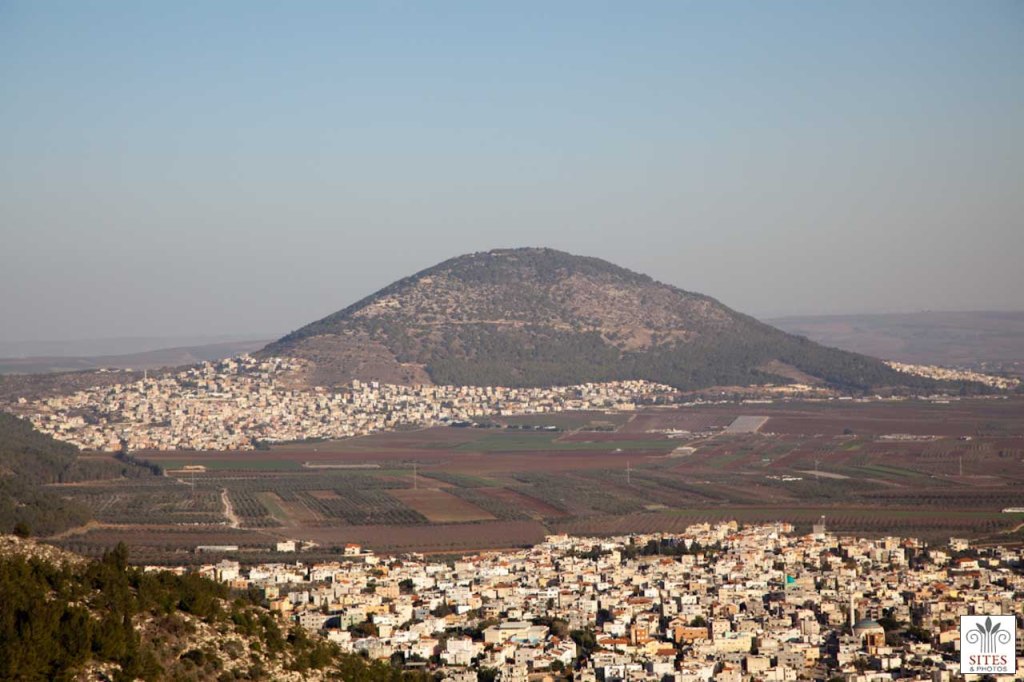
The next day I climb Mt. Tabor after Ulpan class as the sun is setting with what seemed like the only person about my age on the kibbutz, a young Persian Jew named Hadas Naphtali from the nearby village of Ramat Ishai. She claims to be “an anarchist” and practitioner of “black voodoo magic”. We borrowed a copy of the Tenach from the kibbutz library. We say extraordinarily little as I follow her up the mountain, really a large hill. We watch darkness overtake the valley from the top of the mount. She begins to read, her nearly D’s and her tease have me fully under her spell. She is bad, as they say in Brooklyn.    

It was an interesting Biblical passage she recounted describing how King Saul consulted with the wizard woman from Ein Dor before his fatal battle on the Gilboa. King Saul had persecuted spiritual people during his Kingdom, so no wonder she was afraid of the King. Although he came to the meeting disguised, the witch recognized him. Saul required her services to get a sign about the future he would face in the crucial battle the next day against the Philistines. King Saul brought back the ghost of the recently dead prophet Samuel; however, Samuel did not deliver a positive outcome of the battle. Indeed, King Saul died on the next day. 

It was at Ein Dor that King Saul learned of the fate of Israel as well as his own on the next day, which he was completely powerless to stop. His own G-d was silent. In the silence he put fatal trust in the witch of Ein Dor. And now so did I. 

Hadas Shimeon Naphtali, part Persian, part ravishing. She was born here. She reads my palm. The valley’s Arab villages and the electric glow of Kibbutz Ein Dor flickered in the twilight. Hadas turns over my hand examining the lines of my palm. Suddenly she bites the thick my right hand below the thumb, bites it hard. I wrenched my hand back. 

“The spirits will watch over you, but maybe G-d is indifferent,’ she whispers to me, ‘Take precautions, because nothing for you is totally written by G-d. You could be undone on Tisha’bav, or one day they will you be a Messiah. The angels encircle you, but the djinn too. They will strike at you on the day you are the happiest.” Real witch talk. “You’re an epicenter of spiritual war, no one knows how it it ends,” she tells me. 

My hand still smarts from where she just bit into me. Do not let a witch bite you, old Haitian Voodoo saying. Who really knows what is in their bite? 

“What’s all that all supposed to mean?” I asked her. 

“Nothing is written for you when G-d writes the chapters of the year for others. That you’re just foreign sexy and I like you and the sounds you make. We should get the fuck out of this country before it all blows up around us,” she tells me, “What are we doing here,” she asks me, “take me to your homeland America! To Newyorkgrad. There is nothing good for us here in the long run. Only a slow death or a fast death.” 

“This is our homeland.” 

“Is it? Do we have new rights the Arabs no longer have?” 

“There are many other Arab nations.” 

“There should be no nations! No states. It is all a trick on us,” she says. 

“We have been through hell everywhere else.” 

“It’s not true. Thats what they taught you in Hebrew school, but it’s not true! The Arabs and Persians never did anything to us. We had no reason to war with them for 100 years.” 

“They started the war.” 

“It doesn’t matter Zachariah who starts a war. States and kings start wars. Not regular people. No one asked the Palestinians to live here, they just have lived here for thousands of years. This is their land as well. They farmed it. They built homes. They lived here while we rotted in Europes ghettos. But my family comes from Persia. They never had issues with us. There are still 20,000 Iranian Jews living safely in Iran.” 

“They kicked them out of everywhere else.” 

“Did they? Depends on what books you read, I guess. Maybe some left on their own. Some were tricked into coming. Some got kicked out later.” 

“We should have a state of our own.” 

“No. All states are oppressive. All nations are built on death and lies.” 

“Where did you learn all this,” I ask her. 

“Books in the Kibbutz library and my parents.” 

“I like it here,” I tell her. 

“You haven’t seen shit.” 

“Show me everything.” 

“I’ll show you as much as I can.” 

“It’s a very small place. I have been dreaming of being here all my life.” 

“There is so much violence happening here. Behind walls, in plain sight. I was born here, so it is my home now. I am Jewish like you are Jewish, so we are home. But it all has a cost. A cost to keep our many enemies at bay. Life here is not like the kibbutz, it is hard to poor here. It’s hard in the cities. Most people are not so well off. There are many cracks you will see soon. Don’t glamorize this land, and don’t die for anyone’s state.”  

She takes my hand again. 

“Kiss me hard and let’s go to America, ok.” 

She kisses me quite hard and says, “A war unlike any of the ones before is coming.” 

*** 

I do not mention the bombing to either Hadas or my compatriots of the North American Social Club. But they could see I had sunken into a depression. I stopped attending Ulpan class and began to drink more heavily. Yuma began to taunt me, or at least that is how I perceived it.  

Sometime in mid-June a new girl from Ramat Ishai, a small town twenty minutes to the north had moved onto the kibbutz after fighting with her mother about curfew. She hadn’t even unpacked her bags before I took her on a picnic, got drunk in the cornfields, and fucked her in the ass on the floor of her shower. She had black voodoo magic, next thing I knew we were taking nature hikes, and she was interpreting dreams. That was Hadas, punk and exotic. Not at all content with her life in “this colony”, as she called it sometimes. 

Danny Callahan and I grow closer. Danny became a sort of older brother to me, following in an extensive line of slightly older men. After a while we dropped out of the North American Social Club altogether to spend time with our respectively cute native flings. After a day in the yards, we often sat on our own porch watching Debriyiah and sipping from big bottles of frosty cold Coke. I always snared a few liters whenever I ventured off the kibbutz. We’d pontificate about these wonderful desert women. He was set to marry one this time next year. Danny is teaching me to freestyle rap, to rap off the top of my head. I was always something of a makeshift romantic poet and Danny told me this would be yet another tool I might use to communicate my message. I had sense shared with him both my past and my subversive ideals. Back in LA Danny had been a regular at open mikes in various hip clubs. In America I would have laughed at this, but this was the Middle East. You clung to what you were before on some gut level. He gave me my first hip-hop CD by out outfit called LATYRX

I will tell Danny more about my “revolutionary thinkings”. He nods approvingly at most of it and wished me luck as many slightly older men had done before him. He assures me that I’ll never be out of work here. “Something is always broken or exploding or burning down. The trouble is it’s a small place, so they can and will catch you eventually.”  

We rarely talk about the Palestinians, what they want or what should be done about them. Danny tells me he thinks that they had more right to this land than he or I did. After all, they have nowhere else to go. “Their only fallback position is more death and more forced exile.”  

Danny is not a Jew at all, but had claimed his grandmother was one to get an immigration VISA. He would be off to the Army in September once he completed the Ulpan program.  He was 26, which put him at the age for active service. I had neither renewed my soon-to-expire tourist visa nor made any real strides toward official Alleya. Even Johnny Yuma had gotten his Todat Zhoot, which entitled him to some cash and subsidies from the government.  

Danny tells me that even though I was a more bonified Jew with my candle lighting rituals and my intermittent prayers, I would be looking at three years’ service in the Defense forces.  It wasn’t even theoretically legal for a 17-year-old to be bopping about Israel with no guide or family, but no one ever called me on this. My freedom of movement would be further curtailed with registration. As I’d be quickly conscripted. Mr. Jones, my South African foreman in Yards and Gardens told me to catch the next flight out of here. “Go back to America, kid. This whole place is falling apart. In the heat of violence to eventually be swallowed by the sands. There is no actual future for you here.”  

I am getting a lot of advice about my future. Through it all Danny remains mostly neutral. In his cool, collected cold California old stoner way, he says that “I should take all the time I need to decide.  

He urges me to: “Flee the shelter of this stupid boring insular kibbutz and see more of the real country. See what is really happening here, the good, the bad, and the real. Better now than when they stick you with a rifle to defend it. Then give your children a rifle, and their children after them.  

“Alot to see in a very small place.”  

It is all rather good advice. Eventually, I must take some of it. 

“Did you know that in Tel Aviv you can order women from your phone like a pizza, He tells me. 

MEC-A-I-S-XVI

S C E N E (XVI)  

بيروت 

BEIRUT, 1932ce 

*** 

“Counting people is a sensitive matter in any country, often fraught with fraud, gerrymandering, as well as bold lies.” No one is interested in upsetting the balance of theft and power.  

For that is when shooting and raping starts. The war. The civil war took 140,000 to 170,000 lives but no one, especially not the Maronites, want to admit that the new facts on the ground have nothing in common with the ethno-religious confessional system in place. It is typically a system that benefits the Chrisitan and the Sunni elites, at the expense of the Shi’a in general and the placation of the Druze who make up 5-10% of the population. Were one a betting man or a trained anthropologist; the Christian numbers are down from war emigration and the Shi’a numbers are way up from having large family sizes (6-9 children). There are also as many as 478,000 Sunni Palestinians absolutely no one wants to naturalize and as many as 1-2 million Syrian refugees, but only 780,000 are registered with the UN relief agencies. They Syrians have always come and gone for freely, like and awkward armed big sibling. To the South Israel has a long history of invading and occupying, and sometimes getting the President killed (Bachir Pierre Gemayel in 1982). To the Northeast Syria has a long history of invading, occupying, and sometimes killing the President (Rafic Hariri in 2005). 

They say countries with no working census are the real free countries and Lebanon hasn’t had one since 1932. But what does it mean to be “free” if all other parts of life are totally insecure? What does it mean to be counted if the numbers are all lies? It’s unnatural to be counting people like chattel and it’s completely prohibited in Judaism. Surely the State of Israel obsessively counts people every single day. The trouble is, the Lebanese went and fixed these invented numbers of 1932 to their Confessional Quota system, with Maronite Christians, Sunni, Shia, and Druze all getting lion shares of the system. Based upon the old National Pact45 and the Taif Accords which “ended the war”, although most districts are mixed; this system allows for a kind of political horse trading that makes Lebanon a very fragile country to govern. 

The Quota system slots key political and bureaucratic seats to specific ethno-religious groups. Remittances and smuggling make up a large unknown portion of the GDP, could be above 40-45%. No one really knows. The Lebanese also offer boutique medical and legal services to much of the Middle East. There are 42 universities. Tourism makes up much of the rest followed by banking (which used to do better than tourism i=until the sector imploded in hyperinflation), real estate, and construction, money laundering, food processing, wine, jewelry, cement, textiles, mineral and chemical products, wood and furniture products, oil refining, and metal fabricating. You can know that as a maven trader or look it up on hte CIA Fact book, but in general all numbers are inventions here.  

Now, a clever idea for your next vacation; somewhere with a real sunny beach and alot of bang for your the fucking dollar. Somewhere they do not openly hate the Americans and want to put them in bags or bags on their heads. A bad idea; various places with ethno-religious rocket exchanges going on every day. Also perhaps places that use quota systems to link ethnic group factions, of which there are 18 listed, to seats of theft and power. Also the quotas are fixed to parliamentary posts, top military commands, trade institutions, civic leagues, and as a result all Lebanese are living on a mountainous powder keg with valueless currency. The default is that there is not one Lebanon, but instead at least 5. Possibly 18. That’s Lebanon in gross geopolitical simplification in case you didn’t catch that. That’s not all of Lebanon, just a very very problematic part of the most obvious of problematic parts of it. Of course it doesn’t capture “the Lebanese Soul” which was a 5,000-10,000 year journey to materialize, at least. They don’t all hate Americans for sure of course and don’t all want to put them in bags. Putting some one ina bag is not very hospitable and they have done well to stop doing that since the 1980’s. Though many still do. In the 1970s and 1980s kidnapping was a major industry of grievance where at one point 147 American and European hostages were hidden all over Beirut. Perhaps kidnapping people is an advanced form of hospitality, and it was all dictated by Iran, who knows. 

Since the very minute, the Jew purchased his plane tickets it was like a secret to be kept. You see, there are things you tell your friends, and then there are things you hold inside because if you tell your friends they will think you are crazy and try to stop you from doing anything important or interesting in life.  So, Sebastian, later known as the “Jew of Beirut”, didn’t tell that many people about his plans to go to Lebanon. Also, those he told, he made it out like some kind of well deserved “reckless adventurism” to the wild Middle East. Not like there was a whole fully baked reimagined plan, the kind of plan the Jew knew best. 

“You see that was something well know about their people; the ability to hold multitudes of contradictory information in the head; believe all of it to have truth; and formulate plans from the data flowing through.” Of course, all smart people can do this, not unique to Jews. 

You see, the Jew of Beirut rarely acts without acting in concert, which is to say, he manifests a specific line of conspiracy wherever he goes. A fusion of human rights populism, Middle Eastern particularism; and pontification on the love of free life! He has detractors but mostly curious if not enthusiastic supporters. After some time living and working in New York Grad he had ingratiated himself to many people. He’d become a well known person in certain circles. He was like a Mayor of his work force. A person with some connections and agency beyond himself. Even if always filled with self doubt. He had some things to build on therefore some things to barter or totally lose. Or perhaps he was only really important to one person only, his secretary Karessa Abe, arguably the only person that ever really loved him. And he squandered it all the time by never really being a suitable partner to her. Never cheating, but never being available enough. She is more than a decade younger than him and they ain’t in the old country anymore. 

He is President of a Harikaat, a movement of ambulance workers seeking much better conditions. It was somewhere between a charity, a lobby, a union, and Hezbollah without God. He was also a law student. He has thoroughly studied the Zionist idea and found to be, through a Kurdish lens; a universal idea about how rights are won and secured. 

So, being a President of a quasi-underground, reasonably militant labor association devoted to the well being of EMS workers, he figured for the right price some of them could be lured to Lebanon to carry out some basic training. But this was a background thought. The kind of training everyone needs; EMT training; when can’t the world benefit from having a few more EMTs around? Spoken like or thought about like the thinking of a career EMT? Perhaps. Perhaps. Perhaps. The plans of a Jew lawyer paramedic. It’s hard to make small talk when your mind is wide enough to see much of the world moving at the same time. But, the world cries out for help, so sending more Paramedics is only part logical. At least not really something many can oppose if they can figure out how to pay for it. So the Jew of Beirut took off for more than adventure, for less than just a type of altruistic business deal. He wanted to find a way to cross over and remain there. He hadn’t totally considered how much that might hurt or offend other people; it was just a desperate act. 

Now desperate acts usually don’t have high degrees of planning, and although the Jews are known to be quite master planners, sometimes the best plans go very South. Once in 1975 the Israeli Military and some of the Lebanese Maronite Christians had a plot to reconfigure Lebanon46. It went really fucking south. The Israelis occupied a strip of southern Lebanon called the Security Zone for 22 years. In 2000 they unilaterally evacuated, and Hezbollah fully took over there, south Beirut, and the Bekaa Valley. The plan to restore Christian hegemony and unite Lebanon and Israel in an alliance, while driving out the PLO, well all that failed. 

*** 

“The cultural and linguistic heritage of the Lebanese people is a blend of both indigenous Phoenician elements and the waves of foreign cultures that have come to rule the land and its people over the course of thousands of years.”  

In a 2013 interview, Pierre Zalloua, a Lebanese biologist pointed out that genetic variation preceded religious variation and divisions: “Lebanon already had well-differentiated communities with their own genetic peculiarities, but not significant differences, and religions came as layers of paint on top. There is no distinct pattern that shows that one community carries significantly more Phoenician than another.” 

“I’m going to give you a lot of great information; but I want you to focus in on just four primary factions; the Sunni; the Shi’a; the Maronites; and the Druze. 

Please see the Appendix: In Lebanon there are 18 officially recognized ethno-religious confessions which contribute to the rich diversity of the nation, and these include: 

  1. Alawites, a branch off the Shi’a who ritually drink wine and believe in reincarnation. Via the French and the Ba’ath Party this secretive ethnic minority came to control all of Syria; except for now in the years after the Isis War. Today, the Northeast of the country, north of the Euphrates River, is controlled by the Kurds, in an autonomous social experiment called Rojava. 
  1. Armenian Catholics: Ethnic Armenian Christians who accept the rule from Rome. They are very business oriented, but not natural Phoenician style global traders and they aggregate in Bourj Hammoud District of East Beirut. 
  1. Armenian Orthodox: Ethnic Armenian Christians following the Apostolic Church based in Vagharshapat, Armenia; one of the oldest branches of Oriental Orthodox Christianity. Culturally, culinarily, and aesthetically not much different than Armenian Catholics.  
  1. Assyrian Church of the East are following the Eastern Branch of Syriac Christianity not in communion with Oriental Orthodox Churches or Eastern Orthodox Church, nor Rome. Most of its practitioners are ethnic Assyrians, and its base is in Ankawa, Iraq a suburb of Erbil in the Kurdish controlled zone of the KRG; the quasi autonomous Northern third of Iraq.  
  1. Chaldean Catholics: are Assyrians who came into communion with Rome arising from a schism with the Church of the East. But they are not that much different than the Assyrians of Ankawa that did not bend to Rome. They are mainly descended from Iraqi Assyrians. 
  1. Coptic Orthodox are an Oriental Orthodox church based in Alexandria, Egypt who follow the Pope of Alexandria. Established by Mark the Apostle in the 1st century; also, an Eastern Oriental Church. Most of the Copts are descended from Egyptians. 
  1. * * Druze * *; An Abrahamic, monotheistic, syncretic, and ethnic religion whose main tenets are the unity of God and the belief in reincarnation and the eternity of the soul. Most Druze religious practices are kept highly secret. The Druze do not permit outsiders to convert to their religion. Marriage outside the Druze faith is rare and strongly discouraged. Concentrated in the Chouf mountains they have long been viewed as a king maker minority group, perhaps fourth largest on its own accord. There is a larger Druze population living in Syria and a smaller one than the Lebanese clans living in Northern Israel. 
  1. Greek Catholics: ethnic Greeks in communion with Rome. There were several failed attempts to repair the East-West Schism between Greek and Latin Christians: The Council of Bari in 1098, the Council of Lyon in 1274, and the Council of Florence in 1439. Subsequently, many individual Greeks, then under Ottoman rule, embraced communion with the Catholic Church. They typically followed the Roman Rite of the Latin Church, maintaining their parishes through contact and support mostly from the Venetians. 
  1. Greek Orthodox: are the second largest world Christian denomination using Greek in liturgical settings. Ethnically Greek. 
  1.  Islma’ilis: Sometimes called “Sevener Shi’a Islam”. The Isma’ili and the Shi’a Twelvers (the dominant Shi’a sect) both accept the same six initial Imams; the Isma’ili accept Isma’il ibn Jafar as the seventh Imam and none further. At one point the largest branch of Shi’a Islam it concentrates on a deeper more esoteric version of the religion. 
  1.  Jews: an Abrahamic, monotheistic precursor to both Christianity and Islam; also called Hebrews, Judeans, or Israelites. The Israelites emerged from within the Canaanite population to establish the Iron Age kingdoms of Israel and Judah. Judaism emerged from Yahwism, the religion of the Israelites. By the late 6th century BCE they had developed a theology considered by religious Jews to be the expression of a covenant with God established with the Israelites, their ancestors. The Babylonian captivity of Judahites following their kingdom’s destruction, the movement of Jewish groups around the Mediterranean in the Hellenistic period, and subsequent periods of conflict and violent dispersion, such as the Jewish–Roman wars, gave rise to the Jewish diaspora. The Jewish diaspora is a wide dispersion of Jewish communities across the world that have maintained their sense of Jewish history, identity and culture. There are thought to be under 10 Jews in all of Lebanon. To many that is too many. 
  1.  Roman Catholics: Arab followers of the Catholic Church, also known as the Roman Catholic Church, is the largest Christian church, with 1.4 billion baptized Catholics worldwide as of 2024. It is among the world’s oldest and largest international institutions, and has played a prominent role in the history and development of Western civilization. The core beliefs of Catholicism are found in the Nicene Creed. The Catholic Church teaches that it is the one, holy, catholic and apostolic church founded by Jesus Christ in his Great Commission, that its bishops are the successors of Christ’s apostles, and that the pope is the successor to Saint Peter, upon whom primacy was conferred by Jesus Christ. It maintains that it practices the original Christian faith taught by the apostles, preserving the faith infallibly through scripture and sacred tradition as authentically interpreted through the magisterium of the church. The Roman Rite and others of the Latin Church, the Eastern Catholic liturgies, and institutes such as mendicant orders, enclosed monastic orders and third orders reflect a variety of theological and spiritual emphases in the church. 
  1.  * * Maronites * *: third largest ethnic group in Lebanon; The Maronites derive their name from Saint Maron, a Syriac Christian whose followers migrated to the area of Mount Lebanon from their previous place of residence around the area of Antioch and established the nucleus of the Antiochene Syriac Maronite Church. The early Maronites were Hellenized Semites, natives of Byzantine Syria who spoke Greek and Syriac, yet identified with the Greek-speaking populace of Constantinople and Antioch. They were able to maintain an independent status in Mount Lebanon and its coastline after the Muslim conquest of the Levant, keeping their Christian religion, and even their distinct Lebanese Aramaic language. The Maronites are in full communion with Rome. Via the French they came to dominate the political and economic life of the colony; along with Sunni, Shi’a, and Druze still play the leading positions in modern Lebanon, although they have lost their plural majority to the Shiites. 
  1.  Protestants: largely Arab but also some in other confessions; protestants follow the theological tenets of the Protestant Reformation, a movement that began in the 16th century with the goal of reforming the Catholic Church from perceived errors, abuses, and discrepancies. The Reformation began in the Holy Roman Empire in 1517, when Martin Luther published his Ninety-five Theses as a reaction against abuses in the sale of indulgences by the Catholic Church, which purported to offer the remission of the temporal punishment of sins to their purchasers. The term, however, derives from the letter of protestation from German Lutheran princes in 1529 against an edict of the Diet of Speyer condemning the teachings of Martin Luther as heretical. In the 16th  century, Lutheranism spread from Germany into Denmark, Norway, Sweden, Finland, Latvia, Estonia, and Iceland. Calvinist churches spread in Germany, Hungary, the Netherlands, Scotland, Switzerland and France by Protestant Reformers such as John Calvin, Huldrych Zwingli and John Knox. The political separation of the Church of England from the Roman Catholic Church under King Henry VIII began Anglicanism, bringing England and Wales into this broad Reformation movement, under the leadership of reformer Thomas Cranmer, whose work forged Anglican doctrine and identity. 
  1.  * * Sunni * *: Sunni Islam is the largest branch of Islam, followed by 85–90% of the world’s Muslims, and simultaneously the largest religious denomination in the world. Its name comes from the word Sunnah, referring to the tradition of Muhammad. The differences between Sunni and Shi’a Muslims arose from a disagreement over the succession to Muhammad and subsequently acquired broader political significance, as well as theological and juridical dimensions. According to Sunni traditions, Muhammad left no successor and the participants of the Saqifah event appointed Abu Bakr as the next-in-line (the first caliph). This contrasts with the Shi’a view, which holds that Muhammad appointed his son-in-law and cousin Ali ibn Abi Talib as his successor. A large number of Lebanese Sunnis are war refugees from Palestine and Syria with strict controls on their work and movement. It is believed that there are 200,000 to 400,000 Palestinians in Lebanon; and perhaps as many as 2 million Syrian refugees. There are also Kurdish Sunni and Lebanese Arab Sunni. Taken as a whole the Sunni would likely be the second largest ethnic confessions after the Shi’a, largest with naturalization of the refugees.  
  1.  * * Shi’a * *: are the second-largest branch of Islam; 5%-10% of all Muslims. They believe that the Islamic prophet Muhammad designated ʿAlī ibn Abī Ṭālib as his successor (khalīfa) and the Imam (spiritual and political leader) after him, most notably at the event of Ghadir Khumm, but was prevented from succeeding Muhammad as the leader of the Muslims as a result of the choice made by some of Muhammad’s other companions (ṣaḥāba) at Saqifah. This view primarily contrasts with that of Sunnī Islam, whose adherents believe that Muhammad did not appoint a successor before his death and consider Abū Bakr, who was appointed caliph by a group of senior Muslims at Saqifah, to be the first rightful (rāshidūn) caliph after Muhammad. Adherents of Shi’a Islam are called Shi’a Muslims or Shiites. The Shi’a are believed to make up a true plural majority of the population in Lebanon. Their largest representatives are Hezbollah, the Party of God, and Amal, a more secular expression. The Shi’a are heavily dominant in southern Beirut, the Bekaa Valley; and Southern Lebanon. 
  1.  Syriac Catholic: The Syriac Catholic Church traces its history and traditions to the early centuries of Christianity. Following the Chalcedonian Schism, the Church of Antioch became part of Oriental Orthodoxy and was known as the Syriac Orthodox Church, while a new Antiochian patriarchate was established to fill its place by those churches that accepted the Council of Chalcedon. The Syriac Catholic Church came into full communion with the Holy See and the modern Syriac Orthodox Church is the result of those that did not want to join the Catholic Church. Therefore, the Syriac Catholic Church is considered to be a continuation of the original Church of Antioch; though today are headquartered in Beirut. 
  1.  Syriac Orthodox: also known as West Syriac Church or West Syrian Church, officially known as the Syriac Orthodox Patriarchate of Antioch and All the East, and informally as “the Jacobite Church”, is an Oriental Orthodox church that branched from the Church of Antioch. The bishop of Antioch, known as the patriarch, heads the church and possesses apostolic succession through Saint Peter, according to sacred tradition. The church upholds Miaphysite doctrine in Christology, and employs the Liturgy of Saint James, associated with James the Just (also called James the Less and James, son of Alphaeus). Classical Syriac is the official and liturgical language of the church. The See of the church is in Damascus. 

These 18 confessions have lived on or near Mt. Lebanon maintained a diversity that topographically, defensively was lost in the lower levant by waves of invasion from every direction. “That is to say Lebanon is very defensible, and Israel-Palestine is not.”  

These 18 groups are reflective of most surrounding Middle Eastern states; Israel being the only one with a Jewish Oligarchy and Iran being the only one with a Shi’a Oligarchy. Syria and Iraq, after the wars have been partitioned into Kurdish, Shi’a, and Sunni zones. There are of course hundreds if not thousands of break off, off shoot, or otherwise derivative sects of these 18; such as the universalist Baha’i, or the pre-Abrahamic Zoroastrianism. There are unique but derived sub sects like Samaritans or Yazidis.        

One explanation of the Lebanese diversity is that mountains are highly defensible, communities can historically retreat and hold ground; another is that “the Lebanese are actually more gracious than they war like. Even during the civil war, or the current border war; not a very large percentage of the population was under arms.” 

Many would like to shed the Confessional system and see it as a colonial anachronism (as well as how Syria dominates Lebanese affairs). The ruling elites of Lebanon prefer the status quo. As all ruling elites tend to do. 25 long years of civil war altered demographics but not the dominance of the four largest confessions. Maronites, Sunni, Shi’a and Druze each run de facto cantons, but no group is able or willing to fully impose itself on the other. A wise Shi’a leader Al-Sayyid Musa al-Sadr once observed Lebanon’s best protection was its “indigestibility”. “That is a quality that eventually obliges ambitious groups and governments to confront Lebanon as it is, and to accept that definitive solutions are far less likely than persistent contradictions. The Syrians certainly think so. And the Israelis would come to agree. 

MEC-A1-S-XV

S C E N E (XV)  

TEL AVIV, State of Israel, 2001 ce 

*** 

Friday arrives and I catch the last bus out before sundown and head south. Sundown on Friday is when they shut everything down, everything except parts of Tel Aviv. I need eye candy and attractions. I need to sell some art because I am completely out of cash. It was a two-hour trip to get from Afula to the Boardwalk. That night far out pacing any records set in London. The tiyeled is packed. The strip is lit up brightly. I feel good about getting back to this city. I moved through the crowd impressed with how quickly I’d made my first 200 shekels. This equivalent of nearly $50 was chump change except on a kibbutz. Tel Aviv is geared to be one of the most expensive cities on earth. 

I can smell the perfume of the Russian frehhote.  Many of the young Russian men had bleached their hair like Eminem. A salsa band was playing, and an Argentinean Jewish woman was dancing and singing through a Madonna mike surrounded by a crowd of onlookers. Everyone was clapping to the beat. A group of Arab Israelis was hawking watches, lighters and bootleg L & M smokes from a foldout table. Some rough-edged Romanian hustlers and their friends were taking money off stupid, shit-brained cocky American Yeshiva boys in games of three-card Monty. On the beach I saw the flash of fire poi whirling in the night. The Opera Towers looked huge. I could see a security guard patting down Yemenite Jews because they look Arab while he let the paler Ashkenazim in without any trouble at all.  

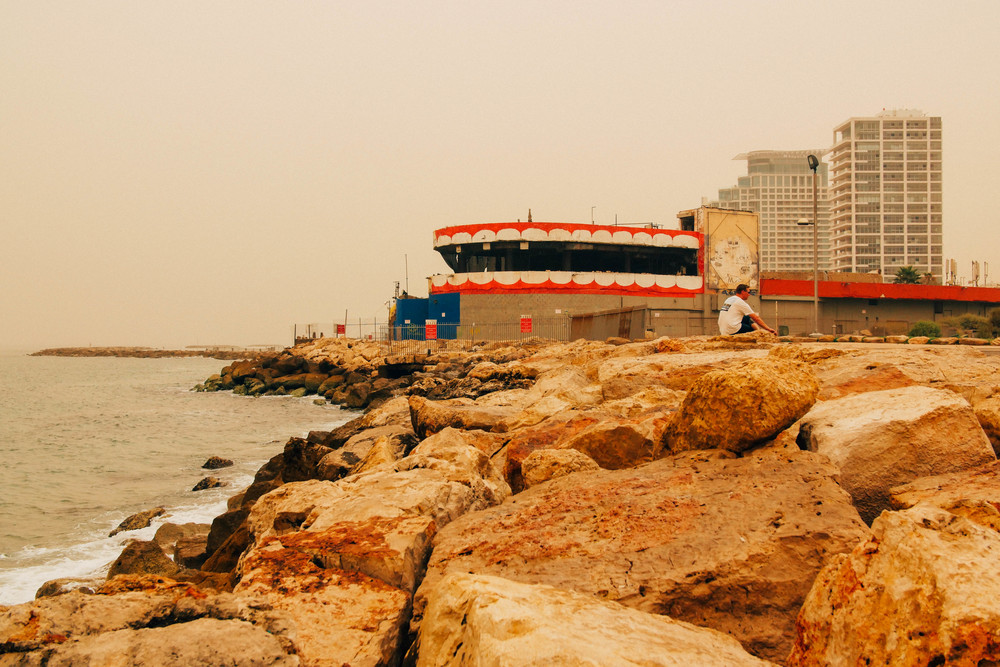
Canadian Dave who is the bartender over at Mike’s Blues Bar gives me a bunch of flyers to hand out. They take up half the space in my bag. He gives me fifty sheks and a hamburger with frenc fries to hand them all out. I got this gig through a girl I drew on the tiyeled a week ago. There are several big parties tonight. I offload flyers to anyone who will take them at drop spots along the way to the Dolphinarium. The Dolphinarium beach-bar-restaurant complex, which houses a mega club called Pacha. Built near the Dan Hotel where the boardwalk hits the Turkish Fort at Yafo, Jaffa, the old Arab port that was here before the Zionists did all this building. No one I give flyers to will actually go to Mike’s because it’s an Americanized tourist jump-off right next to the American embassy.  

It’s 10:40 pm. I make my way to Abulafia for a couple of mini pizzas. Abulafia is a 24-hour bakery that sells mini pizzas and pita soaked in olive oil with zaatar, a green fragrant spice that tastes like Palestinian oregano. The place has non-stop business especially around sunrise when it gets swarmed with club goers on the way home. That is when the fights break out between the Russians and Arabs or the Russians and the Ethiopians. It’s always the Russians and someone else. The owners of Abulafia seem to have a lot of sons and nephews named Muhammad. They do good business. One of them tells me they live in Yafo, the Old City, the Arab Quarter. It was the Arab port of long, long ago. The Yafo-Tel Aviv border is near the Dolphinarium and near a huge Ottoman prison that now apparently houses a sex club called the Dungeon.  

*** 

A man disguised as Orthodox Jew in a cab is approaching the Dolphinarium. He is wearing a club suit and carrying a guitar case that covers a payload of ball bearings and nails. He thinks nervously, 

‘It is too heavy. They will notice me as soon as I step from the cab. This vest and jacket are making me sweat.’ 

He looks out the window. The driver seems nervous. The man doesn’t say much. This is not a situation for small talk. He looks at his watch. It’s 22:53. He observes people strolling on the tiyeled as the cab speeds by. The cab passes the Sheraton Hotel. The man wonders if one day all this will be returned to his people. He wonders when these Jews will be driven back to Hell.  It’s 22:57. He takes a deep breath and tries to come to terms with the fact that he will be dead within the hour. 

*** 

Roman is standing outside the Pasha Club in the parking lot talking to his friends.  He thinks, ‘Fuck this place. Fuck this place big time.’ 

Roman is of regular build and is wearing a tight black T-shirt and FOXX jeans. His shoes are polished. There is gel in his hair. He speaks in thickly accented Hebrew. He mixes in Russian words. When he gets angry, he stops speaking Hebrew altogether. He never goes anywhere without his cell phone, which seems to never stop ringing. All his friends are from the Ukraine. They are racially Slavic and technically Jewish, which is to say that they have a Jewish grandparent. This doesn’t change the fact that they go to the Orthodox Church.  

This is his third time at the Pasha Club. He wouldn’t normally go to this venue, but the girl his friend has fucking dragged them along. Her friends are Russian origin, and they act like whores when they drink like most Russian girls he knows. One of them is Georgian. Her family is using Israel as a halfway point between the former Soviet Union and the US. Like most of the olim hadashim from that part of the world, they have no intention of staying here too long.  Roman hopes his family get their U.S. visas soon because the Arabs are going crazy and he’s about to get drafted into the IDF. 

The line is always too long. The Dan Hotel is across the street. Its plaza is large and white. He’s never stayed there, but he imagines it’s rather decent. When he gets to America, he’ll stay in a hotel like that. Or maybe even own one if he works hard. 

*** 

I remember the basic joy of walking in the damp sand by the water with no shoes. Zachariah and Sebastian equate this with happy childhood memories so it’s pleasing to see the body they now share.  

I finally break free from the crowd as I get to the end of Jerusalem Beach. I deliberately walk on the sand even if it means no people take flyers. I can see Yaffo in the distance. Compared to Tel Aviv it is ominous and lower key. I’m wearing my khaki pants with the tan button-down work shirt that says Mike on the left breast and has a Drop Kick Murphy patch sewn on the right.  

I pass out most of the flyers for Mike’s Blues Bar to groups of arsim and frehhote. They ask me questions in Hebrew or Russian, but I hardly speak either language well enough to know what they are asking me.  

I reach into my pocket and pull out a crumpled pack of Noblisse cigarettes. There are only three left.  

*** 

The waves are crashing against the levy. The rocks extend out into the water, and you can walk along them toward the end, which is as good a place as any to smoke hash. The levy is on the sea side of the Dolphinarium. This section of the Beach is called Tiki Beach. During the day people play Congo drums and an outdoor café serves overpriced beverages with a scenic view. There is a private club next to the Pasha and a barbed wire fence prevents people from climbing from the levy into its outdoor section. House music is blaring from Pasha.  

Slightly removed from the chaos, Ze’ev and his friends smoke a joint of tobacco mixed with hash. Ze’ev knows he’s a scumbag. The girl he and his friends had been gang-raping in his car had been left slumped against the rocks down by the water. They had pissed all over her before they left her. They’d slipped her a ‘knock out’ in the last club. 

*** 

The man in the lethal club suit is approaching Target B in the cab. He had three targets to pick from.  He had rejected the other two as unsuitable. He thinks, ‘I have never been to this part of the city before.’ 

He removes his wristwatch and places it into an envelope in the front seat. The envelope already contained his wedding ring, his wallet, and other petty personal effects. The only thing that remains is a small snapshot of his son and roughly 2 pounds of military grade plastic explosives. He begins a silent prayer, ‘My G-d is merciful, and all good things come of it. I will be your sword, my people’s sword against the Zionist dogs who killed my son and stole my land. Amen.’ 

***  

I finally arrive at the Dolphinarium with no flyers to hinder my game and my two-step. Long lines had formed to get into the club. Its clientele are mostly underage Russian immigrants. Dave doesn’t need or want this demographic at his bar, but fuck Dave. What’s twelve dollars and a beer. Absolutely nothing. I should just dump the damn flyers in a trashcan and rattle off some tourist spots I magically hit up.  

There are arsim everywhere. The word is sort of like the Bridge and Tunnel Crowd of Israel. A little meaner actually. They are dressed pretty much the same. Tight t-shirts, jeans, hair gel. They all reflect the same mannerisms and mentality. They always give me shit everywhere I go in the country while I’m selling art. My style is way too different for them. When they want me to draw something, it’s always crude and they never pay. They might sit and watch me draw and then wander off like crack heads with ADD. They are the club guys of the Middle East, the socio-economic equivalent to a mix of Jersey Guidos and ghetto Blacks coming to Manhattan clubs with a hard-on and a roofy. They love the ultra violence. Most of them aren’t from Tel Aviv. They just come here for the clubs and the tiyeled. Packs of them will follow groups of girls around propositioning them until a rejection or a hook up or rape. They take Ecstasy. They are offensive to everyone. They frequent bad clubs and get into fights. Not unlike the Jersey Guidos, they thrill me. Racially they tend to be non-Ashkenazi, Romanians, Russians, and the Yemenites who live in Israel’s smaller, rougher cities like Bat Yam, Rehovot, Peta Tikvah, and Pardes Hana. I watch young, stupid people try to get laid after they wait on a long line for a high-priced bottle of poison. The Russian immigrant girls look blazing. They are really loving this whole free market thing and are waiting eagerly to get visas for the US or Canada. In the meantime, they’re made up as hell even when they are only going to the store for laundry detergent.  

I see my friend of three weeks, Roman, talking to former Soviet girls. The Israelis are curvier and less made-up. I walk over to give him a pound and he introduces me to several of the girls whose names all end in ‘a.’ They, of course, don’t speak any English. They are maybe Russian but could be from Kazakhstan because they look a little Asian. I have no idea what they are trying to say to me. Roman’s English isn’t too hot either. We mostly communicate through gestures and the occasional sentence or two in Hebrew. He is excited to have ‘an American friend.’ Like most of the Russians I’ve met, I have only the most basic knowledge of who Roman is as a person. I’ve known him for less than three weeks. He was the first person I met in Israel and when I’m in Tel Aviv he always quickly visits to get his lady friends to buy sketches off me. Then we party in broken Hebanglish.  

*** 

Ze’ev wonders what that American asshole is doing here. He remembered how the guy looked at the girl he was with last week when he met them for the first time at his stupid hobo art stand. Ze’ev thinks he dresses like a hobo. I should tell my friend not to let that American hobo into the club. Nobody looked at his girls like that. Ze’ev wasn’t some little punk lookout anymore. He was moving pills and would soon get a piece of Jerusalem beach to milk or bleed.  

Ze’ev knows everyone worthwhile in the Tel Aviv club scene. It’s all he’s been doing for the past four years. He gets comped at most of the low-end joints and a few of the mid-end. He’s still too young for the real hot spots. He does not like the niggers so most of the hip-hop venues are out. All the bouncers know he deals and that he’s affiliated so he gets in quick if the spot is Russian. 

He wonders why those girls are flirting with the hobo. It’s because he’s American and they want to get to America by using him. It’s the only explanation. His pictures are stupid and communist. 

*** 

The human time bomb steps out of a black cab. 

As he surveys the scene, he thinks, ‘I’m so close I can smell them. These Israeli girls smell like whores. It’s the scent of my enemy. They all look so young. I don’t see any soldiers. My lieutenant gave me orders, ‘Take from them their young as they do to us.’ In a few years they’ll all be in the army killing my people anyway. One of those girls is giving me a funny look. They know I’m an Arab and I’m wearing a suit that’s too bulky.’ 

Quick thoughts race through his head. 

He thinks about his son. He thought about his people. He thought about the land that they stole from his people. Someone points at him as he edges near the line. He tugs the ripcord at his sleeve.  

“Salwa, I rejoin you,” he whispers to his long dead wife, “Palestine will be redeemed!”  

*** 

I’m chatting up one of the Russian girls when I realized I was out of cigarettes. I told the girl to hold on for a second. I asked Roman if he had one. He told me that he did not. Everyone smokes, but I really want a Noblisse. They all have L&Ms or worse. I didn’t want to stop talking to the Kazak girl, so I asked Roman if I could toss him some loot to buy me a pack. He didn’t pick up the phrase ‘toss him some loot.’ He looked at me like I was crazy.  

I look at my watch. 11:31pm. I hopped the barrier and was about to cross into the parking lot. I don’t even know if the kiosk is open across the street. I look back to see if the girl is still. . .  

B  O  O  M ! 

*** 

Ze’ev is telling his friend about ‘some chick that gave him head on the beach.’ That chick is a 16-year-old that he and three friends raped. She is lying unconscious face down in the sand by the water. He tells them he came all over her  

B  O  O  M !  

What the fuck was that he wonders. It came from the street by the club entrance. Of course, he knows what it is. This is Israel after all. 

*** 

Roman is on his cell phone. It’s hot as hell here, even in the night. He looks up and sees a quick bright flash before he dies.  

 B O O M ! 

*** 

I’m on my knees half deaf. I hear a terrible ringing in my head, but I can’t hear anything else. There are tiny droplets of blood all over me, but I don’t think any of it’s mine. Dozens of people are screaming, slouched on the ground. Some of them don’t look like much more than bloody bundles of tattered flesh.  

There’s blood on the ground and there’s blood in my hair. I don’t really know what to do. I am slumped down facing what was once the outside of a popular nightclub. I reach into my pocket to pull out a smoke and I realize it is the fucking cigarettes that just saved my life.  

My first suicide bombing. Saved by a fucking pack of cigarettes. There are a lot of dead bodies less than twenty feet away from me. I see the lights of the paramedic trucks and hear the sirens through the cluttered tunnel of my inner ear. I see people trying to pick themselves up and help the wounded. I’ve never seen so much real blood. Not in real life anyway. Everything I thought I knew about anything was ripped to shreds in a fiery burst of nails, ball bearings, and sharp things flying through the air. Violence looks so cool until you meet him in person. Then he just looks like the Angel of Death. 

I try to stand up. I can’t. I am a coward in the face of it all. A part of me is thinking: So that is what a suicide bombing looks like. And another part of me realizes:  Holy fuck! I just got all blown up. And another part of me, the part that has my undivided attention, is asking where the fuck our god was tonight!? Twenty-one victims are dead. Most of the dead are teenage girls from the former Soviet Union. 

MEC-A1-S14

S C E N E (XIV)  

ديار بكر 

Diyarbakir, Türkiye (Ahmed, Kurdistan), 2012ce 

*** 

Recounts Heval Oldivan Amraz, also known in some certain circles as “Comrade Moving Target.” 

HEVAL OLDIVAN AMRAZ 

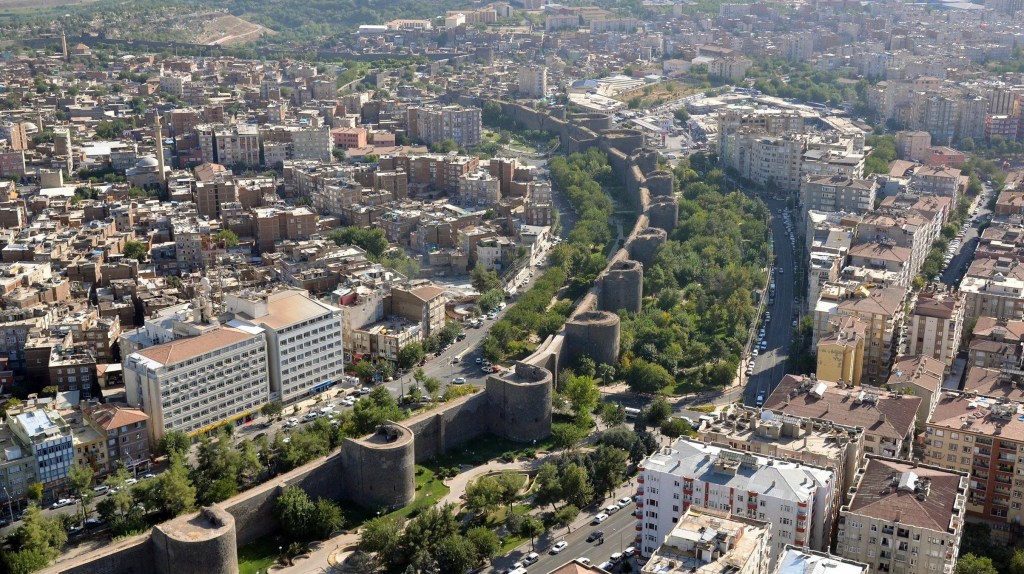
“I found myself as a young man in Diyarbakir City, the place we long call ‘Ahmed’, the future capital of all Kurdistan.” The black walled citadel of Bakur. The proud capital city of a nation that doesn’t exist, yet.” And the wicked Turkish boots do grind the necks and general spirit of the people all around us. 

“A poetic if not fully epic place!” An ancient citadel of giant black stone walls and total martial law. A town of prisons, stories, heroes and valiance in the epoch of the Kurdish people. Little wine bars, a thriving literary scene. It cannot decide whether to be eastern or western, Turkish or Kurdish. The epicenter of a great revolt, or the dystopian mockery of the full-blown repression of a colonizing power forcing a boot heel on our neck.  As Kurdistan is a powerful and long repressed enduring idea, that idea is becoming a reality on the barricades here and in a long running fight in the mountains. An imagined community of over forty million souls who are wrongfully, shamefully divided between the imposed nation states of Turkey, Syria, Iraq and Iran all things have two names, all things are both real and imposed upon us. As if to be a Kurd requires an act of insanity, and an act of double thinking. A persistent zealous fight to make the world acknowledge our rights and identity. To admit we have a right to survive as a nation beset with enemies on all sides.   

AMRAZ 

“Following the Turkish military coup of 1980, the Kurdish language was prohibited in public and private life. The prison of Diyarbakir filled up and the endless wails of rape and torture propelled the movement to full mobilization and to take up arms again. 

Diyarbakir, which in my people’s tradition is also called “Ahmed”, has now swollen to nearly 4 million people since the eradication and ethnic cleansing of over 5,000 Kurdish villages in the great ranges of mountains to the east. The primary battlegrounds between the Party and the Turkish State. Growing up there, there was of course no Kurdish allowed in school, no Kurdish books or music except deep underground. Were it within the Turkish State’s power, we would not even have Kurdish names! We would admit to being backwards people of “Mountain Turks”. I was born in the year of the largest, latest and greatest uprising. And although since the days of the Medes there have been “one thousand sighs and one thousand failed revolts” ‘, this uprising was to be completely different. 

In 1984 Abdullah Ocalan and the Kurdistan Workers Party simultaneously attacked three Turkish army posts and police stations in Bakur and announced the beginning of the revolution. For the next thirty years, almost without pause the P.K.K. and its armed guerrillas would battle the Turkish military across Bakur, the name we call the Turkish occupied zone of Kurdistan which means “the North”. Over 50,000 would die, mostly Kurds actually. The Turks would engage in vast acts of scorched earth barbarism and we in the Party would eventually turn to outright terror. In the end, most of the deaths were Kurdish civilians. In the end the only liberated ground was a handful of villages deep in the mountains of North Iraq, the Qandil. 

Now, ‘Heval Amraz’ is of course not my original name. It is the name given to me by the guerrillas of the P.K.K. when I joined the Party. By that time, we were fully surrounded in Qandil being attacked on all sides and death seemed certain. Total defeat as well. Our great leader had been kidnapped in Kenya. Major leaders of the movement including the brother of Abdullah Ocalan, Osman, had completely betrayed us. Our own Iraqi Kurdish brothers in the K.D.P. and P.U.K.-Peshmerga were collaborating with Turkey and America to annihilate us. 

“How do I tell you, my story? What does it really matter? How does this even begin or end for an outsider? For people who do not even know where Kurdistan begins or ends, or even care.” As Türkiye is a N.A.T.O.43 ally, and no matter what it says or does will remain a beneficiary of great power largesse. 

AMRAZ 

“I cannot tell you my real name of course. I cannot speak for the Party, nor can I fully disclose the depth of my hope and my hate to a stranger. I can only speak to a feeling shared on differing levels by thirty to forty million Kurds.”  

I will try to say something for the benefit of doubt, that non-Kurds could care about us so much that they would come to our land by the hundreds. To fight and die alongside us not simply fighting in resistance to Islamic radicalism, genocide and repression, but also because they grasp the larger idea. The total and utter radicalism and implications of Abdullah Ocalan’s vision. The survival of the revolution rests not in securing a Kurdish State, but instead in exporting these ideas abroad. To make the blood of the martyrs raise the flood waters of all mankind and provide a blueprint for liberation. 

Of course, we began as communists, we began admiring the Cubans and it was the Russians and Palestinians that first trained armed resistance in the early days in the Bekaa Valley of Lebanon. But we are not Communists or Nationalists anymore. Our thinking on the subject of liberation has evolved. The Cuban connection and the Palestinians connection are very real and enduring parts of the story. 

But, when we all almost died on the mountain top, surrounded and out gunned in 2000 there were no Cubans, or Russians or Palestinians to help us as they were all defeated or fully besieged. By some miracle, or just by sheer will the Party survived. And the 1989 defeat of Communism internationally required us to climb higher, dig deeper to criticize and self-criticize. To adopt an evolution in our thinking. With our ranks decimated, the armed struggle in a complete stalemate, declared a terrorist organization by almost every European country; we evolved. The revolution could not ever be won with arms and ideology alone. Nor could we secure Kurdistan while every other nation on earth embraced “Capitalist Modernity”. To secure our victory and survival as a people in Bakur, Bashur, Rojhelat and Rojava we would embrace the ideas of a Jewish anarchist from Vermont, as re-interpreted in prison by Ocalan and implemented by the new largely female leadership of the Party. This methodology called “Democratic Confederalism”, adopted by the Party in 2004 would soon find actual expression in Rojava. The Wild West of Kurdistan, the North most area of Syria. In 2014 when the Civil War broke out the Party and its allied militias seized control of major towns and cities across Syria abandoned by the Assad regime.  

AMRAZ 

“Thus, we came down from the mountains, out of the underground and prepared to make a stand in Rojava where the radicals of the Islamic State were terrorizing our people and butchering everyone in their path.”  

“If we go back to the mountains, it will signal only our isolation and defeat.” If we hold these cities, if we showcase that we are fighting to defend not just for Kurds but for Arabs, Assyrians, Yazidis, Circassians, Chechens and the Turkmen too; if we show that Democratic Confederalism is the solution, the way ahead for all oppressed peoples; then others will join us. And like the Nowruz44 mountain fires this uprising will eventually spread everywhere! There is a historic destiny to our revolution. To be victorious where all others failed! 

A most dramatic pause. 

Out of habit, Comrade Moving Target lights a cigarette and pours himself a cup of black tea. On the walls of the small office set up at the training base, which is also his room, Comrade Amraz looks the dead in the eyes. Or death in the eyes? Or both. As the posters of the martyrs plaster all the walls and the war expands everywhere around us. 

____________

MEC-AI-S13

S C E N E (XIII)  

نيو جيرسي 

Al New Jersey, U.S.A., 2023ce 

*** 

Every time we survived a fire fight in Rojava, usually a few of the internationals were out of sorts. They had just killed someone, maybe for the first time. Or seen someone die. Maybe they had shot someone that wasn’t necessarily a combatant per se in the heat of the battle. Or had just been awake for too many days at a time. For a time from of the international fighters, particularly those in their first trial by fire fight, would seem a phantom in the days after the battle. Maybe they would say nothing at all for a time, or maybe they would say something totally off base.   

Heval Erdal, a British comrade liked to say: 

“I think he lost the plot point.” 

Years later, after some of them made it out of Rojava alive, statistically 1 in 10 international volunteers died in the war, and 4 of 10 died from either suicide or by Russian rockets in Ukraine; some years past the pitched battles to defend Rojava, the Jew of Beirut was in Al New Jersey, a state to the West of Al New York. He was meeting with Souheil Tajer, a Lebanese businessman. Telling a short story about his time in Syria. Trying to make it make sense. 

“We have to circle back to when things still made three dimensions of sense,” Souheil says to the Jew.  

“Circle what?” 

“Circle back as to not lose the trail to the plot points.” 

“What does that mean?” 

“It must make sense to regular people! Stop dancing around in a dabke circle. Stop beating around the bush.”  

“What is it you’re planning to do in my country?” 

Before the Jew of Beirut, who was only really one half-Jew, (he was technically, allegedly Chechen by his father and Cuban Sephardic by his mother), before he flew into Beirut for allegedly the very first time, days before the Great War began. He went first to a place called the coast of Al New Jersey, a neighboring state to New York, across a River. To West New York. Before he departed with an ill established, albeit ambitious plan he met with an elder statesman of Lebanon, a man named Souheil Tajer who presided with his nine brothers over an import-export firm for high end foods. They speak at length about the unbelievably bad timing, the bevy of possible new experiences, “unique experiences” that Lebanon is known for. The culinary extravaganza is obvious to all, but the people and their resilience in a flailing economy at the edge of a war zone are the most profound. A place where pure strangers are easy friends all the time. A people descended from epic trader sailors; the Phoenicians.” 

“The Golden Age of Beirut ended in the Civil War of 1975.” 

From 1975 to 1991 the Palestinian militant groups, the right-wing Christians, left wing Druze, Sunni, and the Shiites set off on a very bloody civil conflict. Not everyone participated but everyone was soon shooting and kidnapping in various power constellations. It eventually involved the Maronite41 right called the “Lebanese Forces” or “Phalange”; the Armenians stayed mostly out; the Christian Orthodox liberals; the Sunni Nasserist Pan Arabists; the Shia Left called “Amal”, the Shia revivalist ethno-nationalist right called “Hezbollah”; the Druze left in the “Progressive Socialist Party”, the Israelis, and the Syrians, the French, and the Americans and about 140,000 to 170,000 people lost their lives. When it ended nothing was ever really resolved. So, in a sense, it was always just a matter of time before something like that could happen in Syria or happen again in Lebanon. None of the demographic problems were ever addressed. But while the iron heel of the Assad regime held Syria together, until 2014, in Lebanon it was a though there are defacto ethnic cantons, states inside the illusion of a state. 

The country once called the “Paris of the East”, was reduced to an exceedingly long slaughter. No one was left in the absolute majority. Except probably the Shia. No census has been taken since 1932, as has been noted. The President was to be a Sunni, the Prime Minister a Christian, and the Speaker of the Parliament a Shi’a. 18 ethno-religious groups (including Jews) were allotted proportions of important posts. Ways to steal really, and every faction got a port to smuggle from. Everyone buried their guns, except for Hezbollah, “the Party of God” representing the Shi’as (believed to be the true plural majority); and then the Syrians killed the President. The Druze stayed up in the Chouf. A mountainous region to the east of Beirut. Each faction controls a port city except the Druze, everyone is smuggling something.  

There was a fast economic upturn from 2008 to 2011, but now the money, the Lira, is valueless and no one can get it out of the bank. Skyscrapers stand empty, the Israelis and Hezbollah exchange daily rocket fire, and life of course somehow goes on. People show up to jobs that don’t really pay and pretend to work. What is the old Russian saying, “we pretend to pay you, and you pretend to work.” Tourism has totally collapsed. But Winter is not tourist season anyway. Only the national carrier Middle Eastern Airways is flying in now. 

ADONAEV   

My understanding is that a “Green line” runs south from Martyr Square, and it divides a mostly Sunni West “Ras” Beirut from a Chrisitan zone in the east. There are 3 major Palestinian camps in the Southwest and Shi’a in the south and Southwest in zones run by Hezbollah. The airport is squarely in the Hezbollah control zone, or at least everything around it is. They didn’t have a map, but a map of varying lines exists in both their heads. Albeit with Mr. Souheil Tajer has the far more intricate and detailed map. 

SOUHEIL TAJER  

It is good you are familiar with the “Green Line”, but there are other lines not to cross. “In good times, you would be testing them, them the Lebanese, but under the current situation, everyone will be tested by you. Testing you, wanting to know why you are there, now. What is your motivation?”  Everyone will be very, terribly angry about the Palestinian situation. How could they not be? 20,000 is a lot of dead Muslims. Alot of dead people. And it will go higher. It will go to 40,000 by the dead of winter. And then higher still. So many dead people, dead Muslims, everyone will ask where you stand on that. No matter what their confessional feelings. You really must stay inside the Christian and Druze lines on the map. Beirut East, the coastal cities until Batroun, the Chouf, and the Matn. Everything else is an abduction possibility. 

You should study that map in real life and your head and use your common sense! Don’t exceed your limits.  

ADONAEV  

I’m there for 25 days. I’m going to rent a little studio in Achrafieh. I’m working on a book. 

SOUHEIL  

Achrafieh is safe. You must not stay in the Muslim area after dark and don’t stay in their hotels. No one can guarantee your security. In East Beirut you have many friends. The weather will be bad. It may rain every single day I’m afraid.  

ADONAEV  

 I plan to do some writing in the Chouf, at your friend’s place in Berkazy.  I am gonna stay in the city, be wary of my encounters, and stay in the right kinds of places.  

SOUHEIL  

Achrafieh is safe, but you must, must, must find a good driver. It’s essential to your safety. I wish I could go with you and make some better introductions! Now repeat what I have told you please. 

ADONAEV  

The green line is the line of demarcation, staying in Muslim areas is not advised in the current situation. Be careful who I get to know because everyone is very curious and will be more curious because of the timing. No ultras, no interviewing extremists, no gangster-type venues. No adventures with fast and easy women of the night. Not an adventure, I won’t wander too much in the night If at all outside the Chrisitan zones. I’m gonna stay to my limits. I’ll get a good driver. 

SOUHEIL  

“How do you know your limits, or any limits in a place you’ve never been?” 

ADONAEV  

I know what kinds of risks I’m taking implicitly. But it’s important to me to know your people in their hard times and then later in the good times. I wish to know the Lebanese. 

Souheil ponders that, but only for a micro minute, he carries on a conversation with ease and expertise. 

SOUHEIL  

You’ll need a driver, a driver you trust. And stay in touch with me every day, I’m here for all your questions. I would love to go with you, I will go with you next time. You must be very conscious of your surroundings. Please do not befriend the wrong people and end up in a trap. 

ADONAEV  

“I’ll get a good driver.” 

SOUHEIL  

Preferably a Christian driver. I know how that comes across to you, but you do not understand how it is yet. You need a driver you trust. Who is very responsive to your logistical needs. And will not make up new hyperinflation prices. Pay for everything in dollars if you can they will charge your credit cards Lira rates that will be preposterous.  

Now listen closely. If Hezbollah and Israel end up in a major escalation you will need to get out quickly and the airport will not be the best way out.  If things go very badly internationally, you must get to the Port and find a ship to Cyprus. The Israelis will certainly bomb the airport into the ground, they always seem to do that. You can also go wait it out in the Chouf, I’ll give you some phone numbers. But ideally, you get out by ship if the war spreads. Which it really might. 

“This is not the best time to go, I really encourage you to reconsider.” 

ADONAEV  

My flights from Paris have already all been canceled due to the security deterioration. I will have to reconsider my options. There are only inbound flights on Middle East Airways. 

SOUHEIL  

One thing you must do is visit the Shrine of Saint Mar Charbel42. He did something like 26,000 plus miracles. A very holy man. If your itinerary allows this, you must go and get some holy water, or oil and walk in the footsteps of this highly righteous man. It will change your whole life! I promise you that. 

ADONAEV  

I love me some miracles! But I never rely on them at all, just my raw wits. Thank you for talking this out with me. It all seems more possible than before. 

SOUHEIL  

Follow your heart but know your limits! 

*** 

In the bustling streets of Beirut, where the scent of spices mingled with the sound of honking cars, a plan was set in motion. A group of seasoned professionals gather in a dimly lit room, their faces obscured by shadows. Among them was Kaveh Atatable Ashuri, a notorious mastermind known for his audacious heists. “We need something big,” Kaveh declares, his voice low but commanding. “Something that will shake the city to its core.” “Make the fat cats afraid.” 

After hours of deliberation, they settled on their target: Banque du Liban et D’Outre Mer, BLOM Bank; the largest bank in Beirut, renowned for its impenetrable security. With meticulous planning and precision, they devised a plan to infiltrate the bank, bypassing every obstacle in their way. 

On the fateful day, chaos erupted in the heart of Beirut as the sound of gunfire echoed through the streets. Masked figures storm the bank, their movements swift and calculated. With a combination of brute force and technological prowess, they breached the vault and laid their hands on the coveted treasure: stacks of cash, worth millions in theory. 

As alarms blared and security forces scrambled to respond, the robbers made their escape, disappearing into the labyrinthine alleys of the city. But their journey was far from over. Meanwhile, the perpetrators of the audacious heist remained elusive, their identities shrouded in mystery. With the authorities hot on their trail, they vanished into the shadows, leaving behind a trail of confusion and intrigue. 

In the dead of night, the stolen fortune found its way to a different kind of terrain: the cramped alleys of a Palestinian refugee camp on the outskirts of Beirut. Here, amidst poverty and despair, the money was dumped unceremoniously, like crumbs scattered to the wind. 

Word spread like wildfire, and soon, the camp was teeming with people, their eyes wide with disbelief as they beheld the unimaginable wealth before them. For a fleeting moment, hope flickered in their hearts, a glimmer of possibility amidst the harsh realities of their existence. In the heart of Ras Beirut, chaos erupted as the deafening sound of gunfire shattered the tranquility of the bustling city streets. It is a scene straight out of a strange foreign dream or an American action movie, but this was all too real. The robbers had struck the biggest bank in the city, leaving behind a trail of destruction and terror! 

As the dust settled, the robbers emerged from the bank, their faces concealed behind masks, their weapons glinting in the sunlight. They moved with military precision, their every step calculated and deliberate. But they were not alone. The police were already converging on the scene, their sirens wailing in the distance. With adrenaline coursing through their veins, the robbers made a run for it, their bags of stolen cash clutched tightly in their hands. They jumped into their getaway vehicles, tires screeching as they sped off into the crowded streets of Beirut. The chase was on! RATAATATATATTATATATTATATATATTATTATA! 

The streets turned into a battleground as the robbers and the police engaged in a deadly game of cat and mouse. Bullets flew, shattering windows and sending bystanders diving for cover. It was a scene of utter chaos and carnage, with no end in sight. But the robbers were not about to go down without a fight. They fought tooth and nail to evade capture, weaving in and out of traffic, narrowly avoiding collisions with oncoming vehicles. Their driving skills were nothing short of extraordinary, but the police were hot on their heels, determined to bring them to justice. As the chase raged on, the robbers made a daring move, veering off the main road and into the narrow alleyways of Beirut’s labyrinthine streets. It was a risky maneuver, but it paid off. The police were momentarily thrown off their trail, giving the robbers a much-needed advantage. 

But their respite was short-lived. The police soon caught up with them, their sirens blaring as they closed in on their prey. With nowhere left to run, the robbers made a split-second decision to turn off the main road and into the sprawling Palestinian refugee camp of Mar Elias. The camp was a maze of narrow streets and crumbling buildings, a haven for those fleeing persecution and violence. It was the perfect place to lose the police, but it was also fraught with danger at every turn. As the robbers raced through the camp, they were met with fierce resistance from the inhabitants, who had no love for outsiders, bringing violence to their doorstep. Shots rang out from every direction, echoing off the walls of the cramped alleyways. But the robbers pressed on, their determination unwavering. They knew they had to keep moving if they were to have any hope of escaping the law’s short arm. And so, they pushed forward, their hearts pounding in their chests, their breath coming in ragged gasps. 

And then, just when it seemed like all hope was lost, they saw it: a narrow alleyway leading out of the camp and into the relative safety of the surrounding city side. Without hesitation, they gunned their engines and raced towards freedom, leaving behind a trail of chaos and destruction in their wake. 

As they emerged from the camp, they were relieved, knowing they had narrowly escaped capture again. But they also knew that this was far from over. The police would not rest until they had brought them to justice, and the robbers would have to stay one step ahead if they were to survive another day in the unforgiving streets of Beirut. 

Blog at WordPress.com.

Up ↑